

Medication safety at home after surgery
Pill Bottle Label Setup for Older Adults After Surgery:
A Safer Home System
The first night home after surgery can feel strangely quiet. The hospital monitors are gone, the discharge folder is thick, and the kitchen counter suddenly looks like a tiny pharmacy wearing bad lighting. For an older adult who is tired, sore, or still foggy from anesthesia, a pill bottle label is not a small detail. It is a handrail.
A safe pill bottle label setup does not mean turning every bottle into a craft project. It means making each medicine answer the same basic questions every time: what it is, why it is being taken, when it is due, what to avoid, and who to call when something feels off. The best system is plain, visible, repeatable, and boring in the most beautiful way.
This guide is written for caregivers, adult children, spouses, home health aides, and older adults who want a practical setup before the first late-night dose. Think of it as a calm countertop protocol, less panic, fewer guesses, and fewer “did we already give that?” moments.
Reduce mix-ups
Separate similar-looking bottles and make high-risk instructions easier to see.
Support tired caregivers
Use a simple routine that still works at 2 a.m. when everyone is running on crumbs.
Prepare better questions
Know when to call the pharmacist, surgeon, or urgent care instead of guessing.
Quiet promise: by the end, you can build a safer medication station before the first night home. 🕯️
Snapshot
This article is for families and caregivers helping an older adult manage medicines after surgery. It solves the common home-recovery problem of small print, unclear “as needed” instructions, duplicate bottles, and caregiver fatigue. You will learn how to set up labels, schedules, color zones, double-checks, and a one-page medication map that makes each dose easier to verify.
Table of Contents
Safety / Disclaimer: Labels Help, But Clinicians Decide
This guide is for organizing medication information at home. It is not medical advice, and it is not a substitute for a surgeon, pharmacist, primary care clinician, nurse, or emergency medical service.
Older adults should take medicines exactly as directed on the pharmacy label and discharge instructions unless a licensed clinician gives different instructions. Do not change dose amounts, dose timing, pill splitting, medicine combinations, or stop-start decisions based on a home label system alone.
The purpose of a pill bottle label setup is to reduce confusion. It should make the official instructions easier to see, easier to repeat, and easier to verify. It should never cover the pharmacy label or replace counseling from a pharmacist.
Key takeaway
Your label setup should clarify, not reinterpret. If a caregiver writes a plain-language note, it should match the official bottle label or be confirmed by the pharmacist.
Why post-surgery medication labels are high-risk
Post-surgery medication routines are different from ordinary daily pill routines. A patient may come home with short-term prescriptions, pain medicine, antibiotics, anti-nausea tablets, stool softeners, eye drops, injections, blood thinner instructions, or temporary changes to regular medicines.
At the same time, the patient may be tired, dizzy, constipated, nauseated, anxious, or sleeping in short broken pieces. The caregiver may be reading discharge papers while answering family texts, making soup, adjusting pillows, and wondering whether the ice pack is still cold enough. That is exactly when small print becomes a trapdoor.
What home labels can and cannot do
A home label can help a family see that one bottle is for pain, another is for infection prevention, another is for nausea, and another should be used only under certain conditions. A home label can also show the last dose time or remind someone to check the written schedule before giving the next dose.
A home label cannot decide whether two medicines are safe together. It cannot decide whether a new symptom is expected. It cannot decide whether a blood thinner should be held, whether constipation medicine should be increased, or whether a pain pill should be taken with another product. Those questions belong to clinicians and pharmacists.
The safest principle: original bottle first
For many post-op situations, keeping medicines in their original bottles is safest because the official pharmacy label, drug name, prescriber, refill information, warnings, and patient name stay attached. A pill organizer may be useful for some long-term routines, but after surgery it can also hide important label details or make “as needed” medicine harder to track.
When in doubt, ask the pharmacist whether a medicine can be moved to an organizer, whether it needs special storage, and whether the cap should remain child-resistant. The best recovery station is not fancy. It is readable, traceable, and stubbornly faithful to the official instructions.
The First 24 Hours: Why Labels Matter Most After Surgery
The first day home is when medication instructions meet real life. The patient may remember part of the discharge talk but not all of it. The caregiver may have nodded in the hospital and then forgotten which paper had the pain schedule. The bottles may arrive in a stapled pharmacy bag with tiny text, multiple warning stickers, and at least one instruction that seems to require a moonlit legal degree.
This is why the first 24 hours deserve a label setup before the household gets tired. You are not trying to build a perfect medical archive. You are trying to make the next dose easier to confirm than to guess.
Post-op fog makes simple instructions harder
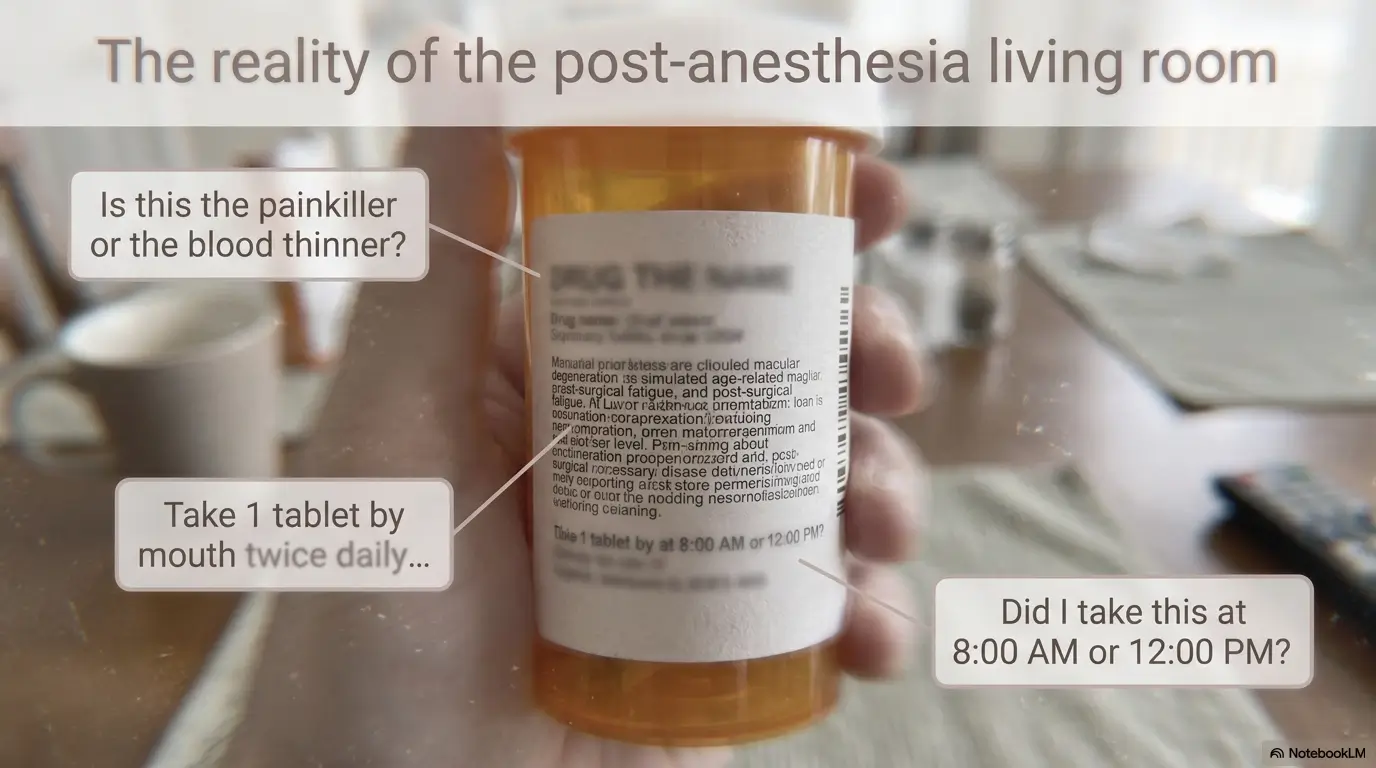
Anesthesia, poor sleep, pain, stress, and unfamiliar surroundings can make ordinary tasks feel oddly slippery. A phrase like “take one tablet every six hours as needed” may sound clear in daylight. At 1:40 a.m., when the patient is uncomfortable and the caregiver is half-awake, that same phrase can become a small thunderstorm.
A safer label setup uses large text, plain timing cues, and a visible last-dose record. The goal is not to make the older adult dependent. The goal is to give everyone a shared script, so memory is not forced to carry the whole tray.
Pain medicine, antibiotics, and daily meds can collide quickly
After surgery, an older adult may still take long-term medicines for blood pressure, diabetes, heart rhythm, thyroid, sleep, mood, reflux, or arthritis. Add temporary post-op medicine, and the counter can fill quickly.
The danger is not only “too many bottles.” The danger is uncertainty. Is this the new pain pill or the old one? Does this replace the regular anti-inflammatory? Did the surgeon say to pause a supplement? Was the antibiotic twice daily or every eight hours? The label system should push those questions into the open before the first dose at home.
Key takeaway
The first 24 hours are the setup window. Sort, label, and document before bedtime, not after the household is tired and the pain schedule is already blurry.
The tiny print problem no one plans for
Many pharmacy labels are accurate but visually crowded. Older adults may have cataracts, dry eyes, bifocals, shaky hands, or low lighting near the bed. Even a careful person can misread a number, skip a warning, or confuse two bottles when the print is small and the bottles look alike.
Good lighting is part of medication safety. So are reading glasses, a magnifier if needed, and a label format that does not require detective work. The safest system assumes human beings will be tired, sore, and imperfect. Then it kindly removes a few ways to fail.
First-night risk scan
- Are all new post-surgery medicines in one place?
- Are old or discontinued medicines stored away from the active recovery station?
- Can the patient or caregiver read the dose instructions without squinting?
- Is there a written schedule beside the bottles?
- Is the last dose of any “as needed” medicine recorded?
- Does everyone know which number to call for medication questions?
The 5-Question Label Rule Every Bottle Should Pass
A pill bottle label setup works best when every bottle is forced to answer the same five questions. This gives the family a repeating pattern. In a tired house, repetition is not dull. Repetition is velvet rope safety.
You can use a large sticky label, a paper sleeve, a bottle tag, or a nearby medication map. The important part is that the home note does not cover the pharmacy label and does not introduce new instructions that have not been confirmed.
1. What is this medicine for?
Many patients remember a brand name but not the purpose, or they remember the purpose but not the name. A plain purpose label reduces bottle roulette.
Instead of writing only “oxycodone” or “cephalexin,” a caregiver might add a large note that says “pain medicine” or “antibiotic,” as long as that purpose matches the clinician’s instructions. For regular medicines, write familiar purposes such as “blood pressure,” “diabetes,” or “thyroid,” if known and confirmed.
This matters when two bottles are both small, white, and deeply committed to looking anonymous. Purpose labels give each bottle a job title.
2. When should it be taken?
Timing is often where post-surgery confusion begins. Some medicines are taken on a schedule. Others are taken only when symptoms appear. Some are taken with food, some at bedtime, and some need spacing from other products.
The safest home label uses the official timing as the source of truth, then translates it into a visible cue. For example, “twice daily” may become “morning and evening” only if that timing is appropriate for the medicine and confirmed by the pharmacy label or pharmacist. “Every 6 hours as needed” should not become “four times daily” unless the prescriber truly intended scheduled use.
3. How much should be taken?
Dose confusion can happen when a bottle says “take 1 to 2 tablets” or when a patient has multiple strengths of a medicine at home. If the instruction allows a range, the caregiver should clarify when one tablet is enough, when two may be used, and what maximum dose applies.
Do not invent a simplified dose just to make the label cleaner. A beautiful label that says the wrong thing is a velvet-wrapped banana peel.
4. What should not be mixed with it?
Some medications have important warnings about alcohol, driving, sedating medicines, blood thinners, NSAIDs, supplements, grapefruit, or duplicate active ingredients. Caregivers should not try to interpret every warning sticker alone, but they should make known high-risk warnings visible.
For example, a pain medicine might need a large “may cause sleepiness, check before walking” note if that matches the official warning. A stool softener might need a note that it is bowel care, not pain medicine. An antibiotic might need a “finish unless clinician says stop” reminder, if that instruction was given.
For a broader official overview of safe medicine use in older adults, the FDA has a consumer guide worth bookmarking.
5. Who should be called if something seems wrong?
A good recovery setup includes phone numbers, not only pill names. Put the pharmacy number, surgeon’s office number, after-hours line, primary care office, and emergency instructions near the medication station.
This prevents the old household ritual of searching for a phone number while someone is dizzy, itchy, vomiting, or confused. The phone list is not dramatic. It is a fuse box with labels.
| Question | Home label should show | Do not do this |
|---|---|---|
| What is it for? | Plain purpose, such as pain, nausea, antibiotic, bowel care | Guess the purpose from memory |
| When? | Official timing, with approved plain-language cue | Turn “as needed” into scheduled use without approval |
| How much? | Dose from pharmacy label or discharge sheet | Round up, split pills, or simplify dose yourself |
| What not to mix? | Known warnings confirmed by label or pharmacist | Ignore warning stickers because they look generic |
| Who to call? | Pharmacy, surgeon, after-hours line, emergency plan | Wait until panic to look up numbers |
Big-Print Labels: The Recovery Room Upgrade That Pays Off
Large-print labels are not about aesthetics. They are about making the right action easier than the wrong one. If the older adult has vision changes, hand tremor, pain, or low energy, a label that looks readable to a younger caregiver may still be too small at the moment it matters.
The safest big-print setup keeps official labels visible and adds a plain, high-contrast note nearby. Some families use a large paper band around the bottle. Others place bottles in labeled bins with large cards in front. The exact method matters less than readability and consistency.
Use large, dark text on a plain background
Use thick black marker on white or pale paper. Avoid patterned stickers, shiny tape, pale ink, tiny cursive, or color combinations that vanish under dim light. The label should be readable from arm’s length in the place where the medicine will actually be taken.
If the patient needs reading glasses, keep those glasses with the medication station. If a magnifier is used, keep it there too. The best label in the world does not help if the tool needed to read it is in the bedroom drawer under two receipts and a mystery charger.
Put the most important instruction front-facing
Most people set a bottle down with the label facing sideways or backward. After surgery, that tiny inconvenience can become a real safety issue. Arrange bottles so the most important instruction faces forward every time.
A front card might say “PAIN, check last dose first,” “ANTIBIOTIC, morning and evening,” or “ASK BEFORE USING.” The card should not hide the pharmacy label. It should act like a road sign, pointing the caregiver back to the official instructions.
Key takeaway
Big print should answer the next action question: “What is this, and what must I check before giving it?” It should not cover or rewrite the pharmacy label.
Add timing cues carefully
Words like “morning,” “midday,” “evening,” and “bedtime” can be easier than medical timing phrases. But they must match the prescription. If a bottle says every 8 hours, “morning and evening” is probably wrong. If a bottle says with food, “bedtime” may be wrong unless a snack is planned and approved.
The rule is simple: translate only what you understand and confirm what you do not. A five-minute call to the pharmacist can prevent days of quiet confusion.
A big-print label template that stays safe
Use a simple format that repeats across every bottle. Repetition helps the caregiver scan quickly and helps the older adult recognize the system.
Large-print label card template
Pain, antibiotic, nausea, bowel care, regular daily med
Use official timing, then add approved plain cue
Last dose, food, warning, symptom, or “ask first”
Pharmacy or surgeon number on the medication map
Color Coding and PRN Meds Without Creating a Rainbow Disaster
Color coding can help, but it can also go spectacularly sideways. Too many colors can turn the recovery counter into a confetti argument. The trick is to use color as a category signal, not as decoration.
For older adults after surgery, color should answer one question: what kind of medicine is this? A color zone can group pain relief, antibiotics, bowel care, nausea medicine, and regular daily medicines. Keep it simple enough that a tired caregiver, a visiting sibling, or a home health aide can understand it within ten seconds.
Use color by purpose, not personal preference
Do not choose blue because Dad likes blue or pink because the bottle is small. Assign colors by purpose. For example, red may mean “pain, check last dose,” green may mean “regular daily meds,” yellow may mean “ask first,” and purple may mean “bowel care.”
Even better, write the word clearly next to the color. Never rely on color alone. Some people have color vision differences, and under warm nightstand lighting, orange and red can become cousins wearing the same coat.
Keep “as needed” medicine separate
PRN means “as needed.” In real homes, it often means “the label most likely to cause a family debate.” Pain medicine, nausea medicine, sleep medicine, and constipation medicine may all be used only under certain conditions. They should not be mixed into the same row as scheduled morning pills.
Use a separate PRN zone labeled “Use only after checking the schedule.” This zone should include a last-dose tracker. Without that tracker, a caregiver may know the patient is hurting but not know whether the next dose is safe yet.
Write minimum spacing in large print
If the label says a medicine may be taken every 4, 6, 8, or 12 hours as needed, write the spacing clearly on the medication map. Do not write only “as needed.” That phrase is a door without hinges.
For pain medicine, a last-dose line can prevent accidental repeat doses. A simple note might read: “Last pain dose: ____ time, ____ amount, ____ initials.” This tiny ritual is boring, which is why it works.
Key takeaway
“As needed” is not a schedule. Pair every PRN medicine with minimum dose spacing, last-dose tracking, and a clear reason to use it.
Short Story: The Two White Bottles on the Counter
Marian brought her father home after knee surgery with four prescriptions, a walker, and a discharge folder that seemed to multiply when no one was looking.
At midnight, he asked for pain medicine. Marian reached for a white bottle, then stopped. Two bottles looked almost identical. One was the pain medicine. The other was a stool softener. Neither label faced forward.
She turned on the kitchen light, found her glasses, and read both labels twice. The dose was not late, but it was close. She wrote the time on a sticky note and taped a big “PAIN, CHECK LAST DOSE” card beside the bottle.
The next morning, she built a full medication map. Nothing dramatic happened, which was the victory. Good systems often feel invisible because they prevent the story no one wants to tell.
Common Mistakes That Turn Labels Into Landmines
Most medication mistakes at home are not caused by carelessness. They are caused by clutter, fatigue, unclear instructions, and systems that ask memory to do too much. A good pill bottle label setup removes the most common traps before they have a chance to bite.
Use this section as a pre-flight checklist. The goal is not to shame anyone. The goal is to make the counter safer before the patient needs the next dose.
Mistake 1: keeping old and new prescriptions together
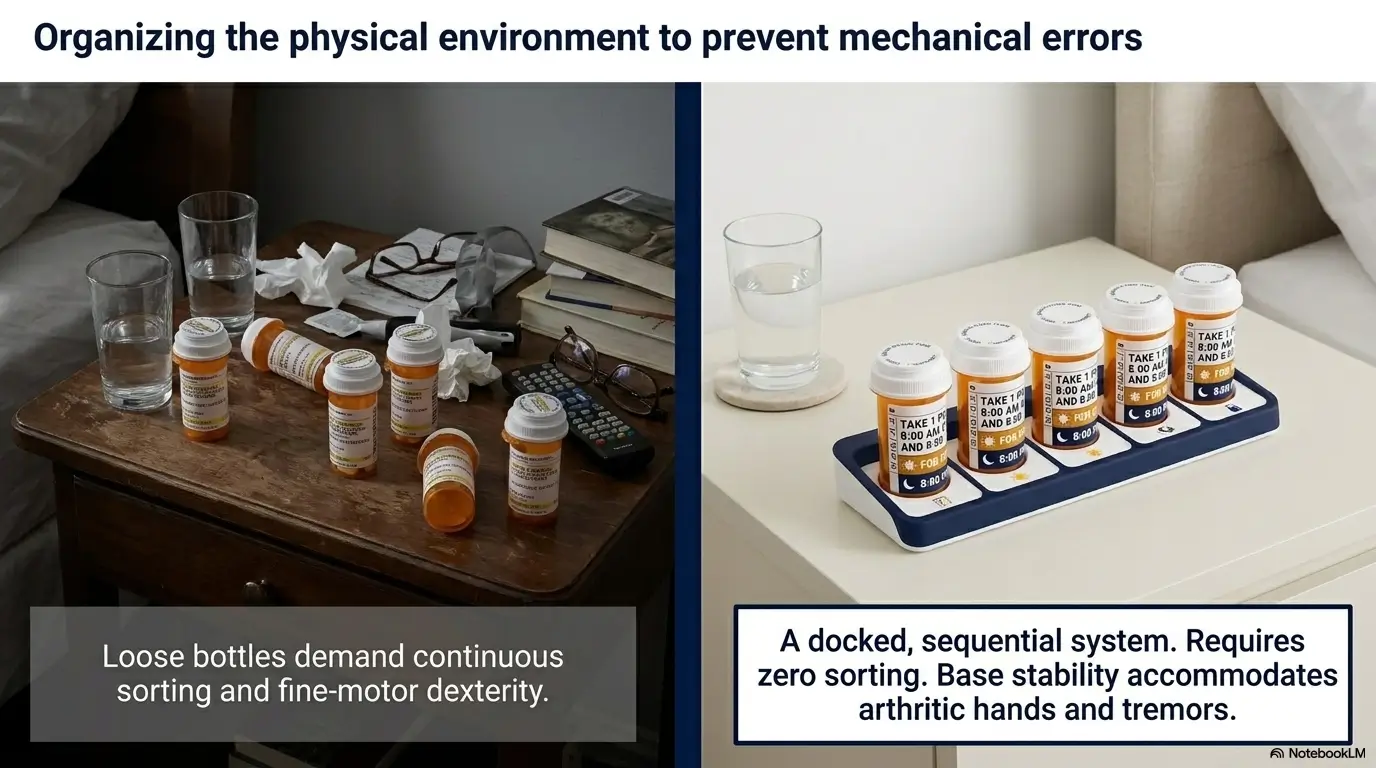
Old pain pills, antibiotics from a past infection, leftover muscle relaxers, and discontinued medicines should not sit beside new post-op bottles. Similar names and similar bottle shapes can invite errors.
Move non-active medicines to a separate “not currently taking” area, unless the clinician says they should be part of the recovery routine. For disposal questions, ask the pharmacist. Some medicines, especially controlled pain medicines, may need careful handling.
Mistake 2: relying on memory instead of a written schedule
Memory works wonderfully for birthdays, soup recipes, and the exact tone your mother used in 1997. It is less reliable for post-surgery medication timing.
Use a written schedule. Put it where the medicine is stored. If a dose is given, record it. If a dose is skipped because the patient is asleep or nauseated, record that too and ask the clinician or pharmacist what to do if the instructions are unclear.
Mistake 3: writing over the pharmacy label
Never cover the patient name, drug name, strength, dose, prescribing clinician, warnings, or pharmacy phone number. Home notes should sit next to the label, not on top of it.
If the pharmacy label is too small, ask the pharmacist whether a larger-print label, duplicate label, medication list, or counseling printout is available. Many pharmacies can help more than families realize.
Mistake 4: forgetting drops, creams, inhalers, patches, and injections
A medication setup should include more than pills. Eye drops after eye surgery, ointments after skin procedures, inhalers, insulin, injectable blood thinners, patches, and topical creams all belong on the medication map if they are part of the recovery routine.
These items often live in different places, the fridge, bathroom, purse, bedroom, or bedside table. That makes them easy to forget. Put them on the schedule even if they cannot physically sit in the same station.
Mistake checklist: remove these from the active station
- Expired medications.
- Leftover pain medicines from an older surgery.
- Duplicate bottles with the same medicine name or strength, unless confirmed as current.
- Supplements the surgeon told the patient to pause.
- Medicines belonging to another household member.
- Any bottle with unclear ownership, missing label, or unreadable instructions.
The Caregiver Double-Check: A 60-Second Safety Ritual
The caregiver double-check is a short ritual before each dose. It is not a sign that the caregiver is nervous or inexperienced. It is the kind of ordinary safety habit that good nurses, pharmacists, pilots, and kitchen timers all understand: the small pause prevents the large problem.
Make the ritual simple enough to repeat every time. If it takes ten minutes, people will skip it. If it takes about a minute, it can become part of the household rhythm.
Read the bottle label out loud
Before giving a dose, read the medicine name, dose, and timing out loud. This may feel theatrical at first, but it makes the brain slow down. It also gives the patient a chance to say, “Wait, didn’t I take that already?” or “That one made me dizzy yesterday.”
If two caregivers are involved, one can read the bottle and the other can check the written schedule. Even when one person is handling the routine, speaking the information aloud can catch errors that silent scanning misses.
Match the bottle to the written medication schedule
Do not give medicine from the bottle alone. Match the bottle to the medication map or discharge list. This step is especially helpful when there are multiple white tablets, multiple pain options, or changes to regular daily medicines.
A schedule also helps visiting family members. Nobody should need to decode a private household memory system. The medication station should speak in a language a careful outsider can follow.
Confirm the last dose before pain medicine
For pain medicine, the last dose time matters as much as the current pain level. A patient may be uncomfortable before the next dose is due. A caregiver may want to help quickly. The label setup should gently force a pause.
Write down the last dose time, amount, and initials. If the patient still has severe pain before the next dose is allowed, call the surgeon’s office or after-hours line for guidance rather than compressing the schedule on your own.
60-second double-check script
- Turn on the light and put on reading glasses if needed.
- Pick up one bottle at a time.
- Read the medicine name and dose out loud.
- Match the bottle to the written schedule.
- Check the last dose time for PRN medicines.
- Give the dose only if the label, schedule, and timing agree.
- Record the dose immediately.
Key takeaway
A double-check is not extra work. It is the work. The dose is not “done” until it has been read, matched, given, and recorded.
For families also setting up the recovery environment, a safer medication station pairs well with a clear walking path. If mobility is part of the recovery plan, your household may also find this guide on walker path safety after surgery useful.
Build a Medication Station and Match the Discharge Papers
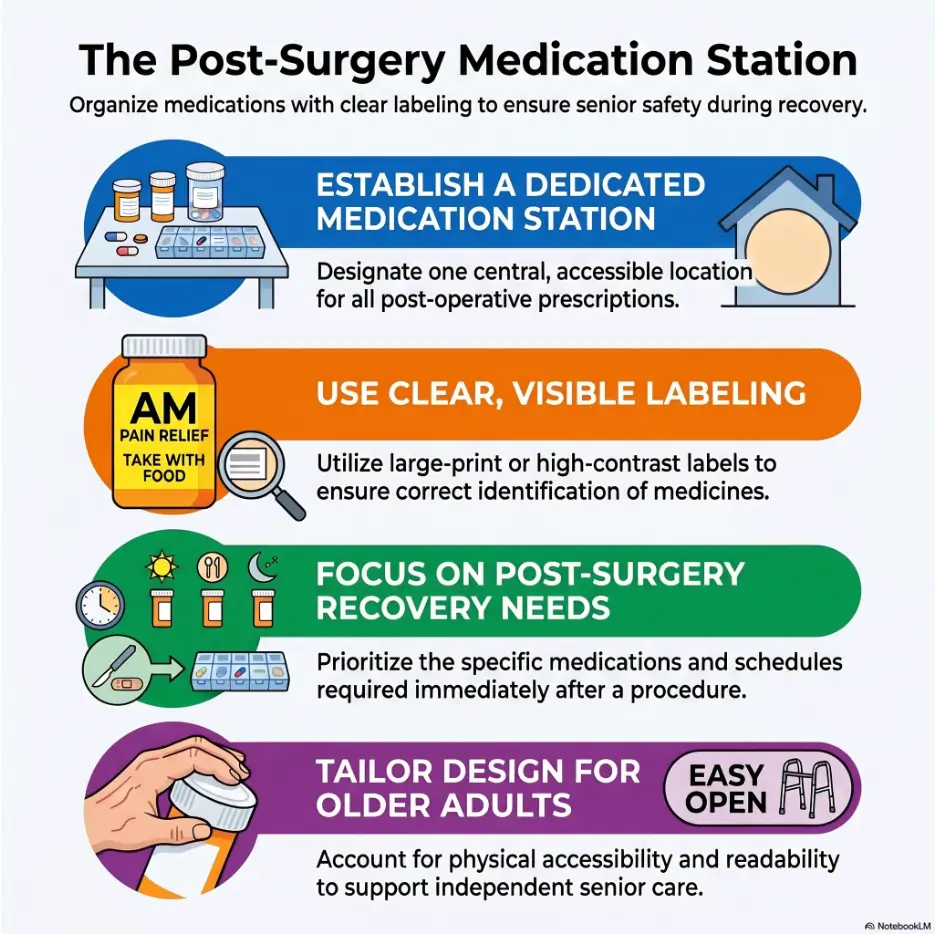
A medication station is a dedicated place where active recovery medicines, the schedule, dosing tools, phone numbers, and notes live together. It should be boringly reliable. Not glamorous. Not hidden. Not scattered across three rooms like clues in a mystery novel.
Choose one location that is well-lit, dry, and away from kitchen chaos. Avoid placing medicines beside the stove, sink, snack pile, pet treats, or cleaning products. Keep the setup out of casual reach of children, visitors, and pets. Controlled pain medicines need especially careful storage.
Choose one well-lit location
The best place is not always the bathroom medicine cabinet. Bathrooms can be humid, cramped, and poorly lit. A small table, counter corner, or shelf may work better if medicines can be stored safely and securely.
Put water, reading glasses, a pen, the medication map, dosing cups or syringes, and the phone list in the same area. If a medicine must be refrigerated, place a card in the station that says “fridge medicine due at ____” so it does not vanish from the routine.
Separate “take now,” “later,” and “ask first”
One basket is rarely enough. Use three simple zones: “take on schedule,” “as needed, check first,” and “ask before using.” The “ask” zone is where unclear bottles, paused medicines, duplicate bottles, or supplements can wait until a pharmacist or clinician confirms the plan.
This prevents the dangerous assumption that every bottle on the counter is active. In post-surgery care, proximity can look like permission. The station should make permission visible.
Match every bottle to the discharge papers
Before the first dose at home, compare each bottle with the discharge medication list. Check the medicine name, dose, timing, purpose, and whether it is new, continued, changed, paused, or stopped.
Do not assume the home medicine cabinet automatically matches the hospital list. Older adults often have prescriptions from multiple clinicians. A medicine may have been changed before surgery, held temporarily, or duplicated under a brand and generic name.
For appointment prep, symptom notes, and medication questions, this related guide on caregiver notes for orthopedic appointments can help turn scattered observations into useful clinician questions.
Use a simple station framework
The C-C-L-S-R medication station framework
Gather active post-op bottles, regular meds, drops, creams, and injections.
Match every item to discharge paperwork and pharmacy labels.
Add large purpose and timing cues without covering official labels.
Create zones for scheduled, PRN, and ask-first medicines.
Log every dose, especially pain medicine and other PRN items.
Show me the nerdy details
Medication safety systems work because they reduce cognitive load. A tired caregiver should not have to remember the bottle purpose, dose interval, last dose time, warning, and clinician phone number all at once. Good labeling turns hidden memory tasks into visible environment cues. This is especially useful after surgery because the medication list is temporary, the patient’s symptoms may change quickly, and multiple people may help during the first week.
The strongest home system uses redundancy: original pharmacy label, large plain-language cue, written schedule, last-dose log, and verbal double-check. Each layer catches a different kind of mistake.
When to Seek Help or Stop
A label setup can prevent confusion, but it cannot diagnose a reaction or decide whether a symptom is safe. When something feels wrong, the safest move is to pause and use the contact plan. The house should know which questions go to the pharmacist, which go to the surgeon, and which need urgent help.
Trust the discomfort signal. If an older adult seems unusually confused, weak, short of breath, faint, severely itchy, swollen, or hard to wake, do not spend the next twenty minutes reorganizing sticky notes. Get medical guidance promptly.
Call the pharmacist for label confusion
The pharmacist is the right call when the label wording is unclear, two medicines look or sound alike, there may be duplicate active ingredients, or the caregiver is unsure about food, timing, storage, pill splitting, or missed-dose instructions.
Pharmacists can also help explain warning stickers. Many warning labels are short because bottle space is limited. A two-minute explanation can turn a vague sticker into a usable safety rule.
The CDC’s medication safety guidance is a useful official reference for basic habits such as keeping a medicine list, following label directions, turning on a light, and asking questions.
Call the surgeon for symptoms or possible conflicts
The surgeon’s office or after-hours line is the right call for unexpected pain changes, worsening swelling, fever, bleeding concerns, wound changes, medication conflicts tied to the procedure, or uncertainty about whether regular daily medicines should restart.
If the patient had orthopedic surgery and pain patterns are hard to describe, a simple pain log can help. This guide on pain check questions for a parent after surgery can help caregivers turn “it hurts” into clearer notes.
Seek urgent help for red flags
Seek urgent medical help for severe allergic reactions, breathing trouble, chest pain, fainting, severe confusion, signs of overdose, severe weakness, uncontrolled bleeding, or any symptom the discharge instructions describe as urgent. If emergency services are needed, call them.
Medication labels are useful, but the human being comes first. If the patient looks unsafe, acts very different, or cannot stay awake normally, treat that as more important than finishing the paperwork.
Key takeaway
When symptoms are severe, sudden, or frightening, do not troubleshoot the label system first. Use the emergency plan or urgent contact instructions.
Ask for medication reconciliation when the list is complicated
Medication reconciliation means comparing all medicines a patient is taking with the current care plan, including prescriptions, over-the-counter products, vitamins, supplements, creams, drops, patches, inhalers, and injections. It is especially helpful when an older adult has several clinicians or a long medication list.
Bring the full list to follow-up appointments. Better yet, bring the bottles if the clinician or pharmacist asks for them. A list is helpful. A bottle with the exact name, strength, and instructions can be even clearer.
MedlinePlus, from the National Library of Medicine, is a patient-friendly place to learn more about medicines, health terms, and safety topics.
| Situation | Best next contact | What to have ready |
|---|---|---|
| Label wording is unclear | Pharmacist | Bottle, discharge list, patient age, allergies |
| Two medicines seem similar | Pharmacist | Both bottles and current medication list |
| Unexpected surgical symptom | Surgeon’s office or after-hours line | Symptom start time, temperature, pain level, medicine log |
| Severe reaction or breathing trouble | Emergency services | Medication bottles if safe to bring |
| Long list with multiple prescribers | Pharmacist, primary care clinician, or surgeon | All prescriptions, OTC products, supplements, drops, creams |
FAQ
How should I label pill bottles for an older adult after surgery?
Keep medicines in their original bottles unless the pharmacist says another setup is safe. Add large-print notes that show the medicine purpose, timing cue, dose-check reminder, and any key warning confirmed by the official label or pharmacist. Do not cover the pharmacy label.
Can I rewrite medication instructions in larger print?
You can create a larger-print helper note, but it must match the official label or clinician instructions. If any wording is unclear, ask the pharmacist before rewriting it. The home note should clarify, not replace.
What is the safest way to organize pain medication after surgery?
Keep pain medication in its original bottle, store it carefully, mark it clearly as “pain medicine,” and use a last-dose tracker. Check the minimum spacing between doses every time. Call the surgeon’s office if pain is severe before the next allowed dose.
Should post-surgery pills stay in their original bottles?
Often, yes. Original bottles keep the official label, warnings, strength, prescriber, pharmacy phone number, and patient name attached. Ask the pharmacist before moving post-op medicines into a pill organizer, especially PRN pain medicine or short-term prescriptions.
How do I prevent missed doses after surgery?
Use a one-page medication map with medicine name, purpose, timing, and last dose. Keep it beside the bottles. Record each dose immediately. Use phone alarms only as a backup, not as the only system.
How do caregivers track “as needed” pain medicine?
Write down the time, amount, and initials for every dose. Keep the pain medicine in a separate PRN zone labeled “check last dose first.” Do not give another dose just because symptoms return unless the minimum spacing and instructions allow it.
What should I do if two medications look or sound alike?
Separate them physically, add large purpose labels, and call the pharmacist if there is any uncertainty. Do not rely on bottle shape, pill color, or memory. Similar-looking medicines deserve extra caution.
When should I call the pharmacist about a pill bottle label?
Call when the dose, timing, food instructions, warning stickers, storage, pill splitting, duplicate ingredients, or missed-dose instructions are unclear. Pharmacists are one of the best resources for turning label confusion into plain next steps.
Next Step: Build the First-Night Medication Map in 15 Minutes
The safest next step is not a perfect binder. It is one plain page beside the bottles before the first night home. A medication map gives the household one shared source of truth when the room is dim, the patient is uncomfortable, and nobody wants to reread the discharge packet from page one.
Set a timer for 15 minutes. Gather the active post-surgery bottles, regular daily medicines, discharge paperwork, reading glasses, a pen, and a clean sheet of paper. Put old, paused, or unclear medicines in an “ask first” area until a pharmacist or clinician confirms them.
15-minute medication map
- Write the patient’s name and surgery date at the top.
- Create four columns: medicine name, purpose, dose time, last dose taken.
- Add a fifth notes column for “with food,” “ask first,” or “watch for dizziness.”
- Copy instructions from the pharmacy label or discharge list.
- Circle PRN medicines and write the minimum spacing in large print.
- Add pharmacy, surgeon, after-hours, and emergency contact information.
- Place the sheet beside the bottles and record every dose immediately.
If you do only one thing tonight, make the PRN pain medicine impossible to give twice by accident. Put it in its own zone. Write the last dose time. Put the minimum spacing where everyone can see it. That one small act can turn the most confusing bottle into the clearest one.
Recovery has enough wildcards already: pain waves, sleep interruptions, appetite changes, family schedules, and the odd ballet of pillows and ice packs. A safer pill bottle label setup gives the home one calm corner. It does not make surgery easy, but it makes the next dose less mysterious. Sometimes that is exactly the kind of mercy a tired household needs.
Last reviewed: 2026-06