
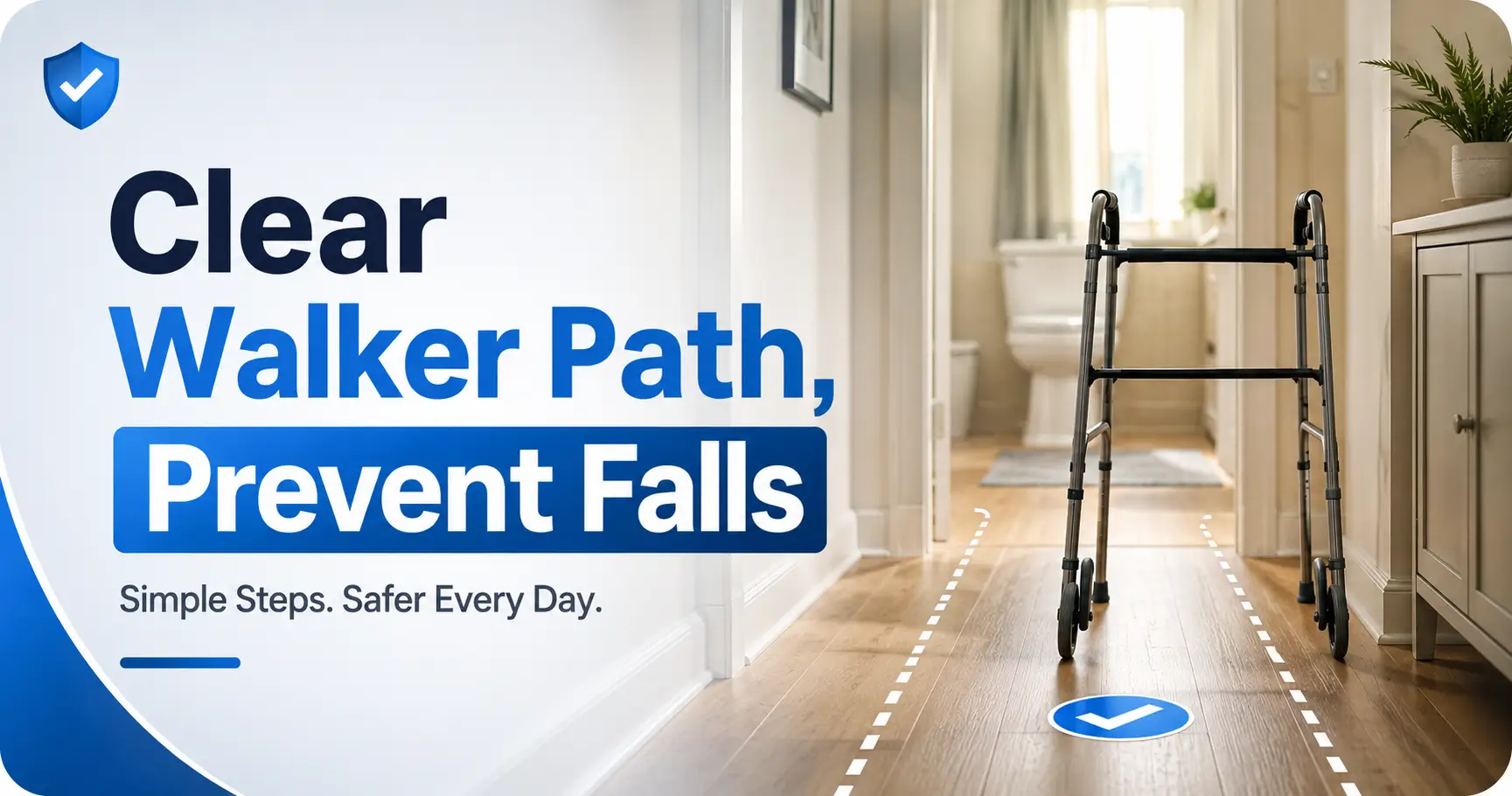
Make the Path Predictable Before You Make the House Pretty
A walker route can look “mostly fine” until 2:13 a.m., when the hallway is dim, the bathroom feels far away, and one slipper has staged a tiny rebellion near the door. That is why clearing a walker path without rearranging the whole house is not about making a home magazine-ready. It is about making one daily route safer, calmer, and easier to repeat.
For many US family caregivers and aging-in-place households, the real problem is not clutter everywhere. It is friction in the exact places where balance is already working overtime: bed to bathroom, recliner to kitchen, entryway to living room, or sofa to medication station. Guessing can cost time, confidence, and sometimes a serious fall. This guide helps you fix the highest-risk route first using practical observation, low-cost changes, and common home safety logic used by physical and occupational therapy teams.
Our Core Approach:
Start small. Follow the walker.
- ✓ Choose the route that matters most today.
- ✓ Remove trip traps without launching a whole-home renovation.
- ✓ Test the path during real-life moments, not just in bright daylight.
- ✓ Know when a clinician, PT, or OT should step in.
The 15-Minute Walker Path Safety Map
Best first route: the path used when the person is tired, rushed, stiff, dizzy, or half-awake.
Most common hidden hazards: loose rugs, cords, thresholds, laundry, pet items, narrow turns, poor lighting, and furniture legs that snag walker wheels.
Goal: create a simple travel lane where the walker can move forward, turn, pause, and park without bumping, lifting, twisting, or negotiating with household chaos.
Table of Contents
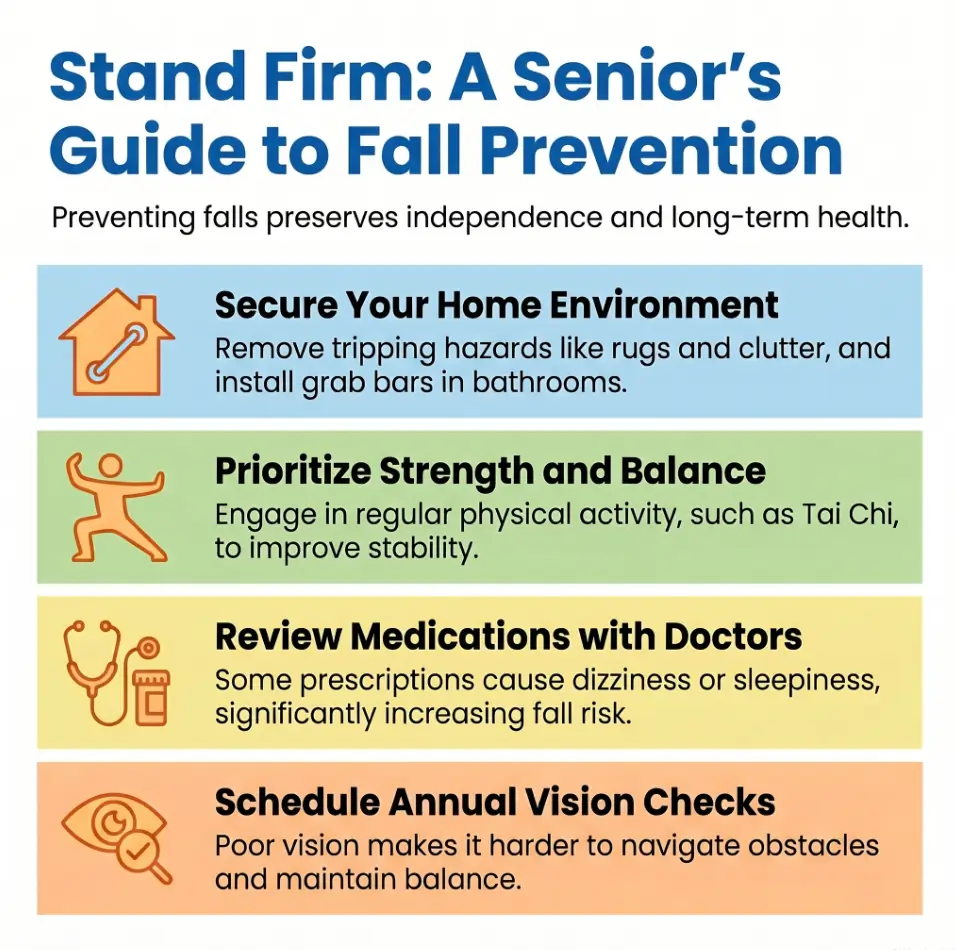
Safety and Disclaimer
This article is for general home safety education. It is not medical advice, occupational therapy advice, physical therapy advice, construction advice, or a replacement for an in-person assessment.
A safe walker path depends on the person’s walker type, balance, strength, vision, medications, diagnosis, pain level, home layout, and recovery stage. A route that works for one person may be risky for another. The same hallway can feel like a calm corridor at noon and a moonlit obstacle course after midnight.
If there has been a recent fall, near-fall, dizziness, sudden weakness, confusion, head injury, severe pain, or new trouble walking, contact a clinician promptly. If the person is recovering from surgery or using a walker after a hospital stay, ask whether physical therapy or occupational therapy should review the home setup.
- Recent falls deserve medical follow-up.
- Post-surgery homes may need professional setup advice.
- New weakness, dizziness, or confusion should not be treated as a furniture problem.
Apply in 60 seconds: Write down the last time the person stumbled, paused, or felt unsafe on the route.
Start With One Route, Not the Whole House
The fastest way to get overwhelmed is to announce, “We need to make the whole house safe.” That sentence has the emotional weight of cleaning the garage, doing taxes, and assembling flat-pack furniture with one tiny wrench.
Start with one route. Not the prettiest room. Not the room guests see. The route that gets used when balance is worst.
Pick the path used when balance is worst
Most walker path problems happen during ordinary transitions. The person is getting up from bed, going to the bathroom, moving toward the kitchen, answering the door, or trying to carry one small thing while keeping both hands near the walker.
Choose the route where urgency, fatigue, stiffness, or poor lighting are most likely. For many homes, that is the bed-to-bathroom path. For others, it is the chair-to-kitchen path, especially if meals, drinks, or medication are involved.
If pain is part of the picture, it may help to track what hurts before changing the route. A simple pain description for a doctor can turn vague worry into useful information at the next visit.
Why bed-to-bathroom beats “clean the living room”
The living room may be more visible, but the bathroom route may be more dangerous. Nighttime bathroom trips combine several risk factors: sleepiness, low light, urgency, stiff joints, possible medication effects, and narrow doorways.
The CDC has long emphasized that falls are a major injury risk for older adults. The point is not to be frightened into bubble-wrapping the house. The point is to respect the route where small hazards become big decisions.
The 10-minute path test: follow the walker, not your eyes
Stand at the start of the route with the actual walker. Move at the person’s usual speed. Watch the wheels, tips, legs, hands, elbows, and turning space.
Do not just scan the room from a doorway. A hallway can look clear from above and still be cruel at ankle height. The walker sees the truth first.
Money Block: One-Route Eligibility Checklist
Use this low-disruption method if most answers are yes:
- Yes / No: The person can currently use the walker with basic confidence.
- Yes / No: The main problem is clutter, cords, rugs, tight turns, or poor lighting.
- Yes / No: There has not been a recent unexplained fall, fainting episode, or sudden weakness.
- Yes / No: The route is mostly on one level.
- Yes / No: The person can tell you where they feel unsafe.
Neutral action line: If two or more answers are no, treat the path cleanup as a temporary safety step and ask a clinician or occupational therapist for guidance.
Measure the Walker Path Before Moving Anything
Before moving chairs, tables, baskets, or lamps, measure the route in the simplest possible way: walk it with the walker. A tape measure can help, but the walker is the main measuring tool. It is honest, stubborn, and shaped exactly like the problem.
Check width, turns, doorways, and “elbow room”
A walker path needs more than straight-line clearance. The person also needs space for elbows, hands, hips, robe sleeves, oxygen tubing if used, and small balance corrections.
Look at four zones:
- Straightaways: Can the walker move without scraping walls, baskets, or furniture legs?
- Doorways: Can the walker pass through without angling sharply?
- Turns: Can the person turn without lifting the walker or stepping sideways?
- Pausing spots: Is there a safe place to stop without blocking a door or reaching awkwardly?
The problem is usually the turn, not the straightaway
Many caregivers clear the middle of a hallway and miss the corner into the bathroom. That corner is where the walker has to rotate, the person has to shift weight, and the floor suddenly becomes a negotiation table.
Watch for scraping, hopping, pivoting, pulling the walker backward, or turning the body before the walker. These are small red flags wearing ordinary clothes.
Let’s be honest: furniture lies until the walker arrives
A side table may look harmless. Then the walker wheel catches one leg. A laundry basket may look neatly tucked in. Then a tired foot clips the corner. A decorative stool may feel charming until it becomes a wooden ambush.
If the person recently had joint surgery, compare the route with recovery-specific home setup needs. For example, a knee replacement apartment setup often requires different clearance priorities than a general decluttering project.
Show me the nerdy details
Walker clearance is not only about width. It is about dynamic movement. A person using a walker shifts weight through the hands, advances the device, steps into the frame, then repeats. During turns, the path widens because the walker rotates and the person may take shorter, uneven steps. That is why a route can pass a visual inspection but fail during a real turn. The practical test is to observe whether the walker can move forward, rotate, pause, and restart without lifting, scraping, sidestepping, or forcing the person to reach for furniture.
No cords, shoes, laundry, pet bowls, or rug edges in the walker’s travel line.
Extra room at bathroom doors, kitchen corners, chair exits, and hallway bends.
Rugs, thresholds, cords, oxygen tubing, uneven mats, and low furniture legs.
A nearby home for baskets, slippers, blankets, chargers, bags, and daily clutter.
Who This Is For, and Who Needs More Help
A one-route cleanup is powerful when the problem is mostly environmental. It is not enough when the problem may be medical, neurological, medication-related, or structural.
Good fit: mild clutter, narrow routes, cords, rugs, tight corners
This guide is a good fit when the walker user is generally steady with the device, but the home makes movement harder than it needs to be.
Common examples include:
- A hallway narrowed by laundry baskets.
- A bathroom door that forces awkward turning.
- A rug edge that catches the walker.
- A lamp cord crossing the path.
- A pet bowl right where the walker needs to land.
- A recliner area surrounded by tiny tables, blankets, chargers, and snack bowls.
That last one is not a living room. It is a small civilization.
Not enough: frequent falls, fainting, severe weakness, major stairs
Home cleanup does not solve fainting, sudden weakness, severe dizziness, major stair problems, severe pain, or confusion. It also does not replace a walker fitting, medication review, vision check, or post-surgery care plan.
If stairs are involved, be especially cautious. A walker route on one level is one thing. Stairs with fatigue, pain, or poor balance are a different chapter with sharper punctuation.
When a quick cleanup becomes a professional safety question
Ask for help when the person has had multiple falls, cannot explain what happened, is afraid to walk, drags a foot, leans heavily to one side, gets dizzy when standing, or seems newly confused.
An occupational therapist can often assess the actual home tasks: bathroom transfers, bed mobility, kitchen movement, clothing, lighting, and route setup. A physical therapist may focus on gait, balance, walker use, strength, and safe movement patterns.

Clear the Floor Like You’re Removing Trip Traps, Not Decorating
Clearing a walker path is not interior design. You are not “refreshing the space.” You are removing tiny floor-level arguments the walker has to win every day.
Shoes, baskets, pet bowls, oxygen tubing, and laundry zones
Start with objects that migrate. Shoes. Slippers. Grocery bags. Laundry piles. Pet toys. Pet bowls. Charging cables. Mail bins. Throw blankets. Oxygen tubing. Small trash cans. Magazine stacks. A heroic but badly placed plant stand.
Move these out of the walker lane. Not almost out. Not “against the wall” if the walker still clips them. Out.
If the person uses oxygen tubing, ask the medical equipment provider or clinician for safe routing advice. Tubing can become a trip hazard quickly, especially around bathroom doors and bedroom furniture.
Why “temporary” clutter becomes permanent danger at night
Temporary clutter has a strange talent for acquiring citizenship. A laundry basket placed “just for now” can live in a hallway for three weeks, quietly auditioning for the role of ankle trap.
Night changes the risk. A shoe that is obvious at 3 p.m. may become invisible at 3 a.m. A dark towel on a dark floor can read as a shadow. A shadow can read as a hole. The brain, half-asleep, does not always file a formal report.
The floor should not require negotiation
A safe walker route should not require stepping over, steering around, lifting the walker, or squeezing sideways. Those moves increase the chance of imbalance.
If the person has pain while using the walker, especially in the back, hip, knee, shoulder, or wrist, route problems can make symptoms worse. A related guide on walker pain management for seniors can help families notice when the device, posture, or route may be adding strain.
- Floor clutter is more dangerous when the person is tired.
- Objects near walls can still catch walker legs or wheels.
- Anything temporary needs a real home outside the route.
Apply in 60 seconds: Remove five loose floor items from the most-used walker path.
Fix Rugs, Cords, and Thresholds Before Touching Big Furniture
Before dragging the sofa across the room like a determined tugboat, inspect the small hazards that cause big trouble: rugs, cords, and thresholds.
Rugs are small until they become a brake pedal
Loose rugs are classic fall hazards because they can wrinkle, slide, catch walker tips, or stop wheels. Bathroom rugs, hallway runners, kitchen mats, and bedside rugs deserve special suspicion.
Some households remove small rugs entirely from the walker route. Others use low-profile, secure, non-slip options after checking that edges do not curl. The safer choice depends on the person, floor type, moisture, and route.
If the person recently had hip surgery, bathroom and bedroom surfaces need extra attention. The guide to showering after hip surgery may help caregivers think through wet floors, transfers, and support placement.
Cord routes that don’t cross the walker lane
Cords should not cross the walking route. Lamp cords, phone chargers, CPAP cords, power strips, and extension cords can catch walker legs or feet.
Route cords along walls when safe, use cord covers designed for floors only when appropriate, and avoid creating raised ridges in the walker lane. Do not run cords under rugs where heat buildup or hidden bumps may become a problem.
Threshold bumps: the tiny mountain at the doorway
Thresholds are tricky because they look minor. But a walker wheel can hesitate at a small lip, especially when the person is turning or tired.
Check bathroom entrances, exterior doors, room transitions, and flooring changes. If a threshold is high, uneven, loose, or slippery, consider asking a home safety professional, occupational therapist, landlord, or contractor about safer options.
Money Block: Rug, Cord, Threshold Decision Card
| Hazard | Low-disruption fix | When to get help |
|---|---|---|
| Loose rug | Remove from route or replace with a secure low-profile option. | If the person needs traction but keeps catching edges. |
| Cord crossing path | Reroute along wall or relocate lamp/device. | If medical equipment cords or tubing are involved. |
| Raised threshold | Mark, repair, or discuss a safe transition solution. | If the walker catches, stalls, or requires lifting. |
Neutral action line: Fix the hazard that touches the walker first, even if it looks less dramatic than the furniture.
Create Walker Turns That Don’t Feel Like Parallel Parking
Walking straight is only half the route. Turning is where many homes reveal their secret obstacle course. A walker needs room to rotate. A person needs room to shift, pause, and recover balance.
The bathroom doorway problem nobody notices early
Bathroom doors are often narrow, and the turn into the bathroom may be tight. Add a bath mat, trash can, hamper, towel stand, or vanity corner, and the walker path can become a slow-motion puzzle.
Watch whether the person has to lift the walker, angle it sharply, or turn sideways. Those workarounds are not personality quirks. They are data.
For bathrooms after shoulder surgery, transfers can be even more complicated because one arm may have limits. The bathroom setup after shoulder surgery guide offers more route and reach considerations for that situation.
Kitchen corners, chair legs, and cabinet pulls that snag
Kitchens are full of little hook points: chair legs, drawer pulls, cabinet handles, trash cans, mats, and open dishwasher doors. A walker can catch on objects that never bothered anyone before.
Make the route from chair to sink, fridge, microwave, and table simple. If carrying food is part of the problem, review safer strategies for carrying a plate with a walker rather than improvising with one hand and hope.
Here’s what no one tells you: turning takes more room than walking
When turning, people often take shorter steps. They may lean, pause, or reposition the walker. That creates a wider safety footprint than a straight path.
So instead of asking, “Can the walker fit?” ask, “Can the person turn, pause, and continue without lifting the walker or grabbing furniture?”
Short Story: The Bathroom Corner That Kept Winning
Linda thought her father’s hallway was clear. She had moved the shoe rack, taped down a cord, and even relocated the heroic fern that had been guarding the bathroom like a leafy security officer. Still, every night he paused at the bathroom door. Not long. Just a small freeze. One evening she followed behind with the walker instead of looking from the hall. The problem was not the hallway.
It was the turn. The walker clipped the trash can, then the bath mat, then the vanity corner. Her father had been solving a three-part geometry problem while half-asleep. Linda moved the trash can beside the sink, removed the mat at night, and shifted the towel stand. The next morning he said, “It feels quieter.” Not wider. Quieter. That is the lesson: a safer route often reduces mental noise before anyone notices the square inches.
Use “Clutter Parking Zones” Instead of Rearranging Rooms
You do not need to turn the house into an empty showroom. People live there. Books migrate. Blankets breed. Mail arrives like confetti with deadlines.
The trick is to create parking zones outside the route, so useful things stay close without colonizing the walkway.
Give every loose item a landing spot outside the path
A clutter parking zone is a specific home for things that usually end up on the floor or in the walker lane. It can be a shelf, basket, wall hook, narrow table, rolling cart parked away from the path, or labeled bin.
Good parking zones are:
- Close enough to use.
- Not inside the walker route.
- Easy to reach without bending too far.
- Simple enough that tired people actually use them.
The basket trick that works only if it has a home
Baskets are useful until they become decorative potholes. A basket without a permanent location is just clutter with handles.
Use one basket for items that need to travel, but park it on a bench, shelf, or table outside the route. If it sits on the floor in the walker path, it has joined the opposing team.
Keep useful things close without letting them colonize the walkway
Care items should be close, but not in the route. This includes medications, water, phone chargers, tissues, glasses, TV remotes, pain logs, braces, and small medical supplies.
If multiple items are needed after surgery or during recovery, a setup plan can prevent the “everything near the chair” pileup. The broader guide to orthopedic home care equipment may help families decide what belongs near the person and what belongs nearby but off the path.
- Floor baskets can become hazards.
- Useful items need homes, not piles.
- Parking zones should support routines, not punish them.
Apply in 60 seconds: Pick one basket, bin, hook, or shelf as the route’s official clutter parking spot.
Don’t Do This: Common Walker Path Mistakes
Some fixes look helpful but create new problems. The goal is not to make the home emptier at any cost. The goal is to make movement safer.
Don’t push hazards against the wall and call it fixed
Walker legs and wheels need side clearance. A basket against the wall can still narrow the route. A cord along the baseboard can still loop outward. A plant stand can still catch a wheel.
If the walker touches it, it is still part of the problem.
Don’t remove helpful furniture without replacing support
Some furniture is clutter. Some furniture is unofficial support. Removing a chair, table, bed rail, or sturdy surface without understanding how the person uses it can make the route less safe.
This is especially important when someone has hip, knee, back, or shoulder pain. A person may be leaning on a surface because the walker is hard to use, the route is too narrow, or the transfer is poorly set up.
If pain is changing how the person moves, a functional pain assessment can help connect symptoms to real tasks such as walking, turning, standing, sitting, and bathroom trips.
Don’t trust daylight safety for nighttime bathroom trips
A route that is safe in daylight may fail at night. Low contrast, glare, shadows, sleepiness, and urgency change the entire test.
Do not test only after your second cup of coffee with all the lights on. That is not the moment that usually causes trouble.
Money Block: Mistake-to-Fix Map
| Common mistake | Why it can backfire | Better move |
|---|---|---|
| Removing every nearby surface | The person may lose a familiar pause point. | Ask how each surface is used before moving it. |
| Tucking clutter beside the wall | Walker legs can still catch it. | Move items fully outside the travel lane. |
| Testing only in daylight | Night trips add shadows, urgency, and fatigue. | Retest with nighttime lighting. |
Neutral action line: Change one mistake at a time, then watch whether the person moves with less hesitation.
Light the Path Like a Runway, Not a Museum
Lighting is not decoration when someone uses a walker. It is navigation. The goal is not dramatic ambience. The goal is a path that announces itself before the first step.
Nightlights, motion lights, and glare control
Use nightlights or motion lights along the route, especially from bed to bathroom. Place lights low enough to show the floor but not so harsh that they create glare.
Glare can be a problem on glossy floors, bathroom tile, mirrors, and glass shower doors. Bright is not always better. Clear is better.
Why shadows can look like objects on the floor
Shadows can look like obstacles. Dark rugs can look like holes. Patterned flooring can look uneven. For someone with vision changes, poor contrast, or cognitive strain, the floor becomes a confusing map.
Use consistent lighting and reduce visual clutter where possible. A plain, visible path is kinder than a dramatic one.
The safest path is visible before the first step
The person should not need to cross the room to reach the light. Keep a bedside lamp, remote switch, motion light, or easy-to-use control accessible from the starting point.
After shoulder surgery, reaching for a lamp may be painful or restricted. In that case, review the route and reach zones together with recovery guidance, especially if the person also uses a sling or immobilizer.
- Night lighting should reveal the floor, not create glare.
- Motion lights can help during bathroom trips.
- High-contrast hazards are easier to avoid than shadowy surprises.
Apply in 60 seconds: Stand at the bed or chair and check whether the next five steps are visible without walking first.
Test the Path During Real-Life Moments
A perfect test is not a perfect moment. It is a realistic one. Use the actual walker, actual shoes, actual lighting, and actual daily routine.
Test it with shoes, robe, glasses, pets, and tired legs
The route changes when the person wears slippers, uses a robe, forgets glasses, moves with morning stiffness, or has a cat who believes the hallway is a performance venue.
Test the route during the times it is actually used:
- Morning stiffness.
- Nighttime bathroom trips.
- After sitting in a recliner.
- After medication, if drowsiness is possible.
- During meal prep or snack trips.
- When pets are active.
Watch for pauses, side-steps, lifting, and walker scraping
Do not only ask, “Was that okay?” Many older adults will say yes because they do not want to be a bother. Watch the movement itself.
Look for:
- Pausing before a doorway.
- Scraping the walker against furniture.
- Lifting the walker over rugs or thresholds.
- Side-stepping around objects.
- Reaching for walls or furniture.
- Turning the body before moving the walker.
Tiny hesitation is data wearing slippers
Hesitation is not failure. It is information. A pause may tell you the turn is tight, the light is poor, the floor looks uncertain, or the person does not trust the next step.
If getting in and out of a vehicle is also part of the daily route, do not treat it as separate from home safety. The guide on getting into an SUV after hip surgery can help connect indoor route planning with outdoor transitions.
Money Block: 3-Input Walker Path Mini Score
Use this simple no-storage calculator to estimate whether a route needs quick attention. It is not a medical tool. It is a conversation starter.
Route score will appear here.
Neutral action line: Use the score to choose the next fix, not to judge the person using the walker.
When to Seek Help Before Changing the Setup
Sometimes the route is the problem. Sometimes the route is revealing the problem. Knowing the difference matters.
Call a clinician after any fall, near-fall, dizziness, or new weakness
Call a clinician after a fall, near-fall, new dizziness, fainting, sudden weakness, new confusion, severe pain, or a major change in walking. Do not assume the carpet caused everything.
Falls can be linked to medication effects, blood pressure changes, infection, dehydration, vision changes, neurological symptoms, pain, or recovery complications. A cleaner hallway cannot diagnose those.
Ask about occupational therapy for home safety and walker fit
Occupational therapists often help people adapt daily tasks and home routines. Physical therapists often help with gait, balance, strength, and walker use. Depending on the situation, both may be useful.
Ask about:
- Walker height and fit.
- Bathroom transfers.
- Bed-to-bathroom route safety.
- Stair and threshold concerns.
- Lighting and contrast.
- Safer ways to carry items.
- Whether equipment such as a raised toilet seat, shower chair, grab bar, or reacher is appropriate.
Equipment choices should match the person’s body and home. A toilet seat riser height decision, for example, can affect transfers, bathroom space, and walker positioning.
Consider urgent help for head injury, severe pain, confusion, or sudden mobility loss
Seek urgent medical help if a fall involves head injury, loss of consciousness, severe pain, inability to bear weight, sudden one-sided weakness, chest pain, shortness of breath, new confusion, or sudden loss of mobility.
If you are unsure whether symptoms are urgent, err on the side of calling a medical professional or emergency services. A hallway can wait. A serious symptom should not.
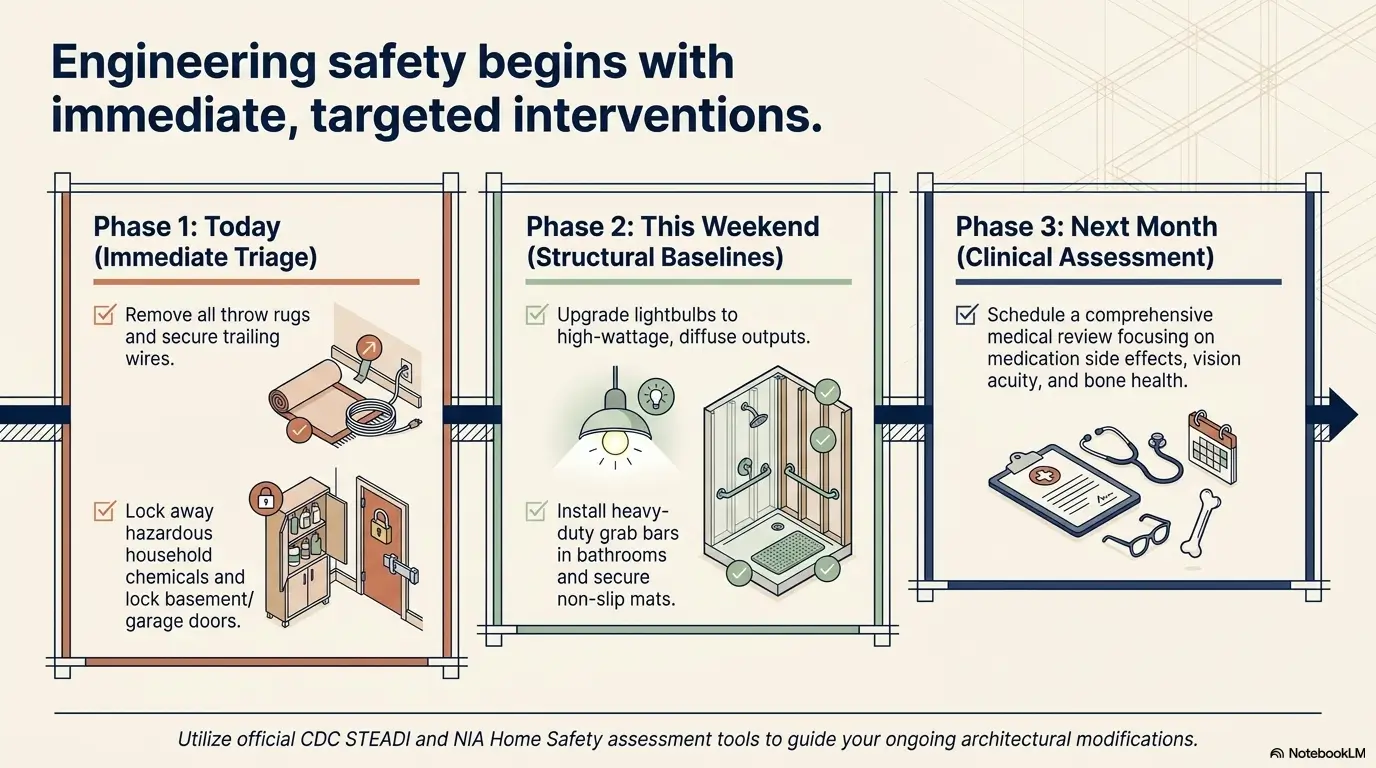
FAQ
How wide should a walker path be at home?
A walker path should be wide enough for the actual walker, the person’s hands and elbows, and safe turning. Instead of relying only on a number, test the route with the walker. If the device scrapes, stalls, requires lifting, or forces side-stepping, the path is too tight for practical use.
What should I remove first to make a walker path safer?
Remove loose floor hazards first: shoes, rugs that slide or curl, cords, laundry, pet toys, baskets, trash cans, and anything that catches walker legs or wheels. These small items often create more immediate risk than large furniture.
Are rugs safe for someone using a walker?
Some rugs can be risky because they slide, bunch, curl, or catch walker tips and wheels. Many households remove small rugs from walker routes, especially near beds, bathrooms, and kitchens. If a rug is needed for traction, ask a clinician or occupational therapist what type is safest for the person and floor.
How do I make a bathroom path safer for a walker?
Clear the turn into the bathroom, remove loose bath mats from the travel lane, improve nighttime lighting, move trash cans and hampers out of the path, and check whether the walker can approach the toilet safely. Bathroom setup may need professional review after surgery or after falls.
Should I move furniture or just remove clutter?
Start with clutter, rugs, cords, and tight turn hazards. Move furniture only when it truly blocks the walker route. Before removing a chair or table, ask whether the person uses it for balance, transfers, or pausing.
What is the safest way to handle cords across a walkway?
The safest cord is usually one that does not cross the walkway at all. Relocate lamps or devices, route cords along walls when safe, and avoid running cords under rugs. For medical equipment cords or oxygen tubing, ask the equipment provider or clinician for safe routing advice.
How can I make a walker path safer at night?
Add nightlights or motion lights that show the floor without glare. Keep the light switch, lamp, or remote control reachable from the bed or chair. Retest the route in actual nighttime lighting because shadows, urgency, and sleepiness change the safety picture.
When should I ask an occupational therapist for help?
Ask about occupational therapy if there have been falls, near-falls, bathroom transfer problems, post-surgery restrictions, trouble turning, unsafe stairs, vision concerns, or uncertainty about equipment. An occupational therapist can assess the real home routine, not just the room layout.
Next Step: Clear One Path in 15 Minutes
The house does not need to become perfect today. The next step is smaller and more useful: choose one route and make it boring. Boring is underrated. Boring is what we want from a walker path at night.
Choose the most-used route
Pick one path: bed to bathroom, chair to kitchen, entryway to living room, or bedroom to medication area. Choose the route where the person is most tired, stiff, rushed, or unsure.
Remove five floor hazards
Remove five things from the travel lane. Shoes count. Cords count. Pet toys count. A towel that “never moves” counts. A basket with suspicious confidence definitely counts.
Walk the route once with the actual walker and adjust one tight spot
Use the walker. Watch the turn. Notice the scrape, pause, or sidestep. Then adjust one tight spot. Not ten. One. A safer home is often built in small, repeatable corrections.
The opening problem was never the whole house. It was the one route where the walker had to bargain with slippers, cords, rugs, shadows, and tight turns. Clear that route first, and you give the person something more valuable than a tidy room: a predictable path.
Within the next 15 minutes, choose the highest-use walker route, remove five hazards, and walk it once with the actual walker. If the route still requires lifting, scraping, grabbing furniture, or guessing in the dark, treat that as useful information and consider professional help.
Last reviewed: 2026-05.