

Before-Surgery Home Safety Guide
Fall Risk Home Checklist Before Surgery:
Fix Hazards Before Recovery Begins
The first walk through your front door after surgery rarely feels like an ordinary homecoming. Your body may be tired, your reactions slower, and the familiar hallway suddenly narrower because a walker, crutches, sling, brace, or protective boot has joined the household.
A useful fall risk home checklist does more than hunt for loose rugs. It examines the real journey you will take from the car to your resting place, from bed to bathroom at 2 a.m., and from the kitchen counter back to a chair while both hands are needed for balance.
This guide helps patients and caregivers prepare that journey before surgery, while there is still time to move furniture, test equipment, ask better questions, and correct the small hazards that become large problems when pain, medication, fatigue, and limited movement arrive together.
Map the route
Prepare the exact paths you will use during early recovery.
Test the setup
Check lighting, turning room, surfaces, supports, and equipment fit.
Plan the handoff
Give caregivers clear instructions instead of hopeful guesswork.
🧭 The safest recovery route is the one you rehearse before your body has to rely on it.
Article snapshot
This guide is for US patients preparing for outpatient or short-stay surgery and for the relatives, friends, or neighbors helping them recover. It shows how to identify home hazards, prepare essential rooms, test mobility routes, organize caregiver support, and recognize situations that require professional help.
Table of Contents
Safety Boundaries: What This Checklist Can and Cannot Do
A home safety checklist can reveal cords, slippery surfaces, awkward furniture, dim hallways, and poorly placed supplies. It cannot predict exactly how you will feel after anesthesia, how much weight you may place on a limb, or whether a particular shower chair, toilet riser, walker, or brace is appropriate for your procedure.
Those details come from your surgical team, physical therapist, occupational therapist, nurse, or another clinician who understands your operation and health history. Treat this article as a preparation tool that helps you ask specific questions, not as a replacement for individualized medical instructions.
Confirm restrictions before rearranging the house
“Take it easy” is not a complete mobility plan. Before surgery, ask what movements, positions, surfaces, and activities may be restricted during the first days or weeks.
- Will you be full weight-bearing, partial weight-bearing, touch-down weight-bearing, or non-weight-bearing?
- Will you use a walker, crutches, cane, wheelchair, brace, sling, protective boot, or no device?
- May you climb stairs immediately, and should someone assist?
- Are there bending, twisting, lifting, reaching, or joint-position restrictions?
- When may you shower, and must the incision remain dry?
- Should someone stay with you after discharge?
- What symptoms should stop you from walking?
Write the answers down. Verbal instructions can blur together on surgery day, especially when several people are speaking and discharge paperwork is arriving in a small paper avalanche.
Equipment must fit the person and the procedure
A mobility aid that is too high, too low, too wide, unstable, or used incorrectly can create a new hazard. The same applies to toilet risers, shower seats, bedside rails, transfer benches, and temporary ramps.
Whenever possible, have the device fitted and demonstrated before surgery. Practice standing, sitting, turning, backing up, crossing thresholds, and opening a door. The goal is not to perform a showroom-perfect walk. It is to discover where your home and the equipment disagree.
Key takeaway
Do not buy recovery equipment solely because another patient used it. Confirm the device, height, installation, and movement technique with a qualified professional who knows your restrictions.
This is preparation guidance, not emergency advice
Seek urgent medical care after a fall involving a head impact, loss of consciousness, new confusion, breathing difficulty, uncontrolled bleeding, severe or rapidly increasing pain, an obviously deformed limb, chest pain, or inability to stand or bear weight. Follow the emergency instructions provided by your surgical team.
Do not force a patient to stand after a fall simply to “see whether they are okay.” Keep them still and comfortable unless the location creates an immediate danger, and contact emergency services or the appropriate clinician for guidance.
Who Can Use This Checklist and Who Needs More Support
This fall risk home checklist before surgery is especially helpful for people returning home after joint, spine, foot, abdominal, cardiac, or other procedures that temporarily affect strength, balance, reaction time, endurance, vision, concentration, or the ability to use one or both arms.
It is also useful for caregivers. A patient may see the home through the lens of long familiarity: “I have always stepped over that cord.” A caregiver can see the same cord as an obstacle waiting at ankle height.
A good fit for planned, short-term recovery
The checklist works well when the patient is expected to return home and can participate in preparation. This includes many outpatient procedures, short hospital stays, and planned orthopedic recoveries.
It can help a healthy adult with a temporary mobility restriction just as much as an older adult. Falls after surgery are not limited to one age group. A younger patient using crutches for the first time may be confident, fast-moving, and surprisingly unprepared for a wet kitchen floor or a dog weaving between the crutch tips.
Signs that a checklist alone is not enough
Ask the clinical team for a more formal discharge or home-safety plan when the patient has repeated falls, major balance problems, severe weakness, cognitive impairment, confusion, fainting, significant vision loss, uncontrolled dizziness, or difficulty following movement instructions.
Additional planning may also be needed when the home has many stairs, no accessible bathroom, narrow doors, an unsafe entrance, no reliable caregiver, or a bedroom that cannot be reached within the patient’s restrictions.
| Situation | Checklist may be enough to begin | Ask for added professional input |
|---|---|---|
| First-time walker use | Home is level and practice is available | Patient cannot turn, sit, or cross thresholds safely |
| Stairs | One short flight with firm rails and approved technique | No rail, unusual steps, severe fatigue, or non-weight-bearing status |
| Bathroom | Stable approved equipment and clear access | Patient cannot transfer or follow bathing restrictions |
| Cognition | Alert, oriented, and able to remember instructions | Confusion, agitation, poor judgment, or memory problems |
| Caregiver support | Reliable helper available at required times | No helper despite instructions not to walk alone |
Renters and apartment residents need a permission plan
Renters may not be able to drill into bathroom walls, alter railings, or install permanent ramps without approval. Contact the landlord or property manager early rather than discovering the limitation three days before surgery.
Ask about temporary accommodations, elevator reliability, package delivery, parking, snow or ice removal, and the route from the building entrance to the apartment. For a more detailed small-space example, review this knee replacement apartment setup guide.
Start With the Recovery Route, Not the Whole House
A room-by-room checklist is useful, but it can encourage equal attention to spaces that will not matter during early recovery. The dining room centerpiece is not the urgent issue. The seventeen steps between the car and the bathroom are.
Begin by identifying the routes the patient will actually use during the first several days. These routes form a small recovery zone inside the larger home.
Map five essential routes
- Vehicle to entrance: Include curbs, steps, slopes, gravel, gates, and the door threshold.
- Entrance to resting area: Identify turns, narrow passages, furniture, and places to pause.
- Bed or recliner to bathroom: Test this path in daylight and darkness.
- Resting area to kitchen or meal station: Reduce unnecessary carrying and reaching.
- Resting area to the safest exit: Keep an emergency route clear.
Use painter’s tape or small removable notes to mark obstacles that need attention. Photograph anything that cannot be fixed immediately, such as a broken step or narrow doorway, so you can show the problem to a therapist, contractor, landlord, or family member.
Choose one low-risk recovery floor when possible
If the home has multiple levels, consider whether sleeping, toileting, meals, medication, and daytime rest can happen on one floor. This does not mean stairs are always forbidden. It means every unnecessary stair trip removes another opportunity for fatigue, rushing, and divided attention to combine.
A downstairs arrangement must still be safe. A low sofa that swallows the patient, a folding card table used as a support, or a narrow half-bath may be less suitable than a carefully planned upstairs room. Compare actual transfers and routes rather than choosing a floor by instinct.
Find the collision points
Collision points are places where the patient, mobility aid, door, pet, furniture, and caregiver compete for the same square foot. Common examples include the front door, bathroom entrance, side of the bed, refrigerator, and the turn at the top of a staircase.
Open each door fully. Stand where the patient will stand. Ask whether a walker can remain planted while the door is unlocked, pulled, or pushed. Check whether a caregiver can assist without being trapped behind the door.
The Recovery-Route Framework
1. Map
Trace the routes used for arrival, sleep, meals, bathing, and emergencies.
2. Clear
Remove trip hazards and create room for turning and transfers.
3. Light
Illuminate doors, thresholds, stairs, hallways, and nighttime routes.
4. Test
Use the expected mobility aid and rehearse real movements slowly.
5. Assign
Decide who handles doors, meals, pets, stairs, medications, and calls.
Short Story: The Front Door Was the Real Obstacle
Martin prepared his living room beautifully before knee surgery. The recliner was firm, medications had a labeled shelf, and frozen meals stood in tidy rows.
What he did not test was the front door. It opened inward across a thick mat, while a planter narrowed the landing. On discharge day, his daughter had to hold the walker, control the door, move the mat, and keep Martin from stepping backward toward the porch edge.
Nothing went wrong, but the awkward minute showed how easily a familiar entrance could become a puzzle when one person needed both hands for a mobility aid.
That evening, they removed the mat and planter, added a brighter porch light, and placed a small stable chair several feet inside. The practical lesson was simple: prepare the route of arrival, not merely the room where recovery will happen.
Key takeaway
The safest room is of little use when the patient cannot reach it safely. Test the full chain from vehicle seat to resting seat.
The Two-Pass Walkthrough That Exposes Hidden Hazards
Walk through the recovery zone twice: once in daylight and once after dark. A bright afternoon can hide the weak night-light, deep hallway shadow, reflective floor glare, or unreachable switch that matters at 2 a.m.
The second pass should imitate recovery conditions without pretending to be injured. Move slowly, keep your hands where they would be on the expected mobility aid, and notice every moment that requires carrying, twisting, reaching, sidestepping, or balancing.
Clear the floor without merely moving clutter sideways
Remove loose rugs, curled mats, baskets, footstools, low tables, decorative objects, shoes, pet toys, charging cables, extension cords, magazines, boxes, and lightweight furniture from walking paths. Secure carpet edges and address uneven transitions between flooring materials.
Do not stack removed items against the wall of the same route. A walker may need more width than the patient expects, especially while turning. Crutches also swing outward and can catch objects that never bothered an ordinary stride.
Measure turning space with the real mobility aid
A pathway can look wide enough until the patient must turn around, back toward a chair, or approach a toilet. Test these movements with the actual device whenever possible.
- Can the walker pass through the narrowest door without scraping both sides?
- Can the patient turn without lifting or twisting the device?
- Can crutch tips remain on firm flooring rather than a rug edge?
- Can the patient back up to a seat without hitting a table?
- Can a caregiver stand nearby without blocking the route?
- Can doors be opened while the mobility aid remains stable?
Create a pet and child management plan
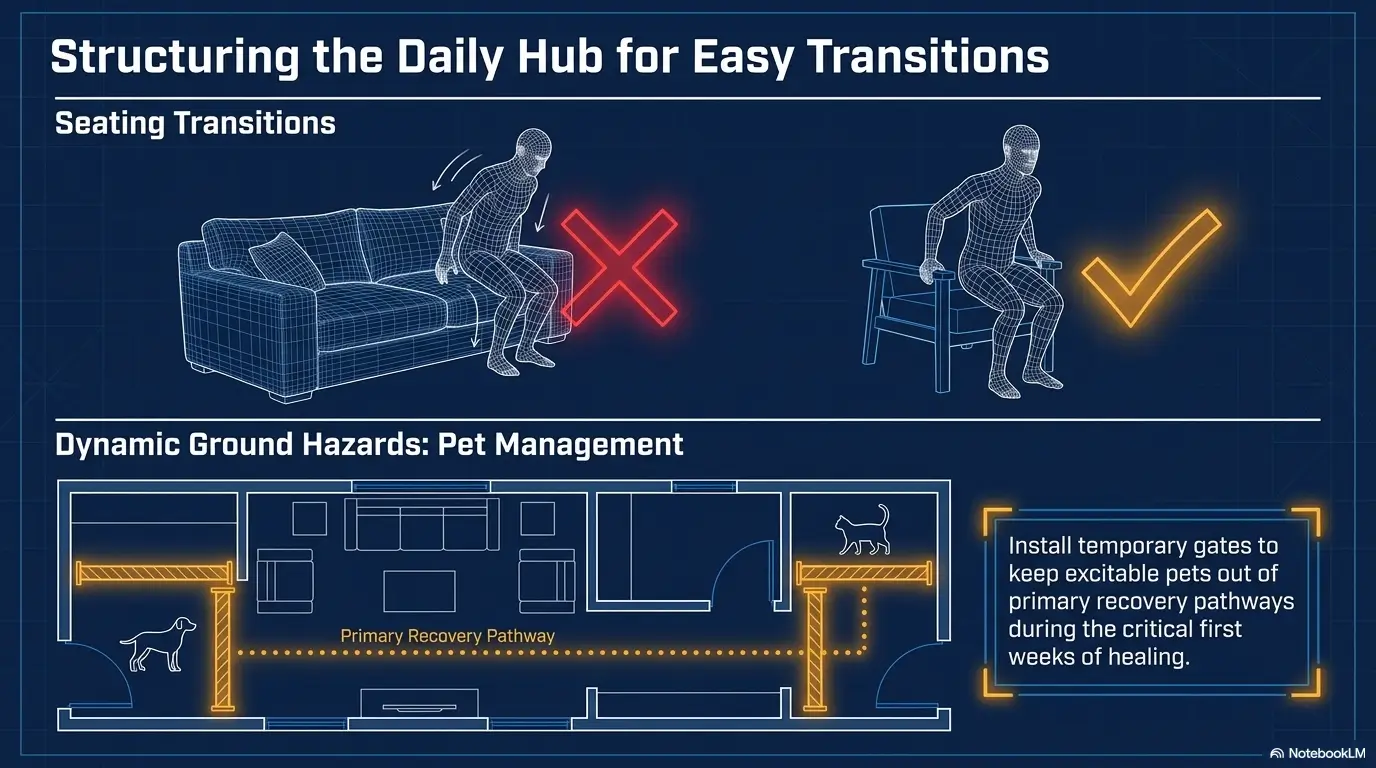
Pets do not understand weight-bearing restrictions. They understand that their person has returned home and may celebrate directly beneath the walker.
Use gates, closed doors, leashes, crates, feeding stations, or another responsible adult to keep pets away from arrival and early transfers. Move bowls and toys out of walking routes. Arrange dog walking, litter care, and feeding before surgery.
Young children may also rush toward the patient, leave toys on the floor, or grab equipment. Explain the new rules in simple language: slow feet near the patient, nothing on the recovery path, and no climbing on the walker or recliner.
Use a simple hazard scorecard
| Checkpoint | Green | Yellow | Red |
|---|---|---|---|
| Path width | Device passes and turns easily | Tight but manageable with adjustment | Device cannot pass safely |
| Floor surface | Firm, dry, level, and uncluttered | Minor edge or transition needs repair | Loose, wet, unstable, or uneven |
| Lighting | Whole route visible before entering | One dim area or awkward switch | Dark steps, glare, or hidden obstacles |
| Support | Approved rail or device available | Support needs tightening or review | Furniture or towel rack used for balance |
| Assistance | Helper knows the plan | Helper available but untrained | No help despite assistance restriction |
A red checkpoint should be corrected, avoided, or reviewed with the care team before discharge. Yellow means the route needs a specific change, not a cheerful promise to “be extra careful.”
Show me the nerdy details
Falls rarely come from one dramatic hazard. Risk often rises when several small demands overlap: reduced strength, pain, an unfamiliar device, a dim route, a quick turn, a sedating medicine, and a pet underfoot.
This is why individualized preparation works better than simply buying more equipment. The useful question is not “Is there a rug?” but “What will this person be doing, with which restrictions, at what time of day, and with what help?”
Bathroom Safety Begins Before the Water Turns On
Bathrooms combine water, hard surfaces, confined space, clothing changes, transfers, and urgency. They also invite a dangerous kind of improvisation: grabbing whatever happens to be nearby.
A towel rack, sliding shower door, sink edge, toilet-paper holder, or loose vanity is not a substitute for a properly installed support. The bathroom should be planned around the patient’s actual bathing and toileting instructions.
Plan the shower entry before selecting equipment
Determine whether the patient has a walk-in shower, tub-shower combination, fixed door, curtain, high threshold, handheld showerhead, and enough space for a helper. Then ask the clinical team what transfer method and equipment are appropriate.
A shower chair may be useful for one patient and unsuitable for another. A transfer bench may help with a tub edge but require more bathroom space. A handheld showerhead can reduce reaching, although the hose must not become a loop underfoot.
Keep soap, shampoo, towels, and wound-protection supplies between shoulder and waist height. The patient should not need to stand, bend deeply, twist, or stretch toward the floor while wet.
For procedure-specific planning, see this guide to having a shower safety conversation before surgery.
Use non-slip surfaces without creating curled edges
The shower or tub surface should have a suitable non-slip treatment, and the floor outside should remain dry. Any mat used outside the bathing area must lie flat, resist sliding, and stay out of the mobility aid’s turning path.
A fluffy bath mat may feel pleasant under bare feet but bunch beneath a walker or catch a crutch tip. Choose stability over spa drama during early recovery.
Do not guess about toilet height
A low toilet can make standing difficult, but an overly high or unstable riser can also create problems. The correct setup depends on the patient’s height, leg length, joint restrictions, balance, equipment, and transfer technique.
Ask a therapist or another qualified professional whether a riser, safety frame, bedside commode, or existing toilet is suitable. This toilet seat riser height guide can help you prepare better questions before purchasing.
Bathroom readiness checklist
- Bathing permission and incision instructions confirmed
- Transfer method practiced or demonstrated
- Approved seat, bench, or support fitted correctly
- Non-slip surface secure inside and outside bathing area
- Towels and toiletries within easy reach
- Floor kept dry and path free of loose mats
- Door can be opened if the patient needs help
Read MedlinePlus Home Preparation Guidance
Key takeaway
The surprise bathroom hazard is often the transition between surfaces: wet foot to mat, shower threshold to floor, or toilet transfer to mobility aid. Test the whole sequence, not one fixture.
Build a Bedroom and Lighting Setup That Reduces Decisions
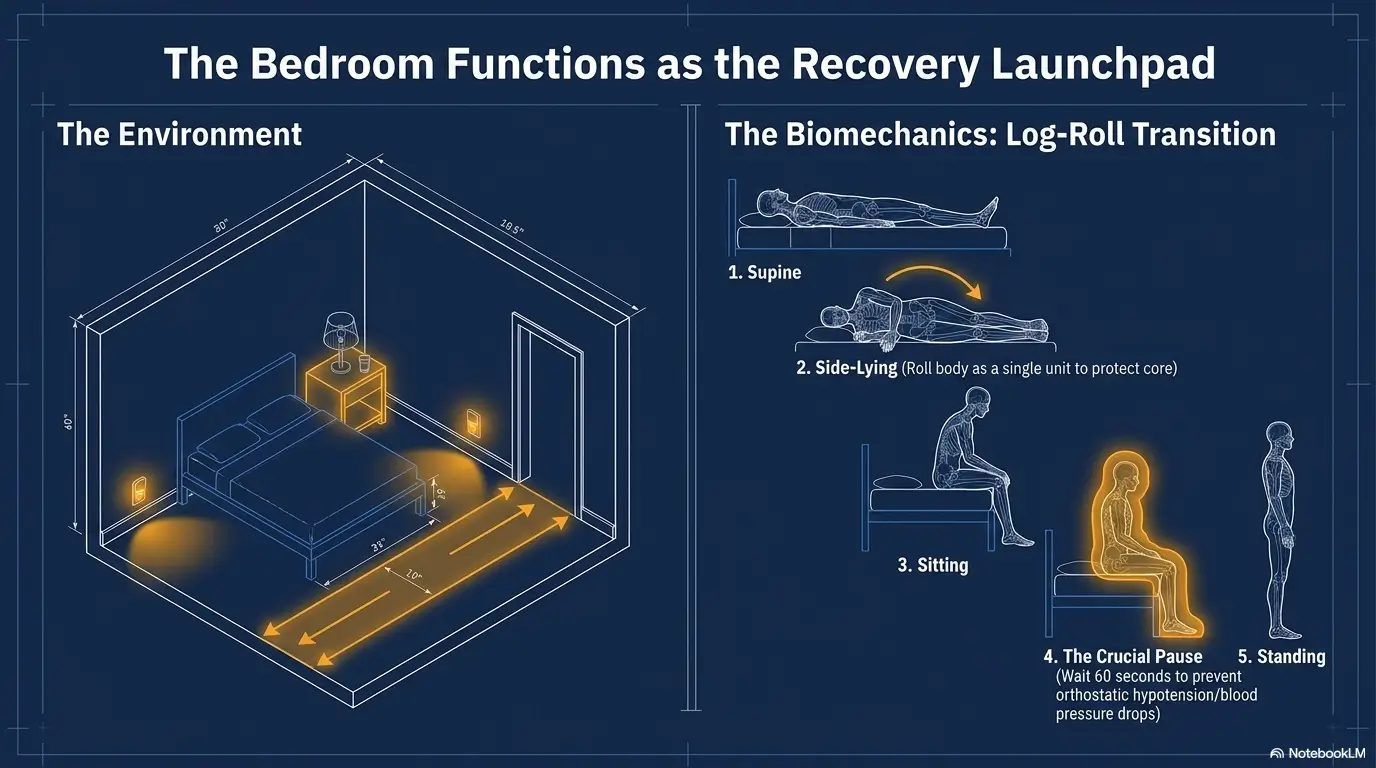
Nighttime is not the moment to search for glasses, untangle a charging cable, remember where the walker was parked, or negotiate with a bedroom chair that rolls backward.
A safe recovery bedroom reduces the number of choices required between waking and reaching the bathroom. Place each item where it can be found by habit, not by a midnight scavenger hunt.
Set the bed for controlled sitting and standing
The patient should be able to approach the bed with the mobility aid, turn using the approved technique, back up, and sit without dropping onto a low mattress. At the edge of the bed, the feet should have stable contact with the floor or an approved setup recommended by the care team.
A mattress that is extremely soft may make movement and transfers harder. A bed that is too high can leave the feet dangling, while one that is too low can demand excessive bending and leg strength.
Do not improvise height with loose boards, unstable blocks, or stacked mattresses. Ask for guidance when the existing bed creates a difficult transfer.
Create a stable nightstand zone
Place essential items within easy reach while the patient is lying or sitting. Keep the surface uncluttered so nothing is knocked onto the floor.
- Phone and charger arranged without a cable across the walking path
- Glasses and hearing aids
- Water in a stable, closed container if permitted
- Medication schedule or log, with medicines stored as instructed
- Tissues and a small waste container
- Call bell, alarm, or agreed method for contacting a caregiver
- Discharge instructions and emergency numbers
- A lamp controlled from the bed
This knee replacement nightstand setup offers a more detailed example of arranging the bedside zone.
Light the route before the first step
The patient should be able to turn on a light before standing or entering a dark hallway. Illuminate the bed area, bathroom route, stair edges, thresholds, and switches.
Motion-activated night-lights can help when they are placed where they do not create floor cords or sudden glare. Light should reveal obstacles without shining directly into the patient’s eyes.
Check whether a dark floor and dark furniture blend together. Contrast tape may help identify a step or threshold when it is placed securely and approved for the surface.
Park footwear and the mobility aid deliberately
Place supportive, well-fitting footwear where the patient can put it on without stepping over it. Avoid loose backless slippers, worn soles, slippery socks, and shoes that require unsafe bending.
Park the walker, cane, or crutches in the same reachable position each time without blocking the exit. The device should not roll, slide, or fall when touched.
Key takeaway
A good bedroom setup removes nighttime improvisation. The light, phone, footwear, mobility aid, and bathroom route should be ready before the patient becomes tired or urgently needs the toilet.
Stairs and Entryways Become the First Recovery Test
The entrance is where discharge-day fatigue meets weather, doors, bags, instructions, uneven ground, and the understandable desire to get inside quickly. Prepare it as carefully as the bedroom.
Inspect rails, steps, landings, and thresholds
Check whether handrails move, end too early, have gaps, or are difficult to grip. Repair loose boards, crumbling edges, uneven pavers, torn carpeting, and raised thresholds.
Remove leaves, snow, ice, hoses, packages, planters, loose mats, and decorative objects. Arrange timely weather clearing rather than assuming someone can do it after the patient arrives.
Make sure the landing provides enough space for the patient, mobility aid, door swing, and helper. A narrow landing may require a carefully planned sequence directed by a therapist or other qualified professional.
Assign jobs for the first trip home
The patient should not be managing overnight bags, discharge papers, medication packages, keys, and a mobility aid at the same time.
- One person stays close to the patient as instructed.
- Another person carries bags and opens doors when available.
- Pets are secured before the vehicle arrives.
- The route is dry, lit, unlocked, and clear.
- A stable resting seat is ready inside.
- Children and visitors wait away from the entrance.
Use the “one hand free” door test
Stand at each important door with the expected mobility aid. Can the patient reach the handle, unlock it, and move the door without releasing a required support or stepping backward unsafely?
Doors with strong closers, heavy weather seals, high thresholds, or awkward locks may need a helper. Do not wedge open a fire-rated or security door unless permitted and safe.
Practice stairs only with approved instruction
Stair technique varies with the device, operated side, weight-bearing status, strength, railing arrangement, and procedure. Obtain a demonstration rather than copying a video or another patient.
Practice before surgery if your team recommends it. Discuss what to do when a stair route includes a turn, landing, missing rail, unusually high step, or exterior surface.
Kitchen Tasks, Medication Effects, and Everyday Fall Traps
Many post-surgery falls are not caused by dramatic architecture. They happen during ordinary tasks: reaching for a mug, carrying soup, standing too quickly, hurrying to the bathroom, or trying to feed a pet while using crutches.
Build a shoulder-to-waist kitchen zone
Move commonly used food, dishes, cups, utensils, and supplies away from high cabinets and low drawers. Keep them within a comfortable reach that does not require climbing, deep bending, or twisting.
Prepare simple meals in advance. Use containers that seal securely and are easy to open. Store single portions where the patient can reach them without shifting heavy cookware.
Place a stable chair near the food-preparation area only if it does not block the mobility route. Sitting may reduce fatigue, but wheeled stools and lightweight folding chairs can move unexpectedly.
Solve the carrying problem before discharge
Walkers and crutches often require both hands. Carrying an uncovered drink, plate, phone, or medication bottle can change posture and reduce control.
Ask whether a properly fitted walker basket, tray, closed container, backpack, cross-body pouch, or caregiver delivery is appropriate. Do not attach a heavy bag to one side of a walker or hang objects where they can strike the legs.
For practical meal transport ideas, see how to carry a plate with a walker and this guide to one-handed meal preparation.
Treat dizziness and slowed reactions as safety information
Anesthesia, pain medicines, sleep medicines, nausea treatments, blood-pressure medicines, and other drugs may contribute to sleepiness, dizziness, blurred focus, poor coordination, or a drop in blood pressure when standing. Individual responses vary.
Review the medication plan with the surgical team or pharmacist. Ask which medicines may affect balance or alertness, whether existing medicines should change around surgery, and what symptoms should prompt a call.
Unless instructed otherwise, change position in stages: move from lying to sitting, pause, place both feet securely, then stand using the approved technique. Sit back down if you feel faint, unstable, unusually weak, or visually unfocused.
Mistakes that quietly raise fall risk
Mistake checklist
- Waiting until the night before surgery to move furniture
- Buying equipment without checking fit or restrictions
- Using furniture, countertops, or towel racks for support
- Walking in loose slippers or socks on smooth flooring
- Carrying hot drinks while using crutches or a walker
- Leaving pets loose during arrival and early transfers
- Rising quickly after lying down
- Assuming the hospital will provide every needed item
- Trying to “push through” new dizziness or weakness
Explore CDC STEADI Fall-Prevention Resources
Key takeaway
When both hands are needed for balance, carrying becomes a safety problem rather than a minor inconvenience. Design a hands-free or caregiver-assisted method for meals, phones, and personal items.
Turn the Caregiver Handoff Into a Usable Safety Plan
A caregiver cannot follow instructions they never received. “Keep an eye on Mom” leaves too much room for interpretation. A useful handoff names the restrictions, tasks, warning signs, contacts, and times when the patient must not walk alone.
Write mobility rules in plain language
Post a one-page summary near the medication area or another visible location. Use the wording provided by the clinical team.
- Which mobility aid must be used
- How much weight may be placed on the operated side
- Whether stairs require assistance
- Whether the patient may walk alone
- Which movements or positions are restricted
- When the patient may bathe
- Which symptoms require a call or emergency help
- Who to contact during business hours and after hours
Learn how to assist without pulling the patient
A helper may instinctively grab the patient’s arm, especially when the patient wobbles. That can be unsafe after shoulder, wrist, chest, spine, or upper-extremity surgery and may also disrupt balance.
Ask a therapist or nurse to demonstrate the correct assistance technique. The helper should understand where to stand, what not to hold, how to manage the mobility aid, and what to do if the patient begins to lose balance.
Assign the tasks most likely to cause rushing
Falls often occur when the patient tries to solve an urgent household problem: the dog needs to go out, the delivery driver is leaving, the kettle is whistling, or the phone is ringing in another room.
| Task | Named helper | Backup plan |
|---|---|---|
| Meals and drinks | Primary caregiver | Prepared portions and closed containers |
| Pet care | Family member or neighbor | Pet sitter or boarding plan |
| Medication pickup | Discharge driver | Delivery service arranged early |
| Nighttime bathroom help | Overnight caregiver | Approved alternative discussed with care team |
| Packages and doors | Household member | Delivery instructions and phone notification |
| Stairs | Trained helper | Single-floor setup |
Questions the caregiver should ask before discharge
- May the patient stand and walk without another person present?
- What is the correct way to help with a chair, toilet, bed, and vehicle transfer?
- How should the mobility aid be positioned?
- What level of dizziness, sleepiness, pain, or weakness is expected?
- Which symptoms mean the patient should stop walking?
- Who should be called after a near-fall or fall?
- What equipment must be available before the patient enters the home?
- When should physical or occupational therapy be requested?
When caregiving will be shared, use one written plan rather than several remembered versions. For additional planning, this guide explains how to organize neighbor help after surgery.
When to Seek Help, Stop Walking, or Recheck the Plan
The correct response to a safety problem is not always another home modification. Sometimes the patient’s condition, restrictions, or environment requires professional reassessment.
Contact the team before surgery when the home is not workable
Tell the surgical team before the procedure if the patient cannot safely enter the home, reach a bathroom, use the required mobility aid, manage unavoidable stairs, or obtain the assistance specified in the plan.
Do not assume these problems will sort themselves out at discharge. The team may recommend equipment training, therapy, home health support, a different discharge arrangement, or another solution based on the patient’s needs and coverage.
Stop and seek guidance for new instability
Stop walking and sit or lie down safely if the patient develops sudden dizziness, near-fainting, unusual weakness, confusion, blurred vision, chest discomfort, breathing difficulty, or a sense that the legs will not support them.
Contact the surgical team promptly for repeated near-falls, worsening balance, new weakness, severe medication-related sleepiness, or a new inability to perform a transfer that was previously safe.
After a fall, assess before moving
Call emergency services for a head strike with concerning symptoms, loss of consciousness, severe pain, major bleeding, breathing difficulty, chest pain, visible deformity, or inability to get up. Use the emergency guidance supplied by the patient’s clinicians.
Even without an obvious injury, notify the appropriate healthcare professional after a fall following surgery. A patient may have disrupted an incision, exceeded movement restrictions, injured a joint, or developed a medical problem that contributed to the fall.
Ask about physical or occupational therapy
Physical therapists can help with gait, strength, transfers, stairs, and correct device use. Occupational therapists can help match daily activities and the home environment to the patient’s abilities and restrictions.
Consider asking for help when equipment does not fit, the bathroom transfer feels unsafe, the patient is afraid to move, the caregiver is unsure how to assist, or the home cannot accommodate the prescribed device.
Review NIH Room-by-Room Fall Prevention Tips
Key takeaway
Repeated near-falls are not harmless practice attempts. They are evidence that the patient, medication plan, equipment, assistance level, or environment needs to be reassessed.
FAQ
How early should I complete a fall risk home checklist before surgery?
Begin one to two weeks before a planned procedure when possible. This leaves time to confirm restrictions, obtain properly fitted equipment, request repairs, coordinate caregivers, and practice routes. Repeat a brief check the day before surgery because packages, laundry, pet items, and charging cables tend to return.
What should I remove from the floor before coming home?
Remove loose rugs, curled mats, cords, shoes, pet toys, baskets, boxes, low stools, unstable furniture, and clutter from recovery routes. Secure flooring transitions and leave enough room for the mobility aid to turn, not merely pass straight through.
Do I need grab bars or a shower chair after surgery?
Possibly, but the correct equipment depends on the procedure, restrictions, bathroom layout, patient height, balance, and transfer technique. Ask the surgical or rehabilitation team before buying or installing equipment. A towel rack or suction device should not be assumed to provide safe body-weight support.
Is it safer to sleep downstairs during recovery?
A single-floor setup can reduce unnecessary stair trips, but only when the downstairs bed, toilet access, transfers, lighting, and walking routes are safe. Compare the full setup with your restrictions rather than assuming downstairs is automatically better.
What shoes should I wear after surgery?
Choose secure, supportive footwear with a stable sole and a fit that does not slide off the heel. Avoid loose slippers, worn soles, and slippery socks unless your clinical team gives different instructions. Consider whether you can put the shoes on without unsafe bending.
Can I use furniture for support instead of a walker?
Do not substitute furniture for a prescribed mobility aid. Chairs, tables, countertops, and dressers may move, tip, or require reaching outside a stable base. Use the device and technique recommended by the healthcare professional managing your recovery.
How can I manage stairs safely after surgery?
Ask for procedure-specific stair instruction before discharge. The safe technique depends on the operated side, weight-bearing status, railing position, device, and strength. Inspect the stairs, improve lighting, repair loose rails, and arrange the recommended level of assistance.
Should someone stay with me after outpatient surgery?
Follow the discharge instructions from your surgical team, which may require a responsible adult for a stated period. Even when overnight help is not mandatory, assistance may be sensible if you have stairs, dizziness, limited mobility, complex medicines, pets, or difficulty reaching the bathroom safely.
Should I practice with a walker or crutches before surgery?
Yes, when your clinical team recommends that device. Practice correct height, hand placement, turning, sitting, standing, thresholds, and stairs with professional instruction. Do not practice an unconfirmed technique that could conflict with your future weight-bearing restrictions.
Perform a 15-Minute Recovery-Route Test Today
You do not need to renovate the entire home this afternoon. Begin with the route that matters most: entrance to resting area, then resting area to bathroom.
The 15-minute test
- Minutes 1 to 3: Walk from the entrance to the planned bed or chair at a slow pace. Note thresholds, turns, doors, rugs, and narrow spaces.
- Minutes 4 to 6: Trace the route from the resting area to the bathroom. Check lighting, floor surfaces, and turning room.
- Minutes 7 to 9: Remove obvious cords, loose mats, footwear, pet items, and lightweight furniture.
- Minutes 10 to 12: Sit in the recovery chair and on the bed. Identify anything too low, soft, unstable, or difficult to approach.
- Minutes 13 to 15: Photograph unresolved problems and write three questions for the surgical or rehabilitation team.
Use this three-question template
Questions to send before surgery
1. “My home has this specific obstacle: __________. What mobility method or assistance do you recommend?”
2. “Will I need this equipment: __________, and who should fit or demonstrate it?”
3. “Under what circumstances should I avoid walking alone or call your office?”
The purpose of the test is not to prove that the home is perfect. It is to discover the difficult moments while they are still easy to change.
A cord moved today, a door tested tonight, or a caregiver question answered before surgery may prevent a hurried decision when the patient is tired, medicated, and focused only on reaching the bathroom. That is the quiet power of early preparation: the home begins doing some of the safety work for you.
Last reviewed: 2026-06