

Timing Your Recovery: The Strategic Map for Sciatica & EMG Diagnostics
Sciatica pain can hijack your week in 48 hours, but an EMG booked at the wrong time can still come back “quiet,” leaving you stuck in diagnostic limbo. Timing is the difference between momentum and a missed diagnosis.
This guide provides a week-by-week strategy for lumbar radiculopathy, helping you navigate shifting symptoms and vague advice with a clear decision framework.
“`- ✔ The Critical Shift: Understand the diagnostic evolution between Week 0–1 and Week 3–4.
- ✔ Result Decoding: What “normal,” “positive,” and “indeterminate” findings actually mean for your next steps.
- ✔ Efficiency Protocol: How to avoid the five common timing mistakes that delay treatment and escalate costs.
Align symptom chronology, neurologic changes, and test actionability before you book. Know when to wait for higher diagnostic yield and when urgent care takes priority.
Table of Contents
Fast Answer
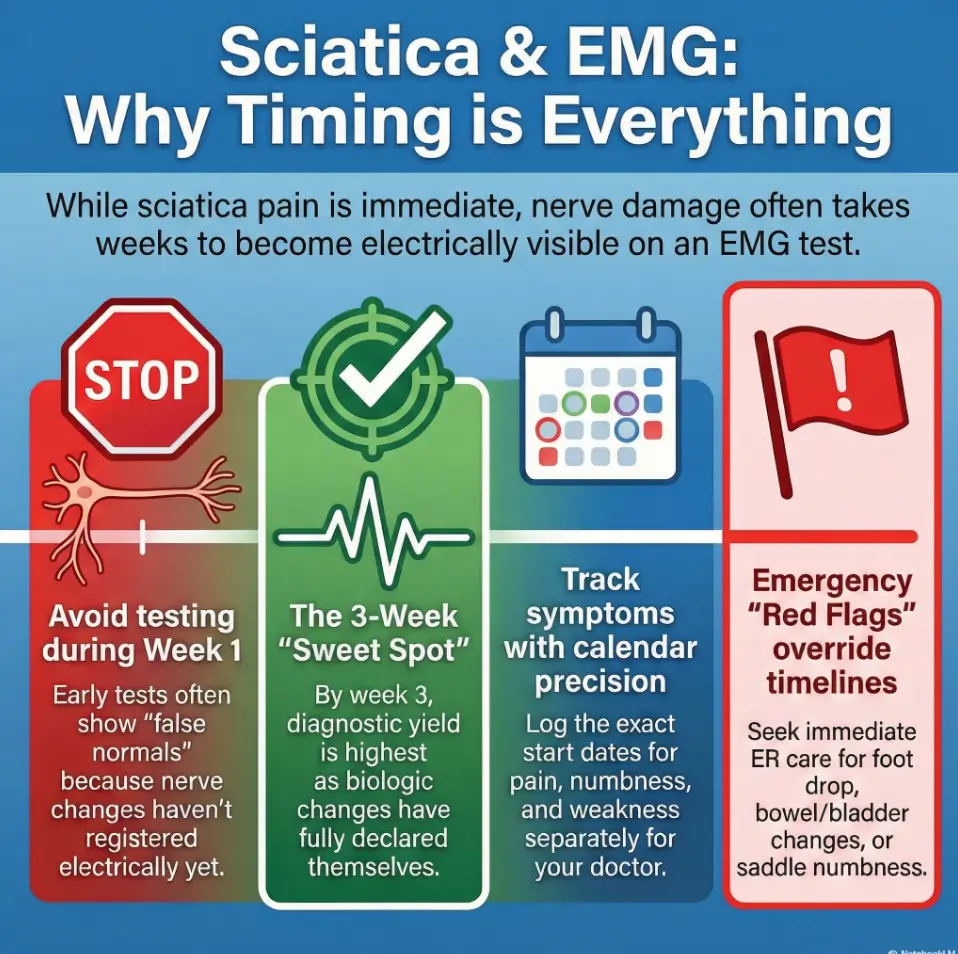
For many people with suspected sciatica from lumbar nerve root irritation, EMG/NCS is often more clinically useful after about 3 weeks of persistent symptoms. The reason is simple: certain nerve injury patterns need time to become electrically visible. If you test too early, you can get a normal or nondiagnostic result that does not match how miserable your leg feels.
That said, this timeline is for stable outpatient situations. If you develop new or worsening weakness, foot drop, bowel/bladder changes, saddle numbness, fever with severe pain, major trauma, or rapidly progressive neurologic symptoms, skip the waiting game and seek urgent/emergency care now. You can also review a focused cauda equina red-flag checklist before deciding whether to wait.
- Early EMG can be falsely reassuring.
- Three-week timing often improves diagnostic yield.
- Red flags always outrank timelines.
Apply in 60 seconds: Write your exact symptom onset date in your phone notes right now.
Start Here First: Why EMG Timing Changes Accuracy
What EMG can answer in sciatica (and what it cannot)
EMG and NCS are not “pain meters.” They are functional tests of nerve and muscle activity. In practice, they help clinicians answer questions like: Is there electrodiagnostic evidence of radiculopathy? Is the pattern more likely root-level vs peripheral nerve entrapment? Is the problem active, chronic, improving, or mixed?
What EMG cannot do: magically replace a careful exam, detailed history, and imaging when imaging is indicated. Think of diagnosis as a three-instrument trio: clinical exam, imaging context, electrodiagnostics. Solo performances sound dramatic but miss notes.
The biology clock: why “too early” can look falsely normal
When a lumbar nerve root is irritated or compressed, the body’s electrophysiologic changes may lag behind symptoms. Pain can arrive in week 1 while denervation signs are not yet robust on needle EMG. That mismatch is why a day-7 test can look “quiet” even when your leg feels like an electrical storm.
I once watched a family member frame a normal early result as “I guess it’s all in my head.” Two weeks later, repeat evaluation finally aligned with symptoms. Same body, different timing, better signal.
Let’s be honest… A normal early EMG does not always mean “nothing is wrong”
A normal or indeterminate early study is data, not destiny. It may mean: wrong timing, mild involvement, sampling limits, different pain generator, or a condition better captured another way. This is exactly why clinicians revisit the plan instead of declaring a verdict after one snapshot.
Show me the nerdy details
Electrodiagnostic studies detect physiologic consequences of nerve dysfunction, not simply structural contact. Temporal evolution matters: abnormalities can emerge over time, and muscle sampling strategy affects sensitivity. Test interpretation is always contextual, never binary in isolation.
Week 0–1: What to Do Before You Even Think About EMG
Typical first-week workflow in US outpatient care
Most uncomplicated first-week sciatica care in the US starts conservative: focused exam, symptom history, neurologic screening, pain-control strategy, activity guidance, and a follow-up plan. Depending on exam findings, your clinician may recommend movement-based rehab, medication adjustments, or watchful reassessment before ordering electrodiagnostics.
This phase can feel annoyingly low-tech. You want a scanner, a wire test, a number. Instead you get “Let’s monitor.” But good clinicians are not stalling. They are aligning timing to actionability.
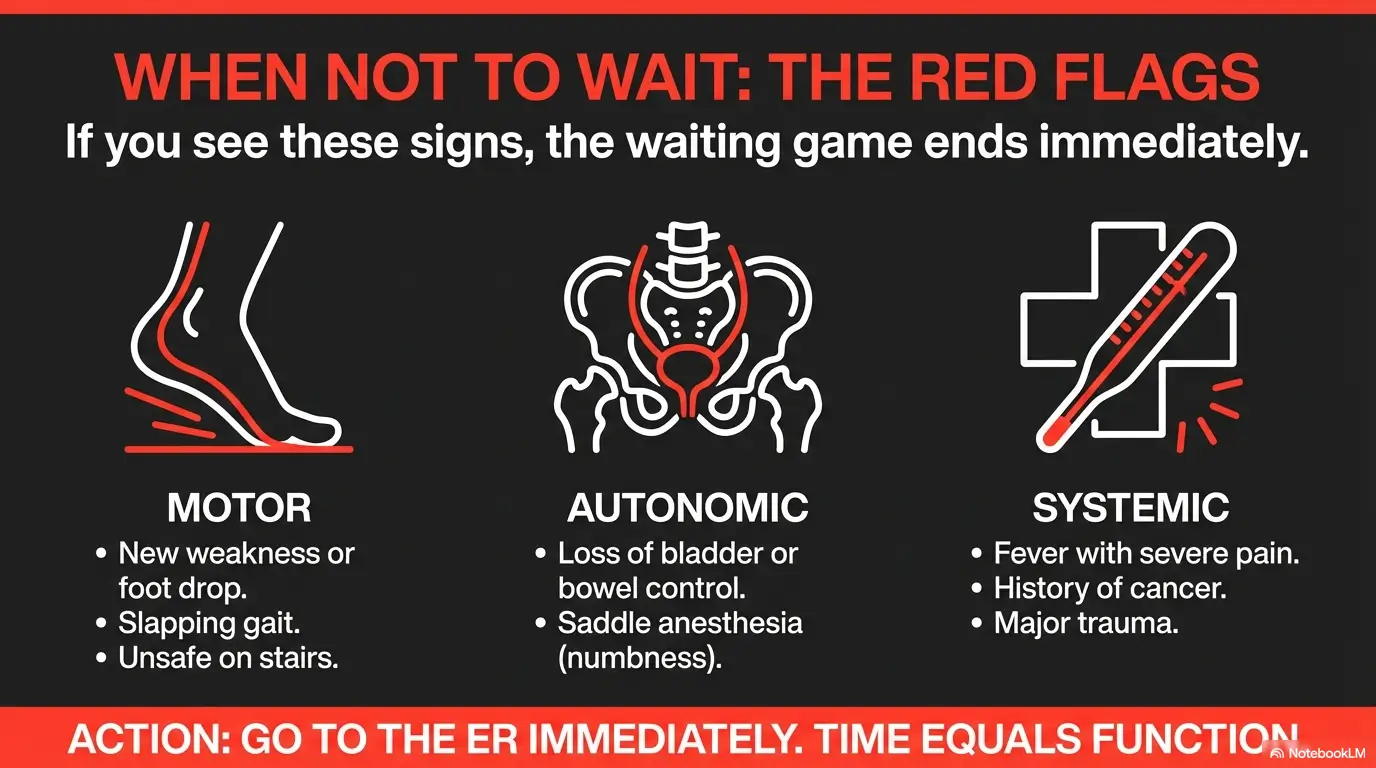
Red flags that override the waiting game
Some signs mean do not pass go:
- New motor weakness or foot drop
- Trouble urinating, loss of bladder/bowel control
- Saddle anesthesia
- Fever plus severe back/leg pain
- Major trauma, cancer history, significant immunosuppression
In these cases, “wait and see” is the wrong script. If unsure, compare your symptoms against this guide on when low back pain becomes an emergency.
What to track daily so your clinician can act faster later
A one-minute daily log can save one to three weeks of diagnostic drift. Track three timelines separately:
- Pain onset date (first day, intensity trend)
- Sensory changes (numbness, tingling zones)
- Motor changes (toe lift, heel walk, stairs, foot slap)
Add what worsens/helps, sleep impact, and missed function (driving, work tasks, standing tolerance). Clinicians make faster, safer decisions when your story has timestamps instead of fog.
- Separate pain, numbness, weakness dates.
- Track function, not just pain scores.
- Escalate immediately for red flags.
Apply in 60 seconds: Start a note titled “Sciatica Timeline” with today’s date and three symptom columns.
Week 2: The Gray Zone Nobody Explains Clearly
Why symptoms may feel worse while tests still look inconclusive
Week 2 is emotionally expensive. You may feel worse, sleep worse, and function worse, yet objective tests can still look partly inconclusive. This gap fuels anxiety and second-guessing. You are not failing recovery. You are living inside the messy middle where symptom burden and test detectability do not move in lockstep.
I remember pacing my hallway at 2:10 a.m., convinced that “more pain means immediate testing.” Sometimes it does. Sometimes it means better symptom control, closer follow-up, and timing the next diagnostic move so it actually changes care.
When clinicians may still order imaging instead of EMG
If structural clarification is urgent or differential diagnosis is broad, MRI may come first. If the key question is functional nerve involvement, level localization, or mismatch between symptoms and imaging, EMG/NCS may become the next logical layer. It is not a turf war between tests. It is sequencing.
Here’s what no one tells you… Early test timing can create diagnostic noise
Testing at the wrong moment can lead to extra appointments, repeat studies, and interpretive confusion. That costs time, money, and confidence. Better timing can reduce churn and make downstream decisions cleaner.
Money Block: Week-2 EMG Eligibility Checklist
- [ ] Symptoms persistent beyond 10–14 days
- [ ] Clinical exam suggests radicular pattern
- [ ] Result would change treatment now
- [ ] No emergency red flags requiring urgent pathway
- [ ] Follow-up plan exists if test is nondiagnostic
Neutral action: If 3 or fewer boxes are checked, discuss whether waiting to week 3–4 improves value.
Week 3–4: The “Sweet Spot” Window for Many EMG Decisions
Why many specialists wait until this point for better yield
By weeks 3–4, electrodiagnostic yield is often better for many radiculopathy questions because biologic changes have had more time to declare themselves. This does not mean every patient must wait. It means timing should match the clinical question and urgency.
In plain language: if your case is stable, this window often provides a stronger chance of getting useful data instead of a shrug-shaped report.
How EMG + NCS together refine the diagnosis
Combined testing can help separate root-level problems from peripheral neuropathies, plexus issues, or focal entrapments. That distinction matters because treatment pathways diverge quickly. A rehab plan for root irritation is not identical to one for common peroneal neuropathy. Same leg pain neighborhood, different houses.
If your exam is still mixed, this comparison of sciatica vs piriformis syndrome patterns can help you prepare cleaner questions before follow-up.
What “positive,” “negative,” and “indeterminate” may mean for next steps
- Positive: Supports radiculopathy or related nerve dysfunction; can sharpen treatment targeting.
- Negative: May reduce likelihood of certain pathologies, but does not erase symptoms or other causes.
- Indeterminate: Often means “context needed,” not “nothing there.” May trigger follow-up strategy.
I have seen people treat “negative” as either victory or betrayal. It is neither. It is one data layer in a continuing clinical decision tree.
Show me the nerdy details
Electrodiagnostic interpretation depends on muscle selection, root-level suspicion, baseline comorbidity, and chronology. A narrow sampling strategy may miss patchy involvement. Correlation with exam and imaging remains essential for avoiding over- or under-calling findings.
- Better timing can reduce false reassurance.
- EMG + NCS supports localization.
- Results guide next-step triage, not just labels.
Apply in 60 seconds: Ask your clinician: “Will testing this week change treatment choices?”
Week 5–8: If You’re Not Improving, How the Plan Should Escalate
Persistent pain vs progressive neurologic deficit: different urgency, different path
At this stage, no improvement deserves a structured review. Persistent pain without progression may justify therapy adjustments, medication strategy changes, targeted injections, or broader differential workup. Progressive weakness, however, is a faster lane. Neurologic decline changes urgency from optimization to protection.
How EMG findings may influence injections, rehab focus, or surgical referral
When findings align with exam and imaging, clinicians can make cleaner calls on intervention pathways. In real life, EMG can influence whether the team emphasizes conservative progression, targeted procedure discussions, or referral conversations. The point is not to “earn surgery.” The point is to avoid drifting in circles.
If intervention talk starts, patients often benefit from reviewing practical differences between TFESI vs interlaminar ESI for sciatica before consenting.
Open loop: What if your MRI and EMG disagree?
This happens more often than people think. Structural findings on MRI do not always equal symptomatic dysfunction, and electrophysiology may capture function that anatomy snapshots miss. When they disagree, clinicians usually revisit exam findings, timeline, symptom maps, and competing diagnoses before escalating.
Short version: disagreement is not failure. It is a cue to refine, not panic. You can also contextualize discordant findings with a clear primer on sciatica vs herniated disc overlap.
Money Block: Decision Card (Week 5–8)
Path A: Stable pain, no new weakness
Time trade-off: slower optimization, lower immediate procedural risk.
Path B: New/progressive weakness
Time trade-off: faster escalation, higher urgency coordination burden.
Neutral action: Bring your symptom log and ask your clinician which path your exam supports today.
Don’t Book EMG Too Soon: 5 Timing Mistakes That Cost Weeks
Mistake #1: Testing for reassurance instead of clinical decision value
If the result will not change management, testing now may be emotional relief with a billing code. Useful tests answer actionable questions.
Mistake #2: Ignoring symptom onset date accuracy
“It started sometime last month” can derail timing decisions. Clinicians need dates for pain, numbness, and weakness separately.
Mistake #3: Treating EMG as a stand-alone verdict
One report cannot replace exam, history, and context. If you frame EMG as final truth, you risk either false certainty or needless despair.
Mistake #4: Waiting despite new motor weakness
Motor decline is not “watch and journal.” It is escalation territory.
Mistake #5: Skipping follow-up after a nondiagnostic result
Nondiagnostic does not mean done. It means next-step strategy: repeat timing, alternative testing, or differential revision.
- Only test when results can change decisions.
- Track onset dates with calendar precision.
- Always pre-plan what happens after each possible result.
Apply in 60 seconds: Add one question to your visit: “If the EMG is normal, what is our Plan B?”
Don’t Self-Triage Red Flags: When Waiting Becomes Risky
Sudden weakness, foot drop, or rapidly progressive deficits
If your foot starts slapping, stairs become unsafe, or toe/ankle lift worsens quickly, that is not routine scheduling territory. Fast reassessment matters. For at-home function checks, this guide on how to use the straight-leg raise test safely at home can help you report symptoms more precisely, not self-diagnose.
Bowel/bladder dysfunction and saddle anesthesia
These symptoms can indicate a neurologic emergency. Do not wait for office triage windows, portal replies, or routine testing slots.
Fever, trauma, cancer history, immunosuppression, or severe unrelenting pain
These context flags increase concern for non-routine causes. Timeline articles are useful for stable scenarios; they are not substitutes for urgent evaluation when risk shifts.
Money Block: Urgency Tier Map (Tier 1→5)
- Tier 1: Mild stable symptoms, improving function
- Tier 2: Persistent pain, stable neurologic exam
- Tier 3: Persistent + functional decline (no objective weakness yet)
- Tier 4: New objective weakness or foot drop
- Tier 5: Bowel/bladder changes, saddle numbness, severe red-flag context
Neutral action: If you are Tier 4 or 5, pursue same-day urgent/emergency evaluation.
Who This Is For / Not For
This is for
- Adults with new or persistent radiating leg pain deciding on EMG timing
- Patients and caregivers who need a practical week-by-week decision map
- People with unclear diagnosis after initial conservative care
This is not for
- Anyone with emergency neurologic red flags
- People seeking self-diagnosis without clinician evaluation
- Cases with strong suspicion for urgent non-routine causes
Quick reality check: smart self-advocacy is not self-diagnosis. Your role is to bring clean history, sharp questions, and early escalation when risk changes. Your clinician’s role is to integrate findings into a safe plan.
Common Mistakes (Quick-Scan Checklist)
Calendar mistake: using “pain started” vs “neurologic symptoms started” interchangeably
These are often different dates. Record both.
Communication mistake: not bringing a week-by-week symptom log
Memory compresses bad weeks into blur. A log restores precision. If desk time is part of your trigger pattern, pair your log with a practical sit-stand schedule for desk-job sciatica.
Decision mistake: delaying reevaluation after new weakness
Do not delay. Weakness changes urgency class.
Interpretation mistake: assuming “normal EMG” equals “imagined pain”
Pain is real even when one test is nondiagnostic. Continue structured evaluation.
Pull-quote: The goal is not to “prove pain.” The goal is to protect function, identify cause, and choose the next best move.
Next Step: Do This in the Next 15 Minutes
Build a one-page “EMG timing brief” for your appointment
- Record exact onset date for pain, numbness, and weakness separately
- Add week-by-week progression and function changes
- Flag any red signs: progressive weakness, bladder/bowel changes, saddle symptoms
- List current treatments and response
- Write one decision question: “Will EMG this week change treatment?”
I have watched this one-page brief cut rambling visits in half and produce clearer plans in a single appointment. It turns “I hurt” into clinically usable data in under 10 minutes.
Money Block: 3-Input Readiness Mini-Calculator
Input A: Weeks since symptoms began
Input B: New/progressive weakness? (Yes/No)
Input C: Will result change treatment now? (Yes/No)
Output: If B=Yes, escalate urgently. If A≥3 and C=Yes with stable status, discuss EMG timing now. If A<3 and C=No, prioritize close follow-up and reassessment plan.
Neutral action: Paste this logic into your phone note before your visit.
When to Seek Help Immediately
Go to urgent/emergency care now if you have:
- New or worsening leg weakness, foot drop, or difficulty walking safely
- Loss of bowel/bladder control or saddle anesthesia
- Severe back/leg pain with fever, trauma, cancer history, or significant immunosuppression
This article is for timing decisions in stable outpatient contexts. Emergency signs are a different category. Do not wait for an ideal testing window when the neurologic picture is shifting quickly.
Short Story: The Week the Calendar Mattered
Short Story: A reader once sent me two photos of the same staircase, taken 19 days apart. In the first, she wrote, “I still climb this.” In the second, she wrote, “My foot catches on step three.” She had already done a day-8 EMG that looked unrevealing and was told to “give it time.” She did the brave, boring thing instead:
she made a timeline with exact dates for pain, numbness, and motor change, then asked one concrete question at follow-up: “What changed since last week, and what does that change mean for urgency?” That single question shifted the visit from reassurance theater to a real plan. No dramatic speeches. Just timestamps, functional decline, and a better next step. The staircase was the same. The signal finally wasn’t.
FAQ
1) Is 7 days after sciatica onset too early for EMG?
Often, yes for many stable radiculopathy cases if the goal is to maximize diagnostic yield. Early studies can be nondiagnostic because physiologic changes may not be fully detectable yet. If red flags are present, urgency overrides timing.
2) Why do many clinicians wait about 3 weeks before EMG?
Because timing can improve the chance of detecting meaningful electrodiagnostic changes and reduce false reassurance from too-early testing.
3) Should I get MRI first or EMG first for leg pain?
It depends on the clinical question. MRI is structural; EMG/NCS is functional. Many care plans use both in sequence when needed, guided by exam findings and risk level.
4) Can EMG detect a pinched nerve if pain is severe but weakness is mild?
Sometimes yes, sometimes not. Pain severity alone does not guarantee detectable EMG abnormalities, especially early on. Timing and muscle sampling strategy matter.
5) What if my EMG is normal but symptoms continue?
A normal result does not invalidate your symptoms. Discuss next steps: reassessment, differential diagnosis review, imaging correlation, treatment adjustment, or repeat evaluation if appropriate. You may also need to separate nerve pain vs post-therapy muscle soreness if flares follow rehab sessions.
6) Does EMG hurt, and how long does it take in the US?
Most people describe discomfort rather than severe pain. Study length varies by protocol and complexity, often around 30 to 90 minutes.
7) Will insurance cover EMG for suspected lumbar radiculopathy?
Coverage varies by payer and medical necessity documentation. Bring your symptom timeline, exam history, and prior care steps to reduce authorization friction.
8) Can physical therapy start before EMG?
In many stable cases, yes. Early guided movement and symptom-informed rehab can begin while diagnostic sequencing continues. If you need a starting point, this overview on physical therapy for sciatica can help you frame realistic expectations.
9) How often is repeat EMG needed?
Not routine for everyone. Repeat studies are considered when the initial test is nondiagnostic, symptoms evolve, or treatment decisions still hinge on updated functional data.
10) When should sciatica symptoms trigger ER care instead of outpatient testing?
New/worsening weakness, bladder/bowel dysfunction, saddle numbness, severe red-flag contexts (fever, trauma, cancer history, immunosuppression), or rapidly progressive deficits should prompt urgent/emergency evaluation.
Conclusion
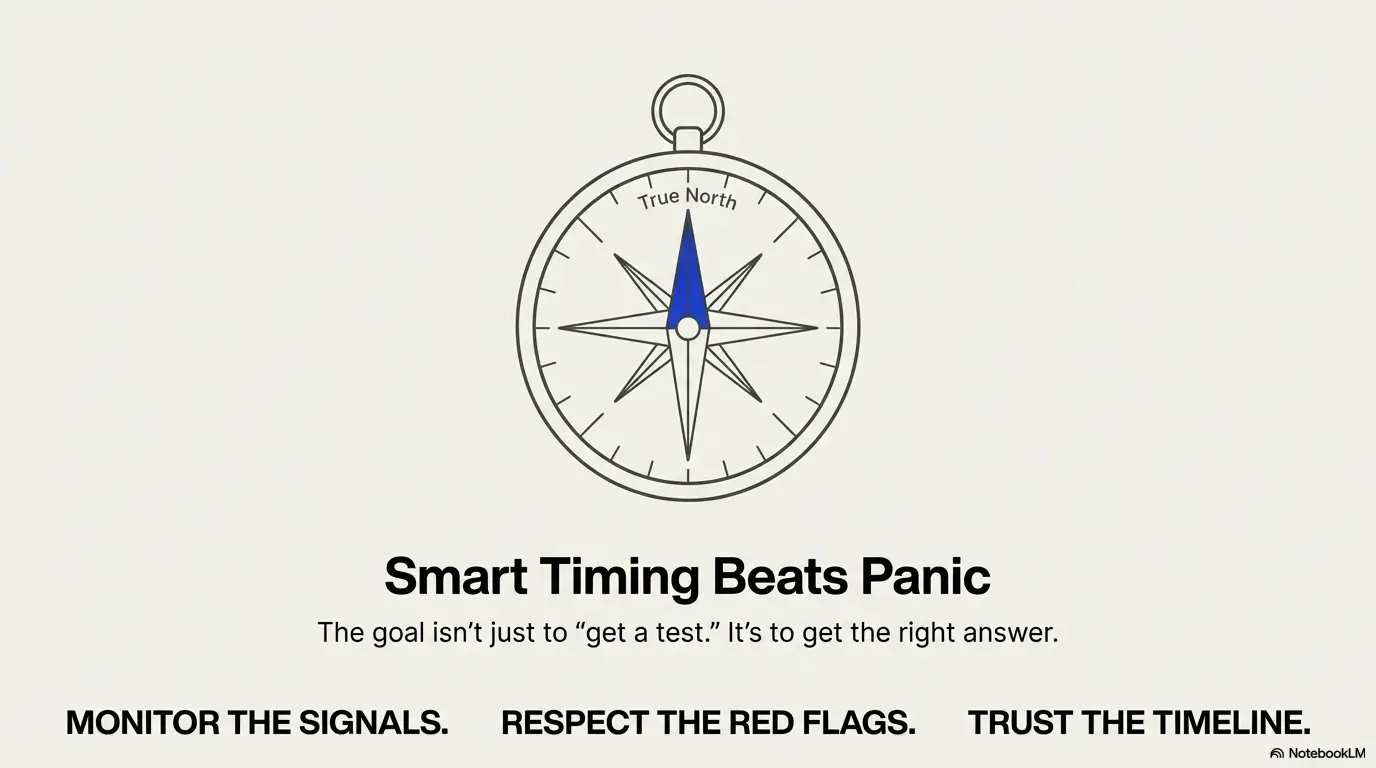
We started with the hallway problem: pain now, clarity later. Here is the loop-closing truth. The right question is not “How fast can I get an EMG?” It is “When will EMG most improve this decision, given my current risk?”
For many stable cases, that answer lands around week 3 or later. For red-flag scenarios, the answer is immediate escalation, not timed testing. If you do one thing in the next 15 minutes, build your one-page EMG timing brief with onset dates, progression, function impact, and red flags. Bring it to your clinician. Better data creates better care, and better care beats panic every time.
Infographic: EMG Timing Compass (Week 0 → Week 8)
Conservative care + red-flag screen + symptom logging.
Gray zone. Reassess urgency and whether early test changes management.
Often stronger EMG decision window in stable cases.
If not improving, escalate plan and reconcile test disagreements.
Override rule: Any new progressive weakness, bowel/bladder change, or saddle anesthesia → urgent/emergency pathway now.
Safety / Disclaimer: This content is educational and not a diagnosis. EMG timing depends on your symptom pattern, neurologic exam, and differential diagnosis. Urgent neurologic changes should never wait for an article timeline. Seek licensed medical care for individualized decisions.
Last reviewed: 2026-02.