

Alignment Before Comfort: The 3:07 A.M. Sciatica Strategy
At 3:07 a.m., the problem usually isn’t “sciatica” in the abstract—it’s a single, boring hinge: your top knee drifting forward and quietly twisting your pelvis for hours.
If you’re a side sleeper experimenting with a weighted blanket, that knee drift is the difference between soothing pressure and a long, trapped spiral. The blanket doesn’t create the issue; it amplifies whatever your hips are already doing—either keeping you stacked and calm, or pinning you in rotation when you most need to reposition. (If you want the bigger picture on side-sleeper sciatica at night, start there and come back.)
Keep guessing and you pay for it in the morning: leg zing, hip bite, and stiffness that steals your first hour. This setup gives you a simple, mechanical framework: knee pillow (not ankle-only), optional back-stop, then blanket last.
The Operator’s Experiment
A three-night A/B test to tell “helps” from “hurts” without turning bedtime into a lifestyle project.
Quick Safety Gates
One variable at a time: focusing on breathing, escape, circulation, and clear stop-signs if symptoms worsen.
Knees first. • Alignment before comfort. • Test—don’t hope.
- Best first move: knee pillow first, weighted blanket last.
- Most common failure: ankle-only pillow (hips still twist).
- Non-negotiable: if breathing feels restricted, abandon the blanket.
Apply in 60 seconds: Put a firm pillow between your knees so your top knee can’t drift forward—then check if your hips feel “stacked,” not spiraled.
Table of Contents
Safety / Disclaimer (read first)
This is educational, not medical advice. Sciatica has multiple causes (disc irritation, stenosis, piriformis-like referral patterns, hip issues pretending to be back issues—bodies are dramatic). A weighted blanket isn’t automatically “bad,” but it can be a problem if it makes you harder to reposition or adds chest pressure. (For the general framework of how to sleep with sciatica, that overview can help you contextualize this specific weighted-blanket experiment.)
- Use extra caution if you have sleep apnea, asthma, COPD, claustrophobia, panic symptoms, rib pain, pregnancy, or any mobility limitation that makes it hard to remove the blanket quickly.
- If you take sedating meds or you’re a very deep sleeper, treat “heavier” as riskier because your brain may not cue you to move when alignment drifts.
- If you have numbness that spreads, new weakness, or symptoms that escalate night-to-night, don’t DIY this into a bigger problem.
Personal note: I once tried to “power through” a new sleep setup because it felt cozy at bedtime. By morning, my hip felt like it filed a formal complaint. Comfort at 10 p.m. isn’t the same as alignment at 6 a.m.
Quick safety gate (30 seconds)
- Breathing check: Can you take a deep breath without feeling pinned? If no, stop.
- Escape check: Can you remove the blanket quickly with one hand? If no, stop.
- Circulation check: Any numbness/tingling increase after you settle in? If yes, stop.
- Yes/No: Can you remove it quickly?
- Yes/No: Can you change positions without strain?
- Yes/No: Does it worsen chest pressure or anxiety?
Apply in 60 seconds: Do the “one-hand peel” test—if you can’t peel the blanket off fast, use a lighter layer or skip it.
When to seek help (don’t power through)
Sleep-position fixes are great for the “my body hates me at night” crowd—until they aren’t. If any of the items below apply, your best move is not a fancier pillow. It’s an evaluation. (If you’re unsure what counts as urgent, bookmark low back pain emergency red flags.)
New neurological signs
- New or worsening weakness (especially ankle/foot), tripping, or foot drop
- Spreading numbness/tingling that doesn’t fade after you’re up and moving
- Pain that escalates in intensity night to night, especially with new areas involved
Emergency red flags
- Loss of bladder/bowel control
- Saddle numbness
- Fever with severe back pain
- Major trauma
“This isn’t just sleep discomfort”
If you can’t find any position that reduces symptoms even briefly, or pain wakes you every hour like a tiny alarm clock with malice, get assessed. There’s a difference between “I slept weird” and “my nervous system is waving a flag.”
Another lived-experience confession: I used to treat every flare like a puzzle I could solve with geometry. Then I met a flare that wanted a clinician, not a diagram. Knowing when to stop is a skill.
Setup logic: Why the knee pillow decides everything
Here’s the core idea: for side sleepers, sciatica often gets worse when the pelvis rotates and the low back twists. The most common cause of that twist is not your blanket. It’s your top leg drifting forward like it has secret plans. (If you want a broader primer on side sleeping with sciatica, it pairs well with this “operator” setup.)
Pelvis-first alignment (the hidden lever)
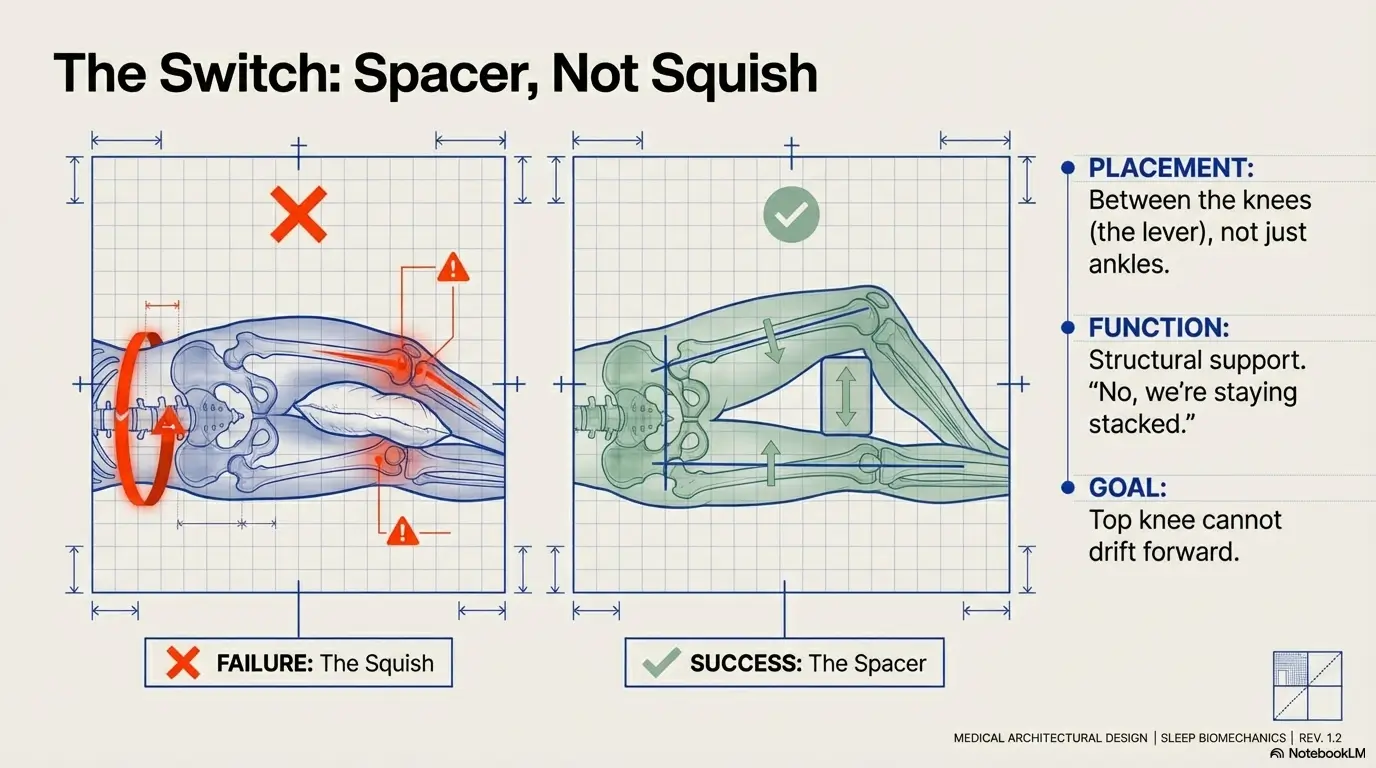
When your top knee falls forward, your femur drags your pelvis with it. That rotation changes what your lower back is doing, and the tissues around the sciatic nerve can get grumpy. A pillow between your knees acts like a spacer that says, “No, we’re staying stacked.”
The weighted blanket “force multiplier”
A weighted blanket can magnify whatever is already happening:
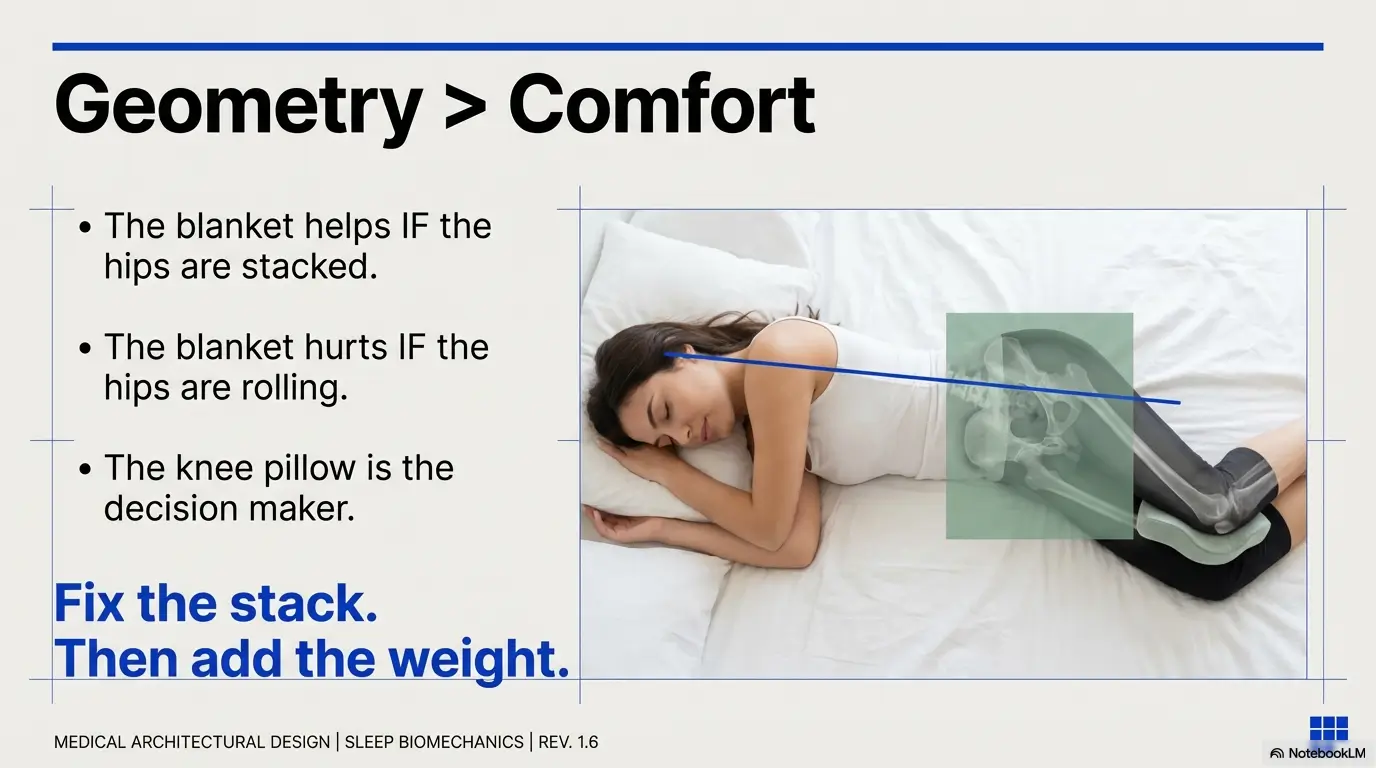
- If your hips are stacked and your spine feels neutral, the blanket may help you stay settled.
- If your hips are rotating, the blanket can make you more stuck in the twist, turning a mild misalignment into a long overnight crank.
Quick principle you can remember at 2 a.m.
- Hips stacked → blanket may help.
- Hips rolling → blanket tends to hurt.
Show me the nerdy details
Think of side-sleeping alignment as a chain: ankle → knee → hip → lumbar spine. When the top knee drops forward, the hip internally rotates and the pelvis follows. That changes lumbar rotation and can increase asymmetric loading. The “knee pillow” works not because it’s magical foam, but because it reduces rotational drift at the hip. In practice, you’re reducing the degrees of freedom your body has to settle into a twist for 6–8 hours.
Small personal anecdote: the first time I used a knee pillow correctly, it felt… underwhelming. No fireworks. Just a weird sense of “nothing is pulling.” That’s the point. Less drama is the win.
Knee-pillow setup: The 60-second build (side sleepers)
Step 1 — Pick the right side (don’t guess)
Many people do better sleeping on the side opposite the pain because it reduces pressure on the irritated side. But bodies vary. Your job is not to be brave; it’s to be observant.
- If lying on the painful side increases tingling/shooting pain quickly, switch sides.
- If lying on the opposite side causes the painful leg to pull forward, you may need a stronger spacer setup (or a partial back-stop).
Step 2 — Place the knee pillow like a “spacer,” not a squish
Put the pillow between your knees, not only between your ankles. Your knees are closer to the hip lever. The goal is simple: your top knee shouldn’t drift forward, and your pelvis shouldn’t roll. (If you’re torn on what style holds up overnight, this knee pillow vs body pillow breakdown can help you pick based on your “failure mode.”)
- Too thin: top leg still falls forward.
- Too squishy: pillow compresses and you lose the spacer effect by midnight.
- Just right: your thighs feel parallel and your hips feel stacked.
Step 3 — Add a “back-stop” if you keep rolling
If you tend to roll forward into a semi-stomach position, wedge a pillow behind your back as a gentle bumper. I call this the “no, we’re not doing that tonight” pillow.
Step 4 — Bring in the weighted blanket last
Once your knee spacer and back-stop are stable, add the blanket. Place it evenly so it doesn’t tug your top hip forward or pull your shoulder into a weird hunch.
Mini calculator: “Start light” blanket range (operator-style, not vibes)
A common rule of thumb for weighted blankets is around 10% of body weight, but sciatica side sleepers often do better starting lighter so repositioning stays easy. This calculator gives a conservative “test range.” It’s not a prescription.
Suggested test range will appear here.
Neutral next step: pick the lowest option in your range for Night 1–2 so your body can move freely while you troubleshoot alignment. If you keep sinking or twisting despite a good knee spacer, your sleep surface may be the bottleneck—see mattress firmness for sciatica (and if you’re using a topper, 2 vs 3 inch mattress topper can change how your pelvis settles overnight).
Weighted blanket choice: Weight, warmth, and the “trap door”
Weighted blankets have three variables that matter for sciatica side sleepers: weight, heat, and how easily you can reposition. People tend to focus on weight only—then wonder why their sleep feels worse even when the blanket feels soothing.
Start lighter than you think
If your goal is pain reduction, you’re not trying to win a “most pressure” contest. You’re trying to keep your nervous system calmer without locking in a twist. Lighter makes it easier to roll your pelvis back into neutral if you drift.
Heat is a variable, not a bonus
Heat can be wonderful—or it can be the thing that makes you restless, sweat, and shift into bad positions all night. If you wake up hot and irritated, you’ll misread the whole experiment. Consider breathable materials, or use the weighted blanket only over your torso and leave legs lighter at first. If you’re also experimenting with warmth as a pain tool, read sleeping with a heating pad for sciatica so you don’t accidentally stack “too much heat + too much weight.”
Here’s what no one tells you…
The blanket isn’t the intervention. The blanket reveals whether your alignment system is stable. If your knee setup is sloppy, the blanket doesn’t fix it—it makes the consequences louder.
- Start lighter for the first 3 nights.
- Keep heat controlled so you don’t fidget into a twist.
- Place it evenly—no heavy edge dragging your top hip forward.
Apply in 60 seconds: If you can’t roll your pelvis back to neutral with one small movement, the blanket is too much for this test.
Tiny lived-experience moment: once I switched from “blanket as a full-body burrito” to “blanket as a calm torso layer,” my hips stopped fighting me. My pride wanted the full cocoon. My back wanted the compromise.
Who this is for / not for
Good fit (likely “helps”)
- Side sleepers whose pain worsens when the top leg collapses forward
- People who already feel better with a pillow between the knees
- Anyone whose main struggle is restlessness + tension more than sharp shooting pain
Not a good fit (higher “hurts” risk)
- Breathing disorders aggravated by pressure (sleep apnea, asthma flares, COPD)
- Claustrophobia/panic symptoms that worsen under weight
- Limited mobility—if you may struggle to remove the blanket quickly
- Active flare with sharp, escalating leg pain where no position gives relief
Decision Card: When A vs B (time/effort trade-off)
- You’re in a flare and need repositioning freedom.
- You wake up twisted or numb.
- You’re testing alignment for the first time.
Time cost: ~60 seconds to set up. Payoff: clearer signal.
- Your hips stay stacked with the pillow.
- Your main issue is restlessness/anxiety at bedtime.
- You can peel the blanket off easily and breathe freely.
Time cost: ~2 minutes to layer right. Payoff: calmer sleep if mechanics hold.
Neutral next step: pick one lane for 3 nights so you’re not “testing” five variables at once.
Another human moment: I used to change three things in one night—new pillow, new blanket, new position—then act shocked when I learned nothing. Your nervous system appreciates scientific manners.
Common mistakes: The 5 ways you accidentally worsen sciatica
Mistake #1 — Ankle pillow only (hips still rotate)
An ankle spacer can help, but if your knees aren’t supported, your thigh can still swing forward and rotate the pelvis. Think “knees first, then ankles if needed.”
Mistake #2 — Knee pillow too thin (your top leg still drifts)
If you wake up with your top knee in front of you like it ran away during the night, your spacer collapsed. Upgrade firmness or height. Squishy fill can feel plush and still fail mechanically.
Mistake #3 — Blanket pulling the top hip forward
This is sneaky: if the blanket edge drapes more heavily over the top hip/thigh, it can encourage forward roll. Even weight distribution matters more than people think.
Mistake #4 — Testing on a bad night, then blaming the setup
If you’re already flared, stressed, dehydrated, or you spent 7 hours in a chair that day, your night will be noisy. That’s why we use a 3-night test.
Mistake #5 — Ignoring breathing comfort
Chest pressure, air hunger, or panic is not a “push through it” situation. Sleep safety wins. Always.
- Support knees (not just ankles).
- Use firmness that survives the whole night.
- Distribute blanket weight evenly.
Apply in 60 seconds: Before sleep, slide your top knee forward 2 inches—if your low back instantly complains, your setup needs more knee spacing. If the pattern keeps repeating, revisit your mattress firmness for sciatica because a too-soft pelvis sink can mimic “bad pillow” symptoms.
“Don’t do this” checklist (printable rules)
If you want a single page of “avoid regret,” this is it. I wish I’d had it the first time I tried to fix sciatica sleep with shopping.
- Don’t start your first trial with the heaviest blanket you own.
- Don’t pin knees together without considering the ankle line—if your knee pillow is thick, add a small ankle spacer so your lower leg isn’t twisted.
- Don’t ignore heat. If you overheat, you’ll fidget into a pretzel.
- Don’t fight panic or breathing discomfort under weight.
- Don’t test five changes in one night and call it “data.”
Let’s be honest… if you wake up twisted like a pretzel, the solution is rarely a fancier blanket. It’s geometry and consistency.
Short Story: The night the “cozy fix” backfired (120–180 words) …
I once bought a weighted blanket after a week of rough sleep, the kind where you’re tired but wired and your hip feels like it’s negotiating rent. The first night was bliss—five minutes in, my shoulders dropped and my brain finally stopped rehearsing tomorrow. I remember thinking, “This is it. I solved it.”
Then I woke up around 4 a.m. with that specific sciatica sensation: not just pain, but a pulling line down the leg that makes you hold your breath. I tried to roll, but the blanket had me pinned in a slightly rotated position, top knee drifting forward, pelvis quietly twisted. It wasn’t dramatic; it was subtle and relentless. The next night I tried again—knee pillow first, lighter blanket second—and everything changed. Same blanket. Different geometry. My body didn’t need more comfort. It needed a better map.
Troubleshooting: If it still hurts, change one thing at a time
If pain is worse down the leg
- Try the opposite side and rebuild the knee spacer setup.
- Reduce blanket weight or remove it entirely for the next 2 nights.
- Check for hip rotation: is your top knee drifting forward by morning?
If hip pain dominates
- Increase knee pillow firmness/height so hips stay stacked.
- Try a small pillow behind your back to prevent rolling forward.
- If the mattress is very soft, consider whether you’re sinking at the pelvis (soft can feel nice and still be mechanically unhelpful).
If you keep rolling forward
Add a back pillow bumper. Not a wall—just enough to discourage the roll. I’ve used everything from a body pillow to a folded duvet. The best “tool” is the one you’ll actually keep using.
If you feel stuck or panicky
Ditch the weighted blanket for now. Keep the knee pillow setup (and back-stop if needed). Reintroduce weight later only if your breathing and mobility checks are solid.
Before you buy anything: the 2-minute “quote-prep” list
- Your usual sleep position drift (do you roll forward, stay stacked, or end up half-stomach?).
- Breathing considerations (snoring, sleep apnea, asthma flares, panic under pressure).
- Your pillow failure mode (too thin, too squishy, too hot, slips away).
- What wakes you: hip pain, leg pain, numbness, overheating, anxiety.
- One measurable goal: fewer wakeups, less morning stiffness, or lower leg pain intensity.
Neutral next step: write those five items in your notes app before you compare knee pillows or blankets.
Small personal anecdote: the only time I “won” quickly was when I wrote down one goal—“wake up without leg zing”—and refused to chase ten other improvements at once. Boring focus is strangely powerful. If mornings are still loud even after a better night, a gentle routine like morning sciatica nerve glides can help you reset without turning your day into rehab theater.
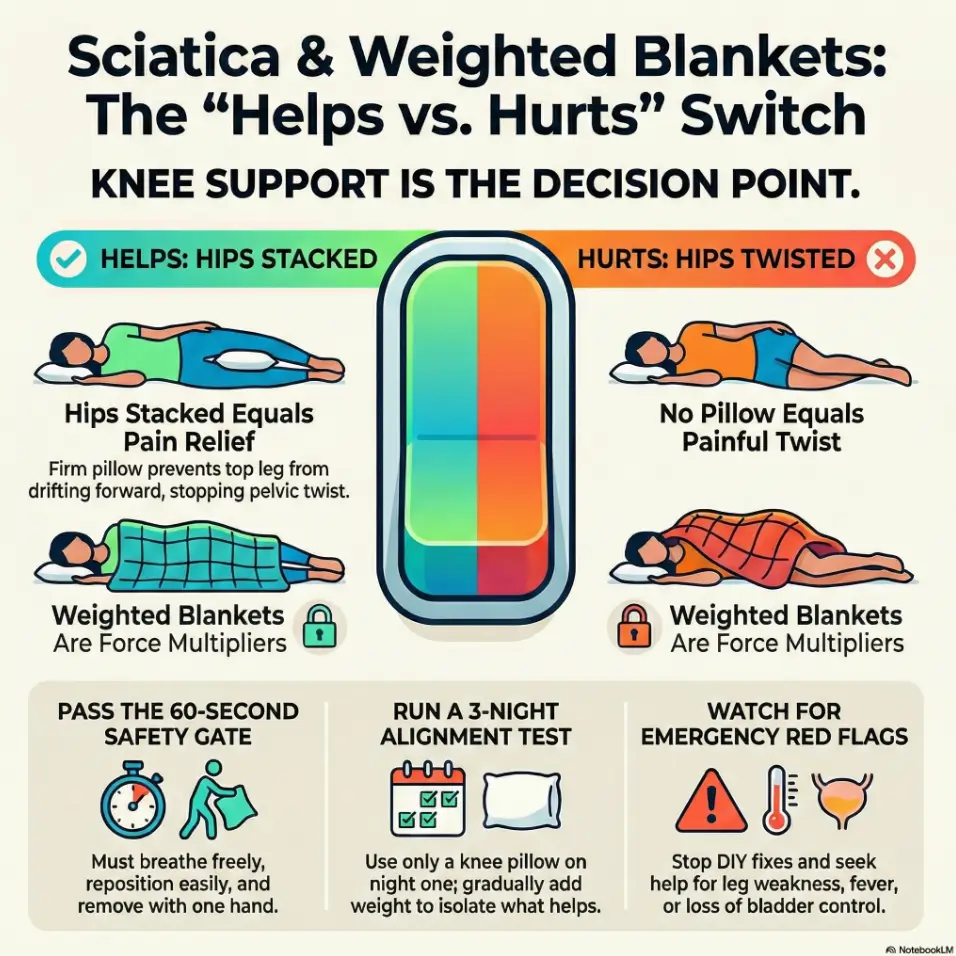
Infographic: The “Helps vs Hurts” Switch (Side Sleeper Edition)
Signal: you can relax without feeling twisted. Repositioning is easy.
Signal: top knee falls forward; you wake up “spiraled.” Blanket can lock this in.
Quick self-check: If your top knee is in front of your body by morning, your pelvis probably rotated overnight.
FAQ
1) Can a weighted blanket make sciatica worse for side sleepers?
Yes—mainly by making it harder to reposition if your hips drift into rotation. If your top knee falls forward and your pelvis twists, the added weight can keep you there longer. The fix is usually not “no blanket forever,” but “knee spacer first, lighter blanket second, and stop if symptoms worsen.” If you want a deeper explanation of what “sciatica” can include (and what it’s not), sciatica nerve pain is a helpful reference point.
2) What’s the best sleeping position for sciatica: painful side or opposite side?
Many people prefer the side opposite the pain to reduce direct pressure on the irritated side. But your best side is the one where you can keep hips stacked and symptoms calm. Test both sides over 2–3 nights with the same knee pillow setup and pick the one with fewer wakeups and less morning stiffness.
3) Does a pillow between the knees actually help nerve pain—or is it just comfort?
It can help because it changes mechanics: it keeps the top leg from dragging the pelvis forward into rotation. That often reduces strain through the low back and hip region. It’s not a cure, and it won’t fix every cause of sciatica, but it’s one of the highest-leverage, lowest-risk experiments for side sleepers.
4) What kind of knee pillow is best: memory foam wedge, cylinder, or regular pillow?
Pick based on whether it stays supportive all night. A regular pillow can work if it’s firm and doesn’t flatten. Memory foam can be great if it holds shape and doesn’t run hot. Cylinders are nice for people who want a consistent spacer. The “best” one is the one that keeps your top knee from drifting forward by morning.
5) How heavy should a weighted blanket be if I have back or hip pain?
Start lighter than the standard rule if your priority is pain and repositioning. The safest approach is a conservative test range and a 3-night trial: knee pillow only first, then add a lighter layer, then try the weighted blanket. If you feel stuck, overheated, or worse down the leg, back off.
6) Should I put the pillow between knees or between thighs for sciatica?
Between the knees is the usual starting point because it directly helps hip alignment. If your knees are supported but your ankles twist, add a small ankle spacer. If your thigh needs more support (for example, if your knee pillow slides), a longer body pillow can help as long as it keeps the knee line stable.
7) Is a weighted blanket safe if I have sleep apnea or asthma?
Extra caution is warranted. If chest pressure, breathing restriction, or anxiety increases, don’t use it. If you have diagnosed sleep apnea, follow your clinician’s guidance and prioritize breathing safety. A lighter blanket or non-weighted calming strategies may be the safer path.
8) Why do I wake up with worse pain after “feeling fine” at bedtime?
Because sleep is long, and small alignment errors accumulate. You can start neutral and slowly drift into rotation or deep sink at the pelvis. By morning, tissues have been loaded asymmetrically for hours. That’s why we care about setups that remain stable, not just what feels nice at the moment you fall asleep.
Next step (one concrete action)
Run the 3-night “alignment A/B test”
This is the part that saves time and money. You’re going to run a tiny experiment instead of “trying stuff” forever.
- Night 1: Knee pillow only (no weighted blanket).
- Night 2: Knee pillow + lighter blanket layer (or partial coverage).
- Night 3: Knee pillow + weighted blanket (full use).
Track just four things (keep it simple):
- Wake-ups (count)
- Leg pain intensity (0–10) on waking
- Hip pain intensity (0–10) on waking
- Morning stiffness duration (minutes)
If Night 3 is worse, the blanket isn’t your “fix.” Either alignment still needs work (knee spacer, back-stop, mattress support) or the blanket’s weight/heat is a bad match for your body right now. And if the real bottleneck is insomnia + pain sensitivity (not just mechanics), you may get more mileage from CBT-I for insomnia with chronic pain than from buying your tenth pillow.
Last lived-experience note: the first time I did this test, I wanted the weighted blanket to be the hero. It wasn’t. The knee pillow was. The blanket was just… honest.
Conclusion
Here’s the loop we opened at the beginning: Does a weighted blanket help sciatica side sleepers—or quietly make things worse? The answer is less about the blanket and more about whether your hips stay stacked through the night. A weighted blanket can be calming, but it can also “lock in” a twist if your top knee drifts forward and your pelvis rotates. If you’re still not sure what you’re dealing with biomechanically, sciatica vs herniated disc can clarify why some “sleep hacks” work for one person and fail for another.
If you do one thing in the next 15 minutes, do this: build the knee spacer setup, add a back-stop if you roll, and run the 3-night test. You’re not chasing perfect sleep. You’re chasing a repeatable setup that makes tomorrow morning easier.
Last reviewed: 2026-01.