

The 2″ vs 3″ Mattress Topper Strategy for Sciatica & Hip Pain
Most topper regret happens in a 10-minute window: the part where “plush” feels heavenly at 10 p.m., then your pelvis quietly rotates for seven hours and you wake up negotiating with your hip.
If you’re a side sleeper with sciatica and hip pain, the choice isn’t really about comfort—it’s about whether you add pressure relief without adding sink that twists your spine. Keep guessing and you don’t just lose money; you lose mornings, return windows, and the small confidence of getting out of bed like a normal person.
Sciatica is pain, tingling, or numbness that travels along the sciatic nerve—often from the low back through the buttock and down the leg. Sleep setups can’t “cure” it, but they can stop aggravating it. (If you want a clear baseline definition first, start with what sciatica nerve pain feels like.)
In this guide, you will find:
- • A no-regret rule (2″ first, 3″ only if…)
- • A 60-second “hammock check” for your mattress
- • A simple alignment + 3-morning symptom map to validate your pick
- • The material logic (memory foam vs latex) that matters more than inches
I’m not guessing from vibes here—I’m using the same tests that keep cozy beds from becoming morning traps.
1. Read this part first.
2. Then do the quick check.
3. Then spend like someone who wants their hips back.
Table of Contents
Fast Answer
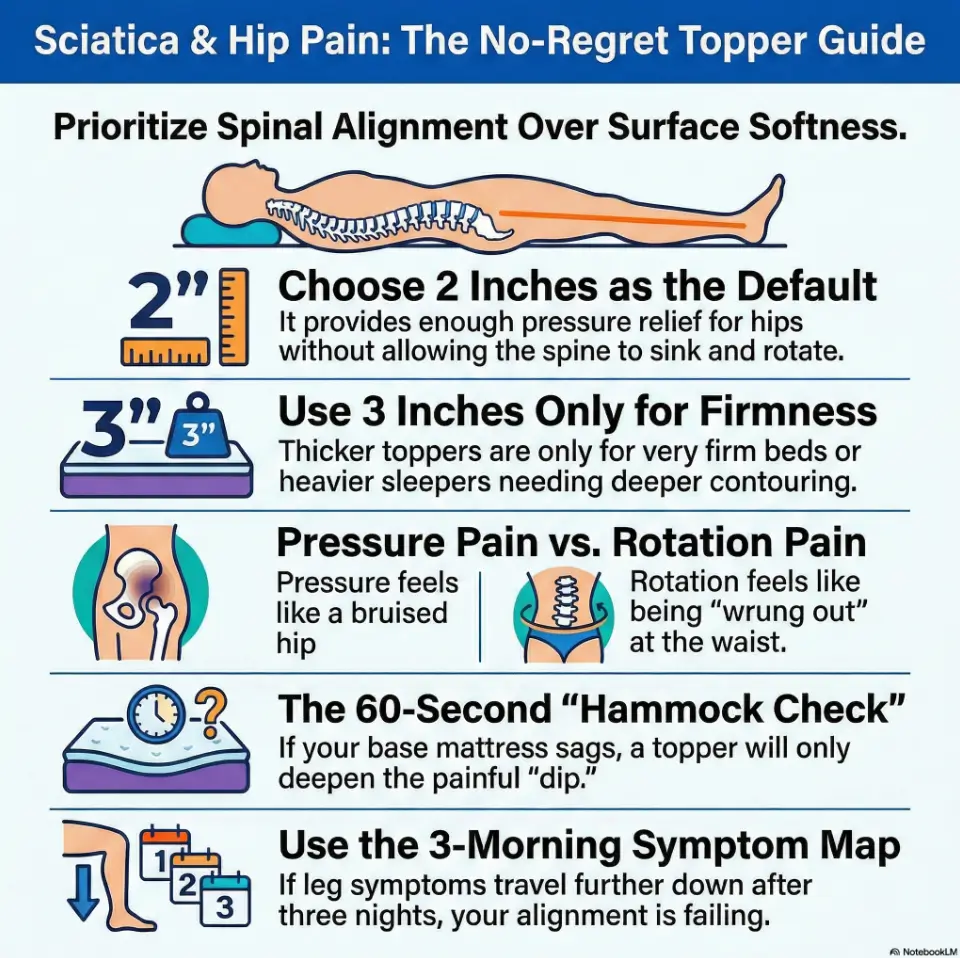
For most side sleepers with sciatica and hip pain, 2 inches is the safer “no-regret” topper: it adds pressure relief without letting your hips sink so far that your spine twists. Choose 3 inches only if you’re heavier, your mattress is too firm, and you can keep alignment (often via medium-firm foam/latex). If your mattress is already soft/sagging, 3″ usually makes sciatica worse. (If nighttime side-sleeping is the core problem, see side sleeper sciatica at night: what actually helps.)
Safety / Disclaimer
This is educational, not medical advice or a diagnosis. “Sciatica” symptoms can come from multiple causes (disc, joint, muscle, inflammation). Stop any change that worsens numbness/weakness, increases radiating pain, or shifts symptoms farther down the leg. If you have severe or progressive symptoms, seek medical evaluation. (If you’re unsure whether your symptoms are urgent, read low back pain emergency red flags.)
- Urgent red flags: new bowel/bladder changes, saddle numbness, progressive weakness, foot drop.
- Play it safe: if a setup change makes symptoms travel farther down the leg over 2–3 mornings, revert immediately.
- Remember: a topper can reduce pressure, but it cannot rebuild a broken support core.
1) Who this is for / not for
Who this is for
- Side sleepers with hip pain + leg symptoms who suspect pressure + alignment are the issue
- People deciding between 2″ vs 3″ (not “which brand”)
- Anyone trying to avoid the wrong-thickness regret purchase
Who this is not for
- Anyone with new weakness, foot drop, bowel/bladder changes, saddle numbness
- Pain from a clearly injured hip joint (sharp groin pain, catching/locking) that worsens with walking
- A mattress that’s visibly sagging or “hammocking” (a topper won’t fix a dip)
Quick personal confession: I’ve tried to “topper my way out” of a tired mattress before. It felt great at 10 p.m. and absolutely betrayed me at 6 a.m. If your base is collapsing, adding more foam is like putting a softer shoe on a sprained ankle and expecting your gait to magically improve.
2) The “no-regret” decision rule (2″ first, 3″ only if…)
Here’s the decision rule that saves the most money: start with the thinnest layer that solves the pressure. For side sleepers with sciatica + hip pain, the trap is thinking “more cushioning = more relief.” Sometimes it’s the opposite: more cushion = more sink = more rotation.
Pick 2 inches if any of these are true
- Your mattress is medium, medium-soft, or already cushy
- You wake with a “twisted pelvis” feeling or low-back tightness
- You’re average-weight or lighter and your hips already sink
- You frequently wake up needing to “re-stack” your body like a misaligned bookshelf
Pick 3 inches only if all of these are true
- Your mattress is too firm (hip pain from pressure points, not sag)
- You’re heavier or have prominent hips/shoulders that need deeper relief
- You can keep spinal alignment (usually medium-firm material, not ultra-plush)
Curiosity gap: the question that decides it
Ask this in plain English: “Is my pain mostly pressure… or rotation?”
Pressure pain feels like bruising at the hip/shoulder. Rotation pain feels like you slept “folded,” and the leg symptoms are louder.
- 2″ = safer alignment for most side sleepers
- 3″ = only for very firm beds + higher body weight + medium-firm feel
- Sagging mattress + 3″ = common sciatica flare recipe
Apply in 60 seconds: Lie on your side and check whether your top knee drifts forward. If it does, you’re already rotating—don’t add more sink.
Money Block: “Am I a 3-inch candidate?” (Yes/No checklist)
- YES if your mattress feels too firm and your hip pain is pressure-based (tender spot on the outside hip).
- YES if you’re heavier and your shoulder/hip feel like they can’t sink enough to keep the spine level.
- NO if your mattress already feels soft, you “roll into a dip,” or you wake up twisted.
- NO if you can see a body-shaped indentation or your bed feels like a gentle hammock.
Neutral next step: If you checked any “NO,” start with 2″ and validate it with the 3-morning symptom map later in this article.
3) The hidden variable: your mattress underneath (the part you can’t out-shop)
Most topper regret isn’t about topper quality. It’s about the base. A topper can change how your body meets the surface. It cannot change whether the support layers underneath are holding your pelvis level. (If you want a quick primer on picking the right baseline, read mattress firmness for sciatica: a practical guide.)
Do the 60-second “hammock check”
- Lie on your side, then roll to your back: do you feel like you’re climbing out of a dip?
- Slide a flat hand under your lower back while lying on your back: is there a huge gap or none at all?
- When you roll, do you feel “stuck” in a groove?
If you answered yes to the dip/groove, a thicker topper often amplifies the problem. You’re adding depth to a hole your body already falls into.
What thickness can’t fix
- Worn support layers, sagging coils, or a soft foam mattress collapsing under hips
- A foundation issue (slats too far apart, center support missing, uneven base)
- Edges that collapse so you subtly curl inward all night
Open loop
If you keep buying softness and your pain keeps moving—what’s actually happening? Often it’s not the nerve “needing cushioning.” It’s your pelvis quietly rotating for 7 hours.
I learned this the hard way: I once tried to “solve” a worn mattress with a thicker topper because the marketing promised cloud-level relief. The cloud arrived. So did the twist. It wasn’t dramatic pain—just the steady, draining ache that makes you dread bedtime.
4) Why sciatica + hip pain hates “too much sink”
Side sleeping is a negotiation between two needs: your hip needs pressure relief, but your spine needs neutral alignment. Too much sink often breaks the second goal to “help” the first. (If you want the broader posture picture, see side sleeping with sciatica: positions that reduce flare-ups.)
The biomechanics in plain English
- Side sleeping loads the greater trochanter (outside hip). If the surface is too firm, it can feel bruised.
- If the surface is too soft (or too thick on a soft base), your top hip can drop and your pelvis can rotate.
- Rotation changes the way your lower back is loaded, and leg symptoms can get louder.
What “better” feels like (target sensations)
- Hip pressure reduced without feeling twisted
- Symptoms “move up” toward the back/hip instead of traveling farther down the leg
- You can roll over without feeling like you’re escaping quicksand
Show me the nerdy details
When the pelvis rotates in side-lying, you often see increased hip adduction and internal rotation on the top leg, plus lumbar side-bending/rotation. That combo can irritate sensitive structures if you’re already dealing with nerve-related symptoms. The goal of a topper choice isn’t “softness.” It’s matching surface compliance to your body so the pelvis stays level while pressure points are buffered.
- Pressure pain improves with cushioning
- Rotation pain improves with stable support
- Thicker isn’t better if it increases sink
Apply in 60 seconds: If you wake up feeling “wrung out,” treat that as an alignment clue—not a softness deficiency.
5) 2″ toppers: the alignment-friendly pressure relief zone
For many side sleepers, 2″ is the sweet spot: enough surface relief to calm the hip, not enough depth to invite the pelvis to fall into a rotated position. This is why 2″ is often the “no-regret” first purchase when you’re dealing with sciatica + hip pain.
Best use-case
- Your mattress support is decent, but your hip feels sore or bruised from pressure.
- You want to soften the surface feel without changing the underlying support geometry.
- You’ve noticed you sleep better on firmer hotel mattresses… until your hip complains.
What to look for (without brand hype)
- A medium to medium-firm feel for side sleepers with sciatica
- Material that rebounds enough that you can reposition
- Enough density to avoid “bottoming out” under your hip
Let’s be honest… you’re not shopping for comfort—you’re shopping for neutral hips
Comfort that twists you is expensive pain. The best-feeling topper at bedtime can be the worst one at sunrise. I’ve had nights where a plush surface felt like a reward—then the morning felt like a bill.
Money Block: Decision Card (When 2″ vs When 3″)
- Your bed is already medium/soft
- You wake up feeling rotated
- You want pressure relief without sink
Trade-off: Might not be enough if your bed is extremely firm.
- Your bed is very firm and creates sharp pressure points
- You’re heavier and need deeper contouring
- You can keep alignment with medium-firm feel
Trade-off: Higher risk of hip drop if the base is soft.
Neutral next step: If you’re torn, buy based on your base mattress first (firm vs soft), not on how sore you feel today.
6) 3″ toppers: when thicker helps—and when it quietly sabotages you
Three inches can be a lifesaver on the right base. It can also be a sciatica multiplier on the wrong one. The difference is not mystical. It’s physics: depth changes how far your hip travels before it hits support.
Best use-case
- Very firm mattress + heavier body + sharp pressure points at hip/shoulder
- You’ve tried 2″ and still feel like your hip is “on the bone”
- You want deeper contouring but can tolerate a medium-firm feel
The sabotage scenario
- A mattress that’s already soft + a 3″ plush topper = spine drift + hip collapse
- You wake up with low-back tightness, glute ache, or leg symptoms louder than bedtime
- You notice you keep pulling your top knee backward in the night—your body trying to de-rotate
Here’s what no one tells you… “plush” is a sciatica multiplier on the wrong base
Thickness is only “better” if the base is supportive. Otherwise, you’ve just added a deeper bowl for your pelvis to fall into.
Another lived moment: I once thought “more cushioning” would be kinder to my irritated leg. Instead, I woke up feeling like my waist had been gently wrung out overnight. The fix wasn’t more softness. It was less sink and a better knee setup. (If knee positioning is the missing piece, start with knee pillow vs body pillow for sciatica: what changes alignment.)
7) Material logic that matters more than inches (memory foam vs latex vs hybrid feel)
Inches are easy to compare. Materials are harder—because two 2″ toppers can behave completely differently. If you only remember one thing from this section, remember this: how a topper rebounds matters as much as how it cushions.
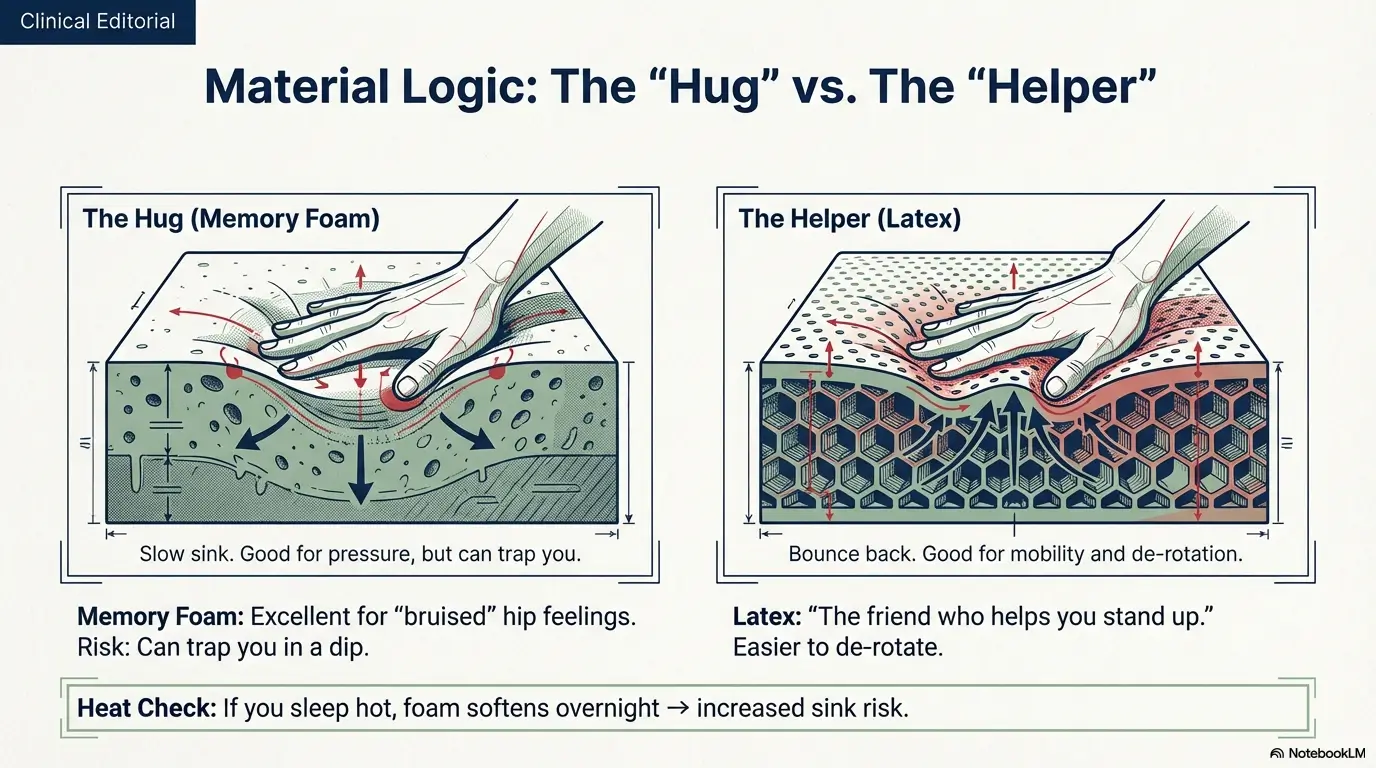
Memory foam (why it’s popular)
- Pros: excellent pressure relief; can calm a hot spot on the outside hip
- Cons: can trap you in a dipped position if too soft; repositioning takes effort
If you’ve ever woken up feeling like you “imprinted” into the bed, that’s the downside. Some bodies love that cradle. Sciatica-sensitive bodies often don’t.
Latex (why some sciatica sleepers prefer it)
- Pros: more bounce; easier to roll; often feels supportive even when plush
- Cons: can feel too springy for people who want slow-melting pressure relief
Latex is the friend who helps you stand up instead of hugging you into the couch. If you wake up stiff, that “helpfulness” can matter.
Hybrid toppers (foam + fiber, or zoned designs)
- Can balance pressure relief with a bit more surface resilience
- Zoning can help some people, but it can also mismatch your body proportions
- If you’re between sizes or have an unusual hip/shoulder ratio, zoning can be unpredictable
A small practical tip from experience: if you tend to run warm or wake up sweating, you’ll tolerate less sink over time. Heat can make softer foams feel even softer through the night—which is not what you want if rotation is your enemy.
Money Block: Mini “Sink Risk” Calculator (3 inputs)
No math heroics—just a quick score to guide your first buy.
- Base mattress: Firm (0) / Medium (1) / Soft or sagging (2)
- Body weight feel: Light/average (1) / Heavier (0)
- Morning twist sign: No (0) / Sometimes (1) / Often (2)
Interpretation: Total 0–1 → 3″ may be worth considering (if medium-firm). Total 2–3 → start with 2″. Total 4–6 → avoid 3″; prioritize base support and alignment accessories first.
Neutral next step: Use the score to pick thickness, then validate with the 3-morning symptom map before the return window closes.
8) The 10-minute at-home test to validate your pick (before the return window becomes your enemy)
The sneaky thing about sciatica and hip pain is that bedtime can lie. You can feel amazing while you’re falling asleep—and still wake up worse. So we test like adults with receipts.
Test A: Alignment photo check (DIY)
Ask a partner to take one photo, or prop your phone on a shelf with a timer. You’re looking for a simple line: ear → shoulder → ribcage → hip. It doesn’t need to be perfect. It just shouldn’t look like a banana.
- If your waist collapses downward: too much sink or not enough support under the pelvis.
- If your shoulder is jammed upward: too firm, not enough surface give.
- If your top leg drifts forward: rotation is happening (fix knee spacing and/or reduce sink).
Test B: Symptom map (3 mornings)
- Track: hip pain (0–10), leg symptoms (0–10), and where symptoms are (hip/glute/thigh/calf/foot).
- “Win” = less hip pressure and symptoms don’t travel farther down the leg.
- If symptoms travel farther down the leg across 2–3 mornings, treat that as a red flag for alignment.
Open loop
If your pain improves at night but rebounds in the morning… what did your sleep posture do while you were “off duty”? (If mornings are the worst window, pair this with morning sciatica nerve glides you can do before you stand.)
A tiny anecdote: I once judged a setup after one night because I woke up sore. Two nights later, it was better—because my body needed a short adjustment window. That’s why “3 mornings” is my minimum. Not because it’s magical. Because it’s enough to notice a trend.
9) Common mistakes (and the expensive myths behind them)
Mistake #1: Buying thickness to fix a sagging mattress
Toppers soften; they don’t restore support. If the center is dipping, 3″ can make the dip feel smoother—while still loading your spine in the same bad shape all night.
Mistake #2: Going plush to “cushion the nerve”
The nerve doesn’t need cushioning—your spine needs less twist. If you’ve ever woken up with symptoms louder after a cozy night, this myth is probably in play.
Mistake #3: Ignoring pillow height and knee spacing
A perfect topper can fail if your top leg collapses forward. If your knee falls toward the mattress, your pelvis rotates. Rotation is the silent thief here. (This is exactly why knee spacing strategies for sciatica matter as much as foam thickness.)
Mistake #4: Testing only at bedtime
Sciatica often “reports” the next morning—judge by morning symptoms. Bedtime comfort is necessary, but not sufficient.
- Support problems don’t disappear under more foam
- Rotation problems don’t improve with plushness
- Your morning symptoms are the real scorecard
Apply in 60 seconds: Before buying, do the hammock check. If you’re climbing out of a dip, fix the base first.
10) Don’t do this: “upgrade” to 3″ because you woke up sore once
Not all soreness is a failure. Sometimes it’s your body adjusting to a new pressure pattern—especially if you’ve been guarding your hip for months. The trick is distinguishing “adaptation soreness” from “alignment warning.”
When soreness is just adaptation
- It fades over 2–5 nights
- Hip spot is a little tender but leg symptoms aren’t traveling farther
- You feel more stable even if it’s not perfect yet
When soreness is a red flag
- Increasing numbness/tingling
- Pain traveling farther down the leg
- New weakness or a “dead” feeling in the foot
A real-world note: if you’re time-poor (most of us), you’ll be tempted to make a call after one night. Don’t. Your nervous system can be dramatic. Give it 3 mornings, then decide like a calm person with data.
11) When to seek help (don’t troubleshoot alone)
Get urgent care now if
- Bowel/bladder changes
- Saddle numbness
- Progressive weakness, foot drop
Make an appointment soon if
- Symptoms persist beyond a couple weeks despite changes
- Pain is severe or sleep is consistently disrupted (if insomnia is becoming the secondary problem, see CBT-I for insomnia with chronic pain)
- You’re relying on constant workarounds just to function (and if you feel yourself spiraling into symptom Googling, cyberchondria with chronic pain is worth reading)
Bring a “sleep setup summary”
- Mattress age/type (foam, hybrid, innerspring)
- Topper thickness/material
- Pillow height and whether you use a knee pillow
- Your 3-morning symptom map
I’ve watched friends walk into appointments with nothing but “it hurts.” The visit goes better when you bring a simple setup summary. It turns guesswork into a real conversation. (If you’re debating next steps, physical therapy for sciatica can help you understand what “good care” often looks like.)
Next step (one concrete action)
Do a 3-morning “symptom map” + one side-lying alignment photo before you buy: if your mattress is supportive but pressure hurts, start with 2″; if your mattress is very firm and you need deeper relief without twisting, consider 3″ medium-firm (not plush). (For a broader sleep setup baseline, you can also read how to sleep with sciatica.)
Rotation → reduce sink + add knee spacing
Money Block: Quote-Prep List (What to check before you buy)
- Return window: Is it truly risk-free, and is return shipping covered?
- Firmness description: Do they label it medium, medium-firm, or plush?
- Material behavior: Does it feel “slow sink” (memory foam) or “springy” (latex)?
- Heat: If you sleep warm, will the topper soften through the night?
- Thickness: If choosing 3″, confirm it’s not marketed as ultra-plush on an already-soft bed.
Neutral next step: Pick one top candidate, then run the 10-minute alignment + 3-morning symptom map before you commit emotionally.

FAQ
1) Is a 2-inch mattress topper enough for sciatica as a side sleeper?
Often, yes—especially if your mattress already has decent support. Two inches is usually enough to reduce hip pressure while keeping your pelvis from dropping too far. If your main issue is “outside hip feels bruised,” 2″ is a strong first bet.
2) When is a 3-inch topper better for hip pain and sciatica?
When the base mattress is very firm and you’re dealing with sharp pressure points—especially if you’re heavier and need deeper contouring. The key is keeping it medium-firm enough to prevent the hip from sinking and rotating the spine.
3) Can a mattress topper make sciatica worse?
Yes. If the topper increases sink on an already-soft or sagging mattress, it can increase pelvic rotation and spinal drift. That’s a common reason people feel better at bedtime but worse in the morning after adding a thicker, plusher layer.
4) Memory foam or latex topper for sciatica—which is better?
It depends on what your body needs. Memory foam often wins for pressure relief but can trap you in a dipped position if too soft. Latex is springier and can make repositioning easier, which some sciatica-sensitive sleepers prefer. If rotation is your enemy, “easy to move” is a real feature, not a luxury.
5) What firmness should a topper be for side sleepers with hip pain?
Many side sleepers with sciatica + hip pain do well with medium to medium-firm. Too firm creates pressure at the hip; too soft creates sink and rotation. If you choose 3″, lean medium-firm even more strongly.
6) How do I know if my mattress is too soft or too firm for sciatica?
Too firm usually shows up as sharp pressure points at the hip/shoulder and frequent position changes. Too soft shows up as waking “twisted,” feeling like you climbed out of a dip, or noticing symptoms travel farther down the leg. The 60-second hammock check is a surprisingly honest test.
7) Should I use a knee pillow with a mattress topper for sciatica?
Many side sleepers benefit from it because it reduces top-leg drift and pelvic rotation. Even a great topper can fail if your top knee collapses forward all night. Think of the knee pillow as alignment insurance. (If you want a straightforward chooser, use knee pillow vs body pillow for sciatica.)
8) How long should I test a topper before returning it?
If symptoms are not worsening, give it 3 mornings minimum and ideally a full week. If you see red-flag changes (more numbness, pain traveling farther down the leg, weakness), don’t “push through”—revert quickly.
9) Does body weight change whether 2″ or 3″ is better?
Yes. Heavier bodies compress materials more, which can make 2″ feel too thin on a very firm mattress—while also making a soft 3″ feel dangerously sinky on a medium-soft bed. Weight isn’t the only factor, but it’s a meaningful one.
10) What if my pain is only in the morning after sleeping?
Morning-only flare often points to sleep posture and sustained positions. That’s when alignment testing matters most: you may need less sink, better knee spacing, or a pillow height adjustment more than you need more thickness.
Conclusion
Let’s close the loop from the beginning: the no-regret pick isn’t “the softest topper.” It’s the one that lets your hip exhale without your spine paying interest. For most side sleepers with sciatica + hip pain, that’s 2 inches. Three inches is a specialized tool: it can help on a truly firm base, especially for heavier sleepers—but it can quietly sabotage you on anything already soft or sagging.
Your best next step takes 15 minutes, not $200: do one side-lying alignment photo, then run a 3-morning symptom map. If the pattern says “pressure,” start 2″. If the pattern says “firm bed + pressure + heavier body,” consider 3″ medium-firm and validate quickly.
Last reviewed: 2026-01.