

Navigating the Recovery Maze
By week 2 after surgery, many knee replacement patients discover an irritating truth: the hardest part is not always the incision. It is the daily math of pain, swelling, stiffness, sleep loss, medication timing, and the nagging fear that one wrong move could set recovery back.
That is what makes pain management after knee replacement in the first month so mentally exhausting. One rough night can feel like failure. One better morning can tempt you into doing too much. Because normal recovery and real warning signs can overlap, guessing gets expensive fast.
“The goal is not to chase zero pain. It is to recover with more control and less chaos.”
This guide helps you sort ordinary post-op pain from patterns that deserve attention, manage swelling before it hijacks your day, and make smarter decisions about walking, icing, exercise, and medication timing.
We focus on the patterns clinicians actually watch:
- ✅ Pain trends and function over time
- ✅ Calf swelling and wound changes
- ✅ Managing the dreaded “night pain”
Some pain is expected. Some pain is a pacing problem. Some pain is your cue to call.
Let’s make those lines easier to see.
Table of Contents
Fast Answer
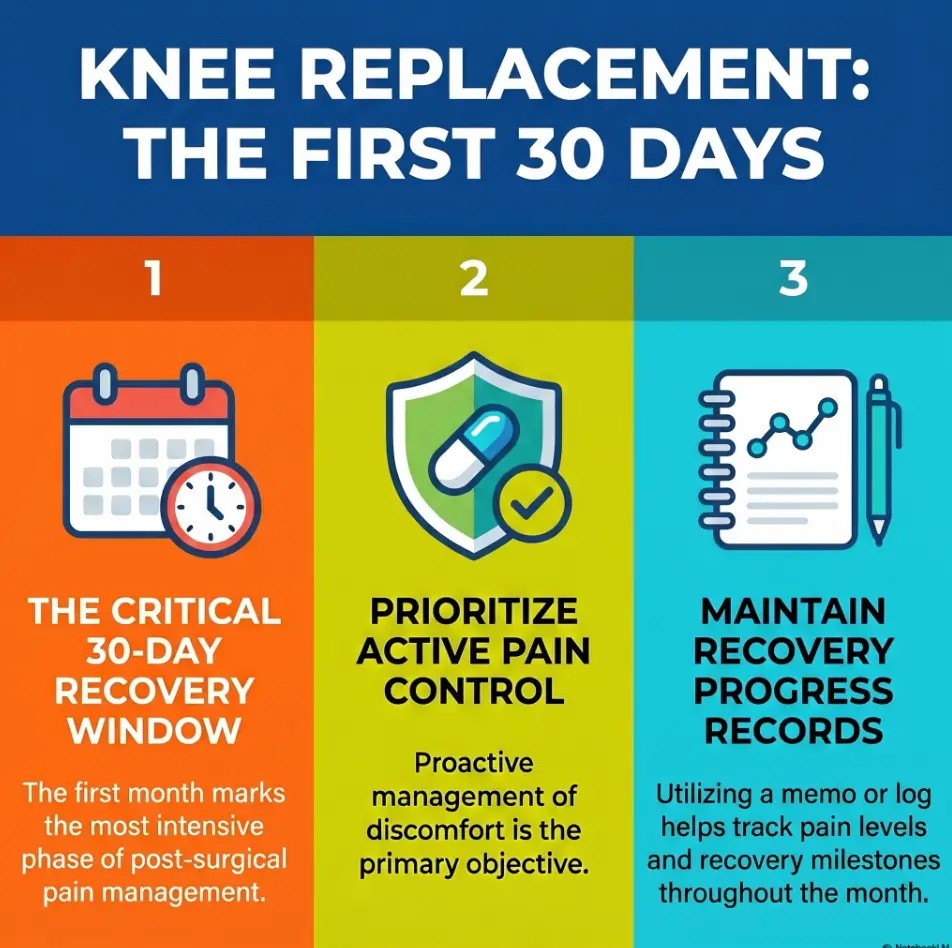
In the first month after knee replacement, pain management usually works best when it does three jobs at once: it lowers swelling, supports safe movement, and keeps pain relief predictable instead of chaotic. Some pain, stiffness, warmth, bruising, and swelling are common in the early weeks. What changes the story is the pattern. If redness is spreading, drainage appears, fever shows up, calf swelling becomes new or severe, or pain rises sharply instead of slowly settling, it is time to contact your surgical team.
- Swelling control often reduces pain more than people expect.
- Routine beats improvisation with meds, walking, and icing.
- Worsening symptoms matter more than one rough afternoon.
Apply in 60 seconds: Write down your current pain level, swelling level, and the last time you moved, iced, and took medicine.
Safety / Disclaimer
This article is for general education only. It is not medical advice, diagnosis, or a substitute for your surgeon’s instructions. Recovery plans can differ by procedure, surgeon, implant type, anesthesia plan, weight-bearing rules, wound closure, and personal risk factors.
Use your own discharge instructions as the home base. If anything in this article conflicts with what your surgeon told you, your surgeon wins. Not philosophically. Not spiritually. Literally.
Chest pain, shortness of breath, worsening wound drainage, fever, new severe calf swelling, or rapidly worsening pain deserve medical attention. CDC patient guidance on blood clots after hospitalization and surgery also highlights limb swelling, pain or tenderness, warmth, and redness as symptoms that should be taken seriously, especially when they are new or getting worse.
First Month Pain After Knee Replacement Feels Different for a Reason
Surgical pain, swelling pain, and exercise soreness are not always the same thing
One reason this month feels confusing is that people use the word pain as if it were one neat box. It is not. Surgical pain often feels raw, deep, and freshly offended. Swelling pain tends to feel tight, pressurized, or band-like, as if the knee has become a suitcase someone overpacked in a hurry. Exercise soreness may show up later, after activity, especially if you pushed range of motion or walked more than usual.
That distinction matters because different patterns respond to different adjustments. A swollen, tight knee may calm down with elevation, icing, and a quieter afternoon. A knee that stiffens because you barely moved all day may need gentle motion instead. A flare after therapy may mean your body needs pacing, not panic.
Why “still hurts” is not the only question that matters
People often ask, “Is it normal that it still hurts?” That question makes sense, but it is incomplete. Better questions are these: Is the pain gradually settling? Does it rise after activity and then ease? Is it paired with increasing redness, drainage, or fever? Is the swelling new, severe, or one-sided in a way that feels different? Does rest help? Does the pattern make sense based on what you did?
I once watched a family member describe every rough evening as proof that recovery had stalled. But when we looked at the day more closely, each bad night had a little parade behind it: extra errands, skipped icing, late medication, and two victory laps around the kitchen because the morning felt surprisingly good. The knee was not betraying them. It was filing a complaint.
The real goal is function with control, not zero pain overnight
The first month is not a contest to see who can be stoic, cheerful, or suspiciously athletic by day 11. The practical goal is function with control. Can you get in and out of bed? Use the bathroom safely? Walk short, appropriate distances? Do your prescribed exercises? Sleep in fragments without feeling like your whole recovery is on fire?
That is progress. Not glamorous progress. Not social-media progress. But real progress.
Show me the nerdy details
AAOS patient guidance notes that moderate to severe swelling can happen in the first days and weeks after joint replacement, with milder swelling sometimes lasting for months. That is one reason early recovery pain is often driven by tissue irritation plus swelling mechanics, not by one single “pain source.”
Who This Is For, and Who It Is Not For
Best for adults managing expected first-month recovery after total or partial knee replacement
This guide is best for adults who are home after knee replacement and trying to understand the ordinary messiness of the first 2 to 4 weeks. It is also useful if your surgeon or therapist has already told you that some pain, stiffness, warmth, and swelling are expected, but you still need a calmer way to think through the daily ups and downs.
Helpful for spouses, adult children, and caregivers watching the day-to-day pattern
Caregivers often see the pattern before the patient does. The patient feels the pain. The caregiver sees that the roughest night came after a busier afternoon, or that the morning was better because the leg was elevated more consistently the day before. If you are the person holding the water bottle, the ice pack, the pill organizer, and everyone’s patience together with dental floss and prayer, this is for you too.
Not for chest pain, shortness of breath, wound drainage, fever, new calf swelling, or rapidly worsening pain
This article is not for emergency judgment calls. If symptoms suggest infection, blood clot, or another complication, do not use an internet article as a waiting room. NHS guidance for knee replacement complications specifically warns about fever, feeling hot or shivery, wound oozing or pus, and worsening redness, tenderness, swelling, or pain.
Eligibility checklist:
- Yes: You are in the first month and trying to manage expected recovery pain at home.
- Yes: You want to understand common patterns like swelling, soreness, stiffness, and sleep disruption.
- No: You have chest pain, shortness of breath, wound drainage, fever, or sudden severe calf swelling.
- No: Your pain is sharply worsening without a clear reason.
Neutral next step: if you checked either “No,” contact your surgeon’s office or seek urgent care guidance now. If you are unsure where that line falls, a quick read on urgent care versus an orthopedic clinic for worsening musculoskeletal symptoms can help frame the decision.
Pain Control Starts Earlier Than the Pain Spike
Why waiting until pain is severe often makes the rest of the day harder
Once pain is already roaring, the whole day becomes harder to steer. You move less, tense more, eat less, drink less, and dread your next exercise session. That is why many postoperative plans work better when pain relief is used as prescribed and on schedule rather than as a heroic last stand after the house is already on fire.
This is not a call to take more medication than prescribed. It is a call to stop treating medication timing like weather. Predictability matters. A planned routine is usually kinder than a dramatic catch-up attempt at 9:40 p.m. after a long, overactive day.
How swelling control quietly changes the pain story
Pain control is not only about pills. In the first month, swelling is often a hidden amplifier. A knee that is more swollen feels tighter. A tighter knee resists bending and straightening. That resistance makes walking and exercise feel more painful. Then the fear of pain makes you move less or move awkwardly, which can increase stiffness. It is an elegant little trap, if by elegant we mean deeply annoying.
That is why elevation, icing, rest breaks, and pacing are not side chores. They are part of pain control. For a broader look at orthopedic pain management strategies that support function without guesswork, it helps to see how this same principle appears across many recovery scenarios.
Let’s be honest… the bad evening is often built in the busy afternoon
Many rough evenings are made long before dinner. A better morning tricks people into folding laundry, chatting standing up, taking an extra loop through the house, then sitting with the leg down for too long. By 7 p.m., the knee feels like a glowing brick.
Try thinking of the day in 2 or 3 blocks instead of one continuous march. Short walks, exercise, food, fluids, rest, and swelling control all need room on the schedule. Recovery is not laziness in compression socks. It is system design.
Mini calculator: Add three numbers from the last 24 hours.
- Hours with the leg hanging down
- Number of icing sessions
- Number of unplanned extra activity bursts
If the first number is high and the last number is more than 1, your pain may be partly a pacing problem, not just a medication problem.
Neutral next step: reduce one activity burst tomorrow and compare your evening pain.
Swelling Management Is Often the Missing Half of Pain Management
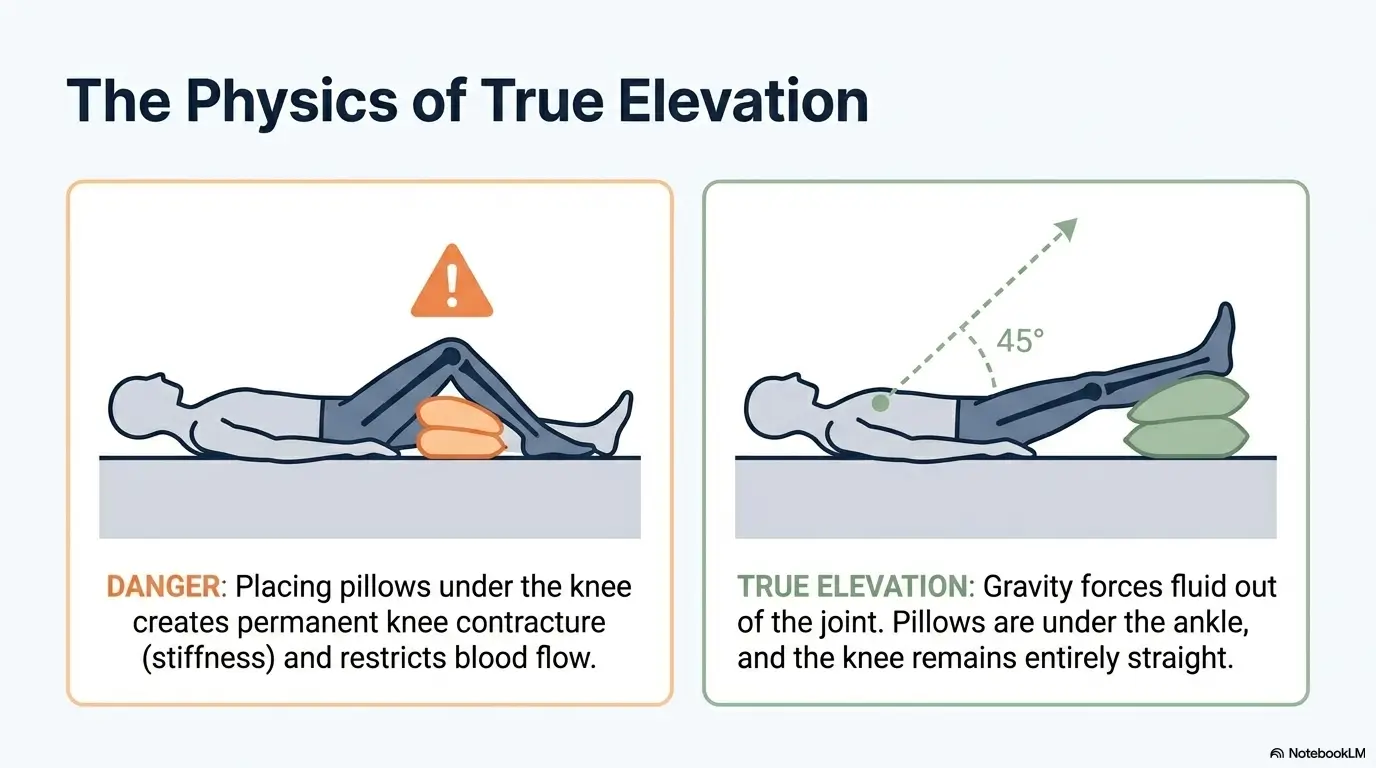
Elevation, icing, and rest are not “extra,” they are part of the plan
AAOS patient education notes that moderate to severe swelling is common in the first few days and weeks after joint replacement. That matters because people often treat icing and elevation like optional bonus rounds, something to do only if there is time left after life happens. In reality, life happening is exactly why they matter.
When swelling is controlled, movement usually feels less punishing. The knee bends more willingly. Sleep may be a little less fractured. The whole day stops feeling quite so combative. That does not mean one ice session fixes everything. It means repeated, boring, faithful swelling management often does more than people give it credit for.
Why the knee can feel tighter before it feels stronger
Strength comes slowly. Swelling shows up fast. That mismatch can be demoralizing. You may be doing the right exercises and still feel tighter than expected, especially later in the day. This is one reason people assume therapy is hurting them or that recovery is reversing when it may simply be reacting.
I remember one patient saying, “Every afternoon it feels like my knee got smaller and my leg got bigger.” That was not textbook language, but it was perfect. Tightness is often the body’s way of reporting swelling, fatigue, and recent workload all at once.
When swelling is expected, and when it starts to look less ordinary
Expected swelling usually fits the story of recovery. It is worse after activity, better with rest and elevation, and gradually trends down over time even if the line is wobbly. Less ordinary swelling is new, severe, rapidly increasing, or paired with red-flag symptoms such as calf tenderness, unusual warmth, spreading redness, wound drainage, or shortness of breath.
CDC blood clot guidance reminds patients that swelling, pain or tenderness, warmth, and redness in a limb can be warning signs. The point is not to become frightened by every warm knee. Early warmth can happen. The point is to respect changes that are new, asymmetrical, intense, or worsening.
- Swelling can increase pain, stiffness, and exercise difficulty.
- Expected swelling usually responds to rest, elevation, and icing.
- New severe swelling or swelling with calf symptoms needs prompt medical review.
Apply in 60 seconds: Compare how your knee looks and feels before and 30 to 60 minutes after elevation and icing.
Movement Matters, but the “More Is Better” Rule Breaks Here
Gentle repetition helps recovery more than heroic effort
After knee replacement, movement matters. Circulation matters. Walking matters. Your home exercises matter. But this is not the month to audition for a motivational poster. In early recovery, gentle repetition usually beats occasional acts of bravery. A modest walk done regularly is often more useful than one ambitious walk that leaves you swollen, angry, and negotiating with the furniture by nightfall.
Think “frequent and tolerable” more than “impressive and memorable.” The knee is learning again. So is the rest of you.
Why pain after exercise can mean “adjust,” not always “stop”
Some soreness after exercise or therapy can happen. That alone does not prove harm. The real question is whether the response is proportionate and temporary. Does the pain settle with rest, icing, and time? Or does the knee become hotter, more swollen, less usable, and worse the next day?
A useful mental model is this: a mild to moderate flare that settles may suggest adjustment. A flare that spirals may suggest overdoing it or missing something important. There is a great difference between “my knee complained” and “my knee filed an appeal.”
Here’s what no one tells you… overdoing rehab can look productive right before it backfires
One of the sneakiest traps in recovery is that overactivity often wears the costume of discipline. You feel determined. You do extra repetitions. You take stairs one too many times because you want to be independent. Then the next 12 hours are paid for in swelling and stiffness.
That does not mean you should fear movement. It means the first month rewards dosage, not drama. If you are thinking ahead about the bigger rehab arc, choosing the right rehab setup after surgery can matter just as much as what happens inside one hard afternoon.
Decision card:
When to adjust, not quit: Your pain rises after exercise but settles with rest, icing, and time, and your function is not clearly worse the next day.
When to call for advice: Your pain is increasing with both activity and rest, swelling is climbing, the knee is becoming redder or hotter, or you are losing function instead of slowly gaining it.
Neutral next step: write down which exercise or activity happened before the flare so your PT or surgeon can assess the pattern.
Common Mistakes That Make First-Month Knee Pain Harder to Manage
Skipping movement until stiffness takes over
There is a version of “rest” that helps healing, and there is a version that quietly feeds stiffness. Spending long stretches avoiding all motion because you are afraid of pain can make the next walk, transfer, or exercise session feel much worse. The result is a nasty loop: you avoid movement because it hurts, then it hurts more because you avoided movement.
Doing too much on a “good day” and paying for it the next morning
This may be the most common early recovery mistake. The knee feels slightly better. Spirits rise. You stand longer, walk more, and do one extra thing because you finally can. Then the next morning feels like a betrayal. It is not. It is an invoice.
Anecdotally, many people discover that a “good day” is not permission to do everything. It is permission to do the same basics a little more comfortably.
Treating swelling like a side issue instead of a pain trigger
People will sometimes say, “The pain is bad, but the swelling is just swelling.” In the first month, that is often exactly backwards. Swelling is frequently one of the engines driving the pain experience. Ignore it, and you may spend the week arguing with a problem you accidentally fed.
Comparing your timeline to someone else’s recovery story
Neighbor stories are the glitter of orthopedic recovery. They get everywhere and are rarely helpful. One person says they walked beautifully at 2 weeks. Another says they threw away the walker in 5 days. Another says they never needed much pain medicine at all. Congratulations to them, their anatomy, their surgical details, their pain thresholds, and possibly their selective memory.
Your useful comparison is not another person’s highlight reel. It is your own trend over several days.
- Too little movement can increase stiffness.
- Too much activity can drive swelling and pain spikes.
- Your trend matters more than somebody else’s timeline.
Apply in 60 seconds: Identify one habit today that is either too much or too little, and adjust only that one thing tomorrow.
Do Not Ignore These Pain Patterns in the First Month
Pain that is getting sharper, hotter, redder, or more constant
Some warmth can be expected early after surgery. Some discomfort can linger. But a pattern that is getting sharper, hotter, redder, or steadily more constant deserves attention. The NHS warns that worsening redness, tenderness, swelling, or pain after knee replacement can be signs of complications such as infection or a clot.
Trust direction, not just intensity. A rough but explainable day after therapy is different from a knee that is becoming progressively angrier for no clear reason.
New calf swelling, wound drainage, or pain that rises with rest and activity
New calf swelling or calf pain matters because postsurgical blood clots are one of the complications clinicians work hard not to miss. CDC blood clot education describes swelling, tenderness, warmth, and redness as symptoms that should prompt evaluation. Wound drainage also matters. Early healing is messy enough without trying to philosophize your way around fluid coming from an incision.
Why “I thought this was normal” can become an expensive delay
Many delayed calls begin with one innocent sentence: “I thought this was normal.” That is understandable. The knee is warm, swollen, bruised, sore, and occasionally theatrical. But worsening wound redness, fever, new drainage, severe calf symptoms, chest pain, or shortness of breath belong in the category of “call now,” not “monitor quietly until Monday.”
Short Story: A man in his late 60s once told me he almost did not call because he did not want to seem dramatic. He had convinced himself that the extra calf tightness was probably just from walking more confidently that morning. By evening, the leg looked more swollen and felt oddly tender in a new way.
His daughter noticed he kept rubbing the same spot and finally called the surgical office herself. It turned out not to be a catastrophe, but the surgeon’s team was grateful they did not sit on it. What stays with me is not the diagnosis. It is the emotional math. People often hesitate because they do not want to be difficult, needy, or wrong. But in early recovery, a timely call is not weakness. It is part of the plan.
Symptom tier map:
- Tier 1: Expected soreness, stiffness, warmth, and swelling that gradually settle.
- Tier 2: Temporary flares after activity that improve with rest, elevation, or icing.
- Tier 3: Repeated flares that disrupt your plan and need review with PT or the surgeon’s office.
- Tier 4: Worsening redness, wound concerns, increasing pain at rest and with activity, or new severe swelling.
- Tier 5: Chest pain, shortness of breath, major drainage, fever, or urgent clot concerns.
Neutral next step: if you are in Tier 4 or 5, stop self-negotiating and contact medical care.
Medication Questions Belong Inside the Real Recovery Routine
Timing, consistency, and side effects matter more than bravado
Medication questions are often framed as a moral drama. Should I be tougher? Should I need less? Am I taking too much if I am following the plan? This is not useful. The better question is whether the medication routine is supporting safe movement, rest, and healing without causing side effects that make the whole day unravel.
AAOS notes that orthopaedic pain medication plans may involve more than one type of medication, and the goal is pain control that supports function. In real life, that means timing, consistency, and attention to side effects matter more than bravado.
Why constipation, grogginess, and poor sleep can quietly worsen pain coping
Pain is not just a number in the knee. It is also your sleep quality, your bowel routine, your appetite, your hydration, your energy, and whether you feel foggy or steady enough to follow the plan. Constipation can make people miserable. Grogginess can increase fall risk. Poor sleep can make normal soreness feel huge at 2:17 a.m. when the room is silent and your optimism has gone to live somewhere else.
This is one reason medication changes should be discussed with your care team instead of improvised alone. Relief that wrecks function is not the same as a working plan. If affordability is affecting adherence, articles on orthopedic pain management with a high deductible may help patients prepare better questions for the next call.
What to ask your surgeon or care team before changing anything on your own
Before making changes, ask practical questions. What is the intended schedule? Which side effects deserve a call? What should you do if pain relief is not lasting long enough to complete your prescribed exercises? What bowel support is recommended? When should sleep disruption or nausea prompt an adjustment? Which over-the-counter medications are acceptable with your current plan?
The right question is not “What did the internet say?” The right question is “Here is my pattern. What would you like me to change?”
Medication check-in list:
- Times you took each medication in the last 48 hours
- When pain tends to spike
- Any constipation, nausea, dizziness, or grogginess
- How medication timing affects walking, exercises, and sleep
Neutral next step: bring this list to your next call so the team can adjust the routine based on a real pattern.
Night Pain, Morning Stiffness, and the Emotional Dip Nobody Prepares For
Why sleep disruption can make pain feel louder than it is
Night pain can feel especially intense because everything else has gone quiet. There is no daytime distraction, no physical therapy appointment to organize your focus, no errand to interrupt the narrative. It is just you, the sheets, the clock, and a knee with opinions.
Sleep loss changes how pain is experienced. A soreness you could tolerate at noon may feel larger and meaner at midnight. That does not mean you are imagining it. It means pain and sleep are old sparring partners.
Morning tightness versus all-day worsening pain
Morning stiffness can be common after a night of relative stillness. The key is whether it loosens with gentle movement and your usual routine or whether the pain is becoming worse all day long regardless of what you do. A knee that is stiff but improves once the day gets moving tells a different story from a knee that is unravelling across morning, afternoon, and night.
The first month is physical, but it also plays tricks on morale
The emotional dip is real. Around weeks 2 to 4, many people feel confused because the initial crisis has passed, but the body is still very much in recovery. Expectations rise faster than capacity. Friends may assume you are “doing great” because the surgery is over. Meanwhile, you are awake at 3 a.m. bargaining with an ice pack.
I have seen more than one strong, practical adult cry over how slowly a sock goes on. Recovery is intimate that way. It takes a person who ran households, teams, or businesses and makes them celebrate a well-executed chair transfer. There is no shame in finding that humbling.
- Sleep disruption can magnify pain perception.
- Morning stiffness can be expected if it improves with movement.
- All-day worsening pain deserves more caution.
Apply in 60 seconds: Note whether your toughest pain is tied to time of day, activity, or swelling.
Week-by-Week Thinking Works Better Than Hour-by-Hour Panic
Week 1 often feels raw, swollen, and highly managed
Week 1 is usually the most obviously surgical. Pain control is more structured. Swelling is loud. The knee feels alien. Getting up, sitting down, toileting, dressing, and sleeping can all feel strangely technical. This is often the week when routines matter more than confidence.
Weeks 2 to 3 may bring better mobility but uneven pain swings
By weeks 2 and 3, some things may improve. Transfers may be easier. Walking can feel less frightening. You may begin to believe you understand the rhythm. Then one overactive day or one aggressive therapy session reminds you that the knee is still very early in the story. This is where people get mentally tripped up. Improvement is real, but it is rarely smooth.
A pattern with more mobility and uneven pain swings is often more common than a simple, glorious daily decline in symptoms. Recovery is not a harp glissando. It is more like a thoughtful drummer with occasional terrible timing.
Week 4 can feel confusing because progress and frustration often arrive together
By week 4, many people expect to feel almost normal. That expectation causes needless distress. In truth, week 4 can be where progress and frustration sit at the same table. You may walk better but still swell by evening. You may bend more but still hate the night. You may need less help but still feel far from yourself.
Use a week-by-week lens. Look at function, swelling, sleep, and pain trend across several days, not one alarming hour.
Infographic: What the first month often looks like
Week 1
High swelling, raw soreness, tight routine, lots of help.
Weeks 2–3
More movement, uneven flares, confidence rises faster than tissue calm.
Week 4
Better function for many people, but swelling and stiffness can still be stubborn.
Rule of thumb: judge the trend over several days, not one rough evening.
When to Seek Help Instead of Trying to Push Through
Fever, chills, drainage, or increasing redness around the wound
If you have fever, chills, drainage, or increasing redness around the wound, contact your surgical team promptly. Infection after joint replacement is uncommon, but AAOS notes it is a real complication and not something patients should try to self-classify by reading symptoms into submission.
New or severe swelling that raises concern for a blood clot
New severe swelling, especially when paired with calf tenderness, warmth, or redness, should be treated seriously. CDC patient materials emphasize that blood clot symptoms can include swelling, pain or tenderness, warmth, and redness. The exact diagnosis is not your job at home. Recognizing that the pattern is concerning is enough.
Increasing pain with both activity and rest, especially if the pattern is worsening
Pain that worsens with activity may reflect overdoing it. Pain that worsens with both activity and rest, especially if it keeps trending the wrong way, deserves more caution. That kind of pattern may signal that the issue is no longer just an ordinary recovery flare.
Trouble following your home plan because pain control is failing
If you cannot walk the necessary short distances, do basic transfers safely, or complete your prescribed home plan because pain control is failing, tell your team. Waiting until the next scheduled appointment may turn a manageable adjustment into a larger setback. In some cases, the faster question is whether telehealth or an in-person orthopedic visit makes more sense for the symptom pattern you are having.
FAQ
Is pain worse at night in the first month after knee replacement?
It can be. Night pain often feels louder because swelling from the day has built up, you are more fatigued, and there are fewer distractions. Night pain alone does not always mean something is wrong, but a worsening overall pattern still deserves attention.
How much swelling is normal after knee replacement?
Some swelling is common early on, and AAOS notes that swelling can remain noticeable for weeks and sometimes longer. What matters is whether the swelling fits the recovery story and improves with rest, elevation, and icing. New severe swelling, especially with calf symptoms, needs prompt medical review.
Should I walk more if my knee feels stiff?
Sometimes gentle movement helps stiffness, but “more” is not automatically better. Short, appropriate walks and prescribed exercises usually work better than one big effort. If walking more predictably increases swelling and leaves you worse by night or the next day, you may be overdoing it.
Is it normal for the knee to feel warm?
Early warmth can happen after surgery. The more important question is whether the warmth is stable and expected or whether it is increasing along with redness, drainage, fever, or worsening pain. Those combined symptoms deserve medical attention.
Why does pain get worse after physical therapy sometimes?
Therapy can temporarily increase soreness because tissues are being challenged. A mild temporary flare that settles can happen. A worsening flare with more swelling, less function, and poor recovery between sessions may mean the workload or timing needs adjustment. If insurance details are part of the hesitation around continuing therapy, understanding how Medicare Part B handles physical therapy can make the next conversation less foggy.
When should I worry about calf pain or swelling?
Take calf pain or swelling seriously when it is new, clearly increasing, one-sided in a concerning way, or paired with warmth, redness, or tenderness. Because blood clots can happen after surgery, it is better to call than to guess.
Can too much activity increase knee replacement pain?
Yes. In the first month, overactivity often shows up as more swelling, tighter movement, worse evening pain, and a rougher next morning. Recovery usually responds better to consistent moderate activity than occasional bursts of ambition.
What symptoms mean I should call my surgeon the same day?
Same-day contact is wise for worsening wound redness, drainage, fever, chills, new severe swelling, calf pain with swelling, pain that is increasingly severe at rest and with activity, or inability to follow your home recovery plan because pain control is failing.
Next Step: Build a Simple 24-Hour Pain-and-Swelling Log
Track meds, walking, exercises, icing, swelling, sleep, and pain spikes for three days
The most useful next step for many patients is not another random internet search. It is a simple 24-hour log. Track when you took medication, when you walked, when you exercised, when you iced, how swollen the knee felt, how well you slept, and when the pain spiked. Do this for 3 days.
Patterns emerge quickly. You may find that pain is worst 2 hours after a certain activity, or that evenings are harder when icing was skipped, or that sleep falls apart on days when medication timing drifted. This is much more useful than saying, “It just hurts a lot.”
Bring the pattern, not just the pain score, to your next PT or surgeon check-in
Clinicians can do much more with a pattern than with a single number. A pain score has value, but a pattern has context. It tells them what may be driving the problem and whether the answer is pacing, swelling control, exercise adjustment, wound review, medication timing, or urgent evaluation.
One clear log often reveals whether the problem is timing, overactivity, swelling, or a red-flag change
This is the quiet magic of a log. It turns a foggy experience into something visible. It also lowers anxiety because you are no longer trying to remember recovery with a sleep-deprived brain at the exact moment you are talking to the nurse line. If you end up needing escalation, it also gives you stronger language for later steps such as an appeal after a denied second opinion for orthopedic pain or a request for MRI referral support for orthopedic pain.
- Track timing, not just pain intensity.
- Use 3 days of notes if possible.
- Bring the pattern to PT or the surgeon’s office.
Apply in 60 seconds: Open a note on your phone or grab paper and create six columns: meds, walk, exercise, ice, swelling, pain.
Last reviewed: 2026-04.
Conclusion
The first month after knee replacement feels hard not only because the knee hurts, but because the signals are mixed. Some pain is expected. Some swelling is expected. Some warmth, stiffness, and sleep disruption are expected. What matters most is the direction of the pattern.
That closes the loop from the beginning: the month feels crowded because many sensations are happening at once, but they are not all saying the same thing. Your job is not to decode every sensation perfectly. Your job is to notice what helps, what predictably backfires, and what is getting worse in a way that deserves a call.
In the next 15 minutes, do one practical thing: build a 24-hour pain-and-swelling log, set out your icing supplies, and write down the phone number for your surgeon’s office somewhere easy to reach. Recovery usually goes better when the plan is visible before the next rough evening arrives.