
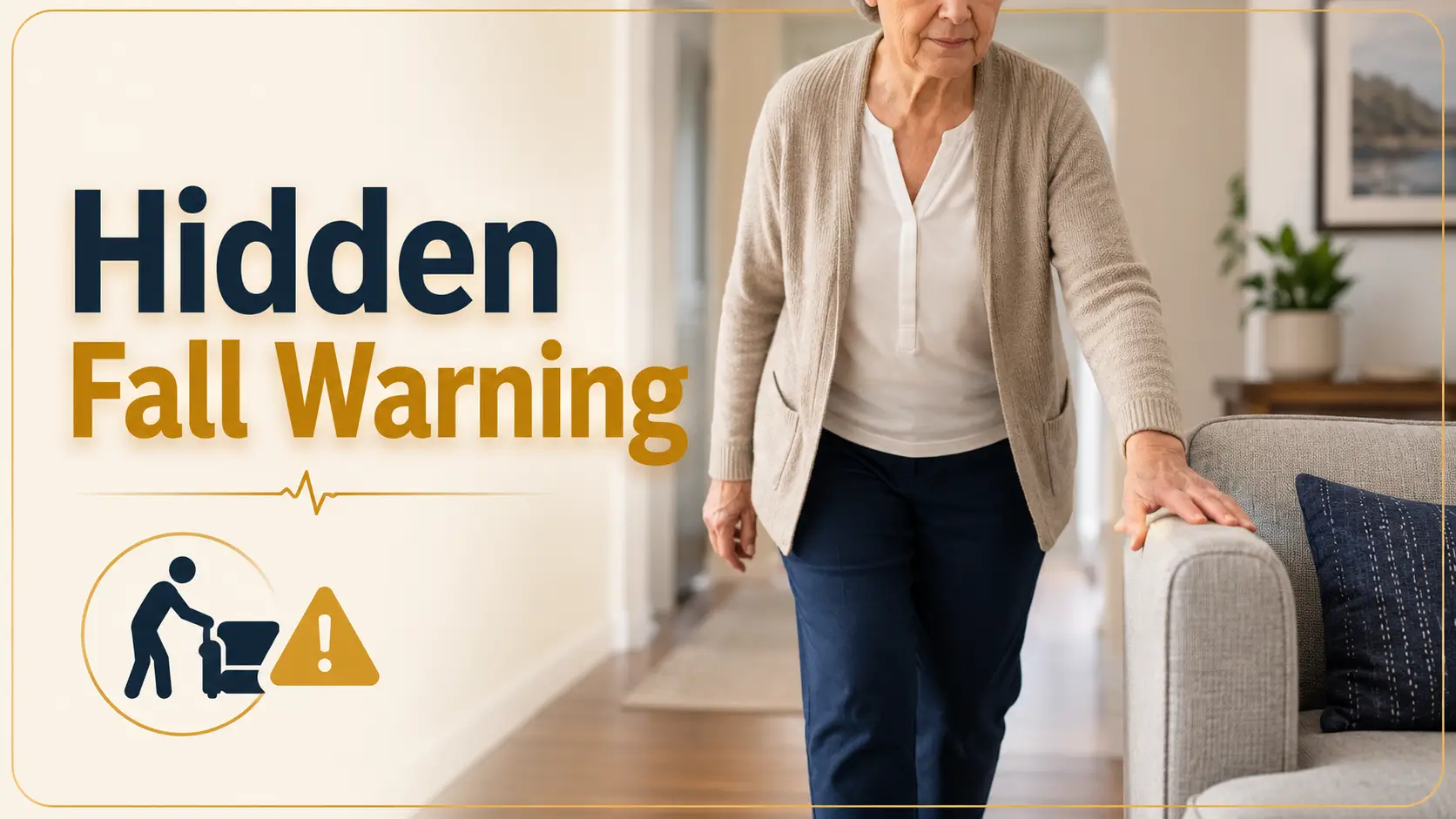
Fall-risk clue hiding in plain sight
Why Reaching for Furniture Is a Warning Sign
Before a Fall
A hand on the kitchen counter. A quick touch against the hallway wall. A palm sliding along the back of the sofa on the way to the bathroom. These tiny gestures can look like ordinary caution, especially in a familiar home. But sometimes the hand is sending a message before the person is ready to say it out loud: walking does not feel fully trustworthy anymore.
Reaching for furniture while walking, turning, or standing up can point to balance changes, leg weakness, dizziness, vision trouble, medication side effects, pain, neuropathy, fear of falling, or a home layout that quietly asks the body to perform circus tricks before breakfast. The goal is not to panic. The goal is to notice the pattern early enough to prevent the frightening version of the story.
This guide turns “furniture walking” into something useful: a calm signal, a room-by-room audit, and a practical conversation starter for older adults, caregivers, adult children, and anyone who has begun wondering why the path from bed to bathroom suddenly feels longer at night.
Spot the pattern
Learn when a “quick grab” is a one-off and when it may be a repeat fall-risk clue.
Fix the room
Find the lighting, rugs, cords, chairs, and bathroom risks that turn small wobbles into big problems.
Know when to call
Separate home-safety fixes from symptoms that need a doctor, pharmacist, eye doctor, PT, or urgent care.
✨ The quiet reach is not a character flaw. It is data from the body, and it deserves to be read carefully.
Snapshot
This article is for older adults, caregivers, and adult children who have noticed furniture grabbing, wall touching, or “almost falls” at home. You will learn what the behavior may signal, what to check first, what not to ignore, and how to replace risky accidental supports with safer, more reliable fall-prevention steps.
Table of Contents
Safety / Disclaimer: When Balance Changes Need Respect
This article is educational and should not diagnose a medical condition. Reaching for furniture can come from something simple, such as poor lighting or a slippery rug, but it can also be connected to medical, medication, vision, neurological, cardiovascular, or mobility issues.
Sudden balance changes, new weakness, fainting, severe dizziness, chest pain, confusion, one-sided numbness, trouble speaking, new severe headache, repeated falls, or an injury after a fall need urgent medical attention. Do not turn those symptoms into a weekend project with a tape measure and a cheerful shopping cart. That is the moment to get real help.
For ongoing furniture grabbing, the right next step may include a primary care visit, medication review, physical therapy evaluation, occupational therapy home safety assessment, eye exam, or assistive-device fitting. The safest plan usually has two lanes: check the person and check the home.
Key takeaway
Treat new or frequent furniture reaching as a fall-risk clue, not a personal quirk. Fix obvious hazards, but do not use home changes as a substitute for medical evaluation when symptoms are new, worsening, or paired with dizziness, weakness, fainting, confusion, or repeated near-falls.
Why this guide stays practical without pretending to be your clinician
Balance is not one single switch in the body. It is a team effort between muscles, joints, eyes, inner ear, nerves, blood pressure, medications, attention, footwear, floor surface, and the home itself. When someone starts reaching for furniture, any one of those systems may be asking for help.
That is why a good fall-prevention plan should not sound like “buy a cane and call it done.” A cane that is too tall, too short, used on the wrong side, or borrowed from a neighbor’s garage can create new problems. A grab bar in the wrong place can be decorative plumbing jewelry. A rug removed from one room while cords remain loose in another only solves part of the puzzle.
The aim here is to help you notice the pattern, ask better questions, and prepare for the right professional conversation. If you are helping a parent after surgery or a flare-up, you may also find this related guide useful: signs a parent needs help after surgery.
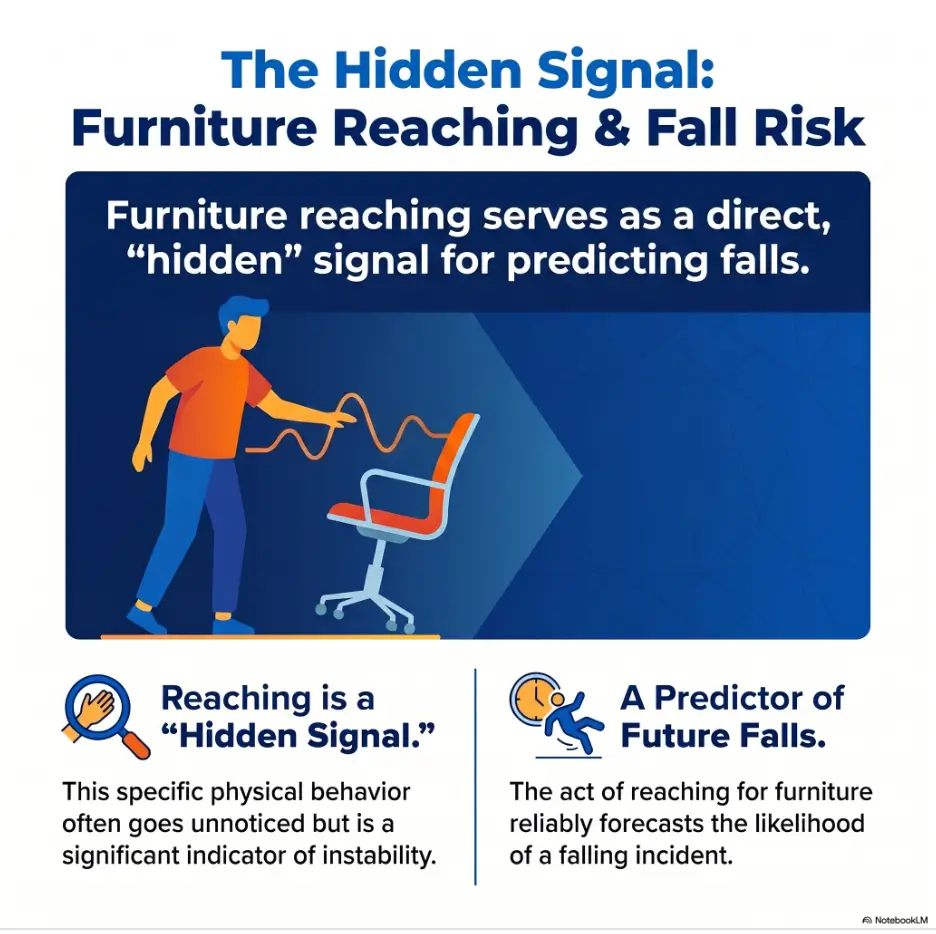
The Hidden Signal: Furniture Reaching Is Not Just “Being Careful”
Most people do not announce, “My balance system is underperforming today.” They say, “I’m fine.” Then they touch the doorway, brush the wall with their fingertips, steady themselves on the dining chair, and keep walking as if nothing happened.
That is why furniture reaching can be so easy to miss. It is quiet. It blends into ordinary movement. It often happens in homes where the person knows every corner, every squeaky floorboard, and every unforgiving coffee table leg.
Why grabbing chairs, counters, or walls can reveal balance compensation
When the body feels uncertain, the hand goes hunting for backup. A countertop becomes an emergency rail. A sofa becomes a bridge. A wall becomes a guide rope through a dim hallway.
That reach may be compensating for weak leg muscles, poor ankle control, dizziness, slow reaction time, pain with weight-bearing, trouble judging depth, or fear after a previous stumble. The person may not feel “dizzy” in a dramatic way. They may simply feel less certain during the two seconds when balance has to adjust.
This is especially common during transitions: standing from a chair, turning around, stepping over a threshold, walking from bright light into a darker room, or getting out of bed at night. Straight-line walking across a quiet living room may look fine. The trouble often appears when the body has to change direction, speed, height, or focus.
The difference between normal support and a repeated walking pattern
Everyone touches furniture now and then. You may lean on a counter while reaching into a cabinet, place a hand on the table while getting up, or steady yourself briefly when carrying groceries. A single touch does not automatically mean danger.
The concern grows when the reach becomes a route. If the same person consistently moves from bed to dresser to doorframe to hallway wall to bathroom sink, the furniture has become an unofficial mobility device. The problem is that furniture was never designed to do that job.
Chairs slide. Rugs bunch. Rolling carts move at the worst possible moment. A towel bar can pull loose. A nightstand can tip if too much weight lands on one corner. The hand may be trying to prevent a fall, but the chosen support may not be strong enough to keep its promise.
Here’s what no one tells you: the hand often knows before the brain admits it
There is a tender human reason furniture walking gets dismissed. Admitting unsteadiness can feel like surrendering independence. For an older adult, the words “I’m afraid I might fall” can sound heavier than the actual risk. They can carry fear of losing privacy, driving, stairs, favorite routines, or even the right to be left alone.
So the hand tells the truth first. It reaches. It checks. It negotiates with gravity in silence.
Caregivers and adult children should treat this as information, not ammunition. A gentle observation works better than a courtroom cross-examination. Try, “I noticed you reach for the counter when you turn. Does that spot feel unsteady?” That question opens a door. “You’re going to fall if you keep doing that” often slams one shut.
Key takeaway
The question is not “Did a fall happen?” The better question is “Is the body using furniture as a private safety system?” Repeated reaching is worth tracking even when there has been no fall yet.
The Body’s Quiet Math: What Your Hand Is Trying to Prevent
Walking looks simple because healthy movement hides its calculations. Your body is constantly measuring where your weight is, where your foot will land, how slippery the floor feels, how far the doorway is, and whether the lighting gives enough information to trust the next step.
When balance gets less reliable, the calculation becomes noisier. The hand reaches because the body wants another data point. It is asking the world, “Are we still upright?”
When your center of gravity starts drifting before you notice
Your center of gravity is the moving point where your body weight balances over your feet. When you stand still, it should stay comfortably inside your base of support. When you walk, it shifts forward and side to side in a controlled rhythm.
If leg strength, joint position sense, vision, or inner-ear input changes, that rhythm can become less steady. The person may sway a little more. They may take shorter steps. They may widen their stance. They may slow down at thresholds or hesitate before turning.
Furniture reaching often appears in that hesitation zone. The reach gives the body a wider “base” for a moment. It may work in the short term, but it also reveals that the body is not fully trusting its own balance strategy.
Why turns, thresholds, rugs, and dim hallways expose the problem
Balance trouble often shows itself at the edges of movement. A turn asks the body to rotate and shift weight at the same time. A threshold asks the foot to clear a change in floor height. A rug asks the toes to skim past fabric without catching. A dark hallway asks the eyes to guess more than they should.
These moments create tiny tests. A steady person may pass them without noticing. Someone with mild balance issues may pass them too, but with a hand on the wall, a pause before stepping, or a sudden grab at the nearest chair.
That is why near-falls matter. If someone says, “I didn’t fall, I caught myself,” the important part is not only the save. It is the fact that a save was needed.
The “almost fall” that never gets counted, but should
A near-fall is a fall that got edited at the last second. The person grabbed the counter. They bumped the wall. They sat down harder than planned. They caught their toe on the rug and recovered. No ambulance. No bruised hip. No story, apparently.
But near-falls are valuable warning data. They tell you where the body and the home are not cooperating. A near-fall in the bathroom at 2 a.m. is not the same as a stumble on a garden hose at noon. The time, place, lighting, footwear, and activity all matter.
Start collecting those details without drama. Write down where it happened, what the person was doing, whether dizziness was present, what shoes or socks they wore, and whether medication, fatigue, pain, or rushing played a role. If pain is part of the story, this guide on how to describe pain to a doctor can help turn vague discomfort into clearer appointment notes.
Near-fall note template
- Where: hallway, bathroom, kitchen, bedroom, stairs, entryway, porch.
- When: morning, after meals, after medication, late night, after standing quickly.
- What happened: reached, stumbled, bumped wall, sat suddenly, tripped, felt lightheaded.
- What helped: counter, chair, wall, caregiver, walker, cane, sitting down.
- What changed recently: medication, illness, sleep, pain, shoes, glasses, home layout.
Who This Is For, And Who Should Read Something Else
This guide is for the gray zone. Not the obvious emergency. Not the person who is fully steady and simply leaning on a counter while making tea. It is for the stage where something small has changed and everyone in the room is quietly deciding whether to mention it.
For older adults who feel steady “most of the time”
If you are an older adult and you have started touching furniture more often, this article is not here to scold you. It is here to protect the parts of life you want to keep: your home, your routines, your privacy, your morning coffee, your preferred chair, your dignity.
Feeling steady “most of the time” is useful information, but fall risk often hides in the exception. The night walk to the bathroom. The turn in the kitchen. The soft couch that traps you low. The slippers that feel cozy but slide like tiny indoor boats.
You do not have to wait until you are “bad enough” to ask for help. Early support is often what keeps support small.
For adult children noticing tiny changes during visits
Adult children often notice furniture walking during ordinary visits: a parent trailing a hand along the wall, using the fridge door to steady a turn, or refusing to carry a drink unless the other hand is free. These observations can feel awkward. No one wants to become the safety inspector at Sunday lunch.
The key is to talk about specific places, not global decline. Instead of “You’re getting unsteady,” try, “That hallway looks dark at night. Would it help to test a motion light?” A specific fix feels less threatening than a sweeping judgment.
If you are unsure whether your parent’s pain, mobility, or recovery changes are becoming a larger concern, the article on parent pain check questions can help you ask more useful questions without turning the conversation into an interrogation chamber.
For caregivers deciding whether a home safety check is overdue
Caregivers often live inside the pattern before they name it. You may already know which chair gets grabbed, which bathroom trip feels risky, and which doorway causes hesitation. That knowledge is valuable.
A home safety check is overdue when the person avoids certain rooms, changes walking routes to stay near furniture, has repeated near-falls, needs help standing from favorite seats, or seems afraid of walking alone. The check does not have to be fancy. It needs to be honest.
Not for sudden severe symptoms that need urgent care now
If balance changes come on suddenly, especially with one-sided weakness, numbness, facial drooping, trouble speaking, confusion, chest pain, fainting, or severe dizziness, do not treat this as ordinary fall prevention. Those symptoms need urgent medical attention.
Home safety matters, but it cannot replace emergency care when the body is waving a red flag with both hands.

The Furniture-Walking Pattern: Where It Usually Shows Up First
Furniture walking usually starts in the places where movement is frequent, automatic, and slightly complicated. The home becomes a map of small negotiations: stand, turn, reach, step, pause, continue.
Watching the location can tell you more than asking, “Are you steady?” Many people answer that question with pride, habit, or embarrassment. The room tells a quieter truth.
Kitchen counters become an invisible handrail
The kitchen is a common starting point because counters are stable, familiar, and always nearby. A person may slide a hand along the counter while moving from sink to stove, hold the refrigerator handle while turning, or lean on the counter before opening a low cabinet.
This can happen when standing endurance is lower, knees or hips hurt, neuropathy reduces foot sensation, or quick turns feel uncertain. It can also happen when the floor is slick, the lighting creates shadows, or frequently used items are stored too low or too high.
A practical first fix is to reduce “reach plus turn” moments. Move daily items between waist and shoulder height. Keep a clear path between sink, stove, fridge, and table. Use non-slip footwear with a secure back. And if someone uses the counter as a support every time they move through the kitchen, consider whether a professional mobility evaluation is needed.
Sofas, bed frames, and doorways turn into stepping stones
Bedrooms and living rooms often reveal a chain pattern. A person stands from the bed, touches the dresser, reaches for the doorframe, then uses the hallway wall. In the living room, they may use the recliner arm, coffee table, sofa back, and TV stand in sequence.
The issue is not only balance. Seat height matters. A soft couch can make standing harder because the hips sink low and the feet slide forward. A low bed can demand more leg strength than the person has at night. A polished floor can turn socks into a poor life choice with excellent comedic timing and terrible safety value.
Look for the furniture that receives the most hand traffic. If a person always pushes off a wobbly side table, the table is not a support. It is a trap wearing a lamp.
Bathrooms are the red-flag room, not the “private problem” room
Bathrooms combine almost every fall-risk ingredient: water, hard surfaces, small spaces, low toilet seats, poor lighting, slippery rugs, awkward turns, and the understandable desire for privacy. Many people also rush to the bathroom at night, when blood pressure may dip after standing and the eyes have not fully adjusted to darkness.
If someone reaches for towel bars, sink edges, shower doors, or the toilet paper holder, take it seriously. These objects may not be anchored for body weight. A fixed grab bar, properly placed, is very different from a towel bar that merely looks helpful.
After surgery or orthopedic pain, bathroom setup becomes even more important. For a related room-by-room approach, see this guide to bathroom setup after shoulder surgery. Even when the surgery type differs, the safety logic around wet floors, reachable items, and stable supports is useful.
Let’s be honest: most people explain it away until the first scare
Common explanations sound reasonable: “I was tired.” “The lights were off.” “These slippers are old.” “I just like to have something nearby.” Sometimes those explanations are partly true. The problem is when they keep repeating.
A useful rule: one odd moment is a note. A repeated route is a pattern. A pattern deserves action.
| Where the hand goes | What it may reveal | First safer step |
|---|---|---|
| Kitchen counter | Unsteady turns, standing fatigue, slippery floor | Clear the path, improve footwear, move daily items higher |
| Doorframe | Transition hesitation, poor lighting, threshold issue | Add lighting, remove threshold clutter, watch turning pattern |
| Towel bar | Bathroom instability, unsafe support habit | Install properly anchored grab bars |
| Soft couch arm | Difficulty standing from low seating | Raise seat height or choose a firmer chair with arms |
| Hallway wall | Nighttime uncertainty, balance compensation | Add motion lighting and consider mobility evaluation |
Why It Happens: The Usual Suspects Behind the Reach
Furniture reaching is not a diagnosis. It is a clue. The same behavior can come from several different causes, and more than one can be present at the same time.
That is why the best approach is not to guess one answer. Think in categories: strength, balance, dizziness, vision, medication, pain, sensation, fear, and environment.
Leg weakness and slower reaction time
Standing, walking, and turning require more leg strength than people realize. The muscles around the hips, thighs, calves, and ankles help control small corrections. When those muscles weaken, the body may still move forward, but with less margin for error.
Slower reaction time adds another layer. If the toe catches a rug or the floor feels uneven, the body must correct quickly. A hand on furniture may become the backup plan because the legs do not respond as fast as they used to.
This is where physical therapy can be powerful. A good PT does more than hand over exercises. They assess gait, strength, step length, turning, transfers, confidence, and assistive-device needs. For older adults managing pain while walking, this related article on walker pain management for seniors may help explain why proper support matters.
Dizziness, vertigo, blood pressure drops, or dehydration
Some people reach for furniture because the room feels like it shifts when they stand, turn, or bend. Dizziness can come from many causes, including inner-ear issues, blood pressure changes, dehydration, medication effects, blood sugar changes, infection, or heart rhythm problems.
A classic clue is feeling lightheaded after standing up. Another is needing to pause at the bedside before walking. If furniture reaching happens mostly after rising from bed, after sitting for a long time, or after a medication change, write that down and share it with a clinician.
Do not assume dizziness is “just age.” It is a symptom with a guest list, and some guests need to be shown out promptly.
Vision changes that make depth and contrast harder to read
Vision affects balance more than many people expect. If contrast is poor, a person may not see the edge of a step, the wrinkle in a rug, the lip of a shower, or the change from carpet to tile. If depth perception changes, thresholds and stairs become trickier.
Low light makes this worse. A hallway that felt safe at noon may become a guessing game at night. Bifocals or progressive lenses can also affect how the floor appears, especially on stairs or uneven surfaces.
An eye exam is not only about reading letters on a chart. For fall prevention, it is about giving the brain cleaner information so the body can trust the next step.
Medication side effects hiding in plain sight
Medications can affect balance through drowsiness, dizziness, blood pressure changes, slowed reaction time, blurred vision, or confusion. The risk can rise when multiple medications are taken together, when doses change, or when over-the-counter sleep aids, allergy medicines, pain relievers, or supplements are added without review.
A pharmacist can be an excellent ally here. Bring a complete list, including prescriptions, over-the-counter medicines, supplements, sleep aids, and “only sometimes” pills. Ask whether any could increase fall risk, especially if furniture reaching began after a change.
Never stop prescribed medication on your own because of a fall concern. Instead, ask for a medication review and explain exactly what has changed.
Pain, arthritis, neuropathy, or fear of falling after a previous stumble
Pain can change the way a person walks. A sore knee may shorten the step. Hip pain may shift weight to one side. Back pain may make turning stiff. Foot pain may reduce push-off. Arthritis can make standing from low chairs harder. Neuropathy can reduce sensation in the feet, making the floor feel less readable.
Fear matters too. After a stumble, the body may become cautious. Caution can be protective, but too much fear can shrink movement, reduce strength, and make confidence worse. The person may begin walking only where furniture is nearby, which can reduce independence room by room.
The solution is not “be brave.” The solution is safer support, targeted strength work, medical review, and a home setup that does not ask fear to do the job of engineering.
Key takeaway
Furniture reaching often has more than one cause. A useful plan checks strength, dizziness, vision, medication, pain, sensation, fear, and the home route where the reaching happens most.
Don’t Dismiss It: The Mistake That Turns Small Clues Into Big Falls
The most dangerous fall-prevention mistake is not missing an obscure product or forgetting a fancy balance gadget. It is seeing a pattern and explaining it away until the first serious scare.
Fall risk often enters quietly. It does not always kick open the door. Sometimes it trails one hand along the hallway wall and hopes nobody notices.
Mistake: calling it “just aging” instead of asking what changed
Aging can bring changes in strength, vision, reaction time, and balance, but “just aging” is not a plan. It is a shrug wearing a lab coat. The more useful question is, “What changed, when did it change, and where does it show up?”
Maybe the reaching began after a medication change. Maybe it started after a winter illness. Maybe a new rug was added. Maybe the person stopped walking outside because of pain. Maybe the hallway bulb burned out and no one replaced it because the ceiling fixture requires a ladder.
Specific changes lead to specific fixes. Vague aging talk leads to vague worry.
Mistake: waiting for an actual fall before changing the home
A fall is not the entry fee for fall prevention. Near-falls, repeated reaching, new fear of walking alone, and route changes are enough reason to act.
The best time to remove a loose rug is before it becomes a witness. The best time to add bathroom grab bars is before the towel bar is tested with full body weight. The best time to improve bedroom lighting is before the 2 a.m. trip becomes a family phone call.
Mistake: buying random gadgets before identifying the real risk
Fall-prevention products can help, but random buying can create clutter, false confidence, or poor fit. A cane from a closet, a walker that is too wide for the bathroom, a shower chair that slides, or a toilet riser at the wrong height can all become new problems.
Match the tool to the task. If the reaching happens while standing from a low couch, the first answer may be firmer seating or chair arms. If it happens in the shower, the answer may be grab bars, non-slip surface, and a shower chair. If it happens during walking throughout the house, a PT or OT may need to assess gait and support needs.
The dangerous sentence: “I only do it at night”
Nighttime does not make the pattern less important. It may make it more important. At night, the person may be sleepy, barefoot, rushed, dehydrated, or lightheaded after standing. Lighting is lower. Pets may be sleeping in creative locations. The bathroom floor may be cold and slick.
If furniture reaching happens only at night, focus first on the bed-to-bathroom route. Add motion-activated lighting. Clear cords and rugs. Keep glasses within reach. Use secure footwear. Consider whether nighttime bathroom frequency, medications, or dizziness should be discussed with a clinician.
Mistake checklist
- Calling repeated reaching “normal” without checking when it began.
- Waiting for a fall instead of acting on near-falls.
- Buying a cane, walker, or bathroom device without fit guidance.
- Removing furniture supports without replacing them with safer fixed supports.
- Assuming “I’m confident” means “I’m safe.”
- Ignoring nighttime trips because daytime walking looks fine.
Show me the nerdy details
Balance depends on three major information streams: vision, vestibular input from the inner ear, and somatosensory feedback from muscles, joints, and the soles of the feet. The brain blends those signals to decide where the body is in space. When one stream becomes less reliable, the body may rely more heavily on another. In dim light, vision contributes less. With neuropathy, foot feedback may be reduced. With dizziness, inner-ear input may feel confusing. Reaching for furniture adds a fourth reference point: touch. That touch can temporarily improve orientation, but it also signals that the body is seeking extra information to stay stable.
Short Story: The hallway that told the truth
Martha insisted she was fine. Her daughter noticed only one odd thing during visits: Martha touched the hallway wall on the way from the bedroom to the bathroom. Not a dramatic grab. Just two fingers, sliding along the paint.
One evening, they walked the route together with the lights exactly as Martha used them at night. The hallway was darker than anyone realized. A small rug curled near the bathroom door. Martha’s slippers had soft backs that collapsed under her heels.
They did not rearrange her whole life. They added motion lights, removed the rug, replaced the slippers, and scheduled a medication review because the reaching had started after a new sleep medication.
Martha did not lose independence. She gained a safer hallway. Sometimes the gentlest safety plan begins by believing the fingertips.
The Home Clues: What Furniture Reaching Reveals About the Space
A home can be familiar and still be unsafe. In fact, familiarity can hide risk. People stop seeing the extension cord, the rug edge, the low chair, the poor hallway lighting, the pet bowl, the stack of magazines, and the narrow turn near the bathroom.
Furniture reaching often reveals the exact places where the home is making balance harder than it needs to be.
Poor lighting makes balance work harder
Lighting is not decoration in a fall-risk home. It is navigation. Shadows can hide floor changes, steps, rug edges, pets, cords, and small objects. Glare can be just as troublesome as darkness, especially for people with cataracts or contrast sensitivity issues.
Focus on transitions: bedroom to hallway, hallway to bathroom, kitchen to dining area, garage to house, porch to entry, and stairs. Add motion lights where the person walks at night. Make switches reachable from both ends of a route when possible.
If you are helping someone after orthopedic surgery or joint pain, lighting becomes even more important because movement is slower and less forgiving. This related article on bedroom lighting setup after joint surgery offers practical ideas that also apply to many fall-risk homes.
Loose rugs and clutter create micro-obstacles
Falls do not always need a dramatic obstacle. A rug corner can be enough. So can a charging cord, pet toy, shoe pile, uneven mat, laundry basket, or floor transition that catches the toe.
For someone who already reaches for furniture, these micro-obstacles matter more because their recovery margin may be smaller. They may not lift their feet as high. They may turn more slowly. They may not react quickly enough when the floor surprises them.
The simplest rule is ruthless and kind: the walking path should be boring. Not stylish, not clever, not “we’ll just remember it’s there.” Boring. Clear. Predictable. Easy to see.
Low chairs and soft couches make standing up harder
Standing from a low, soft seat demands strength, balance, and coordination. The person has to scoot forward, place feet correctly, lean forward, push through the legs, and rise without tipping. If the chair has no arms, the body may search for a table, walker, or nearby furniture.
A safer chair has a firm seat, appropriate height, stable arms, and enough room around it for a cane, walker, or caregiver assistance if needed. The best chair is not always the most expensive. It is the one the person can stand from reliably without grabbing a risky object.
Why the safest path is not always the shortest path
People naturally take the shortest route. But the shortest route may include a rug, a tight turn, a low table, or a dim corner. A slightly longer route with better lighting, more space, and safer support can be the smarter path.
During a home audit, ask: “Which route would we choose if safety mattered more than speed?” That question can reveal a better bed-to-bathroom path, a safer kitchen route, or a clearer way from living room to front door.
Furniture Reaching Decision Flow
1. Notice
Where does the hand reach, and how often?
2. Map
Trace the route: bed, chair, kitchen, bathroom, stairs.
3. Replace
Swap risky furniture support for stable, fitted support.
4. Escalate
Call a professional for new, frequent, or worsening symptoms.
What To Check First: A Practical Fall-Risk Mini Audit
You do not need to remodel the house before dinner. Start with the routes where reaching already happens. A mini audit works best when it follows real movement, not a generic checklist floating in the air like a clipboard ghost.
Do the audit at the time the problem happens. If the reaching occurs at night, check the route at night. If it happens after standing from the recliner, watch that exact transfer. If it happens in the kitchen while carrying a plate, test the kitchen path with an empty plate first.
Watch the path from bed to bathroom
The bed-to-bathroom route deserves special attention because it often combines darkness, urgency, sleepiness, bare feet, and quick standing. Walk the route slowly with the lights as they usually are. Notice where the person reaches. Notice whether they pause after standing. Notice whether they use the wall, dresser, doorframe, sink, or towel bar.
Then improve the route in order of urgency: lighting, floor hazards, footwear, stable support, bathroom setup, and medical review if dizziness or repeated near-falls are present. Do not leave a curled bath mat in place because it matches the towels. The towels are not the boss of the hip fracture prevention department.
Notice whether reaching happens during turns or transitions
Ask the person to move naturally, not perform like they are being graded in a hallway ballet. Watch for reaching during standing, sitting, turning, stepping into the shower, moving from carpet to tile, entering the house, or carrying an object.
If reaching happens mainly during turns, the person may need more space, better support, or gait evaluation. If it happens when standing, seat height and leg strength may be key. If it happens after standing still for a moment, dizziness or blood pressure changes may need attention.
Check footwear, lighting, rugs, cords, pets, and floor changes
Footwear should stay on the foot, support the heel, and grip the floor. Backless slippers may feel easy, but they can slide or collapse. Socks on smooth flooring can be risky. Shoes with worn soles may not provide enough traction.
Lighting should reveal edges and obstacles. Rugs should be removed or secured. Cords should be routed away from walking paths. Pet bowls, toys, and beds should not sit in the main route. Floor changes should be visible and easy to cross.
Ask one better question: “Where do you feel least steady?”
This question is more useful than “Are you okay?” It invites a specific answer. The person might say, “The bathroom at night,” “getting up from the couch,” “turning in the kitchen,” or “stepping down into the garage.”
That answer tells you where to start. It also respects the person’s experience. Fall prevention works better when the person feels involved, not managed.
15-minute mini audit checklist
- Choose one route where reaching happens often.
- Walk it at the same time of day the problem usually appears.
- Mark every object the hand touches for support.
- Remove obvious trip hazards from that route.
- Improve lighting before buying complicated equipment.
- Replace unstable supports with fixed or properly fitted supports.
- Write down symptoms, near-falls, and recent medication changes.
- Book a professional evaluation if the reaching is new, frequent, or worsening.
Better Than Furniture: Safer Supports That Actually Match the Problem
The goal is not to remove every place a person can touch. That can make someone feel stranded. The goal is to replace accidental, unreliable supports with supports that are stable, visible, well placed, and matched to the person’s real movement needs.
Furniture is a tempting support because it is already there. Safe support is different because it is chosen for the job.
Grab bars where hands already reach
Grab bars work best when they are placed where the hand naturally needs support: near the toilet, at the shower entry, inside the shower, or along a risky transition. They should be properly anchored and able to bear weight. A suction cup bar may be useful as a hand cue in some situations, but it should not be trusted like a permanently installed grab bar unless a professional confirms the setup and the product is appropriate.
Watch before installing. If the person always reaches to the left when standing from the toilet, that matters. If they need help stepping into the shower, bar angle and height matter. Good placement is not decoration. It is choreography with screws.
Properly fitted canes or walkers, not borrowed equipment
A cane or walker can reduce risk when it is appropriate, fitted, and used correctly. The wrong device can increase risk. A cane that is too tall may lift the shoulder. One that is too short may pull the person forward. A walker used too far ahead can make posture and balance worse.
Borrowed equipment is common because it feels convenient. But mobility devices are not umbrellas. They need fit, training, and a reason. Ask a physical therapist, occupational therapist, or qualified clinician to help choose and adjust the device.
Physical therapy for strength, gait, and confidence
Physical therapy can address the body side of the fall-risk equation. A PT may work on leg strength, balance reactions, walking speed, step length, turning, stair safety, transfers, and confidence. They can also help decide whether a cane, walker, or other support is appropriate.
PT is not only for recovery after a major injury. It can be valuable when someone has started avoiding movement, reaching for furniture, or feeling less secure in daily walking. If a person has pain that affects movement, a practical appointment checklist can help. See this orthopedic appointment checklist for ideas on what to bring and how to describe function changes.
Occupational therapy for room-by-room home safety
Occupational therapists are excellent at translating daily routines into safer setups. They can look at bathroom transfers, kitchen tasks, dressing, laundry, seating, bed height, lighting, and the actual places where reaching happens.
An OT may recommend grab bars, raised toilet seats, shower chairs, reachers, seating changes, task rearrangement, or practice strategies. The best recommendations are not generic. They fit the person, the room, the budget, and the daily routine.
Vision, footwear, and medication reviews as fall-prevention tools
Some of the most effective fall-prevention steps do not look dramatic. Get vision checked. Review medications. Replace unsafe slippers. Improve lighting. Remove loose rugs. Keep frequently used items easy to reach. These are not glamorous fixes, but neither is a hospital gown, so we choose wisely.
The important part is coordination. If the person has dizziness, pain, poor vision, and a cluttered bathroom, one fix will not solve everything. Layered risk needs layered prevention.
| Problem pattern | Possible support | Who can help fit or plan it |
|---|---|---|
| Reaching in bathroom | Anchored grab bars, shower chair, non-slip surface | Occupational therapist, qualified installer |
| Reaching while walking room to room | Cane or walker evaluation | Physical therapist or clinician |
| Trouble standing from chair | Firm chair with arms, seat-height adjustment | OT, PT, caregiver with clinician guidance |
| Nighttime wall touching | Motion lights, clear route, footwear review | Caregiver, OT, primary care if dizziness exists |
| Unsteadiness after medication change | Medication review | Pharmacist, prescribing clinician |
Key takeaway
Do not remove a person’s informal support system without replacing it. The safer move is to convert risky supports into reliable ones: fixed grab bars, fitted mobility devices, better lighting, stronger seating, and professional guidance when needed.
When To Seek Help: Signs This Needs More Than a Home Fix
Some furniture reaching can improve with home changes. Some needs medical attention. The line is not always obvious, so use changes, frequency, symptoms, and near-falls as your guide.
When in doubt, document what you see and call the appropriate professional. A short, clear note about where and when the reaching happens can make an appointment far more productive.
New or worsening balance problems
If someone who used to walk steadily now reaches often, slows suddenly, avoids certain rooms, or needs support in places they did not before, schedule a medical evaluation. Change is the keyword. A new pattern deserves attention even if the person has not fallen.
Bring examples: “Started two weeks ago,” “mostly after standing,” “happens from bed to bathroom,” “began after medication change,” or “three near-falls this month.” Specifics help clinicians look in the right direction.
Dizziness, fainting, or feeling lightheaded when standing
Dizziness and fainting should not be treated as furniture-placement problems. They may involve blood pressure, hydration, medications, inner-ear issues, heart rhythm, infection, or other medical causes.
If lightheadedness happens after standing, ask about checking blood pressure while lying, sitting, and standing. Do not guess. Write down timing, meals, medications, fluid intake, and whether symptoms improve after sitting.
One-sided weakness, numbness, confusion, or speech changes
Sudden one-sided weakness, numbness, facial drooping, confusion, trouble speaking, severe headache, chest pain, or fainting needs urgent care. Do not wait for a scheduled appointment. Do not test a new nightlight first. This is the emergency lane.
If a fall has already happened and there is head injury, severe pain, inability to bear weight, worsening confusion, or possible fracture, seek medical help promptly.
Repeated near-falls, unexplained bruises, or fear of walking alone
Repeated near-falls are not “lucky.” They are warnings. Unexplained bruises may mean the person is bumping into furniture, catching themselves, or falling without wanting to report it. Fear of walking alone can also reduce movement, which may worsen strength and confidence over time.
If recovery has stalled after illness, injury, or surgery, consider whether the issue is pain, confidence, conditioning, medication, or unsafe setup. This related guide on a recovery plateau at home may help frame the conversation.
Medication changes followed by unsteadiness
If furniture reaching begins after a new medication, changed dose, new sleep aid, new pain medicine, or added over-the-counter product, ask for a medication review. Include everything the person takes, even occasional items.
The phrase to use is simple: “We noticed new unsteadiness and more furniture grabbing after this change. Could any medication be contributing?” That is clear, respectful, and hard to misinterpret.
Key takeaway
Home fixes are important, but new dizziness, fainting, sudden neurological symptoms, repeated near-falls, unexplained bruises, or unsteadiness after medication changes should be discussed with a healthcare professional promptly.
Questions to ask a professional
- Could any current medication increase dizziness, sleepiness, or fall risk?
- Should blood pressure be checked when lying, sitting, and standing?
- Would physical therapy help with strength, gait, turning, or balance confidence?
- Would occupational therapy help with bathroom, bedroom, and kitchen safety?
- Should vision, hearing, neuropathy, or foot problems be evaluated?
- Is a cane, walker, rollator, or other support appropriate, and how should it be fitted?
- Are there symptoms that should prompt urgent care rather than a routine appointment?

FAQ: Reaching for Furniture and Fall Risk
Is reaching for furniture while walking a sign of poor balance?
It can be. Occasional touching is normal, but repeated reaching while walking, turning, or standing may suggest balance compensation, leg weakness, dizziness, pain, vision problems, medication effects, or unsafe home layout. Treat the pattern as a clue worth checking.
What does it mean when an older adult holds walls while walking?
Holding walls may mean the person feels less steady than they appear. It often shows up in hallways, bathrooms, and nighttime routes. Watch when it happens, ask where they feel least steady, and consider a home safety check plus medical review if the behavior is new or frequent.
Is furniture walking dangerous?
Furniture walking can be risky because chairs, tables, carts, towel bars, and door handles may slide, tip, or pull loose. The person may be using objects that were never meant to support body weight. Safer supports should be stable, properly placed, and matched to the person’s needs.
Should I use a cane if I keep grabbing furniture?
Maybe, but do not guess. A cane must be the right height and used correctly. Some people need a walker, therapy, better footwear, grab bars, or medical evaluation instead. Ask a physical therapist or clinician to assess the best support.
Can medication cause balance problems?
Yes. Some medications can contribute to dizziness, drowsiness, low blood pressure, blurred vision, confusion, or slower reaction time. Risk may increase after dose changes or when multiple medicines are combined. Ask a pharmacist or clinician for a medication review.
Why do I feel more unsteady at night?
Nighttime unsteadiness can come from darkness, sleepiness, rushing to the bathroom, bare feet, dehydration, medication effects, or lightheadedness after standing. Improve the bed-to-bathroom route first, and seek medical advice if dizziness, fainting, or repeated near-falls occur.
What home changes reduce fall risk fastest?
Start with better lighting, clear walking paths, secure footwear, removal of loose rugs and cords, safer bathroom supports, and firmer seating with arms. The fastest changes are often simple because they remove surprise from the floor and give the body reliable support.
When should balance problems be checked by a doctor?
Get checked when balance changes are new, worsening, frequent, paired with dizziness or fainting, linked to medication changes, or causing near-falls. Seek urgent care for sudden weakness, numbness, confusion, speech trouble, chest pain, severe dizziness, or injury after a fall.
Next Step: Do One Walk-Through Before Tonight
The promise of this article is simple: a small reach can become useful before it becomes a fall. You do not need to solve every risk in the house today. You need to choose one route and read it honestly.
Start with the route that matters most: bed to bathroom, favorite chair to kitchen, kitchen to dining table, front door to living room, or wherever the hand reaches most often. Walk it slowly. Use the lighting exactly as it is normally used. Do not tidy first. The truth is in the ordinary mess.
Start at the bed and walk to the bathroom with the lights exactly as they are at night
Stand from the bed. Pause. Notice whether lightheadedness appears. Walk the route. Look for the hand. Does it touch the dresser, wall, doorframe, towel bar, or sink? Does the person rush? Are glasses reachable? Are slippers secure? Is a pet bed in the path? Is the bathroom rug flat?
Write down what you see. You are not building a case against the person. You are building a map for safety.
Mark every place a hand reaches for support
Use sticky notes if helpful. Mark the objects that get used as supports. Then ask whether each one is stable enough to handle body weight. A wall is stable but may not offer grip. A towel bar offers grip but may not hold. A rolling chair is an outright comedian with bad intentions.
Every marked spot becomes a decision: remove the hazard, improve lighting, add a proper support, change the route, adjust the chair, review footwear, or call a professional.
Replace risky “accidental supports” with safer, fixed supports
Do not simply tell someone to stop touching furniture. That removes their coping strategy without replacing it. Instead, convert the route. Add a proper grab bar where the hand already reaches. Improve the light where the wall gets touched. Replace the soft chair that traps the hips. Clear the path where the toe catches. Ask about a fitted cane or walker if the pattern extends through the house.
Good fall prevention is not about making the home look clinical. It is about making ordinary movement less fragile.
Book a professional evaluation if the reaching is new, frequent, or getting worse
If furniture reaching has become a pattern, especially with dizziness, weakness, pain, medication changes, near-falls, or fear of walking alone, book help. Start with primary care if symptoms are broad or new. Ask about PT for strength and gait, OT for home safety, pharmacy review for medications, and an eye exam if vision or contrast seems involved.
Within the next 15 minutes, choose one route and walk it. Mark every reach. Remove one obvious hazard. Improve one light. Write down one question for a professional. That is enough to begin.
Your 15-minute action card
- Pick the route where furniture reaching happens most.
- Walk it during the real risk time, such as night or after standing.
- List every object used for support.
- Remove one trip hazard immediately.
- Add or improve one light source.
- Schedule help if the pattern is new, frequent, worsening, or paired with symptoms.
Key takeaway
The hand reaching for furniture is not the end of independence. Handled early, it can be the beginning of a smarter setup: safer routes, better support, clearer medical questions, and fewer moments where luck has to do the heavy lifting.
Last reviewed: 2026-06