

Caregiver appointment notes made usable
Doctor Visit Summary Template for Caregivers:
Turn a Short Appointment Into a Clear Care Plan
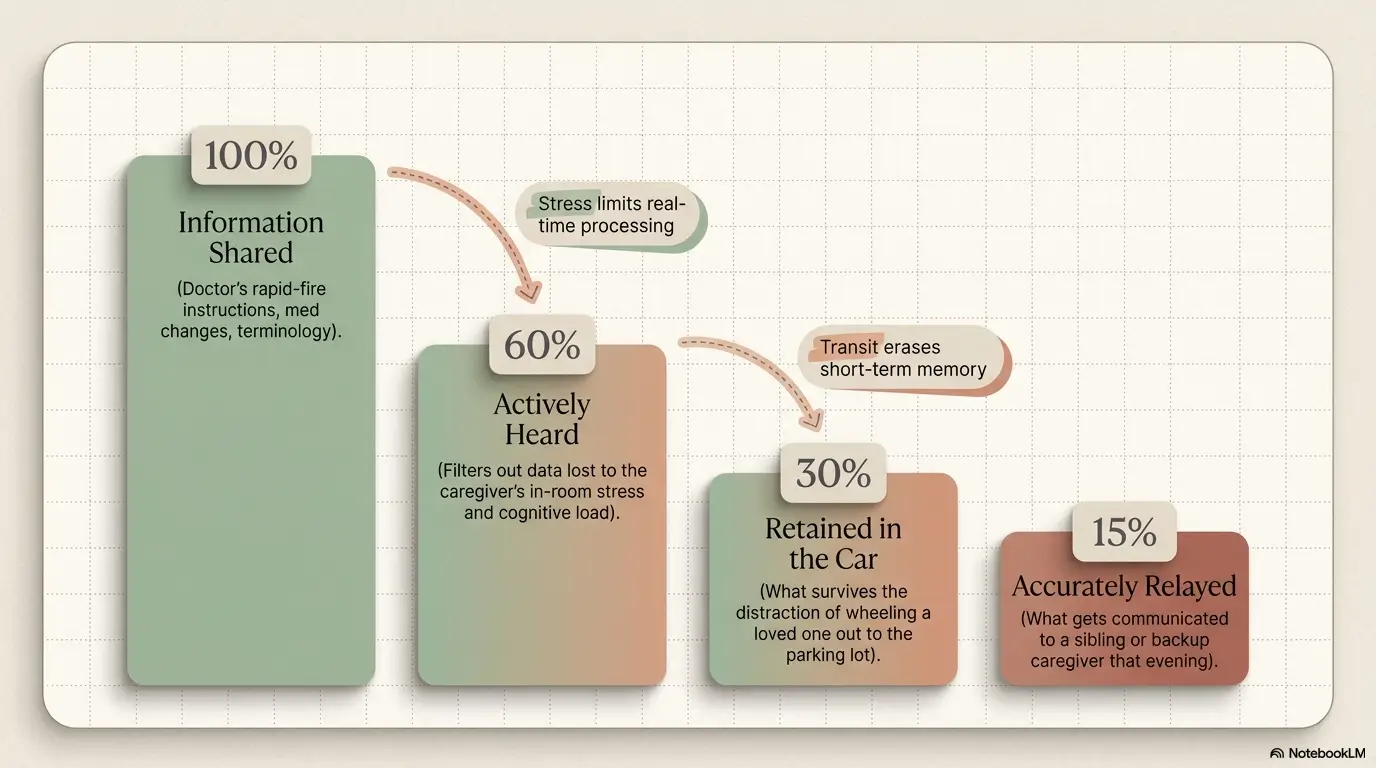
A doctor visit can feel oddly brief when you are caring for someone you love. You wait, explain, listen, nod, absorb a medication change, hear something about lab work, and then step into the parking lot with a paper in your hand and half the visit already dissolving. It is not because you were careless. It is because caregiving asks the brain to be a calendar, pharmacy shelf, interpreter, witness, driver, and emotional sponge all at once.
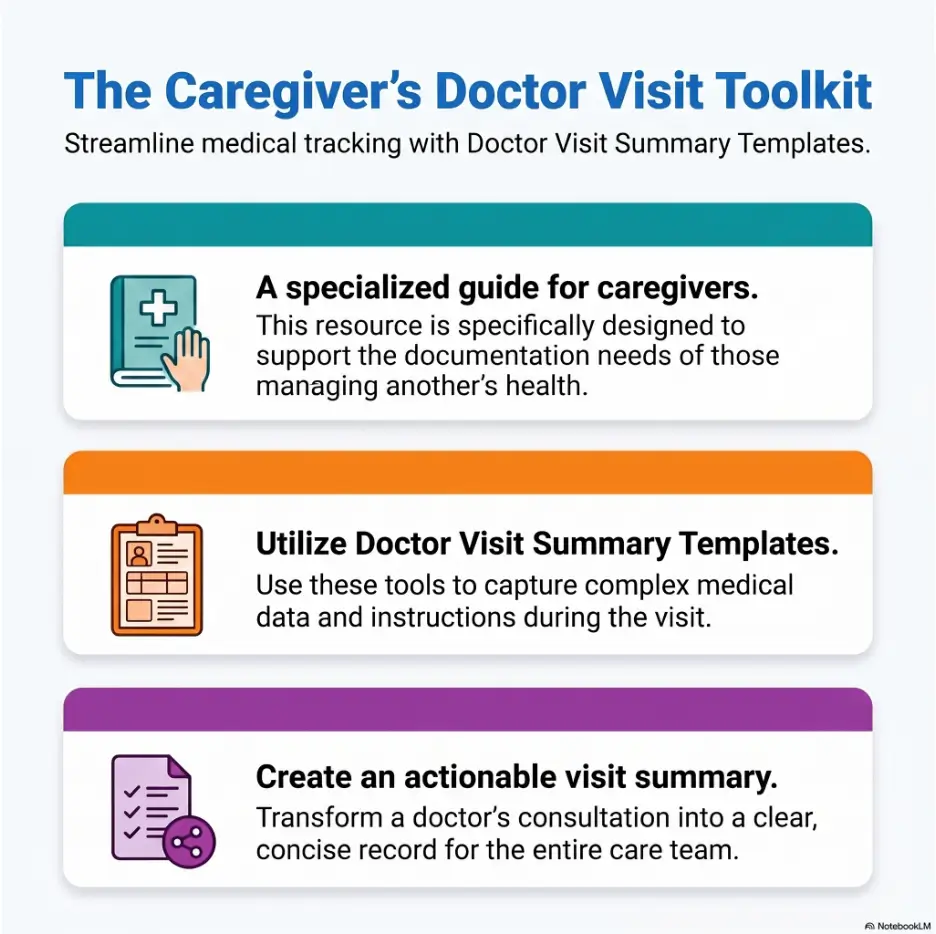
A doctor visit summary template gives that overloaded brain a quiet railing to hold. It captures what changed, what matters next, who is responsible, and when to seek help. The best template is not fancy paperwork. It is a practical memory tool that helps family caregivers, spouses, adult children, and care coordinators leave the exam room with fewer loose threads.
This guide walks you through a caregiver-friendly system for preparing, taking notes, reviewing instructions, tracking medications, sharing updates, and building one reusable page you can bring to nearly any routine medical visit. Keep it simple, keep it honest, and let the page carry what your tired mind should not have to carry alone.
Fewer missed instructions
Capture medication changes, follow-ups, tests, and warning signs before the details blur.
Better family handoffs
Share clear updates with siblings, spouses, aides, or long-distance caregivers without writing a novel.
A calmer next step
Turn a 12-minute visit into a practical plan for the next 24 hours, week, and appointment.
🩺 The goal is not perfect notes. The goal is a care plan you can actually use when everyone gets home tired.
Snapshot
This article is for family caregivers, adult children, spouses, and care coordinators who need a practical way to document medical visits. You will learn what to write before, during, and after an appointment, how to track medication changes, what questions to ask, when notes should never delay urgent care, and how to build one reusable doctor visit summary page today.
Table of Contents
Safety Disclaimer for Caregiver Visit Notes
This guide is for caregiver organization and general education only. It is not medical advice, diagnosis, or treatment guidance. A doctor visit summary template can help you remember and organize information, but it cannot decide whether a symptom is dangerous, whether a medication is safe, or whether a treatment plan is right for the patient.
Caregivers should confirm medication changes, symptoms, test results, diagnoses, and follow-up instructions directly with a licensed healthcare professional. When something feels urgent, strange, sudden, severe, or unsafe, do not pause to polish your notes. Seek medical help.
Key takeaway
A template is a memory tool, not a medical decision-maker. Use it to support conversations with clinicians, not to replace them.
What this template can and cannot do
A caregiver visit summary can help you record what the doctor said, what changed, what to do next, and what warning signs to watch. It can also help you communicate more clearly with other family members, home health aides, pharmacists, and future clinicians.
It cannot tell you whether a symptom is harmless. It cannot confirm that two medications are safe together. It cannot replace the official after-visit summary, medication list, discharge paperwork, lab report, or patient portal message. Think of it as the notebook that sits beside the official record, translating the visit into ordinary life.
The safe caregiver rule
When instructions are unclear, ask. When symptoms worsen, call. When symptoms seem dangerous, seek urgent or emergency care. The most useful caregiver notes are honest, simple, and humble. They do not try to sound medical. They try to be accurate.
That matters because caregiving often happens in a swirl of partial information. One sibling remembers the new pill. Another remembers the lab order. The patient remembers being told to rest, but not for how long. Your template becomes the table where all those scattered pieces can sit without sliding onto the floor.
Why Caregiver Appointment Notes Fall Apart
Caregiver notes usually do not fail because the caregiver is disorganized. They fail because medical visits are compressed. The room is bright, the clock is moving, the patient may be anxious, and the clinician is juggling history, symptoms, tests, medication risks, insurance rules, and next steps.
Then the visit ends. The exam room door opens. A staff member hands over a printout. Someone asks where the car is parked. The patient wants lunch. A phone starts buzzing. The visit has technically ended, but the real work has just begun.
Why caregivers forget details even when they listen
During a visit, you are not simply listening. You are watching the patient’s face, deciding whether to interrupt, wondering whether a symptom matters, and trying to remember the name of the medication that started last month. That is a crowded little theater inside one human skull.
The most fragile details are often the most practical ones: take this at night, call if swelling increases, schedule labs in two weeks, expect results through the portal, stop the over-the-counter sleep aid, use the walker until physical therapy clears stairs. These are not dramatic sentences, but they are the hinges of care.
The car ride home problem
Many caregivers recognize the car ride home problem. In the office, the plan seemed clear. By the time the seat belt clicks, it has softened around the edges. Was the new medication once daily or twice daily? Was the follow-up in two weeks or four? Did the doctor say to call if pain worsened, or only if swelling appeared?
A short doctor visit summary template is built for that exact moment. It gives you a place to capture the plan before memory starts doing its unreliable little card trick.
The appointment is only half the work
Medical appointments create tasks. Someone may need to pick up a prescription, schedule imaging, call a specialist, watch for side effects, update a medication list, arrange transportation, send a portal message, or tell another caregiver what changed.
If the visit summary only records what happened, it is incomplete. The stronger version records what happens next. That is where caregiver notes become a care plan instead of a diary.
Key takeaway
Write for the tired version of yourself who will read the note later. That person needs plain instructions, not elegant sentences.
Who Should Use a Doctor Visit Summary Template
A caregiver doctor visit summary template is most useful when care is ongoing, shared, or easy to misunderstand. It is helpful for routine appointments, post-surgery check-ins, chronic condition management, medication reviews, orthopedic visits, primary care follow-ups, specialist consultations, and appointments where more than one person needs to understand the plan.
It is less useful for true emergencies, where the right next step is immediate medical attention. It also should not be treated as a legal medical record. It is your working copy, your bridge between the clinician’s plan and the kitchen-table reality of caregiving.
Family caregivers managing routine appointments
If you drive a parent to primary care, help a spouse after surgery, support a grandparent with mobility issues, or coordinate appointments for a loved one with multiple specialists, a visit summary can prevent the familiar question: “Wait, what did they say we should do?”
For orthopedic appointments, caregiver notes can be especially useful because pain, movement, sleep, swelling, brace use, medication changes, physical therapy, imaging, and surgery decisions often overlap. If that is your situation, you may also find this guide to caregiver notes for orthopedic appointments useful as a companion resource.
Adult children supporting aging parents from a distance
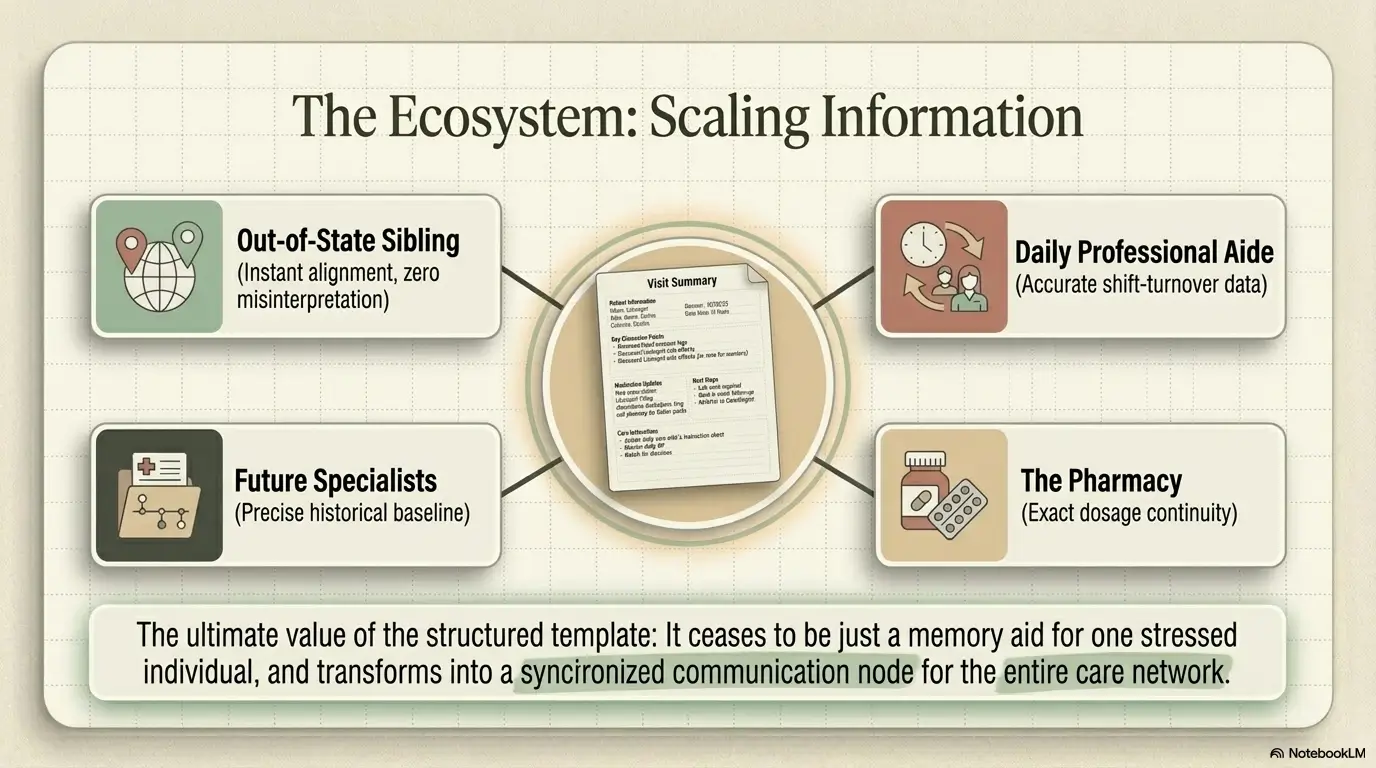
Long-distance caregiving adds another layer. You may not be in the room, yet you still need to understand what happened. A doctor visit summary gives the person who attended the appointment a structured way to share the essentials without sending a scattered stream of texts.
For example, instead of “Doctor said labs are okay but changing one pill,” the update can say: “Blood pressure medication increased from 5 mg to 10 mg daily starting tomorrow. Check blood pressure each morning for two weeks. Call office if dizziness, fainting, or systolic pressure below the number they gave us.” That is a completely different level of usefulness.
Spouses tracking medication and recovery changes
Spouses often do quiet, constant caregiving. They notice sleep, appetite, walking speed, mood, bathroom safety, pain at night, and whether the new medication seems to be helping. A visit summary helps convert those observations into clear notes for the next appointment.
After surgery or injury, that can matter a great deal. A spouse may be the first person to notice that showering feels unsafe, that stairs are still too hard, or that pain has plateaued. Articles like how to start a shower safety conversation and what to do when recovery plateaus at home can pair well with a visit summary because they turn vague concerns into clearer appointment topics.
Utility block: Is this template worth using for this appointment?
- Use it if medications may change.
- Use it if another caregiver needs an update.
- Use it if the patient has trouble remembering instructions.
- Use it if there are tests, referrals, therapy, imaging, or follow-up dates.
- Use it if symptoms have changed since the last visit.
- Skip note-polishing if symptoms are urgent. Get help first.
Before the Appointment, Build the Summary Early
The best doctor visit summary begins before the doctor walks in. That may sound backwards, but it is one of the simplest ways to make the visit more useful. When you arrive with the main reason, symptom timeline, medication list, and top questions already written down, you reduce the chance of leaving with the one thing you meant to ask still trapped in your coat pocket.
Preparation does not need to be elaborate. A half page is often enough. The goal is to make the first three minutes of the visit clear, because those first minutes often shape the whole conversation.
Start with the main reason for today’s visit
Write one sentence that explains why you are there. Not the full saga. Not every concern that has accumulated since the last appointment. One sentence.
Good examples sound like this: “We are here because Mom’s knee pain is worse at night and she is now avoiding stairs.” Or: “We want to review Dad’s dizziness since the blood pressure medication changed.” Or: “We need help understanding whether this recovery pattern is expected after surgery.”
That one sentence keeps the appointment from becoming a drawer full of tangled chargers. Other details can follow, but the visit has a center.
List symptoms by timeline, not panic level
Caregivers naturally lead with the symptom that feels most alarming. That is human. Clinicians, however, often need sequence. When did it start? Is it getting better, worse, or changing? What triggers it? What helps? What has been tried?
A timeline can be simple: “Monday: new swelling. Tuesday: pain worse walking to bathroom. Wednesday: slept poorly. Thursday: took acetaminophen twice with mild relief. Friday: called office and was told to monitor.”
If the visit is about pain, this guide to how to describe pain to a doctor can help you turn “it hurts” into clearer details about location, timing, intensity, function, and triggers.
Bring medications, supplements, and recent changes
Medication confusion is one of the great goblins of caregiving. It hides in pill organizers, old bottles, refill labels, “as needed” instructions, supplements, samples, and medicines prescribed by different clinicians.
Before the appointment, bring an updated medication list or the actual bottles if the office recommends it. Include prescription drugs, over-the-counter medicine, vitamins, supplements, creams, drops, patches, and injections. Also write down recent stops, starts, dose changes, missed doses, and side effects.
Key takeaway
“Nothing changed” is worth checking. Ask about new sleep aids, pain relievers, supplements, stopped pills, missed doses, and medicines from other doctors.
Put three questions at the top
Appointments can wander. Three written questions help you steer without sounding demanding. Put them at the top of your notes where your eyes can find them quickly.
- What changed today?
- What should we do first?
- What symptoms mean we should call, go to urgent care, or call emergency services?
Those three questions work because they turn medical information into action. They also help you leave with fewer “I should have asked” regrets.
During the Visit, Capture the Words That Matter
During the visit, your job is not to transcribe every sentence. A caregiver who tries to write everything often misses the most important thing. Instead, capture the words that change what happens next.
Think of the visit as a small control room. The switches that matter are diagnosis or working explanation, medication changes, tests, referrals, follow-up timing, warning signs, and who does the next task.
Write the doctor’s assessment in plain language
If the doctor gives a diagnosis, write it down. If the doctor is not ready to give a diagnosis, write the working explanation. That distinction matters.
For example, “Doctor says likely arthritis flare, but ordering X-ray because pain changed after fall” is more useful than “arthritis.” It explains both the current thinking and why the next step exists.
When you do not understand a term, ask for plain language. A good phrase is: “Can you say that in everyday words so I can explain it correctly at home?” Most clinicians would rather clarify in the room than have the plan misunderstood later.
Record medication changes with dose, timing, and purpose
Medication notes should answer four questions: What is changing? How much? When should it be taken? Why is it being used?
“Start new pill” is not enough. “Start gabapentin 100 mg at bedtime for nerve pain; call if severe dizziness, confusion, rash, or other concerning side effects” is far more useful, assuming those are the exact instructions provided by the clinician. Never invent the warning signs yourself. Ask and record.
If the clinician says “as needed,” ask what need. Pain? Nausea? Sleep? Anxiety? Constipation? Shortness of breath? “As needed” is a small phrase with a big trapdoor under it.
Note tests, referrals, and results timing
Tests and referrals often create administrative drift. The clinician orders labs, imaging, therapy, or a specialist referral, but the family is not sure who schedules it, when results arrive, or what to do if nobody calls.
Write down the test or referral, the purpose, who schedules it, the expected timing, and how results will be shared. If something matters urgently, ask how quickly it should happen.
For example: “Blood work ordered today to check kidney function before medication change. Lab downstairs today. Results expected in portal within three business days. Call office if no result by Friday afternoon.” That note has legs. It can walk itself into action.
Ask what to watch before the next visit
One of the most useful caregiver questions is also one of the simplest: “What should we watch for before the next visit?”
This question invites the clinician to name warning signs, expected changes, side effects, recovery milestones, or reasons to call sooner. It also helps caregivers avoid two extremes: panicking over every change or ignoring a change that deserves attention.
Utility block: Words to capture during the visit
- Diagnosis or working explanation
- Medication start, stop, dose change, or timing change
- Reason for each medication change
- Tests ordered and why
- Referral name, specialty, and scheduling responsibility
- Follow-up date or trigger
- Warning signs and who to call
- Any activity limits, home care steps, or therapy instructions
The Caregiver-Friendly Doctor Visit Summary Template
A good doctor visit summary template for caregivers is short enough to use in the room and complete enough to prevent confusion later. That balance is important. If the page is too long, nobody uses it. If it is too thin, it becomes a decorative napkin.
The template below is designed as a one-page structure. You can print it, copy it into a notes app, place it in a binder, or turn it into a shared document for family caregivers. Keep the labels consistent from visit to visit so your brain does not have to relearn the page every time.
The one-page template
| Section | What to write | Example |
|---|---|---|
| Patient basics | Name, date of birth, provider, clinic, appointment date | Maria R., DOB 4/12/1948, Dr. Lee, June 8 |
| Visit reason | One-sentence reason for today’s appointment | Night pain after knee replacement is interrupting sleep |
| Symptoms discussed | What changed, when it started, what helps, what worsens | Swelling increased three days ago; ice helps mildly |
| Assessment | Diagnosis, working explanation, or concern | Likely expected recovery pain, checking for infection due to swelling |
| Medication updates | Start, stop, increase, decrease, continue, side effects to watch | Continue acetaminophen as directed; stop ibuprofen until cleared |
| Tests and referrals | Labs, imaging, therapy, specialist, home health | Labs today; physical therapy referral renewed |
| Follow-up plan | Date, trigger, call, portal message, recheck | Follow up in two weeks or sooner if fever or redness worsens |
| Warning signs | When to call office, urgent care, or emergency services | Call office for fever, drainage, increased redness, or worsening swelling |
| Next actions | Who does what and by when | Anna schedules PT by Friday; James picks up prescription today |
Summary card template for caregiver handoffs
Sometimes you do not need to share every note with every person. A short handoff version can help another caregiver understand the plan quickly. This is especially useful when siblings rotate duties, a spouse handles medications, or a home aide needs to know what changed.
Utility block: Caregiver handoff summary card
Today’s visit was about: ______________________________
Doctor’s main concern or explanation: ______________________________
Medication changes: ______________________________
Tests, referrals, or appointments: ______________________________
Watch for: ______________________________
Next person responsible: ______________________________
Short Story: The note that prevented the second phone call
Elena took her father to a follow-up visit after a fall. She had a small notebook, but she usually wrote scattered phrases: “hip better,” “new pill,” “call if bad.” That day, her brother asked her to send a clear update because he lived two states away and worried from a distance.
So Elena tried a one-page visit summary. She wrote the reason for the visit before they left home. During the appointment, she asked what changed, what to watch for, and who should schedule the physical therapy referral.
That evening, instead of a long family text thread, she sent six lines: diagnosis, medication unchanged, PT referral, follow-up date, warning signs, and her next task.
Her brother did not ask a dozen follow-up questions. Her father did not have to retell the appointment. The note did not make caregiving easy, but it made the next step quieter.
Make it easy to repeat
The template works best when it is boringly consistent. Same sections. Same order. Same place to store it. A caregiver system should not require heroic creativity. It should be familiar enough to use on a Tuesday morning when the coffee was weak and the appointment is across town.
If you use paper, keep blank copies in the car, folder, or medical binder. If you use a phone, create a reusable note with headings already typed. If several caregivers share duties, use a shared document or photo of the completed page, while respecting the patient’s privacy preferences.
Caregiver Visit Summary Flow
1. Prepare
Write the visit reason, symptom timeline, medication list, and top questions.
2. Capture
Record diagnosis, medication changes, tests, referrals, and warnings.
3. Confirm
Ask what to do first, when to call, and who schedules the next step.
4. Update
Revise the medication list, calendar, and care tasks before the day ends.
5. Share
Send only the details another caregiver truly needs to help safely.
Medication Notes: The Small Box With Big Consequences
If your template has one section that deserves extra respect, it is medication updates. Medication instructions are easy to mishear and easy to misremember. They also have real consequences.
The medication box does not need to contain the entire medication history. In fact, rewriting everything during every visit can create mistakes. The most useful approach is to track what changed today, then update the central medication list after the appointment.
Track what changed instead of rewriting everything
During the visit, write only the change: start, stop, increase, decrease, continue, hold, take with food, take at bedtime, or use only as needed. After the visit, update the main list in one central place.
This prevents two common errors. First, it avoids copying an old medication list again and again with tiny differences. Second, it helps everyone see what the appointment actually changed.
Separate prescriptions, OTC medicine, and supplements
Over-the-counter medicine and supplements can still matter. Pain relievers, sleep aids, allergy pills, laxatives, vitamins, herbal products, and topical creams may affect symptoms, side effects, bleeding risk, alertness, constipation, blood pressure, or interactions.
Use separate headings so nothing hides. Prescription medications in one section. OTC medicines in another. Supplements in another. Allergies and past reactions in a visible spot.
Confirm what “as needed” actually means
“As needed” sounds flexible, but it is not always clear. Ask what symptom should trigger the medicine, the maximum daily amount, how many days it should be used, what side effects matter, and when to call if it is not helping.
For example, an “as needed” pain medication may have very different instructions from an “as needed” nausea medication or inhaler. Write the purpose beside the medication name.
Never guess a dose from memory
If you are unsure about a dose, do not guess. Check the written after-visit summary, medication bottle, pharmacy label, patient portal, or call the clinician or pharmacist. A caregiver note that says “confirm dose before giving” is much safer than a confident-looking guess.
Key takeaway
The medication section should make uncertainty visible. “Need to confirm dose” is a responsible note, not a failure.
Show me the nerdy details
A strong caregiver medication note separates identity, instruction, purpose, and follow-up. Identity means the exact medication name and strength when available. Instruction means dose, route, timing, and whether it is scheduled or used as needed. Purpose means why the clinician wants the patient to take it. Follow-up means what to watch, when to call, and whether labs or rechecks are needed.
This structure reduces ambiguity. “Take one pill at night” may not be enough if there are several evening pills. “Increase lisinopril to 10 mg daily for blood pressure; check home readings each morning; call if dizziness or other concerning symptoms occur” gives the caregiver more context. The exact wording should come from the clinician, pharmacist, prescription label, or official after-visit summary.
Common Mistakes That Make Caregiver Notes Less Useful
Caregiver notes can be wonderfully helpful, but they can also become a junk drawer. The problem is usually not effort. It is lack of structure. A caregiver may write pages and still miss the one instruction that matters most on Thursday morning.
Here are the mistakes most likely to turn notes into fog, plus a cleaner alternative for each one.
Mistake: writing too much and missing the instruction
Full sentences can feel thorough, but during an appointment they may slow you down. You do not need to capture every explanation. You need the decision, the reason, and the next action.
Instead of writing a paragraph about the entire conversation, try this format: “Concern: swelling. Doctor thinks: expected recovery but checking labs. Next: labs today, call if fever/redness/drainage, follow-up two weeks.” That is not poetic. It is useful. Useful wins.
Mistake: recording the diagnosis without the plan
A diagnosis label is only part of the visit. “Arthritis,” “high blood pressure,” “sprain,” “infection concern,” or “possible nerve pain” does not tell you what to do next.
Pair every assessment with a plan. If the plan is watchful waiting, write what to watch. If the plan is medication, write the instructions. If the plan is testing, write where, when, and why. If the plan is referral, write who schedules it.
Mistake: forgetting who owns the next task
Many care plans fail in the space between “someone should” and “someone did.” A referral is ordered, but nobody schedules. A lab is recommended, but nobody knows whether it happens today or next week. A prescription is sent, but nobody checks whether the pharmacy filled it.
Add a next-action line to every visit summary. Write the person, task, and deadline: “Maya calls cardiology by Wednesday.” “Tom picks up prescription tonight.” “Dad checks portal Friday.” “Caregiver sends blood pressure log next Monday.”
Mistake: assuming the patient portal will explain everything
Patient portals are helpful, but they are not always instant, complete, or written in the way a tired family needs. A portal may show lab results before the clinician comments on them. It may list medication names without explaining the reason for the change. It may not capture the practical advice spoken in the room.
Use the portal as an official source to verify information, not as an excuse to leave the appointment without understanding the plan. Before leaving, ask whether instructions can be included in the after-visit summary.
| Common note | Why it breaks down | Better caregiver note |
|---|---|---|
| “New medicine.” | No dose, timing, or purpose. | “Start medicine name/dose as directed for symptom; confirm side effects and timing.” |
| “Follow up later.” | No date or trigger. | “Follow up in four weeks, sooner if symptoms worsen or listed warning signs occur.” |
| “Doctor said okay.” | Too vague for future decisions. | “Doctor not concerned about mild soreness today; call if swelling, fever, redness, or pain increases.” |
| “Needs PT.” | No owner for scheduling. | “PT referral placed; daughter calls clinic by Friday to schedule.” |
After the Visit, Turn Notes Into Action
The first hour after the visit is the golden hour for caregiver organization. Not because everything must be solved immediately, but because the plan is still warm. The words still have shape. The paper has not yet vanished into the kitchen drawer where appointment papers go to become sediment.
After the visit, do three things: review the summary, update the central records, and schedule or assign next actions. This is the difference between “we went to the doctor” and “we know what happens next.”
Review the summary with the patient
If the patient is able and willing, review the summary together. This respects their role in their own care and gives them a chance to correct anything you misunderstood.
Keep the review gentle. Try: “I want to make sure I wrote this correctly. Here is what I heard: no medication change, labs today, follow-up in two weeks, and call sooner if swelling gets worse. Does that match what you heard?”
Update the medication list in one central place
Do not let medication changes live only in one appointment note. Update the central medication list the same day whenever possible. That list might be in a binder, wallet card, shared document, notes app, or printed page near the pill organizer.
Include the date of the change and the clinician who made it. This helps later when another doctor asks, “When did this start?” or a pharmacist needs to understand the timeline.
Schedule follow-ups before paper disappears
Calendar tasks quickly. Follow-up appointments, lab dates, imaging windows, therapy sessions, refill reminders, portal result checks, and transportation needs all deserve a place on the calendar.
If the patient has orthopedic recovery needs, small home tasks may also belong on the follow-up list. For instance, after joint surgery, a visit note might lead to a safer nightstand setup, clearer pain tracking, or a question for the next appointment. Guides such as knee replacement nightstand setup and building a pain timeline before an orthopedic visit can help turn vague recovery friction into practical changes.
Share key updates without oversharing
Not every caregiver needs the full note. One person may need the medication change. Another may need the next appointment date. A home aide may need mobility restrictions or warning signs. A sibling may need only the broad update and next task.
Share the minimum useful information with the people who need it, while respecting the patient’s wishes and privacy. Care notes are helpful, but they are still sensitive.
Key takeaway
The visit summary is not finished when the appointment ends. It is finished when the medication list, calendar, and next actions are updated.
Utility block: Same-day after-visit action list
- Read the note once before leaving the parking lot, if safe to do so.
- Confirm unclear medication instructions with the office or pharmacy.
- Update the central medication list.
- Add follow-up dates, labs, imaging, and referral tasks to the calendar.
- Assign one owner for each next action.
- Send a short update to involved caregivers, using only necessary details.
- Store the visit summary where it can be found before the next appointment.
When to Seek Help Instead of Updating a Template
A template should never slow down urgent care. It is tempting to document everything when you are worried, especially if caregiving has trained you to be thorough. But some symptoms do not belong first in a notes app. They belong in a call for help.
The exact warning signs for a patient depend on their condition, age, medications, recent procedures, and clinician instructions. Always follow the patient’s care team’s guidance. The examples below are broad safety reminders, not a complete list.
Call emergency services for dangerous symptoms
Call emergency services for symptoms such as severe chest pain, trouble breathing, stroke-like symptoms, loss of consciousness, severe injury, or any situation where the person seems in immediate danger. In the United States, that usually means calling 911.
Stroke-like symptoms may include sudden face drooping, arm weakness, speech trouble, sudden confusion, sudden severe headache, or sudden vision or balance problems. Chest pain and breathing problems can also be emergencies, especially when sudden, severe, or associated with weakness, sweating, fainting, or confusion.
Seek urgent help for sudden or severe changes
Sudden confusion, severe weakness, uncontrolled bleeding, major medication reactions, serious falls, new inability to walk safely, high fever with concerning symptoms, severe allergic reaction signs, or rapidly worsening pain may require urgent medical help.
If you are unsure whether urgent care, the doctor’s office, a nurse line, or emergency services is appropriate, use the most direct medical resource available. A caregiver’s job is not to perfectly classify the situation. It is to get timely help when something seems unsafe.
Call the doctor for worsening symptoms or unclear instructions
Not every concern is an emergency. But many concerns deserve a prompt call or portal message. These may include worsening symptoms, side effects, inability to follow the plan, missed medication doses, trouble scheduling a referral, unexpected test result notifications, or instructions that conflict with what another clinician said.
Your visit summary can help here. When calling, you can say: “At the visit on Monday, we were told to increase the medication and call if dizziness occurred. Dizziness started Wednesday morning after the second dose. What should we do?” That is clear, calm, and much easier for the office to respond to than a tangled story.
Key takeaway
When symptoms are severe, sudden, or dangerous, the next step is medical help. The template can wait.
Privacy, Sharing, and Family Caregiver Boundaries
Caregiver notes can make family coordination easier, but medical information is personal. A useful note should be easy to find, but not casually exposed. The sweet spot is secure, accessible, and respectful.
Privacy can feel awkward in families because caregiving often grows out of love, urgency, and habit. Still, the patient’s preferences matter whenever they are able to decide. Ask how much they want shared and with whom.
Keep care notes secure and findable
A note that nobody can find is not useful. A note that everyone can see may be too exposed. Choose a storage method that fits the household: a labeled binder in a known place, a password-protected phone note, a shared folder with limited access, or a printed appointment folder kept with medication lists and insurance cards.
If you use digital notes, consider who has access to the device or shared account. If you use paper, avoid leaving sensitive details in public places, cars, waiting rooms, or open counters where visitors may see them.
Share only what another caregiver needs
Different helpers need different information. The person driving to physical therapy needs the appointment time and mobility instructions. The person managing pills needs medication changes. A neighbor bringing dinner does not need diagnosis details unless the patient wants that shared.
A good rule is to share the smallest useful update. That protects dignity while still allowing people to help.
Understand HIPAA basics for US caregivers
In the United States, healthcare privacy rules can affect how doctors, hospitals, and clinics communicate with family members. Patients can often give permission for certain people to receive information, but the details depend on the situation, the provider, and the patient’s decision-making ability.
If you regularly attend appointments, ask the clinic what forms or permissions are needed for caregiver communication. Do this before a crisis if possible. It is much easier to arrange access on a calm Tuesday than during a Friday afternoon medication question.
Ask the patient what they want shared
When the patient can decide, ask directly and kindly: “Who do you want me to update after appointments?” “Are there things you prefer I keep private?” “Do you want me to send the full note or just the plan?”
Those questions can feel tender, but they protect trust. Caregiving should not quietly erase a person’s voice. The visit summary should support the patient, not take ownership away from them.
FAQ
What should be included in a doctor visit summary for caregivers?
Include patient basics, appointment date, provider name, reason for the visit, symptoms discussed, doctor’s assessment, medication changes, tests or referrals, follow-up plan, warning signs, and next actions. The most important part is not just what happened, but what must happen next.
Is a doctor visit summary the same as an after-visit summary?
No. An after-visit summary is usually an official document from the clinic or health system. A caregiver doctor visit summary is your personal working note. It helps you understand, organize, and act on the plan, but it should be checked against official instructions when there is any uncertainty.
Can caregivers take notes during a medical appointment?
Often, yes, especially when the patient agrees and the caregiver is present to help. It is polite to say, “I’m taking notes so we remember the instructions correctly.” For recordings, always ask the clinician and follow local laws and clinic policies.
What is the best format for caregiver medical notes?
The best format is the one you will actually use. A printed page works well for appointments. A notes app works well for quick updates. A spreadsheet may help for many appointments or multiple caregivers. A binder can be useful for older adults with several conditions and paper documents.
How do I track medication changes after a doctor visit?
During the appointment, write only what changed: start, stop, increase, decrease, continue, timing, dose, purpose, and side effects to watch. After the visit, update one central medication list. If you are unsure about a dose or instruction, confirm with the clinician or pharmacist before acting.
Should I bring a printed template or use my phone?
Both can work. Printed templates are easy to scan in the room and helpful for older caregivers who dislike typing. Phone notes are searchable and easy to share. Some caregivers use paper during the appointment, then transfer the final plan into a digital note later.
How can long-distance caregivers use a doctor visit summary?
Ask the person attending the appointment to fill out a short summary with the diagnosis, medication changes, tests, follow-up date, warning signs, and next tasks. A photo or shared document can help everyone stay aligned without long, confusing text threads.
What should I do if the doctor’s instructions are unclear?
Ask before leaving if possible: “Can you write that in the after-visit summary?” or “Can you explain what we should do first?” If confusion appears later, contact the doctor’s office, nurse line, patient portal, or pharmacist as appropriate. Do not guess medication doses or safety instructions.
Make One Reusable Visit Summary Page in 15 Minutes
The purpose of a doctor visit summary template for caregivers is not to create another perfect system. Caregivers already have enough systems, passwords, pill bottles, portal logins, and tiny scraps of paper living in coat pockets. The purpose is to make the next appointment easier to understand and easier to act on.
Here is the simplest next step: create one blank visit summary page today. Put the patient’s name, medication list location, top three questions, medication changes, tests, follow-up plan, warning signs, and next actions on it. Save it where every appointment starts.
If you use paper, print five copies and place them with the insurance card or appointment folder. If you use your phone, create a reusable note and duplicate it before each visit. If care is shared, decide who updates the summary and who receives the short handoff.
Your 15-minute setup
- Create a note titled “Doctor Visit Summary Template.”
- Add patient basics and emergency contact information.
- Add the current medication list location, not necessarily the whole list.
- Add sections for visit reason, symptoms, assessment, medications, tests, follow-up, warning signs, and next actions.
- Write three questions at the top before the next visit.
- After the visit, update the medication list and calendar before the day ends.
Caregiving can make life feel like a hallway of doors that all need opening at once. A visit summary does not remove the hallway. It gives you a key ring. Small, plain, easy to carry, and surprisingly powerful when the day gets noisy.
Last reviewed: 2026-06