
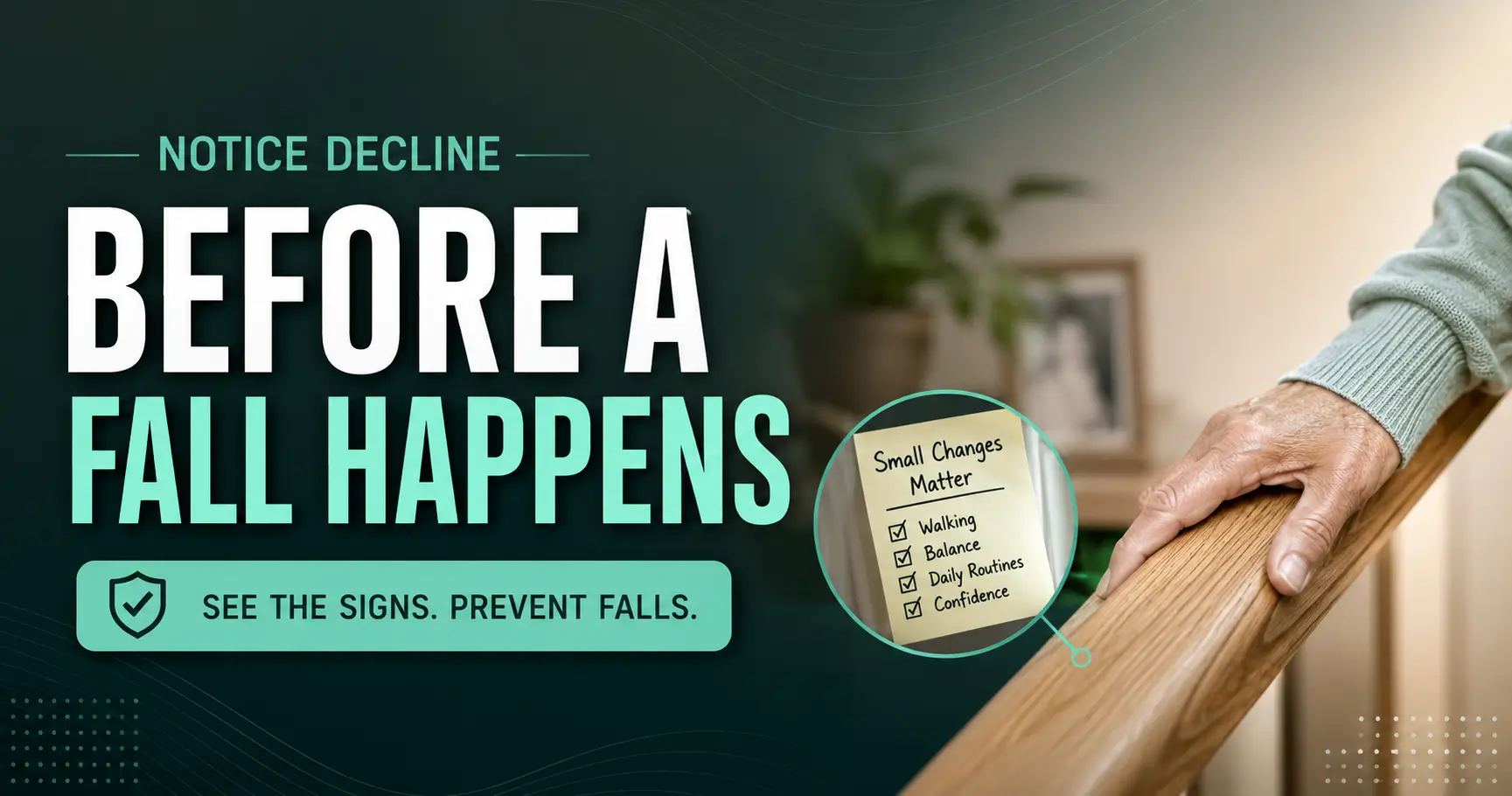
A practical guide for families, caregivers, and aging-in-place households
How to Notice Decline
Before a Fall Happens
Falls rarely send a polite calendar invitation. More often, they are preceded by quiet edits to ordinary life: a hand lingering on the kitchen counter, a slower turn in the hallway, a favorite shower skipped because the whole process suddenly feels exhausting.
Those changes can be easy to dismiss. Families may call them caution, tiredness, stubbornness, or simply aging. Yet when several small changes begin traveling together, they may reveal declining strength, balance, confidence, vision, coordination, or general health before an injury forces everyone to pay attention.
This guide shows you what to observe, how to separate a one-off awkward moment from a meaningful pattern, when to request professional help, and how to raise the subject without making an older adult feel watched, managed, or quietly evicted from their own independence.
See the early clues
Recognize changes in walking, transfers, routines, and confidence.
Know what matters
Distinguish gradual decline from symptoms that may need urgent care.
Act without taking over
Start a useful healthcare conversation while protecting dignity.
👣 The goal is not to predict every fall. It is to notice when everyday movement begins asking for more help than it used to.
Article snapshot
This guide is for older adults, family caregivers, and anyone noticing subtle changes in mobility or daily function. You will learn what to watch, what to record, which home risks to address, how to discuss concerns respectfully, and when symptoms should move from observation to prompt or emergency care.
Table of Contents
Safety Note: Observation Is Not Diagnosis
This article can help you notice and describe changes, but it cannot determine their cause. A slower walk may relate to pain, weakness, medication effects, reduced vision, infection, dehydration, low blood pressure, neurological illness, heart problems, fear of falling, or several factors operating at once.
That uncertainty matters. The safest response is not to diagnose from the kitchen doorway. It is to collect clear observations, reduce immediate hazards, and involve an appropriate healthcare professional when a change is new, repeated, worsening, or interfering with daily life.
Symptoms that may require emergency care
Call 911 in the United States, or your local emergency number elsewhere, when symptoms appear life-threatening. Do not drive someone yourself when they may need emergency monitoring or treatment during transport.
- Sudden weakness or numbness, especially on one side
- Facial drooping, trouble speaking, or difficulty understanding speech
- New confusion, collapse, fainting, or inability to stay awake
- Severe dizziness with inability to stand or walk
- Chest pain, severe shortness of breath, or a racing or irregular heartbeat with weakness
- A sudden, severe headache unlike the person’s usual headaches
- Head injury followed by vomiting, confusion, unusual sleepiness, or worsening pain
- Inability to bear weight after a fall or a visibly shortened, rotated, or deformed limb
Changes that deserve a prompt medical review
Not every concerning change is an emergency, but waiting for the next routine visit may be unwise. Contact a clinician promptly for new balance problems, repeated near-falls, unexplained bruising, worsening weakness, new difficulty rising from a chair, persistent dizziness, sudden fatigue, or a noticeable decline after a medication change or illness.
The word new carries weight. A person who has always moved slowly but remains stable presents a different picture from someone who walked comfortably last week and now reaches for every piece of furniture.
Key takeaway
A home observation is most useful when it answers three questions: What changed? When did it begin? Is it happening again or getting worse?
The Quiet Changes That Often Arrive Before a Fall
Early decline often hides inside ordinary behavior. The person may still get from the bedroom to the kitchen, still attend appointments, and still insist that everything is fine. The change is not necessarily whether a task gets completed. It may be how much effort, support, planning, or recovery the task now requires.
A useful question is: What does this activity cost today compared with a month ago? More time, more hand support, more rest, more pain, and more hesitation can all be meaningful.
Walking speed drops before anyone calls it mobility decline
A slower pace does not automatically mean danger. People slow down when they are tired, distracted, sore, or walking on an unfamiliar surface. Concern grows when the change persists across settings or arrives with shuffling, shorter steps, uneven timing, widened foot placement, or difficulty beginning to walk.
Watch for a person who starts moving normally but fades after a short distance. That may reveal reduced endurance that is not obvious during a brief greeting at the door. Also notice whether conversation makes walking less steady. Managing movement and attention at the same time can expose difficulty that disappears when the person concentrates on walking alone.
Do not secretly race the person or announce a timed test unless a clinician has asked you to do so. Natural observation is often more representative and far less irritating. Nobody enjoys discovering that the trip to the refrigerator has become an unauthorized sporting event.
Furniture becomes an unofficial handrail
One light touch on a counter may simply be habit. A chain of touches is different: bedframe, dresser, wall, doorjamb, countertop, chair back. This pattern is sometimes called furniture walking, and it can suggest that the person no longer trusts unsupported movement.
The distinction between touching and loading matters. A fingertip brushing the counter is not the same as a palm pressing down while the shoulders stiffen. Look at the whole movement rather than policing every hand placement.
Furniture is also an unreliable support system. Chairs move. Tables tip. Decorative cabinets were designed to hold family photographs, not a startled adult’s body weight. When someone needs regular support, a professional assessment may help determine whether a properly fitted mobility aid, targeted therapy, or another intervention is appropriate.
Daily routines shrink without an announcement
Decline may first appear as subtraction. The person stops going downstairs for laundry, avoids the mailbox, eats whatever requires the fewest steps, or showers less often. They may stop attending a weekly activity and offer a reasonable explanation each time.
One canceled outing proves very little. A series of canceled outings, especially when paired with fatigue or fear, deserves attention. Reduced activity can also create a difficult loop: movement feels harder, so the person moves less; moving less gradually reduces strength and confidence; the same activity then feels even harder.
Ask about the missing routine rather than accusing the person of decline. “I noticed you have not been out to the garden lately. Is something making that harder?” opens a door. “You cannot manage the garden anymore” closes it with a heavy click.
Confidence may disappear before strength does
Fear of falling can change behavior before a measurable loss of strength becomes obvious. A person may pause at thresholds, refuse unfamiliar chairs, avoid turning quickly, or become tense when someone walks close behind them.
This fear is not imaginary just because a fall has not occurred. A near-fall, a friend’s injury, a slippery bathroom moment, or a spell of dizziness can make the floor feel newly untrustworthy. The resulting caution may be adaptive, but severe avoidance can reduce independence and physical capacity.
Instead of saying, “There is nothing to be afraid of,” ask, “Which part feels least steady?” The answer may point to a specific, fixable problem: low lighting, pain while turning, poor footwear, a rushed bathroom trip, or difficulty stepping over the tub wall.
Early-warning checklist
- Walking noticeably slower than usual
- Using walls or furniture for repeated support
- Taking several attempts to stand
- Avoiding stairs, showers, errands, or social activities
- New bruises or unexplained scrapes
- Becoming unusually tired after routine movement
- Expressing fear about falling or “giving way”
The Five-Minute Home Scan That Reveals More Than a Formal Conversation
A formal question such as “Are you having trouble walking?” often receives a quick “No.” The answer may be sincere. People compare themselves with a dramatic image of disability, not with their own movement three months earlier.
Observation adds context. You are not trying to administer a clinical test. You are watching a few ordinary transitions that combine strength, balance, coordination, vision, judgment, and confidence.
Watch the first few steps after standing
The transition from sitting to walking is especially informative. Notice whether the person rocks several times, pushes heavily through both arms, pauses after standing, looks dizzy, or begins walking before fully steady.
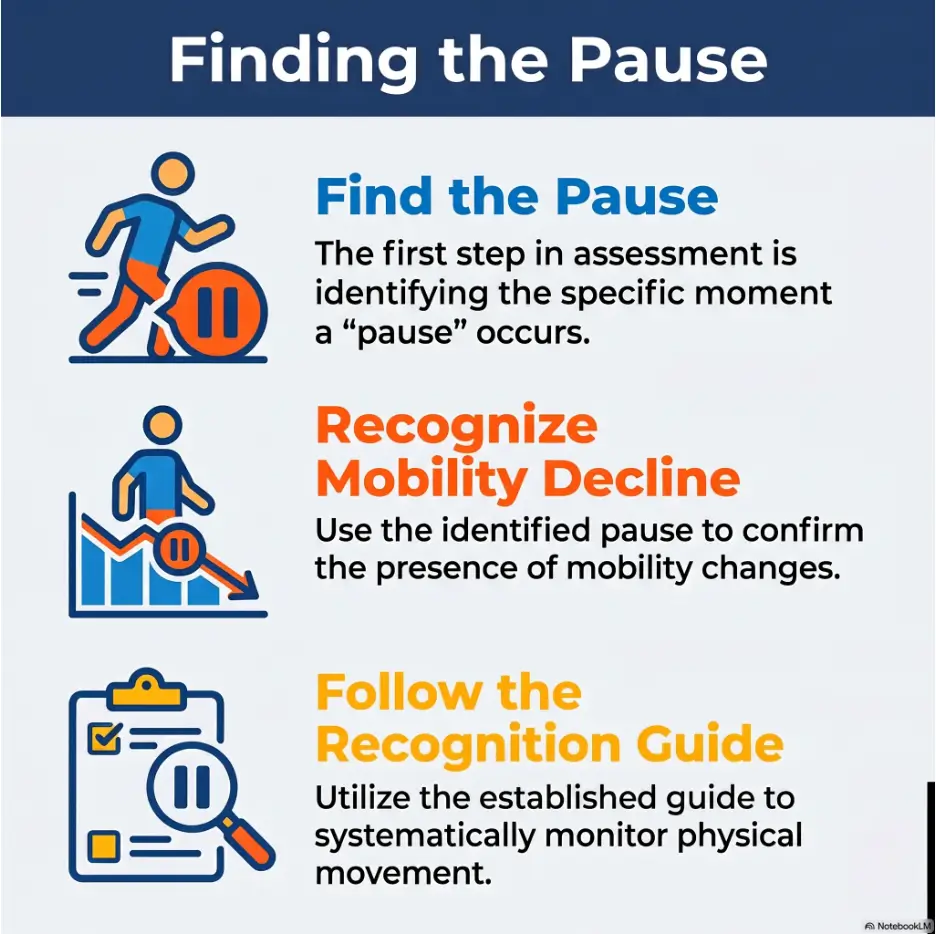
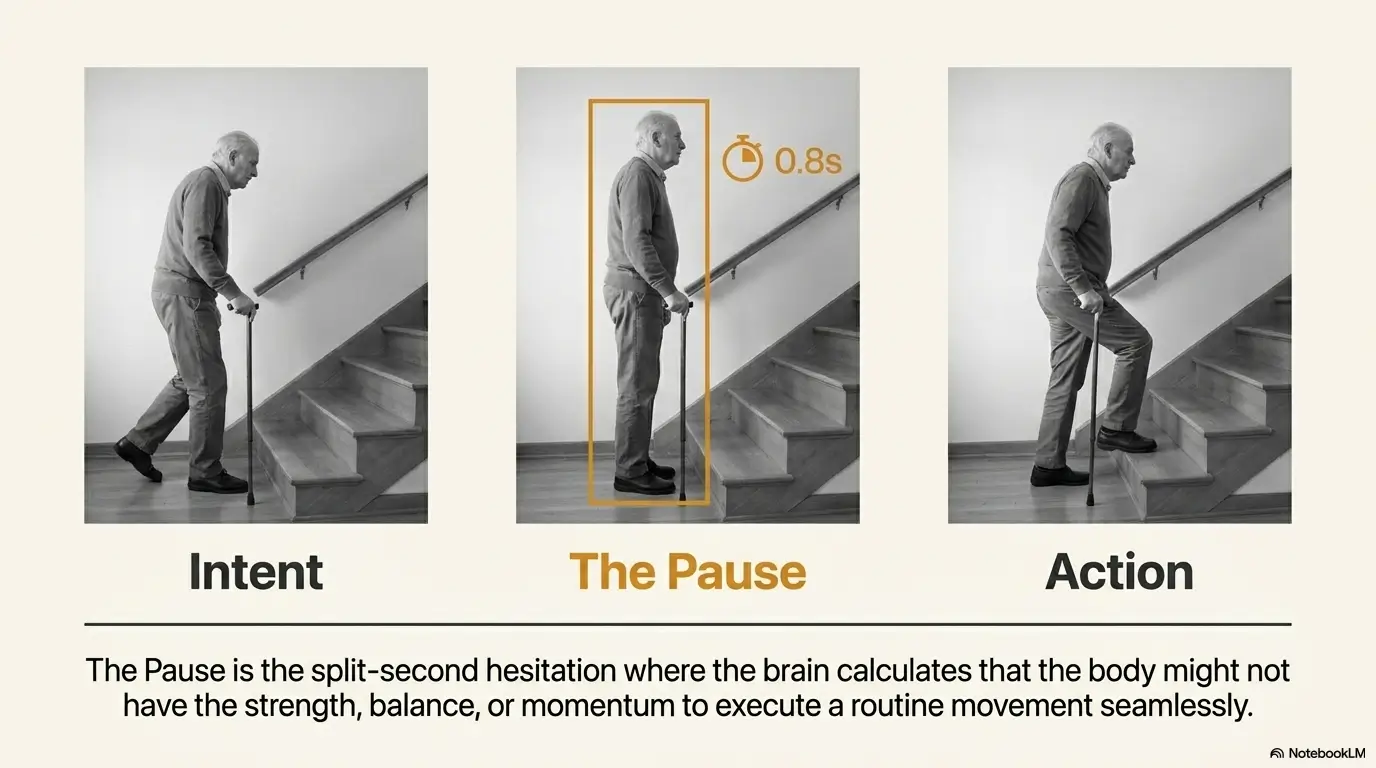
A brief pause can be wise. A new pause accompanied by swaying, gripping, blinking, or a comment such as “Give me a second” deserves closer attention. It may relate to pain, weakness, blood pressure changes, medication effects, or another medical issue that requires assessment.
Also notice chair height. A low, soft couch is harder to rise from than a firm dining chair. Difficulty in one unusually deep seat is less informative than difficulty across several ordinary chairs.
Notice how the person turns, pauses, and changes direction
Straight-line walking tells only part of the story. Many falls happen during transitions: turning toward a chair, stepping around a pet, backing up, opening a door, or carrying something while changing direction.
Watch whether the person turns smoothly or uses many tiny steps. Notice crossed feet, sudden grabbing, excessive leaning, or a tendency to lose balance when looking over a shoulder. These observations are more useful than saying someone “seemed off.”
In a medical appointment, “She now takes six or seven little steps to turn around and reaches for the wall” gives the clinician something concrete to investigate.
Look for hesitation at thresholds, stairs, and uneven flooring
Transitions in surface height or texture demand visual judgment and foot clearance. A dark mat on a light floor may look like a hole to someone with reduced contrast sensitivity. A raised threshold may catch a foot that no longer lifts as high as it once did.
Look for toe scuffing, incomplete foot placement on steps, reaching for both walls, or stopping before a change in surface. Hesitation may reflect caution, but repeated hesitation can indicate that the environment and the person’s current abilities no longer fit comfortably.
For a room-by-room approach to safer walking routes, see this practical guide to walker path safety at home. Even when a walker is not currently used, the same principles help expose clutter, narrow turns, unstable furniture, and poorly lit transitions.
The hidden clue: what happens when attention is divided
Walking while talking, carrying a mug, finding keys, or responding to a pet requires the brain to manage several tasks at once. A person may walk steadily in silence but stop moving whenever they speak. That “stop walking when talking” pattern can be worth reporting if it is new or pronounced.
Do not manufacture distractions. Simply observe real life. Does the person wobble when turning to answer? Do the steps become shorter while carrying laundry? Does reaching into a pocket interrupt balance?
The Notice–Compare–Record–Respond Framework
1
Notice
Describe the exact movement, hesitation, support, or symptom.
2
Compare
Ask whether this differs from the person’s usual function.
3
Record
Note timing, frequency, triggers, medications, illness, and recovery.
4
Respond
Remove immediate hazards and choose routine, prompt, or emergency care.
Chair, Stairs, Shower: Three Places That Expose Early Decline
Some movements are especially revealing because they ask several body systems to cooperate. Standing from a chair requires leg strength and forward weight shift. Stairs require single-leg control, foot clearance, vision, and confidence. Bathing adds slippery surfaces, temperature changes, reaching, and privacy concerns.
Chair rises reveal changes in strength and balance
Observe how a person gets up from a familiar chair. Do they move toward the edge first? Do they place both feet under the knees? Do they need several attempts? Do the knees buckle inward, or does one leg do most of the work?
Using armrests is not inherently a problem. The concern is a change in reliance. Someone who previously stood without using the arms but now pulls hard on a table may be compensating for pain, weakness, or reduced balance.
Also watch the landing. A person may successfully stand, then fall backward into the chair or remain bent forward while searching for stability. That recovery phase is part of the movement, not an afterthought.
Stair habits show whether one side is compensating
A new step-to pattern, where both feet meet on each stair, may indicate pain, weakness, fear, or reduced control. Sideways climbing, pulling heavily on the railing, or consistently leading with the same leg can also reveal compensation.
Do not insist that a person demonstrate stair difficulty for you. Observe only when stairs are already part of the routine, and stay close enough to summon help without crowding or startling them.
Environmental details matter here. Loose carpet, objects left on steps, poor lighting, and an absent or unstable handrail can turn a manageable physical limitation into a dangerous equation.
Shower routines can uncover fear, fatigue, or dizziness
Bathing is physically demanding and deeply private. A person may avoid discussing difficulty because they fear loss of independence or unwanted help. Clues may include fewer showers, switching to sink washing, leaving hair unwashed, wearing the same clothes, or refusing to bathe unless someone is nearby.
The problem may be stepping over the tub wall, standing with eyes closed while rinsing, reaching the feet, coping with heat-related dizziness, or getting out when tired. Each problem calls for a different response.
A respectful conversation is often more effective than arriving with equipment and a renovation plan. This guide to having a shower safety conversation can help families discuss support without turning the bathroom into a referendum on competence.
Key takeaway
Look at effort, support, hesitation, and recovery. Completing the task does not always mean the task is still safe or sustainable.
Short Story: The Countertop Route
Every morning, Ellen walked from her bedroom to the kitchen and made tea. Her daughter noticed nothing dramatic. The tea still appeared. The kettle still clicked. The ritual looked intact.
Then one Saturday, her daughter arrived early and saw the route itself. Ellen touched the dresser, slid a hand along the hallway wall, paused at the kitchen doorway, and pressed both palms into the counter before reaching the kettle.
Instead of saying, “You are going to fall,” her daughter said, “I noticed the walk to the kitchen takes more support than it used to. Has something changed?” Ellen admitted that a new medication left her lightheaded in the mornings.
The practical lesson was not that every countertop touch predicts a fall. It was that an unchanged destination can hide a changed journey. The useful clue lived between the bedroom and the tea.
Near-Falls Count: The Events Families Often Forget
A near-fall is an event in which someone loses balance but avoids landing on the floor by grabbing an object, stepping quickly, leaning into a wall, or receiving help. Because there is no injury, the event often vanishes from family memory within hours.
That is a missed opportunity. Near-falls can reveal triggers and patterns before the consequences become more serious.
A stumble without injury is still useful information
Record what happened immediately before the loss of balance. Was the person turning, standing after a long rest, walking to the bathroom at night, stepping over a threshold, carrying an object, or reacting to a pet?
Then note the recovery. Did they catch themselves easily, need several minutes to settle, report dizziness, or seem confused about the event? A quick trip over a visible object differs from an unexplained loss of balance on a clear floor.
New bruises may tell a story the person does not remember
Bruises on the arms, hips, knees, or back may result from bumping into furniture or catching the body during a near-fall. Some medications and health conditions also make bruising easier, so bruises alone do not prove that a fall occurred.
Ask neutrally: “Do you remember how this happened?” Avoid an interrogation. If bruises are frequent, unexplained, unusually large, painful, or accompanied by other symptoms, contact a healthcare professional.
Take special care when a person uses blood-thinning medication. A fall or head impact that appears minor can carry additional risk and may require medical advice even when the person initially feels well.
Repeated little saves matter more than one dramatic incident
A single stumble over a delivery box may be exactly what it looks like. Three near-falls in two weeks, each during ordinary walking, form a different pattern. Frequency, similarity, and change from baseline matter more than theatricality.
Do not wait for a numeric threshold before seeking help. There is no universal rule that the third near-fall is medically important while the second is harmless. A single unexplained event with dizziness, weakness, faintness, or injury may warrant prompt assessment.
| Observation | Possible context | Useful next step |
|---|---|---|
| One trip over obvious clutter | Environmental hazard | Remove the hazard and watch for repetition |
| Repeated grabbing during turns | Balance, strength, vision, pain, or coordination change | Document examples and arrange a medical review |
| Near-fall after standing | Possible lightheadedness or blood pressure change | Contact a clinician, especially if new or recurring |
| Loss of balance with sudden weakness or speech difficulty | Possible emergency neurological event | Call emergency services immediately |
The Pattern Behind the Pattern: What Else Changed?
Fall risk does not always begin in the legs. A change in movement may be the visible end of a much longer chain involving medications, sleep, hydration, pain, vision, hearing, footwear, illness, nutrition, mood, or the environment.
When mobility changes, look sideways as well as downward. Ask what else changed in the days or weeks before the new difficulty appeared.
New medications, dose changes, and sedating combinations
Prescription drugs, over-the-counter medicines, sleep aids, and supplements can affect alertness, blood pressure, coordination, vision, or reaction time. Risk may increase when several medicines have overlapping effects.
Do not stop prescribed medication abruptly unless a qualified clinician instructs you to do so. Instead, prepare a complete medication list that includes doses, timing, recent changes, nonprescription products, and any symptoms noticed afterward.
A pharmacist can often help identify duplication, timing problems, and combinations worth discussing with the prescriber. The key question is not simply “Does this medicine cause falls?” It is “Could this person’s current combination, dose, timing, health status, or recent change be contributing to these symptoms?”
Vision, hearing, footwear, and foot pain
Reduced vision can make steps, curbs, shadows, and floor transitions harder to judge. Bifocal or multifocal lenses may distort the lower visual field during stair use. Hearing changes can reduce awareness of approaching people, pets, alarms, or environmental cues.
Footwear deserves more respect than it usually receives. Loose slippers, worn soles, backless shoes, and socks on smooth floors can undermine otherwise steady movement. Painful feet, numbness, long toenails, swelling, or poorly fitting shoes may change the way a person places each step.
Do not solve every footwear concern by buying heavy, rigid shoes. Comfort, fit, traction, fastening, swelling, foot shape, and the person’s ability to put the shoes on all matter. A podiatrist, physical therapist, occupational therapist, or other qualified professional may be helpful when foot problems affect walking.
Illness, dehydration, poor sleep, and reduced appetite
A mild illness can have an outsized effect on an older adult’s function. Infection, fever, vomiting, diarrhea, reduced fluid intake, and poor appetite can contribute to weakness or confusion. Sometimes the first visible sign of illness is not a textbook symptom but a sudden inability to manage the usual routine.
Poor sleep can also reduce attention and reaction speed. Nighttime bathroom trips become more hazardous when someone is groggy, rushed, underhydrated, or affected by medication.
Watch for dark urine, dry mouth, low intake, unusual sleepiness, confusion, fever, or a rapid decline in function. These observations should be discussed with a clinician rather than treated solely as a home-safety problem.
Mood changes and social withdrawal can quietly reduce movement
Depression, anxiety, grief, and loneliness can shrink daily activity. A person who stops going out may lose conditioning, eat less regularly, sleep poorly, and become more fearful of movement.
Conversely, physical decline may cause withdrawal. Someone may stop attending a group because the entrance stairs feel unsafe, not because they have lost interest. Ask what made the activity harder before assuming a lack of motivation.
Show me the nerdy details
A fall often results from several smaller contributors rather than one dramatic defect. A person may have mild leg weakness, slightly reduced vision, a sedating medication, and a poorly lit route to the bathroom. Each factor alone may be manageable. Together, at 2 a.m., they can overwhelm the person’s ability to recover from a misstep.
This is why useful fall-risk assessment looks beyond balance. Clinicians may review gait, strength, blood pressure changes, cognition, vision, feet, footwear, medications, home setup, continence, pain, and recent illness. The goal is to identify modifiable contributors rather than assign one tidy cause to a complicated event.
Explore the CDC STEADI Fall-Prevention Resources
Common Mistakes That Make Decline Harder to See
Families usually miss early decline for understandable reasons. The changes are gradual, the person compensates skillfully, and nobody wants to overreact. Yet several common responses can hide the pattern or make cooperation less likely.
Mistake: waiting for an actual fall
A fall is not the admission ticket for assessment. Repeated near-falls, new furniture walking, sudden activity reduction, or growing difficulty with transfers may justify action before an injury occurs.
Early action does not always mean a large intervention. It may mean reviewing medication, replacing a loose mat, scheduling an eye examination, addressing pain, improving lighting, or asking for physical or occupational therapy.
Mistake: blaming every change on normal aging
Aging can bring changes in strength, vision, reaction time, and endurance. That does not make every sudden or progressive decline inevitable, untreatable, or unworthy of evaluation.
“She is 82” explains her age. It does not explain why she began stumbling this week. Treat the timeline as information. A new change has a beginning, and that beginning may contain an important clue.
Mistake: asking only whether the person feels dizzy
Dizziness is important, but the word means different things to different people. One person means spinning. Another means faintness, blurred vision, imbalance, weakness, or a vague sense that the body is not keeping up.
Ask specific questions: “Does the room spin?” “Do you feel faint after standing?” “Do your legs feel weak?” “Does your vision darken?” “Does it happen before meals, after medication, or during turning?” Specific language improves the quality of the medical conversation.
Mistake: removing every activity instead of making movement safer
Fear can prompt families to say, “Do not use the stairs,” “Stop walking outside,” or “Just sit down and let me do it.” In the immediate aftermath of an injury or during an acute illness, temporary restriction may be appropriate under professional guidance.
As a long-term strategy, unnecessary inactivity can reduce strength, endurance, confidence, and social connection. The better question is often: “How can this activity be made safer, and what support is appropriate?”
Do not turn observation into surveillance
Avoid narrating every wobble, following inches behind, or correcting movement all day. Constant monitoring can create anxiety and resistance. Agree on what will be observed, share what you notice, and involve the person in deciding the next step.
| Less useful response | More useful response | Why it helps |
|---|---|---|
| “You are getting too old for this.” | “I noticed the stairs take more effort lately.” | Uses observation rather than judgment |
| “You are going to fall.” | “What part feels least steady?” | Invites useful detail |
| “Stop doing that.” | “Let us find a safer way to keep doing it.” | Keeps independence in view |
| “You never listen.” | “Would you prefer to call the doctor or pharmacist first?” | Offers a manageable choice |
When to Seek Help Before the Situation Becomes a Crisis
Seeking help early does not mean declaring that someone can no longer live independently. In many cases, assessment is precisely what protects independence by identifying treatable medical issues, safer techniques, useful equipment, or targeted exercises.
Arrange a medical review for new or worsening mobility changes
Start with the person’s primary care clinician when the cause is unclear. Bring examples rather than broad labels. “He seems frail” is less useful than “During the last ten days, he has needed both arms to rise from the dining chair and has nearly fallen twice while turning.”
The clinician may assess strength, gait, balance, blood pressure, cognition, heart rhythm, pain, neurological function, hydration, infection, and other possible contributors. Testing and referrals depend on the symptoms and medical history.
For pain or function concerns that may need specialty input, an organized orthopedic appointment checklist can help the family arrive with medication details, symptom timing, functional changes, and practical questions.
Ask for medication, vision, balance, and strength assessment
A comprehensive review may involve more than one professional. A pharmacist may review medication interactions and timing. An eye-care professional may evaluate vision. A physical therapist may assess gait, strength, balance, transfers, and mobility-aid use.
An occupational therapist may examine how the person manages bathing, dressing, cooking, bathroom use, stairs, and movement within the home. The focus is practical function: not simply whether a muscle is weak, but how that weakness affects real tasks.
Consider therapy when daily tasks become harder
Physical therapy may be helpful when walking, balance, strength, endurance, or transfers have changed. Occupational therapy may be helpful when daily activities, home setup, equipment use, or task methods need attention.
Therapy should be individualized. Copying exercises from a friend, a video, or a faded handout from 2014 may not address the current problem. Pain, neurological symptoms, recent surgery, heart or lung disease, and other conditions may change what is safe.
Stop and escalate when symptoms change suddenly
Stop a home observation or activity if the person develops chest pain, severe shortness of breath, faintness, new neurological symptoms, severe pain, sudden inability to bear weight, or rapidly worsening weakness. This is not the moment to collect one more data point.
After a fall, do not rush to pull the person up. Check for pain, bleeding, deformity, head impact, confusion, and ability to move. Call emergency services when a serious injury or medical event is possible.
Review the National Institute on Aging Home Fall Checklist
Appointment preparation list
- Exact date or week the change began
- Two or three specific examples
- Number and circumstances of falls or near-falls
- Current medication and supplement list
- Recent illness, appetite, sleep, or hydration changes
- New pain, numbness, dizziness, weakness, or confusion
- Tasks the person has stopped or modified
- Questions about therapy, vision, footwear, and home safety
A Fall-Risk Conversation That Preserves Dignity
A technically correct observation can still fail if it is delivered as a verdict. Older adults may resist because they fear losing their car, home, privacy, routines, or decision-making authority. Those fears are not irrational. Safety conversations can carry consequences.
The aim is partnership. Speak to the person, not around them. Choose a calm time rather than raising the issue during a frightening wobble, a family argument, or a rushed departure.
Begin with a specific observation, not a frightening prediction
Say what you saw and when you saw it. “Yesterday, you needed the counter and chair to get from the stove to the table” is more respectful and more useful than “You are unstable now.”
Avoid presenting your interpretation as settled fact. You may have noticed the result without knowing the cause. Pain, dizziness, fear, footwear, weakness, or a temporary illness may produce similar behavior.
Ask what feels harder rather than declaring what is wrong
Questions give the person room to contribute information that observation cannot provide. Useful prompts include:
- “Which movement feels least steady?”
- “Do you feel pain, weakness, spinning, or faintness?”
- “Is there a time of day when it is worse?”
- “Did this begin after an illness or medication change?”
- “What activity are you avoiding because it feels difficult?”
- “What kind of help would feel useful rather than intrusive?”
Offer choices about the next step
Choice protects agency. You might ask whether the person prefers to call the primary care office, speak with the pharmacist, schedule an eye examination, or begin with a home-safety review.
The choices must be real. “Would you like to call the doctor now or after I call for you?” is not much of a choice. When the situation is not urgent, allow time for discussion and include the person in practical decisions.
Keep independence at the center
Frame support as a way to preserve valued activities. Better lighting may protect nighttime bathroom independence. Therapy may help someone keep using the garden. A properly fitted mobility aid may make community outings possible again.
Safety works better when it does not sound like a takeover. The question is not “How do we stop you from doing things?” It is “What would help you keep doing the things that matter?”
Key takeaway
Use the sequence: observation, question, choice, next step. It keeps the conversation grounded and reduces the urge to defend, deny, or retreat.
Use the NCOA Caregiver Fall-Prevention Conversation Guide
Build a Simple Decline Log Without Turning Life Into a Spreadsheet
Memory compresses repeated events. Three near-falls become “a couple of wobbles.” A gradual decline becomes “she has been like this for ages.” A short, objective log preserves the timeline without turning the household into a research laboratory.
Record the date, activity, and exact change
Write what an outside observer could have seen or heard. Avoid labels such as “frail,” “careless,” “confused as usual,” or “being difficult.” Those phrases mix observation with interpretation.
A useful entry might read: “June 8, 7:30 a.m. Stood from kitchen chair using both arms. Paused about ten seconds and held the table. Said vision felt dark for a moment. Improved after sitting.”
Separate one-time incidents from repeating patterns
One difficult morning after poor sleep may resolve. Similar difficulty on four mornings after a new medication is a pattern worth reporting. Use the log to identify frequency, timing, triggers, and progression.
Do not wait for certainty. The log is not a courtroom exhibit. It is a communication tool that helps a clinician ask better questions.
Add context without writing a biography
Include recent medication changes, illness, pain, poor sleep, reduced food or fluid intake, and any unusual stress. These details may explain why function varies by day or time.
Keep the entry brief enough that you will continue using it. A six-column masterpiece abandoned after Tuesday is less useful than four plain sentences maintained for two weeks.
Bring the log to appointments
Place the most important changes at the top. Clinicians often work within tight time limits, so begin with the headline: new mobility decline, repeated near-falls, or sudden difficulty with a specific task.
Caregivers can use these caregiver notes for orthopedic appointments to organize observations without speaking over the patient or losing the essential details in a long family history.
Simple decline-log template
Date and time: ______________________________
Activity: ____________________________________
What I observed: _____________________________
Symptoms reported: ___________________________
Possible context: medication, illness, sleep, food, fluids, pain
Recovery or outcome: ___________________________
What to leave out
Skip arguments, motives, amateur diagnoses, and character judgments. “Refused because stubborn” is interpretation. “Declined the walk and said the right knee hurt” is usable information.
FAQ
What are the earliest signs that an older adult may be at risk of falling?
Early signs may include slower or shorter steps, repeated use of furniture for support, difficulty rising from a chair, hesitation during turns, reduced activity, new fear of falling, unexplained bruises, and repeated near-falls. A pattern or change from the person’s usual function matters more than one isolated sign.
Is slower walking always a sign of physical decline?
No. People may walk slowly because of fatigue, pain, distraction, unfamiliar surroundings, or caution. Concern increases when the slower pace is new, persistent, worsening, uneven, or accompanied by shuffling, weakness, dizziness, furniture-grabbing, or reduced activity.
Why does holding onto furniture increase concern about fall risk?
Repeated furniture support may indicate reduced balance, strength, confidence, or endurance. Furniture can slide or tip, so it is not a reliable substitute for professional assessment or a properly selected mobility aid.
Can medication changes cause sudden balance problems?
Yes. Some medications and combinations may contribute to dizziness, sedation, blurred vision, lower blood pressure, or slower reactions. Do not stop prescribed medication on your own. Contact the prescriber or pharmacist and report the timing of symptoms in relation to the change.
How many near-falls should happen before contacting a doctor?
There is no universal number. One unexplained near-fall with faintness, sudden weakness, confusion, or other concerning symptoms may need prompt attention. Repeated near-falls, even without injury, should be discussed with a healthcare professional.
What type of healthcare professional evaluates fall risk?
A primary care clinician can begin the medical evaluation. Depending on the findings, the person may also benefit from a pharmacist, physical therapist, occupational therapist, eye-care professional, podiatrist, neurologist, cardiologist, or another specialist.
Should an older adult stop exercising after a near-fall?
Not automatically. Unnecessary inactivity can reduce strength and confidence. However, exercise should stop when there is severe pain, faintness, chest pain, new neurological symptoms, injury, or sudden inability to move safely. A clinician or therapist can help determine an appropriate return to activity.
When does dizziness or weakness require emergency care?
Call emergency services for sudden weakness, facial drooping, speech difficulty, severe chest pain, fainting, severe shortness of breath, new confusion, inability to stand, or severe dizziness with neurological symptoms. When uncertain and symptoms appear serious, emergency evaluation is safer than waiting.
Observe One Everyday Movement Today
Choose one routine movement that already happens naturally: standing from the dining chair, walking to the bathroom, turning toward the kitchen counter, stepping onto the porch, or getting into bed.
Do not coach, challenge, time, or test. Simply notice six things: speed, balance, hand support, hesitation, pain, and recovery. Write one or two sentences describing only what happened.
Then ask whether the movement is different from the person’s usual pattern. If the answer is yes, note when the change began and whether it is repeating. Remove any immediate hazard, such as loose clutter or poor lighting, without assuming that the environment is the whole explanation.
If the change is new, worsening, repeated, or paired with symptoms such as dizziness, weakness, confusion, or unusual fatigue, use your observation to begin a healthcare conversation. You do not need a diagnosis. You need a clear sentence that helps the right person understand what changed.
Your 15-minute next step
- Observe one ordinary movement without interrupting.
- Write the exact change in one sentence.
- Check the route for one removable hazard.
- Ask the person what felt difficult.
- Decide whether to monitor, call a clinician, or seek urgent help.
The warning before a fall is rarely a flashing sign. It may be a hand on a wall, a smaller world, or a pause that was not there last month. Noticing that pause with care, accuracy, and respect can turn a vague worry into a practical next step.
Last reviewed: 2026-06