

A practical home-recovery guide for family caregivers
Bed Sheet Changes After Hip Surgery:
Safer Steps for Caregivers
Changing a fitted sheet usually belongs in the harmless corner of household life. After hip surgery, however, the task quietly gathers sharp edges: a walker parked too far away, a low chair, a rushed turn, a damp protector, or one determined patient saying, “I can manage.” The laundry itself is rarely the difficult part. The transfer before it and the return afterward are where safety is won or lost.
This guide helps family caregivers prepare the room, move a medically stable adult out of bed using the method taught by the care team, remake an empty bed without straining, and recognize when an occupied-bed change requires professional instruction. It also explains why generic hip precautions are not enough. A person recovering from total hip replacement may have different instructions from someone recovering from hip-fracture repair, revision surgery, or another procedure.
You will not find heroic lifting advice here. Good caregiving is less like a rescue scene and more like setting a quiet stage: the path is clear, every prop is within reach, the patient knows the next movement, and nobody improvises while balancing on one foot.
PREPARE ONCE
Gather linens, clear hazards, and choose the waiting chair before the patient moves.
TRANSFER SAFELY
Follow the exact bed-exit and weight-bearing method taught during rehabilitation.
KNOW WHEN TO STOP
Pause for dizziness, new pain, weakness, wound changes, or an unsafe transfer.
🛏️ The goal is not a perfectly tucked corner. It is a clean bed reached without a fall, forced movement, or caregiver injury.
Article snapshot
Who it is for: Family caregivers helping a medically stable adult recover at home after hip replacement, hip-fracture surgery, or a related operation. What it solves: How to change bedding without turning an ordinary chore into a risky transfer. What you can do next: Build a safer linen station, check the patient’s individualized instructions, and request a five-minute transfer demonstration when anything remains uncertain.
Table of Contents
Safety Comes Before Fresh Sheets
Hip recovery instructions are not interchangeable. The safest movement for one patient may conflict with another patient’s operation, weight-bearing status, wound location, strength, balance, or surgical approach.
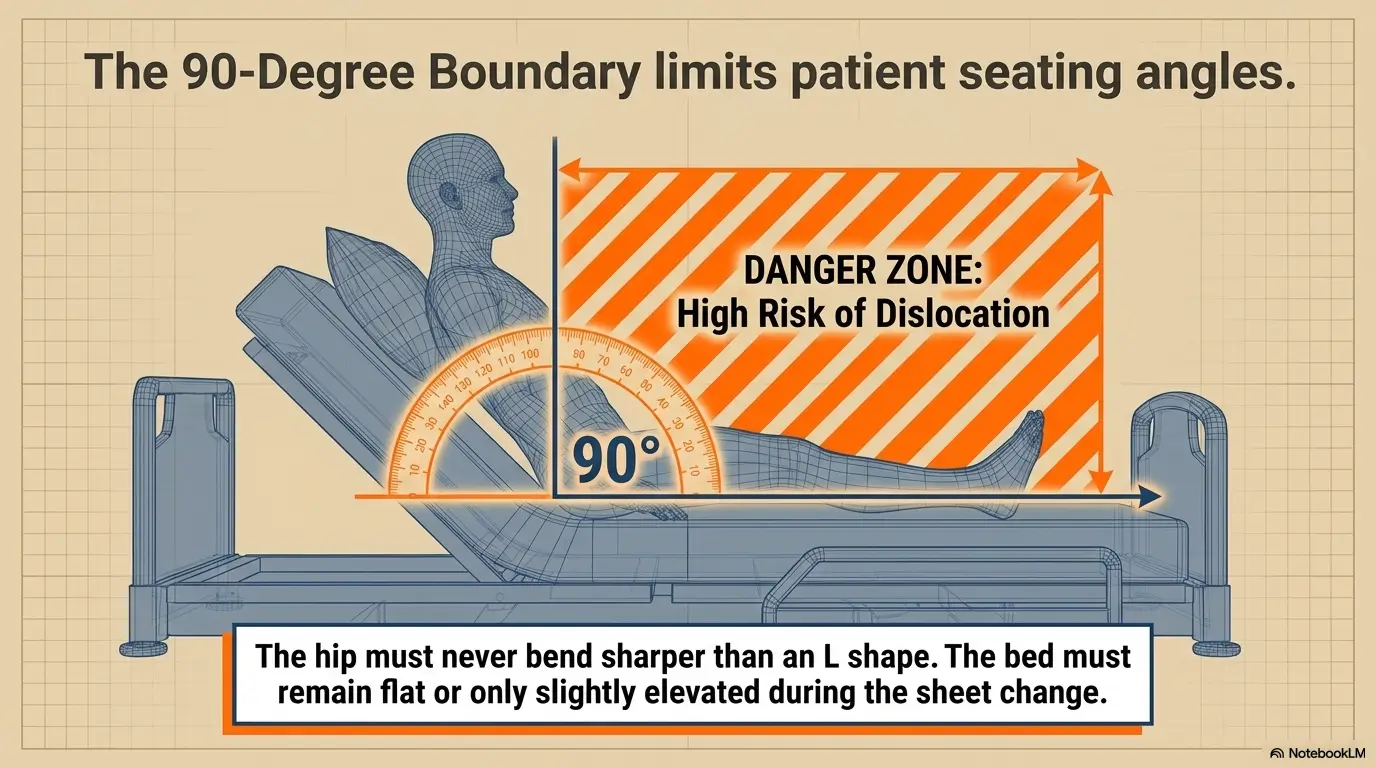
Some people are instructed to limit hip bending, avoid crossing the legs, or prevent the operated leg from turning inward. Others receive fewer movement restrictions but still have temporary weakness, pain, dizziness, or limits on how much weight they may place through the operated side. A person recovering after a fracture may also be managing frailty, anemia, confusion, or fear after a fall.
Safety and medical disclaimer
This article provides general caregiver education, not individualized medical or transfer training. Follow the patient’s surgeon, physical therapist, occupational therapist, nurse, and written discharge instructions. Do not attempt a solo transfer, occupied-bed change, lift, roll, or repositioning maneuver that the care team has not approved and demonstrated.
Why the exact procedure changes the plan
“Hip surgery” is a broad label. It may refer to total hip replacement, partial hip replacement, fracture fixation with screws or a nail, revision surgery, or another operation involving the pelvis or upper femur. Each can produce a different set of movement rules and recovery expectations.
Before changing sheets, confirm what operation occurred and which leg was treated. It sounds basic, yet in a busy household details can blur, especially when several relatives share caregiving duties. Write the information on a single caregiver sheet rather than relying on memory.
Understand the patient’s weight-bearing language
Discharge instructions may use terms such as weight bearing as tolerated, partial weight bearing, toe-touch weight bearing, or non-weight bearing. These terms affect how the patient stands, turns, and reaches the temporary chair.
Do not translate these phrases into your own household version. “Just put a little weight on it” may be wrong. Ask the therapist to show exactly what the instruction looks like during a bed transfer and a short walk.
Why “I feel fine” is not a movement plan
Pain medicine, determination, embarrassment, or the relief of finally being home can make a patient feel more capable than they are. Muscle control and blood pressure may still lag behind confidence.
Respect the patient’s independence while keeping the agreed sequence intact. A useful response is, “I know you can do a lot. Let’s use the method the therapist approved so you do not lose ground over a fitted sheet.”
Key takeaway
Do not begin with a universal list of hip precautions. Begin with this patient’s operation, written restrictions, weight-bearing order, prescribed mobility aid, and demonstrated transfer method.
Start With the Discharge Instructions, Not the Laundry Basket
A safe sheet change starts on paper. Before touching the bedding, locate the discharge packet, therapy notes, or home-health instructions. You are looking for the rules that affect standing, turning, sitting, rolling, and returning to bed.
Many caregivers read the medication list carefully but skim the mobility section. For this task, the mobility section is the map. A clean fitted sheet is not worth guessing whether the patient may roll onto the operated side.
Confirm these five facts before the first sheet change
- The exact operation and date of surgery.
- The operated side.
- The current weight-bearing instruction.
- The prescribed walker, crutches, cane, brace, or other equipment.
- The approved sequence for getting out of and back into bed.
Add any positioning instructions, such as use of an abduction pillow, limits on side sleeping, restrictions on rolling, or instructions for supporting the leg. Include a phone number for the surgical team and the name of the therapist who demonstrated the transfer.
Create a one-page caregiver movement card
Condense the approved steps into plain language that everyone in the household can follow. Keep the card near the bed rather than buried in a hospital folder beneath insurance papers and parking receipts.
Caregiver movement card
Operation: Write the exact procedure.
Operated side: Left or right.
Weight bearing: Copy the clinical wording exactly.
Mobility aid: Walker, crutches, cane, or other device.
Bed exit: List the steps taught by therapy.
Do not: Record patient-specific bending, twisting, crossing, rolling, or positioning limits.
Call: Add the surgical office, home-health service, and emergency numbers.
Ask the most useful question first
Ask the patient, “Show me how you were taught to get out of bed.” This reveals more than asking, “Can you get up?” The second question invites a yes-or-no answer. The first invites the approved sequence.
If the patient cannot remember the sequence, do not invent one from a video or another relative’s experience. Call the physical therapist, occupational therapist, home-health nurse, or surgical team and request clarification.
Key takeaway
A caregiver card prevents each helper from creating a different transfer method. Consistency is not fussy. It is protective.
Prepare the Room Before the Patient Moves
The most preventable mistakes occur before the patient stands. A laundry pile narrows the path. A phone charger loops across the floor. The walker sits beyond reach. The “temporary” chair turns out to be low, soft, and eager to swallow the patient whole.
Preparation should reduce the number of decisions made during the transfer. Once the patient is standing, the room should already know what happens next.
Clear the entire exit path
Trace the route from the patient’s side of the bed to the waiting chair. Remove cords, small rugs, laundry baskets, shoes, pet toys, footstools, and anything that might catch a walker leg.
Check lighting at floor level. A bright ceiling fixture can still leave shadows beside the bed. The patient may be moving before sunrise, after pain medication, or with glasses still on the nightstand.
The bedroom-lighting principles in this guide to setting up bedroom lighting after joint surgery can help you spot glare, shadows, and poorly lit walking routes before they become part of the transfer.
Choose a firm waiting chair with arms
The chair should be stable, high enough for the patient’s approved sitting posture, and equipped with armrests that support the taught sit-to-stand technique. Avoid rolling desk chairs, folding chairs, dining chairs that slide, low couches, deep recliners that are difficult to exit, and beds on casters that do not lock.
Place the chair close enough to minimize walking but far enough that you can work around the bed. The patient should not sit in a doorway, beside a wet bathroom floor, or in the middle of your linen route.
If chair height has been a recurring problem, review the practical measurements in office chair height after hip surgery. Although an office chair may not be suitable as a waiting seat, the discussion helps explain why seat height changes hip angle and standing effort.
Build a one-trip linen station
Place every clean item at waist height on a dresser, stable chair, or cleared table. Do not store fresh sheets on the floor where you must bend deeply or step around them.
- Fitted sheet.
- Top sheet or light blanket.
- Pillowcases.
- Approved mattress protector or absorbent pad.
- Laundry bag for soiled items.
- Disposable gloves if body fluids or wound drainage may be present.
- Any positioning pillows or equipment specified by the care team.
- A clean place for the patient’s phone, glasses, water, and call device.
Skip decorative pillows, heavy quilts, and complicated layers during early recovery unless the patient truly needs them. Each extra layer is another reach, another bend, and another object that may slide to the floor.
Use this two-minute readiness checklist
Before the patient stands
- The floor is dry and uncluttered.
- The walker or prescribed aid is positioned as taught.
- Nonslip footwear is available.
- The waiting chair is stable, firm, and correctly placed.
- Clean linens and the laundry bag are within easy reach.
- Pets and small children are outside the transfer path.
- The patient is alert enough to follow the transfer sequence.
- You know what to do if the patient becomes dizzy.
The safer sheet-change flow
1. VERIFY
Check procedure, precautions, weight bearing, and the approved bed transfer.
2. PREPARE
Clear the floor, stage linens, position the walker, and choose a safe chair.
3. TRANSFER
Let the patient use the sequence taught by rehabilitation staff.
4. REMAKE
Roll dirty linens inward, fit corners, smooth wrinkles, and inspect the bed.
5. RETURN
Use the same approved sequence and restore essential items within reach.
Move the Patient Out of Bed Without Pulling
The patient should lead with the transfer sequence taught in rehabilitation. Your role may be to supervise, provide the approved level of assistance, manage equipment, or guard against loss of balance. Your role is not to replace technique with muscle.
Never pull the patient by the arms, wrists, clothing, operated leg, or neck. Do not let the patient hang around your shoulders. These improvised holds can injure both people and may twist the patient at exactly the wrong moment.
Pause before the patient sits up
Ask how the patient feels before movement begins. Pain, nausea, unusual sleepiness, shortness of breath, or confusion may mean this is not the right moment for a linen change.
Make sure the patient has appropriate footwear and that loose clothing will not catch under a foot or walker. If a leg lifter, bed rail, transfer pole, or other device was prescribed, use it only as instructed.
Treat the bed edge as a checkpoint
Many patients need a brief pause after moving from lying to sitting. Medication, dehydration, blood loss, reduced activity, and changes in blood pressure can contribute to lightheadedness.
Do not hurry from sitting to standing. Let the patient settle with feet and operated leg positioned according to the taught method. Ask a simple question such as, “Is the room steady?” A patient who looks pale, sways, closes their eyes, or stops responding clearly should not stand.
Use small steps instead of a planted-foot pivot
When turning is allowed, the patient may be taught to take several small steps rather than twisting the trunk over planted feet. The prescribed walker should stay positioned as the therapist demonstrated, and the patient should not reach for distant furniture in place of the mobility aid.
Caregivers often create trouble by moving the walker too soon. Let the patient complete the sequence rather than whisking equipment aside to “help.” A walker is not bedroom clutter during a transfer. It is part of the patient’s temporary operating system.
For a broader review of keeping routes usable, see walker path safety at home. The same principles apply around the bed: adequate width, clear turning space, predictable surfaces, and no last-second obstacles.
Seat the patient before touching the sheets
The patient should be fully seated in the stable chair, positioned according to instructions, and able to remain there safely for the duration of the bed change. Place the walker where it will not roll or trip you but remains available for the return transfer.
Do not ask the patient to stand beside the bed while you strip it. Standing is an active recovery task, not a waiting room. Even a patient who feels strong may fatigue, sway, or take an unplanned step backward when the fitted sheet snaps free.
Key takeaway
The patient should be safely seated before any bedding is removed. Do not combine balance practice with housekeeping.
Change the Empty Bed One Side at a Time
Once the patient is safely seated, the job becomes ordinary housekeeping again, but your own body mechanics still matter. Caregivers can strain their backs by lifting mattress corners, reaching across wide beds, or carrying a bundle of linen while stepping over equipment.
Work methodically. A calm two-sided sequence is usually faster than circling the bed with armfuls of fabric and discovering that the waterproof pad has migrated into a small mountain beneath the patient’s future hip.
Roll soiled linens inward rather than shaking them
Unfasten the fitted sheet and roll the used surface toward the center. Avoid snapping or shaking bedding, particularly when it contains drainage, sweat, urine, stool, blood, or wound-care debris.
Place soiled linens directly into a laundry bag or washable container. Do not set them on the floor, waiting chair, clean linen stack, or walker handles.
Use gloves when contact with body fluids is possible, and wash your hands after removing the gloves. Follow any wound-care or infection-control directions provided by the care team.
Fit the far corners before the near corners
Place the fitted sheet over the far upper and lower corners first, then move to the near side. This reduces repeated reaching across the mattress.
If the mattress is unusually heavy or the fitted sheet is extremely tight, do not wrestle it into place with one hand while lifting the mattress with the other. Use a correctly sized sheet, ask for help, or change your technique. Caregiver back pain is a poor souvenir from a clean bed.
Smooth the places that bear weight
Inspect the area beneath the hips, sacrum, heels, and operated-side leg. Smooth wrinkles, folded pads, seams, cords, and bunched fabric. A small crease that barely registers to you may become painful after the patient lies still for hours.
A protective pad can be useful for drainage, sweating, or continence needs, but it should lie flat and stay in place. Avoid stacking several disposable pads unless the care team recommends it. Multiple slippery layers may shift as the patient transfers.
Inspect the bed before calling the patient back
| Check | What safe looks like | Why it matters |
|---|---|---|
| Fitted sheet | Secure at every corner without loose edges | Loose fabric can bunch beneath the patient or catch a foot |
| Protective pad | Flat, centered, dry, and not sliding | Wrinkles and movement can increase discomfort and instability |
| Top bedding | Light enough to manage and clear of the floor | Overhanging fabric can catch a walker or shoe |
| Mattress position | Centered and stable on the frame | A shifted mattress can make the bed edge less predictable |
| Bed height | Returned to the prescribed or previously approved height | An unexpectedly low or high surface changes transfer mechanics |
| Equipment | Cords, tubes, chargers, and devices routed safely | Entanglement can disturb the wound or create a trip hazard |
| Return path | Dry, clear, lit, and free from the linen bag | The patient must be able to approach without detouring |
Show me the nerdy details
A bed transfer is a linked movement task. Surface height, mattress compression, foot placement, hand support, walker location, hip position, and the patient’s center of mass all affect one another. Changing even one element can make a familiar transfer feel unfamiliar.
A deep pillow-top mattress may compress at the edge and make standing harder. A loose mattress protector may reduce friction. A low bed may require more hip and knee bending. A bed raised too high may prevent secure foot contact before standing.
This is why the bed should be returned to the same approved setup after the linen change. “Almost the same” can still produce a noticeably different transfer for someone who is weak, sore, or following movement restrictions.
When an Occupied-Bed Change Is the Only Option
Sometimes the patient cannot safely leave the bed. They may require two-person assistance, have severe weakness, be under strict mobility limits, or become symptomatic when sitting or standing. In that situation, an occupied-bed change may be considered, but it is not simply an empty-bed change performed around a person.
Occupied-bed methods can involve rolling, supporting the operated leg, maintaining alignment, moving medical equipment, and coordinating more than one caregiver. Those actions may conflict with the patient’s restrictions or exceed what a family caregiver can safely manage.
Use an occupied-bed method only after demonstration
Ask a nurse, physical therapist, occupational therapist, or home-health professional to demonstrate the method using the patient’s actual bed and equipment. A hospital bed with adjustable height and trained staff is different from a queen-size mattress against a bedroom wall.
The demonstration should answer whether the patient may roll toward either side, how the operated leg must be supported, how many helpers are required, and whether a slide sheet or other repositioning equipment is appropriate.
Ask these questions before attempting it
- May the patient roll toward the operated side?
- May the patient roll away from the operated side?
- How should the operated leg be supported during the roll?
- Must the legs remain separated or aligned in a specific way?
- Is a second trained helper required?
- Is a slide sheet, draw sheet, or positioning device recommended?
- How should drains, catheters, wound dressings, or oxygen tubing be managed?
- What symptoms require the maneuver to stop immediately?
Never drag the patient across the mattress
Do not pull a standard bed sheet from one side to slide the patient across the bed. This can create friction, twist the body, shift the operated leg, disturb a dressing, and injure the caregiver’s back or shoulders.
Do not pull the patient higher in bed by the arms or ankles. Repositioning may require specialized equipment and more than one trained helper. When the patient cannot assist safely, the threshold for professional help should be low.
Short Story: The Fitted Sheet That Could Wait
Elaine planned to change her father’s sheets before the home-health nurse arrived. He had slept poorly, and the lower corner was damp from a spilled water cup. He insisted he could stand long enough for her to pull the sheet free.
At the bed edge, he became quiet and stared at the floor. Elaine noticed his face had lost color. Instead of urging him up, she helped him remain seated using the method they had been taught and called the nurse.
The nurse later showed them how to replace only the damp top layers while keeping him safely positioned, then arranged a full change when a second helper was present.
The lesson was not that Elaine had failed to finish a chore. She had succeeded at the larger task: noticing that the plan had become unsafe and allowing the sheet to wait.
Key takeaway
If the patient cannot safely transfer out of bed, the answer is not greater caregiver effort. The answer is individualized instruction, proper equipment, and enough trained help.
Sheet-Changing Mistakes That Raise the Risk
Most dangerous moments do not look dramatic. They look efficient. The caregiver tries to save one trip, the patient turns too quickly, or the chair seems “close enough.” Small shortcuts stack like thin plates until the tower begins to wobble.
Mistake 1: Letting the patient wait while standing
A standing patient may fatigue, become dizzy, shift weight unexpectedly, or step away from the walker. Seat the patient securely before removing any bedding.
Mistake 2: Parking the walker across the room
The walker should be positioned according to the transfer plan, not placed wherever it looks tidy. A patient should not twist, reach, or take unsupported steps to retrieve it.
Mistake 3: Using a low or soft waiting seat
A deep couch may require greater hip bending and more effort to stand. It can also make it harder for a caregiver to assist safely. Use the surface approved by the rehabilitation team.
Mistake 4: Treating caregiver strength as equipment
Do not lift, catch, or hold a falling adult by yourself. Do not assume that being physically strong makes an untrained transfer safe. A sudden loss of balance can injure the patient and pull the caregiver to the floor.
| Risky shortcut | Safer replacement |
|---|---|
| Ask the patient to hold the walker while standing beside the bed | Seat the patient fully in a stable, approved chair |
| Pull the patient by both hands | Use the exact assistance and hand placement taught by therapy |
| Pivot on the operated leg | Use the approved small-step turning method |
| Drag the operated leg by the ankle | Use prescribed leg-management equipment or trained assistance |
| Shake dirty sheets into a hamper | Roll them inward and place them directly into a laundry bag |
| Stack several slippery pads | Use one secure, flat protector unless instructed otherwise |
| Rush because the patient feels impatient | Pause, explain the next step, and preserve the approved sequence |
| Change bed height without restoring it | Return the bed to the transfer height approved for the patient |
Mistake 5: Letting “I’m fine” end the safety check
Ask specific questions: “Are you dizzy?” “Is the pain different from ten minutes ago?” “Do you feel steady enough to stand?” Specific questions are easier to answer honestly than a broad “Are you okay?”
Observe behavior as well as words. A patient who grips the chair, breathes rapidly, looks pale, hesitates, or forgets the transfer sequence may need more time or medical guidance.
Key takeaway
The safest caregiver is not the fastest one. It is the person who notices when an ordinary shortcut changes the patient’s balance, posture, or access to support.
Return to Bed With the Same Care Used to Leave It
A freshly made bed can create false relief. The household task looks finished, yet the second transfer remains. Fatigue may now be greater, and the caregiver may be holding a laundry bag or mentally moving on to the next job.
Reset before the return. Put dirty linens aside, wash or sanitize your hands as appropriate, clear the path again, and give the patient your full attention.
Recheck the bed height and edge
Make sure the mattress has not shifted and the bed is at the height used during the approved transfer. If the mattress compresses deeply at the edge, tell the therapist. A surface that feels stable to a standing caregiver may behave differently under a seated patient.
Ensure the top sheet and blanket do not hang into the walking path. Move the laundry bag, spare pillows, and clean-linen packaging away from the approach.
Use the taught approach, turn, and sitting sequence
The patient should approach the bed with the prescribed aid and turn using the approved method. Many patients are taught to back toward the surface until they can feel it behind their legs, but the exact sequence and hand placement must come from their rehabilitation instruction.
Do not let the patient grab your neck or shoulders to sit. Do not push the patient backward by the chest. Provide only the level of assistance the care team has taught you to give.
Manage the move from sitting to lying carefully
This is often the point where the operated leg needs particular attention. The patient may use a leg lifter, strap, unoperated foot, or caregiver assistance, depending on the plan. Do not pull the operated leg by the foot or ankle unless a qualified professional has explicitly taught that handling method.
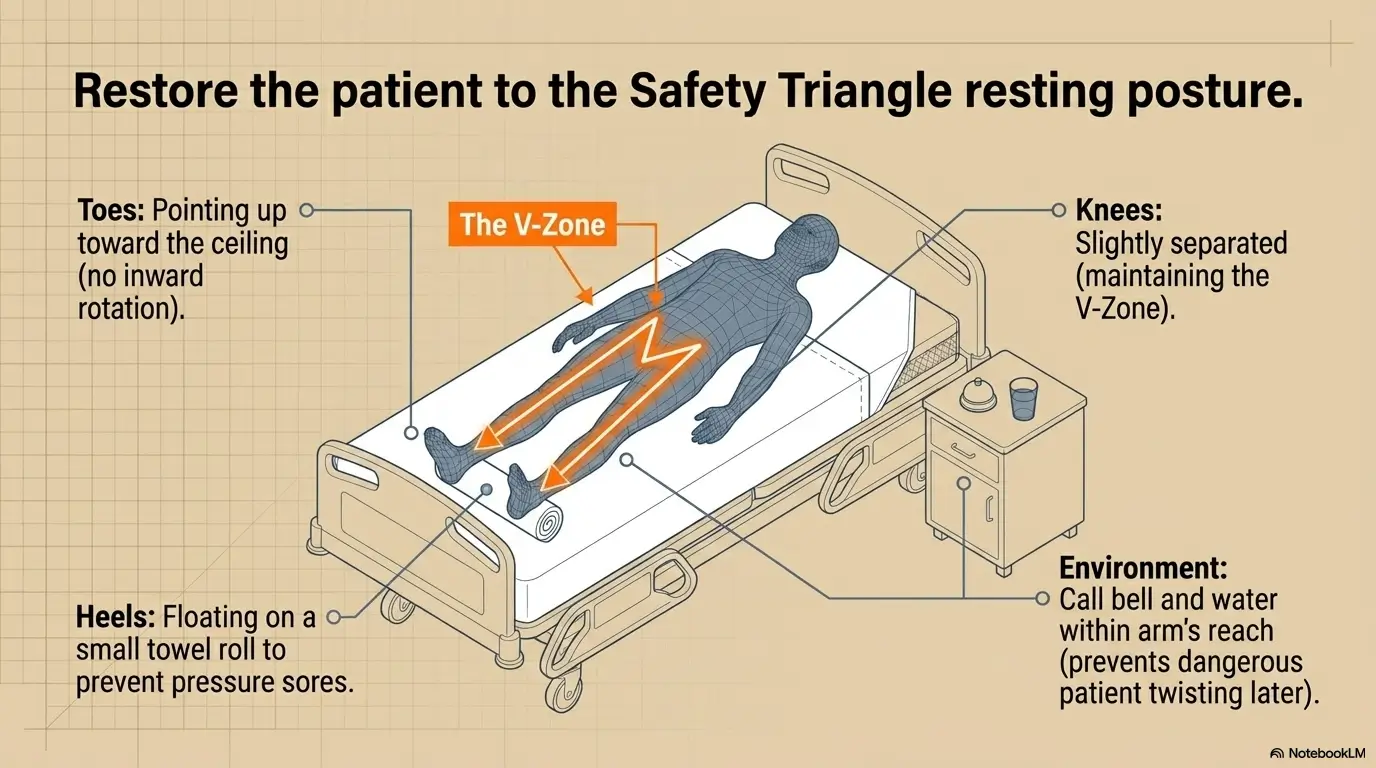
Keep positioning pillows, wedges, or prescribed separation devices ready. Do not force the legs together, cross them, or rotate the hip in an effort to make the patient look symmetrical beneath the blanket.
Restore the patient’s reach zone
Before leaving, place essential items where the patient can reach them without twisting, leaning far over the bed edge, or trying to stand alone.
- Phone and charger.
- Water.
- Glasses and hearing aids.
- Prescribed medication schedule or alarm.
- Call bell, alert device, or household bell.
- Tissues and wastebasket.
- Walker or prescribed aid positioned for the next approved transfer.
- Night-light or lamp control.
The ideas in this post-surgery nightstand setup guide also apply here: the best bedside arrangement reduces unnecessary reaching, twisting, and unplanned standing.
Key takeaway
The sheet change is not complete until the patient is safely positioned and the next drink, phone call, bathroom trip, and request for help can begin without an unnecessary reach.
When to Stop and Seek Help
Stop the sheet change whenever the patient’s condition, balance, pain, or behavior changes. A half-made bed is not an emergency. A fall, serious wound problem, breathing difficulty, or new confusion may be.
Stop the transfer immediately for these warning signs
- Dizziness, faintness, swaying, or a near-fall.
- Sudden weakness or inability to follow the transfer sequence.
- New or sharply worsening hip, groin, thigh, or leg pain.
- A new inability to place the permitted amount of weight through the leg.
- A popping sensation followed by pain, deformity, or loss of movement.
- New shortness of breath, chest pain, bluish lips, or collapse.
- Sudden confusion, difficulty speaking, facial droop, or one-sided weakness.
- Bleeding, wound opening, or a dressing that becomes rapidly saturated.
If the patient becomes dizzy, help them remain or return to a safe supported position using the method you were taught. Stay with them. Do not encourage them to “walk it off.” Follow the discharge plan and seek medical advice when symptoms are severe, persistent, recurrent, or accompanied by other warning signs.
Contact the surgical team for concerning recovery changes
Call the care team for increasing redness, warmth, swelling, drainage, wound separation, fever according to the patient’s instructions, worsening pain that is not controlled as expected, new mobility loss, or questions about permitted movements.
Use the patient’s discharge thresholds rather than a generic number found online. Surgical teams may provide specific temperature, drainage, swelling, and pain instructions based on the procedure and the patient’s health.
Do not automatically lift someone after a fall
If the patient falls or slides to the floor, assess for immediate danger and call for appropriate help. Do not attempt to haul the person upright by the arms or under the shoulders.
Emergency services may be needed when there is severe pain, suspected fracture or dislocation, head injury, bleeding, altered consciousness, chest pain, breathing difficulty, or an inability to move safely. Follow local emergency instructions and the patient’s discharge plan.
Recognize when the task exceeds one caregiver
Do not perform a solo sheet change when the patient requires two-person assistance, cannot maintain sitting balance, cannot follow directions, is acutely confused, or has equipment you have not been trained to manage.
Ask for home-health support, a therapy visit, respite assistance, or instruction for another family member. The need for help is not evidence that home recovery is failing. It is evidence that the task has been measured honestly.
FAQ
How often should sheets be changed after hip surgery?
Change sheets when they are wet, visibly soiled, contaminated by drainage or body fluids, bunched, or uncomfortable. For routine changes, choose a time when the patient is rested, alert, and receiving pain control as prescribed. There is no benefit in forcing a full change during a poor mobility period merely to follow a rigid household schedule.
Can the patient stay in bed while the sheets are changed?
Sometimes, but only when the required rolling and repositioning are permitted and a professional has demonstrated the occupied-bed method. The technique may require two trained helpers or specialized repositioning equipment.
What is the safest place for the patient to sit?
Use the firm, stable, appropriately high chair approved by the rehabilitation team. Armrests are often useful. Avoid low couches, soft recliners, folding chairs, rolling chairs, stools, and any seat that slides or requires excessive bending.
Can I use the bed sheet to pull the patient higher in bed?
Not without individualized training, appropriate equipment, and enough assistance. Pulling alone can create friction, twist the body, disturb the operated leg, and injure the caregiver. Ask a therapist or nurse to demonstrate a safe repositioning method.
What type of sheets are easiest after hip surgery?
Choose smooth, breathable sheets that fit the mattress securely without requiring extreme force to stretch over the corners. Avoid oversized fabric that bunches, very tight sheets that demand heavy mattress lifting, and thick layered protectors that create ridges beneath the patient.
Should I place a waterproof pad beneath the patient?
A smooth, secure protective pad can help with drainage, perspiration, or continence needs. It should remain flat, dry, and stable. Ask the care team where it should be positioned and whether repeated moisture requires a wound, skin, or continence assessment.
What should I do if the patient becomes dizzy during the transfer?
Stop the movement and help the patient remain safely supported using the method you were taught. Stay with them and follow the discharge instructions. Seek prompt medical guidance for severe, persistent, or recurrent dizziness, especially when it occurs with chest pain, breathing difficulty, fainting, confusion, weakness, or other concerning symptoms.
When can caregivers stop following hip precautions?
Only when the surgeon or rehabilitation professional confirms that the relevant restriction is no longer needed. Do not use a friend’s recovery timeline, a calendar estimate, or reduced pain as permission to abandon instructions.
What if the patient refuses help with the transfer?
Respectfully explain the specific risk and offer choices within the safe plan, such as choosing the time of day or selecting between two approved chairs. If the patient repeatedly attempts unsafe transfers, contact the clinical team. New confusion, poor judgment, or sudden behavior changes deserve prompt attention.
Your 15-Minute Next Step: Request One Complete Transfer Demonstration
The most valuable preparation is not buying a special sheet or memorizing a universal list of precautions. It is watching a qualified professional guide one complete bed exit, chair transfer, return approach, and move back into bed using the patient’s real equipment.
During the next therapy, home-health, or surgical follow-up contact, ask the professional to observe rather than merely describe. A transfer that sounds simple over the phone may reveal a low mattress, poorly placed walker, unstable chair, weak operated leg, or caregiver hand position that needs correction.
Use this five-minute demonstration request
What to say
“Before we change the bedding at home, could you watch one full bed exit and return? Please show us where the walker and chair should go, how much help I should provide, how to manage the operated leg, and what movements we must avoid.”
“Could you also tell us whether an occupied-bed change is permitted, how many helpers it requires, and what symptoms mean we should stop?”
Record the approved sequence in plain language
- Write each step immediately after the demonstration.
- Include the patient’s exact weight-bearing and movement instructions.
- Mark where the walker, chair, and caregiver should stand.
- Record how the operated leg should be managed.
- List the signs that require the transfer to stop.
- Place the instructions beside the clean linens.
- Share the same sequence with every caregiver.
The calmest workable plan
Prepare the room while the patient rests. Gather every linen before movement begins. Transfer only with the approved method. Seat the patient securely. Change the empty bed without rushing. Inspect the surface and return path. Then complete the return transfer with the same attention you gave the first one.
That is the quiet promise of safer caregiving: not that every task becomes easy, but that fewer things are left to chance. The corners may not look hotel-perfect. The blanket may sit a little crooked. Yet the patient is secure, the caregiver is uninjured, and recovery continues without a preventable detour.
Key takeaway
Within the next 15 minutes, write down the operation, operated side, weight-bearing instruction, mobility aid, and transfer contact number. Then place that card beside the linen station.
Last reviewed: 2026-06