

From “PT Tried” to MRI Approved
An MRI can be delayed for weeks because a chart remains vague. In prior authorization, pain alone rarely moves the file, documentation does. The gap between real-life treatment and the written record is the primary cause of denials, resubmissions, and preventable back-and-forth.
The Problem
Vague “continue PT” fog and “hopeful shrugs” that burn staff hours and keep patients in pain.
The Solution
An appeal-ready paper trail that makes a reviewer’s “yes” easier than their “no.”
This guide helps you turn messy charts into clean decision pathways: dates, visit counts, objective limits, and the one sentence that explains why MRI is needed now and what it will change next. Let’s make the record say exactly what the case already knows.
To document “failed conservative care” for an MRI prior authorization, chart what was tried, for how long, with objective response: dates of conservative treatments (PT, meds, home program, activity modification), adherence, functional limits, red-flag screening, and why MRI is needed now (persistent symptoms, worsening function, suspected structural pathology). Use a tight timeline, measurable outcomes (pain scale, ROM, work limits), and a clear “medical necessity” statement tied to next management steps.
Table of Contents
1) Who this is for / not for
For you if…
- You’re a patient told, “Insurance wants conservative care first.”
- You’re a front desk/referral coordinator assembling prior auth packets.
- You’re a clinician/therapist who needs documentation to support imaging.
Not for you if…
- You need diagnosis or treatment advice. This is paperwork strategy and documentation clarity.
- You’re dealing with emergency symptoms. Jump to the “When to seek help” section. If red flags are in play, a piece like cauda equina syndrome red flags is closer to the question than prior auth strategy.
A tiny personal confession: the first time I helped someone build an imaging packet, I assumed the reviewer would read like a human. They didn’t. They scanned. They hunted for dates, duration, and “what changes if MRI is abnormal.” That’s not cruelty. It’s volume. Your job is to make the “yes” easier than the “no.”
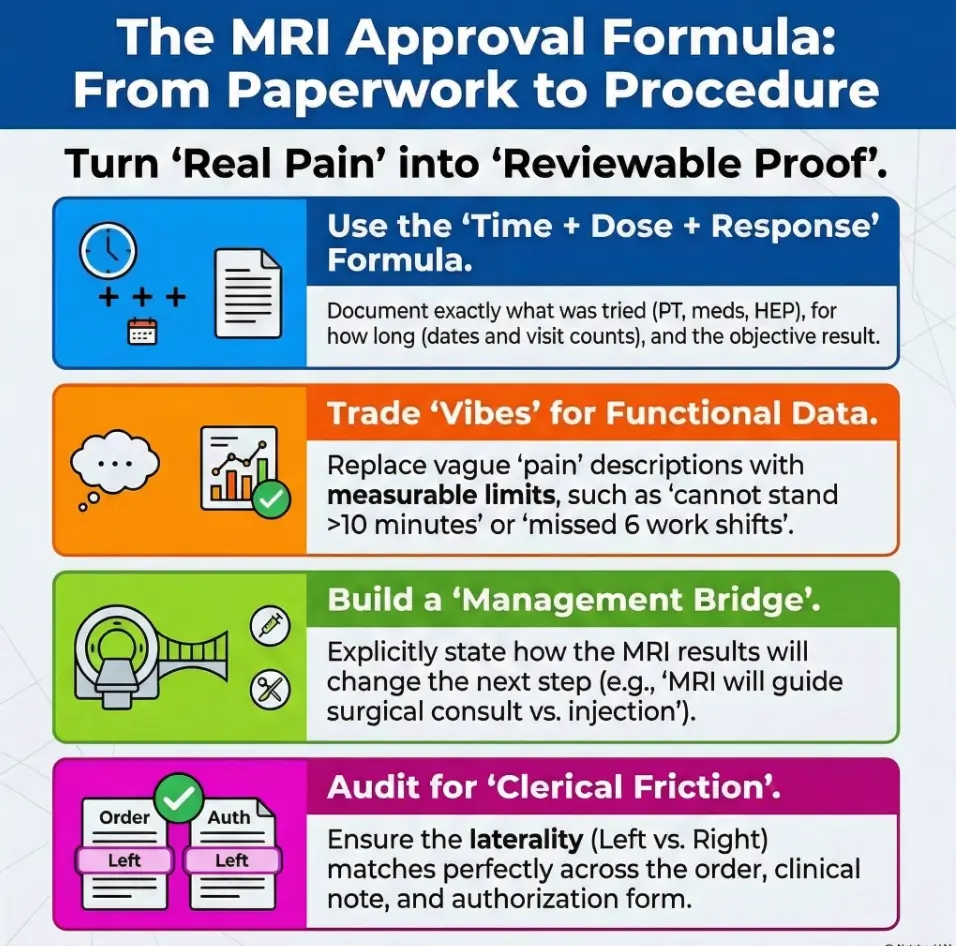
- Time: dates, weeks, visit counts
- Dose: what you did, not just what you meant to do
- Response: measurable change (or stubborn lack of change)
Apply in 60 seconds: Write a 5-line timeline from symptom onset to today, with dates.
2) The hidden checklist: what “failed conservative care” usually means (in plain English)
What insurers are often trying to confirm
- Appropriate first-line care happened (not just “rest”).
- Adequate duration was attempted (often measured in weeks).
- Functional impairment is real and documented (ADLs, work, sleep, walking tolerance).
- MRI will change management (procedure planning, surgical referral, or clarifying differential diagnosis).
The three proof pillars (chart these every time)
- Time: start/end dates, number of visits, frequency.
- Dose: what exactly was done (PT protocol focus, med name/dose, home plan details).
- Response: objective improvement, no improvement, or worsening.
This is where people get stuck: “failed conservative care” sounds like a moral judgment. It’s not. It’s a documentation standard. When reviewers see “PT tried,” their next question is boring and fatal: How long? How many visits? What changed?
A timely reality check: large chunks of imaging prior authorization in the U.S. run through standardized clinical decision support logic and third-party radiology benefit managers. Many systems lean on evidence-based imaging appropriateness frameworks, including the American College of Radiology’s Appropriateness Criteria, which were designed to guide appropriate imaging selection. That doesn’t mean your case is “wrong.” It means your paperwork has to speak the same language: criteria, duration, function, and what the MRI will decide. It also helps to understand where MRI fits relative to simpler imaging, especially in conditions where patients wonder about MRI versus X-ray for sciatica.
Show me the nerdy details
Reviewers often map your chart to internal criteria trees: symptom duration, exam findings, conservative care duration, and the “next step” hinge. If your note says “improving,” the criteria engine can flag the request as low-necessity, even if your patient is still failing functionally. Your best defense is aligning the narrative: improvement in one metric can coexist with persistent functional impairment, but you have to document both.
3) Timeline first: build a “one-glance” conservative care record
Create a clean care timeline (the PA reviewer can’t ignore)
- Symptom onset date + precipitating event (if any)
- Conservative care start and stop dates (or “ongoing”)
- Visits completed: PT/chiro/OT, including frequency
- Medication trials (name, dose if known, start/stop, reason stopped)
- Work restrictions, missed work, activity limits
- Prior imaging (X-ray/US) and key findings (if relevant)
Include objective measures (even simple ones)
- Pain trend (best/average/worst) and how it changes with activity
- Walking/standing tolerance (minutes), sitting tolerance, driving tolerance
- ROM limits, strength deficits, neuro findings (if documented)
- Patient-reported tools (ODI, Neck Disability Index) when available
A small, real-life scene: I once watched a coordinator print 34 pages of notes, staple them like a crime novel, and send them off. Denied. Why? The reviewer couldn’t find the PT dates without playing “Where’s Waldo” with the EMR. A one-page timeline would have saved hours.
Money Block: 30-second “Conservative Care Clock” calculator (no login, no drama)
Use this to sanity-check your packet before submission. It’s not medical advice. It just turns dates into a clean number you can put in the record.
Enter dates to generate a chart-ready sentence.
Neutral next step: Paste the generated sentence into your case summary and verify it matches the actual note dates.
4) Medical necessity sentence: the line that makes the request “make sense”
Write the “why MRI, why now” in one tight paragraph
- Current symptoms + duration + functional impact
- Conservative care tried + adherence + outcome
- Clinical concern prompting MRI (rule in/out structural cause, persistent neuro symptoms, pre-procedure planning)
- Decision MRI will inform (next step in management)
Here’s what no one tells you…
The reviewer is often scanning for a bridge: “MRI results will change what we do next.” If your documentation never names the next step, the request can look optional, even when the patient is miserable and missing work.
If you want a “plug-and-play” framework that still sounds human, use this structure:
Template: one-paragraph medical necessity (copy, then customize)
“Patient has [symptom] for [duration] with functional limitation including [work/ADL limits]. Completed [timeframe] of conservative care including [PT/HEP], [med trials], and [activity modification] with [no improvement / worsening] despite adherence. Clinical concern for [specific concern]; MRI is requested to [rule in/out / localize] and to guide [next management step].”
Neutral next step: Add 1 objective metric (tolerance minutes, ODI/NDI score, strength grade) to make it concrete.
A quick anecdote from the trenches: a provider once wrote “MRI to evaluate pain.” Denied. Same case, resubmitted with “MRI to guide targeted injection planning versus surgical consult if severe nerve root compression is present.” Approved. The patient didn’t change. The sentence did. If you are trying to explain that decision tree to a patient, it can help to connect the imaging request to practical downstream choices like nerve root block versus epidural steroid injection or a question of decompression without fusion.
5) Document PT and home program like evidence, not vibes
PT documentation that tends to land well
- Frequency/duration: “2x/week for 6 weeks” (and actual attendance)
- Modalities + therapeutic focus (core stabilization, McKenzie extension, rotator cuff protocol)
- Home program: specific exercises + adherence notes
- Functional reassessment: what improved, what didn’t
If PT wasn’t completed, document why (without sounding defensive)
- Scheduling barriers, cost/coverage limits, transportation
- Clinical intolerance (worsening neuro symptoms, unsafe exacerbation)
- Alternative conservative measures attempted in parallel
- Plan to resume/modify when feasible
If your documentation style is “PT ongoing,” you’re leaving money on the table, time on the calendar, and the patient in limbo. Write like you’re testifying to your future self, tired, caffeinated, and trying to remember what happened.
Another tiny lived moment: I once saw “HEP given” in a chart, with no details. The patient did three random YouTube stretches for two days. In the packet, that reads like “home program performed.” That gap is how denials are born. If you prescribe a home program, list three exercises and frequency. That’s it. It doesn’t have to be pretty. For readers who need a more concrete benchmark, a standalone guide on physical therapy for sciatica can help translate “PT tried” into something more documentable than fog.
Money Block: Eligibility checklist (yes/no) before you hit “submit”
- Yes/No: Do you have start and end dates (or “ongoing”) for conservative care?
- Yes/No: Are visit counts documented (PT/therapy/chiro/OT)?
- Yes/No: Is adherence noted (attendance + HEP follow-through)?
- Yes/No: Is functional impairment described with at least 1 objective metric?
- Yes/No: Does the note state what MRI results will change next?
Neutral next step: If you answered “No” to any item, add a one-paragraph case summary before submitting.
6) Make functional impairment undeniable (without exaggerating)
Translate symptoms into daily-life limitations
- Sleep disruption (hours/night), driving tolerance, stairs, lifting limits
- Work duties affected (standing, overhead activity, typing, patient care)
- Safety issues (falls, dropping objects) if true and documented
Let’s be honest…
“Pain 8/10” alone is easy to dismiss. “Can’t stand >10 minutes, missed 6 work shifts, completed 6 weeks of PT with no improvement” is harder to swat away because it’s anchored to function, not vibes.
If you’re a patient, here’s the gentle trick: pick two functional items and report them consistently at each visit. People get denied because their story changes, not because they’re lying, but because memory under stress is a slippery thing. One visit: “I’m improving.” Next visit: “I can’t work.” Reviewers interpret that as inconsistency, not nuance.
Personal snapshot: I’ve watched patients try to sound “tough” in the clinic, downplay symptoms, then panic when the denial letter arrives. You don’t need to perform bravery in documentation. You need to describe your actual limits with plain numbers. When walking tolerance is central, language that mirrors everyday function, like the examples in sciatica pain when walking or going down stairs with sciatica, often produces cleaner chart language than a generic “pain with activity.”
- Use tolerance minutes (walk/stand/sit/drive)
- Use work impact (missed shifts, duty restrictions)
- Use sleep impact (hours/night, awakenings)
Apply in 60 seconds: Add one line: “Walking tolerance limited to ___ minutes due to symptoms.”
7) “Don’t do this” #1: the vague charting traps that trigger denials
Common denial magnets
- “Tried conservative care” with no dates and no details
- No mention of duration or adherence
- No documented functional deficits
- MRI request reads like curiosity: “to evaluate” with no management plan
Upgrade phrases reviewers can actually use
Replace “failed PT” with something reviewable:
- “Completed 10 PT sessions over 6 weeks with adherence to HEP; persistent radicular symptoms and functional limitation despite progression of therapy.”
- “Trialed NSAIDs for 14 days and activity modification; symptoms persist with limited walking tolerance and work restriction.”
- “MRI requested to guide injection planning versus surgical consult depending on severity of structural findings.”
I’ll say the quiet part: vague charting is not a character flaw. It’s a time problem. But denials create more time problems, so this is one of those rare admin habits that pays you back. The same logic applies when documenting medication trials. “Meds tried” is thin gruel. A phrase that notes start, stop, and reason discontinued is far more useful, especially when the next step may involve something like an oral steroid taper for sciatica rather than continued watchful waiting.
8) “Don’t do this” #2: contradictions, missing pieces, and the copy-paste curse
Inconsistencies that quietly sink approvals
- Notes say “improving,” PA says “worsening” (or vice versa)
- Missing conservative care dates across facilities
- Diagnosis codes don’t match symptoms described
- Prior imaging referenced but not attached (or not summarized)
- Laterality/region mismatch (right vs left, lumbar vs thoracic)
Packet hygiene checklist (fast)
- Most recent visit note + exam findings
- PT eval and at least one progress note (or discharge note)
- Medication trial list (start/stop and response)
- Red-flag screening notes (even if “negative”)
- Prior imaging results (if any)
- Signed order + correct CPT + correct laterality/region
A small story from a waiting room: I saw a patient get denied because the order said “left shoulder,” but the note said “right.” Nobody was trying to deceive anyone. It was just a click in the wrong dropdown. That single click cost two weeks and a lot of stress. If you do one thing today, match laterality across order, note, and PA form.
Money Block: Decision card (Submit now vs. Fix first)
Submit now if:
- Timeline is complete (dates + visits)
- Functional impairment is objective
- “MRI changes management” is stated
Trade-off: Faster decision, but weak packets get denied fast.
Fix first if:
- PT dates/visit counts are missing
- There’s a laterality mismatch
- Notes say “improving” without context
Trade-off: Adds 10–20 minutes now, saves days later.
Neutral next step: Do a 2-minute “control-F” scan for left/right and lumbar/cervical consistency across documents.
9) Common mistakes
Patient-side mistakes
- Stopping PT early without documenting barriers
- Reporting functional limits inconsistently across visits
- Assuming an MRI order automatically equals approval
Clinic-side mistakes
- Submitting before the conservative care clock is documented
- Missing the “change management” rationale
- Not matching laterality/region across order, note, and PA form
I’ve watched a clinic lose a full afternoon to a denial that could have been prevented with a single sentence: “Patient completed X weeks of conservative care and remains unable to Y.” The denial wasn’t “medical.” It was structural. A chart that’s missing its spine collapses under scrutiny.
Short Story: The packet that finally worked (120–180 words) …
Short Story: The first denial letter arrived like an unwanted birthday card. The patient was angry, the coordinator was exhausted, and the clinician was convinced the insurer “just doesn’t approve MRIs.” We rebuilt the request in a single page: symptom onset date, six weeks of PT with ten documented visits, two medication trials with start/stop dates, and one blunt functional line:
“Cannot stand more than 8 minutes without leg symptoms; missed four work shifts.” Then we added the bridge: “MRI results will guide injection planning versus surgical referral if severe compression is present.” That was it. No extra adjectives. No begging. The next response was approval. The patient didn’t magically get better. The paperwork just finally sounded like a decision pathway instead of a vague hope.
10) Appeal-ready documentation: write it like you’ll need it (because you might)
What to add when you suspect denial risk
- A brief case summary paragraph (timeline + failed care + necessity)
- Objective deficits (neuro changes, strength loss, reflex changes) if documented
- A clear next step contingent on MRI results (injection planning, surgical consult, differential)
If denied, what to request in the denial letter
- The specific policy criteria not met
- The clinical rationale for denial
- Peer-to-peer process details and deadline
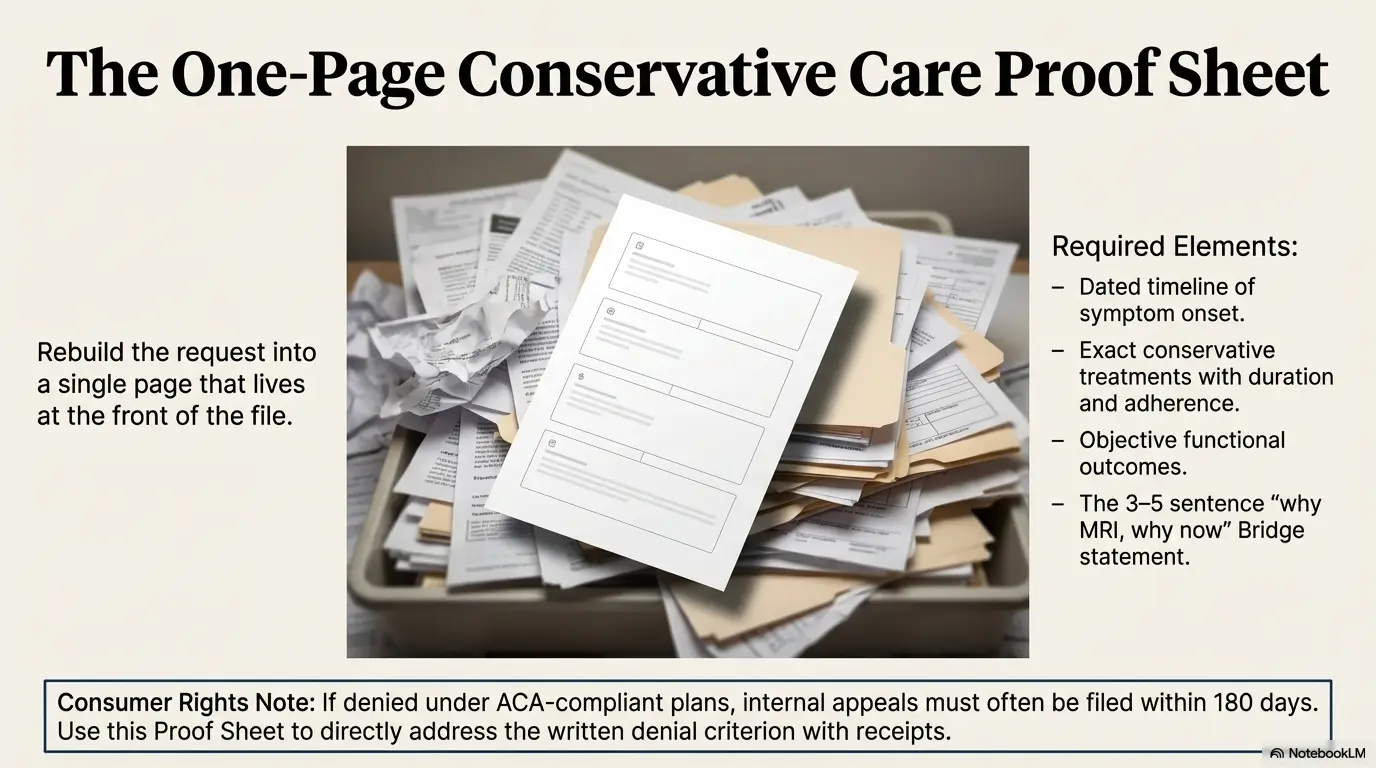
A truthful, timely consumer-rights detail: if you’re in an ACA-compliant plan context, Healthcare.gov explains that internal appeals generally must be filed within a specific window (commonly 180 days from the denial notice), and urgent situations can have faster pathways. The exact process depends on your plan type, but the overarching principle is consistent: you want the denial reason in writing, then you respond directly to that criterion with dates, doses, and functional proof. If cost confusion is also part of the swirl, patients sometimes benefit from separate explainers on lumbar MRI cost on an HDHP or how procedure billing can look in the wild, such as a spine injection bill and CPT code breakdown.
Money Block: Peer-to-peer / appeal prep list (what to gather)
- Denial letter with the exact reason and criteria cited
- One-page conservative care timeline (dates + visits + adherence)
- Most recent exam note (especially neuro deficits if present)
- PT eval + progress note showing lack of functional improvement
- “Why MRI now” paragraph with the next-step decision
Neutral next step: Put these in one PDF in the same order a reviewer reads: denial reason first, evidence second.
11) When to seek help (urgent symptoms and escalation)
Seek urgent care / ER if you have (examples)
- New bowel/bladder changes, saddle anesthesia
- Progressive weakness, severe numbness, new foot drop
- Fever with severe back pain, cancer history with new severe pain
- Major trauma with new neurologic symptoms
If it’s not urgent but you’re stuck
- Ask your clinic: “What exact criteria did insurance cite?”
- Ask your insurer: “Which conservative care elements are missing from documentation?”
This section is short on purpose: urgent symptoms are not a paperwork puzzle. If something is rapidly worsening, the right move is care, not crafting the perfect paragraph. If you need a plain-language patient explainer for triage thinking, low back pain emergency symptoms is the kind of page that belongs in that conversation.
12) Next step
Build a one-page “Conservative Care Proof Sheet” today: a dated timeline (treatments + duration + adherence + outcomes) plus a 3–5 sentence “why MRI, why now” statement. Then send it to the ordering clinician’s office to include in the PA submission. If you’re clinic staff, paste it into your cover sheet. If you’re a clinician, drop it into the assessment/plan so it’s not living in someone’s inbox where it goes to die.
One-page “Conservative Care Proof Sheet” (copy/paste template)
Symptom onset: ____ / ____ / ____ (trigger: ____)
Conservative care timeline: PT ____ weeks (____ visits), HEP adherence: ____; meds tried: ____; activity modification: ____
Functional limitation (objective): cannot ____ more than ____ minutes; missed ____ shifts; sleep ____ hours/night
Response: ____ (no improvement / worsening / partial improvement but function still limited)
Why MRI, why now: ____ (what concern + what decision it changes)
Neutral next step: Attach PT progress note + latest exam note behind this sheet.
Infographic: the “approval logic” flow, made visible
1) Proof pillars
- Time (dates, weeks)
- Dose (what was done)
- Response (objective outcomes)
2) “Why MRI now” bridge
- Persistent/worsening function
- Specific clinical concern
- MRI changes management
3) Packet hygiene
- Latest note + exam
- PT eval/progress
- Correct region/laterality
Tip: If any box is weak, denials become “administrative,” not clinical.
FAQ
1) How many weeks of PT count as “failed conservative care” for an MRI?
It depends on your insurer and condition, but reviewers usually want something that reads like an adequate trial, not a weekend experiment. What matters most is that your documentation clearly states the duration, visit count, adherence, and the objective outcome. If your plan has a specific requirement, ask for the written criteria and match your documentation to it.
2) Does home exercise count if I couldn’t attend PT?
It can, but “HEP given” is too thin. Document the home program as if it were a prescription: what exercises, how often, and what changed (or didn’t). Also document barriers to in-person PT (coverage limits, transport, scheduling). The more factual and specific, the better.
3) What if I tried PT months ago? Does it still count?
Sometimes. Older conservative care can support your story, especially if symptoms are persistent or recurring, but some criteria prefer a recent trial. The safest approach is to document the prior PT with dates and response, then document what has happened since (recurrence, worsening function, new neuro findings) and what conservative steps are being tried now.
4) Will an X-ray denial affect MRI approval?
Not automatically, but missing “step” documentation can. Some pathways expect initial imaging or specific exam findings first. If your case doesn’t follow the typical pathway, your “why MRI now” paragraph needs to explain the clinical logic for jumping ahead (for example, persistent neuro symptoms or planning next management steps after a failed conservative trial).
5) What wording should my doctor use for “medical necessity”?
Aim for one paragraph that includes: symptom duration, functional impairment, conservative care duration with adherence, and the decision the MRI will change. The phrase “to rule out” can be helpful when it’s specific (rule out severe compression, structural cause), but the strongest part is the management bridge: “MRI results will guide next step.”
6) Can I get an MRI approved if symptoms are worsening?
Worsening symptoms can strengthen the rationale, but only if the chart reflects it clearly and consistently. Document what is worsening in functional terms (tolerance minutes, work ability, safety issues) and include any objective findings your clinician documented. If symptoms are rapidly worsening or include red flags, seek urgent evaluation.
7) What documents should be included in the prior authorization packet?
Best practice: latest clinical note with exam, PT evaluation and a progress note, medication trial history, a one-page conservative care timeline, and any prior imaging results if mentioned. Also double-check region/laterality consistency across the order and documentation.
8) What’s the difference between a peer-to-peer review and an appeal?
A peer-to-peer is typically a clinician-to-clinician discussion intended to clarify clinical rationale quickly. An appeal is a formal process with documentation and deadlines. If you do a peer-to-peer, treat it like a structured pitch: timeline, objective function, and the management bridge. If you appeal, answer the exact denial criterion like you’re checking boxes with receipts.
9) How long does MRI prior authorization typically take?
Timelines vary widely by plan and urgency. The most reliable way to reduce delays is not guessing the number of days, but removing predictable friction: missing PT dates, missing exam documentation, unclear “why now,” and inconsistent laterality.
10) If insurance denies MRI, what’s my best next move?
First: get the denial reason and criteria in writing. Second: rebuild the packet to directly address that criterion with dates, visit counts, adherence, and functional proof. Third: ask your clinic about peer-to-peer timing and deadlines. Keep everything organized in one PDF, with the denial reason up front.
Conclusion
Remember the curiosity loop from the beginning, the one that makes this whole process feel unfair? It’s this: why does “pain” need proof? Because prior authorization is built to approve patterns, not feelings. That’s frustrating, but it’s also navigable. When your documentation shows time + dose + response, plus a clean bridge to “MRI changes management,” you stop asking for a favor and start presenting a decision.
If you do one thing in the next 15 minutes, do this: create the one-page Proof Sheet and attach (1) the latest exam note and (2) the most relevant PT progress note. Then verify laterality and region across every document. That’s the fastest path to fewer denial loops and fewer “we’re missing one thing” phone calls. For readers trying to separate imaging logic from symptom anxiety, pieces on MRI and pain mismatch or hip versus spine pain can also help keep the narrative clean before you build the packet.
This is general educational information about documentation and prior authorization workflows in the United States. It’s not medical advice, diagnosis, or a guarantee of coverage. Policies vary by plan, state, and clinical scenario. If you have severe or rapidly worsening symptoms, seek urgent medical care.
Last reviewed: 2026-03-06