

Navigating the Needle: Intent vs. Outcome in Spinal Injections
Most injection “failures” aren’t failures. They’re mismatched scoreboards: you wanted a cure, your clinician needed a clean signal.
If you’re hearing nerve root block vs diagnostic ESI as if it’s a coin flip, you’re about to walk into a high-stakes appointment with the wrong map. The real divider is intent: one needle tries to name the guilty nerve; the other tries to prove (and calm) an epidural pain source.
“`
The Definitions:
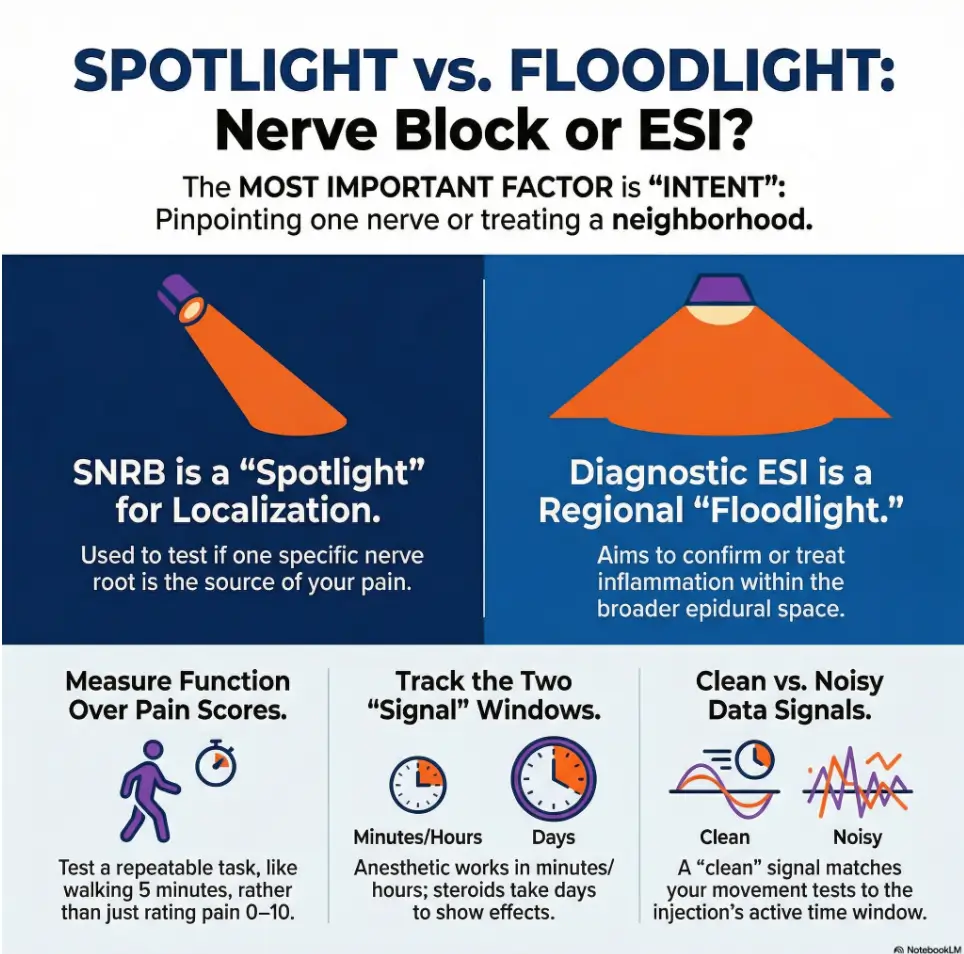
Selective Nerve Root Block (SNRB): Places a small amount of local anesthetic near one suspected nerve root to test a short, on/off window.
Diagnostic Epidural Steroid Injection (ESI): Targets the epidural space and often includes steroids, meaning the “signal” unfolds over days and is harder to localize.
This guide helps you read the timing, track radicular pain changes, and avoid the label trap. You’ll leave with a 48-hour signal log and clinic-ready questions to make follow-ups sharper.
“`A Selective Nerve Root Block (SNRB) is usually designed to test one specific nerve root (diagnostic “yes/no” signal). A diagnostic epidural steroid injection (ESI) is often used to confirm an epidural pain generator and/or reduce inflammation, but its “signal” can be blurrier because steroid effects unfold over days. The key is intent: pinpointing a nerve vs treating/confirming an epidural source. That intent changes technique, interpretation, and next steps.
Table of Contents
1) Intent first: “What question are we trying to answer?”
The two hidden questions behind every needle
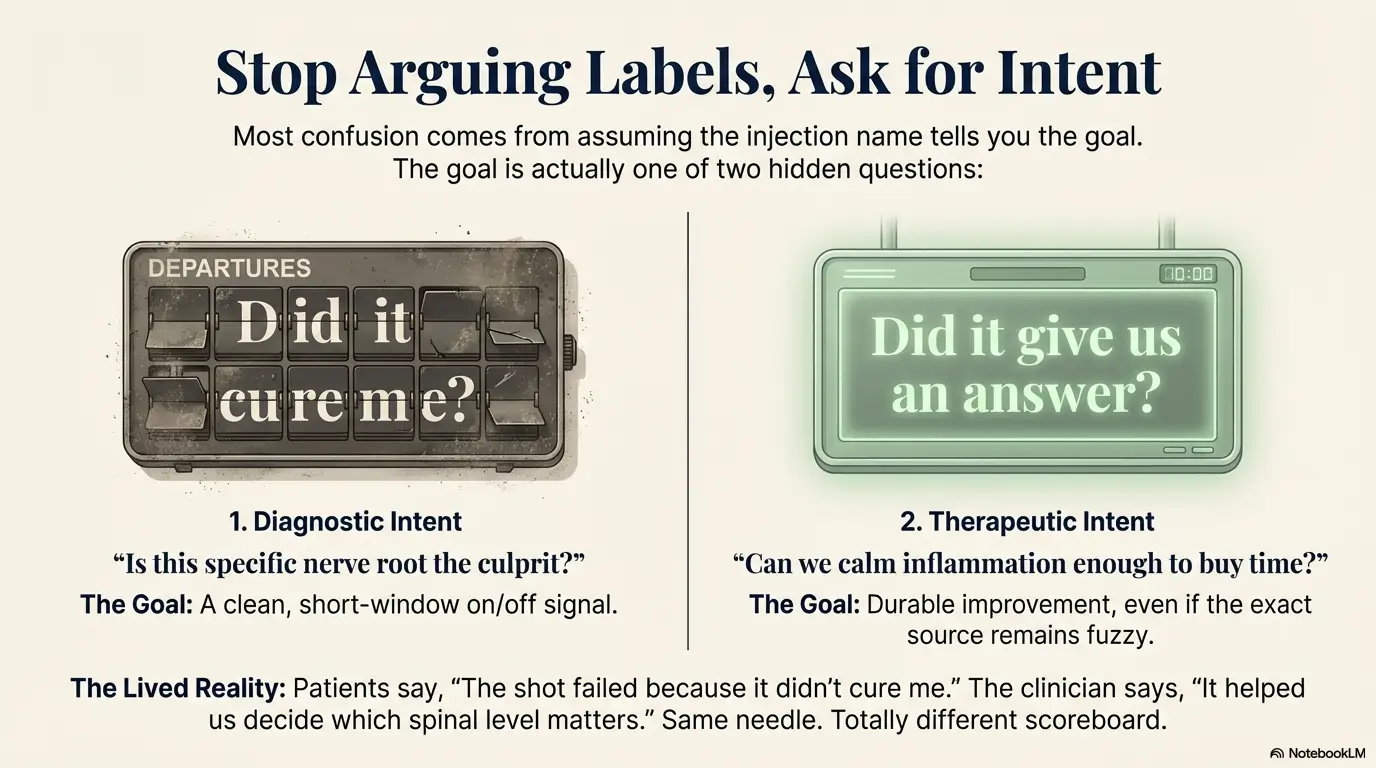
Most confusion comes from assuming the injection name tells you the goal. It doesn’t. The goal is usually one of two:
- Diagnostic intent: “Is this nerve root the culprit?”
- Therapeutic intent: “Can we calm inflammation enough to restore function and buy time?”
Here’s the practical difference: diagnostic intent wants a clean, time-linked on/off signal. Therapeutic intent wants durable improvement, even if the exact pain generator remains a little fuzzy.
A small, lived moment: I’ve watched smart, exhausted people leave a clinic saying, “The shot failed.” Then you ask, “Failed at what?” They meant, “It didn’t cure me.” The clinician meant, “It helped us decide which level matters.” Same needle. Totally different scoreboard.
- Diagnostic intent wants a short-window “switch” response.
- Therapeutic intent expects slower changes over days.
- Same technique can be used for different intent, so ask explicitly.
Apply in 60 seconds: Write one sentence for your appointment: “My goal is to localize vs treat.”
Curiosity gap: The same injection can mean two different things
This is where the language gets slippery. People casually say “root block” when they mean “transforaminal ESI,” and others say “ESI” when they mean “we’re testing one nerve.” The conversation becomes a game of telephone, and you are the one who pays with confusion.
A simple rule that protects you: don’t argue labels, ask for intent. Try this line: “When you say ‘root block,’ do you mean we’re testing one nerve root with anesthetic, or treating epidural inflammation with steroid?”
- Imaging shows multiple possible levels.
- You need a level decision (surgery, targeted rehab).
- Your symptom map points to one root, but MRI is messy.
- You suspect an epidural pain generator.
- You need inflammation control to move again.
- You’re testing whether epidural treatment changes function.
Neutral action: Bring this card and circle the left or right column before you check in.
Show me the nerdy details
“Diagnostic” is really about signal quality. Local anesthetic provides a short, high-contrast time window. Steroids can improve pain by reducing inflammation over days, but they also introduce more variables (sleep, activity, systemic effects). When clinicians talk about “diagnostic value,” they’re talking about how confidently they can map relief to a specific structure.
2) Selective Nerve Root Block: a one-nerve spotlight, not a floodlight
What “selective” actually means in real life
A Selective Nerve Root Block (SNRB) is typically designed to put medication right next to one suspected nerve root, usually on one side and one level. Think “spotlight,” not “fog machine.”
In a perfect world, the medicine hugs that one root and your symptoms respond in a way that matches your anatomy. In the real world, bodies are generous with sharing: fluid spreads, tissues vary, and pain can come from more than one structure at once. That’s why “selective” is an aim and not a guarantee.
A small lived moment: I’ve heard patients say, “They did L5 and S1 in the same visit.” That can be appropriate sometimes, but it also changes how “selective” the test really is. If you’re trying to localize, fewer variables is the whole point. If you’re trying to map which root is actually guilty, it helps to understand how L4 vs L5 vs S1 sciatica patterns usually differ when the symptom line is clean.
What a “positive” block is supposed to look like
If the goal is diagnostic, clinicians often look for a time-linked relief pattern from the local anesthetic:
- Minutes to hours: noticeable change while anesthetic is active (timing varies).
- Function changes you can test: walking, sitting, stairs, sit-to-stand, driving posture.
- Symptom map changes: leg/arm pain line fades, tingling reduces, sharp “electric” quality softens.
Here’s a practical upgrade: don’t treat pain score like the only scoreboard. Instead, pick a repeatable task you can test the same way each time. “I can walk 8 minutes without stopping” is harder to argue with than “I feel 2 points better.” If you want an easy, repeatable “provocation” to pair with your log, consider adding a simple at-home screen like the straight leg raise test at home (only if it’s safe and already part of your symptom pattern).
Input 1: Baseline walking time (minutes) before symptoms force you to stop.
Input 2: Walking time (minutes) during the numbness window after injection.
Output: Functional delta = (After − Before) minutes. If you gained 5+ minutes with the same pace and route, that’s a stronger “signal” than a small pain-score change.
Neutral action: Choose one task and measure it the same way twice.
Here’s what no one tells you…
If you numb the wrong structure or the medication spreads, the “signal” can lie. This is how you get:
- False positives: you feel better, but not because the suspected root is the real culprit.
- False negatives: you don’t feel better, but the root still matters (timing, spread, competing pain sources, anxiety, movement avoidance).
A lived moment: some people brace so hard from fear that they move differently for hours. Then later they say, “It didn’t work.” But when you ask, they never tested the same motion during the window. The signal didn’t fail. The experiment didn’t run.
Show me the nerdy details
Signal quality is shaped by spread pattern, dose, and anatomy. Even with image guidance, small volumes can travel along tissue planes. This is one reason some clinicians use very small anesthetic volumes for a purer diagnostic test. The trade-off is that smaller volumes can also fail to bathe the target root if positioning isn’t ideal.
3) Diagnostic ESI: when the epidural space is the suspect
Diagnostic ESI isn’t “fake therapeutic”
A diagnostic ESI can still reduce pain. The difference is that the clinician is watching what your response suggests about the epidural space as a pain source. In other words: “If we treat inflammation around irritated nerves and tissues in the epidural space, does function improve in a meaningful way?”
The epidural space is a neighborhood, not a single house. So even when relief is real, localization can be less precise than a truly selective block. If your symptoms could plausibly be coming from another joint in the neighborhood (especially when pain feels “low-back + buttock + groin-ish”), it can help to understand how clinicians separate SI joint injection vs lumbar ESI questions before you interpret any single response as “proof.”
Steroid timing changes the story
Local anesthetic can kick in relatively quickly. Steroids, when used, often act over days, and that delayed effect can blur cause and effect. This is where patients get emotionally whiplashed:
- “I felt amazing for 4 hours, then it came back.” (That may have been anesthetic.)
- “I didn’t feel anything day one, then day three I could sleep.” (That may reflect steroid effect, activity changes, or both.)
A lived moment: people often schedule an injection, start new physical therapy, and change meds in the same week. Then, when they improve, everyone argues about what “worked.” That’s not a moral failing. It’s a design problem.
- Anesthetic relief is the fast chapter.
- Steroid relief is the slower chapter.
- Both chapters matter, but they mean different things.
Apply in 60 seconds: Ask your clinician which time window they care about most for interpretation. If you want a simple way to keep the window honest, use an epidural steroid injection relief timeline as your reference frame.
Curiosity gap: Why “helped” doesn’t always mean “we found it”
Sometimes relief comes from a general anti-inflammatory effect rather than precise localization. That can still be a win if the goal is getting you moving again. But if the goal is “Which level should we treat?” the interpretation needs more discipline.
One high-stakes, truthful fact worth knowing: the FDA has warned about rare but serious neurologic problems reported after epidural corticosteroid injections, and it notes that corticosteroids are not FDA-approved for epidural administration. That doesn’t mean “never do it.” It means this is a real medical procedure with real risk-benefit decisions, not a casual “shot.” (If you’ve ever felt dismissed, keep that line in your pocket.)
Show me the nerdy details
“Diagnostic ESI” can be performed through different approaches (interlaminar, transforaminal, caudal). Each approach changes where medicine tends to spread, which changes the type of question it can answer. If your clinic says “diagnostic,” ask which approach they’re using and what they expect that approach to prove. If you’re comparing approaches, a practical companion is TFESI vs interlaminar ESI for sciatica, because “same label” can hide very different spread patterns.
4) The “signal” problem: why interpretation is harder than people think
Clean signal vs noisy signal
In clinic life, you’re not just a patient, you’re also an experiment with imperfect controls. The “signal” is how clearly the injection result points to a structure.
- Cleaner: short-window anesthetic response tied to one suspected nerve root.
- Noisier: delayed improvement, systemic steroid effects, natural symptom fluctuation, activity changes, sleep changes.
A lived moment: I once watched someone do the “right” thing (log symptoms) but on injection day they also skipped breakfast, ran on anxiety, and barely moved afterward. When you’re dehydrated, tense, and immobile, your pain and numbness can behave like a different person. That’s not your fault. It’s why we build simple structure.
Let’s be honest…
If your pain varies day to day, you can accidentally “credit” the injection for a good day. Or blame it for a bad day. That’s why experienced clinicians may ask about:
- Baseline variability (“How different are your best vs worst days?”)
- Sleep and stress (they change pain amplification)
- What you did in the first 24 hours (activity shapes symptoms)
- Yes/No: I tested the same movement before and during the window.
- Yes/No: I avoided major new variables (new meds, new PT intensity) for 48 hours.
- Yes/No: I wrote down the start time of numbness/relief and when it faded.
- Yes/No: I can describe what changed first (pain line, tingling, strength, function).
- Yes/No: I can state whether relief matched my radicular pattern (arm/leg line) vs general ache.
Neutral action: If you answered “No” to 2+ items, treat the result as “data, but noisy.”
5) What gets injected and why it matters (more than the label)
Local anesthetic: the on/off switch
Local anesthetic is the closest thing to a diagnostic “switch.” If your pain is coming from a structure that can be numbed in that region, you may see a relatively quick change. But it can’t tell you everything:
- It can suggest: “This region/structure is involved.”
- It can’t prove: “This is the only cause,” or “surgery will definitely help.”
A lived moment: people sometimes panic when numbness shows up in a new area. But numbness can reflect how anesthetic spreads, not necessarily damage. It’s still worth reporting, calmly and clearly, especially if it’s severe or unexpected.
Steroid: the inflammation negotiator
Steroids may reduce inflammation and irritation, which can improve function, sleep, and tolerance for rehab. Many major medical institutions note that steroid injections can cause side effects like temporary blood sugar elevation, flushing, insomnia, mood changes, and that frequency is often limited to reduce risk of cumulative effects. If you have diabetes or are sensitive to steroid side effects, bring that up early, not as an afterthought at the end of the visit. If you want to set expectations without doom-scrolling, it helps to know what a steroid flare after injection can feel like, and what timing is considered typical.
Contrast + imaging: the map, not the territory
Image guidance and contrast help clinicians see where medication is going. That matters for diagnostic confidence. But it’s still a map. Pain is the territory. Your job is to give the map a readable legend: consistent testing and a clean log. And when imaging feels like it’s “arguing” with your symptoms, you’re not imagining things, the MRI pain mismatch problem is a real reason diagnostic strategies exist.
Show me the nerdy details
Contrast spread can show whether medication stayed near the target root vs traveling more broadly. A broad spread can be useful therapeutically, but it can muddy diagnostic specificity. This is one reason you should ask, “How selective was the spread?” and “Does that change how you interpret my response?”
6) Who this is for / not for
This is for you if…
- You have radiating arm/leg pain (radicular symptoms) and imaging shows more than one possible level.
- A surgeon/pain clinician is trying to confirm the symptomatic level before an operation.
- You need a decision tool (not just pain relief) because next steps are high-impact.
This is not for you if…
- The pain is mainly midline back pain without clear radicular features.
- You’re expecting a single injection to “fix the disc.”
- You’re in a red-flag scenario (see safety section).
A lived moment: many people arrive convinced they must choose between “shot” and “surgery,” like it’s a coin toss. The reality is often a sequence: stabilize symptoms, clarify the level, then decide whether rehab is now possible or whether escalation is needed. If you’re still in the “what does my imaging even mean” fog, it can be clarifying to read sciatica MRI vs X-ray as a quick map of what each test can and cannot answer.
- Multi-level findings often benefit from a diagnostic strategy.
- Radicular symptoms are a stronger fit than midline ache alone.
- Your goal determines what “success” looks like.
Apply in 60 seconds: Write your top 2 goals: “localize” and/or “function.”
7) Common mistakes: the “label trap” that breaks the decision
Mistake #1: Treating the name like the intent
“Root block” and “ESI” can describe similar routes, but intent drives interpretation. If your clinician’s goal is diagnostic and your goal is “pain relief forever,” you’ll both walk away disappointed even if the procedure did exactly what it was supposed to do.
Mistake #2: Measuring only pain, not function
Pain scores are subjective and noisy. Function is stubbornly honest. Good functional tests are simple:
- Walking tolerance (same pace/route)
- Stairs (same number of steps)
- 10 sit-to-stands
- Driving posture tolerance (if safe and relevant)
- Sleep position tolerance
A lived moment: one patient told me, “Pain only dropped from 7 to 6.” Then they added, “But I could put on socks without sitting down.” That’s not “only.” That’s a life difference.
Mistake #3: Mixing too many variables at once
New meds, new PT intensity, a new mattress, and an injection in the same week can erase diagnostic value. If you can, keep the next 48 hours boring. Boring is beautiful. Boring gives clean data. If your follow-up plan includes ramping rehab, it helps to know how to recognize nerve pain vs muscle soreness after physical therapy, so you don’t accidentally label every post-PT sensation as “the injection wore off.”
8) Don’t do this: 7 ways to accidentally ruin a diagnostic injection
Don’t do this #1: “I’ll just rest all day and see”
If you rest all day, you learn something about resting, not about your nerve. You need standardized activity to test the signal. Think “repeatable,” not “heroic.”
Don’t do this #2: “I forgot which day the numbness happened”
Memory is a storyteller, not a spreadsheet. Write it down. Even three timestamps can rescue the usefulness of the whole visit.
Don’t do this #3: Chasing the strongest steroid instead of the clearest answer
Stronger anti-inflammatory effect does not automatically equal cleaner localization. Sometimes the cleanest diagnostic test uses minimal variables. Ask what’s being optimized: comfort, clarity, or both.
Don’t do this #4: Change three meds the day before
If you can safely avoid major medication changes right before and right after (per your clinician), do it. If you can’t, document it clearly so interpretation stays honest. If your team is considering a medication bridge instead of (or before) another injection, it can be useful to understand an oral steroid taper for sciatica as a separate tool with its own timing and trade-offs.
Don’t do this #5: Test five movements, then forget which mattered
Pick one primary test movement and one backup. That’s it. The goal isn’t to audition for a fitness show. It’s to produce a readable signal.
Don’t do this #6: Assume a “bad” result means you’re doomed
A negative or unclear result can still be useful. It may narrow options, reduce unnecessary interventions, or redirect focus to a different level or pain generator.
Don’t do this #7: Leave without asking how they’ll interpret it
Before you leave, ask: “What response pattern would count as positive, negative, or inconclusive?” That single question saves you from a week of internet spirals.
- Your MRI/CT report impression (bring the printed page or PDF).
- Your current meds list (including blood thinners and diabetes meds).
- Your baseline function metric (walk minutes, sit minutes, sleep position).
- Your top 3 symptoms with a simple map (line of pain, numbness zones, weakness task).
- Any prior injections: level, approach, and what changed (even roughly).
Neutral action: Put these in one note on your phone titled “Injection signal.”
9) Safety / Disclaimer + When to seek help (High-stakes)
Safety/Disclaimer (short)
This content is general education, not medical advice. Injection choices depend on diagnosis, imaging, medications (especially blood thinners), allergies, diabetes control, pregnancy status, and neurologic exam. Discuss risks, benefits, and alternatives with a licensed clinician who knows your case.
When to seek urgent or same-day care
- New or worsening weakness, foot drop, loss of hand function
- Bowel/bladder changes, saddle numbness
- Fever, severe new back pain after procedure, severe headache that changes with position
- Rapidly progressive numbness, confusion, or severe allergic symptoms
A lived moment: people sometimes wait because they “don’t want to bother anyone.” Please bother someone. The job of urgent care and on-call clinicians is literally to be bothered by the right symptoms. If you want a crisp checklist that matches how clinicians talk about the highest-risk presentation, keep cauda equina syndrome red flags bookmarked for the “don’t wait on this” category.
Also, if you take antithrombotic medications, neuraxial procedures can have different safety considerations. Professional societies like ASRA Pain Medicine publish evidence-based guidance for regional and neuraxial procedures in patients on antithrombotic therapy. The specifics are individualized, but the principle is simple: tell your clinic every blood thinner and supplement well before procedure day.
FAQ
Is a selective nerve root block the same as a transforaminal epidural steroid injection?
They can overlap in approach (transforaminal route), but not always in intent or medication mix. Some clinicians use “nerve root block” to mean a transforaminal injection. Others reserve SNRB for a more purely diagnostic anesthetic-focused test. Don’t guess. Ask what they’re trying to prove and what they’re injecting.
Which is more “diagnostic”: SNRB or diagnostic ESI?
In general, an SNRB designed around a tight anesthetic window aims for a cleaner localization signal. A diagnostic ESI can still be informative, but steroid timing and broader spread can add “noise.” The best choice depends on your clinical question: “Which root?” vs “Does epidural treatment change function?”
How fast should I feel relief if it’s the correct nerve root?
If local anesthetic is the key diagnostic component, changes may occur within a relatively short window (minutes to hours). The most useful pattern is not just “less pain,” but better function during the same test movement. Always follow your clinic’s activity and safety instructions.
Can a diagnostic injection still include steroid?
Yes. Some clinicians include steroid even when they’re looking for diagnostic clues, especially if there’s also a therapeutic goal. But adding steroid can blur interpretation across days. If clarity is your priority, ask whether they can separate “diagnostic clarity” from “therapeutic boost,” or at least clarify which time window matters most.
What does it mean if I feel numbness but the pain doesn’t change?
It can mean anesthetic spread reached sensory fibers without addressing the pain generator, or that your symptoms aren’t primarily driven by the targeted root. It can also mean your pain has multiple contributors. Document the timing and what area went numb, and share that detail at follow-up.
How many levels can be tested at once without ruining the results?
There’s no universal number. Testing multiple levels in one session can reduce selectivity and create interpretive blur, but sometimes it’s necessary. If localization is critical, ask how they’ll keep the result readable (sequence, volumes, separate visits, or staged approach).
Can imaging (MRI) replace a diagnostic nerve root block?
MRI is excellent for anatomy, but symptoms don’t always match imaging perfectly, especially with multi-level degenerative findings. A diagnostic block can sometimes help when the anatomy is “busy.” The best approach often combines history, exam, imaging, and (when appropriate) a carefully designed diagnostic injection.
What if the injection helps for a week then the pain returns?
Short-term relief can still be meaningful: it might confirm inflammation is part of the problem, buy time for rehab, or clarify what movements flare you. Recurrence doesn’t automatically mean failure. It may mean the underlying mechanical issue remains, or that your plan needs layering (rehab, activity modifications, next-step diagnostics).
Are these injections used to decide on surgery?
Sometimes, yes, especially when multiple levels could explain symptoms and a clinician is trying to confirm the symptomatic level. That’s why keeping the diagnostic “signal” clean (and logged) matters. It can influence how confidently a surgeon targets a level, or whether they recommend continued conservative care.
What questions should I ask my pain doctor before scheduling?
- “Is this injection intended to localize one nerve root or treat epidural inflammation?”
- “What response pattern counts as positive vs inconclusive?”
- “Which time window matters most for interpretation?”
- “What variables should I avoid changing for 48 hours?”
- “Given my meds (blood thinners/diabetes), what safety steps apply?”
11) Next step: one concrete action (do this today)
Bring a “48-hour signal log” to your appointment
Copy/paste and fill this out. It turns your experience into usable clinical data, not vibes.
48-hour signal log (copy/paste)
- Baseline (before injection): worst pain (0–10), best pain (0–10), main location, numbness/tingling map, weakness (what task fails?)
- Test movement (same each time): 8-minute walk OR stairs OR 10 sit-to-stands
- 0–6 hours after: pain + function change? what changed first?
- 6–24 hours after: what returned? what stayed better?
- 24–48 hours after: any slower improvement, sleep, walking, sitting
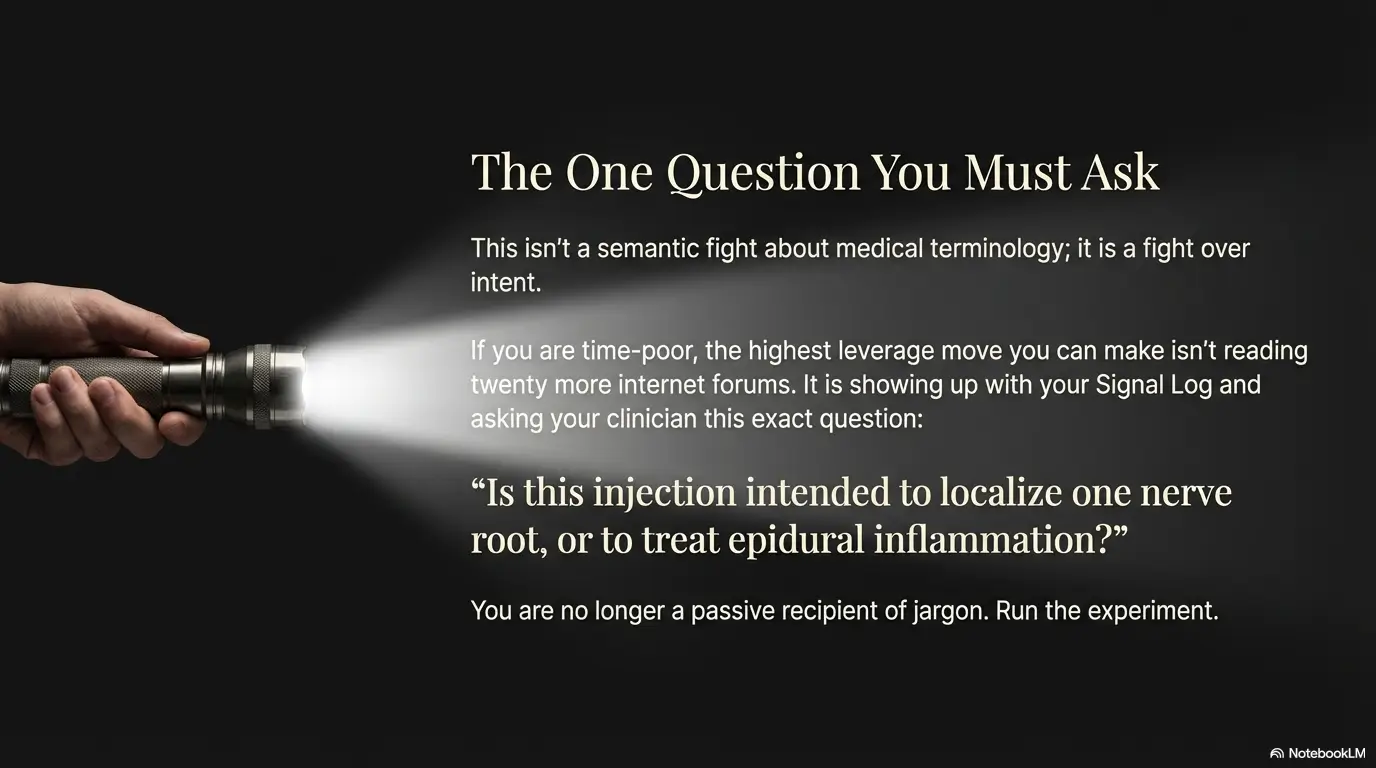
- One-line interpretation question: “Is this injection intended to localize one nerve root or to treat epidural inflammation?”
- Tier 1 (clear positive signal): Symptoms and function improve in the expected window and pattern.
- Tier 2 (partial signal): Some improvement, but timing/pattern is mixed.
- Tier 3 (noisy signal): Big life variables changed; hard to interpret.
- Tier 4 (negative signal): No meaningful change in symptoms/function for the target pattern.
- Tier 5 (red flag): New severe symptoms or neurologic changes need urgent evaluation.
Neutral action: Ask your clinician which tier they believe your response fits and why.
Conclusion
Let’s close the loop from the beginning: the reason “nerve root block vs diagnostic ESI” feels like a semantic fight is because it’s really an intent fight. One path tries to answer “Is it this nerve?” The other asks “Does epidural treatment change function enough to matter?” When you walk into your appointment with that single organizing idea, you stop being a passive recipient of jargon and become the person holding the flashlight.
And one more honest, practical note from the trenches: if you’re time-poor, the highest leverage move isn’t reading 20 more forum threads. It’s showing up with a clean signal log and asking one sharp question about intent. That can change the entire arc of your care.
Short Story: The day the “failed shot” became useful data
I once watched a patient walk into a follow-up visit furious. “The injection didn’t work,” they said, already braced for disappointment. The clinician asked one question: “What did you do during the numbness window?” The room went quiet. The patient had gone home, lay perfectly still, and waited for pain to vanish like a magic trick. No walking test. No stairs. No sit-to-stand. Nothing.
So the clinician reframed it gently: “We didn’t run the experiment. We only waited.” They pulled out a simple plan: one eight-minute walk before the next injection, then the same walk again during the window, and three timestamps. The patient returned the next week with a tiny note full of imperfect handwriting and surprisingly clean information. The result wasn’t a cure. But it was clarity. And clarity changed the plan.
If you do one thing in the next 15 minutes: copy the 48-hour signal log into your phone, pick one test movement, and write the single question you’ll ask: “Is this intended to localize one nerve root or treat epidural inflammation?”
Last reviewed: 2026-02-27.