
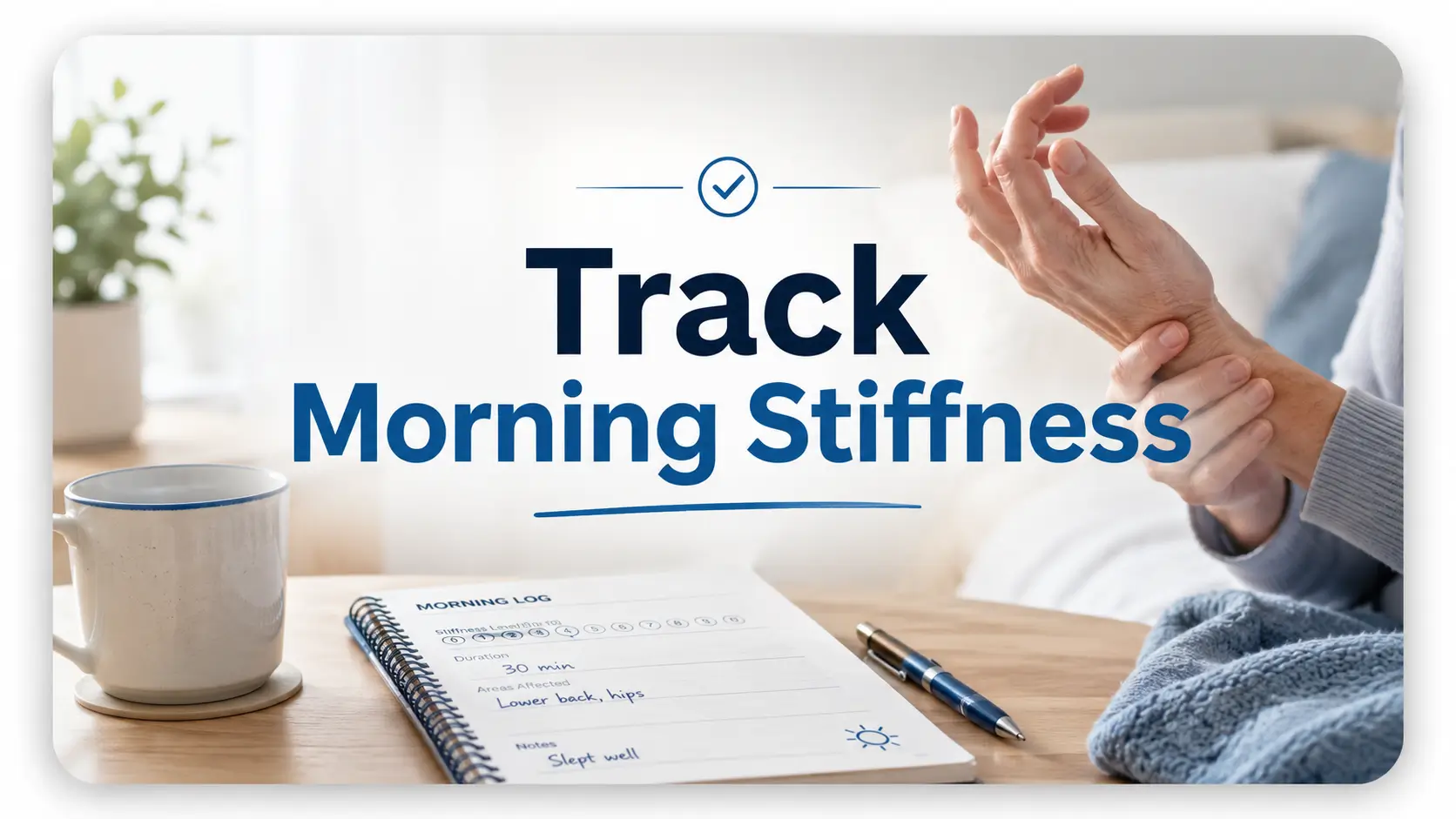
Calm symptom tracking for real mornings
How to Track Morning Stiffness
Without Overthinking It
Morning stiffness has a strange talent for stealing the first quiet minutes of the day. Before coffee, before emails, before the house remembers its own noise, your hands, knees, back, hips, or shoulders may send a small report: something feels slow, sticky, locked, or not quite awake.
The goal is not to turn your body into a courtroom of suspicious witnesses. The goal is much simpler: notice enough to see a pattern, but not so much that the tracking becomes louder than the symptom. A good stiffness log should feel like putting a bookmark in the morning, not writing a medical novel before breakfast.
This guide gives you a tiny, repeatable system: duration, location, movement response, and a simple 0–3 score. It also shows when to relax, when to keep watching, and when to bring the pattern to a healthcare professional with clear notes instead of a foggy memory.
Track less
Use one minute, three data points, and one calm score.
Explain better
Bring useful patterns to a doctor, PT, or specialist without guesswork.
Spiral less
Review weekly, not emotionally every morning.
Simple promise: by next week, you should know whether your stiffness is random morning static or a pattern worth discussing. 🌤️
Snapshot
This article is for adults who wake up stiff and want a practical way to track it without feeding health anxiety. You will learn what to write down, what not to over-track, how to review a 7-day pattern, and when symptoms deserve professional attention.
Table of Contents
Before You Act: What This Tracker Can and Cannot Tell You
A morning stiffness log is not a diagnosis. It cannot tell you whether you have osteoarthritis, rheumatoid arthritis, an autoimmune condition, a tendon issue, a sleep-position problem, a medication side effect, or a workout recovery pattern. It can do something quieter and often more useful: help you describe what is happening with less panic and more precision.
Think of tracking as gathering a clean signal. A doctor or physical therapist can do more with “my hands are stiff for 45 minutes most mornings, both sides, and movement helps” than with “my joints feel weird lately.” The first sentence has shape. The second is fog wearing sneakers.
This guide is for symptom awareness and practical preparation only. If your stiffness is severe, rapidly worsening, linked with swelling, warmth, fever, rash, weakness, numbness, chest symptoms, unexplained weight loss, or daily-life limitations, do not wait for a perfect log. Contact a qualified healthcare professional.
Key takeaway
Tracking is helpful when it makes your next decision clearer. It becomes unhelpful when it turns every sensation into a private emergency broadcast.
For reliable background reading, official and nonprofit health resources can help you understand general symptom patterns. Use them as context, not as a substitute for a clinical visit when symptoms are concerning.
What this guide is for
Use this guide if your morning stiffness is mild, moderate, intermittent, or confusing enough that you want to see whether it repeats. It is especially useful if you have a desk job, have changed your workout routine, are recovering from an orthopedic issue, are aging into new body noises, or are preparing for an appointment and want to explain symptoms clearly.
It also works for caregivers who are trying to help a parent describe morning stiffness without interrogating them over toast. A small log can make a conversation feel less like a cross-examination and more like shared navigation.
What this guide is not for
This is not for ignoring red flags. It is not a replacement for urgent care, primary care, orthopedics, rheumatology, physical therapy, or emergency evaluation when symptoms point in that direction.
If you are having sudden severe pain, new weakness, new numbness, loss of bladder or bowel control, fever with joint swelling, chest pain, shortness of breath, or symptoms after a significant injury, seek medical help promptly.
The 3-Point Morning Stiffness Check That Keeps You Sane
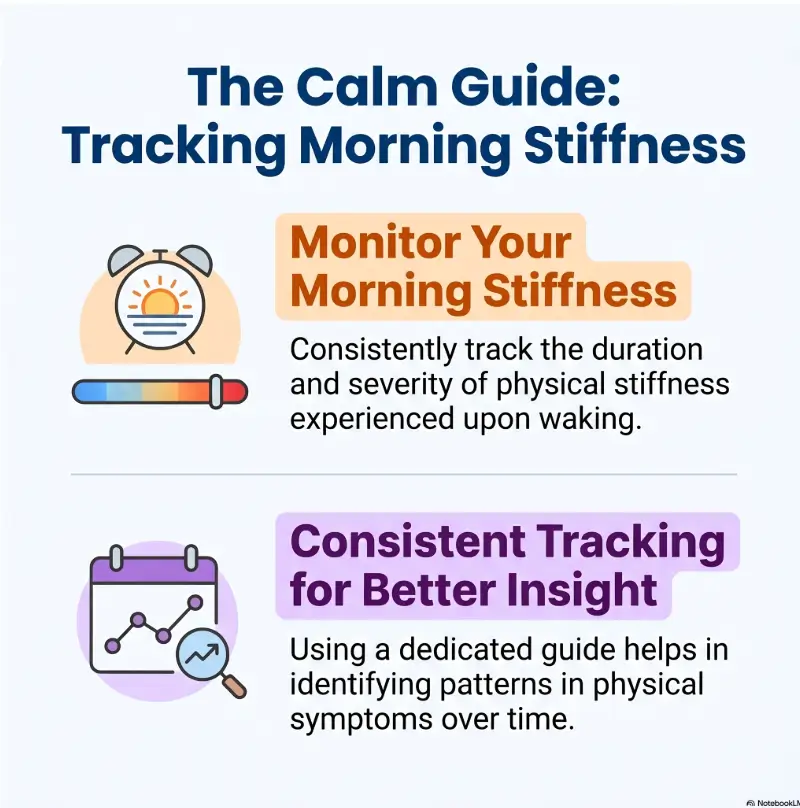
The best way to track morning stiffness is to record only three things before your day becomes a parade of distractions: how long stiffness lasts, where you feel it, and whether gentle movement improves it. That is enough for a first pass.
You are not trying to create a perfect medical document. You are building a small pattern map. The map does not need decorative mountains, tiny villages, and a dragon in the corner. It needs the roads.
Track duration, location, and movement response
Write the answer to these three questions:
- Duration: How long did the stiffness last after waking?
- Location: Where did you feel it most clearly?
- Movement response: Did gentle movement loosen it, change nothing, or make it worse?
A good entry can be painfully ordinary: “25 minutes, both hands, better after moving.” That is not glamorous. It is also exactly the kind of note that can become useful if it appears again and again.
Why “how long it lasts” matters more than how scary it feels
Fear has terrible measurement skills. It can make five minutes feel like an hour, especially when symptoms arrive before your brain has put on its shoes.
Duration gives you a steadier reference point. Stiffness that fades after a few minutes may tell a different story from stiffness that lingers through breakfast, the commute, and the first meeting of the day. Duration does not diagnose the cause, but it helps you decide whether the pattern deserves more attention.
The one-minute note that beats a perfect health journal
Use this format for seven mornings:
One-minute morning note
Time stiff: ___ minutes | Where: ___ | Score: 0 / 1 / 2 / 3 | Movement: better / same / worse | One context note: ___
That is the whole system. If you can brush your teeth while half-awake, you can run this log.
Your Simple Scale: 0–3 Is Enough
A 10-point scale can sound serious, but for everyday tracking it often creates false precision. Is today a 4 or a 5? Did coffee change the score? Does a 6 in your knee equal a 6 in your hands? The brain begins doing tiny courtroom math, and suddenly the log has eaten breakfast.
A 0–3 scale is blunt in a useful way. It asks one practical question: how much did this interfere with your morning?
| Score | Meaning | Example morning | What to do |
|---|---|---|---|
| 0 | No stiffness | You got moving normally. | Record 0 only if you are tracking a week. |
| 1 | Mild | You noticed it, but it did not change your routine. | Track duration and location, then move on. |
| 2 | Noticeable | You moved slower, avoided stairs, or needed extra warm-up time. | Add one context note, such as workout, poor sleep, or long drive. |
| 3 | Limiting | It changed what you could do, delayed your morning, or made basic tasks difficult. | Watch closely and consider professional advice, especially if repeated. |
Why 10-point scales often create false precision
There is nothing wrong with a 10-point pain scale in a clinical setting. Clinicians may ask for it because it gives a shared reference. But at home, especially for stiffness rather than pain, a smaller scale can reduce rumination.
The goal is not to measure the exact emotional temperature of your left knee. It is to notice whether your stiffness is absent, mild, noticeable, or limiting.
Track pain and stiffness separately when they behave differently
Stiffness and pain can travel together, but they are not identical. Stiffness may feel like tightness, slowness, resistance, or reduced range of motion. Pain may feel sharp, aching, burning, throbbing, or electric.
If both are present, write a short split note: “Stiffness 2, pain 1.” This helps prevent one sensation from impersonating the other.
Key takeaway
Use a 0–3 score when tracking for yourself. Use a 0–10 score if your clinician asks for it. Both can live peacefully in the same notebook.
How Long Stiffness Stays: The Clue Worth Measuring
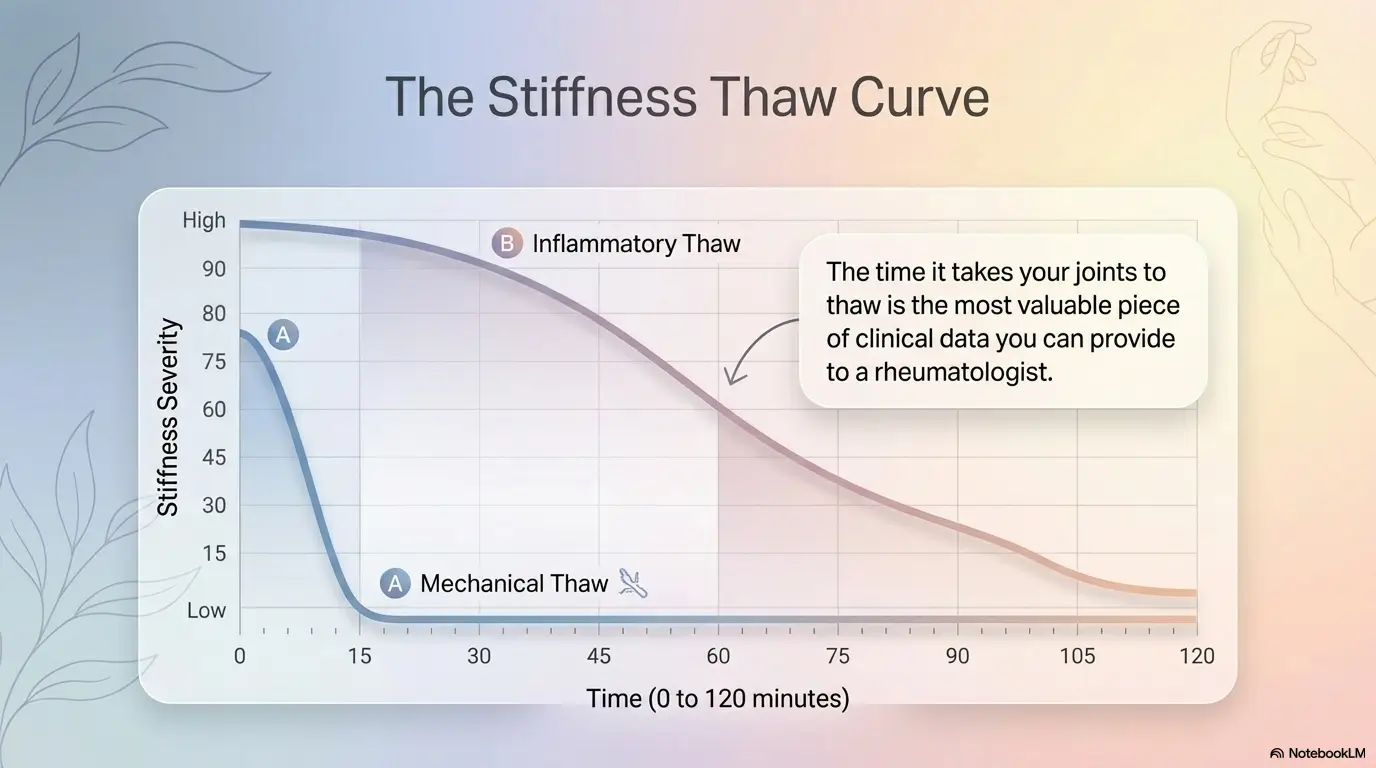
Duration is one of the most useful parts of a morning stiffness log because it turns a fuzzy complaint into a pattern. “It takes me a while to loosen up” becomes “it lasts 10 minutes on most days, but 50 minutes after poor sleep and long drives.” That is a different conversation.
Do not obsess over the stopwatch. A reasonable estimate is enough. Use ranges if needed: under 15 minutes, 15–30 minutes, 30–60 minutes, or more than an hour.
Under 15 minutes often points to mechanical or routine factors
Brief stiffness can happen after sleeping in one position, sitting too much the day before, lifting something awkwardly, changing workouts, or waking after a poor night of sleep. It can also happen with joint wear-and-tear patterns. The key word is “can,” not “must.”
If stiffness fades quickly and does not return, a simple log may be enough. Look for practical triggers: a new pillow, a long drive, extra yardwork, a long desk day, or a weekend warrior moment that sounded heroic until Monday morning.
30 minutes or longer is worth watching more carefully
Stiffness that often lasts 30 minutes or longer deserves closer attention, especially when it appears in multiple joints, affects both sides of the body, improves with movement, or comes with swelling, warmth, fatigue, fever, rash, or unexplained weight loss.
That does not mean you should leap to the worst possible conclusion. It means the pattern is worth documenting and discussing if it persists.
The quiet pattern hiding inside “it goes away eventually”
“Eventually” is a sneaky word. For one person, it means five minutes. For another, it means lunchtime. Your log should rescue you from that ambiguity.
Write the first time you feel reasonably functional, not the time every last trace disappears. That makes the measurement easier and more realistic.
Show me the nerdy details
Morning stiffness can reflect several different processes, including inactivity overnight, joint fluid behavior, inflammation, muscle guarding, sleep position, tendon irritation, or pain sensitivity. Duration alone cannot identify the cause. But duration plus location plus movement response can help separate a random morning from a repeating pattern.
For tracking, use functional duration: the time from waking until you can move through basic morning tasks with your usual level of comfort. This keeps the log practical. You are measuring usefulness, not perfection.
Map the Stiff Spots Without Becoming a Detective
Location matters, but your notes do not need to read like a crime scene report. “Both hands,” “right knee,” “low back,” “hips,” “neck and shoulders,” or “feet” is enough for a basic log.
The body is not always poetic. Sometimes it is just specific. Let it be specific.
Write the area, not an essay
If you write too much, you may quit by Thursday. Use short labels that you can repeat:
- Hands or fingers
- Wrists
- Knees
- Hips
- Low back
- Neck or shoulders
- Feet or ankles
- One side or both sides
Repeated vague notes can still be useful. “Hands again” for six mornings tells you something. It may not tell you the whole story, but it points to the next question.
One joint versus both sides: why symmetry can matter
Stiffness in one joint after a specific activity may be easier to connect to mechanics, strain, posture, or old injury. Stiffness in both hands, both feet, or multiple joints may deserve more careful tracking, especially if it lasts longer or comes with swelling or fatigue.
Do not diagnose yourself from symmetry alone. Just note it. “Both hands” is more useful than “hands.” “Right knee only” is more useful than “knee.” Tiny precision, large payoff.
Use function as a second map
Sometimes the best location note is not anatomical. It is functional: “hard to button shirt,” “slow on stairs,” “hard to grip mug,” “stiff getting out of car,” or “low back tight when bending.”
Functional notes are especially helpful before appointments. If you need a stronger framework, this related guide on functional pain assessment can help you describe how symptoms change daily tasks.
Movement Response: The Detail People Forget
Morning stiffness is not only about how bad it feels. It is also about what happens when you start moving. Does gentle movement loosen things up? Does it do nothing? Does it make pain sharper or more limiting?
This detail can help you avoid lumping every morning sensation into one messy bucket.
Does gentle movement loosen it or make it worse?
Try a calm first-five-minutes test. Do not launch into aggressive stretching. Do not attempt a personal best before the kettle clicks. Simply move through gentle, normal morning motions.
- Open and close your hands slowly.
- Stand and walk around the room.
- Move your shoulders gently through a comfortable range.
- Take a few relaxed steps before judging your knees or hips.
Then write one word: better, same, or worse.
Why stiffness that improves after moving tells a different story
Stiffness that loosens with gentle movement may suggest a different pattern from pain that escalates as you move. That does not mean one is harmless and the other is serious. It means the body is giving you a behavior pattern, not just a complaint.
If movement helps, note how quickly. If movement makes pain sharper, note that too, and avoid forcing through severe symptoms.
The “first five minutes” test for calmer tracking
For seven days, do not judge the whole morning from the first ten seconds. Give your body five minutes of gentle ordinary movement, then score the stiffness.
This small pause prevents the log from becoming a fear diary. It also makes your entries more consistent.
The no-spiral stiffness flow
1. Wake
Do not Google first.
2. Time it
Estimate minutes.
3. Map it
Name the area.
4. Move gently
Better, same, or worse?
5. Score 0–3
Keep it simple.
6. Review weekly
Look for repeats.
Mistakes That Make Tracking Feel Bigger Than the Symptom
A symptom log should reduce mental clutter. If it increases dread, the system is too heavy. Most people do not fail at tracking because they are careless. They fail because they build a tiny hospital administration department in their notes app.
Mistake 1: rating every sensation like an emergency
Your body produces background noise: twinges, creaks, tight spots, fatigue, awkward sleep effects, and the occasional “why does my ankle have opinions?” moment. Not every sensation needs a label.
Track the stiffness that shows up when you wake and affects movement. Do not chase every passing sensation through the day unless your clinician asks you to.
Mistake 2: changing five habits at once
If you start a new supplement, buy a new mattress topper, change your workout, stop caffeine, begin stretching, and switch shoes in the same week, your log becomes a soup. Maybe something helped. Maybe something annoyed your hip. Good luck finding the spoon.
Change one major variable at a time when possible. Give it several days before judging.
Mistake 3: tracking too much data and quitting by Thursday
A beautiful spreadsheet you abandon is less useful than a messy seven-day note you finish. Track only what you will actually record on a tired morning.
| Common mistake | Why it backfires | Safer alternative |
|---|---|---|
| Googling symptoms before breakfast | It raises anxiety before you have data. | Track first, search later if needed. |
| Using a 10-part daily questionnaire | It feels like homework. | Use duration, location, movement response, and 0–3 score. |
| Changing many routines at once | You lose the signal. | Adjust one habit at a time. |
| Judging one bad morning | Single days can mislead. | Review weekly patterns. |
| Ignoring context completely | You may miss obvious triggers. | Add one context note only when something changed. |
Mistake 4: ignoring sleep, stress, workouts, and alcohol
Context does not need to become a second job. But certain notes are worth adding when they clearly changed: poor sleep, a new workout, a long drive, illness, medication changes, unusual stress, heavy lifting, alcohol, or weather shifts if you notice a repeating connection.
If pain flares are part of your broader pattern, you may also find this pain flare trigger log useful for separating true triggers from noisy coincidence.
Weekly Review: Look for Repeats, Not Drama
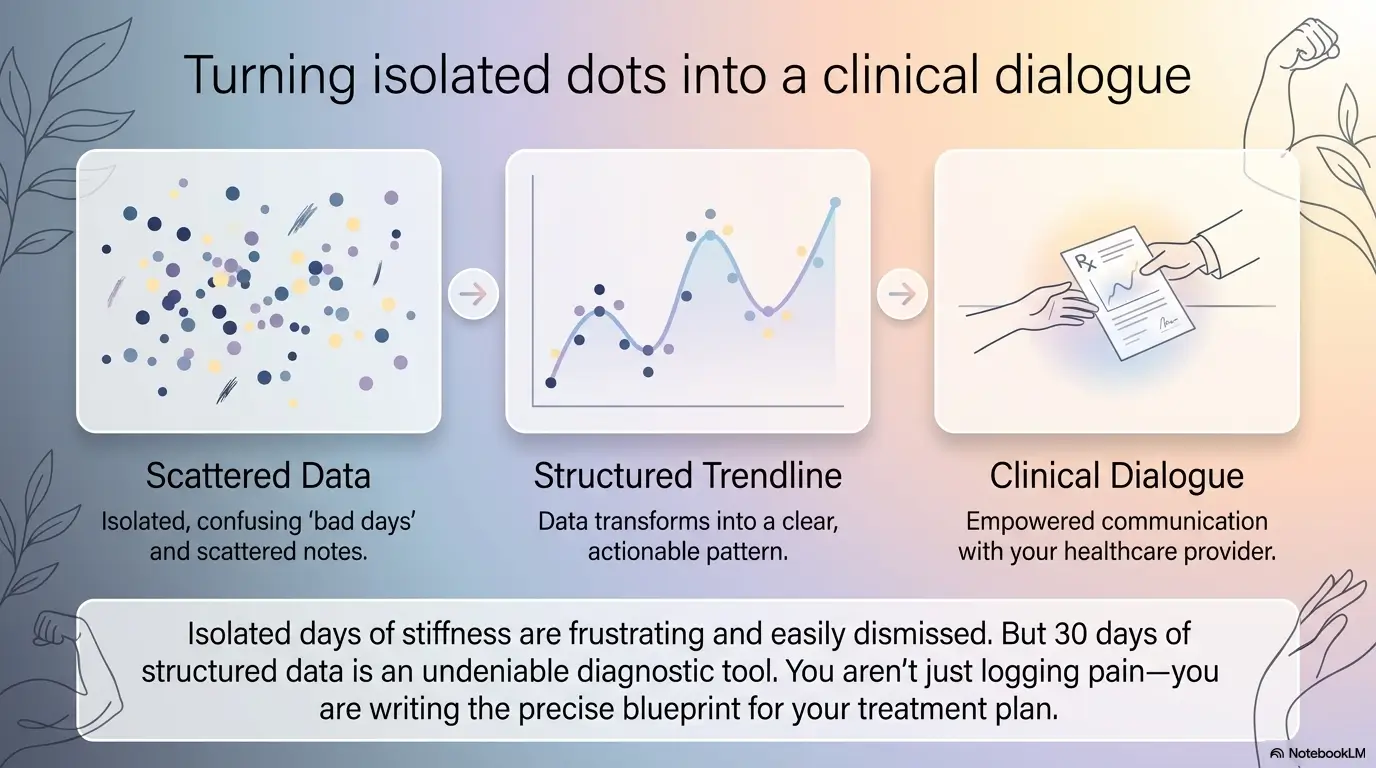
The daily log is only the ink. The weekly review is where the picture appears. Pick one calm time, preferably not during the stiffest part of the morning, and review the week in five minutes.
You are looking for repeats, not courtroom evidence. Ask: Is this improving, stable, or slowly expanding?
Circle days when stiffness lasted longer than usual
If your usual stiffness lasts 10 minutes, a single 35-minute day may be a blip. Three or four 35-minute days tell a different story. Circle those days and check what else was happening.
Did you sleep badly? Did you sit for hours? Did you do new exercise? Did multiple joints appear at once? The answers may guide your next step.
Notice whether the same joints keep showing up
Repeating locations matter. If your right knee is stiff after gardening, that may be one kind of pattern. If both hands are stiff most mornings and take an hour to loosen, that is another kind of pattern.
If you decide to schedule an appointment, pair your stiffness log with a simple pain timeline before an orthopedic visit or primary care visit. A timeline helps the clinician understand what changed and when.
Short Story: The Mug That Taught the Pattern
Marianne first noticed it because of her blue coffee mug. Every morning, her fingers felt too slow to trust the handle. She blamed age, then winter, then the new pillow her daughter insisted was “life-changing.”
For a week, she wrote three notes before coffee: “hands, 40 minutes, better after moving.” By Friday, the pattern was almost boring. Both hands. Most mornings. Not terrible, but persistent.
At her appointment, she did not have to perform the foggy dance of “sort of, sometimes, maybe.” She handed over the pattern. The clinician asked sharper questions, examined her hands, and discussed next steps.
The lesson was not that the mug had solved anything. It had simply pointed to a repeat. Sometimes the body whispers through the most ordinary object in the kitchen.
Key takeaway
One bad morning is a weather report. A repeating weekly pattern is a map.
Tools, Costs, and When Paid Help Is Worth Considering
You do not need expensive tools to track morning stiffness. A notes app, paper calendar, or printable page is enough for most people. Paid options may help if you already like structured tracking, need reports, or are managing multiple symptoms with a clinician.
The best option is the one you will use consistently without feeding anxiety. A gold-plated app that makes you check twelve boxes before coffee is not a tool. It is a tiny tyrant with push notifications.
Free, low-cost, and paid options compared
| Option | Best for | Approximate cost style | Pros | Watch-outs |
|---|---|---|---|---|
| Paper notebook | People who want zero friction | Free to low cost | Fast, private, no app rabbit holes | Harder to search or summarize |
| Phone notes app | Busy readers who always have their phone nearby | Usually free | Quick, searchable, easy to edit | Easy to drift into symptom searching |
| Spreadsheet | Pattern lovers and appointment prep | Usually free | Easy weekly review, sortable entries | Can become too detailed |
| Symptom tracking app | People tracking several symptoms or medications | Free to subscription | Charts, reminders, export features | Check privacy terms and avoid over-tracking |
| Professional evaluation | Persistent, worsening, limiting, or red-flag symptoms | Depends on insurance, location, and provider | Clinical exam, testing decisions, treatment guidance | Prepare notes so the visit is focused |
What to ask before paying for a tracking app or service
If you are considering a paid app, health journal, coaching service, physical therapy visit, or clinical consultation, compare features with a practical eye. You are not buying certainty. You are buying clarity, convenience, or professional interpretation.
- Can I export or print a simple summary for appointments?
- Does it let me track stiffness separately from pain?
- Can I keep entries short?
- Does it explain privacy and data use clearly?
- Will this reduce confusion, or will it make me check symptoms more often?
- If seeing a professional, what should I bring to the first visit?
- What costs should I confirm before scheduling, including copays, imaging, labs, or follow-up visits?
Good / Better / Best setup for a 7-day stiffness log
| Setup | Use this if | What to include |
|---|---|---|
| Good | You want the fastest possible start | Duration, location, 0–3 score |
| Better | You want clearer patterns | Duration, location, score, movement response |
| Best | You are preparing for a visit | All of the above, plus one context note and functional impact |
If you are preparing for a medical appointment, this guide on how to describe pain to a doctor can help turn your notes into a clear conversation.
When to Seek Help Without Panicking
The point of tracking is not to delay care. It is to bring better information when care is appropriate. Some patterns should move you from “watch and log” to “schedule a conversation.” Others deserve prompt attention.
Use the following list as a practical safety filter. It is not exhaustive, and it does not replace medical judgment.
Patterns that deserve a non-urgent appointment
- Morning stiffness lasting more than 30–60 minutes on many mornings
- Stiffness that is slowly expanding to more joints
- Symptoms affecting both hands, both feet, or multiple joints
- Stiffness that limits work, caregiving, stairs, driving, dressing, or sleep
- Repeated swelling, warmth, or tenderness around joints
- Stiffness paired with unusual fatigue, rash, low fever, or unexplained weight loss
For these patterns, a primary care clinician can often help decide whether you need labs, imaging, physical therapy, orthopedics, rheumatology, or another route.
Symptoms that should not wait for a 7-day log
- Sudden severe pain
- New weakness or numbness
- Joint swelling with fever
- Red, hot, intensely painful joint
- Chest pain or shortness of breath
- Symptoms after a fall, accident, or significant injury
- Loss of bladder or bowel control with back or leg symptoms
- Pain that wakes you at night and keeps worsening
When symptoms feel urgent or unsafe, choose timely care over perfect documentation.
What to bring to a doctor, physical therapist, or specialist
You do not need to bring every emotional weather pattern from the week. Bring the practical summary:
- How long stiffness usually lasts
- Which joints or areas are involved
- Whether symptoms are one-sided or both-sided
- Whether movement helps, changes nothing, or worsens symptoms
- Your 0–3 score pattern
- Any swelling, warmth, fever, fatigue, rash, weakness, numbness, or weight change
- Any new workouts, injuries, medication changes, illness, or major stress
- What daily tasks are harder
Key takeaway
A log is not proof that something is wrong. It is a clean way to say, “This pattern keeps happening, and I would like help understanding it.”
FAQ
How long should morning stiffness last before I worry?
Brief stiffness that fades within a few minutes can happen for many reasons, including sleep position, recent activity, or ordinary body stiffness after rest. Stiffness lasting 30–60 minutes on many mornings, especially with swelling, warmth, fatigue, fever, rash, or multiple joints, is worth discussing with a healthcare professional.
Is morning stiffness normal as you get older?
Some stiffness can become more common with age, changes in activity, sleep quality, and joint wear. But “common” does not mean “ignore everything.” Track duration, location, and movement response. If the pattern is persistent, worsening, symmetrical, swollen, or limiting, ask for medical guidance.
Can sleeping position cause morning stiffness?
Yes, sleeping position can contribute to stiffness, especially in the neck, shoulders, back, hips, or knees. If the stiffness changes after a pillow, mattress, sleep posture, or long night in one position, note it. If stiffness persists no matter how you sleep, that is useful to know too.
What does it mean if stiffness improves after moving?
It means movement response is part of the pattern. Some stiffness loosens as joints and muscles warm up. Improvement with movement does not diagnose the cause, but it is helpful information for a clinician, especially when paired with duration and location.
Should I track pain and stiffness separately?
Yes, if they feel different or behave differently. You might write “stiffness 2, pain 1” or “stiff hands, no pain.” This helps avoid turning one symptom into a blurry label for everything.
Can stress make morning stiffness feel worse?
Stress can affect sleep, muscle tension, pain sensitivity, routines, and activity levels. It may not be the root cause, but it can change how symptoms feel. Use one short context note if stress was unusually high, then keep the log moving.
What should I write down for my doctor?
Bring a one-week summary: duration, location, 0–3 score, movement response, whether symptoms are one-sided or both-sided, and any red flags such as swelling, warmth, fatigue, fever, rash, weakness, numbness, or unexplained weight loss. Add what daily tasks are affected.
Is it better to stretch right away or wait?
For mild stiffness, gentle movement may be reasonable. Avoid aggressive stretching, bouncing, or forcing painful motion. If movement worsens pain, symptoms are severe, or you have a recent injury or medical restriction, ask a healthcare professional what is appropriate.
Start a 7-Day Stiffness Snapshot Before Tomorrow Gets Noisy
The next step is not a new life system. It is not a drawer full of wellness gadgets or a color-coded spreadsheet with the emotional density of a tax audit. It is seven mornings, one minute each.
Before coffee, write three numbers or phrases: duration, location, and 0–3 score. Add movement response. Add one context note only if something clearly changed. At the end of the week, ask whether the pattern is improving, stable, or expanding.
| Day | Duration | Location | Score 0–3 | Movement response | One context note |
|---|---|---|---|---|---|
| Day 1 | Better / same / worse | ||||
| Day 2 | Better / same / worse | ||||
| Day 3 | Better / same / worse | ||||
| Day 4 | Better / same / worse | ||||
| Day 5 | Better / same / worse | ||||
| Day 6 | Better / same / worse | ||||
| Day 7 | Better / same / worse |
If the week looks mild and random, you may have earned yourself some peace. If the week shows persistence, longer duration, symmetry, swelling, or functional limits, you have something useful to bring to a professional. Either way, you are no longer arguing with a vague morning feeling. You have a small map.
Your 15-minute action
Create one note titled “Morning Stiffness Snapshot.” Add the 7-day table labels, choose your 0–3 scale, and put tomorrow’s date at the top. That is enough. Let the pattern arrive before you judge it.
Last reviewed: 2026-07