

Paperwork doesn’t fail loudly. It fails in a quiet checkbox.
It then shows up on a Friday as a “cure letter” that steals two more weeks you don’t have. If you’re dealing with back-pain flare-ups, the hard part isn’t the pain narrative—it’s translating it into something HR can administer without second-guessing your FMLA certification.
One vague phrase like “PRN” or “as needed” can turn an honest request into “insufficient information,” even when your condition is real and treated. Keep guessing, and you risk denied time, disciplinary “attendance” fallout, or a record that doesn’t match what payroll already sees.
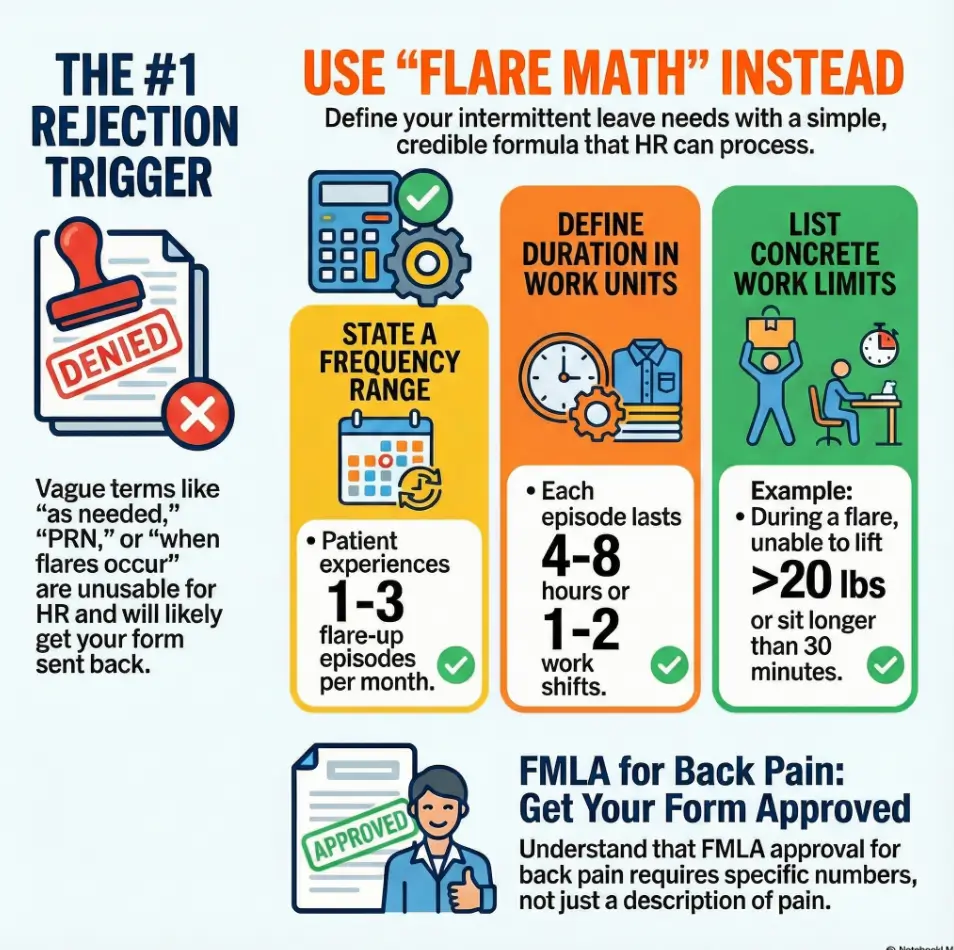
WH-380-E intermittent leave works when it reads like a schedule: a credible frequency range, typical duration in the unit your workplace tracks (hours/shifts/days), and clear functional limitations tied to essential duties.
Note: WH-380-E is the U.S. Department of Labor’s medical certification form for an employee’s serious health condition under FMLA. “Intermittent leave” means taking protected time off in separate blocks when medically necessary, rather than one continuous stretch.
This is built from the real failure points that trigger cure letters—and the simple structure that gets forms accepted.
For back-pain flares, WH-380-E works best when it translates pain into work impact + leave math: a credible frequency range, typical duration, and concrete functional limits tied to essential job tasks. Avoid vague wording (“PRN,” “as needed”). Intermittent FMLA is allowed when medically necessary, and employers can require certification—so your best defense is a certification that reads like a schedule: predictable ranges, clear limits, consistent dates.
Table of Contents
WH-380-E first: the logic HR uses in 30 seconds
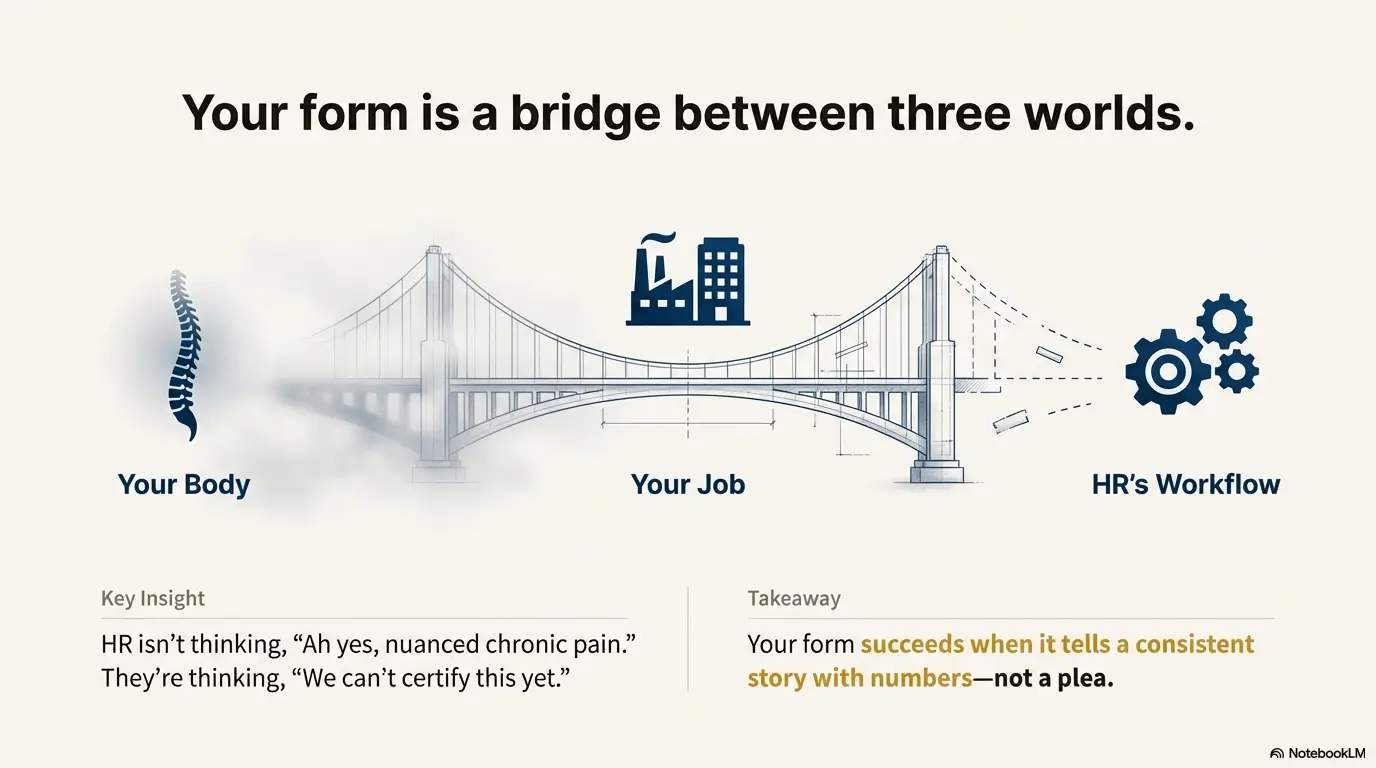
Think of WH-380-E like a bridge between three worlds that don’t naturally get along: your body, your job, and HR’s compliance workflow. If those worlds don’t “line up” on paper, HR isn’t thinking, “Ah yes, nuanced chronic pain.” They’re thinking, “We can’t certify this yet.”
- Condition: a serious health condition with episodic flares
- Limits: what you can’t do at work during a flare
- Leave pattern: intermittent/reduced schedule that matches the flare pattern
Apply in 60 seconds: Write one sentence that links flare → function → time off (example in Section 5).
What HR is really checking vs what they legally shouldn’t need
In practice, many organizations route FMLA through a leave administrator or an HRIS workflow (Workday, ADP, UKG—pick your flavor). Those systems are designed to process “complete” vs “incomplete.” They’re not designed to interpret subtlety.
- They check: Is the condition described clearly enough to qualify? Do the limits explain incapacity? Does the requested time off match those limits?
- They shouldn’t need: your entire diagnostic saga, personal history, or a play-by-play of every flare.
The 3 anchors that must match: serious health condition → incapacity/limits → schedule need
If your certification says “can work with restrictions” but also requests unpredictable full-day absences, that’s an anchor mismatch. If it lists weekly episodes but no limits, same problem. If it claims months of incapacity but also notes “no treatment plan,” anchor mismatch.
Curiosity gap: The one sentence that quietly invites “insufficient information”
It’s usually some version of: “Leave as needed for flare-ups.” That line feels compassionate. It also leaves HR with nothing measurable. The fix isn’t exaggeration. The fix is structure: a range, a unit, and a functional reason.
- Yes/No: Have you worked for your employer at least 12 months total (not necessarily consecutive)?
- Yes/No: Have you worked at least 1,250 hours in the last 12 months?
- Yes/No: Does your employer have 50+ employees within 75 miles (common threshold in many cases)?
Neutral next step: If you’re unsure on any item, ask HR for your eligibility notice and dates before your clinician completes the form.
Intermittent leave fit: choose the right leave pattern for flares
Back pain that flares is a scheduling problem disguised as a medical problem. The wrong leave pattern creates contradictions that look like “inconsistency” even when you’re being honest.
Intermittent vs reduced schedule: what “medically necessary” looks like on paper
If you can do your job most days but occasionally can’t safely perform essential functions, intermittent leave often fits. If you can work every day but only in shorter shifts or with built-in recovery time, a reduced schedule can be cleaner.
- Flares are unpredictable
- Some days you can’t safely do essential duties
- Absences happen in blocks (hours/shift/day)
- You can reliably work, but fewer hours
- Recovery time prevents worsening symptoms
- The pattern is stable (e.g., 6-hour shifts)
Neutral next step: Pick one primary pattern for the form; add the second only if your clinician can explain it clearly.
Curiosity gap: Why “continuous leave” can backfire for a flare pattern
If your reality is “mostly okay, occasionally not,” a continuous-leave request can raise questions: Why full-time out if you’re normally working? Sometimes continuous leave is right (post-surgery, acute injury, severe functional decline). But for flares, it can look mismatched unless the story supports it.
When the employer may move you temporarily (and why that matters to your wording)
Some employers can temporarily move you to a role that better accommodates intermittent absences, especially if treatment is planned. This doesn’t mean “they can punish you.” It means scheduling is part of the system. If your job is shift-based, write the certification in shift units when possible.
Small anecdote: I once wrote “1–2 days” thinking it was clear. Payroll tracked leave in 4-hour increments. HR returned it for clarification. That one mismatch cost me two weeks of back-and-forth—and yes, my back flared while I was waiting. Poetic, in a rude way.
Who this is for / not for: a quick self-sort
This article is for people who want to tell the truth and still get the form accepted. No drama. No posturing. Just paperwork that matches reality.
For: episodic incapacity, chronic condition with occasional flare incapacity
- Back pain that is usually manageable, but periodically makes essential work tasks unsafe or impossible
- Chronic conditions with documented treatment (physical therapy care that’s documented and trackable, injections, meds, specialist visits) and intermittent “bad days”
- Caregivers helping someone else navigate appointments and flare-related incapacity
Not for: vague discomfort with no functional impact (how it reads to HR)
If the form can’t connect symptoms to work limits, HR is likely to request clarification. “My back hurts sometimes” is real—but it doesn’t automatically translate into “unable to perform essential functions.” The form needs the translation.
If you have mixed issues (pain + sleep + stress): keep the narrative medically clean
Many people with chronic pain also have sleep disruption, stress, or anxiety. That’s normal. The paperwork strategy is to keep WH-380-E focused on: functional limitation, treatment, and leave pattern. If other conditions exist, your clinician can address them in appropriate documentation—but don’t turn WH-380-E into a life autobiography.
- Your job’s essential duties (lifting, standing, driving, patient handling, desk work)
- How attendance is counted (hours vs shifts vs days)
- Last 8–12 weeks: flare frequency and typical duration (rough ranges are fine)
- Upcoming treatment dates (PT scheduling and what “counts” as a medically necessary visit, injections, follow-ups)
Neutral next step: Bring this as a one-page note so your clinician isn’t guessing.
The flare math that wins: frequency–duration–limits (your credibility triangle)
This is where most certifications get soft. Not because people lie—because they don’t know how to quantify something that feels unpredictable. The trick is to use ranges and units your workplace uses.
Frequency ranges that don’t sound fabricated (and why ranges beat exact counts)
A range reads like medicine. Exact numbers often read like fantasy. “2 flares per month” implies precision that most patients don’t have. “1–3 episodes per month” is both honest and usable. The range can tighten over time if your condition stabilizes.
Duration units: hours vs shifts vs days—pick the unit payroll tracks
One of the most common “paper cuts” is the unit mismatch. Desk jobs may track in hours; hospitals may track in shifts; union roles may track by scheduled day. Ask HR (or look at your timekeeping system) and match the unit. That alone can reduce cure-letter risk.
Limits that matter: lift/carry, sit/stand tolerance, bending/twisting, driving time
“Pain” is not a work limit. “Unable to lift more than 10–20 lbs during flares” is. “Can’t sit longer than 30–45 minutes without changing position” is. Limits are about safety and function, not stoicism.
Show me the nerdy details
If your workplace uses an absence management system, it often treats leave as a rate: events per month × time per event. That’s why “PRN” triggers problems: it can’t be turned into a rate. A range can.
Curiosity gap: The “range” that signals realism vs the “range” that signals bluffing
Realistic ranges usually align with treatment and daily life. If your range implies you’re out more than you’re in—but you’re still actively working full-time— it can look off. The goal isn’t to shrink your reality. It’s to make the math match the reality your workplace already observes.
Output (copy/paste idea): “Patient experiences episodic flare-ups [events] per month, lasting [duration], during which patient is unable to perform essential functions due to [top limit].”
Neutral next step: Bring your filled ranges to your clinician so they can validate and document them accurately.
Section-by-section WH-380-E: what to write, what to leave out
Here’s the operator truth: WH-380-E is not trying to judge your pain tolerance. It’s trying to confirm a medically supported need for leave, with enough detail to administer time off consistently.
Condition description: specific, short, and medically supportable
Your clinician should describe the condition in a way that makes sense medically without turning the form into an MRI report. “Chronic low back pain with episodic exacerbations,” “lumbar radiculopathy with intermittent flares,” or similar language (as appropriate) is often enough.
Incapacity: describe functional inability (not emotions)
This is where you translate “flare” into “can’t do essential work tasks safely.” If your job is physical, name the physical functions. If your job is sedentary, name the sitting/standing tolerance and the need to change position, lie down, or use heat/ice during flares.
- “Unable to lift/carry > X lbs during flares”
- “Unable to stand longer than Y minutes during flares”
- “Must alternate sitting/standing every Z minutes; may need unscheduled breaks during flares”
Apply in 60 seconds: Write your top 3 essential duties and circle which ones fail during a flare.
Treatment plan: enough detail to show continuing care without a diary
Treatment is the “why this is medically managed” portion. PT, follow-ups, medications, injections, imaging, referrals—whatever is true for your case. A treatment plan helps explain why flares happen and why intermittent leave may be necessary during exacerbations or after procedures.
Show me the nerdy details
In many workplaces, the “insufficient certification” problem comes from missing linkages: a flare pattern with no treatment context, or a treatment plan with no leave implications. A sentence connecting treatment to functional impact often resolves ambiguity.
Pattern interrupt (micro H3): Let’s be honest—your provider is busy. Hand them a one-page brief.
If you walk in saying, “Can you fill this out?” you’ll get what rushed paperwork always produces: vagueness. If you walk in with a one-page flare profile (we’ll build it at the end), your clinician can confirm, edit, and sign something coherent.
Anecdote #2: I once tried to “be low maintenance” and told the clinician, “Whatever you think.” They wrote “PRN.” HR sent it back. The clinician was annoyed. I was annoyed. The only winner was my email inbox.
It was a Friday afternoon when the email hit: “Your certification is insufficient. Please provide clarification within the allowed timeframe.” I stared at it like it was written in another language, even though it wasn’t. My back had been flaring for weeks, and I’d done the “responsible” thing: I got the form completed quickly. Too quickly.
My clinician had written, “Intermittent leave as needed,” and I’d thought, Great—simple. HR thought, Great—unusable. The next week became a scavenger hunt: clinic phone tree, message portal, a nurse who hadn’t seen the form, and me trying to explain my job duties while standing in a pharmacy line, shifting weight like a guilty metronome. When the updated form finally went in, it wasn’t more dramatic. It was more specific: frequency, duration, limits, and a unit payroll understood. That’s when I realized: clarity isn’t cold. It’s protective.
Common mistakes: the cure-letter and denial triggers (don’t step on these)
This section is pure loss prevention. Not because you’re doing something wrong—because forms are unforgiving. Most cure letters are not accusations. They’re requests for missing structure.
Mistake #1: “PRN / as needed / when flares occur” with no numbers
“As needed” is the #1 ambiguity trigger. Replace it with a range and a unit. If your flares vary, that’s exactly what ranges are for.
Mistake #2: symptoms listed, no work limitations stated
“Pain” is a symptom. HR needs to understand function: what you can’t do and for how long.
Mistake #3: date collisions (first visit vs onset vs next appointment)
If the form suggests you were incapacitated before you sought care (sometimes true), your clinician can clarify. But inconsistent dates without explanation can trigger questions.
Mistake #4: “can work with restrictions” but asks for intermittent absence blocks
This isn’t inherently wrong—many people can work with restrictions on good days and cannot work during flares. The form must say that clearly. Otherwise it reads like a contradiction.
Mistake #5: frequency says “weekly,” duration says “months” (contradiction)
“Episodes weekly, lasting months” sounds like continuous incapacity. If that’s true, continuous leave might fit better. If it’s not true, revise the units.
- Replace vague terms with ranges
- Match the unit to payroll tracking
- Resolve contradictions in one clarifying sentence
Apply in 60 seconds: Read your form once as if you’re HR. Circle anything you can’t schedule.
Anecdote #3: I once wrote “cannot sit” because it felt true in the moment. HR interpreted it literally: no sitting at all, ever. The clinician later clarified “cannot sit longer than 30 minutes during flares.” Same truth—now it’s administrable.
Don’t do this: the oversharing trap (and how it can hurt you)
There’s a tender impulse in chronic pain: if you explain everything, maybe people will understand. Unfortunately, forms reward the opposite. They reward minimal necessary clarity.
Too much detail invites side debates (imaging, blame, workplace conflict)
If you include a long narrative, you increase the odds that someone latches onto one detail (“but the lumbar MRI was normal,” “but you worked last week”) and misses the actual point: episodic incapacity with functional limits.
Mixing multiple conditions into one blurry story
If you have more than one condition, it may be medically accurate—but on a form, it can blur the “why now?” and “how often?” questions. A cleaner strategy is to focus WH-380-E on the condition driving the leave pattern.
Writing your own addendum that conflicts with the clinician’s form
You can provide your flare profile as a helper. But avoid submitting a separate narrative that contradicts the clinician’s statements or numbers. Consistency is your friend.
Pattern interrupt (micro H3): Here’s what no one tells you—less detail can be safer.
“Safer” doesn’t mean smaller truth. It means fewer irrelevant facts for someone to misunderstand. You want the form to be hard to misread.
“Patient has a medically treated back condition with episodic exacerbations. During flares, patient is unable to safely perform essential job functions due to functional limitations (e.g., lifting/standing/sitting tolerance). Intermittent leave may be medically necessary in ranges of [X–Y] episodes per month, lasting [A–B] [hours/shifts/days] per episode.”
Neutral next step: Ask your clinician to adjust the numbers and limits to match your medical record.
Anecdote #4: I once attached a three-paragraph explanation “for context.” HR ignored it and asked the clinician for clarification anyway. I’d managed to spend energy without gaining clarity—a very on-brand chronic pain hobby.
FMLA + ADA together: when leave isn’t the only tool
If FMLA is the time-off tool, ADA accommodations are often the “keep you working safely” tool. They can complement each other. They can also reduce your need for leave if the right change lowers flare frequency.
If you can work with changes: accommodation may fit (ergonomics, schedule flexibility)
Examples that can matter for back pain: sit/stand setup, lifting limits, team lift policy, modified duties, reduced driving time, more frequent micro-breaks, or a temporary schedule adjustment. If your employer has an accommodations process, it’s worth using it.
If you’re in a desk-heavy role, the smallest hardware changes can reduce provocation over time—think ergonomic chair vs standing desk decisions and a setup that stops your spine from doing quiet overtime.
If you can’t work during flares: intermittent leave fits the pattern
Accommodations can’t always solve “today my body says no.” That’s where intermittent leave is protective: it covers the unpredictable blocks without requiring you to pretend you’re okay.
Curiosity gap: The moment “accommodation-first” becomes the smarter move
If your flares are becoming more frequent (or your leave usage is climbing), it may be a signal that your work setup is feeding the problem. An accommodation that reduces triggers can be the difference between “1–2 episodes a month” and “every week.” That’s not optimism. It’s mechanics.
- Use ADA to reduce triggers when you can still work
- Use FMLA to protect intermittent absences when you can’t
- Keep both aligned to the same functional limits language
Apply in 60 seconds: List your top two flare triggers at work and one change that would reduce each.
Anecdote #5: A simple change—moving heavy lifting tasks to earlier in the shift—reduced my “end-of-day lockup” flares. I didn’t become a new person. The environment stopped poking the injury.
When to seek help: medical red flags + paperwork red flags
A final grounding point: sometimes the most responsible thing you can do is stop treating this like a paperwork problem.
Medical red flags (new weakness, bowel/bladder changes, fever, saddle anesthesia)
If you have severe pain with new weakness or numbness, fever, saddle anesthesia, or bowel/bladder changes, seek urgent medical evaluation. This article is not a substitute for care. It’s a guide for paperwork when you’re already in a treatment pathway. If you’re unsure whether symptoms cross the line, use a clear checklist like when low back pain is an emergency to decide faster.
Paperwork red flags: repeated “insufficient,” inconsistent HR instructions, retaliation fears
- Multiple cure letters for the same missing details
- HR asks for information your clinician says is inappropriate or unrelated
- You receive sudden discipline tied to absences that were requested as protected leave
Who can help: clinic manager, HR leave admin, attorney (how to decide calmly)
Start with the lowest-friction help: your clinician’s office manager (they understand forms), then HR or the leave administrator (they understand what’s missing). If the issue becomes adversarial—especially around retaliation—consider consulting an attorney. Calm, step-by-step beats doom scrolling every time.
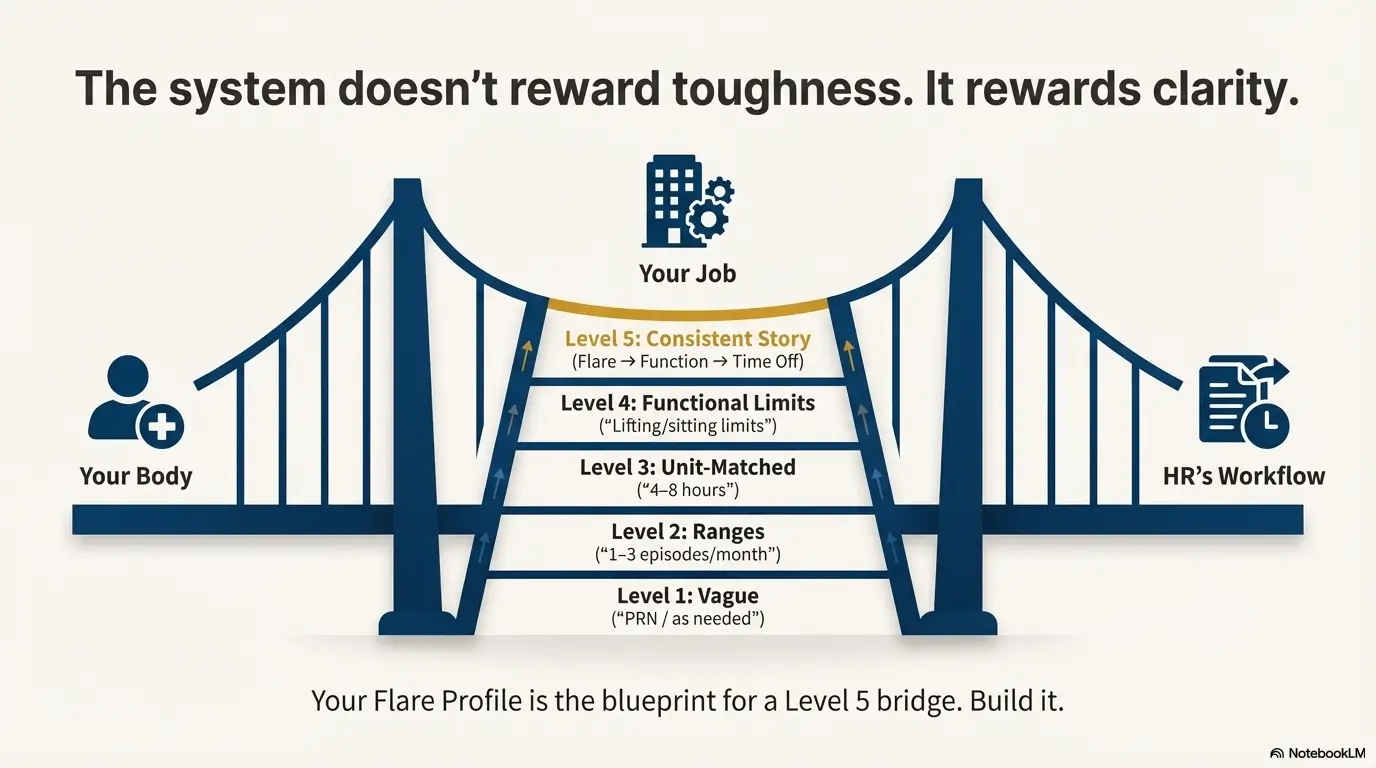
Neutral next step: Aim for Level 4+ before submitting—especially if you’ve had a cure letter before.
Anecdote #6: The day I stopped trying to “sound tough” on forms was the day things got easier. I wrote limits without shame. Not dramatic limits—just accurate ones. The system doesn’t reward toughness. It rewards clarity.
FAQ
Does FMLA cover chronic back pain flare-ups?
It can, when the condition qualifies as a serious health condition and the certification supports medically necessary leave. The details matter: treatment, functional impact, and a leave pattern that matches the flare reality.
How do I describe intermittent back pain flares on WH-380-E?
Use a range and a unit: “1–3 episodes per month, lasting 4–8 hours each,” then tie it to functional limits (lifting/standing/sitting tolerance) and essential job duties. Avoid “PRN/as needed” without numbers.
What frequency and duration should be listed for intermittent FMLA?
The truthful range that matches your medical history and observed pattern. If it varies, use a range. Choose hours/shifts/days based on how your workplace tracks leave. Your clinician should validate and document the final numbers.
Can my employer require a medical certification for intermittent leave?
Often, yes—many employers require certification to designate leave. The goal isn’t to “prove pain.” It’s to provide administrable information: diagnosis category, incapacity/limits, treatment plan, and expected frequency/duration.
Can HR contact my doctor about my certification?
Employers may have processes to clarify certifications, but the scope should stay focused on what’s necessary to administer leave. If you’re uncomfortable, ask what exactly they need clarified and whether your clinician’s office can respond through a standard channel.
How quickly do I need to return WH-380-E after I receive it?
Many workplaces set a deadline window. Ask HR for your exact due date and submit as early as you can, because clinic turnaround time is often the bottleneck.
What if my flare lasts longer than the provider estimated?
If reality changes, communicate early. Document the change through your clinician as needed. A good certification uses ranges to absorb normal variability, but major shifts may need updated documentation.
Can I use FMLA for PT visits, injections, and follow-ups?
Often, leave can cover medically necessary appointments and treatment-related time when supported by certification. Make sure the treatment plan portion of the form reflects scheduled care and likely recovery windows. If injections are part of your pathway, it can help to understand common visit patterns (for example, TFESI vs interlaminar epidural scheduling and follow-up burdens) so your ranges stay realistic.
Do I have to disclose my diagnosis to my manager?
Many people choose to share only what’s necessary for scheduling and coverage. You can usually keep details limited while still following workplace call-out procedures. If you’re unsure, ask HR what your manager will see in your organization’s process.
When should I consider ADA accommodations instead of (or with) FMLA?
If changes to your work setup could reduce flares or allow you to perform essential duties safely, ADA accommodations may help. If you still have unpredictable incapacity during flares, intermittent FMLA can provide protection for those absences. In practice, that often means pairing a paperwork plan with a physical plan—like a laptop stand vs external monitor decision that reduces strain during long days.
Next step: build the 60-second “flare profile” your clinician can sign
Remember the hook—paperwork fails quietly. Here’s how you stop that quiet failure: you hand your clinician a one-page brief that makes “rushed” less likely. This is the closest thing to a cheat code that still stays honest.
Your flare profile: frequency range + typical duration + top 3 work limits
- Flare frequency (range): ______ per month
- Typical duration (unit): ______ hours / shifts / days
- Functional limits during flares: (1) ______ (2) ______ (3) ______
- Essential job duties affected: ______
- Treatment plan snapshot: PT / meds / injections / follow-up schedule: ______
Neutral next step: Ask your clinician to edit this into their own language and align it with your medical record.
Your job snapshot: essential duties (lifting, driving, standing, patient handling, keyboarding)
Keep this tight. Three to five bullets. Real verbs. “Lift 30–50 lbs,” “stand 6–8 hours,” “drive 2–3 hours/day,” “transfer patients,” “stock shelves,” “type for extended periods.” Your clinician can’t connect “incapacity” to your job if they don’t know what your job demands.
Submission discipline: dates, confirmation, and how to respond to cure letters without spiraling
- Before you submit: confirm the unit HR uses (hours/shifts/days)
- After you submit: save confirmation, date, and who received it
- If you get a cure letter: don’t rewrite your story—clarify the missing structure (range, unit, limit, date)
If you do one thing in the next 15 minutes, do this: open a blank note and write your flare profile in plain language. That page becomes your calm center—whether you’re talking to HR, a leave administrator, or a clinician who’s speed-running their inbox.
Last reviewed: 2025-12-26
If you’re tracking the bigger picture, it can also help to understand how chronic back pain costs stack up over time—not to dramatize your story, but to anchor your decisions in reality and keep your plan sustainable.