

Medicare Facet Joint RFA Cost in 2025: It’s Not the Needle, It’s the Setting
The same facet joint RFA can cost you “about the same” on the phone—and then land in three different price universes once the bills arrive. The difference is rarely the needle. It’s the setting.
If you’re trying to pin down Medicare facet joint RFA cost in 2025 for CPT 64635/64636, the most common trap is comparing codes while ignoring the quiet multipliers: units/levels, laterality, and the facility fee that shows up in an office vs ASC vs hospital outpatient (HOPD) split.
Keep guessing and you don’t just risk a bigger bill—you risk delays, denials, or scheduling the “default” site that quietly costs more. (If you’ve ever tried to budget around pain, you already know how quickly “quietly” turns into “loudly.”)
No billing voodoo—just a simple method, plus a short script that forces a written estimate with the right details.
- Good—now lock the multipliers.
- Then isolate the facility fee.
- Then compare settings without getting played by “about.”
Let’s make the bill make sense.
For Medicare facet joint RFA billed as CPT 64635/64636, your 2025 out-of-pocket often depends less on the code and more on where it’s done: office, ASC, or hospital outpatient. The biggest swings commonly come from facility fees and add-ons (imaging, sedation, multiple levels/sides). The safest shortcut is a 3-setting written estimate that lists units/levels, laterality, and facility fee separately before you schedule.
Table of Contents
64635/64636 decoded: why “levels” quietly drive your bill
If you want a reliable estimate, you need to understand one thing: 64635 and 64636 are not “one flat price.” They’re a billing language that can expand depending on how many spinal levels are treated and whether it’s one side or both.
I learned this the hard way watching a friend get quoted “about $___” on the phone, only to see the final bill jump after the visit because nobody clarified the number of levels. It wasn’t fraud. It was “missing details.” (Which is a strangely polite way to describe a financial surprise.)
64635 vs 64636: the add-on code that multiplies cost
In plain terms, 64635 is typically the “base” code for the first level treated, and 64636 is the add-on for additional levels. That means two clinics can both say “we bill 64635/64636,” yet one is treating a single level and another is treating multiple levels—so the units can differ.
- Ask “How many units of 64635 and 64636 are you expecting?”
- Confirm the spinal region (cervical/thoracic/lumbar) only as needed for clarity.
- Make them state the plan: one level vs multiple levels.
Apply in 60 seconds: Text yourself: “CPT + units + side + setting.” That’s your call checklist.

Bilateral vs unilateral: the two-word switch that changes everything
“Left only” and “both sides” can look similar in a short note, but they don’t behave the same on a bill. When laterality is unclear, estimates turn into ranges (and ranges turn into anxiety).
Small lived experience: I once booked what I thought was a simple outpatient service and only realized later the estimate was “single side.” The day-of paperwork used the word “bilateral.” That one word is where your cost-control plan either holds… or slips.
Open loop: “Same CPT, different total”—what gets added next?
Even with the same code and units, your out-of-pocket can change when extra charges appear. The big ones are facility fees, imaging, sedation/anesthesia, and “who bills what” (professional vs facility). We’ll unpack those next—because this is where the setting starts to matter.
Show me the nerdy details
When billing feels inconsistent, it’s often because multiple variables change at once: units, place of service, and whether separate entities bill professional vs facility components. If you only track the CPT without tracking units and setting, you’re comparing labels—not totals.
2025 Part B math: deductible, 80/20, and where copay language goes wrong
Most Medicare cost confusion starts here: people use “copay” as a universal word, but Medicare cost-sharing can behave like coinsurance (a percentage) or a fixed copay depending on your coverage type.
And yes—this matters even if you’re time-poor and just want a number. Because the fastest path to a number is knowing which number system you’re in.
Original Medicare: why 20% coinsurance is the baseline story
Under Original Medicare (Part B), a common pattern is: you pay the Part B deductible (which changes over time), then Medicare pays its share and you’re responsible for a percentage (often described as 20%) of the allowed amount for covered services. That’s why “a bigger allowed amount” in one setting can produce a bigger out-of-pocket—even when the clinical service is identical.
- Coinsurance grows when the allowed amount grows.
- Facility fees can raise the allowed amount.
- Separate bills can mean separate coinsurance responsibilities.
Medigap: when 20% becomes near-$0 (and when it doesn’t)
If you have a Medigap (Medicare Supplement) plan, it may cover some or most of the Part B coinsurance—depending on the plan type and your situation. This is why two neighbors can have the same procedure, same day, same clinic, and wildly different out-of-pocket: one has robust supplemental coverage; the other doesn’t.
Quick anecdote: I’ve watched people argue about the “true price” of a procedure like it’s a universal constant. It’s not. It’s a number filtered through your coverage.
Medicare Advantage: fixed copays vs coinsurance (why it feels random)
Medicare Advantage plans often use copays, coinsurance, networks, and prior authorization rules that can differ by plan. A setting that looks “cheaper” on paper can become “more expensive” if it’s out-of-network or needs approval that wasn’t obtained.
Let’s be honest… your “Summary of Benefits” isn’t a quote.
It’s a map. Useful, but not your GPS. A quote needs your CPT codes, units, laterality, setting, and who’s billing.
Show me the nerdy details
When you hear “copay,” verify whether it’s truly fixed or percentage-based for outpatient procedures, and whether facility billing changes your cost share. Many “my copay should be X” disputes are really “my place of service wasn’t what I assumed.”
Office vs ASC vs hospital outpatient: where the copay split usually breaks
If you remember only one concept from this article, make it this: the setting can change the total allowed amount—and therefore change your out-of-pocket—even when the CPT codes match.
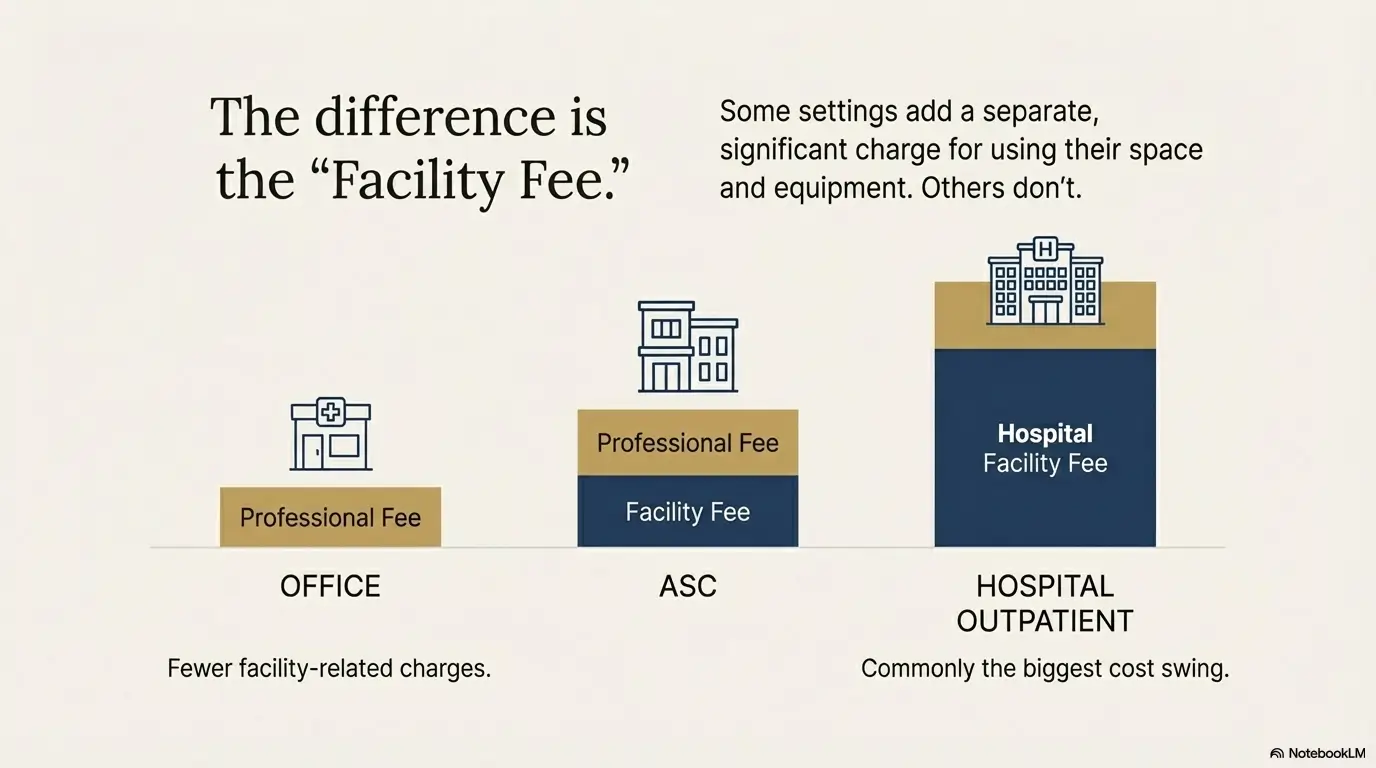
Here’s the mental model: the “same” service can be billed in different environments. Some environments bill extra facility components. Some don’t. That difference is where your cost swings live—and it’s exactly why a side-by-side look at hospital outpatient vs ASC facility fees is so useful before you commit to a date.
- Office: often fewer facility-related charges; simpler billing.
- ASC: can be predictable; still involves facility billing; add-ons matter.
- Hospital outpatient: commonly includes hospital facility fees; biggest swings.
Office setting: fewer moving parts, fewer facility-fee surprises
Office-based procedures can feel refreshingly straightforward: one place, fewer separate bills, fewer “who billed what” puzzles. That doesn’t guarantee it’s cheaper, but it often reduces the number of variables that can inflate an estimate.
Micro-experience: the calmest billing conversations I’ve witnessed are the ones where the clinic can say, “We bill the professional fee here. No separate facility entity.” Your brain relaxes immediately.
ASC setting: often predictable—until add-ons sneak in
Ambulatory Surgery Centers may have structured facility billing that can be more predictable than hospital outpatient, but they can still generate separate facility charges. Add-ons (sedation, supplies, additional units) are where predictability gets wobbly.
Hospital outpatient: the facility-fee accelerator (sometimes clinically necessary)
Hospital outpatient departments can be the right choice for certain patients based on medical complexity or resources available. But they often involve facility fees that change the cost picture. If you schedule at a hospital outpatient department by default—without asking why—that’s where people most commonly experience sticker shock.
Open loop: the one setting choice that creates the biggest “why is this so high?” moment
It’s usually the moment you realize you didn’t just choose a clinician—you chose a billing ecosystem. In the next section, we’ll do a “facility fee audit” so you can see the moving parts before they move.
Facility fee audit: the line item to isolate before you schedule
This is the grown-up, boring, wildly powerful move: separate the professional fee from the facility fee. It turns “mystery total” into “two manageable parts.”
I like to think of it as cleaning your glasses. The numbers don’t change, but suddenly you can see what you’re looking at.
Professional vs facility: two bills, two NPIs, one appointment
You may receive one bill from the clinician (professional services) and another from the facility (the place where it happened). In hospital outpatient settings, the facility component can be substantial compared to office-based care—especially when the claim includes a separate hospital outpatient facility fee line item.
“Technical component” vs “professional component” (plain English translation)
When staff use technical/professional language, they’re usually describing “the building and equipment” vs “the clinician’s work.” You don’t need to become a billing expert. You just need to ask for the numbers in those two buckets.
Pattern interrupt: If the quote doesn’t show a facility fee, it’s not done cooking.
A quote that only lists CPT codes but not the setting’s facility fee is like a recipe that says “add spices” and refuses to name the spices.
- Do you have the exact CPT codes 64635/64636 and expected units?
- Do you know whether it’s one side or both sides?
- Do you know the setting (office vs ASC vs hospital outpatient)?
- Have you confirmed whether the provider/facility accepts assignment or is in-network for your plan?
- Did you ask whether sedation and imaging are expected?
Next step: If any answer is “no,” don’t schedule yet—get that missing item first.
Show me the nerdy details
When you compare estimates, insist on a side-by-side that keeps professional and facility amounts distinct. Otherwise, you’re comparing a “partial” number in one setting with an “all-in” number in another.
Add-ons that bite: imaging, sedation, and the “extras” that change totals
Even if you pick the best setting, add-ons can still reshape your out-of-pocket. The trick is not paranoia—it’s precision. Ask what’s expected, then ask what’s optional.
Small anecdote: the phrase “it’s usually included” has cost people I know more money than any medical device ever has. “Usually” is not a billing term.
Fluoroscopy/imaging: bundled vs separately billed scenarios
Imaging guidance can be part of the workflow. Sometimes it’s bundled into an overall allowed amount; sometimes it’s billed separately depending on documentation and setting. You don’t need to debate policy—you just need to confirm whether it’s expected and whether it affects the estimate. If imaging is likely, it can also help to understand related cost context like lumbar MRI cost on an HDHP—not because it’s the same charge, but because it trains you to ask for the “separate line items” before you’re surprised by them.
Moderate sedation: when it appears (and when it shouldn’t)
Sedation practices vary by setting, patient needs, and facility workflow. If sedation is planned, you may see additional professional services (anesthesia-related billing) and/or facility-related charges. If it’s not planned, ask them to note that in the estimate.
Multi-level + bilateral: the most common cost escalators
If you treat multiple levels or both sides, costs can grow because billing units grow. This is why “one level, one side” is not the same as “two levels, both sides,” even though both conversations might begin with “We bill 64635/64636.”
Open loop: why two clinics quote wildly different totals for the same 64635/64636
Because they’re not actually quoting the same thing. One quote includes facility + sedation + imaging. The other quote is professional-only, office-based, single side, and single level. The CPT label is the same; the content isn’t. In the next section, we’ll look at the “friction points” that make clinics default to vague numbers.
| Setting | Typical extra cost driver | What to ask |
|---|---|---|
| Office | Fewer facility components | “Is there a separate facility bill?” |
| ASC | Facility bill + add-ons | “Facility fee estimate—separate line?” |
| Hospital outpatient | Hospital facility fees | “Is this billed as hospital outpatient (HOPD)?” |
Next step: Choose one “ask” per setting and get it in writing.
Coverage friction in 2025: prior auth, documentation, and frequency limits
Here’s the part nobody wants to read, but everybody eventually lives: billing isn’t only about what’s done. It’s about what’s documented, approved, and coded in a way your coverage recognizes.
When people say “Medicare won’t pay,” sometimes they mean “the paperwork didn’t match the rules.” That’s fixable—if you treat it like a process, not a personal insult.
Medical necessity basics: what usually needs to be in the chart
Policies vary by plan and region, but “medical necessity” typically means the documentation supports why the procedure is appropriate. If your care team has done diagnostic steps beforehand, ask that those results and notes are clearly included in the record. For facet RFA specifically, many patients also end up asking about the medial branch block percent-relief cutoff that clinics and policies often use as a practical gate for “yes, this is worth doing.”
Prior authorization reality (especially in certain settings)
Many Medicare Advantage plans, and sometimes facilities depending on workflow, rely on prior authorization processes. If prior authorization is needed and not completed, you can end up with delays or denials—and then you’re stuck in “phone call purgatory.”
Repeat procedures: what “how often” really means in practice
Frequency questions often appear because people have recurring pain and want predictable coverage. Instead of asking, “How often will Medicare pay?” ask a sharper question: “What documentation and timing rules do you follow for repeat RFA?” That tends to produce a more useful answer than a generic yes/no. (And if you’re trying to plan life around relief windows, it can help to understand how long lumbar medial branch RFA relief tends to last so “repeat” isn’t a vague fear—it’s a calendar question.)
- Ask whether prior authorization is required for your plan and setting.
- Confirm who submits it (clinic vs facility vs you).
- Request the reference number or confirmation once submitted.
Apply in 60 seconds: Write one line: “Who submits prior auth?” and ask it before scheduling.
Show me the nerdy details
If you ever need to troubleshoot, ask for: the procedure order, the authorization status (if applicable), and a clear description of place of service. Those three items solve more billing mysteries than long debates do.
Who this is for / not for: quick filter before you price-shop
This section is short on purpose. If you’re in the right place, you’ll feel relief. If you’re not, you’ll save time by exiting cleanly.
For you if: you need a setting-based out-of-pocket comparison
- You’re on Original Medicare or Medicare Advantage and want to compare office vs ASC vs hospital outpatient.
- You already have CPT 64635/64636 (or can request them) and want a quote that includes units.
- You’re trying to avoid surprise facility fees and understand what “covered” really means.
Not for you if: you need personalized medical advice or urgent evaluation
- You need a clinician’s judgment on whether facet RFA is appropriate for your specific situation.
- You have red-flag symptoms (weakness, bowel/bladder changes, fever, cancer history, recent trauma).
- You’re looking for a single national price number (Medicare pricing and plan design vary).
Caregiver note: what to ask when you’re calling for someone else
If you’re calling for a parent or spouse, keep it simple: ask for the CPT codes, units/levels, laterality, and setting. Then ask for the written estimate to be emailed or placed in the portal. I’ve watched caregivers carry entire billing battles on their shoulders; you deserve a lighter load than that.
Common mistakes: the five moves that cause surprise bills
These mistakes aren’t “dumb.” They’re normal. The healthcare system is a maze, and most people are navigating it while tired. The goal isn’t perfection—it’s removing the biggest traps.
Mistake #1: scheduling hospital outpatient “by default”
If your clinic books you at a hospital outpatient department automatically, ask why. Sometimes it’s clinically appropriate. Sometimes it’s just the default workflow. Defaults are powerful—and expensive.
Mistake #2: hearing “covered” and assuming “$0”
“Covered” can mean you still owe cost-sharing. It can also mean “covered if prior authorization is approved,” or “covered in-network,” or “covered if documentation meets policy.” Ask what “covered” means in your situation.
Mistake #3: not confirming units/levels on the estimate
Without units, you’re not quoting a procedure—you’re quoting a category. This is one of the most avoidable mistakes because it takes one sentence to fix.
Mistake #4: skipping assignment/network checks (especially MA plans)
If you’re on Medicare Advantage, network status can be the difference between a manageable copay and a billing headache. For Original Medicare, “accepting assignment” is still a key phrase worth confirming.
Mistake #5: relying on a phone quote instead of a written estimate
Phone quotes are often made without full details. A written estimate forces the details into the light, where you can actually review them.
- Your coverage type: Original Medicare + Medigap (which plan), or Medicare Advantage (which plan).
- The CPT codes: 64635/64636 plus expected units.
- Laterality: left/right/bilateral.
- Setting: office vs ASC vs hospital outpatient (HOPD).
- Whether sedation is expected; whether imaging guidance is expected.
Next step: Bring this list to one phone call—don’t spread it across five.
Don’t do this: two decisions that can double your share
This is the “save future you” section. Two decisions tend to create the biggest financial regret—and both are preventable.
Don’t pick the setting before you see facility fee + professional fee separated
If the estimate is one blended number, you can’t compare it properly. Ask for the split. If they can’t provide it, ask who can.
Don’t proceed if the estimate doesn’t list laterality + units
Laterality and units are where quotes become real. Without them, you are agreeing to a fog. (And if you’re still deciding between options, it can also help to compare approaches like lumbar facet RFA vs facet steroid injections—not because it changes the billing math, but because it clarifies what you’re actually scheduling.)
Here’s what no one tells you… the absence of units is a bill waiting to happen.
It’s not malicious. It’s just how math behaves when you omit the multiplier.
- Demand the split: professional vs facility.
- Demand the multiplier: units/levels + laterality.
- Demand the setting label: office vs ASC vs hospital outpatient.
Apply in 60 seconds: If any of those three are missing, pause scheduling and request a corrected estimate.
Get a real estimate: the 10-minute script that forces clarity
If you’ve ever called billing and felt like you were asking questions in a foreign language, this is for you. You’re not trying to be difficult. You’re trying to be informed.
I once watched a clinic staffer become visibly calmer when the patient asked questions in a clear, structured way. Not because the patient was “easy,” but because the patient was precise. Precision makes work easier.
Ask these 7 items (and don’t apologize for it)
- CPT codes: 64635 and 64636
- Units/levels: how many units of each code are expected?
- Laterality: left, right, or bilateral?
- Setting: office, ASC, or hospital outpatient (HOPD)?
- Facility fee: is there a separate facility estimate?
- Sedation/anesthesia: expected or not expected?
- Assignment/network: do you accept assignment (Original) / are you in-network (MA)?
“If you can’t answer this…” the polite escalation line
Try: “No worries—who is the best person to provide a written estimate with units, laterality, and setting listed?”
What to do if they give a range, not a number
- Ask what variables create the range (units? facility fee? sedation?).
- Ask which variables are already decided and can be removed from the range.
- Request the estimate in writing so you can compare settings accurately.
This is not a quote. It’s a “gut-check” tool so you can understand how facility fees change coinsurance behavior. (If you’re trying to understand the bigger money picture beyond one appointment, see how these expenses add up in chronic back pain costs over time.)
Estimated out-of-pocket (rough): —
Neutral action: Use this only to compare “small facility fee vs large facility fee” scenarios.
Short Story: A retired teacher I know scheduled facet RFA after months of careful pacing—tiny walks, heating pad, the whole routine. The clinic said it was “covered,” and she assumed that meant “affordable.” The day before, her daughter called and asked one question: “Is this hospital outpatient?” Silence. Then: “Yes.”
They requested a written estimate and discovered the facility portion was the real swing. The teacher didn’t cancel. She simply moved the setting to an ASC that could safely do it for her case. The procedure itself didn’t change, but the anxiety did. When she told me later, she said, “I didn’t want a discount. I just wanted the bill to make sense.” That’s what a good estimate does—it returns you to sanity.

Denied or re-billed? what to do when Medicare (or your plan) says no
When a denial hits, it can feel personal. It’s not. It’s paperwork colliding with policy. The goal is to move from “panic” to “sequence.”
First read: EOB vs bill vs prior auth letter (what each means)
- EOB (Explanation of Benefits): how the claim was processed.
- Bill: what someone is asking you to pay.
- Prior auth letter: what was approved (or not) before the service.
Start by matching dates and services. Many confusion storms are just mismatched documents.
Appeals basics: why documentation usually wins more than arguing
If coverage is denied, ask what documentation is missing or what policy criterion wasn’t met. Calmly request the clinic’s help assembling the chart notes that support medical necessity. If you’re on Medicare Advantage, follow your plan’s appeal steps and timelines. If you’re on Original Medicare and you’re asked to sign something like an Advance Beneficiary Notice (ABN), read it carefully and ask what it means for you financially.
When to involve the clinic’s billing manager vs your plan
- Clinic billing manager: coding accuracy, units, setting, missing documentation, claim resubmission.
- Plan: network status, authorization status, appeal steps, cost-share rules.
- CPT 64635/64636
- Units/levels
- Laterality
- Office
- ASC
- Hospital outpatient (HOPD)
- Professional fee
- Facility fee
- Add-ons (sedation/imaging)
- You want fewer billing variables.
- Your clinician can safely do it in-office.
- You’re trying to minimize facility-fee exposure.
- You need a procedure center environment.
- You want predictability vs hospital outpatient.
- You can get a clear facility estimate.
- Your clinical situation requires hospital resources.
- Other settings are not appropriate or available.
- You’ve confirmed facility fees and coverage rules.
Neutral action: If you’re unsure, ask your clinician to document why a higher-cost setting is necessary.
When to seek help + Next step: one safe action you can take today
Cost clarity matters, but safety comes first. If symptoms are urgent, don’t bargain with time. Then, once you’re safe, you can bargain with the billing system all you want. (Respectfully. With snacks.)
Medical red flags: don’t wait because you’re comparing prices
- New or worsening weakness, severe numbness, or trouble walking
- Bowel or bladder changes
- Fever or signs of infection
- Cancer history with new severe pain, or recent significant trauma
If you’re unsure whether symptoms count as urgent, treat it as a safety question first (not a pricing question). A practical reference point is a low back pain emergency red-flag checklist so you’re not doing risk math while exhausted.
Billing help triggers: out-of-network risk, unclear facility fees, missing units
- You can’t get a written estimate listing units, laterality, and setting.
- You’re on Medicare Advantage and can’t confirm network status.
- Your estimate is “all-in” for one setting and “professional-only” for another.
Next step: Run a “3-setting quote” before you schedule
- Request CPT 64635/64636 plus expected units and laterality.
- Ask for written estimates for office, ASC, and hospital outpatient if clinically appropriate.
- Compare professional vs facility components separately.
- Schedule the setting that fits your medical needs and your budget reality.
- Units/levels + laterality = your multiplier control
- Setting = your facility-fee control
- Written estimate = your comparison control
Apply in 60 seconds: Copy/paste your 7-item estimate script into your notes app.
FAQ
Does Medicare cover facet joint radiofrequency ablation under CPT 64635 and 64636?
Coverage depends on medical necessity, documentation, and your coverage type (Original Medicare, Medigap, or Medicare Advantage). The most reliable path is confirming the setting, units, and authorization requirements (if any) before scheduling.
What’s the difference between CPT 64635 and 64636 for Medicare billing?
In many billing contexts, 64635 functions as the base code for a first level treated and 64636 as an add-on for additional levels. Your total can change when the number of levels (units) changes.
Why is hospital outpatient facet RFA often more expensive than office or ASC?
Hospital outpatient departments commonly bill facility fees that can increase the total allowed amount. When cost-sharing is percentage-based, that larger allowed amount can translate into a higher out-of-pocket share. If you want a clean explainer you can hand to a family member, start with what a hospital outpatient facility fee is and why it changes totals.
Do I pay a facility fee for RFA in an ASC or hospital outpatient department?
Often, yes—though the structure and size of the facility component can differ by setting. That’s why asking for the estimate split (professional vs facility) is so important.
How does Medicare Advantage copay for facet RFA differ from Original Medicare coinsurance?
Medicare Advantage plans may use copays, coinsurance, networks, and prior authorization requirements that vary by plan. Original Medicare is commonly discussed in terms of deductible and coinsurance patterns. Always confirm network and authorization status for your specific plan.
Will Medigap cover the 20% coinsurance for facet joint RFA?
Many Medigap plans help cover Part B coinsurance, but the details depend on the plan type and your specific situation. Use your Medigap plan materials or customer service to confirm how outpatient procedures are handled.
Can sedation or imaging guidance increase my out-of-pocket cost for RFA?
Yes. If sedation or additional billed services are expected, they can create separate charges or increase the total allowed amount. Ask whether sedation and imaging are planned and whether they’re included in the estimate.
How many “levels” are billed for 64635/64636 and how does that change cost?
The number of billed units can change depending on how many levels are treated and whether the procedure is unilateral or bilateral. Ask your clinician’s office to state the expected units in writing.
What should I ask to get a written estimate that includes units and setting?
Ask for CPT 64635/64636 with expected units, laterality, the setting (office/ASC/hospital outpatient), and a split estimate showing professional and facility portions separately.
What should I do if Medicare denies facet RFA as not medically necessary?
Start by identifying which document you’re looking at (EOB vs bill vs prior auth letter). Then ask what criterion wasn’t met and what documentation is needed. In many cases, correcting documentation or following the plan’s appeal process can change the outcome.
Closing the loop: The “same CPT code” isn’t the same bill. The setting often decides whether you’re dealing with a simple professional charge or a bigger facility-fee ecosystem. If you want one move that pays off within 15 minutes, do this: request a written estimate that includes units/levels, laterality, and a professional vs facility split, then compare office vs ASC vs hospital outpatient like-for-like.
Last reviewed: 2025-12.