
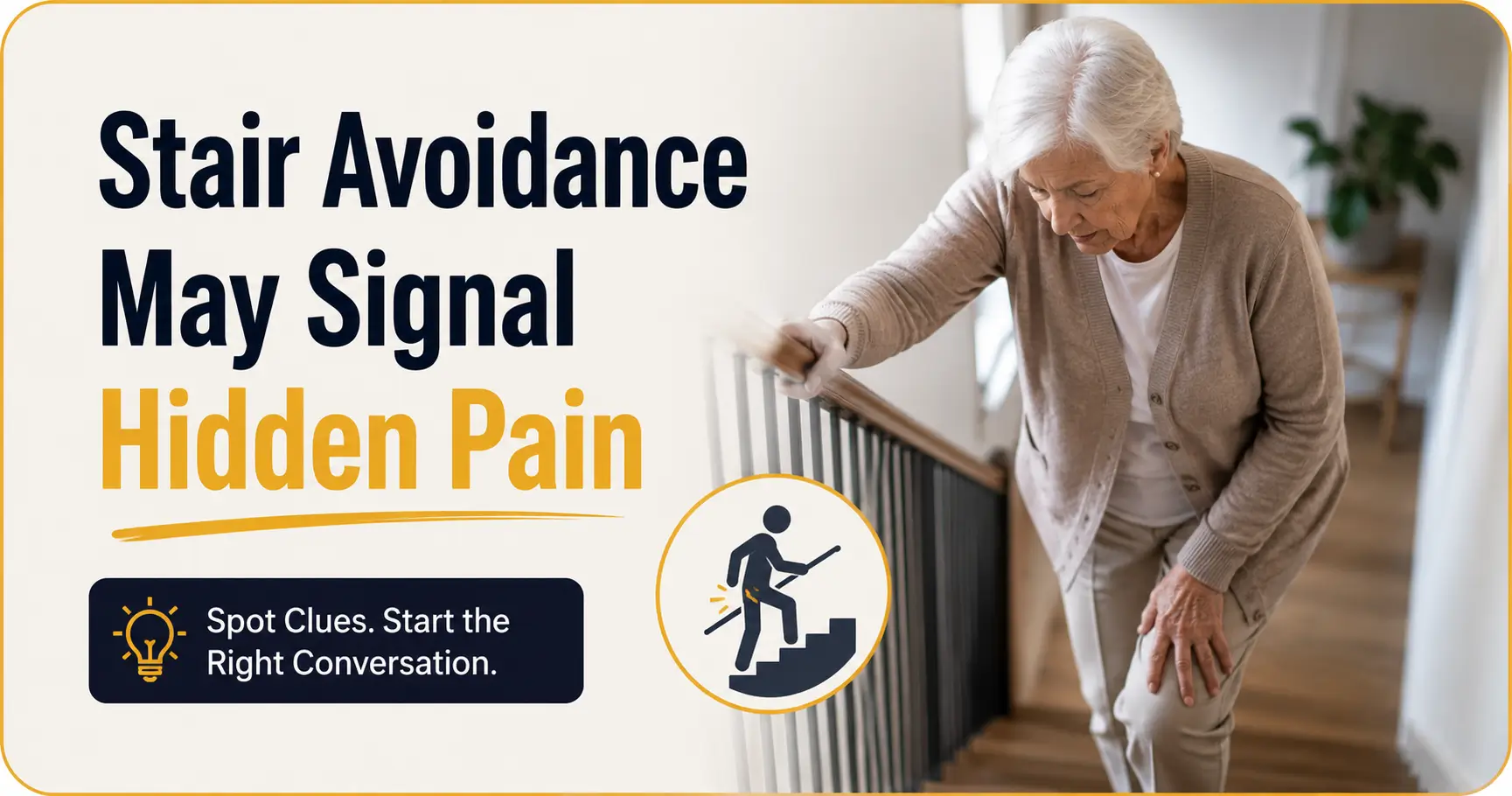
Caregiver stair-safety guide
How to Tell If a Parent Is Avoiding Stairs
Because of Pain
Sometimes the first sign is not a fall, a complaint, or a dramatic announcement. It is quieter. The laundry basket stays downstairs. The upstairs bedroom becomes “too much trouble.” Your parent grips the handrail with a seriousness you have not seen before. The house starts rearranging itself around one avoided staircase.
This guide is for adult children and family caregivers who feel that small tug in the stomach: something has changed, but nobody is naming it. Stair avoidance can come from knee pain, hip pain, back pain, foot pain, weakness, balance worry, vision changes, medication effects, fear after a stumble, or a mix of all the above. Your job is not to diagnose from the hallway. Your job is to notice patterns early enough to make the next conversation safer and kinder.
Below, you will learn what to watch during the first few steps, why going downstairs often reveals more than going up, how to separate pain clues from fear and weakness, and how to talk about it without making your parent feel inspected like a used car. Practical, calm, dignity-first. The good kind of household detective work.
Spot hidden patterns
See how chores, sleep location, errands, and excuses can reveal stair pain before anyone says “pain.”
Read movement clues
Watch grip, pauses, step style, breathing, sideways movement, and recovery after stairs.
Start a safer talk
Use gentle questions that protect pride while making room for medical and home-safety help.
🕯️ One useful promise: in about 10 minutes this week, you can gather better stair clues than a rushed “Are you okay?” ever will.
Snapshot
This article is for adult children, spouses, and family caregivers who suspect an older parent is avoiding stairs because something hurts, feels unstable, or suddenly feels risky. You will learn what clues to watch, what not to assume, how to check the home setup, and how to turn observations into one calm next step with a healthcare professional.
Table of Contents
Safety First: What This Guide Can And Cannot Tell You
This article cannot diagnose arthritis, a fracture, nerve pain, balance problems, medication side effects, vision changes, heart or lung issues, or any other condition. It is a practical observation guide for families who want to notice stair-related changes and respond with care.
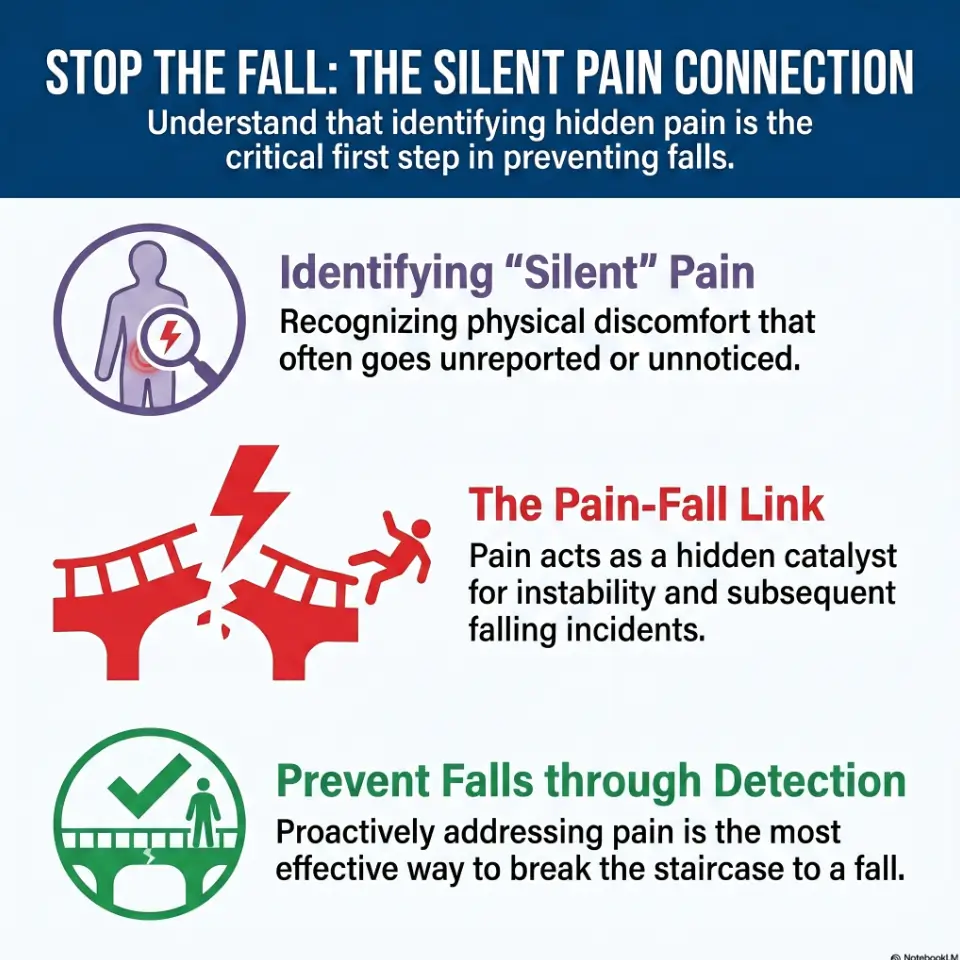
Stair avoidance matters because it can sit at the crossroads of pain, fear, and fall risk. A parent who quietly stops using stairs may be protecting a sore knee. They may also be reacting to dizziness, leg weakness, poor lighting, a near-fall, or new numbness in the feet. Those are not moral flaws. They are signals.
If your parent has sudden severe pain, new weakness, confusion, chest pain, shortness of breath, fainting, one-sided symptoms, inability to bear weight, a head injury after a fall, or rapidly worsening mobility, seek urgent medical help. Do not turn the staircase into a family science project when the body is waving a red flag.
Key takeaway
- Stair avoidance is a pattern to notice, not a diagnosis to announce.
- New or worsening pain, weakness, dizziness, or falls deserves medical attention.
- Your best first move is calm observation, not blame.
Apply in 60 seconds: Write down when the stair change started and whether it followed a fall, illness, medication change, or pain flare.
Who This Is For, And Who Needs Faster Help
For adult children noticing small stair changes
This guide is especially useful when you are not sure whether you are seeing aging, preference, pain, fear, or stubbornness wearing a cardigan. Your parent may still drive, cook, pay bills, and insist everything is fine. Yet the staircase has become strangely important.
Maybe they used to pop upstairs for a sweater, but now they wait until bedtime. Maybe they used to carry laundry down once a week, but now the basket has become a permanent exhibit. Maybe they ask you to “grab one little thing” from upstairs every time you visit.
These clues are easy to dismiss because they do not arrive with sirens. But for older adults, changes in daily movement can be early evidence that something hurts or feels unsafe. The staircase is not just architecture. It is a daily mobility test with carpet.
For caregivers who hear “I’m fine” but see the laundry pile growing
Many families get trapped between what a parent says and what the house shows. “I’m fine” may be true in spirit. It may also be a protective phrase that keeps everyone from worrying, fussing, or discussing loss of independence over chicken soup.
Caregivers often notice the practical evidence first. Mail collects near the entryway. Cleaning supplies migrate to the main floor. A favorite upstairs hobby gets abandoned. The guest room becomes a new sleeping area because it is “cozier,” though nobody has ever called that lumpy guest bed cozy before.
When words and patterns disagree, patterns deserve attention. They do not prove pain, but they do give you a kinder opening than interrogation.
Not for emergencies: when pain, weakness, or confusion needs urgent care
Some stair changes should not wait for a planned appointment. Sudden inability to climb stairs, severe joint pain after a fall, new numbness, new foot drop, severe back pain with bladder or bowel changes, chest symptoms, fainting, sudden confusion, or one-sided weakness needs prompt medical evaluation.
Also pay attention if your parent suddenly avoids stairs after starting a new medication, after an infection, or after several days of poor eating and drinking. A staircase can expose weakness that a favorite armchair politely hides.
The Stair-Clue Pattern: What Changed Without an Announcement?
The bedroom quietly moved downstairs
One of the loudest quiet clues is a sleeping change. A parent may say the downstairs couch is “fine for now” or that the guest room is easier because it is near the bathroom. Sometimes that is practical. Sometimes it is the body negotiating with pain.
Ask yourself: did this change happen after knee pain, hip pain, back pain, sciatica symptoms, a stumble, or a surgery recovery? Did they stop going upstairs only at night, when fatigue and low light make stairs feel harder? Did they bring more personal items downstairs over time?
A temporary downstairs setup can be wise after surgery or during a flare. A quiet permanent shift without discussion deserves a calm check-in, especially if your parent also moves clothing, medications, chargers, books, or toiletries to one floor.
Laundry, mail, and medicine now live on one floor
Household objects migrate when movement gets expensive. Laundry stops traveling upstairs. Mail is sorted wherever the strongest chair lives. Medication bottles appear on a kitchen counter because the upstairs bathroom cabinet might as well be in another county.
Do not treat this as messiness first. Treat it as information. If the daily map of the home has shrunk, ask what the stairs cost your parent in pain, energy, confidence, or breath.
Internal link opportunity fits naturally here: if your parent struggles to explain pain clearly, your family may benefit from a simple guide on how to describe pain to a doctor. Better words can turn vague worry into useful appointment notes.
“I’ll do it later” became a daily staircase detour
Everyone postpones chores. But stair-related postponement has a flavor. It happens around tasks that require going up or down: changing sheets, bringing down laundry, getting seasonal clothes, checking the upstairs window, carrying gifts, retrieving medicine, feeding a pet on another floor.
One postponed task is life. A repeated pattern is a breadcrumb trail. The question is not “Why are you being difficult?” The better question is, “Which part of that task is making it harder now?”
Stair Pattern Tracker
| What changed? | Possible meaning | Gentle question |
|---|---|---|
| Sleeping downstairs | Night pain, fatigue, fear, bathroom urgency | “Is bedtime stair climbing feeling harder lately?” |
| Laundry piles up | Carrying load hurts or feels unsafe | “Is it the basket, the stairs, or both?” |
| More items on one floor | Home activity range is shrinking | “What would make upstairs feel easier?” |
Pain Hides in Polite Excuses
“I’m just tired” may mean knees, hips, back, or feet hurt
Older parents may not use the word pain right away. They may say they are tired, busy, stiff, annoyed, lazy today, not in the mood, or saving their energy. Some of those may be true. But repeated tiredness around stairs may be pain wearing a polite hat.
Knee arthritis, hip pain, back pain, foot pain, neuropathy, and muscle weakness can all make stairs more demanding. Going upstairs asks the legs to lift and push. Going downstairs asks the knees, hips, ankles, and balance system to control the body’s weight step by step. That is a lot of negotiation for two railings and a carpet runner.
Watch whether “tired” appears only before stair tasks. If your parent can chat, cook, and sit comfortably but suddenly becomes “too tired” to climb, the timing matters.
“The stairs are annoying” may mean the stairs are painful
Annoying is a safer word than painful. Pain can feel like an admission that something is changing. Annoying keeps the problem outside the body. The staircase becomes the villain, not the knee.
Listen for changes in language. “These stairs are steep.” “This railing is weird.” “Who designed this house?” “I hate going down there.” The stairs may truly be poorly designed, but the new irritation can also mean they now amplify discomfort.
A useful follow-up is not “So you are in pain?” Try, “Which part is the worst: starting, turning, carrying something, going down, or getting back up?” That gives your parent a menu instead of a courtroom.
Here’s what no one tells you: pride often speaks before pain does
Stair avoidance can feel emotionally loaded because stairs represent independence. The same parent who taught you to tie your shoes may now dread being watched while taking one careful step at a time. That role reversal can sting.
So pride speaks first. Pride says, “I do not need help.” Pain says nothing. Fear says even less. The family hears the pride and misses the quieter signals underneath.
The antidote is not argument. It is observation plus respect. “I noticed you pause before the stairs now. I do not want to make a big production. I just want to understand what would make it easier.” That sentence leaves the door open without kicking it down.
Key takeaway
- Excuses can be emotional camouflage, not deception.
- Repeated stair-related “tiredness” deserves a second look.
- Specific questions work better than yes-or-no pain questions.
Apply in 60 seconds: Replace “Are you in pain?” with “Which part of the stairs feels hardest today?”
Watch the First Three Steps, Not the Whole Staircase
The pause before stepping up
The first three steps often tell you more than the full climb. That is when your parent decides which leg to lead with, whether to grip the railing, how much weight to trust, and whether the body feels ready.
Look for a pause that did not exist before. It may be only one or two seconds. They stand at the bottom, look down, shift weight, adjust the foot, or take a breath. That small pause can mean pain anticipation. The body remembers yesterday’s sting before the mouth admits today’s worry.
Do not hover while watching. Hovering changes behavior and irritates everyone, including the wallpaper. Observe once during a normal household moment. Make a note later.
The handrail grip that suddenly looks like a lifeline
Using a handrail is good. A secure handrail is a friend. The concern is a sudden change in how your parent uses it. Are they pulling themselves up instead of lightly supporting balance? Are the knuckles whitening? Do they use both hands on one railing? Do they stop speaking while climbing?
Heavy railing dependence can point toward pain, weakness, balance worry, or reduced confidence. It may also mean the stairs lack a second railing, have poor tread depth, or feel slippery. The body may be asking for better support before it asks for help.
If stair grip has changed, check the railing itself. A loose handrail turns every step into a tiny gamble. Tightening it may not solve the medical issue, but it can reduce risk while you investigate.
One-step-at-a-time climbing versus normal alternating steps
A common stair adaptation is “step-to” climbing: one foot steps up, then the other foot joins it on the same step before moving again. Many people do this after injury or surgery. In older adults, a new step-to pattern can signal pain, weakness, balance concern, or fear of trusting one leg.
Notice whether your parent always leads with the same leg. The phrase some rehab professionals teach is “up with the good, down with the bad,” but do not turn that into a home diagnosis. Simply note whether one side seems protected.
If your parent recently had surgery, follows a physical therapy plan, or uses a cane or walker, stair technique should follow professional guidance. For related home setup thinking, a guide on functional pain assessment can help families focus on what pain prevents, not just where it hurts.
First-Three-Steps Observation Card
- Does your parent pause before the first step?
- Do they lead with the same leg every time?
- Do they pull with the railing instead of lightly holding it?
- Do they stop talking while climbing?
- Do they grimace, hold breath, rub a joint, or sit immediately afterward?
- Does the pattern worsen later in the day?
The Descent Test: Going Down Often Reveals More Than Going Up
Knee pain can show up louder on the way down
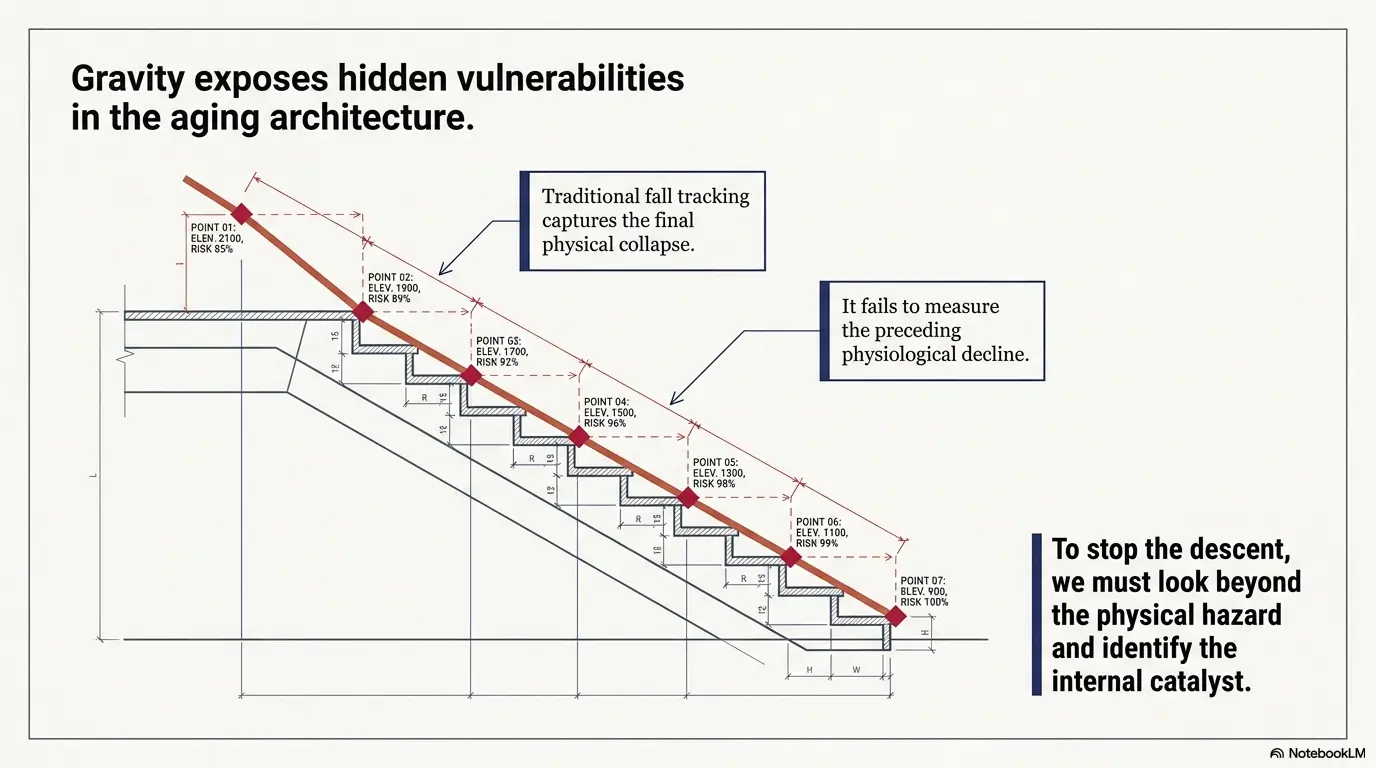
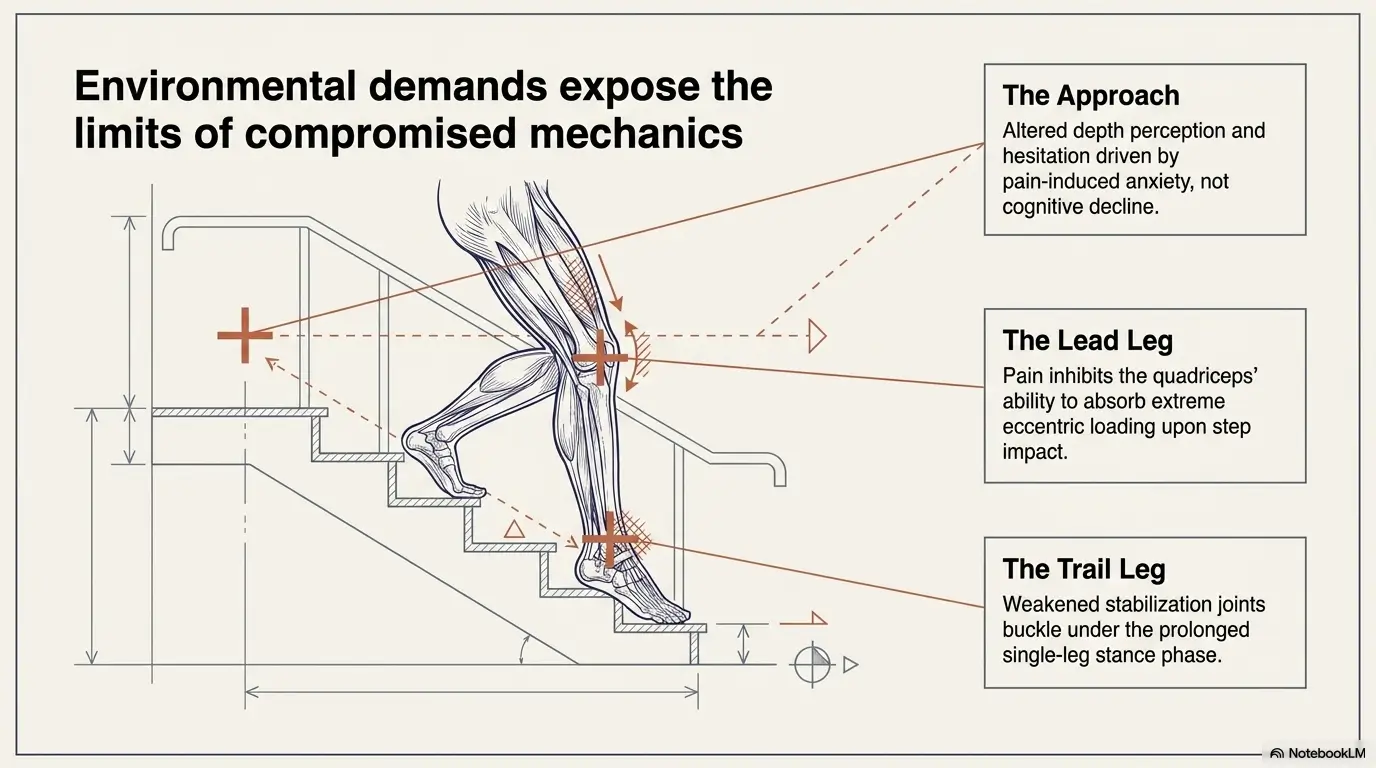
Many families focus on climbing up because it looks like effort. But going down can reveal more. Descending stairs requires control. The knee and hip must help slow the body’s weight. The ankle must adjust. The eyes and balance system must cooperate. It is a full orchestra, and one off-key violin can make the whole song tense.
Knee pain often becomes more obvious during descent. You may see a slower pace, a sideways angle, a sudden grab, a soft grunt, or a choice to descend one step at a time. Your parent may also avoid carrying anything downstairs because the load steals attention and balance.
If knee pain on stairs is part of the picture, do not rush straight to braces, supplements, or a stairlift. Start with notes: when it happens, which direction is worse, which knee seems protected, and whether swelling, stiffness, or instability appears. Those details can help during an orthopedic or primary care visit.
Looking down too long may signal fear, vision issues, or balance worry
Some parents stare at each step because the edges are hard to judge. That can happen with poor lighting, patterned carpet, weak contrast, bifocals, cataracts, depth perception changes, or fear after a past stumble.
Looking down is not automatically bad. But if your parent freezes, bends forward too much, or seems unable to move without watching each foot, the staircase may feel visually confusing or physically unsafe.
Check whether stair edges are visible. Dark wood stairs in dim light may look elegant in a real estate photo and treacherous at 2 a.m. Add bright, glare-free lighting. Remove visual clutter. Make sure glasses prescriptions are current. Small improvements can turn a hostile staircase into a calmer one.
Don’t miss this: sideways stepping is not just “being careful”
Sideways descent can be a clue. A parent may turn sideways to reduce pain, keep both hands near the railing, shorten the movement, or avoid bending a painful knee. It may help them feel safer, but it also tells you the normal stair pattern no longer feels reliable.
Watch whether sideways stepping appears only when going down, only when tired, or only on certain stairs. Does it happen on basement stairs but not porch steps? Does it happen when carrying laundry? Does it happen after sitting for a long time?
If sciatic pain or back-related leg symptoms are part of your parent’s history, this related guide on sciatica going down stairs may help you understand why descent can feel different from climbing.
Common Mistakes Families Make When They Suspect Stair Pain
Mistake 1: Calling it laziness when it may be pain protection
When a parent avoids stairs, families sometimes interpret it as laziness, moodiness, or refusal. That response is understandable when chores pile up and nobody explains why. But pain protection often looks like avoidance from the outside.
The body is economical. If a staircase caused pain three days in a row, the brain may start routing life around it. That is not weakness of character. That is a nervous system trying to avoid a repeat performance.
Try swapping judgment language for function language. Instead of “You never go upstairs anymore,” say, “I noticed upstairs tasks have become harder. What changed?” The second version has a door handle.
Mistake 2: Waiting for a fall before taking stair avoidance seriously
A fall is not the beginning of the story. Often, it is the chapter everyone finally reads. Before that, there may be near-falls, pauses, route changes, abandoned chores, and “I’m fine” delivered with theatrical firmness.
Stair avoidance should be taken seriously before a fall because it may reveal modifiable risks. Lighting can improve. Railings can be secured. Pain can be assessed. Physical therapy can address strength and balance. Medication side effects can be reviewed. Shoes can be changed. Clutter can be removed. This is the practical magic: not glamorous, but often useful.
Mistake 3: Buying gadgets before understanding the actual problem
Families often want to solve the problem quickly, so they buy devices. A brace. A cane. A stair tread. A motion light. A stairlift brochure appears on the kitchen table like a very expensive bird.
Some equipment is helpful. But the right tool depends on the actual barrier. Knee pain is different from dizziness. Hip stiffness is different from poor lighting. Fear after a stumble is different from leg weakness. A device that helps one problem can fail another.
Before buying, identify the pattern: up or down, morning or evening, loaded or empty-handed, pain or fear, one side or both sides, sudden or gradual. If braces are part of the discussion, this related guide on a hinged knee brace for stairs can help you think more carefully before purchasing.
Mistake 4: Asking “Are you in pain?” only once
Pain conversations often need more than one pass. The first answer may be “No.” The second may be “Not really.” The third, asked gently and specifically, may become “Only going down.” That is not lying. That is trust warming up.
Ask at different times. Ask after a stair trip, not during one. Ask about specific tasks. “Does going down bother your knee?” is easier to answer than “Are you in pain?”
Mistake Checklist
| Instead of… | Try… |
|---|---|
| “You are being lazy.” | “Something about the stairs seems harder lately.” |
| Buying equipment first | Watching the pattern before choosing tools |
| Waiting for a fall | Acting on near-falls, pauses, and route changes |
| Asking once | Asking specific, gentle questions over time |
The Conversation That Does Not Make a Parent Feel Cornered
Start with what you noticed, not what you fear
Fear makes families sound sharper than they mean to sound. “You’re going to fall!” may come from love, but it can land like accusation. Start smaller. Start with what you noticed.
Try: “I noticed you have been keeping more things downstairs.” Or: “I saw you pause before going down the stairs.” Or: “The laundry seems harder to move lately.” These statements are harder to argue with because they are observations, not verdicts.
Then pause. Silence can be useful. Nobody likes being peppered with questions while standing near the very staircase under discussion.
Use softer questions: “Which step feels hardest?”
Softer questions help because they do not demand a dramatic confession. “Which step feels hardest?” is practical. “Does it hurt more going up or down?” is specific. “Is it worse when you carry something?” gives the person something concrete to answer.
Questions that begin with “why” can sound accusatory even when you mean well. “Why won’t you go upstairs?” can feel like a cross-examination. “What makes upstairs harder lately?” feels more collaborative.
If your parent shuts down, try later. The goal is not to win the conversation. The goal is to keep the conversation possible.
Let’s be honest: nobody wants to be audited by their own child
Aging parents often resist help because help can feel like surveillance. A loving adult child can accidentally become a walking clipboard. You notice the limp, the rail grip, the pill bottles, the laundry, the chair height, the shoes. Suddenly dinner feels like an inspection.
Protect dignity by asking permission. “Can I share something I noticed?” is better than launching into your findings as if presenting evidence in court. Also make it clear that you are not trying to take over.
You might say, “I want you to stay independent. That is why I care about this now, before it becomes a bigger problem.” That sentence reframes the talk from control to protection.
Short Story: The Laundry Basket That Told the Truth
Marianne noticed her father’s laundry basket sitting by the basement door for three visits in a row. He joked that retirement had made him “professionally relaxed.” She laughed, but she also watched. When he finally carried towels downstairs, he paused at the top step, shifted the basket to one hip, gripped the rail, and went down sideways.
Later, instead of asking, “Why didn’t you tell me your knee hurts?” she tried, “Dad, is the basket making the stairs harder?” He shrugged, then said, “Only going down. It catches.” That one sentence changed the appointment. His doctor heard a specific problem, not a vague complaint. A physical therapist later worked on strength, stair technique, and safer carrying. The practical lesson was simple: the basket was not clutter. It was evidence waiting patiently by the door.
Key takeaway
- Start with observations, not accusations.
- Ask permission before raising a sensitive mobility concern.
- Specific task questions create better answers than broad pain questions.
Apply in 60 seconds: Write one sentence that begins, “I noticed…” and removes blame from the conversation.
Pain, Fear, Or Weakness? How to Separate the Clues
Pain clues: grimacing, rubbing joints, slower movement after stairs
Pain clues often show up before, during, and after the stair trip. Your parent may rub a knee, press a hand into the low back, rotate a hip before starting, wince on a certain step, or sit down right after reaching the top.
Also watch recovery time. If a parent climbs the stairs and then needs several minutes before talking, cooking, or moving again, that matters. Pain is not only the step itself. It is the aftershock.
Useful notes include location, direction, timing, and triggers: right knee going down, hip after sitting, back pain when carrying laundry, foot pain in the morning. These specifics help clinicians far more than “stairs are bad.” For appointment prep, see this orthopedic appointment checklist.
Fear clues: hesitation, over-gripping, avoiding stairs after a stumble
Fear of falling can make a parent avoid stairs even when pain is not the main problem. Fear often follows a slip, a near-fall, a friend’s fall, a hospital stay, or a spell of dizziness. It may also grow quietly when balance feels less trustworthy.
Fear clues include freezing at the top, insisting someone stand nearby, refusing to carry anything, avoiding stairs at night, or repeatedly saying, “I just do not like those stairs.” Fear is not silly. It can be protective, but it can also shrink daily life.
If fear is part of the pattern, the solution may include home changes, balance assessment, physical therapy, vision review, medication review, and confidence-building practice. Telling someone “just be careful” is not a plan. It is a decorative sentence.
Weakness clues: heavy breathing, pushing off thighs, needing rest breaks
Weakness often appears as effort. Your parent may push off the thighs, pull hard on the rail, stop halfway, breathe heavily, or say the legs feel heavy. They may do better in the morning and worse later, or they may struggle after illness or inactivity.
Weakness can come from many sources, including deconditioning, pain inhibition, neurologic issues, nutrition problems, medication effects, or heart and lung conditions. That is why sudden or severe weakness should be checked promptly.
For gradual weakness, the right professional assessment can help. Physical therapy may address strength, balance, gait, and stair strategy. The key is not to shame the weakness. It is to understand it before it steals more territory.
Pain, Fear, Weakness Comparison Table
| Pattern | What you may see | Useful next question |
|---|---|---|
| Pain | Wincing, rubbing joints, protecting one side | “Where do you feel it, and is up or down worse?” |
| Fear | Hesitation, over-gripping, avoiding stairs after a near-fall | “Did something happen that made the stairs feel less safe?” |
| Weakness | Heavy breathing, pulling on rail, rest breaks | “Do your legs feel tired, shaky, or hard to trust?” |
Show me the nerdy details
Stairs require more than leg strength. The body must combine joint range of motion, muscle control, foot placement, vision, inner-ear balance signals, sensation in the feet, cardiovascular endurance, reaction time, and confidence. Going up stairs emphasizes lifting and pushing. Going down emphasizes controlled lowering and balance. That is why a parent can look “fine” walking across a room but struggle on stairs.
Pain can change movement even when pain is not severe. A sore knee may cause a shorter step, a hip may rotate outward, a back problem may make carrying loads harder, and foot numbness may make step edges feel uncertain. These small changes can raise fall risk when combined with poor lighting, loose railings, clutter, pets, slippers, or fatigue.
The Home Check: Stairs Can Make Pain Worse When the Setup Is Bad
Loose railings turn mild pain into a daily gamble
A painful knee is one problem. A painful knee plus a loose railing is a little household trap with a paint color. Handrails should be secure, easy to grip, and available where your parent actually needs support.
Check the entire rail, not just the middle. Wiggle it gently. Look at brackets. Notice whether the rail stops before the last step. Many falls happen at transitions: top, bottom, turn, landing, doorway. That is where the body is changing tasks.
If there is only one railing, ask whether a second railing would help. Some older adults feel much safer when both sides are available, especially if one side hurts or one hand is weaker.
Poor lighting hides depth, edges, and confidence
Lighting is not decoration when stairs are involved. It is information. Each step edge needs to be visible without glare. Light switches should be easy to reach at both top and bottom. Night lighting matters if your parent uses stairs for bathroom trips, pets, temperature control, or sleep changes.
Look for shadows, burned-out bulbs, dim fixtures, shiny surfaces, and patterned carpet that makes step edges blur. The eye should not have to solve a puzzle while the knee is already filing a complaint.
For post-surgery or pain-flare homes, lighting changes can be especially useful. This guide on bedroom lighting setup after joint surgery may help if your parent’s stair issue is tied to night movement or recovery.
Clutter on stairs is not clutter, it is a tiny obstacle course
Stairs often become a staging area: mail going up, laundry going down, shoes waiting for someone, books in transit, a tote bag that has achieved legal residency. For a parent with pain or fear, those objects can turn a hard task into a risky one.
Remove objects from steps and landings. Check for loose rugs near the top and bottom. Watch pets, cords, slippery socks, and shoes without secure backs. The goal is not to make the house sterile. The goal is to make the staircase boring, predictable, and slightly less theatrical.
The Stair-Clue Framework
1. Observe
Watch grip, pause, step style, direction, and recovery.
2. Ask
Use specific questions about up, down, carrying, and timing.
3. Check
Review railings, lighting, clutter, shoes, and stair edges.
4. Track
Write down direction, pain location, fear, weakness, and changes.
5. Act
Bring notes to a clinician, physical therapist, or home-safety review.
Key takeaway
- Stair safety is both body and environment.
- Railings, lighting, and clutter can magnify pain-related risk.
- Small home fixes can support safer movement while medical questions are addressed.
Apply in 60 seconds: Stand at the top and bottom of the stairs tonight and check whether each step edge is easy to see.
When to Seek Help
New stair avoidance after a fall, near-fall, or sudden pain
New stair avoidance after a fall or near-fall deserves attention. Even if your parent says they are fine, pain and fear can appear later. Some injuries are obvious. Others start as “just sore” and become a bigger limitation over days.
Call a healthcare professional if stair avoidance begins suddenly, if your parent cannot bear weight, if pain is severe, or if the pain follows a twist, trip, impact, or fall. If there was head impact, confusion, fainting, or blood thinner use, seek urgent guidance.
Pain with swelling, redness, numbness, weakness, dizziness, or shortness of breath
Some symptoms raise the concern level. Pain with swelling, redness, warmth, fever, numbness, new weakness, dizziness, fainting, chest discomfort, or shortness of breath should not be treated as ordinary stair trouble.
Also be careful with new numbness in the feet, sudden balance changes, or a leg that feels unreliable. These can make stairs more dangerous and should be discussed with a clinician.
Repeated balance trouble, medication changes, or fear of falling
If your parent has repeated balance trouble, dizziness, new sleepiness, confusion, or fear of falling after a medication change, bring that to a medical professional. Medication side effects and interactions can affect balance, alertness, blood pressure, and fall risk.
Fear of falling is also worth discussing. It can limit activity, reduce strength, and make the world smaller. A fall-risk screening, physical therapy evaluation, vision check, and home safety review can be practical next steps.
Ask about physical therapy, fall-risk screening, and home safety review
Bring your stair notes to a primary care clinician, orthopedist, physical therapist, or other appropriate professional. Ask whether the pattern suggests joint pain, weakness, balance issues, vision concerns, medication effects, or another cause.
Useful questions include: “Would a fall-risk screening make sense?” “Could physical therapy help with stairs?” “Should medications be reviewed?” “Should we check vision or footwear?” “Would a home safety assessment help?”
Questions to Ask a Professional
- Could this stair avoidance be related to pain, balance, weakness, medication, vision, or fear of falling?
- Would a fall-risk screening be appropriate?
- Should we consider physical therapy for stair technique, strength, or balance?
- Are there warning signs that should prompt urgent care?
- Would any home safety changes reduce risk while we work on the cause?
- Should assistive devices, braces, or stair modifications be evaluated before purchase?
Next Step: Do a 10-Minute Stair Pattern Check This Week
Watch one normal stair trip without hovering
Choose a normal moment. Do not announce a stair evaluation. Do not stand two inches behind your parent with the anxious face of a border collie. Just notice.
Watch the approach, first step, hand position, pace, direction, breathing, facial expression, and recovery afterward. If you can safely observe both going up and going down, do so. Down may reveal the clue that up hides.
Write down what changed: speed, grip, pain words, pauses, side-stepping
Write notes in plain language. “Paused at top before going down.” “Held rail with both hands.” “Said left knee catches.” “Avoided carrying basket.” “Sat immediately after stairs.” These notes are more useful than a dramatic summary.
Include dates. Patterns over two weeks tell a better story than one anxious memory. If symptoms are sudden or severe, do not wait two weeks. Seek help sooner.
Turn the notes into one calm question for their next appointment
The best appointment question is specific. “My mom has started going down stairs sideways and says her right knee catches. Should we evaluate knee pain, balance, or strength?” That is far more useful than “She hates stairs now.”
If your parent is open to it, bring the notes. If they are not, ask whether they would be willing to mention one specific stair problem. One honest sentence can be enough to begin.
Key takeaway
- A 10-minute stair check can reveal patterns without turning your parent into a project.
- Specific notes make medical conversations clearer.
- Observation should feel calm, not sneaky or controlling.
Apply in 60 seconds: Create a phone note titled “Stair pattern” and add today’s date.
FAQ
Why would an older parent avoid stairs but deny pain?
They may not want to worry anyone, admit a change in independence, or start a medical discussion. They may also describe pain as tiredness, stiffness, annoyance, or “not feeling steady.” Watch behavior patterns, then ask specific questions.
Is stair avoidance a normal part of aging?
It can become more common with age, but new or worsening stair avoidance should not be brushed off as normal. Pain, weakness, balance issues, vision changes, medication effects, and fear of falling may all contribute.
What does knee pain on stairs usually look like?
You may see slower movement, one-step-at-a-time climbing, grimacing, rubbing the knee, avoiding carrying items, or turning sideways when going down. Knee pain may be especially noticeable during descent because the knee must control body weight.
Could fear of falling make a parent avoid stairs even without pain?
Yes. Fear after a fall, near-fall, dizziness episode, or balance scare can make stairs feel unsafe. Fear deserves attention because it can reduce activity, confidence, and strength over time.
Should I install a stairlift right away?
Not necessarily. A stairlift may be appropriate for some homes and conditions, but first understand the cause of stair avoidance. Pain, lighting, railings, balance, strength, and medical issues should be assessed before making a major purchase.
How can I talk about stair safety without embarrassing my parent?
Use observations, ask permission, and focus on independence. Try, “I noticed the stairs seem harder lately. Can we talk about what would make them easier?” Avoid blaming, scolding, or turning the conversation into a performance review.
What should I track before calling a doctor?
Track when the change started, whether going up or down is worse, pain location, swelling, weakness, dizziness, falls, medication changes, time of day, and whether carrying items makes it worse. Bring specific examples.
When is stair pain an urgent warning sign?
Seek urgent help for severe sudden pain, inability to bear weight, new weakness or numbness, chest pain, shortness of breath, fainting, confusion, head injury, or symptoms after a significant fall. Trust the red flags over the calendar.
The Quiet Step That Protects More Than Knees
When a parent avoids stairs, the staircase is rarely just a staircase. It may be a pain diary, a confidence meter, a fall-risk clue, and a dignity test all in one narrow strip of carpet and wood.
The loving move is not to panic. It is not to buy the largest gadget first. It is not to say, “I knew something was wrong,” with the triumphant energy of a detective in the final scene. The loving move is smaller and better: notice the pattern, protect dignity, improve the home setup, and bring useful notes to the right professional.
Your 15-minute next step is simple. Walk through the home once today and look at the stairs from your parent’s point of view. Check lighting, railings, clutter, step edges, shoes, and where daily objects have migrated. Then write one calm question you can ask without cornering them.
Something like: “I noticed the stairs seem harder lately, especially going down. What part feels most difficult?” That question is not dramatic. It is a small lantern. Sometimes that is enough to find the safer path.
Last reviewed: 2026-05