

Caring from a Distance: Navigating Medication Confusion With Grace
The first warning sign is often small. Your parent says, “I took the round one,” then laughs it off. The refill arrives early. A bottle from last year is still in the kitchen drawer. From three states away, those crumbs of information can feel like trying to read tea leaves through a foggy window.
How to monitor medication confusion from far away is not really a gadget question. It is a trust question, a routine question, and sometimes a safety question. Missed doses, double doses, drug interactions, side effects, and sudden confusion can move from “family worry” to “call someone now” with startling speed.
This guide helps adult children, long-distance caregivers, and family coordinators build a calm system: one medication list, smarter check-ins, refill clues, local backup, privacy boundaries, and a weekly rhythm that does not turn every phone call into a siren.
• Start small.
• Stay respectful.
• Make the system easier to tell the truth inside.
- Spot early signs of medication confusion without interrogating your loved one.
- Use pharmacy, refill, and routine clues before buying tech.
- Know when to call a pharmacist, prescriber, local helper, Poison Control, or emergency services.
Quick Safety Frame Before You Begin
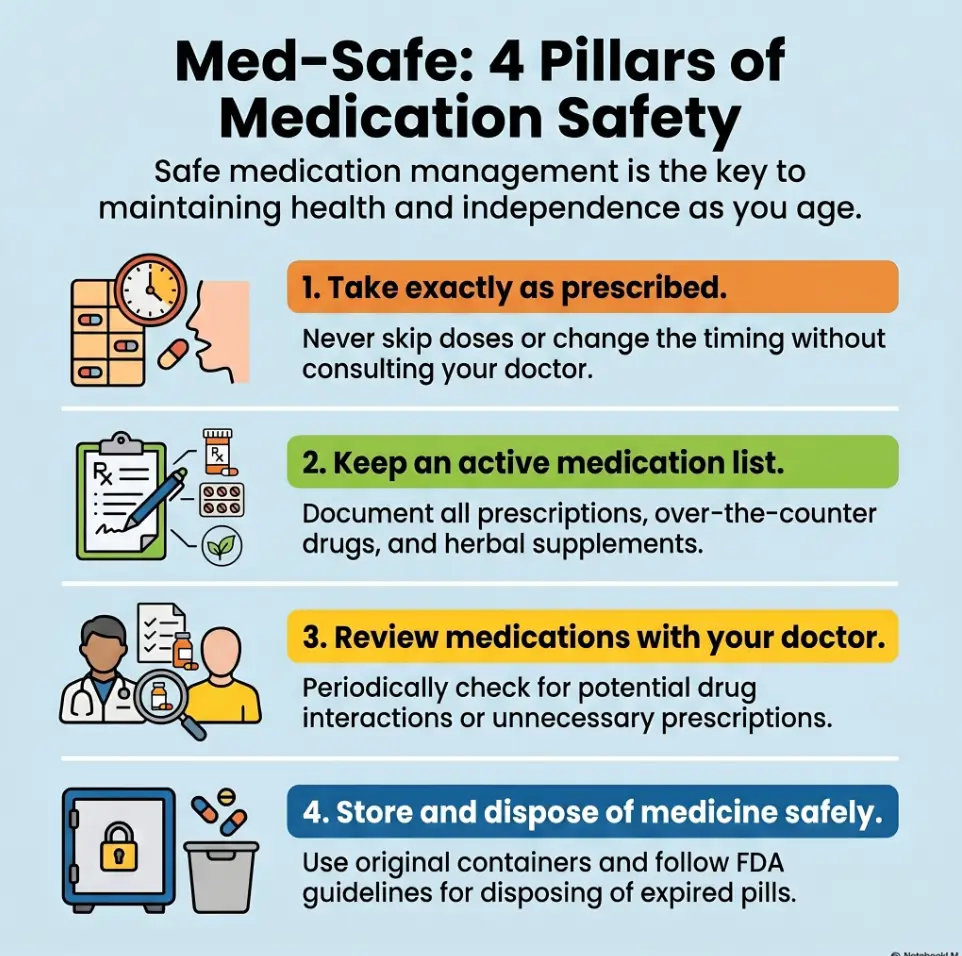
This article is for general caregiver education, not medical advice, diagnosis, emergency guidance, legal advice, or a substitute for a clinician’s medication review. The FDA and National Institute on Aging both encourage older adults and caregivers to keep an up-to-date medication list, follow professional instructions, and ask questions before changing how medicines are taken.
Never tell a loved one to stop, restart, split, combine, or “make up” doses unless their prescriber or pharmacist gives that instruction.
Table of Contents
The First Clue Is Not the Pillbox
Families often picture medication confusion as a pillbox problem. Monday pills are missing. Thursday pills are gone. Saturday has somehow become a tiny plastic confetti parade. That does happen, but the earliest clues are usually verbal.
Listen for the soft changes: “the little white one,” “the heart pill,” “the new one from the tall doctor,” or “I took it, I think.” None of these proves danger by itself. Together, they can show the routine is getting slippery.
Listen for tiny wording changes before you count tablets
Medication confusion often appears as vague naming, repeated questions, misplaced confidence, or small contradictions. A loved one may know they take “something for blood pressure” but not remember whether the new dose replaced the old bottle or joined it. That is where the trouble starts wearing slippers.
During a normal call, gently notice whether they can name:
- What they take in the morning, afternoon, and evening.
- Which medicine recently changed.
- Why each medicine matters.
- Who told them to change the dose.
- Which pharmacy filled the newest bottle.
The goal is not a pop quiz. The goal is pattern recognition. If your loved one is usually precise and suddenly becomes vague, that deserves attention.
Build a “normal baseline” while things are calm
A baseline is the family’s quiet measuring stick. Before there is a crisis, write down what your loved one typically knows and does. Do they organize pills on Sunday? Do they use one pharmacy or three? Do they call the doctor, the pharmacist, or a neighbor when instructions change?
This baseline helps you avoid two bad outcomes: underreacting to a real change, and overreacting to a normal quirk. Some people have always called medications by color. Others have always kept vitamins in a cookie tin that looks like it survived three presidents. The question is whether the pattern changed.
- Notice language, timing, refill habits, and confidence level.
- Track changes after appointments, illness, hospital discharge, or new prescriptions.
- Use patterns instead of single awkward moments.
Apply in 60 seconds: Write down one thing your loved one usually knows about their medication routine and one thing they often forget.
Pattern-interrupt: The phone call is data
A two-minute call can show more than a device if you ask the right kind of question. “Did you take your pills?” invites a fast yes. “Walk me through what you took after breakfast” gives you a little movie of the routine.
That little movie matters. You may hear that the pillbox sits next to the coffee maker, but breakfast is sometimes skipped. Or that an evening pill is taken “whenever the TV news comes on,” except the news schedule changed. Human routines are full of trapdoors.
Who This Is For, And Who Needs More Than This
This guide is for families trying to support an independent adult who still manages much of daily life but may be wobbling around a complicated medication routine. It is not a substitute for in-person care when safety is already breaking down.
Best fit: independent adults with mild confusion or complex routines
Remote monitoring can work well when the person is generally independent but has one or more risk factors:
- Multiple prescriptions from more than one clinician.
- New generics that look different from the previous refill.
- Recent hospital discharge or urgent care visit.
- Memory lapses that are mild but noticeable.
- Medication taken at different times of day.
- Over-the-counter medicines, vitamins, or supplements mixed into the routine.
Many long-distance caregivers are not trying to control everything. They are trying to prevent the “I ran out somehow” moment from becoming a 10 p.m. emergency call with everyone speaking in half-sentences.
Not enough: unsafe solo medication management
Remote monitoring is too thin a bridge if your loved one is frequently double-dosing, missing critical medications, mixing old prescriptions, or showing worsening confusion. In that case, the family may need a clinician-led medication review, home health support, caregiver visits, pharmacy packaging, or a higher level of supervision.
Medication confusion can also be a sign of infection, dehydration, poor sleep, depression, cognitive decline, medication side effects, or interactions. A family spreadsheet cannot diagnose that. It can only wave a flag.
Respect first, monitor second
The emotional risk is real. Nobody wants to feel managed like an appliance with a maintenance schedule. Start from dignity. Say, “I want to make this easier,” not “You can’t handle this anymore.” The first opens a door. The second boards it shut.
Money Block: Remote Monitoring Fit Check
Use this yes/no checklist before building the system.
- Yes/No: Your loved one agrees to some type of medication support.
- Yes/No: There is one accurate medication list or a realistic way to create one.
- Yes/No: At least one local person can help if confusion becomes urgent.
- Yes/No: A pharmacist or clinician can review unclear instructions.
- Yes/No: The person is not repeatedly taking dangerous wrong doses.
Neutral action line: If you answer “no” to two or more items, ask a pharmacist, prescriber, or care manager what level of support is appropriate.
Make One Medication List the Family Can Actually Trust
A medication list sounds boring until the day everyone needs it. Then it becomes the family’s air traffic control tower. Without it, each bottle is a tiny plane with no runway plan.
The FDA and National Institute on Aging recommend keeping a complete medication list and asking healthcare professionals questions about how medicines should be taken. For remote caregivers, this list is the foundation. Not the app. Not the dispenser. The list.
Include prescriptions, OTC drugs, vitamins, and supplements
A useful medication list includes more than prescription bottles. Add over-the-counter pain relievers, allergy medicines, sleep aids, cold medicines, vitamins, herbal products, eye drops, creams, inhalers, patches, and “only when needed” medicines.
For each item, include:
- Medicine or product name.
- Dose or strength.
- When it is taken.
- Why it is taken.
- Who prescribed or recommended it.
- Which pharmacy filled it.
- Start date, stop date, or “ask clinician.”
- Special instructions, such as with food or not with certain products.
If pain medicines are part of the routine, it can help to connect medication notes with symptom notes. A simple plain-language way to describe pain to a doctor can make follow-up calls more useful and less theatrical.
Add “why this matters” beside each medication
Knowing the purpose helps you spot risk. “Blood thinner” is different from “vitamin.” “Diabetes medicine” is different from “occasional antacid.” You do not need to become a pharmacology wizard in a velvet cape. You do need enough context to know which questions matter.
Use simple labels:
- Blood pressure: ask what to do if doses are missed.
- Blood thinner: ask about bleeding, falls, and interactions.
- Diabetes: ask about meals, blood sugar, and missed-dose instructions.
- Sleep or anxiety: ask about drowsiness, falls, and confusion.
- Pain: ask about maximum daily dose and combining products.
Update after every appointment, discharge, refill, or pharmacy change
Medication confusion sneaks in through transition points. A specialist changes a dose. The hospital discharge list contradicts the old routine. A mail-order pharmacy sends a different-looking generic. A dentist prescribes something temporary. Suddenly the medicine cabinet has a subplot.
After any appointment, ask three questions:
- Was anything started?
- Was anything stopped?
- Was anything changed?
If orthopedic pain, surgery recovery, or mobility issues are part of the larger care picture, a structured orthopedic appointment checklist can help families bring medication questions, pain notes, and function changes into one conversation.

The 3-Layer Remote Monitoring System
A sturdy remote medication system has three layers: human check-ins, physical organization, and digital backup. Build them in that order. Otherwise, you may end up with a smart dispenser sitting on top of a confused routine, blinking like a tiny judgmental lighthouse.
1
Human Check-Ins
Open-ended calls, calm tone, routine questions, and early pattern spotting.
2
Physical Organization
Pill organizers, blister packs, labeled bins, disposal of old bottles, and visible routines.
3
Digital Backup
Reminder apps, smart dispensers, shared calendars, refill alerts, and pharmacy portals.
Layer 1: Human check-ins
Human check-ins are the softest tool and often the most revealing. Use the same time, a calm voice, and questions that invite detail.
Better than “Did you take your pills?”:
- “Walk me through your morning medicines.”
- “What is still left in today’s box?”
- “Which bottle looks different this week?”
- “What did the pharmacist say when you picked it up?”
Layer 2: Physical organization
Physical organization reduces decision fatigue. A weekly pill organizer, pharmacy blister packs, separate “current” and “ask before using” bins, and large-print labels can make the routine easier to follow.
For loved ones recovering from surgery or managing chronic pain, physical setup matters too. If standing at the counter is hard, medication sorting may need a seated station, a good light, and a reachable surface. The same practical mindset used for orthopedic home care equipment applies here: reduce friction before it becomes a safety issue.
Layer 3: Digital backup
Digital tools can help, especially when routines are stable and the person accepts them. Options include shared calendars, medication reminder apps, smart pill dispensers, pharmacy refill alerts, and patient portal access.
Technology works best when it answers a clear problem. “We need to know whether the noon pill was accessed” is a clear problem. “We need technology because everyone is nervous” is a fog bank with a charging cable.
Show me the nerdy details
Remote medication monitoring works best when it separates three different questions: whether the medicine was available, whether the dose was accessed, and whether it was taken correctly. Refill records may show availability. A smart dispenser may show access. A conversation or local check may reveal whether instructions were understood. No single data source proves safe use. Combining routine questions, refill timing, medication-list updates, and local verification gives families a stronger signal without pretending the system is perfect.
- Start with respectful conversations.
- Make the physical routine easier to see and repeat.
- Add technology only to solve a specific gap.
Apply in 60 seconds: Choose the weakest layer in your current system and write one small improvement for it.
Don’t Start With a Smart Dispenser
Smart pill dispensers can be useful. They can lock compartments, send alerts, and reduce some missed-dose patterns. But buying one before understanding the routine can be like installing a fancy doorbell on a house with no front door.
Mistake: buying tech before mapping the routine
Before buying a device, map the routine on paper:
- Where are medicines stored?
- Who fills the organizer?
- What happens after an appointment?
- How are old bottles removed?
- What happens when a dose is missed?
- Which medications are taken with food?
- Who answers medication questions?
If the answers are fuzzy, fix the routine first. A device cannot solve duplicate bottles, unclear instructions, or mistrust.
Mistake: assuming app silence means safety
No alert does not always mean the medicine was taken correctly. It may mean a reminder was dismissed, a drawer opened, or a device was offline. Silence is not proof. It is just silence wearing a lab coat.
Use alerts as one signal. Pair them with refill records, weekly check-ins, and periodic review by a pharmacist or clinician.
Here’s what no one tells you: low-tech wins often last longer
A paper checklist on the fridge, pharmacy packaging, and a Sunday refill call may beat an expensive gadget with a forgotten password. Low-tech tools are not primitive. They are often sturdy, visible, and less embarrassing to use.
Money Block: Smart Dispenser vs. Low-Tech System
| Option | Best When | Watch-Out |
|---|---|---|
| Weekly pill organizer | Routine is stable and someone can fill it correctly. | Easy to fill wrong if the list is outdated. |
| Pharmacy blister packs | Multiple daily doses create confusion. | Changes after appointments must be updated quickly. |
| Smart dispenser | Missed doses or double doses need alerts and locked compartments. | Requires setup, refilling, trust, power, and troubleshooting. |
Neutral action line: Pick the simplest option that solves the specific failure pattern you have actually observed.
Ask Better Check-In Questions Without Sounding Like a Nurse With a Clipboard
Good questions make the truth easier to say. Bad questions make people perform confidence. If your loved one feels judged, they may hide the small mistakes that would have helped you prevent the large ones.
Use open-ended prompts
Open-ended prompts reveal the routine. They also protect dignity because they sound like conversation, not an audit.
- “Walk me through your morning medicines.”
- “Which one changed recently?”
- “What is still left in today’s box?”
- “Which bottle is the most annoying right now?”
- “What did the pharmacist explain?”
If symptoms are part of the concern, connect the medication question to function. “Did the new pain medicine make it easier to sleep?” may reveal more than “Did you take it?” A functional pain assessment can help families track whether a treatment is actually changing daily life, not just the number on a pain scale.
Ask about the routine, not just the result
The result is “I took it.” The routine is where safety lives.
Ask:
- “Where do you keep them?”
- “What happens if breakfast is late?”
- “How do you know you already took the evening dose?”
- “Where do you put medicine that was stopped?”
- “Who do you call when the label is confusing?”
Keep the tone calm enough for truth
Caregivers often panic because they care. Unfortunately, panic can teach a loved one to edit the story. Keep your voice neutral, even when your insides are banging pots together.
Try:
- “That sounds confusing. Let’s write it down and ask the pharmacist.”
- “I’m glad you told me. We can make the routine easier.”
- “Let’s not guess. Let’s call someone who can check.”
Short Story: The Tuesday Bottle
Marian called her father every Tuesday after work. He was 82, independent, proud of his tomato plants, and allergic to being fussed over. One evening he said, “I took the new blue one after lunch.” Marian almost corrected him sharply because the new medicine was supposed to be taken at bedtime. Instead, she paused and asked, “Can you walk me through where the bottle is sitting?” He carried the phone to the kitchen.
The “new blue one” was actually an old bottle with a similar label, left behind after a dose change. No drama. No accusation. Just a quiet discovery before it became a bigger problem. The next day, a neighbor helped remove the stopped medicines, and the pharmacist reviewed the current list. Marian learned the lesson many caregivers learn late: the calm question is not weakness. It is the key that opens the cabinet.
Refill Clues Reveal More Than People Admit
Refill timing can tell a story. It will not tell the whole story, and it should not be treated like courtroom evidence. But early refills, late refills, unopened mail-order packages, and pharmacy calls can reveal confusion before anyone admits feeling lost.
Too early may suggest double doses
An early refill may mean a dose was doubled, a bottle was lost, instructions changed, or the person spilled tablets into the sink and chose not to mention it. It may also mean travel, insurance timing, or pharmacy synchronization. The clue is worth checking, not prosecuting.
Ask calmly: “I noticed this one ran out sooner than expected. Did the doctor change the dose, or did the routine get messy?”
Too late may suggest skipped doses
Late refills can point to missed doses, cost problems, side effects, fear, or the quiet belief that the medicine is no longer needed. Many people stop medicines because they feel better, feel worse, or feel tired of being a walking spreadsheet.
Do not assume laziness. Ask what got in the way.
Pharmacy history is a quiet map
With permission, pharmacy refill records can help families spot patterns without counting pills over video. Some pharmacies can package medicines by dose time, offer automatic refill reminders, or flag duplicate therapy concerns. Policies vary, and privacy rules matter, so ask directly what access is available.
Money Block: Refill Pattern Decoder
| Refill Signal | Possible Meaning | Next Step |
|---|---|---|
| Refill requested early | Dose change, double dose, lost bottle, travel, or confusion. | Confirm current instructions with pharmacist or prescriber. |
| Refill delayed | Skipped doses, cost concerns, side effects, or stopped medicine. | Ask what made the medicine hard to take. |
| Multiple pharmacies | Fragmented records and higher chance of missed interaction review. | Consider one primary pharmacy when possible. |
Neutral action line: Use refill clues as conversation starters, then verify with a professional before changing anything.
Common Mistakes That Make Medication Confusion Worse
Families usually do not create medication confusion on purpose. It grows from tiny reasonable choices: keeping old bottles, trusting pill color, using multiple lists, or forgetting that supplements count too.
Mistake: keeping old bottles “just in case”
Old prescriptions can look useful, especially to people who grew up saving twist ties and margarine tubs as if civilization depended on it. But old bottles become dangerous when doses change or medicines are stopped.
Ask the pharmacist how to dispose of expired or discontinued medicine safely. Many communities have medication take-back locations or pharmacy disposal options.
Mistake: using pill color as the main identifier
Generics can change color, shape, or manufacturer. A person who identifies medicine as “the blue one” may be thrown off by a routine refill. Use name, dose, instructions, and purpose instead.
Mistake: letting every doctor work from a different list
Medication lists should follow the patient. Share the same list with primary care, specialists, dentists, therapists, pharmacists, and discharge teams when relevant.
If pain management, mobility limits, or surgery recovery complicate the picture, bringing one list to each visit can prevent crossed wires. For older adults dealing with pain, orthopedic pain management for older adults often works better when medication, function, sleep, and fall risk are discussed together.
Mistake: ignoring supplements and OTC medicines
Vitamins, sleep aids, cold medicine, allergy pills, pain relievers, and herbal products can matter. They may interact with prescriptions or worsen side effects such as drowsiness, dizziness, constipation, bleeding risk, or confusion.
- Remove discontinued medicines with pharmacist guidance.
- Identify medicines by name and dose, not color.
- Keep one list that travels across appointments.
Apply in 60 seconds: Add “OTC, vitamins, supplements, creams, drops, patches” to the top of your medication list.
The Local Backup Person Is Your Safety Valve
Long-distance caregiving needs a nearby human. Not for spying. Not for taking over. For the moments when a label must be read, a bottle must be found, or someone sounds suddenly “not right.”
Choose one nearby helper before the emergency
A local backup might be a sibling, neighbor, friend, home health aide, building manager, faith community contact, or trusted family friend. Choose someone who is calm, available enough, and acceptable to your loved one.
The best backup person is not always the most medically knowledgeable. Sometimes it is the person who can show up, stay kind, and read a label without turning the kitchen into a courtroom.
Give them a narrow, respectful role
Keep the role specific. Examples:
- Check whether the weekly organizer is filled.
- Read a label during a phone call.
- Notice unopened mail-order medication packages.
- Help remove discontinued bottles after pharmacist guidance.
- Visit if your loved one sounds suddenly confused.
Put contact rules in writing
Write down when the local helper should call you, when they should call the pharmacy, and when they should call emergency services. Keep the instructions plain.
For example:
- Call family: repeated confusion, unopened medicines, missed refills, unclear bottles.
- Call pharmacist or prescriber: wrong dose, duplicate bottle, side effects, conflicting instructions.
- Call emergency services: sudden severe symptoms, suspected overdose with symptoms, chest pain, breathing trouble, stroke-like signs, fainting, severe weakness, or sudden major confusion.
Privacy, Permission, and the Awkward Conversation
This is the tender part. Medication monitoring can feel like love to the caregiver and loss of control to the person receiving help. The conversation needs care, not a PowerPoint deck with a grim title slide.
Start with autonomy, not control
Try language that protects dignity:
- “I want to make this easier, not take it away from you.”
- “Can we build a backup plan for confusing pharmacy changes?”
- “You stay in charge. I help with the boring tracking.”
- “Let’s choose what kind of help feels least annoying.”
That last phrase matters. Some people do not want daily calls but will accept refill help. Others reject family involvement but will agree to a pharmacist review. Respectful options are the hinges on this door.
Ask what kind of help feels acceptable
Offer a menu, not a mandate:
- Shared medication list only.
- Weekly call before refills.
- Pharmacy packaging.
- Local helper check once a week.
- Medication reminder app.
- Portal access for appointment summaries.
If the person has pain, mobility limits, or post-surgical recovery, ask whether medication help can be paired with practical support. A person who struggles to stand, carry food, or get to the bathroom safely may also struggle to sort medicines. Guides such as one-handed meal prep and choosing toilet seat riser height show the same principle: independence often improves when the environment stops arguing with the body.
Consider HIPAA, pharmacy access, and healthcare proxies
In the U.S., privacy rules can limit what clinicians and pharmacies share without permission. Depending on the situation, your family may need written permission, patient portal access, emergency contact information, healthcare proxy documents, or power of attorney forms.
Do not assume being the adult child automatically opens every file cabinet. It does not. Ask the clinic and pharmacy what forms are needed and what information can be shared.
When to Seek Help
Medication confusion is not something to “wait out” when patterns repeat or symptoms change. A family can organize information, but clinicians and pharmacists should review medical risk.
Call a pharmacist or prescriber for repeated confusion
Ask for a medication review if you notice:
- Duplicate medicines.
- Conflicting instructions.
- Frequent missed doses.
- Possible double doses.
- New OTC or supplement use.
- Side effects such as dizziness, drowsiness, confusion, stomach trouble, bleeding, or falls.
- Medication changes after hospitalization or urgent care.
Pharmacists can often explain labels, identify possible duplicate therapies, review timing questions, and advise when the prescriber must be contacted.
Seek urgent medical help for sudden confusion
Sudden confusion is different from mild forgetfulness. It can signal infection, medication reaction, dehydration, low blood sugar, stroke, overdose, or another urgent condition. Seek urgent help for sudden confusion, extreme drowsiness, fainting, breathing problems, chest pain, severe weakness, stroke-like symptoms, or suspected overdose with concerning symptoms.
If the medication issue involves a possible poisoning or wrong dose, Poison Control in the U.S. can help guide next steps. For life-threatening symptoms, call emergency services.
Watch for “new confusion after a new medicine”
A change in thinking, balance, sleep, appetite, mood, or alertness after a new medicine deserves clinical attention. The timing may be coincidence, but it is worth reporting. Bring the medication list, symptom timing, dose changes, and refill details.
If your loved one has pain or orthopedic issues, the line between pain, sleep loss, sedating medication, and confusion can blur. A simple pain timeline before an orthopedic visit can help show whether confusion appeared before or after a medication change.
- Call a pharmacist or prescriber for repeated errors or unclear instructions.
- Seek urgent help for sudden severe symptoms.
- Report new confusion after medication changes.
Apply in 60 seconds: Add pharmacist, prescriber, local backup, Poison Control, and emergency numbers to the One-Page Medicine Map.
A Simple Weekly Monitoring Rhythm
A routine works best when it is boring. Boring is beautiful here. Boring means fewer emergency spirals, fewer mystery bottles, and fewer family calls that begin with, “So, don’t panic, but…”
Monday: confirm the medication list
Ask whether anything changed after appointments, pharmacy calls, hospital visits, or new symptoms. Update the shared list only after confirming the source of the change.
Wednesday: ask one routine question
Choose one friction point. Do not cover everything. One good question beats twelve anxious ones.
- “Which medicine is hardest to remember?”
- “What happens if lunch is late?”
- “Any bottle look different this week?”
- “Any side effects you have not mentioned?”
Friday: review refill and appointment signals
Look for early refills, late refills, unanswered pharmacy calls, upcoming appointments, or new discharge paperwork. If medical costs or visit planning are also stressful, resources on telehealth vs. in-person orthopedic visits can help families decide which questions need a screen and which need a room.
Sunday: reset the system
Sunday is for pill organizer refills, pharmacy packaging checks, calendar reminders, and confirming that the local backup person knows about changes. Keep it brief. The goal is a reset, not a family tribunal.
Money Block: Weekly Monitoring Mini Calculator
Use this simple calculator to estimate how much caregiver time your current routine needs each week.
Neutral action line: If the estimate feels unrealistic, reduce the routine or add local/pharmacy support instead of relying on willpower.
Next Step: Build the “One-Page Medicine Map”
The One-Page Medicine Map is the practical heart of the system. It is not a museum label. It is a living kitchen calendar for the body.
Do this in 15 minutes
Create one shared page with these fields:
- Medicine name.
- Dose or strength.
- Time taken.
- Reason for taking it.
- Prescriber.
- Pharmacy.
- Refill date.
- Special instructions.
- What would make this confusing?
- Who to call with questions.
That last field is magic. “What would make this confusing?” turns the list from inventory into prevention.
Send it to the right person
Share the map with your loved one, the primary caregiver, the local backup person, and the pharmacist or clinician who can verify it. Do not blast private health information to every cousin with a group-chat opinion and a thumbs-up emoji.
Keep the map alive
Update it after appointments, hospital visits, pharmacy changes, new symptoms, side effects, and medication changes. Put a review date at the top. A list with no review date becomes folklore surprisingly fast.
- Keep the list complete and current.
- Include purpose, prescriber, pharmacy, and refill details.
- Ask what could make each medicine confusing.
Apply in 60 seconds: Open a blank document and create the columns before you collect every answer.
FAQ
How can I tell if my parent is confused about medication from another state?
Look for repeated questions, vague medication descriptions, early or late refills, missed appointments, changed behavior, unexplained symptoms, inconsistent stories about what was taken, and sudden changes in confidence. One clue may be harmless. A pattern deserves a pharmacist or clinician review.
What is the safest first step for remote medication monitoring?
Start with a complete medication list that includes prescriptions, over-the-counter medicines, vitamins, supplements, dose, timing, purpose, prescriber, and pharmacy. Then ask a pharmacist or clinician to verify unclear items. Technology should support a clear system, not replace one.
Are smart pill dispensers worth it for older adults?
Smart pill dispensers can help when missed doses, double doses, or timing problems are the main issue. They are less helpful when the medication list is outdated, instructions are unclear, the person resists the device, or no one can refill and troubleshoot it reliably.
Should I count pills over a video call?
Sometimes, but it can feel intrusive and may still be inaccurate. A better first step is reviewing the medication list, pill organizer, refill dates, and daily routine with permission. If pill counting becomes necessary, keep the tone calm and explain that the goal is safety, not blame.
What should I do if my parent took the wrong medication?
Do not guess or tell them to fix the dose on your own. Call their pharmacist, prescriber, Poison Control, or emergency services depending on the medication, amount, timing, and symptoms. For severe symptoms such as trouble breathing, chest pain, fainting, or sudden major confusion, seek emergency help.
Can medication confusion be an early sign of dementia?
It can be, but medication confusion can also come from side effects, drug interactions, infection, dehydration, poor sleep, depression, pain, vision problems, hearing problems, or a complicated routine. New or worsening confusion should be evaluated by a clinician.
How often should medications be reviewed?
Many families benefit from a medication review at least once a year and whenever there is a hospitalization, new prescription, new supplement, fall, side effect, noticeable confusion, pharmacy change, or major health change.
What if my parent refuses help with medication?
Start with the least intrusive support they might accept. That may be a shared list, pharmacy review, refill reminders, or permission to call if something changes. Use autonomy-first language: “You stay in charge. I help with the boring tracking.” If safety is already at risk, involve a clinician or care manager.
Conclusion
The first clue was never really the pillbox. It was the wording, the refill rhythm, the old bottle, the changed routine, the tiny hesitation in a Tuesday phone call. Long-distance medication support works when families stop trying to become a human alarm system and start building a calmer safety net.
Use one trusted medication list. Ask better questions. Watch refill patterns. Choose one local backup person. Respect privacy. Call pharmacists and clinicians early when patterns appear. Treat sudden confusion as urgent, not as a family puzzle to solve over text.
Your concrete next step: spend 15 minutes creating the One-Page Medicine Map. Add the medicine name, dose, timing, reason, prescriber, pharmacy, refill date, and one question beside each item: “What would make this confusing?” That single question can turn a scattered cabinet into a clearer conversation.
Last reviewed: 2026-05.