
Safety First: Navigating Your Kitchen Without the Balancing Act
A plate of scrambled eggs should not become a balance test. For many older adults, post-surgery patients, and caregivers, moving breakfast from counter to table can feel like threading a needle while the floor auditions for trouble.
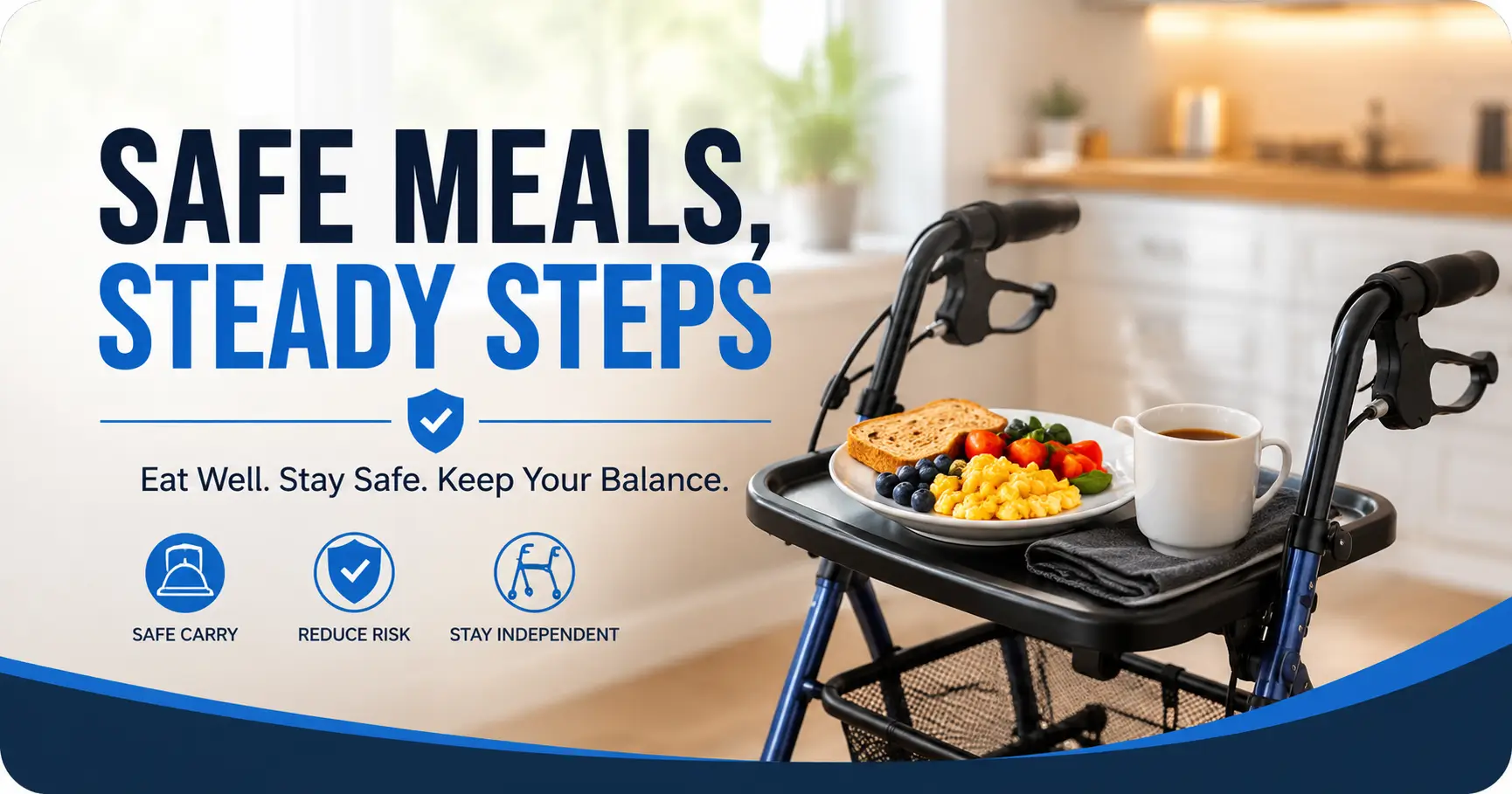
The real issue isn’t the plate—it’s what happens when hands leave the walker, rugs catch feet, or a pet wanders by. The safest rule: Do not carry an open plate in your hands. Use a walker tray, basket, caddy, or a sealed container instead.
Making life easier doesn’t have to turn your kitchen into a medical supply showroom.
The Plate Rule That Protects Your Balance
A walker is not a serving tray with legs. It is a balance tool. The safest meal-carrying setup keeps both hands available, keeps food stable, and makes the path from counter to table boring in the best possible way.
Simple rule: if carrying the plate makes you grip the walker less, twist more, rush more, or look down more, the setup needs a safer option.
Table of Contents
Safety / Disclaimer Block
This guide is for general home-safety education. It is not personal medical advice, diagnosis, or a substitute for professional care. Anyone recovering from hip, knee, spine, shoulder, abdominal, or neurological surgery should follow the restrictions from their surgeon, physical therapist, occupational therapist, or primary care clinician.
Ask for individual guidance before changing your meal-carrying routine if you have dizziness, neuropathy, Parkinson’s disease, stroke recovery, new weakness, arthritis flares, low vision, medication side effects, or recent falls. The CDC continues to identify falls as a major injury risk for adults 65 and older, and even a small home hazard can become a large problem when balance is already working overtime.
Hot food and liquids deserve extra caution. A fall is bad enough. A fall with soup, coffee, or boiling pasta water is a tiny kitchen opera no one bought tickets for.
- Do not treat the walker like a serving tray.
- Do not carry hot food by hand if you need the walker for support.
- Do ask a clinician if your balance, strength, or surgery restrictions have changed.
Apply in 60 seconds: Look at your usual route and name the one spot where you feel least steady.
Start Here: Your Hands Are Not the Delivery System
The walker’s real job is balance, not storage
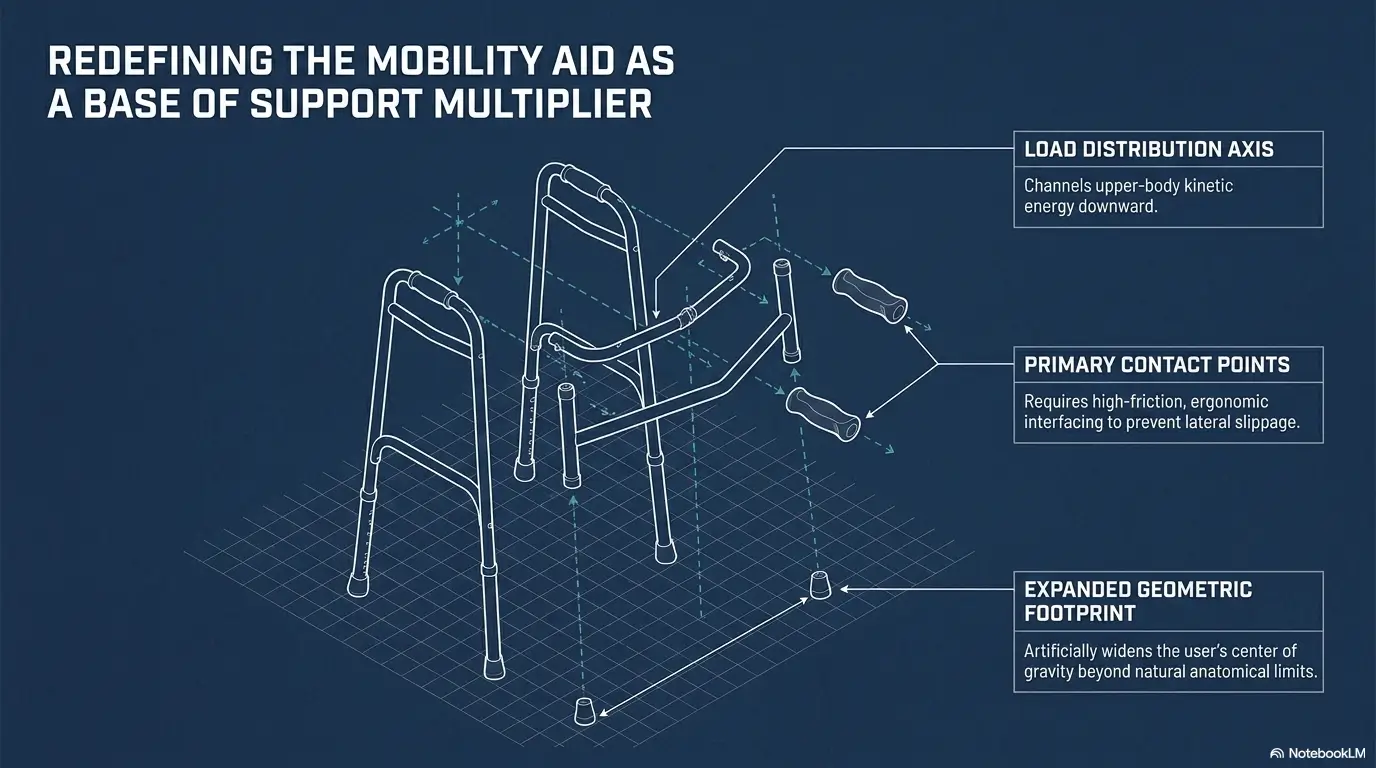
A walker earns its place in the home because it gives your body a wider, steadier base. It helps with balance, weight shifting, confidence, and controlled movement. The moment you remove a hand to carry a plate, the walker loses part of that job.
This matters because many falls do not begin with dramatic movement. They begin with something ordinary: reaching sideways, turning too quickly, stepping around a chair, or looking down at a sliding plate instead of watching the floor.
A walker is a support tool. A plate is cargo. The two should not fight for the same hands.
Why “just one plate” is where trouble begins
“Just one plate” sounds harmless. So does “just one step,” “just one rug,” and “just one quick turn.” Home accidents often come dressed in tiny words.
The problem is that one plate can cause a chain reaction:
- You grip the walker with only one hand.
- Your shoulder turns unevenly.
- Your eyes drop to the food.
- Your pace changes because the food is hot.
- Your balance system now has several jobs at once.
That is a lot of negotiation for a sandwich.
The safer rule: move the food, not your stability
The goal is not to make someone dependent. The goal is to remove the bad bargain. Independence should feel steady, not improvised.
Use tools that move the food while your hands remain available for safe walker use. That might be a fitted tray, a walker basket for sealed containers, a pouch for utensils, or a rolling cart only when a clinician says it is safe for your situation.
Decision Card: Hands vs. Helper
| If you are tempted to… | Use this safer option |
|---|---|
| Carry a plate in one hand | Walker tray with raised edge |
| Carry soup or coffee uncovered | Lidded container or travel mug |
| Hook a heavy bag on one side | Balanced caddy or two light trips |
| Rush while the meal is hot | Use a closer landing zone first |
Neutral action line: Choose the option that keeps both hands closest to their normal walker position.
Who This Is For, and Who Should Not Try This Alone
Good fit: steady walker users carrying light meals indoors
This guide is most useful for people who already walk safely with a walker on level indoor flooring and need a practical way to move a light meal a short distance. Think toast, a sandwich, fruit, a bowl with a lid, or a room-temperature plate that will not punish a small delay.
It is also useful for caregivers setting up a home after surgery or during a period of reduced mobility. If you are already comparing orthopedic home care equipment for safer daily routines, meal transport belongs on that list right beside shower safety, bed positioning, and toilet transfers.
Not a good fit: dizziness, new weakness, recent falls, or hot liquids
If standing makes you lightheaded, turning feels uncertain, or you recently had a near-fall, meal carrying should pause until a clinician reviews the setup. The plate can wait. Gravity is famously impatient.
Hot liquids are a special category. Coffee, tea, soup, gravy, and microwaved leftovers can burn skin quickly. If you must move liquids, use a sealed bottle, travel mug, or lidded container, and keep the route short.
Post-surgery caution: hip, knee, spine, or shoulder restrictions
After surgery, your movement rules may include no bending, no twisting, limited weight bearing, no reaching behind, or no lifting above a certain amount. These restrictions can change whether a tray, cart, basket, or caregiver setup is appropriate.
For example, someone recovering from hip surgery may already be using tools for dressing, such as the strategies in putting on socks after hip surgery without risky bending. The same principle applies to meals: reduce twisting, reaching, and one-handed balancing.
Caregiver note: independence should not mean improvisation
Caregivers often walk a narrow bridge between helping and hovering. The goal is not to take over every sandwich. The goal is to set up the environment so the person can do more with less risk.
That may mean moving the table closer, buying lighter dishes, installing a fitted tray, keeping pet bowls out of the walkway, or preparing meals in lidded containers. Support can be quiet. Sometimes the kindest safety tool is a boring kitchen route.
Eligibility Checklist: Try Meal Carrying Only If These Are “Yes”
- Yes / No: You can walk the route with both hands on the walker.
- Yes / No: You can turn without dizziness or rushing.
- Yes / No: The route is clear of rugs, cords, pets, clutter, and wet spots.
- Yes / No: The food is light, stable, and not dangerously hot.
- Yes / No: Your walker feels properly fitted and does not drag, tip, or catch.
Neutral action line: If any answer is “No,” change the setup before carrying food.
The Best Answer Is Usually a Walker Tray
Why a tray beats hand-carrying
A walker tray gives the plate its own surface. That sounds simple because it is. Simple is the point. A tray reduces the temptation to carry food in one hand while steering with the other.
For many standard walkers, a fitted tray can hold a plate, small bowl, utensils, napkin, and sometimes a cup. Mayo Clinic notes that trays can help walker users carry food, drinks, and other items, while pouches and baskets are better for personal items or shopping-style loads.
Look for raised edges, cup holders, and a secure fit
A good walker tray should not feel like a loose cafeteria tray balanced on a fence. Look for three practical features:
- Raised edges to reduce sliding.
- A secure fit designed for the walker’s width and style.
- Cup holders or recessed areas for sealed drinks, not open mugs.
Compatibility matters. A tray that fits one walker may wobble on another. If the tray slides, lifts, rattles, or blocks the hand grips, it is not a tiny inconvenience. It is a design problem wearing plastic.
Test it empty before trusting it with dinner
Before using a tray with food, test it empty. Then test it with an empty plate. Then test it with a plate and utensils. This sounds fussy until the first time a fork slides sideways and announces itself like a cymbal crash.
The test should include the full route: counter, turn, doorway, table, and sitting area. Most trouble appears during turns and stops, not while moving straight.
Tiny but important: the plate should not slide
A plate that slides even one inch can make the walker user look down, reach, or freeze. Use a non-slip mat, a plate with a grippy base, a shallow bowl, or a lidded container. If the tray surface is slick, treat that as a fixable hazard.
- Raised edges matter.
- Non-slip surfaces matter.
- Testing the route matters more than the product photo.
Apply in 60 seconds: Put an empty plate on the tray and gently stop, turn, and restart.
Tray, Basket, Caddy, or Cart? Pick the Right Helper
Walker tray: best for plates and flat meals
A tray is usually the best tool for a plate because it provides a flat surface. It works well for sandwiches, cut fruit, toast, small plates, and covered bowls. It is less ideal for heavy meals, open drinks, or foods that roll, slide, or spill.
Walker basket: better for sealed containers than open plates
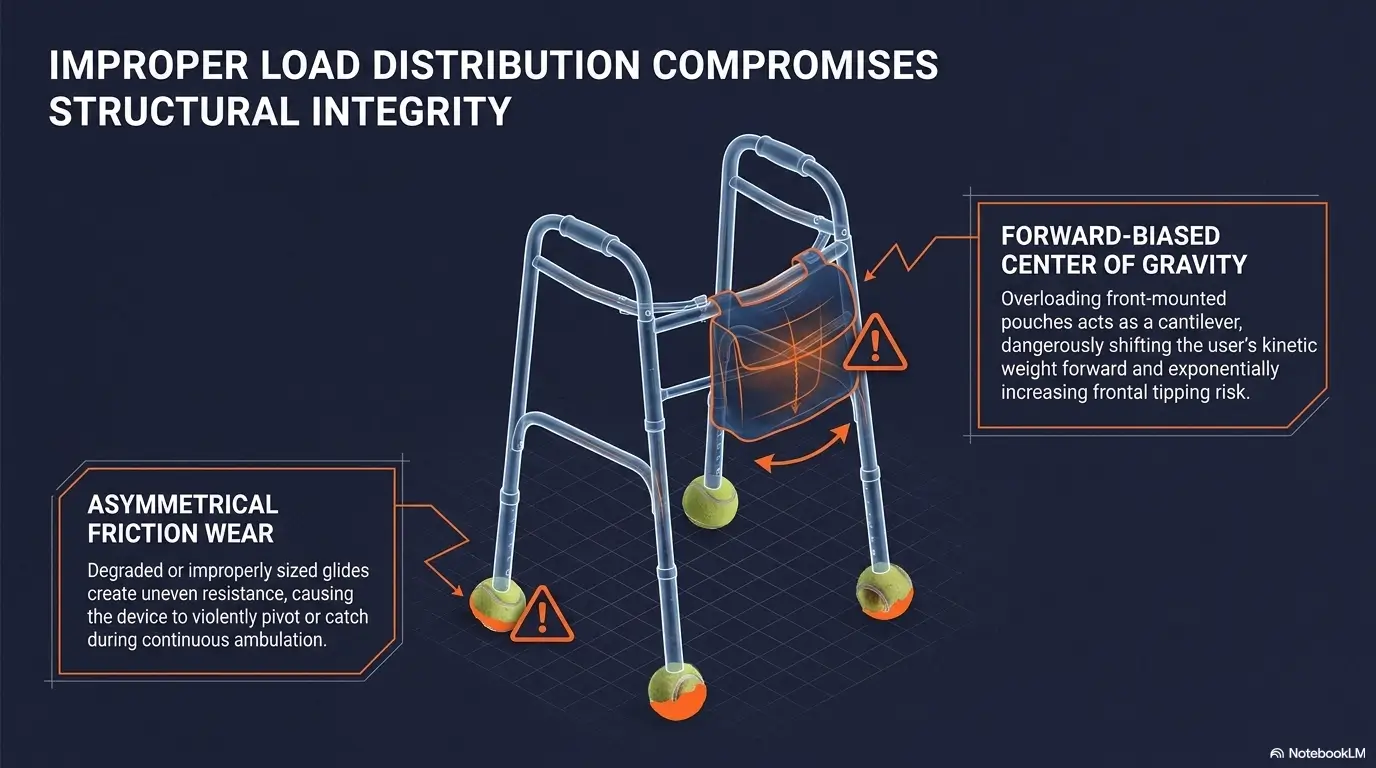
A basket can be excellent for sealed containers, fruit, packaged snacks, mail, or lightweight items. It is not ideal for open plates because the base may be uneven. A basket may also tempt people to overload one side of the walker.
If the basket is front-mounted, check that it does not make the walker feel nose-heavy. If it is side-mounted, keep the weight light and balanced.
Walker pouch: good for phone, napkins, utensils, not soup
A pouch is terrific for utensils, medication lists, glasses, napkins, a phone, or a small remote. It is not a soup vehicle. A pouch filled with a bowl of chili has chosen chaos.
Use pouches for supporting items, not unstable food. A pouch can make the meal routine smoother by carrying the fork, napkin, salt packet, or phone while the tray carries the actual food.
Rolling cart: useful only if your clinician says it is safe
A rolling kitchen cart may look like the perfect answer, but it changes the task. Now you may be trying to manage a walker and a moving cart, or using the cart instead of the walker. That can be unsafe for people who need stable support.
Some people can use a cart safely after training. Others should not. Ask a physical therapist or occupational therapist before replacing walker support with a cart, especially after joint replacement, spine surgery, or a fall.
Here’s what no one tells you: accessories can change walker balance
Any accessory changes how a walker behaves. A tray adds surface area. A basket adds weight. A pouch changes where items hang. A drink holder can catch on furniture. These are not reasons to avoid accessories. They are reasons to fit and test them carefully.
Use a fitted tray with raised edges and a non-slip surface.
Use a sealed container or travel mug. Avoid open liquids.
Use a pouch, caddy, or second trip. Keep hands free.
Use caregiver setup, closer landing zone, or split into lighter trips.
Coverage Tier Map: From Safest to Riskiest Meal Transport
| Tier | Setup | Best use |
|---|---|---|
| Tier 1 | Caregiver places meal at table | High fall risk, hot meals, post-surgery limits |
| Tier 2 | Walker tray plus non-slip plate | Light plates on level indoor routes |
| Tier 3 | Basket with sealed containers | Leftovers, snacks, cold foods |
| Tier 4 | Rolling cart after clinician approval | Selected users with stable balance |
| Tier 5 | Hand-carrying an open plate | Avoid if walker is needed for balance |
Neutral action line: Move one tier safer whenever the meal is hot, heavy, slippery, or far from the table.
The “Two-Trip Dinner” Method That Saves Pride and Knees
Trip one: plate and utensils
The two-trip dinner method is gloriously unglamorous. That is why it works. Instead of trying to carry the plate, drink, napkin, medicine, condiments, and dignity in one grand parade, split the job.
On the first trip, move the plate and utensils. Keep the load light. Keep the walker predictable. Sit if needed. Then decide if the second trip is still necessary.
Trip two: drink, condiments, or extras
On the second trip, move the sealed drink, condiment, napkin, or small extra. If fatigue is a problem, reverse the order: place the drink and utensils first, rest, then move the plate.
For someone with knee pain or hip pain, fewer awkward turns may matter more than speed. If stairs or longer routes are involved, the safest answer may be meal setup by a caregiver, not a clever carrying trick.
Use lidded containers when the food can travel badly
Some foods are bad travelers. Soup sloshes. Grapes roll. Pasta slides. Sauce behaves like it has a lawyer. Use lidded containers for leftovers, stews, saucy foods, and anything that might move if the walker stops suddenly.
Lidded containers are especially helpful for people managing pain, stiffness, or slower movement after surgery. The same planning mindset that helps with using a wedge pillow after surgery for positioning and comfort can help meals too: set up the environment before the hard part begins.
Let’s be honest: hot coffee has betrayed better plans
Open mugs are risky because the liquid moves, the cup handle changes grip, and the heat increases urgency. A travel mug with a secure lid is usually safer than a traditional coffee mug on a tray.
Do not fill it to the brim. Leave space at the top. A half-full sealed mug is not defeat. It is physics behaving itself.
Short Story: The Toast That Changed the Route
Marian had carried breakfast from her kitchen to the small table for years. After knee surgery, she tried the old routine with a walker, one hand on the grip and one hand holding toast on a plate. Nothing dramatic happened at first. Then the plate shifted when she turned near the refrigerator. She looked down, the walker angled slightly, and her heart did that cold little drumbeat people remember later.
Her daughter did not ban breakfast. She moved the table six feet closer, added a tray with a raised lip, put a non-slip mat under the plate, and made drinks travel in a lidded mug. Marian still made her toast. She still sat by the window. The win was not doing less. The win was making the route so uneventful that breakfast became breakfast again.
Common Mistakes That Turn a Simple Meal Into a Fall Risk
Mistake 1: carrying the plate in one hand and steering with the other
This is the classic mistake. It feels efficient. It is also exactly where balance support gets diluted. A walker works best when the user can control it evenly. One-handed steering can cause drifting, twisting, and awkward stopping.
Mistake 2: placing food on an unstable walker seat
Some rollators have seats, but that does not automatically make them food trays. Seats can be curved, padded, slick, or too low. Food placed on a rollator seat may slide when the walker moves or stops.
If you use a rollator, ask whether a manufacturer-compatible tray or basket is available. Do not invent a dinner platform from a cushion, towel, and optimism.
Mistake 3: overloading a tray until the walker feels top-heavy
A tray should carry a light meal, not the entire Thanksgiving subplot. Too much weight can change how the walker starts, stops, and turns.
Keep loads small. Split the trip. Move the drink separately. If the tray makes the walker feel different, the setup needs adjustment.
Mistake 4: rushing because the food is getting cold
Rushing is the villain in slippers. It sneaks in when the microwave beeps, the phone rings, or someone feels embarrassed needing extra time. But speed rarely helps balance.
Use lids, smaller portions, or a closer eating spot. A warm meal is nice. An unbroken hip is nicer.
Mistake 5: forgetting rugs, pets, thresholds, and cabinet doors
Most meal routes are not just floor. They include corners, rugs, pet bowls, chair legs, cabinet doors, dropped napkins, slippers, and thresholds. Each item is small. Together, they form a tiny obstacle course with soup.
People recovering from hip or knee procedures may already be changing bathroom routines, such as safer strategies for showering after hip surgery without bending or slipping. Bring that same caution into the kitchen.
- One-handed walker use reduces control.
- Unstable surfaces invite sliding.
- Rushing turns ordinary hazards into surprises.
Apply in 60 seconds: Remove one rug, cord, or pet bowl from the meal route before the next snack.
Don’t Do This: The Plate-Balancing Tricks That Look Clever Until They Don’t
Don’t wedge a plate between your body and the walker
Wedge-carrying a plate against the body may seem clever, but it encourages leaning, twisting, and looking down. It also gives the plate a terrible job description: stay level while the body moves.
If a plate cannot sit securely on a tray or in a safe container, it should not travel that way.
Don’t carry soup, coffee, or sauce uncovered
Open liquids move independently. They keep their own calendar. Even a small bump can send liquid over the rim, leading to burns, surprise movements, and sudden reaching.
Use a lid. Use a travel mug. Use a bowl with a snap-on top. If the food cannot be covered, ask someone to move it or eat closer to where it is prepared.
Don’t hang a heavy bag from one side of the walker
Uneven hanging weight can pull the walker sideways or make turns feel strange. A light pouch for small items is different from a heavy grocery bag swinging from one side.
If you need to move multiple items, use balanced storage designed for the walker, or break the job into smaller trips.
Don’t use the walker as a serving cart on uneven flooring
A walker is not meant to be pushed like a restaurant cart across thresholds, rugs, outdoor surfaces, or uneven flooring while loaded with food. Uneven surfaces change the force needed to move and stop.
When flooring changes, slow down. Better yet, avoid carrying meals across that boundary unless a clinician has reviewed the setup.
Show me the nerdy details
Walker safety depends on base of support, hand contact, visual attention, friction, and load distribution. When a person carries a plate by hand, the body often rotates slightly, grip becomes uneven, and the eyes may shift from the walking path to the food. Add a sliding plate or hot liquid, and the nervous system has to manage balance, steering, spill avoidance, and threat response at the same time. A fitted tray or sealed container reduces the number of moving variables. The safest setup is not the fanciest one. It is the one that reduces reaching, twisting, asymmetrical load, and rushed decisions.
Build a Safer Kitchen-to-Table Route Before the Meal Exists
Clear the path before heating food
Do the route check before the food is hot. Once the microwave dings, people hurry. That is when the slipper is in the wrong place, the dog is underfoot, and the chair leg becomes a tiny wooden ambush.
Before preparing food, walk the route with the empty walker. Look for rugs, cords, wet spots, loose floor transitions, cabinet doors, and low lighting.
Create a landing zone near the microwave or counter
A landing zone is a stable surface where food can pause. It might be a small table near the counter, a cleared part of the kitchen island, or a tray-height surface close to the microwave.
The landing zone helps because you do not have to solve everything at once. You can heat the food, place it down, reposition the walker, then move it safely.
Move chairs, rugs, pet bowls, and cords out of the route
Do not rely on memory. Move hazards out of the route physically. The body may be tired, distracted, medicated, or stiff. A clear path is kinder than a heroic memory.
Caregivers can help by creating a repeatable route. Same chair. Same table position. Same clear walkway. Boring routines are underrated safety technology.
Keep the table close enough that the last step is boring
The last few feet are often where people relax too soon. Keep the eating spot close enough that the finish is simple. If the walker user must turn sharply, reach across a chair, or back up with a tray, the table position needs rethinking.
For people with chronic joint pain, a closer meal station can also reduce strain. If pain is part of the daily math, the practical guidance in walker pain management for seniors may pair well with a kitchen safety reset.
Quote-Prep List: What to Ask Before Buying Walker Accessories
- What brand and model is the walker?
- Is it a standard walker, two-wheel walker, or rollator?
- What is the inside and outside width?
- Does the tray block the handles, brakes, folding mechanism, or seat?
- Does the user need cup holders, raised edges, or a non-slip insert?
- Can the accessory be returned if it does not fit securely?
Neutral action line: Measure the walker and confirm compatibility before ordering accessories.
Small Meal Changes That Make Carrying Easier
Choose bowls over flat plates for loose food
Bowls can be safer for loose foods because they give food a boundary. Rice, pasta, fruit, peas, and chopped vegetables are less likely to travel independently if they have a rim.
Use shallow bowls for meals that would otherwise slide on a flat plate. If the bowl has a grippy base, even better.
Use containers with lids for leftovers and meal prep
Leftovers are often easier to move in the container they were stored in. Heat the food, secure the lid loosely if steam needs to escape first, then close it for travel once safe. Follow food safety basics and avoid sealing very hot food in a way that causes pressure or burns when opened.
For anyone managing daily pain or limited energy, meal prep containers can reduce repeated cooking trips. A practical setup is not glamorous, but neither is dropping meatloaf on the hallway rug.
Put drinks in sealed bottles or travel mugs
Drinks are often more dangerous than plates because liquids slosh. Use sealed bottles, lightweight travel mugs, or cups with secure lids. Avoid glass if hand strength or grip is uncertain.
Carry drinks separately from plates unless the tray is designed for it and the drink is sealed.
Cut food before moving it, not after sitting down
Cutting food at the counter may reduce effort at the table. It can also help avoid juggling utensils later. If knife use is difficult or unsafe, a caregiver can cut food in advance.
Small portions are easier to move than large plates. You can always get seconds. Seconds are a meal strategy, not a moral failure.
The quiet upgrade: lighter dishes with grippy bottoms
Heavy ceramic plates may feel stable on a table but become awkward on a walker tray. Lightweight dishes with rubberized or textured bottoms can reduce sliding and wrist strain.
People with arthritis may also benefit from easier-grip utensils or supportive gloves. If hand pain is part of the problem, review practical options such as compression gloves for arthritis during daily tasks and discuss persistent symptoms with a clinician.
- Use bowls for loose food.
- Use lids for liquids and leftovers.
- Use lighter dishes when grip or strength is limited.
Apply in 60 seconds: Swap one open drink for a lidded mug or sealed bottle today.
Walker Fit Matters More Than the Plate
A poorly fitted walker makes every carry method worse
If the walker is too low, the user may hunch and reach. If it is too high, the shoulders may rise and the arms may tire. If the walker is too wide, turns may become awkward. If it is too narrow or unstable, the user may not trust it.
Cleveland Clinic emphasizes that a healthcare provider can help select the right walker, adjust it to the user’s body, and teach safe technique. That professional eye can be especially valuable after surgery or a new diagnosis.
Handles should support upright posture, not hunched reaching
A common fitting cue is that walker handles should allow a comfortable posture with a slight bend in the elbows. The exact setup depends on the person, footwear, walker type, and medical condition.
If the user looks hunched, strained, or unsure, do not solve the problem by adding more accessories. Fix the fit first.
Wheels, brakes, and tennis balls need real inspection
Two-wheel walkers, standard walkers, and rollators behave differently. Wheels should roll smoothly. Brakes should work. Rubber tips should not be worn smooth. Tennis balls, if used, should not be split, dirty, or catching on flooring.
A walker that drags or catches can turn a tray into a hazard. The food may be stable, but the walker is not.
Ask a physical therapist or occupational therapist to watch one meal route
One of the most useful things a professional can do is watch the real routine. Not a pretend walk in a clinic hallway. The actual kitchen. The actual chair. The actual rug that everyone says is fine until it is not.
An occupational therapist can often suggest home modifications, adaptive tools, and safer task sequencing. A physical therapist can assess gait, balance, strength, and walker technique. Together, they are the kitchen choreography department.
When to Seek Help Before Carrying Meals
You have fallen or nearly fallen in the past month
A recent fall or near-fall is a signal, not an embarrassing footnote. Tell a clinician. Many older adults do not report falls, but fall history changes the safety plan.
If you have fallen, do not add plate-carrying experiments to the week. Ask for an assessment first.
You feel lightheaded when standing or turning
Lightheadedness can come from medication changes, dehydration, blood pressure shifts, illness, or other medical issues. It deserves attention. Carrying meals while dizzy is not independence. It is a weather warning.
You cannot keep both hands available for walker control
If the current setup requires one hand to hold food, one hand to steer, and a secret third hand to open the chair, the setup is not ready. Use a tray, change the route, ask for help, or eat closer to the preparation area.
You are recovering from surgery or have new pain
Post-surgical restrictions can change quickly as healing progresses. New pain, swelling, numbness, weakness, or incision concerns should be discussed with the surgical team or clinician.
If you are also trying to manage costs, visits, or equipment decisions, internal planning resources like Medicare Advantage orthopedic care questions and orthopedic home care equipment planning may help you prepare for conversations.
You need to carry hot liquids, heavy plates, or meals across rooms
Distance increases risk. Heat increases urgency. Weight changes walker feel. Combine all three, and it is time for a safer system.
Consider a closer eating station, meal delivery to the table, covered containers, or caregiver setup.
Your walker tips, drags, catches, or feels too low or too high
A walker should feel predictable. If it tips, drags, catches, or feels awkward, pause meal carrying until the walker is inspected and adjusted.
- Recent falls need clinical attention.
- Dizziness changes the safety plan.
- Hot liquids and heavy plates deserve extra caution.
Apply in 60 seconds: Write down one symptom or hazard you would mention to a therapist or doctor.
FAQ
Can I carry a plate in my hand while using a walker?
It is usually safer not to carry a plate in your hand if you need the walker for balance. Holding a plate can reduce your grip, change your posture, and make you look down instead of watching the floor. Use a walker tray, sealed container, caregiver setup, or a shorter route instead.
Is a walker tray safe for hot food?
A walker tray can help, but hot food still needs caution. Use small portions, stable dishes, raised tray edges, and non-slip surfaces. Avoid open hot liquids. Soup, coffee, tea, and sauces should travel in lidded containers or travel mugs whenever possible.
What is better for meals, a walker tray or walker basket?
A walker tray is usually better for plates and flat meals. A basket is usually better for sealed containers, packaged snacks, or lightweight items. A basket may not provide a stable base for an open plate, especially during turns or stops.
How do I carry a drink while using a walker?
Use a sealed bottle, lightweight travel mug, or cup with a secure lid. Do not carry an open mug in your hand while using a walker. If using a tray with a cup holder, test it empty first and avoid filling the drink to the top.
Can I use a rollator seat to carry food?
A rollator seat is not automatically safe for food. Seats may be padded, curved, low, or slick. If you use a rollator, look for manufacturer-compatible trays or baskets, and ask a therapist if using the seat for transport changes your balance or braking safety.
What should I do if I live alone and need to move meals?
Set up a closer eating station, use lidded containers, choose lighter dishes, split meals into two trips, and clear the route before cooking. Consider asking an occupational therapist to review your kitchen setup. Small changes can protect independence without turning every meal into a production.
Are walker bags safe for plates?
Walker bags and pouches are better for utensils, napkins, phones, glasses, and small personal items. They are usually not ideal for open plates, soup, or drinks. Use them as support storage while the food itself travels on a tray or in a sealed container.
Should Medicare cover walker accessories?
Coverage can vary by plan, medical necessity, supplier, and whether the item is considered durable medical equipment. Basic walkers may be covered when medically necessary, but accessories such as trays, baskets, or pouches may not always be covered. Check with Medicare, your Medicare Advantage plan, supplier, or clinician before buying.
Next Step: Run the Empty-Plate Test Today
Put an empty plate on the tray or in the caddy
Start with no food. Place an empty plate where you think the food would go. Add utensils if you normally carry them. Do not add hot liquid. Do not add a full meal. This is rehearsal, not dinner theater.
Walk the exact kitchen-to-table route slowly
Use the real route. Start at the counter or microwave. Move through the real turn. Approach the real table. Stop where you normally stop. If you must back up, twist, or reach, notice it.
Watch for sliding, tipping, reaching, and awkward turns
Pay attention to the small signals. Does the plate slide? Does the tray rattle? Does the walker feel heavier? Do you look down? Do you need one hand to rescue the plate? Does the chair block your path?
These are not failures. They are clues.
Fix one hazard before carrying real food
Do not try to fix the whole house in one afternoon. Choose one improvement: remove a rug, move the chair, add a non-slip mat, switch to a lidded bowl, relocate the eating spot, or ask someone to measure the walker for a tray.
If shoulder, hip, knee, or back pain is part of your routine, connect meal carrying with the broader home setup. A safer kitchen route often belongs beside other practical changes, from hip pain management for seniors to lumbar support choices that reduce strain during daily movement.
If the test feels shaky, ask for a safer setup before the next meal
If the empty-plate test feels unsafe, do not graduate to lasagna. Ask a family member, caregiver, physical therapist, occupational therapist, surgeon, or primary care clinician for help. A professional may see one small change that makes the whole routine easier.
The plate was never the real problem. The real problem was asking your hands to do two jobs at once: carry dinner and protect balance. Once the food has its own safe way to travel, the walker can return to its proper work.
Within the next 15 minutes, run one empty-plate test from the counter to the table. Move one hazard. Choose one safer container. Then let the next meal be calmer, slower, and much less dramatic.
Last reviewed: 2026-05.