
The Fine Line Between Cozy and Unsafe
At 2:14 a.m., a heating pad can feel like mercy—until morning shows you the fine line between “cozy” and “unsafe.” The hard truth is that relief and risk can live in the same warm square of fabric, especially when your body goes still and your attention fades.
If you’re trying to sleep with a heating pad for sciatica, you’re usually not chasing heat—you’re chasing one uninterrupted stretch of rest, without the electric line down your leg or the tense, clamped hip that won’t let go. Keep guessing, and you risk trading a rough night for a skin burn, overheating, or a pattern that quietly worsens because pain got masked instead of managed.
This guide gives you before-bed timing rules, a burn-proof setup (low setting, barrier layer, auto-shutoff), and safer overnight substitutes—positioning upgrades, micro-mobility, and a gentle nerve slider—so you can get the same “ahh” feeling without gambling on eight hours of contact heat. It’s built like a small experiment: clear rules, simple tracking, and no heroics.
Let’s make tonight boring—in the best way.
Fast Answer (snippet-ready):
Sleeping on a heating pad for sciatica is usually not recommended because prolonged heat can cause skin burns, overheating, or symptom masking—especially if you drift off and don’t notice rising heat. A safer approach is heat before bed: 15–30 minutes on low/medium, with a barrier layer and auto-shutoff, then remove it before sleep. If night pain persists, consider safer alternatives like positioning, a short walk, or a gentle nerve “slider.”
- Educational only—not medical advice or a diagnosis.
- Do not use heat on areas with reduced sensation (neuropathy), impaired circulation, open wounds, active skin infection, or over topical numbing creams.
- Avoid sleeping with plugged-in heat devices if you’re drowsy from meds/alcohol or you can’t reliably wake to discomfort.
- Go urgent for red flags (new weakness, foot drop, bowel/bladder changes, saddle numbness). We cover these below.
Table of Contents
Start here: Can you sleep on a heating pad?
The real question (and why Google keeps mixing it up)
When people type “sleep with a heating pad,” they often mean one of two things:
- Fall asleep on it (pad under hip/back/leg)
- Use it before bed, then remove it
The first one is where the risk lives. The second one is usually the compromise that gives relief without turning your bedding into a slow-cook situation.
My honest confession: I’ve done the “just five more minutes” thing. It’s cozy. It’s human. It’s also how people end up with a blister they didn’t feel forming until morning.
The hidden risk: burns without pain
Here’s the problem: heat injuries can happen gradually. If your sensation is dulled—by nerve irritation, neuropathy, alcohol, or sedating meds—you may not get a loud “ow.” You get a quiet burn that shows up later.
Electrical Safety Foundation International (ESFI) gives a blunt safety tip: heating appliances should never be used while sleeping. That’s not drama. That’s years of fire-and-burn reports condensed into one sentence.
Curiosity gap: when heat feels good—but makes tomorrow worse
If you’ve noticed the pattern—heat feels great at night, but you wake up tighter, crankier, and more “electric”—you’re not imagining it. Heat can relax guarding muscles, but it can also:
- Make you stay in a position longer than your nerve likes
- Mask warning signals you actually need for pacing
- Encourage “deeper stretch” decisions at the worst time
- Heat is a tool, not a bedtime companion.
- Nighttime drowsiness + heat = higher burn risk.
- If you’re likely to drift off, treat it like “overnight use” and stop early.
Apply in 60 seconds: Set the pad to low, set the timer, and place it on top of you—not under you.

Risk check: Who this is for / not for
Good fit: “tight + guarded” evenings
Heat tends to help when your night pain feels like muscle guarding—hips clamped, glutes clenched, low back stiff, and relief comes with warmth + gentle movement. This is the “I’m bracing without meaning to” version of nighttime sciatica.
I notice it when I stand up and my body moves like a folding chair—stiff at first, then loosening as I walk to the kitchen for water.
Not a fit: numbness, weakness, or pain that travels farther
If you’re seeing progression—symptoms traveling farther down the leg, new weakness, foot slapping, or numbness spreading—heat can blur the line between “temporary comfort” and “problem getting worse.” That doesn’t mean you’re doomed. It means you need better tracking and sometimes a clinician’s eyes on the pattern.
Special caution groups (don’t skip)
Be extra careful (or skip heat entirely) if you have:
- Diabetes with neuropathy or reduced sensation (if you’re unsure where yours falls, compare patterns like diabetic neuropathy vs sciatica)
- Known circulation issues
- Very sensitive skin, thin skin, or history of burns
- Pregnancy (avoid raising core temperature; keep heat local and brief)
- Heavy sedation (sleep meds, strong pain meds, alcohol)
- Older age with reduced heat perception
| Can you feel hot/cold normally on the area? | Yes / No |
| Will you stay awake during heat use? | Yes / No |
| Does your device have auto-shutoff? | Yes / No |
| Any open wounds / skin infection / numbing cream on the area? | Yes / No |
| Any new weakness, foot drop, bowel/bladder changes? | Yes / No |
Next step: If you answered “No” to sensation/awake/auto-off, or “Yes” to wounds/red flags, skip bedtime heat and jump to the red flags and alternatives sections.
Timing rules: The safe “before-bed window”
The 15–30 minute rule (most people should start here)
If you want one rule you can follow on a bad night: heat is a pre-sleep ritual, not an all-night strategy. Start with 15–20 minutes. If you tolerate it well and it reliably helps, you can “earn” up to 30 minutes.
Mayo Clinic’s self-care guidance for sciatica includes heat as an option and emphasizes using a heating pad on the lowest setting. That’s exactly the vibe we’re going for: gentle, controlled, boringly safe.
The 3 settings that matter (more than brand)
- Low/medium: If you need “high” to feel anything, that’s a safety problem—not a toughness badge.
- Auto shut-off: Treat it like seatbelts. You don’t plan to crash, but you plan for being human.
- Moist vs dry: Moist heat can feel “deeper” for some people, but it’s also easier to overdo if you chase intensity.
Let’s be honest… the moment you “just close your eyes”
This is the line in the sand: if you’re even slightly likely to drift off, the heating pad becomes an overnight device. And ESFI’s safety guidance is clear: don’t use heating appliances while sleeping.
My personal rule (learned the hard way): once my breathing slows and my brain starts negotiating—“I’m awake, I’m awake”—I turn it off and remove it. No debate club.
Set your plan while you’re lucid (not half-asleep). This keeps you from “accidentally overnight-ing” the heat.
Neutral next step: Write your start/stop times on a sticky note tonight. Future-you will thank present-you.
Common mistakes: Heating pad + sciatica (don’t do this)
Mistake #1: falling asleep on heat “just this once”
It’s never “once.” It becomes a habit because it works—until it doesn’t. People often get burned because they didn’t notice the heat concentrating under pressure for hours.
Mistake #2: turning it up to chase numbness
Higher heat doesn’t equal deeper relief. Sometimes it equals irritated skin, more inflammation, and a nervous system that’s already on edge getting one more reason to complain.
Mistake #3: pinning the pad under your hip
Pressure + heat is a classic burn setup. Your body weight compresses the pad, concentrates heat, and reduces airflow. If you remember nothing else: heat on top, never under.
Mistake #4: using heat on the wrong pain
Heat helps muscle guarding. But if you’re in an acute inflammatory flare, some bodies respond better to short cold packs first. The goal is not to “pick a team.” The goal is: calm the system and protect your sleep.
Show me the nerdy details
Heat changes local blood flow and tissue elasticity, which can reduce the feeling of stiffness and guarding. But nerve-related symptoms don’t always behave like tight muscles. That’s why a “heat-only” strategy can feel amazing for 20 minutes and still fail overnight if positioning keeps irritating the nerve root.
Don’t do this: Overnight heating pad rules (non-negotiable)
Never sleep directly on a heating pad
If you’re going to use heat in bed, place it on top of the area (over a thin layer), not under your back/hip. Under-body heat is where pressure makes burns sneaky.
Barrier layer rule (always)
Use a thin cotton layer between your skin and the pad. Mayo Clinic’s general back-care guidance also emphasizes a cloth layer between skin and heat/cold sources to prevent skin damage. Translation: no bare-skin bravado.
Auto-shutoff is not optional
If it doesn’t shut off automatically, it’s not a bedtime device. ESFI also highlights that heating appliances shouldn’t be left unattended or used while sleeping. Auto-off doesn’t make sleeping on it safe, but it does reduce the “I forgot” hazard in your pre-bed window.
Here’s what no one tells you… warmth can hide worsening symptoms
Heat can make you tolerate a position that’s actually irritating your nerve. If you notice any of these, stop the heat experiment and switch to tracking + safer alternatives:
- Symptoms traveling farther down the leg over days (if you want the “what kind of sciatica is this?” map, start with sciatica nerve pain patterns and why they feel electric)
- New weakness, tripping, or foot slapping
- Numbness spreading or “dead” patches
- Never place heat under your body weight.
- Barrier layer every time.
- Auto-shutoff or skip it.
Apply in 60 seconds: Put the timer control in your hand now. If you can’t find it quickly in the dark, rethink using it tonight.

Sciatica logic: Heat vs nerve pain (what it helps, what it can’t)
Heat works best for muscle guarding around the nerve
Many “sciatica nights” are actually “muscle guarding nights.” Your glutes, piriformis area, low back muscles—everything tries to protect you by tightening. Heat can help those tissues unclench.
On my worst nights, the giveaway is this: if I stand up and walk for 60 seconds and the pain shifts from “sharp panic” to “stiff ache,” that’s guarding. Heat often helps.
When ice can win (even if you hate it)
Cold is useful for some people early in a flare or after overdoing it. Mayo Clinic’s self-care guidance for sciatica includes cold packs (up to 20 minutes) as an option. You don’t have to love ice. You just have to respect it as a tool.
| If your night pain feels like… | Try first | Time/cost trade-off |
|---|---|---|
| Stiff, clamped, guarded; loosens with walking | Heat (low, 15–20 min) | Fast comfort; must stop before sleep to reduce burn risk |
| Hot, sharp, irritated after activity; “angry nerve” vibe | Cold (10–20 min) | Less cozy; can reduce flare intensity without drowsy-heat risk |
| Mixed or unsure | Contrast (cold then heat, separate) | More steps; better clarity on what your body prefers |
Neutral next step: Pick one method for 2 nights before switching. Consistency beats chaos.
Open loop: the “two kinds of night pain” test
Try this quick test (no acrobatics):
- Type A: You wake up stiff, and standing is the worst moment. After a short walk, it eases a bit. (Often guarding.)
- Type B: You wake up with an electric line down the leg, and any stretch feels like it “lights up.” (Often nerve irritation / sensitization.)
Both can be real. But they respond to different strategies. That’s why this article is so picky about timing and alternatives.
Burn-proof setup: If you’re using heat at bedtime
Placement map: where heat goes (and where it shouldn’t)
Target muscles, not pressure points. Think: glute and low back—areas that tend to guard. Avoid wedging heat directly under a bony hip point or under your spine where body weight compresses the pad.
- Better: Pad on top of glute/low back (over a thin cotton layer), while you’re awake
- Avoid: Pad pinned under hip, under lower back, or under the calf where you can’t feel it well
Duration ladder: start small, then earn more
Start with 10 minutes the first night. If you respond well (no skin irritation, no symptom spread, no next-day flare), move to 15, then 20. Most people don’t need more than 30 minutes for the “guarding off-switch” effect.
Personal anecdote: I used to assume “more time = more relief.” Turns out, for me, 20 minutes is magic and 40 minutes is regret. Your number may differ, but your body will tell you if you’re willing to track it.
Device checklist (quick buy/no-buy)
Keep it neutral and boring. You’re not buying a personality—you’re buying safety features.
- Auto-off timer you can set without squinting
- Consistent low heat (no surprise spikes)
- Flexible pad that lies flat (folding can overheat)
- Washable cover (skin oils + heat = irritation combo)
- Safety certification/standards markings (many manufacturers reference UL standards for heating pads)
Neutral mentions (not endorsements): you’ll see common consumer brands like Sunbeam, Thermophore, and Pure Enrichment in this category. Whatever you choose, read the manual like it’s a contract—because it is.
Show me the nerdy details
Prolonged low-grade heat exposure has been linked in dermatology literature to erythema ab igne (“toasted skin syndrome”), a net-like discoloration that can become persistent. It’s often reported with long sessions and repeated daily use—especially when heat is applied directly to skin for hours. The simplest prevention is boring: barrier layer, low setting, short duration, and stop before sleep.
- Your sleep position (side/back/stomach) and primary pain zone (low back, glute, calf)
- Any reduced sensation areas (numb patches, neuropathy, diabetes)
- Whether you take sedating meds at night
- Your realistic use case: “pre-bed only” vs “I know I’ll drift off”
- What you can tolerate: heat, cold, or contrast
Neutral next step: Write your answers in your notes app. You’ll choose faster and safer.
Better alternatives: Safer ways to get the same relief (overnight-friendly)
Positioning upgrades that beat gadgets
Most nighttime sciatica relief is not a product. It’s geometry.
- Side sleeper: pillow between knees + slight hip stacking (keep top knee from dropping forward)—if you want the practical comparison, see knee pillow vs body pillow for sciatica
- Back sleeper: pillow under knees to reduce lumbar strain
Small confession: I resisted the knee pillow because it felt “extra.” Then I tried it for three nights and got fewer wake-ups. My pride survived.
“Heat without heat”: warm shower + socks + blanket microclimate
If what you crave is “overall comfort” more than “targeted heat,” build a microclimate instead:
- Warm shower (or warm compress) before bed
- Warm socks (yes, really)
- One good blanket you can adjust easily
This gives the soothing signal without the concentrated contact-burn risk.
Micro-mobility: the 90-second reset
If you wake up with that “locked” feeling, try 90 seconds of something gentle:
- Short hallway walk
- Slow hip hinge (tiny range)
- Calm breathing that drops your shoulders
You’re telling your nervous system: we’re safe. Sciatica nights often behave like a nervous system problem as much as a tissue problem.
Nerve-friendly option: the gentle “slider,” not a hard stretch
If you’ve ever tried to “stretch the sciatica out” and got a lightning bolt, you’ve learned the hard lesson: aggressive stretching can irritate a sensitive nerve. A gentle nerve slider is different: small range, low reps, no pushing into pain—here’s a simple walkthrough for morning sciatica nerve glides and gentle sliders that keeps the goal “quiet the nerve,” not “win a stretch contest.”
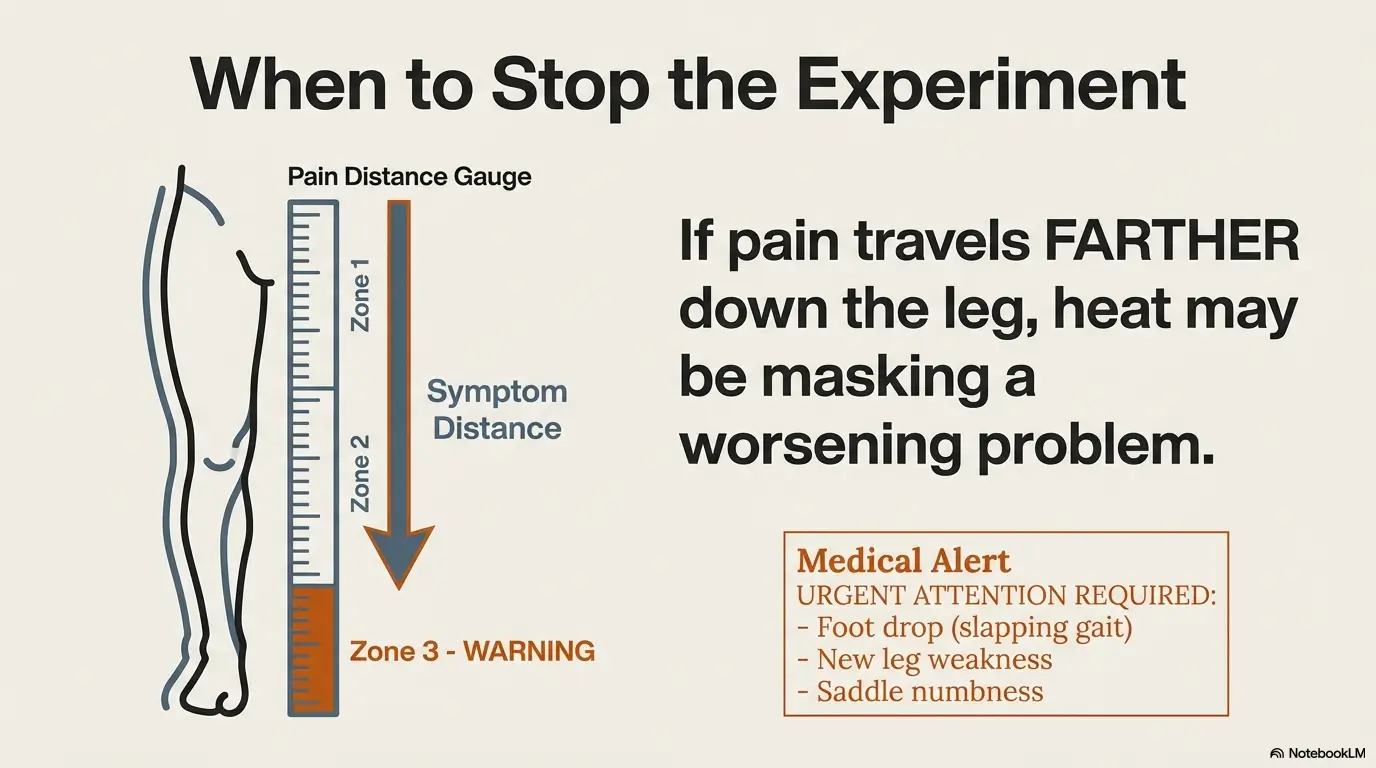
Rule of thumb: if symptoms travel farther down the leg, you went too far.
Low setting + barrier + timer
walk / hinge / breathe
knee pillow / under-knee pillow
- Comfort can come from microclimate, not contact heat.
- Small movement often beats dramatic stretching.
- Track symptom distance—farther down the leg is a warning.
Apply in 60 seconds: Add one pillow tonight—between knees (side) or under knees (back).
Short Story: The night I learned “cozy” isn’t the same as “safe” (120–180 words) …
It was one of those nights where the pain feels personal. I did the full ritual—dim lights, water glass, pillow fortress—and still, the nerve buzzed like a phone that wouldn’t stop vibrating. I grabbed the heating pad and slid it under my hip like a secret weapon. Instant relief. My body exhaled. My brain said, “Finally.” Then, somewhere in the soft fog between awake and asleep, I stopped noticing the heat.
In the morning, I had a tender patch of skin that felt sunburned, and the nerve was worse from staying curled in the same position too long. That was the day I started treating heat like coffee: helpful in the right dose, in the right window, and absolutely not something you leave running all night just because you’re desperate. It wasn’t a moral failure. It was a systems problem—and systems can be fixed.
If heat helps… run the 10-minute swap routine (without sleeping on it)
Step-by-step: heat → move → settle
- Heat 15–20 minutes (low/medium, barrier layer, timer)
- Move 60–90 seconds (walk, gentle hinge, or breathing reset)
- Settle into bed positioning (knee pillow or under-knee pillow)—especially if you’re a side sleeper dealing with sciatica at night
This routine works because it tackles the three usual night drivers: guarding, sensitization, and positioning. Also: it gives you something to do other than doom-scrolling chronic pain forums (and feeding cyberchondria) at 2:14 a.m. (Ask me how I know.)
What to track for 7 nights (so you know it’s working)
- Wake-ups: how many times did pain wake you?
- Morning stiffness: 0–10 rating when you first stand
- Symptom distance: does it travel farther down the leg?
If symptom distance increases or weakness appears, stop the experiment and switch to clinician guidance.
When to seek help: Red flags that should change the plan
Go urgent / same-day if you have:
- New or worsening leg weakness
- Foot drop (toes catching, slapping gait)
- Numbness spreading, especially saddle-area numbness
- Bowel/bladder changes
- Fever with back pain, or severe unrelenting pain (if you’re unsure what “emergency” actually means, use this checklist for low back pain red flags and when to go in)
Book a clinician visit if:
- Symptoms persist beyond a few weeks or keep recurring
- Night pain repeatedly wakes you
- Symptoms keep traveling farther down the leg
Questions to bring (so you don’t waste the appointment)
- “What pattern suggests disc vs muscle vs joint?” (a quick primer many people find clarifying: sciatica vs herniated disc patterns)
- “Which movements are safe for my presentation?”
- “What signs mean I should stop home treatment?”
FAQ
Can you sleep with a heating pad for sciatica all night?
Most safety guidance says no. The risk is prolonged contact heat while you’re asleep—burns, overheating, and symptom masking. If heat helps you, use it before bed (15–30 minutes, low, barrier, auto-off), then remove it before you fall asleep.
Is it safer to put a heating pad under your back or on top of your leg?
Safer is generally on top of you (over a thin layer) while you’re awake. Under-body placement increases risk because your weight compresses the pad and concentrates heat. If you can’t stay awake, skip the pad and use positioning instead.
What heating pad temperature is safe for bedtime use?
Use the lowest effective setting. If you “need high,” that’s a red flag for reduced sensation or chasing intensity. Your goal is mild warmth that relaxes guarding—not heat that makes the skin hot or pink.
Heat vs ice for sciatica at night—what should I choose?
Heat often helps when muscles are guarding and stiff. Cold can help during acute flares or after overdoing it. If you’re unsure, try one approach consistently for 2 nights and track wake-ups, morning stiffness, and symptom distance.
Can a heating pad make sciatica worse?
Yes—if it encourages you to stay in a nerve-irritating position too long, if it irritates skin, or if it masks a worsening pattern. If symptoms travel farther down the leg, or weakness appears, stop the heat experiment and get evaluated.
Is a heated blanket safer than a heating pad?
Sometimes, because it spreads warmth over a wider area (less concentrated pressure), but it still carries “sleeping with heat appliance” risks. If you use any heated bedding, follow the manufacturer instructions and avoid using it while sleeping if you can’t monitor heat or wake reliably.
Should you use heat if you have numbness or tingling?
Be cautious. Numbness can reduce your ability to notice overheating. If numbness is significant or spreading, prioritize positioning, micro-mobility, and clinical guidance over heat.
How long should you use heat before bed for sciatica?
Start with 15–20 minutes. If it reliably helps and you have normal sensation, you can go up to 30 minutes. Always use a barrier layer, and always remove it before you’re likely to drift off.
Next step: Do the 7-night “before-bed heat” experiment
If you want results without guessing, run this like a tiny, boring experiment (boring is good; boring is safe):
- For the next 7 nights, use 15–20 minutes of low/medium heat before bed (barrier + auto-off).
- Remove heat before sleep and switch to a positioning setup (knee pillow for side sleepers, under-knee pillow for back sleepers).
- Track: wake-ups, morning stiffness, and whether symptoms travel farther down the leg.
If symptoms spread or weakness appears, stop and seek care. This is not you “failing.” This is you catching a pattern early. If you want the broader sleep framework this fits into, you can pair this with a full how to sleep with sciatica setup so heat becomes one tool—not the whole plan.
Conclusion
Let’s close the loop from the beginning: yes, heat can feel like mercy at night—but the goal isn’t to strap mercy to your body for eight hours. The goal is to use heat like a professional: short, low, protected, and awake, then let positioning do the overnight work.
Here’s the simplest “15-minute next step” you can do tonight: set your timer for 20 minutes, put a thin cotton layer under the pad, place it on top of your glute/low back, then stand up for 60 seconds before bed and build your pillow geometry. Try it for three nights before you judge it. Your body likes patterns. (And if your “night pain” is starting to look like a bigger diagnostic question—disc, joint, nerve, or muscle—bookmark herniated disc sciatica treatment basics as a calm starting point, not a panic rabbit hole.)
Last reviewed: 2026-01.