

Master Your Recovery: A Smarter Approach to Swimming with Sciatica
A “recovery swim” can cost you three workdays if you judge it by pool pain alone. The pattern is brutally common: you feel smoother in warm water, add a little effort, then wake up with that electric calf buzz and a stiffer back than yesterday.
For swimmers managing a sciatica flare in the pool, the hard part is not motivation—it’s load calibration. Most people are underloading the nervous system where it needs calm and overloading it where symptoms spike later. Keep guessing, and you don’t just lose one workout; you lose training continuity for the entire week.
This guide gives you a low-error way to decide between a pull buoy and a gentle flutter kick, then verify the choice with a simple 24-hour symptom rule. You’ll know when to offload, when to reintroduce kick volume, and how to progress without triggering delayed flare-ups.
“Train for tomorrow morning, not today’s ego.”
Small doses. Clear stop rules. Better weeks.
Let’s make your next swim predictable again.
Table of Contents
Pick Your Priority First: Calm the Nerve or Keep Conditioning?
The 2-goal rule that prevents “I did too much” days
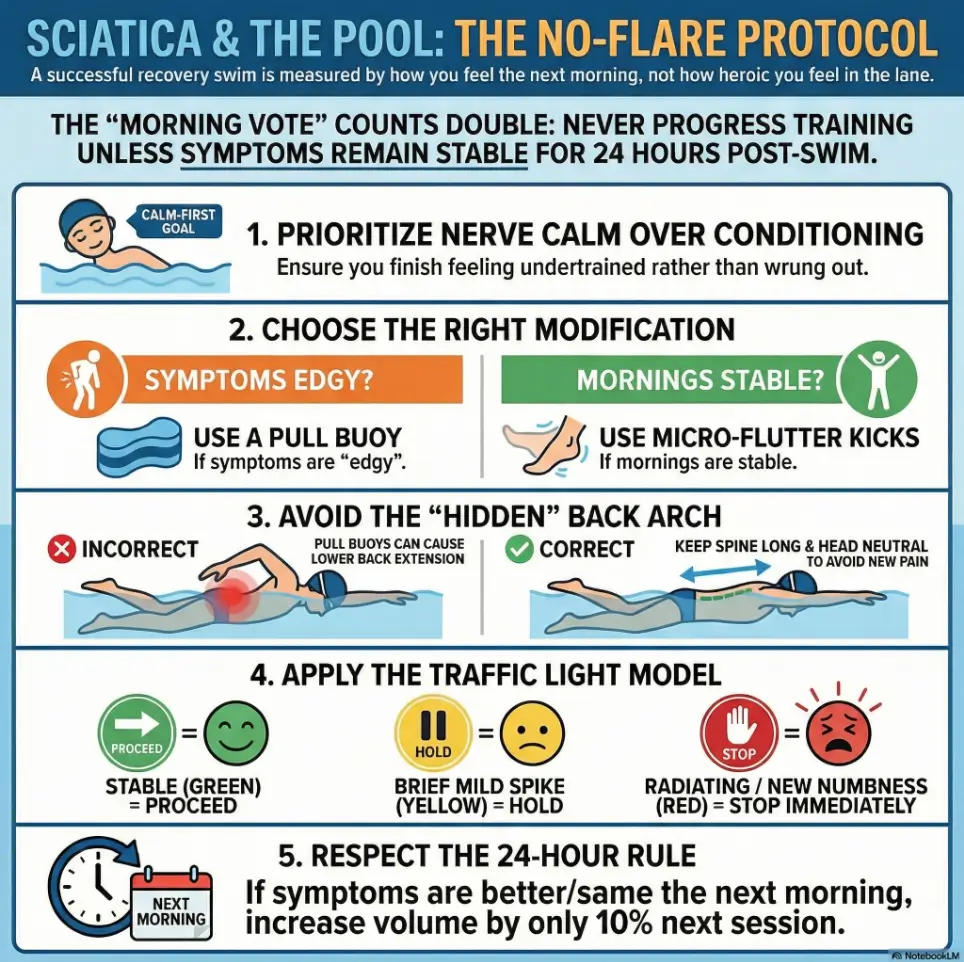
During a flare, every pool choice should serve one primary goal and one secondary goal. Primary: calm the nerve. Secondary: preserve conditioning. Reverse that order and you often pay for it tomorrow. A common trap is saying, “I’ll do both perfectly today,” then accidentally doing a threshold set disguised as recovery. If your symptoms are currently spiky, pick calm-first.
Use this simple session declaration before you start: “Today is symptom control with aerobic maintenance.” That one sentence changes pacing, rest, and ego management. You’ll stop chasing splits and start chasing stable mornings.
Let’s be honest… fitness goals can wait 7 days if nerve symptoms are escalating
One week of conservative load is not detraining disaster. I know it feels dramatic in the moment. I once watched a masters swimmer insist on “just one honest 100” in the middle of a flare week. She finished the rep, felt heroic for 12 minutes, and then limped through three workdays. The cost wasn’t the lap; it was the delayed irritability.
If symptoms are escalating, your win condition is not pace. It is predictability. If day-to-day symptoms are also triggered on land, pairing this pool strategy with a sit-stand schedule for desk-job sciatica can reduce total weekly load noise.
What “successful pool session” means during a flare
Success means:
- Symptoms remain stable or slightly better during session.
- No new tingling/numbness pattern.
- Next morning is same or better versus baseline.
- You finish feeling undertrained, not wrung out.
If you are time-poor, this framework saves expensive trial-and-error. It prevents the “three good reps, two bad days” loop.
- Set one primary goal before warm-up.
- Judge success tomorrow morning, not just in-lane.
- Stop while you still feel “too fresh.”
Apply in 60 seconds: Write your session goal in your phone notes before you enter the water.
Pull Buoy First? The Hidden Trade-Off Most Swimmers Miss
Why offloading the kick can reduce nerve irritability
A pull buoy can be a smart temporary tool because it reduces repetitive hip motion and leg-driven shear that may aggravate an irritable neural system. For many people in week one of a flare, this means fewer symptom spikes and less post-session fatigue. It’s also easier to keep intensity under control when the legs aren’t pushing rhythm and speed.
In practical terms, pull buoy sets can create a quieter baseline so you can still get aerobic work in 20–30 minutes without provoking the leg.
Where pull buoy can backfire: lumbar extension and hip compression
Now the part most people miss: buoy position can nudge your low back into extension and compress irritated areas if you arch to keep your chest high. If your kick disappears but your lumbar arch rises, symptoms may simply move from leg-irritation to back-irritation.
Red flags with buoy use:
- You feel pinchy pressure in low back after 100–200 easy yards.
- Hip flexors feel crampy or jammed.
- You need to “hold posture” aggressively to stay balanced.
Fixes are small and boring—and incredibly effective: neutral head, long exhale into water, lighter catch pressure, and a buoy size that supports without over-lifting. On dry land, foundational trunk control from a dead bug exercise for sciatica can make this neutral posture easier to maintain in water.
Pool test: 4 x 50 easy with symptom check between reps
Run this decision test exactly once per session:
- Swim 50 easy with pull buoy.
- Rest 20–30 seconds. Ask: “Any increase, same, or better?”
- Repeat for 4 reps.
If symptoms trend upward by rep 3 or 4, stop buoy work and shift to easy back/side glide or water walking. No drama. No heroics.
Show me the nerdy details
Load-tolerance in neural irritation behaves more like a threshold system than a pure strength limit. A pull buoy may reduce distal motion but can alter proximal mechanics. The relevant variable is not “buoy yes/no,” but whether overall neural irritability remains within recoverable range over a 24-hour window.
Gentle Flutter Kick: Safer Than You Think—If You Shrink the Range
Kick mechanics that usually calm vs provoke symptoms
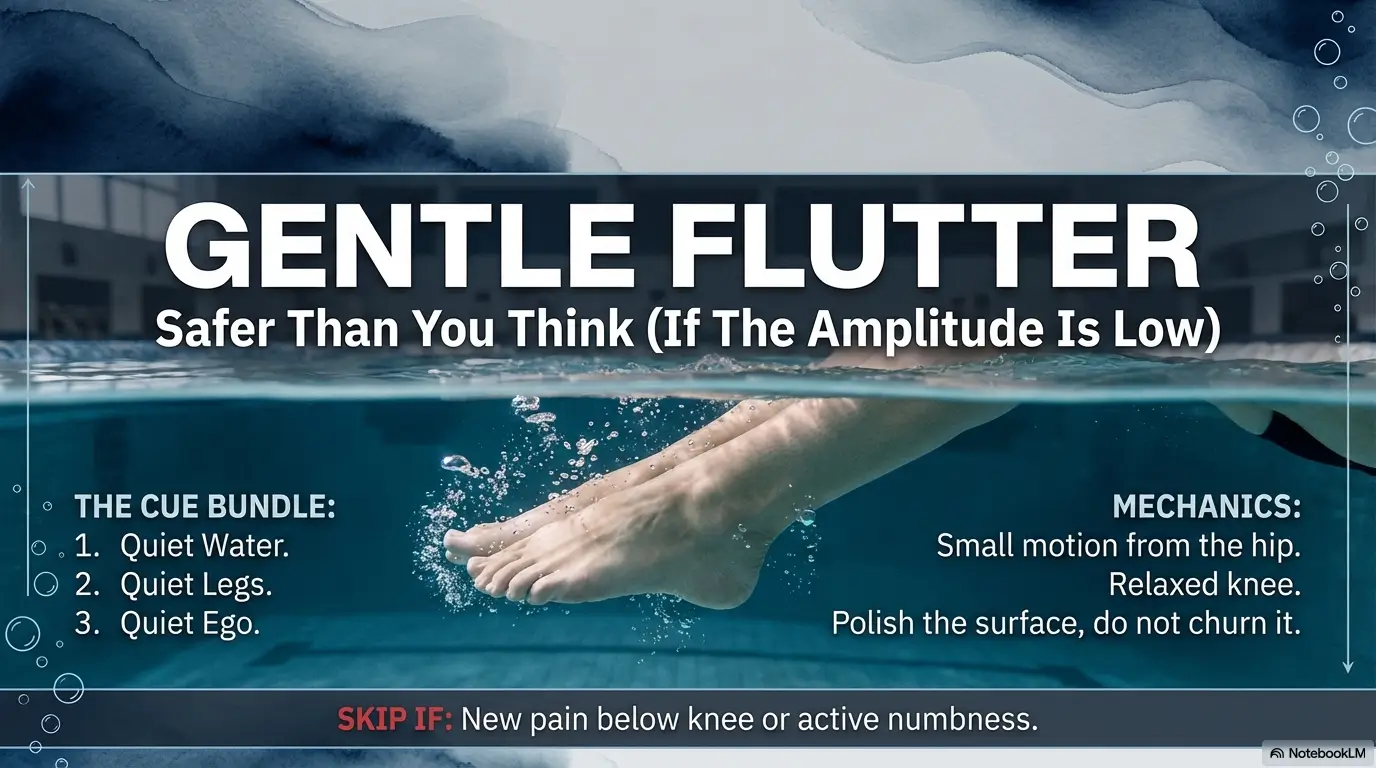
Gentle flutter kicking is not automatically the villain. In some swimmers, tiny-range, low-force kicking improves rhythm and reduces trunk stiffness. What usually provokes symptoms is large amplitude, stiff ankles, and speed chasing.
Calming pattern:
- Small kick from hip with relaxed knee.
- Ankles soft, surface disturbance minimal.
- Easy pace where conversation breath is possible.
Provoking pattern:
- Big whip kicks from knee.
- Rigid feet and forced plantarflexion.
- Trying to “feel the burn” during flare week.
Tempo, amplitude, and ankle softness: the “quiet water” cue set
I teach one cue bundle during flare management: quiet water, quiet legs, quiet ego. If your kick is loud, it’s often too big. If your breathing is ragged, pace is too high. If you can’t keep form at easy tempo, reduce distance per rep.
Try 6 x 25 easy kick-integrated freestyle with 20–30 seconds rest. Keep amplitude tiny. Think of polishing the surface, not churning it.
When flutter kick is a no-go (today)
Skip kick testing today if any of these are true:
- New pain shooting below knee at rest.
- Active numbness/tingling increasing through day.
- Yesterday’s pool session worsened morning symptoms.
- You’re tempted to “test limits” because you finally feel okay.
That last one hurts to read, I know. But it’s where many setbacks are born. If your symptoms include confusing leg tightness, it can help to review hamstring stretch vs nerve pain patterns before deciding whether to push kick volume.
- Use micro-dose kick reps.
- Keep water disturbance low.
- Abort at first upward symptom trend.
Apply in 60 seconds: Commit to 6 x 25 at “quiet water” intensity, then reassess.
Don’t Guess—Use This 24-Hour Symptom Scorecard
During-swim signals: green, yellow, red
Your nervous system does not care about your intentions; it responds to load. So we measure load response with a simple traffic-light model.
- Green: stable or improving symptoms, smooth movement, no spread of symptoms.
- Yellow: mild increase that settles within minutes after rest.
- Red: pain radiating farther, new numbness, weakness sensation, or escalating pain rep-to-rep.
Green can progress cautiously. Yellow holds. Red regresses immediately.
The next-morning check that predicts whether to progress
Before coffee, ask three questions:
- Is leg pain lower, same, or higher than pre-swim baseline?
- Is morning stiffness longer than usual (for example, >30 minutes)?
- Any new neurological symptom versus yesterday?
If baseline is same or better and no new neurological signs, you may progress by 10–20% session volume next time. If worse, reduce volume and return to calm-first template. For people who wake up especially flared, a short pre-pool reset like morning sciatica nerve glides may improve your starting baseline before you test tolerance.
Here’s what no one tells you… delayed flare often matters more than pool pain
Many people feel fine in water because buoyancy and warmth can temporarily mute symptoms. That does not equal tissue or nerve tolerance. I once logged a session that felt like a perfect comeback, then woke with electric calf pain at 5 a.m. The lesson stuck: the morning vote counts double.
Mini Calculator: Progress or Hold?
Input A: Last session total minutes (example: 25)
Input B: Next-morning symptom change (better / same / worse)
Input C: Any new neuro signs? (yes/no)
Output: If B = better/same and C = no, next session = A + 10% (about +2 to 3 minutes). Otherwise, hold or reduce by 20%.
Neutral action: Log this in one line after every swim for two weeks.
Who This Is For / Not For
Best fit: mild-to-moderate flare, no progressive neuro signs, wants active recovery
This guide fits swimmers who still want motion but need structure: people with mild-to-moderate flare patterns, stable symptoms, and enough self-control to stay submaximal. If you can follow a plan and respect stop rules, pool work can be a useful bridge between total rest and regular training.
Not for: new severe weakness, foot drop, bowel/bladder changes, uncontrolled pain
If symptoms include severe weakness, evolving foot drop, saddle-region sensory change, or bowel/bladder dysfunction, this is not a self-management lane. Those signs need urgent medical assessment. If you’re unsure whether your symptoms cross that line, review emergency thresholds in low back pain emergency warning signs.
If you’re returning after a bad week, start below your ego pace
Return sessions should feel almost too easy. Think 60–70% effort ceiling, short reps, generous rest. “Under-cook” session one and two. This is not fear—it’s intelligent sequencing.
Eligibility Checklist (Yes/No)
- Symptoms stable over last 24 hours?
- No progressive weakness today?
- No bowel/bladder red flags?
- Can keep session easy without racing others?
- Can log next-morning response?
Neutral action: If any answer is “No,” switch to recovery-only pool mobility or seek clinical guidance.
Build the Session: A Flare-Friendly Pool Template (20–35 Minutes)
Warm-up block: decompression + easy aerobic entry
6–8 minutes total. Start with 2 minutes of water walking or gentle side-glide breathing, then 4–6 minutes very easy swim (choice stroke). Aim for relaxed exhale and long spine. If symptoms jump early, end session here and count it as a win. Yes, really.
Main set option A: pull buoy dominant
Option A (12–18 minutes):
- 4 x 50 easy with pull buoy, 20–30 sec rest.
- 2 x 75 easy pull, 30 sec rest.
- 2 x 25 easy swim no buoy to retest tolerance.
If symptoms rise by more than a mild, brief yellow signal, cut last two reps.
Main set option B: micro-dose gentle flutter
Option B (12–18 minutes):
- 6 x 25 easy freestyle with tiny flutter kick, 20–30 sec rest.
- 4 x 50 easy pull buoy, 20–30 sec rest.
- 2 x 25 easy flutter retest.
This sandwich structure lets you test kick in safe doses while preserving control.
Cool-down: downshift breathing + easy back/side glide
4–8 minutes. Easy backstroke or side glide breathing, zero pace pressure. Finish with 60–90 seconds of standing decompression in chest-deep water and slow nasal breathing. The point is to leave calm, not accomplished. If post-swim stiffness lingers, a brief 90-90 position for sciatica relief can be a useful landing routine.
Show me the nerdy details
Micro-dosing movement can reduce threat response while maintaining motor pattern familiarity. Short reps with rest intervals allow symptom sampling between efforts. This creates better signal quality than long continuous efforts during a flare window.
- Use intervals, not long continuous sets.
- Place symptom checks between reps.
- End with calming breath work.
Apply in 60 seconds: Screenshot one template and follow it exactly for your next swim.
Common Mistakes That Turn a “Recovery Swim” Into a Setback
Mistake #1: long continuous kicking too early
Continuous kick sets remove your chance to sample symptoms every 25–50 yards. During a flare, that’s like driving with no dashboard. Intervals are safer because they force feedback checkpoints.
Mistake #2: buoy too high, arching the low back
If buoy height drives extension, you might “save” your leg and irritate your back. Keep posture neutral, reduce stroke force, and choose the smallest buoy that still lets you stay relaxed.
Mistake #3: intensity drift (“just one hard 100”)
Hard efforts during nerve irritability often feel good until they don’t. I’ve done this myself and pretended it was discipline. It was impatience wearing athletic clothing.
Mistake #4: judging success by same-day pain only
Same-day comfort is helpful but incomplete. Next-morning status is the real pass/fail metric for progression. This is the same logic behind why some people report that sciatic nerve flossing made pain worse when timing and dosage are off.
Decision Card: When A vs B
Choose Pull Buoy-Dominant when symptoms are edgy, sleep was poor, or yesterday had flare signals.
Choose Micro-Flutter Testing when two prior mornings were stable and you can keep range tiny.
Time trade-off: buoy sessions are simpler to control; kick sessions build return-to-normal readiness.
Neutral action: Pick one track before warm-up and do not switch mid-session unless symptoms require regression.
Don’t Do This During a Flare (Even If It Feels Fine in the Moment)
Sprint fins, hard walls, and aggressive dolphin work
Fins magnify lever forces. Hard push-offs and aggressive dolphin patterns can spike lumbar and neural load quickly. During flare week, they are usually not worth the gamble.
Deep hip flexion drills that compress irritated tissue
Any drill that bunches you into repeated deep hip flexion can irritate sensitive structures. Keep movement smooth, mid-range, and low-force.
“No pain, no gain” language in a nerve-irritable phase
That slogan belongs to healthy tissue adaptation phases, not irritated nerve phases. During flare management, the better motto is “No spike, more often.” Outside the pool, the same principle applies if you’re testing loaded movements like deadlifting with sciatica or higher-impact return plans like running with sciatica.
Coverage Tier Map: What Changes from Tier 1→5
- Tier 1: Symptoms volatile — water walking + glide only.
- Tier 2: Stable in-session — pull buoy short intervals.
- Tier 3: Stable mornings — micro-dose flutter test.
- Tier 4: Two stable weeks — gradual buoy removal.
- Tier 5: Return to structured training, still using 24-hour checks.
Neutral action: Identify your current tier before every week, not every mood.
Progression Ladder: When to Move From Buoy to Kick
Step 1: symptom-calming baseline (2–3 sessions)
Run 2–3 calm sessions with either buoy-dominant work or mixed easy swimming. No progression yet. You are proving stability first.
Step 2: add 10–20% kick volume only after stable mornings
Once mornings are stable for at least two sessions, increase kick volume by 10–20%. Example: from 4 x 25 to 5 x 25 or 6 x 25. Keep tempo and amplitude unchanged.
Step 3: remove buoy gradually, not suddenly
Reduce buoy dependence incrementally: swap one buoy rep for no-buoy easy swim each session. Sudden removal often fails because load jumps faster than adaptation.
Regression plan if symptoms spike
If symptoms worsen during session or next day:
- Drop total volume by ~20–30% next session.
- Return to prior successful tier for 2 sessions.
- Reattempt progression only after stable mornings return.
This is not “starting over.” It’s adaptive programming. For many swimmers, adding 1–2 short dry-land stability sessions (for example, a McGill Big 3 in 10 minutes routine) improves progression durability.
Show me the nerdy details
Progressive overload during pain sensitivity should prioritize consistency of response over magnitude of load increase. Smaller increments improve signal detection and reduce confounding from sleep, stress, and non-training activities.
When to Seek Help (Do Not Self-Manage Past These Flags)
Urgent signs: progressive weakness, saddle symptoms, bowel/bladder changes
Urgent neurological signs are not “watch and wait” territory. If weakness is progressing or bowel/bladder/saddle symptoms appear, get immediate medical assessment.
Non-urgent but important: pain lasting >2–6 weeks despite load reduction
If you’ve reduced load intelligently for a few weeks and symptoms remain stubborn, get evaluated by a clinician experienced in spine and sports rehab. You may need a more specific plan than generic “keep active” advice. A practical next step is a structured care plan for physical therapy for sciatica with objective progression markers.
What to ask a PT/sports clinician so visits are actionable
Bring a concise log and ask targeted questions:
- Which movements are likely irritability drivers for me specifically?
- What progression markers should I track weekly?
- What should change in my swim technique this month?
- Which red flags mean I should stop immediately?
Real entities worth knowing in this decision ecosystem include the CDC for general health communication standards, MedlinePlus for plain-language condition overviews, and the Mayo Clinic for patient-friendly care guidance. None replaces personalized evaluation, but each helps you ask better questions.
Next Step: Run One “Low-Error” Pool Session This Week
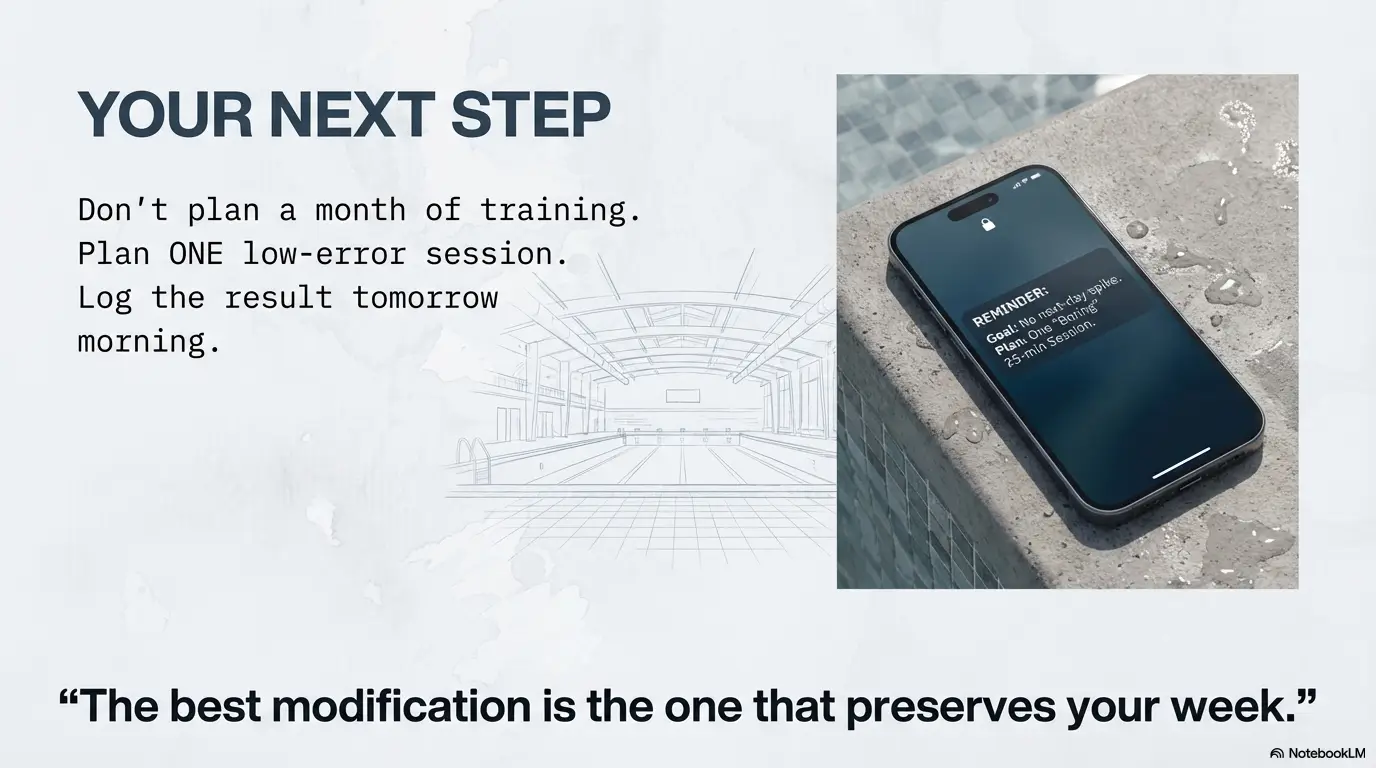
Your one concrete action: do a 25-minute test session with a 24-hour symptom check and log
Here is your exact mission: one 25-minute session, no pace targets, one template only, and a next-morning log. That single data point is worth more than three emotional guesses.
If you have been stuck in the loop of “felt okay in water, awful tomorrow,” this process closes the loop. It replaces hope-driven training with evidence-driven training.
Keep or cut decision rule for your next swim
Keep if next morning is same or better and no new neuro symptoms. Cut/regress if worse. If in doubt, choose the calmer option for one more session. You’re not losing fitness—you’re protecting continuity. On non-swim days, many readers do well with low-compression cardio using a recumbent bike setup for sciatica.
Infographic: 60-Second Decision Path
Worse than baseline or new neuro signs? → Recovery-only pool day.
Edgy symptoms → Pull buoy dominant. Stable mornings → Micro-flutter test.
Green continue / Yellow hold / Red regress immediately.
Same or better → +10% next session. Worse → -20% and step back.
- Run one controlled test session.
- Use green/yellow/red during reps.
- Let next-morning data decide progression.
Apply in 60 seconds: Put “No next-day spike” as your lock-screen note before training.
Short Story: The Week I Finally Stopped Negotiating with Pain
For months, I treated every decent warm-up as permission to gamble. I’d start careful, feel a little better by lap six, and quietly raise the pace because “I’m probably fine now.” By evening, I’d be stiff; by morning, my calf would buzz like a live wire. One Tuesday, I did the opposite.
I swam just 24 minutes, mostly easy pull, two tiny flutter tests, and left while I still wanted more. The next morning I waited for the usual punishment. It didn’t arrive. Same again two days later. Then better. That week taught me something blunt and useful: recovery responds to consistency more than courage. I didn’t need a perfect diagnosis to train smarter. I needed rules I would actually follow when I felt impatient.
FAQ
Is a pull buoy better than kicking for sciatica?
Often yes during acute irritability, because it can reduce leg-driven aggravation. But it is not universally better; poor buoy mechanics can irritate low back. Use short test intervals and 24-hour follow-up before deciding.
Can flutter kick irritate the sciatic nerve?
Yes, especially with large amplitude, rigid ankles, or hard effort. Tiny-range, easy-tempo flutter can be tolerated in many cases when introduced gradually.
How long should I swim during a sciatica flare?
Start around 20–35 minutes with intervals and symptom checks. In early flare, shorter sessions done consistently are usually safer than long continuous swims.
Should I use fins if I have sciatica?
Usually avoid fins during active flare, especially sprint fins. They increase lever forces and can provoke symptoms. Reintroduce only when mornings are consistently stable.
Is backstroke safer than freestyle for sciatica?
It can be for some swimmers because it may reduce certain flexion/rotation demands. But safety depends on your specific triggers and technique. Test in small doses and monitor next-day response.
Why does sciatica feel worse the day after swimming?
Buoyancy and warm water can mask irritability during session. Delayed flare reflects accumulated load response. That’s why the next-morning check matters more than immediate pool comfort.
Can pool exercise help a herniated disc flare?
It can help maintain activity with lower impact and controlled loading, but it does not replace individualized clinical care when symptoms are severe or persistent. For treatment pathways by severity, compare options in herniated disc sciatica treatment.
What stroke modifications are safest when pain shoots down the leg?
Use short intervals, lower intensity, reduced kick amplitude, longer rest, and stop rules. Pull buoy-dominant sets are often a useful temporary option.
Should I stop swimming if I get tingling in my foot?
If tingling is new, increasing, or spreading, stop and regress the session. Persistent or progressive neurological symptoms warrant professional assessment.
How do I return to normal swim training without re-flaring?
Use a ladder: establish 2–3 stable sessions, add 10–20% load, remove buoy gradually, and keep the 24-hour rule. If symptoms spike, step back one tier for two sessions.
Can I swim every day with sciatica?
Sometimes, if each session is low-load and next-morning symptoms remain stable. In many cases, alternating swim and recovery days gives a cleaner adaptation signal.
Is a kickboard good or bad for sciatica?
Kickboards can encourage postures and kick forces that irritate symptoms for some people. During flare, they’re often less forgiving than streamlined easy swim with tiny flutter.
Last reviewed: 2026-02.
If you only remember one thing, make it this: the best modification is the one that preserves your week. In the pool, that usually means less intensity, more checkpoints, and ruthless honesty about tomorrow morning. Your next 15-minute step is simple—schedule one 25-minute low-error session, log the 24-hour response, and choose your next set from data, not hope.