

Mapping the Bill Path: The Hidden Reality of Orthopedic Consultation Costs
The cost of an orthopedic pain management consultation can start climbing before a joint injection is even on the table. For many U.S. patients, the first surprise is not the needle. It is the quiet stack of charges around it: specialist evaluation, imaging, facility billing, and insurance cost-sharing that turns one appointment into a small billing ecosystem.
That is what makes this stage so frustrating. You are trying to solve knee, shoulder, hip, or spine pain, but the first obstacle may be financial ambiguity rather than medical clarity. The visit sounds simple. The cost path rarely is.
“Keep guessing, and you risk paying for the wrong sequence, the wrong setting, or the wrong assumptions about what ‘covered’ actually means.”
This guide helps you estimate orthopedic pain management cost before a joint injection consultation with more realism and less wishful thinking. It shows where pre-injection costs usually begin, how imaging and conservative care affect the total, and which questions can help you avoid preventable billing shocks.
The approach here is practical, not theatrical. It follows the actual path patients encounter, where the consult, not the procedure, often starts the money conversation.
Table of Contents
Before the Injection: The Expensive Part May Start Earlier Than You Think
Why many patients budget for the shot but not for the pathway leading to it
Most people hear “joint injection” and imagine a single price tag attached to a single event. That would be nice. It would also be wildly optimistic. What usually costs money first is the orbit around the procedure: the new-patient evaluation, the physical exam, chart review, possible imaging, maybe a referral trail, and sometimes the small administrative choreography required before anyone even says yes, no, or not yet.
I have watched friends do this mental math in reverse. They ask, “How much is the injection?” when the more useful question is, “What series of paid steps usually happens before a clinician is comfortable offering one?” That little wording change can save you from the classic American healthcare jump scare where the first bill is merely the opening credits.
What “pre-injection cost” usually includes in a US orthopedic setting
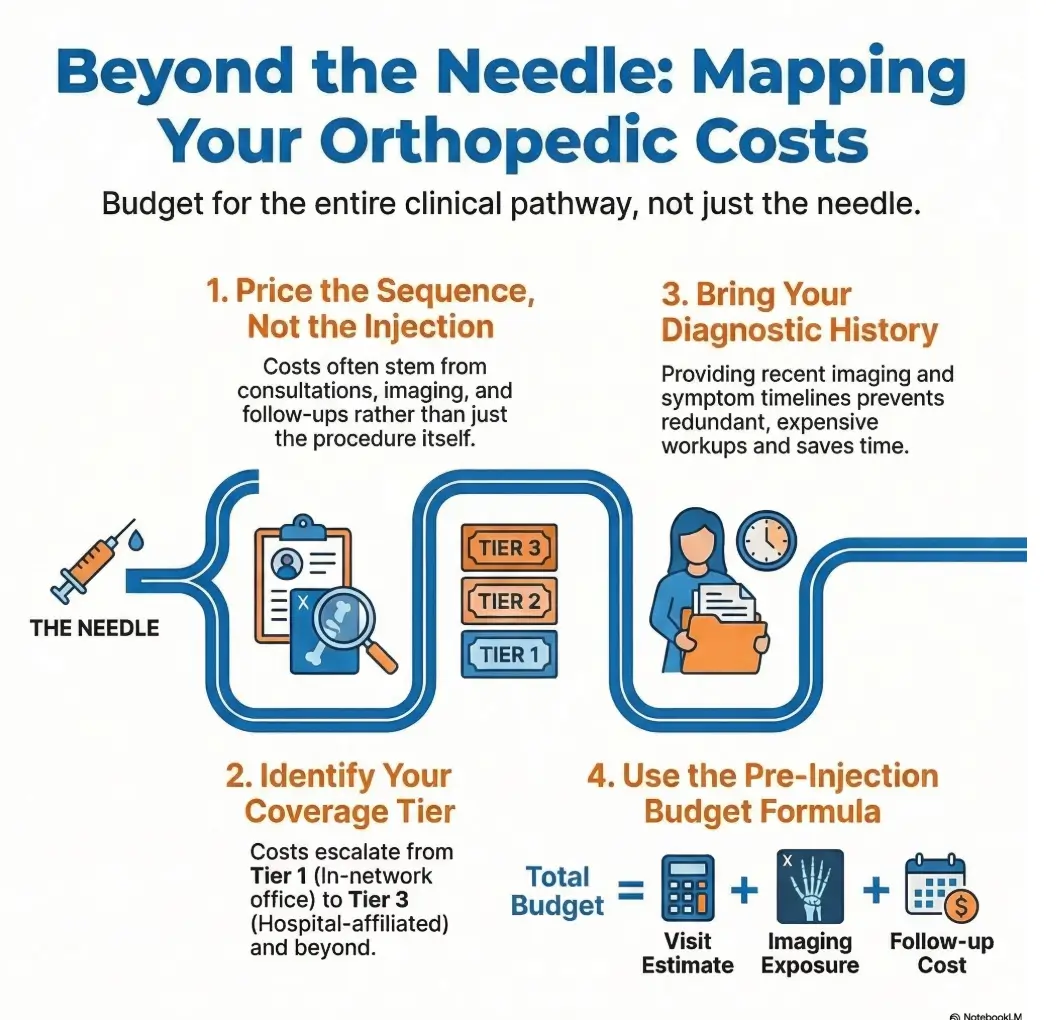
Think of pre-injection cost as a stack, not a sticker. The stack may include a specialist consultation, any imaging the clinic considers necessary, the insurance cost share for those services, and whatever conservative treatment history has to be reviewed or established. If you have a high-deductible plan, this stack can land with all the softness of a dropped cast-iron skillet. For patients on a deductible-heavy plan, it helps to understand how orthopedic pain management with an HDHP can change the entire cost sequence before treatment is even approved.
The hidden bill sequence: consult, imaging, documentation, and decision-making
The sequence matters because even modest individual charges can add up fast when they arrive from different places. A clinic visit can generate one bill. Imaging can generate another. A facility-linked setting can create a different billing texture than a stand-alone office. The Centers for Medicare & Medicaid Services explains that payment structures differ between physician-office and facility settings, which is one reason similar care can produce very different patient-cost experiences.
- The consult is usually its own paid event.
- Imaging may be discussed, ordered, or performed before any injection decision.
- Site of care changes cost more often than patients expect.
Apply in 60 seconds: Write down three categories before booking: visit, imaging, and follow-up.
Plain-English point: The procedure is often the second money conversation, not the first.
Cost Starts With Triage: What the First Orthopedic Visit Is Really Pricing
A consultation is not just “meeting the doctor”
Patients often describe the first orthopedic appointment as if they are buying ten minutes of face time. In billing reality, they are usually paying for medical evaluation and decision-making. That includes history, exam, review of records, analysis of the likely cause, and a plan. Sometimes that plan is “yes, injection.” Sometimes it is “not yet.” Sometimes it is, frustratingly but appropriately, “we need more information.”
The aggravating part is that none of those outcomes necessarily changes the fact that the visit itself still had value. If the appointment rules out a more expensive wrong turn, it may save money even when it feels anticlimactic. I once went to a specialist expecting fireworks and got a glorified lesson in biomechanics instead. Annoying? Slightly. Useful? Very.
Why symptom history, exam complexity, and body part involved can affect billing
Body part matters because the workup is not always interchangeable. A straightforward knee arthritis discussion may move differently than a shoulder complaint with weakness, or a spine-related pain pattern with numbness. Complexity in the history, red flags in the symptoms, and the amount of prior documentation to review can shape how the visit unfolds.
How a knee, shoulder, hip, or spine complaint may trigger different next-step costs
A joint complaint may sound simple at home and become less simple under exam-room lighting. A knee or shoulder issue may lead to plain films first. A hip complaint might raise questions about gait, referred pain, or functional limitation. Spine-adjacent pain often becomes its own weather system. The American Academy of Orthopaedic Surgeons notes that steroid injections are used in a variety of joints and pain conditions, but the clinical context is what determines whether and when they are discussed. When the pain pattern blurs body regions, readers often find it useful to compare hip pain versus spine pain before assuming the consultation path will be straightforward.
When A: You only know “it hurts” and have no prior records. Expect a broader first-visit workup.
When B: You bring recent notes, imaging reports, and a clean symptom timeline. The visit may move faster and more efficiently.
Neutral next action: Gather records before you compare clinics.
Insurance Math First: The Number on Your Card Is Not the Number That Matters
Copay vs coinsurance vs deductible before a joint injection consultation
The words sound tidy. The experience is not. Healthcare.gov defines a deductible as the amount you pay for covered services before your plan starts paying, a copay as a fixed amount for a covered service, and coinsurance as the percentage you pay after the deductible rules are satisfied. Out-of-pocket costs can include deductibles, copayments, coinsurance, and costs for services that are not covered. That is the part many patients miss: “covered” does not mean “cheap,” and “specialist visit” does not mean “single predictable number.”
Why “specialist visit covered” can still mean a surprisingly high bill
If you have not met your deductible, coverage may behave more like a technicality than a comfort blanket. The visit may be covered in the sense that it is allowed under your plan, but you may still be responsible for much of the allowed amount. Add imaging or separate facility charges, and the phrase “my insurance covers specialists” starts to sound like a joke told by a filing cabinet.
The network trap: surgeon, clinic, imaging center, and facility may bill separately
This is where people get ambushed. The orthopedic clinician may be in network, but the imaging center or facility may not align exactly the same way. Or the clinic may send imaging to a hospital-linked department that prices differently than an independent center. The paper map in your head says “one appointment.” The billing universe sometimes interprets it as a small ensemble cast. For readers dealing with spine-specific escalation, this is the same logic behind surprise bills around spine procedures and why one “covered” visit can still produce several separate claims.
Let’s be honest… insurance language often hides the real patient decision: “How much will this visit actually cost me this month?”
That is the question worth forcing into plain English. Not annual theory. Not plan brochure poetry. This month. This visit. This likely next step. Ask your insurer for the specialist cost share, whether imaging hits the deductible, and whether hospital outpatient settings change your patient responsibility. Those three answers are dull, glorious, money-saving bricks.
- Deductible status can matter more than the specialist copay.
- Coinsurance can make imaging feel much pricier than the office visit.
- Network status may differ across the doctor, facility, and imaging site.
Apply in 60 seconds: Check whether you have met your deductible before you call any clinic.

The Imaging Question: When One X-Ray Turns Into a Budget Problem
When orthopedic clinics commonly want imaging before discussing injections
Many clinics want some visual baseline before discussing an injection, especially if the pain pattern is new, worsening, or suspicious for something other than a routine flare. This does not always mean an MRI. In plenty of ordinary cases, plain X-rays are the first stop. The financial problem begins when patients hear “imaging” and mentally jump straight to the largest, loudest, most expensive machine in the room.
Why MRI expectations often distort the real cost conversation
The MRI has become a sort of medical celebrity. It has dramatic branding, excellent tunnel ambiance if you enjoy being marinated in magnet noises, and a reputation for importance. But not every joint complaint needs one before a consultation becomes useful. Sometimes the expensive expectation is not the clinic’s idea. It is the patient’s. And when you assume the “good” workup equals the maximal workup, your estimate starts wobbling before the appointment exists. It is worth understanding the difference between MRI versus X-ray decision paths, especially when the first visit may only need simpler imaging.
What changes when you already have recent imaging vs when you do not
If you already have recent imaging and the clinic accepts it, that can compress time and sometimes cost. The key word is accepts. Some offices will want actual image files, not just a one-line report. Others care about timing: imaging from last month is one thing, imaging from two years and several injuries ago is another.
The timing issue: same-day imaging convenience vs lower-cost imaging elsewhere
Convenience has a price, and in medicine it sometimes wears a polo shirt and says, “We can do that right here today.” Same-day imaging can be efficient and clinically sensible. It can also be more expensive than using a lower-cost independent center, depending on your insurance and location. This is one of those grown-up decisions where saving time and saving money do not always hold hands. If your plan is especially sensitive to deductible exposure, a separate HDHP imaging cost estimate can make the decision much less foggy.
| Item | What changes the price | Practical note |
|---|---|---|
| Specialist consult | Deductible status, visit complexity, site of care | Ask for self-pay and insurance estimate both |
| X-ray | Office vs hospital-affiliated site, network | Recent films may prevent duplication |
| MRI | Authorization, setting, deductible, coinsurance | Do not assume it is required before the first visit |
Neutral next action: Ask whether the first visit usually includes or merely orders imaging.
Conservative Care First: The Costs That Often Appear Before Anyone Approves an Injection
Why rest, medication, home exercise, or physical therapy may be discussed first
There is a reason many visits do not leap directly to a needle. Sometimes the diagnosis is not settled yet. Sometimes the condition may respond to simpler care. Sometimes an injection would be reasonable later, but not as the very first move. Orthopedics can feel like a field full of sturdy shoes and cautious eyebrows for a reason.
This is the part that irritates people who arrive ready for action. You leave with instructions for exercise, topical medication, activity modification, or physical therapy, and it can feel like paying to be told to stretch. Yet for many conditions, that is not dismissal. It is the starting line. The danger is financial drift: each “try this first” step may be individually sensible while the cumulative cost quietly fattens.
How “try this first” can be medically reasonable but financially frustrating
A short run of conservative care may be the cheapest path if it works. It may be deeply annoying if it does not. The point is not to romanticize delay. It is to see that “not injected today” does not automatically equal “wasted visit,” even though it can feel that way in the parking lot with your seat heater on and your dignity folded like a receipt. That is especially true when you are comparing physical therapy copay versus coinsurance, because the financial shape of “try PT first” varies wildly by plan.
When documented prior treatment matters for insurance approval or specialist recommendations
Documentation matters because specialists and insurers often want to know what has already been tried. A clean record of duration, symptom severity, prior medications, physical therapy, home exercise attempts, or previous imaging can move the conversation along more efficiently. Sloppy history invites repetition. Clear history can reduce it. In some cases, this same paper trail becomes crucial when proving failed conservative care before MRI approval.
Show me the nerdy details
For cost planning, conservative care is not just “before the injection.” It is part of the same episode of care. When you compare clinic options, compare their default pathway: some start with imaging, some with therapy, some with reassessment after home care. The clinical difference may be subtle, but the spending pattern can be very different.
Who This Is For / Not For
This is for
- U.S. patients trying to estimate orthopedic costs before booking a joint injection consultation
- People with knee, shoulder, hip, ankle, elbow, or similar joint pain
- Patients with HDHP, coinsurance-heavy plans, or uncertain specialist benefits
- Adults deciding whether to see orthopedics, pain management, sports medicine, or primary care first
This is not for
- People needing emergency care for sudden deformity, inability to bear weight, fever with joint pain, or major trauma
- Patients looking for a diagnosis from an article instead of an in-person evaluation
- Readers seeking guaranteed pricing without checking their own insurer, clinic, and facility details
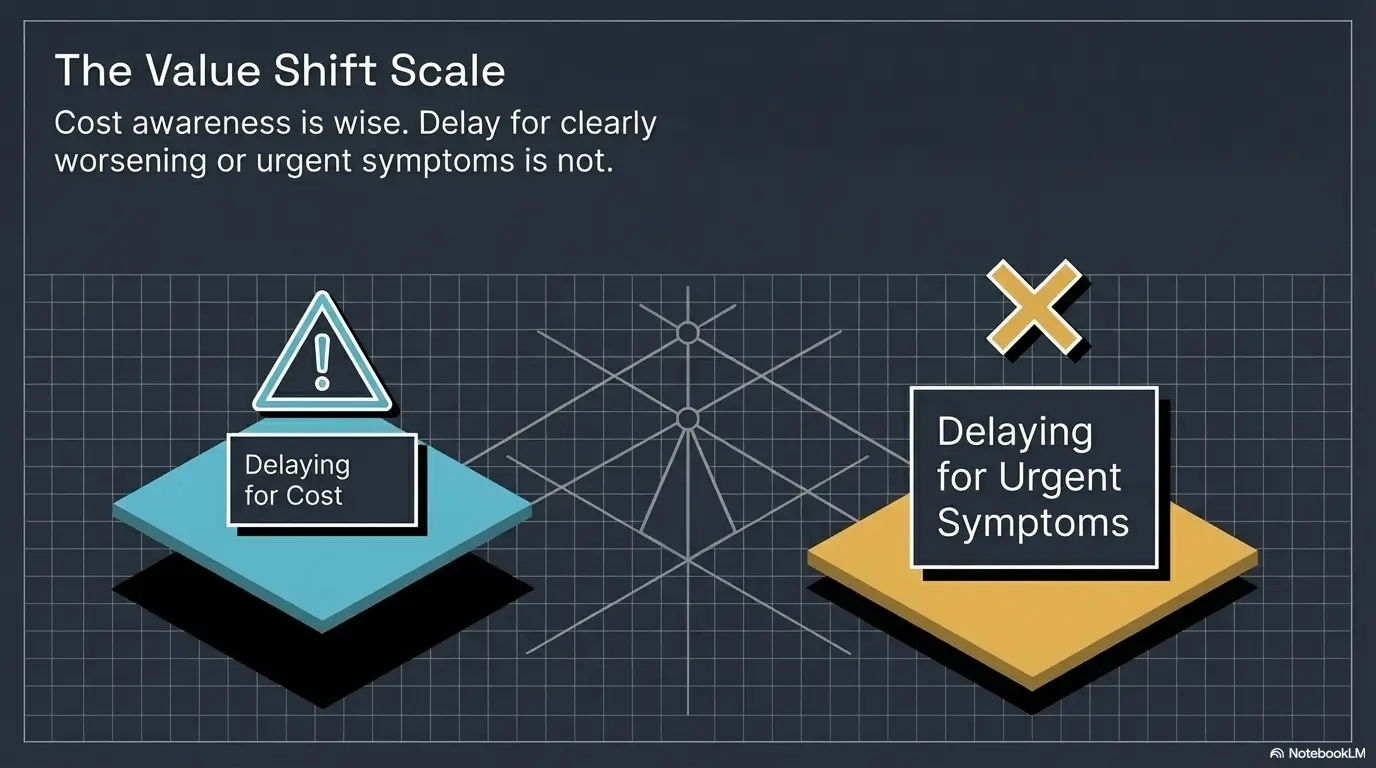
One useful reality check: if your symptoms include infection warning signs, major neurologic symptoms, or rapidly worsening function, the cost conversation should not become an excuse for heroic procrastination. Bargain-hunting is noble in groceries. It becomes less charming when your joint is hot, swollen, and angry.
The Setting Changes Everything: Office Visit, Hospital Clinic, or Surgery-Linked Practice
Why site of care can change the bill before treatment changes at all
Two consultations can feel identical to the patient and still bill very differently. That is one of the most maddening features of this landscape. You may sit in a similar chair, describe the same pain, get the same exam, and yet your wallet experiences two entirely different climates because the visit occurred in a different billing environment.
The difference between physician fees and facility-linked charges
CMS explains that physician-office and facility settings are paid differently, and that difference helps explain why a hospital outpatient department can feel more expensive than a stand-alone physician office for what appears to be the same service. The clinician’s work may be one piece; the facility context may be another. Patients comparing settings may also want to understand hospital outpatient versus ASC facility fee differences before assuming two locations are financially interchangeable.
Why two “orthopedic consults” can feel identical clinically but cost very differently
Patients tend to compare doctors by specialty, credentials, and appointment date. Those matter. But for cost, the first three comparison questions are often less glamorous: where is the visit billed, where is the imaging performed, and what else is routinely triggered from that site?
Here’s what no one tells you… the cheapest specialist is not always the cheapest path if their process triggers extra testing automatically
A lower consult fee is lovely until it leads to the most expensive imaging pathway by default. A slightly pricier first visit can be the cheaper episode if the workup is tighter and avoids duplication. This is why price-shopping one code in isolation can produce very expensive confidence.
Tier 1: In-network office, deductible partly met, no facility fee
Tier 2: In-network office, deductible unmet, imaging billed separately
Tier 3: Hospital-affiliated visit, coinsurance applies, imaging on-site
Tier 4: Mixed network status across provider and imaging center
Tier 5: Out-of-network or unclear benefit path
Neutral next action: Ask the clinic how the visit is billed before comparing dates.
Don’t Book Blind: Questions to Ask Before You Schedule the Consultation
Ask whether the visit is evaluation-only or likely paired with imaging
This question sounds humble and saves real money. If the answer is “we usually do X-rays here on new joint patients,” that affects your estimate. If the answer is “the doctor decides after the exam,” that is different. Neither answer is bad. Hidden answers are the expensive ones.
Ask which CPT or visit-level categories they commonly bill for new patients
You do not need to cosplay as a billing specialist, but it is fair to ask how new patient visits are typically categorized and whether they can provide a self-pay estimate or an insurance estimate. Clinics vary in how specific they are willing to be. Still, the question itself often reveals whether the office is organized or improvising with the confidence of a jazz drummer. If self-pay is on the table, it helps to compare the broader self-pay cash price range for pain care before assuming insurance is automatically the cheaper route.
Ask whether the provider requires prior imaging, referral notes, or physical therapy first
This helps you avoid duplicate work and pointless delays. If a clinic wants prior records sent in advance, give them that chance. A $0 fax-equivalent can prevent a three-figure rerun.
Ask whether an injection can happen the same day or only after a separate authorization path
Even if you are focused on pre-consultation cost, this question matters because it clarifies whether the first visit is likely a planning appointment or a potential treatment day. That affects not only budget but logistics, time off work, and expectations. Nothing sours a Tuesday like assuming “one and done” and discovering you have actually booked “one and maybe later.”
- Will imaging happen today, be ordered, or not be needed?
- How is the new-patient visit usually billed?
- Do you need prior records or therapy first?
- Can an injection happen the same day?
Apply in 60 seconds: Paste those four questions into your phone notes before you call.
Common Mistakes
Mistake 1: Treating the consultation fee as the whole cost
This is the classic error. It is understandable. It is also how one bill turns into three with the elegance of a card trick.
Mistake 2: Assuming “specialist” means one bill instead of several
Provider, imaging, and facility can travel as separate billing species. They are related. They are not always married.
Mistake 3: Waiting until the check-in desk to ask about self-pay pricing
Front desks can be helpful, but check-in is a poor moment for financial strategy. That is triage theater, not calm negotiation.
Mistake 4: Getting imaging at the highest-cost location out of convenience
Convenience is a fine reason to spend more when you have chosen it consciously. It is a painful reason when you never knew the alternative existed.
Mistake 5: Confusing “recommended” with “required right now”
Sometimes urgency is real. Sometimes the next test is sensible but not time-critical. Those are different. Your questions should try to separate them.
- Do you know whether the provider and imaging site are both in network? Yes / No
- Do you know whether your deductible is met? Yes / No
- Do you know whether same-day imaging is routine? Yes / No
- Do you already have recent records or films? Yes / No
- Do you know whether the visit is consult-only or may include treatment planning for the same day? Yes / No
Neutral next action: Any “No” on this list is a good phone call target before booking.
Don’t Do This: Costly Moves That Make Joint Pain More Expensive Than It Needs to Be
Do not chase an injection before understanding what diagnosis is being evaluated
An injection is a tool, not a personality type. Wanting one before understanding the underlying problem can send you toward the wrong specialist or the wrong workup.
Do not skip benefit verification because the clinic “takes your insurance”
That phrase is comforting in exactly the wrong way. A clinic accepting your insurance is not the same as your plan making the visit cheap.
Do not assume prior authorization protects you from all surprise costs
Authorization addresses one kind of permission. It does not magically flatten all cost-sharing or site-of-care differences. Patients often hear “approved” and imagine “affordable.” Healthcare rarely rewards that optimism. This becomes even more painful when patients later discover issues like an out-of-network gap exception for spine care only after the expensive path has already started.
Do not compare only the injection price while ignoring the workup around it
This is like comparing airfare without luggage, seat selection, or the fact that one airport is three hours away by bus. Technically a comparison, spiritually nonsense.
Why the Cheapest Path Is Not Always the Safest Path
When delaying care to save money can create a bigger medical and financial problem
There is a version of frugality that becomes expensive. Waiting too long can mean more visits, more limitation, worse function, or a bigger intervention later. This is not a sales pitch for rushing. It is a reminder that price-shopping needs a clock, not just a calculator.
When paying for a better first evaluation may reduce repeat visits later
A careful first visit can reduce duplication, especially when it organizes the problem clearly and tells you what does not need to happen. That can be worth a lot. Some of the best money in medicine is spent on ruling out the drama you feared.
How to think in sequences, not isolated charges
Ask yourself which path is most likely to get you a useful answer with the fewest repeated steps. That is usually the better question than “Which appointment is cheapest today?” The shortest receipt is not always the lowest total cost.
AAOS patient materials on cortisone shots emphasize that these injections are used for many conditions and joints, but they are still part of a broader treatment decision, not a universal first move. That framing is clinically ordinary and financially important.
Build a Smarter Cost Estimate: A Pre-Visit Budget Framework That Actually Helps
Step 1: Estimate the specialist evaluation cost under your plan
Start with the most boring number in the room, because boring numbers pay the rent. Ask whether the visit is subject to deductible, copay, or coinsurance. Ask for the clinic’s self-pay estimate too. Sometimes the comparison is enlightening. Sometimes it is a small emotional event.
Step 2: Add likely imaging exposure
Do not assume imaging. Do not omit it either. Assign a placeholder range based on what the clinic says is common for new patients with your kind of complaint. If MRI becomes part of the pathway later, comparing a lumbar MRI cost on an HDHP can help you keep your estimate tethered to reality.
Step 3: Check whether conservative treatment documentation may be expected
If you have already tried home care, medications, or therapy, gather dates and outcomes. If you have not, note that as a possible next-step cost rather than a surprise later.
Step 4: Separate “today’s cost” from “full episode-of-care cost”
Today’s cost is the visit and maybe imaging. Episode-of-care cost includes the follow-up logic. Keep those separate. People panic when they blur them together and become unrealistically optimistic when they ignore the second one.
Step 5: Write down the threshold where self-pay, in-network care, or postponement changes your decision
Choose your threshold before a charming scheduler hands you the most convenient slot. Convenience is persuasive. Pre-committed numbers are your defense against your own desperate shoulder.
Visit estimate + likely imaging exposure + probable follow-up cost = your pre-injection working budget.
Neutral next action: Put a low, medium, and high version of that budget in your notes before you schedule.
Show me the nerdy details
For decision-making, a three-number estimate often works better than a single “expected price.” Use low if no imaging is needed, medium if X-rays are likely, and high if imaging plus follow-up are plausible. That range-based method is usually more honest than pretending you have precision before the visit is booked.
When the Consultation Is About More Than an Injection
Why some orthopedic visits end with reassurance, rehab, or watchful waiting instead
Not every useful orthopedic visit ends with a procedure. Sometimes the biggest win is diagnostic clarity. Sometimes the right answer is rehab, pacing, modification, or watchful waiting. That can feel emotionally underwhelming, especially if you arrived hoping to be fixed by lunchtime, but it is often exactly what a good evaluation is supposed to do.
Why the most valuable outcome may be diagnostic clarity, not a procedure
Patients often undervalue clarity because it is less cinematic than treatment. Yet clarity can prevent repeat visits, bad assumptions, unnecessary scans, and the strange hobby of collecting opinions until one matches your original hunch. That is particularly true when symptoms and scans do not line up neatly, a problem explored in MRI pain mismatch scenarios.
The paradox: paying for a visit that tells you not to get the injection may still save money
This is the curiosity loop from the beginning. The first visit can be worth the money even when the needle never enters the scene, because the real product of that visit may be a narrower, safer, cheaper path. A non-procedure outcome can still be a good financial result. Sometimes the best bill is the one that stopped five worse ones from being born.
When to Seek Help Sooner Instead of Price-Shopping Too Long
New weakness, numbness, or loss of joint function
If weakness or numbness is showing up, the conversation moves beyond “what is the cheapest consult near me?” Those symptoms deserve more urgency.
Fever, redness, warmth, or swelling that suggests infection or urgent inflammation
A hot, swollen, painful joint with systemic symptoms is not a great setting for leisurely spreadsheet comparisons.
Severe pain after injury, inability to bear weight, or rapidly worsening symptoms
There is a difference between price discipline and dangerous delay. Know which side you are on.
Persistent pain that is disrupting sleep, walking, work, or basic daily activity
When daily function is sliding, the cost of waiting includes more than medical bills. It may include missed work, worse movement habits, poorer sleep, and the familiar household ritual of pretending you are “fine” while opening jars like they have offended your ancestors.
- Function loss changes the urgency math.
- Red-flag symptoms deserve faster evaluation.
- The cheapest calendar slot may not be the best decision.
Apply in 60 seconds: If you have red-flag symptoms, stop price-shopping and seek timely care.
The twist was that the appointment still saved her money in the long run, because the problem turned out to be less about inflammation and more about weakness and movement pattern. Instead of rushing into a procedure, she got a tighter diagnosis, targeted rehab, and a better plan. She still winced at the first receipts. But she stopped cycling through random fixes, missed fewer workdays, and avoided bouncing from one expensive maybe to another. The bill was annoying. The clarity was worth it.
FAQ
How much does an orthopedic consultation cost before a joint injection?
There is no single national number that is reliable enough to quote across plans and settings. The more useful answer is that your cost usually depends on deductible status, specialist benefit design, site of care, and whether imaging is part of the first step.
Does insurance usually cover the first orthopedic visit?
Often yes in the coverage sense, but that does not guarantee a low bill. If you have not met your deductible, you may still owe a substantial amount for covered services.
Do I need imaging before a doctor will discuss a joint injection?
Not always. Some clinics discuss options after the exam and then decide whether imaging is needed. Others routinely want X-rays before or during the first orthopedic evaluation. MRI is not automatically the first stop for every joint complaint.
Can I ask for self-pay pricing before I book?
Yes. Ask for both self-pay and insurance-based estimates. Sometimes the comparison is useful, especially if your deductible is high or largely unmet.
Is a joint injection consultation billed separately from the injection itself?
Often, yes. The evaluation and the procedure are not automatically the same billing event. Even when the injection is discussed at the first visit, the consult can still be its own charge. For spine readers trying to decode the later bill stack, it also helps to understand common spine injection bill CPT codes.
Why was I charged more than a specialist copay?
Possible reasons include deductible exposure, coinsurance, imaging charges, facility-linked billing, or separate provider and imaging claims. “Specialist copay” is often only one layer of the final number.
Do I need physical therapy before I can get an injection?
Sometimes it is recommended first, and sometimes prior conservative treatment history helps specialists or insurers evaluate what should happen next. It is not universal, but it is common enough that you should ask.
Is it cheaper to see primary care before orthopedics?
Sometimes. Primary care may help with early evaluation, basic treatment, or referrals. But if it only adds a separate visit before the specialist path you were likely to need anyway, it may not reduce total cost. The answer depends on your plan design and how the local referral process works.
Final Thoughts
The hook at the beginning was simple: the needle may not be the first money problem. By now, you can see why. The more expensive surprise is often the path leading up to the decision, not the decision itself. That is the loop worth closing. A joint injection consultation is rarely just a question of procedure price. It is a question of sequence, setting, insurance math, and whether the first visit is being used to buy clarity or merely convenience.
If you do one useful thing in the next 15 minutes, make it this: call the clinic and your insurer on the same day, and write down three numbers before you book. Your specialist cost share. Your likely imaging exposure. Whether the visit is evaluation-only or commonly triggers additional pre-injection charges. That tiny checklist is not glamorous, but neither is opening three envelopes and pretending they are all somehow a misunderstanding.
Last reviewed: 2026-03.