
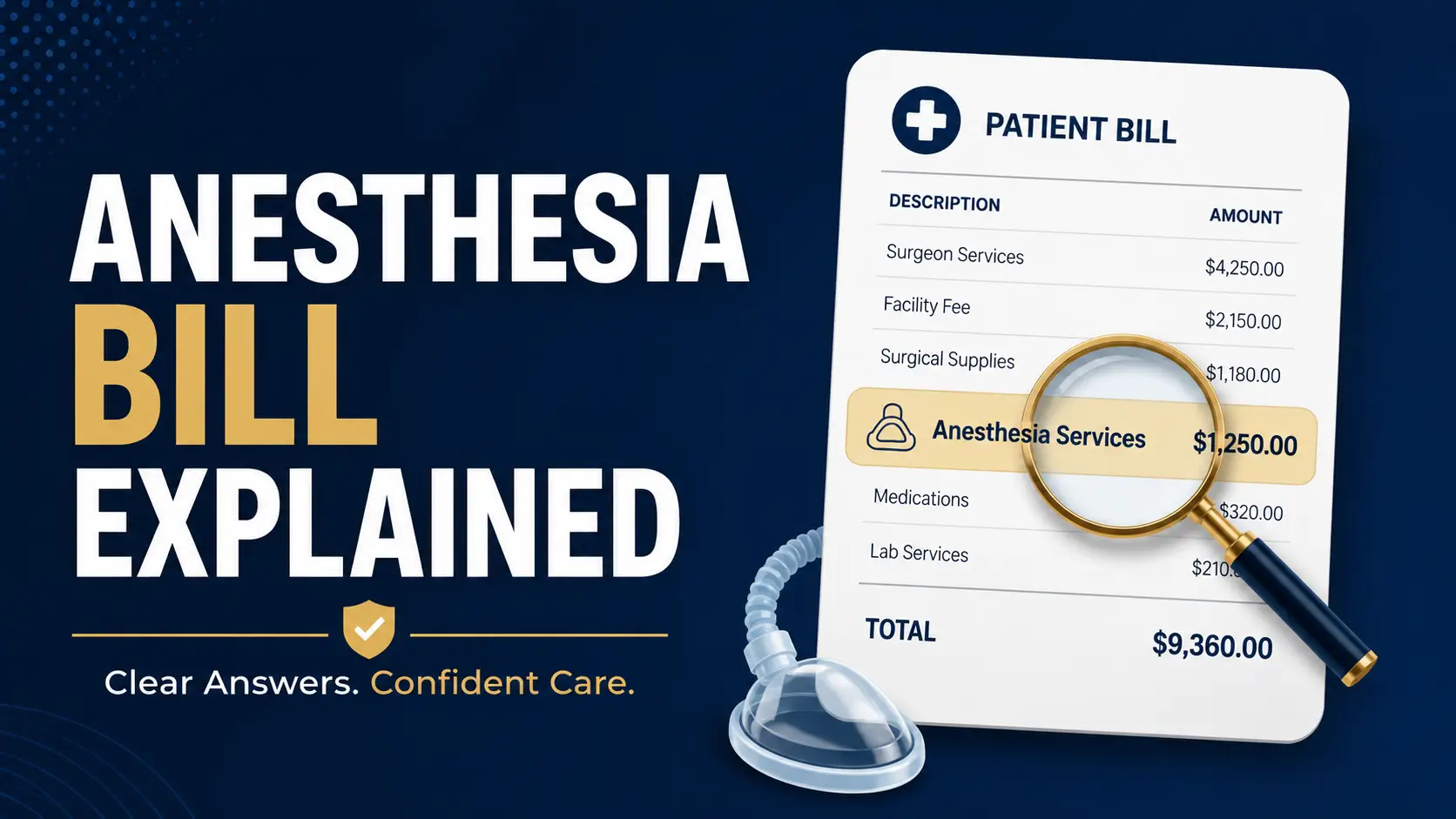
Medical billing clarity for the bill that arrives after the surgery
Why Anesthesia Appears Separately
on Surgery Bills
A separate anesthesia bill can feel like a second envelope falling out of the sky. You already saw the surgeon’s charge. Maybe the hospital sent its own statement. Then another bill arrives from a name you do not recognize, and suddenly the kitchen table becomes a small claims courtroom with coffee rings.
The short version is reassuring but not dismissive: anesthesia is often billed separately because it may be provided by a different professional group than the surgeon or facility. That does not automatically mean the charge is wrong. It also does not mean you should pay blindly. Medical bills have their own fog machine, and anesthesia billing can be especially hard to read because time, codes, network rules, and insurance processing all stack together.
This guide walks you through what the charge usually represents, how to compare it with your Explanation of Benefits, when surprise billing protections may matter, and what to ask before money leaves your account. Think of it as a calm flashlight for a very expensive drawer of paper.
Know what is normal
Learn why one surgery can create several legitimate bills.
Spot billing trouble
Check dates, network status, allowed amounts, denials, and duplicate-looking lines.
Call with a script
Ask the right office the right questions before paying or appealing.
One useful promise: by the end, you should be able to put the anesthesia bill and insurance paperwork side by side and know what to check first. 🧾
Snapshot: This article is for patients, caregivers, and family bill-payers who received a separate anesthesia charge after surgery and want to avoid overpaying, missing an appeal deadline, or confusing a normal separate bill with a billing error.
You will learn how anesthesia billing fits beside surgeon and facility bills, how to read the EOB, what surprise billing rules may protect, and what to do in the next 15 minutes before paying.
Table of Contents
Safety and Billing Disclaimer
This article is for general education about United States medical billing, insurance paperwork, and patient cost questions. It is not medical, legal, tax, financial, or insurance advice.
Billing rules vary by health plan, state, provider contract, facility type, employer plan design, Medicare or Medicaid rules, and procedure. A separate anesthesia bill may be normal, incorrect, partly protected, fully patient-responsible, or still waiting for insurance correction. The paperwork has to be checked against your own plan documents and claim history.
If a bill is large, denied, near collections, tied to an emergency, or connected to out-of-network care at an in-network facility, consider contacting your insurer, the billing office, your state insurance department, a medical billing advocate, or an attorney familiar with medical debt issues.
Key takeaway: Do not treat this article as a coverage promise.
Use it as a reading map. The final answer for your bill lives in the EOB, claim number, network status, provider contract, and any applicable federal or state surprise billing rules.
Who This Guide Is For, And Who May Not Need It
A separate anesthesia bill usually arrives when life is already cluttered: the patient is healing, a caregiver is sorting paperwork, and the insurance portal has become an accidental hobby. This guide is for that moment.
It is especially useful if you had surgery in a hospital, hospital outpatient department, ambulatory surgery center, endoscopy center, orthopedic practice, pain clinic, or similar medical setting and later received a bill from an anesthesiologist, certified registered nurse anesthetist, anesthesia care team, or anesthesia management group.
For Patients Opening A Confusing Surgery Bill
If you are the patient, your first reaction may be, “Wait, did I already pay for this?” That question is reasonable. Surgery billing is rarely presented as one clean receipt. Instead, it often arrives in parts, like a puzzle mailed by three different cousins.
You may have a surgeon bill, a facility bill, a pathology bill, an imaging bill, a lab bill, and an anesthesia bill. The anesthesia charge may look separate because the anesthesia provider may not be employed by the hospital or the surgeon. Even when the care happened in the same operating room, the billing entity may be different.
For Caregivers Managing Bills After Surgery
Caregivers often become the family’s unofficial billing department. You may be helping a parent after a joint replacement, a spouse after outpatient surgery, or a relative after an emergency procedure. The problem is not just the money. It is the translation work.
Caregivers should build a simple bill folder: date of service, provider name, bill amount, insurance EOB, claim number, payment status, and next call date. If you are also managing post-surgery logistics, articles like signs a parent needs help after surgery can sit beside billing work as part of the bigger recovery picture.
For People Comparing Hospital, Surgeon, And Anesthesia Charges
This guide is also for people preparing for surgery who want to understand why a cost estimate may not include every professional service. A hospital estimate may include facility charges but not all independent clinician charges. A surgeon’s quote may not include anesthesia. An insurer’s estimate may be helpful but incomplete.
Before a scheduled procedure, ask whether the surgeon, facility, anesthesia provider, assistant surgeon, pathologist, radiologist, and labs are in-network. That sounds like a lot because it is a lot. Medical billing turns one appointment into a small cast list.
Who May Not Need This Guide
You may not need this guide if your anesthesia bill clearly matches your EOB, the provider is in-network, the patient responsibility matches your deductible or coinsurance, and the amount is manageable. You may also need direct professional help rather than an article if you are already facing a lawsuit, wage garnishment, damaged credit concerns, or a very large disputed balance.
Practical utility block: quick sorting checklist
- Do you have the anesthesia bill and the EOB for the same date?
- Does the provider name match or at least clearly relate to the surgery?
- Does the EOB say the claim was processed, denied, pending, or adjusted?
- Does the bill ask for more than the EOB says you owe?
- Does the bill mention out-of-network status, balance due, or collections?
The Separate Anesthesia Bill Is Not Always A Red Flag
A separate bill can feel suspicious because ordinary life teaches us that one service should create one bill. You order dinner, you get one check. You repair a car, you get one invoice. Surgery does not always work that way.
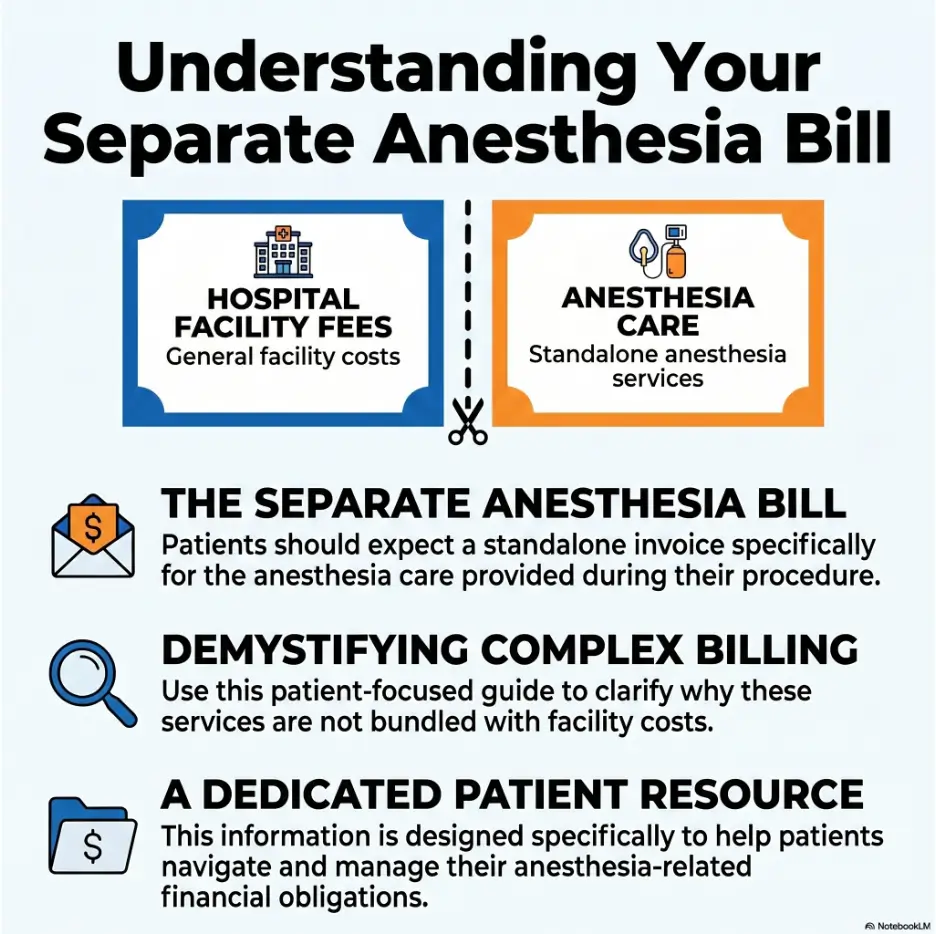
In many medical settings, the hospital or surgery center bills for the room, equipment, nursing staff, supplies, and facility overhead. The surgeon bills for performing the operation. The anesthesia professional or anesthesia group bills for anesthesia evaluation, medication management, monitoring, and time.
Why The Anesthesia Team May Bill Apart From The Surgeon
The anesthesiologist or anesthesia care team may be part of an independent group that contracts with the hospital or surgical center. In that arrangement, the facility hosts the surgery, the surgeon performs it, and the anesthesia group provides a separate professional service.
That is why the bill may come from a name you never heard aloud. You may remember the surgeon’s name because you met before the procedure. You may remember the hospital because you parked there. The anesthesia group may be a corporate or professional name printed on paperwork you barely saw while wearing a hospital bracelet and trying not to think about the IV.
How Facility Fees, Surgeon Fees, And Anesthesia Fees Split The Same Surgery
Think of a surgery bill as three overlapping invoices for one event. The facility fee pays for the place and support system. The surgeon’s fee pays for the operation itself. The anesthesia fee pays for sedation, anesthesia monitoring, airway support when needed, medication choices, and physiological oversight during the procedure.
This split matters because each entity may have a different tax ID, billing office, insurance contract, claim number, and payment timeline. One claim may process quickly. Another may deny. A third may be adjusted weeks later. The patient sees one surgery, but the insurance system sees multiple claims.
The Tiny Billing Detail That Makes The Whole Bill Look Stranger Than It Is
The tiny detail is the billing name. A bill from “Regional Anesthesia Associates,” “Premier Anesthesia Services,” or another unfamiliar group can look unrelated to your surgery. Before assuming fraud or duplication, match the date of service, facility, procedure, and EOB claim information.
If the date and setting match your surgery, the bill may be legitimate. If the date is wrong, the procedure code does not match, the provider name never appears on your EOB, or the bill asks for more than the EOB patient responsibility, it deserves review before payment.
Key takeaway: Separate is not the same as duplicate.
A separate anesthesia bill can be normal. The warning sign is not separation alone. The warning sign is a mismatch between the bill, EOB, network status, date of service, or patient responsibility.
Anesthesia Is A Service, Not Just Being Put To Sleep
Many patients think anesthesia means the moment they drift off and wake up later asking a nurse whether they said anything embarrassing. That is part of the story, but not the whole bill.
Anesthesia care can begin before the operating room and continue into recovery. The professional charge may reflect evaluation, risk review, medication selection, monitoring, airway management, response to blood pressure or oxygen changes, and recovery oversight. For some procedures, anesthesia is light sedation. For others, it is general anesthesia with deeper monitoring and more complex management.
Pre-Op Review: The Bill May Start Before The Operating Room
Before surgery, the anesthesia team may review your health history, medication list, allergies, prior anesthesia problems, sleep apnea risk, heart or lung conditions, and fasting status. This review helps choose the safest anesthesia plan for the procedure and patient.
If you have diabetes, a pacemaker, severe reflux, blood thinner use, chronic pain medication use, or a history of difficult intubation, that pre-op review becomes more than a quick hello. Even a routine-looking procedure can require careful planning behind the curtain.
Intraoperative Monitoring: The Clock Matters More Than Patients Expect
During the procedure, anesthesia professionals monitor vital signs and respond to changes. They may adjust medications, fluids, oxygen, ventilation, blood pressure support, and sedation depth. The charge often reflects both the complexity of the procedure and the time spent providing anesthesia care.
This is why two people can have similar procedures but different anesthesia charges. A longer case, a more complex case, or a case with added risk factors may create a different billing result. The patient may experience the surgery as one nap. The anesthesia record may show a carefully timed sequence of medical decisions.
Recovery Oversight: Why The Charge May Continue After The Procedure
Anesthesia does not necessarily end the moment the surgeon finishes. Recovery may involve waking safely, managing nausea, checking breathing, monitoring pain, and making sure the patient is stable enough for the next level of care.
For outpatient surgery, recovery oversight may be part of getting the patient ready to go home. For inpatient surgery, it may be part of the transition to a recovery unit or hospital room. Either way, the service is broader than the dramatic movie scene where a mask lowers and the screen fades to black.
Short Story: The Bill That Looked Like A Second Surgery
Maria helped her father after knee surgery. The first bill came from the hospital, thick as a wedding invitation and almost as emotional. The second came from the surgeon. She expected those.
Then a third envelope arrived from an anesthesia group. Her father frowned and said, “I already paid the hospital. Are they charging me twice for the same room?”
Maria placed the anesthesia bill next to the EOB and circled three items: the surgery date, the claim number, and the patient responsibility. The bill was separate, but the EOB showed it had processed as an in-network professional claim.
The lesson was simple: the envelope felt alarming, but the paperwork told a calmer story. She still called to confirm the balance, but she did not start from panic. She started from matching facts.
The Three-Bill Problem Patients Often Miss
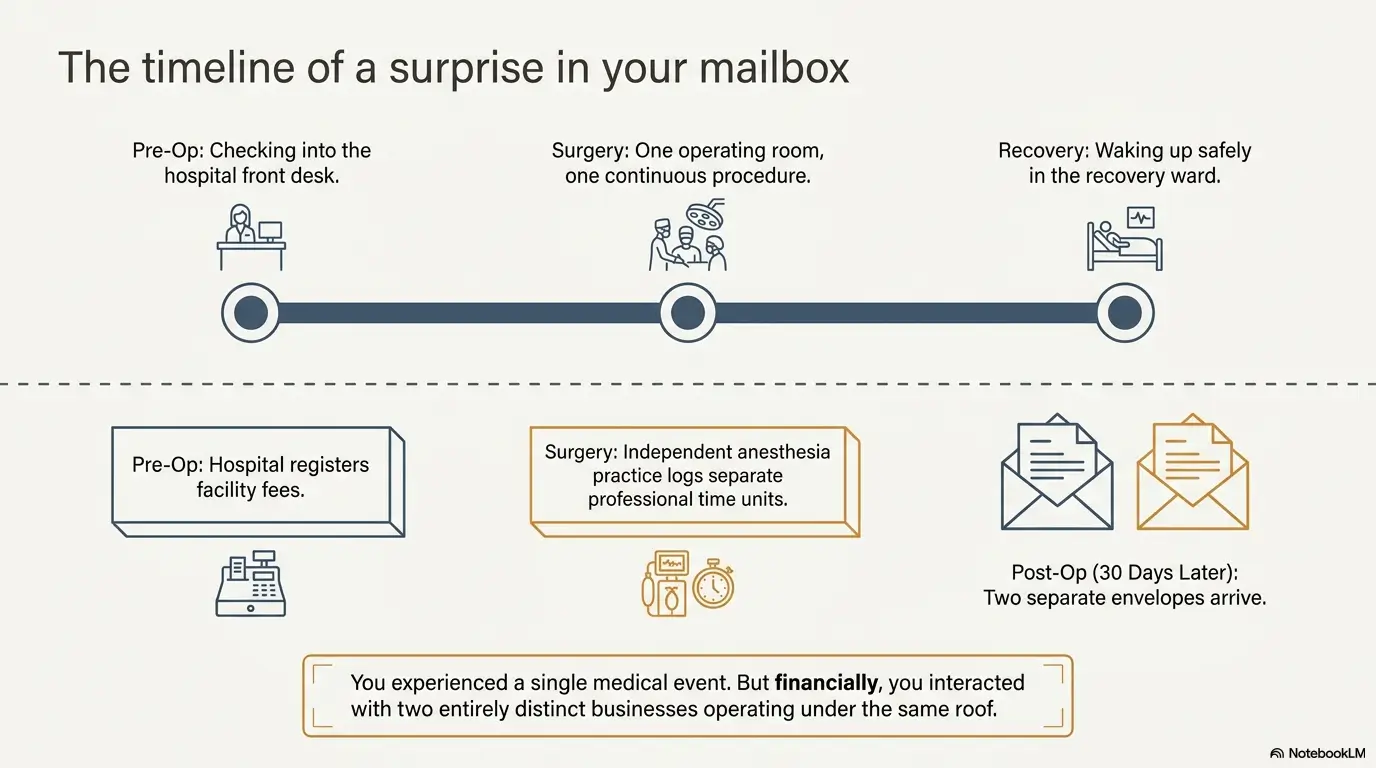
The biggest mental shift is this: one surgery can produce multiple claims because multiple parties provide different pieces of the care. This is not intuitive. It is, however, common.
Patients often get confused because the bills arrive out of order. The facility may bill first, the surgeon later, and the anesthesia group after insurance finishes processing. Or the EOB may arrive before the bill. Or the bill may arrive before insurance has finished. The sequence can make normal billing look chaotic.
Surgeon Bill: The Person Performing The Procedure
The surgeon’s bill is the professional charge for performing the operation. It may include pre-op planning and post-op care depending on the global surgery rules and payer arrangements. This bill is usually the easiest for patients to recognize because the surgeon’s name is familiar.
Still, the surgeon’s bill may not include the operating room, anesthesia, implants, imaging, pathology, or facility supplies. A patient may hear a surgeon quote and assume it represents the whole event. Often, it represents one lane of the event.
Facility Bill: The Hospital Or Surgery Center Hosting The Procedure
The facility bill may be the largest because it can include use of the operating room, recovery area, nursing, equipment, supplies, medications, implants, sterile processing, and overhead. Hospital outpatient departments may bill differently than ambulatory surgery centers.
If you are comparing surgery sites, the facility bill can be a major cost driver. For related reading on how setting can affect charges, see hospital outpatient vs ASC facility fee and hospital outpatient facility fee.
Anesthesia Bill: The Team Managing Sedation, Safety, And Monitoring
The anesthesia bill is the professional charge for anesthesia care. It may come from an anesthesiologist, a CRNA, an anesthesia care team, or an anesthesia group. The name on the bill may not match the hospital name.
That mismatch creates a lot of distrust. The better first question is not “Why did they bill separately?” but “Did this claim process correctly under my plan for the correct date, provider, and setting?”
Here’s What No One Tells You: One Surgery Can Have Multiple Businesses Behind It
Behind one surgical appointment, there may be several business relationships. The surgeon may work for a physician practice. The facility may be owned by a hospital system. The anesthesia group may be contracted. The lab may bill separately. The insurer may treat each one as a different claim.
This is why calling only the hospital may not solve an anesthesia bill. The hospital billing office may be able to explain facility charges, but the anesthesia group may control its own billing. The insurer, meanwhile, controls how the claim was processed under your benefits.
| Bill Type | What It Usually Covers | Common Patient Confusion | Best First Question |
|---|---|---|---|
| Surgeon bill | Professional surgical service | “Does this include the whole surgery?” | Does the surgeon’s claim match the procedure and EOB? |
| Facility bill | Operating room, equipment, recovery space, supplies | “Why is the room so expensive?” | Was this billed as hospital outpatient, inpatient, or ASC care? |
| Anesthesia bill | Anesthesia evaluation, time, monitoring, medications, recovery oversight | “Why is this from a different company?” | Was the anesthesia provider in-network or protected from balance billing? |
| Other professional bills | Pathology, radiology, assistant surgeon, labs | “Who are these people?” | Did each service occur on the same date and process correctly? |
Why Insurance Treats Anesthesia Differently
Insurance does not look at your surgery as a single emotional event. It looks at claims, codes, contracts, plan rules, deductibles, allowed amounts, and provider network status. This is why a “covered surgery” can still produce a painful anesthesia balance.
Covered does not always mean free. Covered may mean the insurer applied the allowed amount, discounted the billed charge, counted part toward the deductible, and assigned coinsurance to you. The bill may be correct and still unpleasant. A cactus can be real and still rude.
Contracted Providers: Why Network Status Can Split Even Inside One Facility
A hospital or surgery center can be in-network while a specific professional group is out-of-network. This has been one of the classic pain points in medical billing, especially for services patients do not usually choose directly, such as anesthesia, emergency care, radiology, and pathology.
Federal surprise billing protections may help in certain situations, but you still need to verify how the claim was processed. Ask the insurer whether the anesthesia claim was treated as in-network, out-of-network, or protected under surprise billing rules.
Allowed Amounts: The Number That Matters More Than The Sticker Price
The billed charge is the amount the provider asks for. The allowed amount is the amount the insurer recognizes under the plan or contract. Your responsibility is usually calculated from the allowed amount, deductible, coinsurance, copay, and plan rules.
For example, an anesthesia group might bill $2,800. The insurer may allow $900. If you have not met your deductible, the EOB may assign some or all of the allowed amount to you. If the provider is in-network, the provider may have to write off the difference between the billed charge and allowed amount. If the provider is out-of-network, the analysis becomes more complicated.
Coinsurance And Deductibles: Why A Covered Bill Can Still Hurt
If your deductible has not been met, insurance may process the claim but still leave the allowed amount to you. That can feel like insurance did nothing, even though the claim may have received a network discount or counted toward your deductible.
Coinsurance can also surprise patients. If your plan pays 80 percent after the deductible, you may owe 20 percent of the allowed amount. For expensive procedures, that 20 percent can still feel like a piano landing in the hallway.
Key takeaway: The EOB is your compass.
Before paying an anesthesia bill, compare it to the Explanation of Benefits. The EOB should show billed charges, allowed amount, insurer payment, adjustment, denial reason if any, and patient responsibility.
The Anesthesia Time Code Trap
Anesthesia billing can feel unusually mysterious because time often matters. A routine office visit may be billed one way. Anesthesia often involves a formula using base units, time units, modifying units, and a conversion factor set by payer arrangements.
You do not need to become a coding expert to protect yourself. You only need to understand enough to ask useful questions. The goal is not to perform surgery on the spreadsheet. The goal is to know where the seams are.
Base Units: The Procedure Difficulty Built Into The Charge
Base units represent the relative complexity of the anesthesia service for a procedure. A more complex procedure may have more base units than a shorter or less complex procedure. The base unit component is not simply the number of minutes you were asleep.
If the base charge looks high, ask what anesthesia code was billed and whether it matches the procedure performed. The billing office may not give a lecture, but it can review whether the code, date, and procedure align.
Time Units: Why Longer Procedures Can Mean Higher Bills
Anesthesia time usually reflects the period during which anesthesia care is provided, not merely the surgeon’s cutting time. It may include preparation and handoff time defined by billing rules and documentation.
If your surgery was delayed, extended, converted to a more complex procedure, or involved recovery concerns, anesthesia time may be longer than you expected. If the time seems impossible, ask for a review of the anesthesia start and stop times.
Modifiers: The Small Codes That Can Change Payment Responsibility
Modifiers can indicate who provided the service, whether medical direction was involved, patient physical status, emergency conditions, or other billing details. These small codes can affect how a claim is processed.
Patients do not usually see every modifier clearly on a bill. The EOB may show procedure codes or denial codes, while the itemized statement may provide more detail. If a claim is denied or processed out-of-network, a coding review may be worthwhile.
Let’s Be Honest: Most Patients Were Never Taught To Read This Language
There is no shame in not understanding anesthesia billing codes. Most people learn this language only after a bill arrives, which is a terrible classroom. The desk is a kitchen table, the textbook is a PDF, and the exam costs $1,200.
Use plain language when calling: “Please review whether the anesthesia code, time, modifiers, and network processing match my procedure and EOB.” That sentence is enough to begin. You do not need to sound like a billing specialist. You need to be specific and calm.
Show me the nerdy details
Many anesthesia payments are built from a unit-based structure. A simplified version is: base units plus time units plus certain modifying units, then multiplied by a payer-specific conversion factor.
That does not mean the patient can calculate the final bill from the public charge alone. Insurance contracts, plan rules, network status, deductibles, coinsurance, Medicare rules, Medicaid rules, and claim edits can all change the final patient responsibility.
For a disputed bill, ask for the anesthesia code, start and stop times, billed units, modifiers, allowed amount, adjustment amount, and reason for any denial or out-of-network processing.
Surprise Billing Protections May Apply, But Not Always
Separate anesthesia bills often raise one urgent question: “Can they do this if I chose an in-network hospital?” Sometimes federal surprise billing protections may limit out-of-network balance billing. Sometimes they may not apply. The exact answer depends on the situation.
The federal No Surprises Act generally protects many patients from certain surprise out-of-network bills for emergency services and for certain non-emergency services from out-of-network providers at in-network facilities. Anesthesia is one of the service areas patients commonly worry about because they often do not choose the anesthesia provider directly.
When Federal Surprise Billing Rules May Protect Patients
Protections may matter when you receive emergency care or when you receive certain non-emergency services from an out-of-network provider at an in-network hospital or ambulatory surgical center. In those situations, the patient may owe only the in-network cost-sharing amount rather than a surprise balance bill.
However, the details matter. The facility type, plan type, service type, consent rules, state law, and claim processing all matter. If the anesthesia provider is out-of-network but the facility was in-network, ask your insurer whether the claim was processed under applicable surprise billing protections.
Emergency Surgery Vs Scheduled Surgery: Why The Difference Matters
Emergency care often receives stronger protection because patients usually cannot choose the facility or clinicians. Scheduled surgery is more complicated because some services may involve notices, consent documents, or pre-treatment estimates.
That said, patients often still have limited practical control over anesthesia staffing for scheduled procedures. You may choose the surgeon and facility but never meet the anesthesia provider until shortly before surgery. This is why anesthesia bills deserve a careful surprise billing review when network status becomes a problem.
In-Network Facility, Out-Of-Network Anesthesia: The Classic Pain Point
This is the scenario that makes people feel trapped. You checked the hospital. You checked the surgeon. You thought you did the responsible thing. Then the anesthesia group appears as out-of-network.
If this happens, do not assume the bill is final. Ask whether the out-of-network anesthesia charge should be limited to in-network cost-sharing under federal or state surprise billing protections. Also ask whether the provider can bill you for any amount above the EOB patient responsibility.
The Loophole Feeling: Why “I Chose An In-Network Hospital” May Not Be Enough
Patients often feel betrayed because they did what the system asked: they searched the insurer directory, selected an in-network facility, and followed preauthorization steps. Then a hidden professional bill appears. The feeling is not irrational. It is a design problem.
Your job is to move from outrage to documentation. Keep the bill, EOB, preauthorization record, facility estimate, any network confirmations, and any consent forms. If you appeal, those details become your paper trail. For a related topic, see surprise bills after spine procedures.
Key takeaway: Ask the magic processing question.
“Was this anesthesia claim processed under surprise billing protections, and if not, why not?” That one question often gets you farther than asking only whether the provider was out-of-network.
Common Mistakes That Make Anesthesia Bills Harder To Fix
The first anesthesia bill may not be the final truth. It may be accurate. It may be premature. It may reflect a denied claim that can be reprocessed. It may be missing insurance information. It may be a balance bill that should be limited. The danger is acting too quickly without checking the paperwork.
Here are the mistakes that most often turn a fixable bill into a long, expensive tangle.
Mistake 1: Paying Immediately Without Waiting For The EOB
A bill is a request for payment. An EOB is the insurer’s explanation of how the claim was processed. If you pay before the EOB arrives, you may pay an amount that should have been adjusted, discounted, corrected, or limited.
If the bill says insurance is pending, wait or call. If the bill says you owe a balance but you have no EOB, ask the billing office whether insurance has fully processed the claim. If they say yes, ask for the claim number.
Mistake 2: Assuming Separate Means Duplicate
Separate billing is common. Duplicate billing is different. A duplicate problem might involve the same provider, same date, same service, same code, and same charge appearing twice without explanation.
Do not waste your first call accusing the billing office of double billing unless the documents support it. A better opening is: “I received a separate anesthesia bill and want to confirm whether it matches the insurance claim and is not duplicative.”
Mistake 3: Ignoring The Provider’s Network Status
Network status can be the difference between a negotiated patient responsibility and a much scarier balance. If the anesthesia provider appears out-of-network, ask whether the claim should be treated as in-network because of the facility setting or surprise billing protections.
Do not rely only on the provider’s bill for network status. Check the EOB and call the insurer. The insurer controls claim processing under the plan, while the provider controls its billing statement.
Mistake 4: Calling Only The Hospital When The Bill Came From An Anesthesia Group
The hospital may not control the anesthesia group’s billing. If the bill came from a separate anesthesia company, you may need to call both the anesthesia billing office and the insurer.
Start with the insurer when the question is claim processing, network status, deductible, coinsurance, or surprise billing protection. Start with the anesthesia billing office when the question is provider identity, coding, time, itemized statement, payment plan, or account hold.
| Problem | Call First | What To Ask |
|---|---|---|
| No EOB yet | Insurer | Has the anesthesia claim processed? |
| Bill is higher than EOB | Anesthesia billing office | Can you adjust the account to match the EOB patient responsibility? |
| Out-of-network denial | Insurer | Should this be processed under surprise billing protections? |
| Wrong date or procedure | Anesthesia billing office | Can you perform a coding and date-of-service review? |
| Collection notice | Billing office and insurer | Can the account be placed on hold during dispute review? |
What To Check Before Paying The Anesthesia Charge
Before paying, do a document match. Not a dramatic investigation. Not a ten-hour spreadsheet séance. Just a focused comparison between the bill and the EOB.
Place the anesthesia bill on the left and the EOB on the right. If everything is digital, open both in separate windows or print them. Medical billing is easier when your eyes are not trapped in portal tabs.
Match The Date Of Service To The Surgery Date
The date of service should match your surgery or procedure date. If you had a multi-day hospital stay, the anesthesia date should still make sense in relation to the operation.
A wrong date can cause insurance denial or patient confusion. If the bill date does not match any procedure, ask for an itemized statement and claim review.
Compare The Bill Against Your Explanation Of Benefits
The EOB should show whether the claim was paid, denied, adjusted, or applied to deductible. It should also show the patient responsibility. The bill should not demand more from you than the amount the EOB says you owe for a properly processed in-network or protected claim.
If the EOB says patient responsibility is $350 and the bill asks for $1,100, ask the provider to explain the difference. It may be an account not yet adjusted, an out-of-network balance, a secondary insurance issue, or an error.
Confirm Whether The Anesthesia Provider Was In-Network
Do not assume. Confirm. Ask your insurer: “Was the anesthesia provider in-network on the date of service?” Then ask: “If not, was this claim processed under any surprise billing protections because the facility was in-network?”
If you had surgery in an orthopedic or pain setting with high deductible plan concerns, you may also find orthopedic care with a high deductible helpful for planning future bills.
Request An Itemized Statement If The Charge Looks Vague
A vague bill that says only “anesthesia services” may not give you enough information. Ask for an itemized statement showing the date of service, provider, procedure code, anesthesia time or units if available, insurance payments, adjustments, and remaining balance.
You can also ask for a temporary account hold while the claim is reviewed. This does not erase the bill, but it may slow the march toward collections while everyone checks the facts.
Practical utility block: before-you-pay checklist
- Find the EOB for the same anesthesia claim.
- Match the date of service to your surgery date.
- Match the provider name or anesthesia group to the EOB.
- Compare billed charge, allowed amount, adjustment, insurer payment, and patient responsibility.
- Check whether the claim was in-network, out-of-network, denied, or applied to deductible.
- Ask whether surprise billing protections were considered.
- Request an itemized statement if the bill is vague.
- Ask for an account hold if the bill is disputed or near collections.
Anesthesia Bill Review Flow
1. Identify
Who sent the bill and what date of service appears?
2. Match
Find the EOB for the same anesthesia claim.
3. Network
Confirm in-network, out-of-network, or protected status.
4. Review
Check codes, time, allowed amount, and denial reasons.
5. Act
Pay, appeal, request correction, negotiate, or seek help.
When To Seek Help Before The Bill Gets Worse
Some anesthesia bills can be handled with two phone calls and a decent folder. Others need escalation. The trick is knowing when the problem has moved beyond ordinary confusion.
Seek help early when the balance is large, the claim is denied, the provider threatens collections, or the insurer and billing office give conflicting answers. Waiting can shrink your appeal window and increase stress.
If The Bill Was Denied As Out-Of-Network
An out-of-network denial is not always the end. Ask whether the provider, facility, and procedure fall under any surprise billing protections. Ask whether the claim can be reprocessed as in-network cost-sharing due to the care setting.
If the insurer says no, ask for the specific reason in writing. A vague answer is hard to appeal. A written denial reason gives you something to respond to.
If The Anesthesia Provider Says Insurance Processed It Incorrectly
Sometimes the provider says the insurer processed the claim incorrectly. Sometimes the insurer says the provider billed incorrectly. You are now standing between two administrative foghorns.
Ask for a three-way call with the insurer and billing office. If that is not possible, gather specific facts: claim number, denial code, procedure code, provider tax ID, network status, and what each party says must happen next.
If The Balance Seems Protected Under Surprise Billing Rules
If you believe the bill should be protected, say so clearly: “I received non-emergency anesthesia from an out-of-network provider at an in-network facility. Please review whether my patient responsibility is limited under surprise billing protections.”
Keep notes from every call. Include date, time, representative name, reference number, and exact next step. A clean call log is boring in the best possible way. It turns memory into evidence.
If The Account Is Near Collections Or No One Gives Matching Answers
If the account is near collections, ask the billing office to pause collection activity while the claim is under review. If it is already in collections, ask for validation of the debt and continue working through the insurer and provider.
If you cannot get matching answers, consider contacting your state insurance department, employer benefits administrator, medical billing advocate, or legal aid organization. For employer-sponsored self-funded plans, federal agencies may also be relevant.
Practical utility block: escalation trigger map
- Small balance, EOB matches: consider paying or requesting a payment plan.
- Bill higher than EOB: ask provider to adjust the account to the EOB.
- Out-of-network denial: ask insurer about surprise billing protections and appeal rights.
- Wrong date, wrong provider, or wrong procedure: request coding correction before paying.
- Collection threat: request account hold and written dispute review.
- Conflicting answers: escalate to supervisor, employer benefits office, state insurance department, or advocate.
How To Call The Billing Office Without Getting Lost
Billing calls are easier when you bring structure. You do not need to win a debate. You need to gather facts, request review, and preserve deadlines.
Before calling, write the patient name, date of birth, date of service, account number, claim number, bill amount, EOB patient responsibility, and your main question. Keep the bill and EOB nearby. If you are helping someone else, make sure the provider can speak with you under its privacy rules.
Start With The Claim Number, Not The Emotion
Emotion is natural. Start with the claim number anyway. It moves the call from general frustration to a specific record.
Try this: “I’m calling about an anesthesia bill for date of service March 12. The EOB claim number is 123456. I want to confirm whether the bill matches the processed patient responsibility.”
Ask Who Actually Billed The Anesthesia Service
Ask for the legal billing entity, provider name, tax ID if needed, and relationship to the facility. This helps when the insurer cannot find the claim by the name printed on the bill.
Sometimes the provider name on the bill differs from the claim name in the insurer portal. That does not automatically mean something is wrong, but it can slow the search. Ask the billing office what name the insurer would see.
Request A Coding And Network Review In Plain Language
Use a sentence like this: “Please review whether the anesthesia code, time, modifiers, network status, and patient responsibility are correct for this date of service.”
If the bill is out-of-network, add: “Please also review whether this should be limited under surprise billing protections because the facility was in-network.”
Take Notes Like A Small Claims Detective
Your notes should include the date and time of the call, the number you called, the representative’s name or ID, what they said, what they promised, and when you should follow up. Ask for a reference number when available.
If you are managing several surgery-related bills, a simple spreadsheet helps. Include a column for “waiting on insurer,” “waiting on provider,” “appeal needed,” “paid,” and “hold requested.” For preparing medical appointments and paperwork, an orthopedic appointment checklist can also help keep documents organized.
Key takeaway: Calm wording gets cleaner answers.
Instead of saying, “This bill is wrong,” start with, “I need help matching this anesthesia bill to the EOB and confirming the correct patient responsibility.” It invites review instead of defensiveness.
| Call Script Moment | What To Say | Why It Helps |
|---|---|---|
| Opening | I’m calling about an anesthesia bill for this date of service. | Centers the call on a specific account. |
| EOB match | The EOB says my patient responsibility is this amount. Can you confirm the account matches? | Prevents paying more than processed responsibility. |
| Network issue | Was this provider in-network, out-of-network, or processed under surprise billing protections? | Targets the cost driver. |
| Vague charge | Can you send an itemized statement with codes, time, payments, and adjustments? | Gives you reviewable details. |
| Collection risk | Can you place the account on hold while the claim is reviewed? | May reduce pressure during dispute review. |
FAQ
Why Did I Get A Separate Bill From The Anesthesiologist?
You may receive a separate bill because the anesthesia provider or anesthesia group bills separately from the surgeon and facility. This is common when the anesthesia team is an independent group or separate professional entity. Check the bill against your EOB before paying.
Is Anesthesia Included In The Hospital Bill?
Sometimes part of anesthesia-related supplies or facility support may appear on the hospital bill, but the professional anesthesia service may be billed separately. The hospital bill, surgeon bill, and anesthesia bill can all relate to the same surgery without being duplicates.
Can An Anesthesiologist Be Out-Of-Network At An In-Network Hospital?
Yes, it can happen. An in-network facility does not always mean every professional group is in-network. If the anesthesia provider was out-of-network, ask whether federal or state surprise billing protections should limit your patient responsibility.
Is A Separate Anesthesia Bill The Same As Balance Billing?
No. A separate bill is simply a separate charge from a separate billing entity. Balance billing usually means an out-of-network provider is billing you for the difference between its charge and what insurance allowed or paid. A separate bill can be normal, while a balance bill may require closer review.
What Is An Explanation Of Benefits For Anesthesia?
An Explanation of Benefits is the insurer’s statement showing how the anesthesia claim was processed. It may show the billed charge, allowed amount, insurer payment, adjustment, deductible, coinsurance, denial reason, and patient responsibility. It is not the same as a bill.
Why Is My Anesthesia Bill So High After Insurance?
Possible reasons include an unmet deductible, coinsurance, out-of-network processing, long anesthesia time, coding issues, denied claim processing, or a balance bill. Compare the bill with your EOB and ask whether the patient responsibility is final and correctly processed.
Can I Negotiate An Anesthesia Bill?
Sometimes. First confirm the claim is processed correctly. Then ask about financial assistance, prompt-pay discounts, payment plans, hardship review, or balance reduction. Do not negotiate a bill that may actually need correction or insurance reprocessing first.
Should I Pay The Anesthesia Bill Before Insurance Finishes Processing?
Usually, it is safer to wait until insurance has processed the claim and you have the EOB. If the bill is near a due date, call the billing office and ask whether insurance is pending and whether the account can be held until processing finishes.
Next Step: Do One Concrete Thing Today
Do this within 15 minutes: put the anesthesia bill and the EOB for the same date of service side by side. If you do not have the EOB, log in to your insurer portal or call the insurer and ask whether the anesthesia claim has processed.
Circle six items: provider name, date of service, claim number, network status, allowed amount, and patient responsibility. If those six items line up, you may be looking at a normal separate bill. If they do not line up, do not pay yet. Call the insurer first and ask how the anesthesia claim was processed.
The main promise of this whole guide is modest but powerful: a separate anesthesia bill should no longer feel like a sealed envelope from a foreign kingdom. It is a document. You can match it, question it, and decide what to do next with a steadier hand.
Final 15-minute action card
- Find the anesthesia bill.
- Find the matching EOB.
- Check whether the EOB patient responsibility matches the bill.
- If it does not match, call the insurer and ask why.
- If out-of-network appears anywhere, ask whether surprise billing protections apply.
Last reviewed: 2026-06