
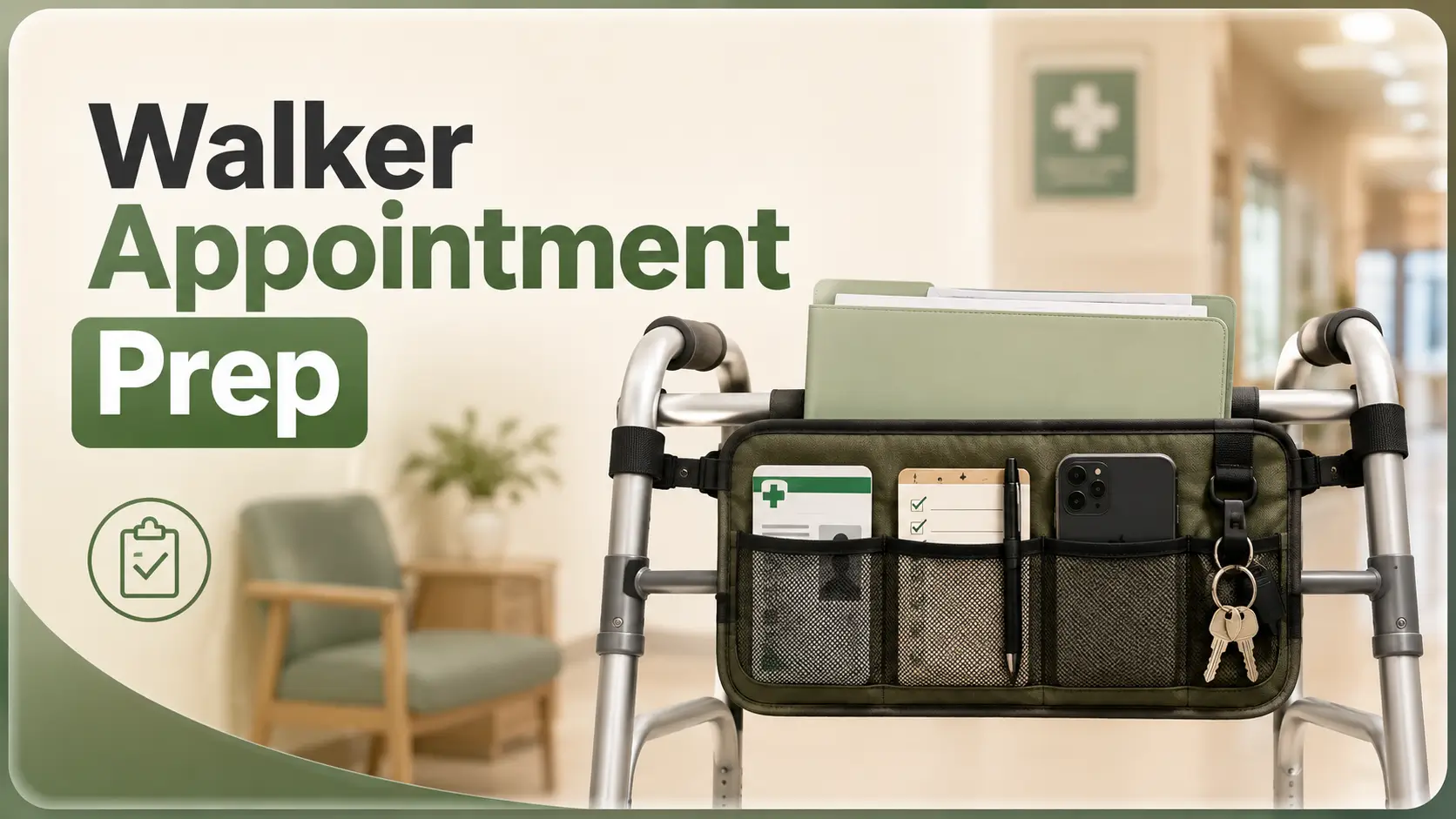
Walker appointment prep
What to Bring When You Use a Walker to an Appointment
A calmer, safer packing plan
Using a walker changes the whole texture of an appointment day. A folder is no longer “just a folder.” A purse is no longer “just a purse.” The small things that used to ride along without much thought can suddenly tug, swing, slide, or sit just out of reach when your name is called.
This guide is built for real appointment mornings: the half-zipped coat, the insurance card that moved pockets, the parking lot that feels longer than it looked online, the waiting room chair that seems designed by a committee of elbows. The goal is not to pack more. It is to pack smarter, lighter, and closer to your hands.
Whether you are using a walker yourself or helping a parent, spouse, neighbor, or rehab patient get ready, you will find a practical one-folder, one-bag system for documents, medication details, comfort items, safety gear, and the call-ahead questions that can prevent lobby-side chaos.
Pack without overloading
Choose items that help without turning the walker into a rolling coat rack.
Move through check-in faster
Keep ID, insurance, forms, and notes in one reachable system.
Reduce surprise stress
Plan for parking, doors, elevators, waiting rooms, and bathroom timing.
The best appointment bag is not the biggest one. It is the one that keeps both hands free when the day gets wobbly. 🧭
Snapshot
This article is for walker users, caregivers, adult children, rehab patients, and clinic visitors who want a safer appointment day. You will learn what to pack, what to leave home, how to organize documents, what to ask before arriving, and how to build a reusable appointment kit in about 15 minutes.
Table of Contents
Before You Act: Safety Notes for Walker Appointment Prep
This article can help you organize what to bring when you use a walker to an appointment. It cannot tell you whether your walker is the right height, whether a symptom is urgent, or whether you are safe to walk a certain distance that day.
If your walker feels unstable, your balance has recently changed, you have fallen, or you have new weakness, dizziness, chest pain, severe shortness of breath, sudden confusion, or intense pain, do not treat packing as the main problem. Call your clinician, use urgent care or emergency services when appropriate, and ask for direct medical guidance.
For routine appointments, though, a good packing system can lower the number of tiny hazards between your front door and the exam room. Think of it as appointment friction control: fewer loose papers, fewer swinging bags, fewer “where did I put that?” moments.
Key takeaway
Use this guide for routine appointment preparation. For new, worsening, or urgent symptoms, contact a qualified medical professional rather than relying on a checklist.
For broader fall-prevention basics, official health resources can be useful background reading. The most important step, however, is simple: match the plan to the person in front of you. A confident walker user going to a dental cleaning needs a different setup from someone leaving rehab after a new injury.
Start With the Hands-Free Rule Before You Pack
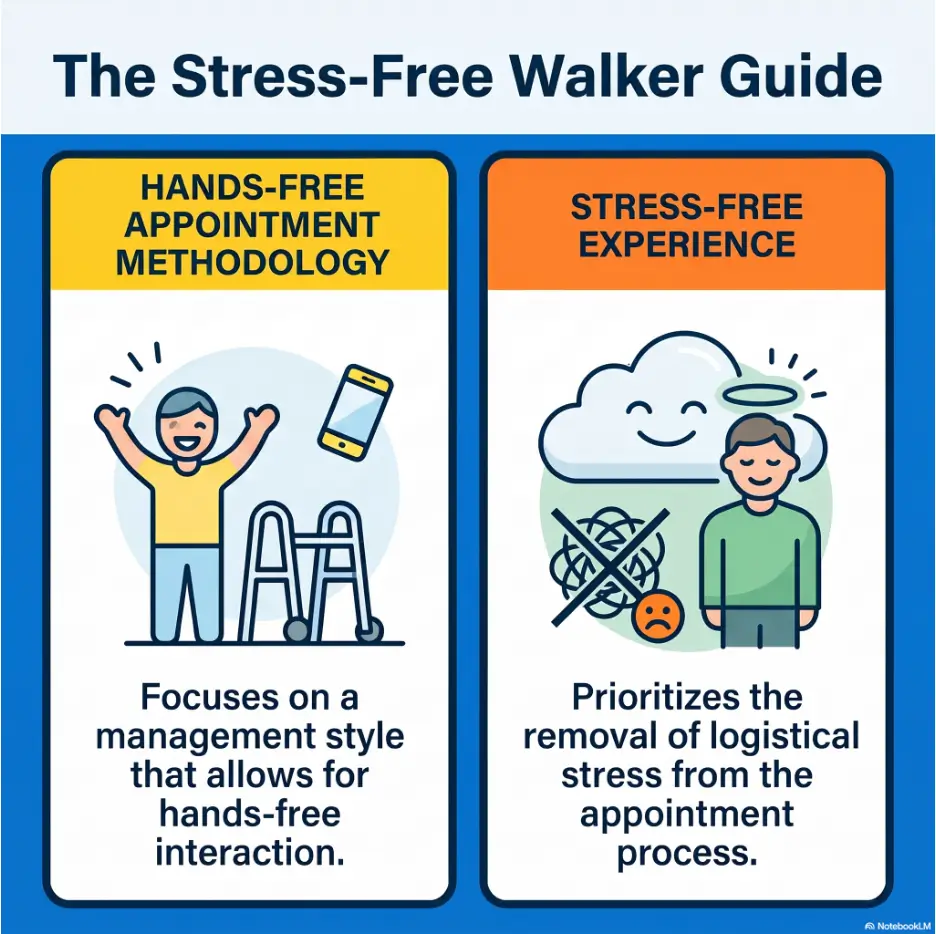
The first rule is beautifully plain: when you are moving with a walker, your hands should be available for the walker. Not for clutching papers. Not for balancing a purse. Not for rescuing a slipping water bottle that has developed theatrical ambitions.
That is why appointment packing starts with the container, not the contents. A good bag system keeps items secure, close, and easy to reach without pulling the walker to one side.
Why a walker changes what counts as “easy to carry”
Before using a walker, “easy to carry” may have meant a tote over one shoulder or a purse in the crook of an arm. With a walker, easy means something more specific: no swinging, no dragging, no reaching down, no shifting weight while standing.
The safest item is not always the smallest item. A tiny clutch that must be held in one hand may be worse than a slightly larger pouch attached securely to the walker frame.
The best bag is the one that does not swing, drag, or slip
Look for a walker pouch, basket, or organizer that attaches firmly and keeps weight centered. It should not hang from only one handle. It should not scrape the floor. It should not force the user to bend low to retrieve check-in papers.
For a budget-conscious setup, a basic walker pouch may be enough. For someone attending frequent medical, therapy, or government appointments, a more structured organizer with separate pockets can be worth comparing. The best option is the one that makes the important items reachable without turning the walker into a luggage cart.
Here’s what no one tells you: a full tote can become a fall risk
A heavy tote can pull the body sideways. A purse on one handle can make the walker feel uneven. A loose bag can catch on doors, chairs, elevator edges, or another person’s foot. The appointment has not even started, and the plot has already thickened.
Use this simple test before leaving: place the bag where it will ride, then lift and move the walker a few steps indoors. If the bag swings, shifts, or changes the feel of the walker, lighten it or move it.
| Carry choice | Why it may help | What to watch |
|---|---|---|
| Walker pouch | Keeps documents and small items close | Can become cluttered if not sorted |
| Walker basket | Useful for bulkier light items | Loose items may bounce or shift |
| Crossbody bag | May keep weight close to the body | Can interfere with sitting, transfers, or balance |
| Heavy purse on handle | Familiar and convenient | Often pulls unevenly and may affect walker control |
Appointment Papers You Should Not Leave on the Kitchen Table
Paperwork is the quiet villain of appointment mornings. It hides in mail piles, jacket pockets, glove compartments, and the one folder that “was right there yesterday.” A walker user does not need a lobby scavenger hunt.
The fix is a single appointment folder. Not three envelopes. Not a hopeful stack of loose pages. One folder, clearly labeled, that always goes in the same pocket of the walker bag.
Photo ID, insurance cards, referral forms, and copay method
For most medical, dental, therapy, legal, or government appointments, start with the basics: photo ID, insurance card if relevant, appointment confirmation, referral or authorization form if required, and a payment method for copays or fees.
If the visit is at a new clinic, bring any intake forms the office sent ahead of time. If the appointment involves imaging, therapy, surgery follow-up, disability paperwork, or a second opinion, bring related reports or notes the office specifically requested.
Medication list, allergy list, pharmacy name, and recent changes
A medication list is one of the highest-value items in the folder. Include prescription medications, over-the-counter medicines, supplements, eye drops, creams, inhalers, patches, and anything taken only as needed.
Add allergies, medication reactions, pharmacy name, pharmacy phone number, and recent changes. If a medication was stopped, changed, skipped, or started recently, write that down. “I think it was the small white one” is a very human sentence, but not a very useful medical record.
Print, screenshot, or both? The backup that saves check-in time
Digital confirmations are helpful until Wi-Fi sulks, the patient portal logs out, or the phone battery performs its tiny farewell opera. For important appointment details, use both a printed copy and a screenshot.
The screenshot should show the appointment date, time, address, provider name, and any special instructions. The printed version belongs in the front of the folder so it can be handed over without rummaging.
One-folder appointment checklist
- Photo ID
- Insurance card or benefit card, if used
- Appointment confirmation
- Referral, authorization, or intake forms
- Medication and allergy list
- Pharmacy name and phone number
- Questions for the provider
- Recent symptom notes, pain log, or caregiver observations
If you are building a broader appointment routine, you may also find it useful to review a related orthopedic appointment checklist or a spine doctor visit checklist when the visit involves joint, back, or mobility concerns.
Walker Setup Items That Make the Trip Less Awkward
The walker itself deserves a pre-appointment check. Not a full mechanical inspection with dramatic music. Just a calm look at the parts that touch the floor, carry items, and help the user move through public spaces.
Walker pouch, basket, cup holder, or clip-on organizer
A walker pouch is often the best starting point for appointment days because it can hold a folder, phone, tissues, and small comfort items without requiring hand-carrying. A basket can work well for light items, but papers may need a folder or envelope so they do not bend or scatter.
A cup holder may be useful if the user needs water nearby, especially during long therapy visits or government appointments. Check that the cup holder does not widen the walker too much or catch on door frames.
Tennis balls, glide skis, rubber tips, and when to check wear
Before leaving, look at the walker tips, glides, skis, or tennis balls. Worn rubber tips can reduce grip. Uneven wear can make the walker feel less steady. A missing or loose glide can turn a normal hallway into a tiny obstacle course.
If anything looks cracked, loose, uneven, or badly worn, ask a clinician, physical therapist, durable medical equipment provider, or pharmacist who handles mobility supplies what replacement part is appropriate for that walker model.
Don’t do this: hanging a heavy purse from one handle
Hanging a heavy purse from one handle is one of those small choices that feels harmless until it is not. The weight can pull the walker sideways, shift during turns, or make the user compensate without noticing.
If a purse must come along, remove what is not needed, place essentials in the walker pouch, or have a companion carry the purse. A walker should support movement, not negotiate with a handbag.
| Setup level | Best for | What to compare before buying |
|---|---|---|
| Good | Occasional appointments | Basic pouch, light folder, phone pocket |
| Better | Frequent clinic or therapy visits | Structured organizer, secure fasteners, easy-reach pockets |
| Best | Long visits or caregiver-supported care | Organizer plus emergency card, water holder, clear document zone, replacement tips ready at home |

Comfort Items for Waiting Rooms That Run on “Almost Ready” Time
Every waiting room has its own weather system. One corner is chilly, one chair is too low, someone is watching a game show at heroic volume, and the appointment that was “almost ready” now appears to be simmering gently in another dimension.
Comfort items matter, but they need to earn their place. The goal is to bring what prevents discomfort or confusion without creating a heavy, disorganized bag.
Water, light snack, sweater, and pain-safe seating needs
Bring water if it is allowed and appropriate for the appointment. A light snack can help during long waits, but check restrictions if fasting, lab work, sedation, dental work, or a procedure is involved.
A light sweater or wrap can be useful because medical offices often run cool. If sitting is painful, bring a small cushion only if it is light, easy to carry, and safe to use. For bulky comfort items, call ahead and ask whether the office can provide a higher chair, exam room seating, or wheelchair backup.
Glasses, hearing aids, dentures, brace, compression socks, or cane backup
Bring the devices that help the appointment actually work: glasses for reading forms, hearing aids for instructions, dentures if they affect speech or comfort, braces or supports used during walking, and any backup device your clinician has recommended.
If a cane is sometimes used with the walker, ask a physical therapist or clinician whether bringing it as a backup makes sense. Do not improvise with mobility devices in a busy lobby unless a professional has already told you how to switch safely.
Let’s be honest: “just a quick appointment” often is not quick
Plan for the appointment to take longer than expected. That does not mean packing for a weekend in the mountains. It means having the small items that prevent discomfort from becoming the loudest voice in the room.
For someone with pain flares, fatigue, bladder urgency, hearing trouble, or medication timing needs, a small comfort kit can be the difference between a useful visit and a visit spent simply enduring the wait.
Key takeaway
Comfort items should reduce strain, not add weight. Choose the few things that protect communication, pain control, hydration, temperature, and dignity.
Who This Is For, And Who Should Use a Different Checklist
A walker appointment checklist is most useful when the visit is planned and the person is medically stable. It helps turn an awkward trip into a predictable routine.
It is not the right tool for every situation. Some symptoms need medical triage, not better bag organization.
Good fit: routine doctor, dentist, therapy, lab, DMV, or legal visits
This checklist fits routine primary care visits, orthopedic appointments, dental cleanings, physical therapy sessions, lab appointments, government office visits, DMV appointments, and legal or benefits meetings where documents matter.
For these visits, preparation can prevent delays and reduce the amount of standing, reaching, and repeated walking required.
Good fit: caregivers helping someone pack without overpacking
Caregivers often pack from love. That is sweet. It can also produce a bag heavy enough to qualify for its own zip code.
This guide helps caregivers separate essentials from emotional extras. The best caregiver packing system supports independence while still covering paperwork, safety, comfort, and backup needs.
Not enough: urgent symptoms, new weakness, severe pain, or recent falls
Use a different plan if the person has fallen recently, suddenly cannot walk as usual, has new weakness, severe pain, trouble breathing, chest symptoms, confusion, fever with serious illness signs, or symptoms that feel urgent.
In those cases, call the clinic for guidance, use urgent care, or seek emergency help when appropriate. The folder can wait. The person cannot.
The Caregiver Add-On: Bring Help Without Taking Over
A good caregiver is not a rolling file cabinet with opinions. A good caregiver is a bridge: organized enough to help, respectful enough to let the walker user remain the main character of the appointment.
The caregiver add-on is small: notes, permissions, backup documents, and a clear agreement about who will speak when.
Questions list, symptom notes, and the patient’s own priorities
Before the appointment, ask the walker user what they most want answered. Write those questions at the top of the note page. Then add caregiver observations below, such as changes in walking distance, fatigue, pain timing, medication confusion, bathroom urgency, or difficulty getting in and out of chairs.
A good format is simple: “What changed, when it started, what makes it better or worse, and what we need help deciding.” That structure keeps the conversation useful without turning the exam room into a courtroom.
Permission forms, HIPAA release, power of attorney, or care documents
If the caregiver needs to discuss care, billing, records, or scheduling, bring any permission forms the office requires. For medical offices in the United States, this may include a HIPAA release or patient authorization. For legal or financial matters, it may include power of attorney or other documents.
Do not assume staff can share information just because you drove the person there. Privacy rules and office policies can limit what staff can discuss without proper permission.
The quiet win: let the walker user control what they can
Ask before taking over. Offer the folder, but let the person hand over their ID if they want to. Help with doors, but do not steer the walker unless asked or unless there is an immediate safety issue.
Independence often lives in small gestures. The appointment is not only about getting through the door. It is also about preserving choice, pace, and dignity.
Short Story: The folder that saved the morning
Marion’s daughter used to pack for appointments like she was preparing a tiny expedition. Snacks, extra socks, three pens, a novel, old test results, two water bottles, and a purse that dragged against the walker basket.
At one orthopedic visit, the insurance card slipped behind a loose envelope. Marion stood at the counter, tired from the parking lot, while her daughter searched every pocket. Nobody was unkind. Still, the moment felt bigger than it needed to.
The next time, they tried one folder and one walker pouch. ID in front. Insurance behind it. Medication list clipped to the left. Questions on a bright sticky note.
Check-in took less than a minute. Marion handed over the folder herself. That was the real victory: not speed, but control returned to the person who needed it most.
Common Mistakes That Turn a Simple Visit Into a Stress Parade
Most appointment problems do not come from one dramatic failure. They come from four or five tiny choices stacked together: loose papers, a low pocket, a bad entrance, a full bladder, and a purse that swings like a pendulum with opinions.
Here are the mistakes worth preventing before the car leaves the driveway.
Mistake 1: carrying loose papers instead of one folder
Loose papers are hard to manage while standing with a walker. They slide, bend, fall, and disappear into bags. A folder keeps the appointment day from turning into a paperwork confetti machine.
Mistake 2: packing items too low to reach safely
If the person must bend, twist, or squat to reach the phone, wallet, or medication list, the packing system is working against them. Put check-in items in a top or front pocket.
Mistake 3: assuming the building has easy walker access
Accessible on paper does not always mean easy in practice. The closest entrance may have a heavy door. The ramp may be on the side of the building. The office may be down a long hallway with thick carpet.
Call ahead when the distance matters. Ask which entrance is easiest for a walker, where accessible parking is located, and whether staff can help with doors or a wheelchair if walking farther than expected becomes difficult.
Mistake 4: forgetting bathroom timing, parking distance, and elevators
Bathroom timing is not a small detail for many older adults, post-surgery patients, or people taking certain medications. Build in time. Know whether the office has a restroom before check-in or only after entering the clinical area.
Parking distance and elevators matter too. A “short walk” for one person may be a major energy expense for another. The best appointment plan protects both safety and stamina.
| Common mistake | Safer alternative | Why it helps |
|---|---|---|
| Loose papers in hand | One labeled folder | Reduces standing and searching at check-in |
| Heavy purse on walker handle | Light pouch attached evenly | Helps avoid uneven pull |
| Phone buried at bottom | Top pocket phone zone | Makes calls and emergency access easier |
| No building access plan | Call ahead for entrance and parking | Reduces unnecessary walking |
| Overpacked comfort items | One small comfort kit | Keeps weight manageable |
Call Ahead Questions That Prevent Lobby-Side Chaos
A two-minute phone call can save fifteen minutes of standing, circling, and polite frustration. This is especially true for new offices, large medical campuses, dental clinics in older buildings, government offices, and legal buildings with security checkpoints.
Is there accessible parking near the entrance?
Ask where the closest accessible parking is and whether it is near the correct entrance. In large buildings, the “main entrance” may not be the easiest walker entrance.
If walking distance is limited, ask whether drop-off is allowed near the door. If a caregiver is driving, plan where the walker user can wait safely while the car is parked.
Is the appointment room walker-friendly?
Some exam rooms, dental rooms, therapy spaces, and legal offices are tight. Ask whether there is enough room for the walker, whether the patient will need to transfer to a chair or exam table, and whether staff can allow extra time.
Can staff help with doors, forms, or wheelchair backup?
Ask what help is available before assuming. Some offices can provide a wheelchair from the entrance. Others cannot. Some can help with forms at check-in. Others may ask you to complete everything online first.
If the person has hand pain, vision trouble, fatigue, or confusion with forms, ask whether paperwork can be completed at home or with staff assistance.
Ask this early: which entrance should I use?
This may be the most useful question of the whole call. Ask, “Which entrance is easiest for someone using a walker?” Then ask where to park for that entrance.
For public buildings, it may also help to review accessibility rights and general accommodation information from official sources, especially when access barriers are repeated or significant.
The safer appointment flow
1. Call
Confirm entrance, parking, doors, forms, and wheelchair backup.
2. Folder
Place ID, insurance, medication list, and questions together.
3. Walker
Check tips, pouch, brakes if using a rollator, and loose parts.
4. Top pocket
Keep phone, wallet, keys, and emergency card reachable.
5. Lighten
Remove extras that add weight without helping the visit.
The Small Safety Kit That Belongs in the Walker Bag
A safety kit should be small enough to stay in the walker bag all the time. It is not a medicine cabinet. It is a practical backup for common appointment-day annoyances and urgent information needs.
Phone, charger, emergency contact card, and medical alert details
Keep the phone charged and reachable. Add a compact charger or power bank if the person attends long appointments or relies on the phone for transportation, patient portals, rideshare, caregiver communication, or emergency calls.
An emergency contact card should include name, emergency contact, major allergies, important medical conditions if the person chooses to list them, primary clinician, preferred pharmacy, and medical alert details. Keep it easy to find.
Tissues, sanitizer, mask, bandages, and spare incontinence supplies if needed
Small hygiene items can prevent small problems from becoming large distractions. Tissues, hand sanitizer, a mask, a couple of adhesive bandages, and personal supplies such as spare incontinence products can be useful.
Keep these items in a separate pouch so they do not bury the appointment folder. The safety kit should be useful, not a drawer with straps.
Do not bury the emergency card under ten unrelated items
The emergency card should be in a top pocket or clearly marked section. If a caregiver, staff member, or first responder needs it, they should not have to excavate through receipts, peppermints, old appointment cards, and three mystery pens.
Small safety kit checklist
- Charged phone
- Small charger or power bank
- Emergency contact card
- Medical alert bracelet or card details, if used
- Tissues and sanitizer
- Mask, if wanted or required
- Small personal care supplies
- One or two adhesive bandages
Packing Light Without Forgetting the Important Stuff
The best packing system is boring in the most glorious way. Same pocket. Same folder. Same emergency card location. Same pre-door checklist. Boring is excellent when balance, paperwork, and appointment stress are all trying to play percussion at once.
Use a three-zone system: top pocket, middle pocket, and leave-at-home pile.
The “top pocket” system for check-in items
The top pocket is for anything needed in the first ten minutes: phone, keys, wallet, ID, insurance card, appointment confirmation, and emergency contact card.
If the folder is too large for the top pocket, place it in the easiest front-facing section of the walker bag. The key is consistency. Do not move it around every visit.
The “middle pocket” system for comfort and health items
The middle pocket is for items that matter after check-in: glasses case, hearing aid batteries, light snack if allowed, tissues, sanitizer, sweater, pain log, brace, or small personal care supplies.
Group similar items in small pouches. One pouch for documents, one for hygiene, one for device accessories. This keeps the bag from becoming a velvet cave of lost things.
The “leave at home” pile: nice-to-have items that add weight
Leave behind anything that is unlikely to help the appointment: full-size books, heavy water bottles, old paperwork, duplicate snacks, large cosmetic bags, bulky blankets, extra shoes unless specifically needed, and every loyalty card known to civilization.
For appointment days, light is not less caring. Light is often more caring because it protects movement.
Key takeaway
A walker bag should be organized by reach, not category alone. Put first-needed items where they can be reached without bending, twisting, or unloading the whole bag.
Show me the nerdy details
The best walker appointment kit reduces four kinds of friction: physical, cognitive, administrative, and environmental.
- Physical friction means the bag should not add uneven weight, require hand-carrying, or force unsafe bending.
- Cognitive friction means the user should not have to remember where every item is stored under stress.
- Administrative friction means check-in documents should be grouped and easy to hand over.
- Environmental friction means the plan should account for parking, doors, elevators, bathrooms, chairs, and long hallways.
This is why a cheap pouch can outperform a fancy bag if it is lighter, simpler, and easier to use. The right purchase is not the most feature-heavy organizer. It is the organizer that reduces the most friction for that specific person.
| Option | When it is enough | When to consider upgrading |
|---|---|---|
| Free checklist and folder | Rare appointments, caregiver present, low paperwork needs | Items keep getting lost or carried by hand |
| Low-cost walker pouch | Routine visits with basic documents and phone | Pockets are too deep, flimsy, or hard to reach |
| Structured walker organizer | Frequent appointments, multiple documents, caregiver notes | Weight or width interferes with movement |
| Professional mobility review | Walker feels unstable, access is hard, recent falls or new concerns | Always worth asking when safety is uncertain |
For home and parking-lot movement, related preparation may help too. Review parking lot safety with a walker and walker path safety if the trip from home to the appointment has become the hardest part.

FAQ: Walker Appointment Prep Questions
What should I carry in a walker bag for a doctor appointment?
Carry photo ID, insurance card, appointment confirmation, medication list, allergy list, phone, keys, wallet, emergency contact card, tissues, sanitizer, glasses or hearing aid supplies, and any forms the office requested. Keep the bag light and place check-in items in the easiest pocket to reach.
Is it safe to hang a purse on a walker?
A heavy purse on one walker handle can pull unevenly and may make the walker harder to control. A light, securely attached walker pouch or balanced organizer is usually a better option. If you are unsure, ask a physical therapist or clinician to review your setup.
What documents should seniors bring to medical appointments?
Common documents include photo ID, insurance card, medication and allergy list, appointment confirmation, referral or authorization forms, recent test results if requested, pharmacy details, and a short list of questions. For caregiver involvement, bring any required permission or authorization forms.
Should I bring my medication bottles or just a medication list?
For many routine appointments, a clear medication list is enough. Some clinics may ask for actual medication bottles, especially for medication reviews, confusion about doses, or complex regimens. Call ahead and ask what the office prefers.
How can I make a walker easier to use in a waiting room?
Keep bags light, avoid hanging weight on one handle, choose a seat with enough room to park the walker safely, and ask staff for help if the waiting area is crowded. Place important items in a front or top pocket before sitting down.
What should a caregiver bring to an appointment?
A caregiver should bring the patient’s questions, symptom notes, medication changes, permission forms if needed, a pen, and any documents the office requested. The caregiver should also ask the walker user what they want help saying before the visit begins.
Can a clinic help if I cannot walk far from the parking lot?
Some clinics can help with wheelchair access, closer entrances, staff assistance, or drop-off guidance. Call before the appointment and ask what support is available. Do not assume every office has the same setup.
What should I do if my walker feels unstable before leaving?
Do not ignore it. Check for loose parts, worn tips, uneven glides, or a bag pulling the walker to one side. If the walker still feels unstable, contact a clinician, physical therapist, equipment provider, or the appointment office for guidance before trying to manage a difficult trip.
Next Step: Build a One-Folder, One-Bag Appointment Kit Today
You do not need a perfect system. You need a repeatable one. The next appointment morning should not depend on memory, luck, or the mysterious migration habits of insurance cards.
Set a timer for 15 minutes. Find one folder and one walker-safe bag or pouch. Put ID, insurance, medication list, appointment notes, emergency contact card, and a pen together. Choose one pocket where that folder will live every time.
Then do the final doorway check: phone, keys, wallet, walker tips, appointment address, bathroom timing, and the correct entrance. That is the quiet promise of good preparation. The trip may still be tiring, but it does not have to be chaotic.
Your 15-minute appointment kit
- Place ID, insurance, and appointment confirmation in one folder.
- Add a current medication and allergy list.
- Write three questions for the appointment.
- Put phone, keys, wallet, and emergency card in the top pocket.
- Remove anything heavy that does not help the visit.
- Check walker tips, glides, pouch, and the appointment address before leaving.
Last reviewed: 2026-07