
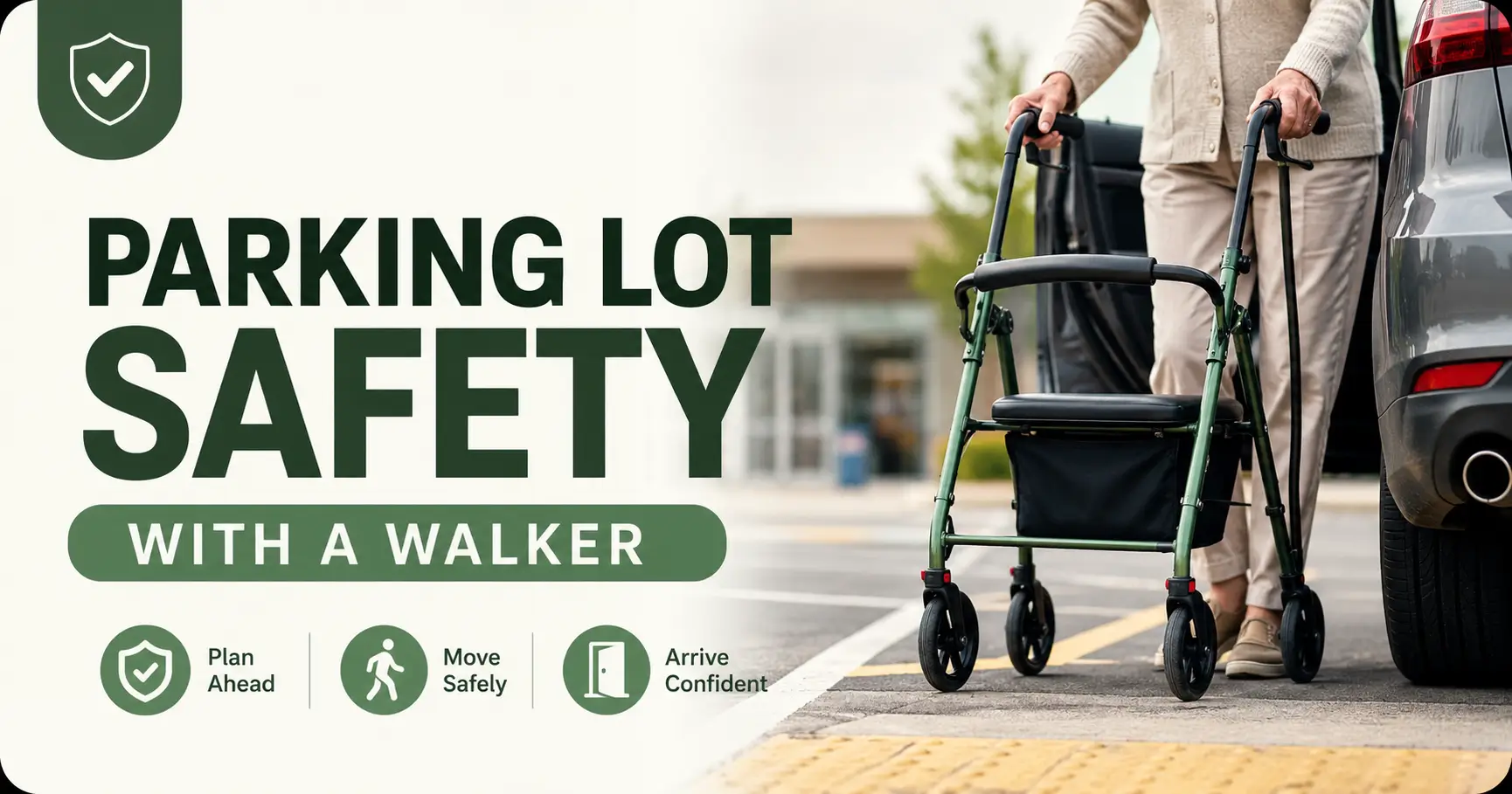
Navigating the First Eight Feet
The riskiest part of a shopping trip may not be the store aisle, the checkout line, or the heavy gallon of milk waiting at the bottom of the cart. It may be the first eight feet after the car door opens.
Parking lot safety with a walker begins before anyone stands up, because curbs, slopes, wet paint, access aisles, glare, and reversing cars can turn ordinary pavement into a small obstacle course with exhaust fumes. For older adults, caregivers, rehab patients, and family members, the problem is not simply “walking carefully.” The real problem is managing a fast-changing outdoor space while using a mobility device that needs stable ground, enough room, and unhurried hands.
“A fall can change the week. A near-fall can change confidence.”
So let’s make the trip smaller. Safer. More repeatable.
This guide gives you a practical, car-door-to-store-door routine grounded in fall-prevention thinking, walker setup basics, and real parking lot geometry. The goal is not perfection. The goal is fewer surprises under the walker and fewer rushed decisions near moving vehicles.
Fast Answer: The Safer Parking Lot Routine
Parking lot safety with a walker means choosing a flat, clear parking space; setting the walker before standing; keeping both hands on the grips; avoiding blocked access aisles, wet paint, curbs, slopes, and traffic blind spots; and pausing before each transition. Treat every parking lot as a short mobility route, not empty pavement.
- Before standing: check the door zone, feet, walker position, bags, and traffic.
- Before walking: choose the safest route, not just the shortest line.
- Before entering: pause at mats, doors, carts, puddles, and crowd bottlenecks.
Table of Contents
Safety Disclaimer: When Parking Lot Help Should Become Medical Help
This article is for general safety education. It is not medical, physical therapy, occupational therapy, legal, or ADA compliance advice. A walker can support safer movement, but it cannot diagnose dizziness, weakness, vision changes, medication side effects, blood pressure issues, or pain that changes how someone walks.
If a person has fallen recently, nearly fallen more than once, started avoiding errands because of fear, or feels newly unsteady, that is not a character flaw. It is useful information. Share it with a healthcare professional, physical therapist, or occupational therapist.
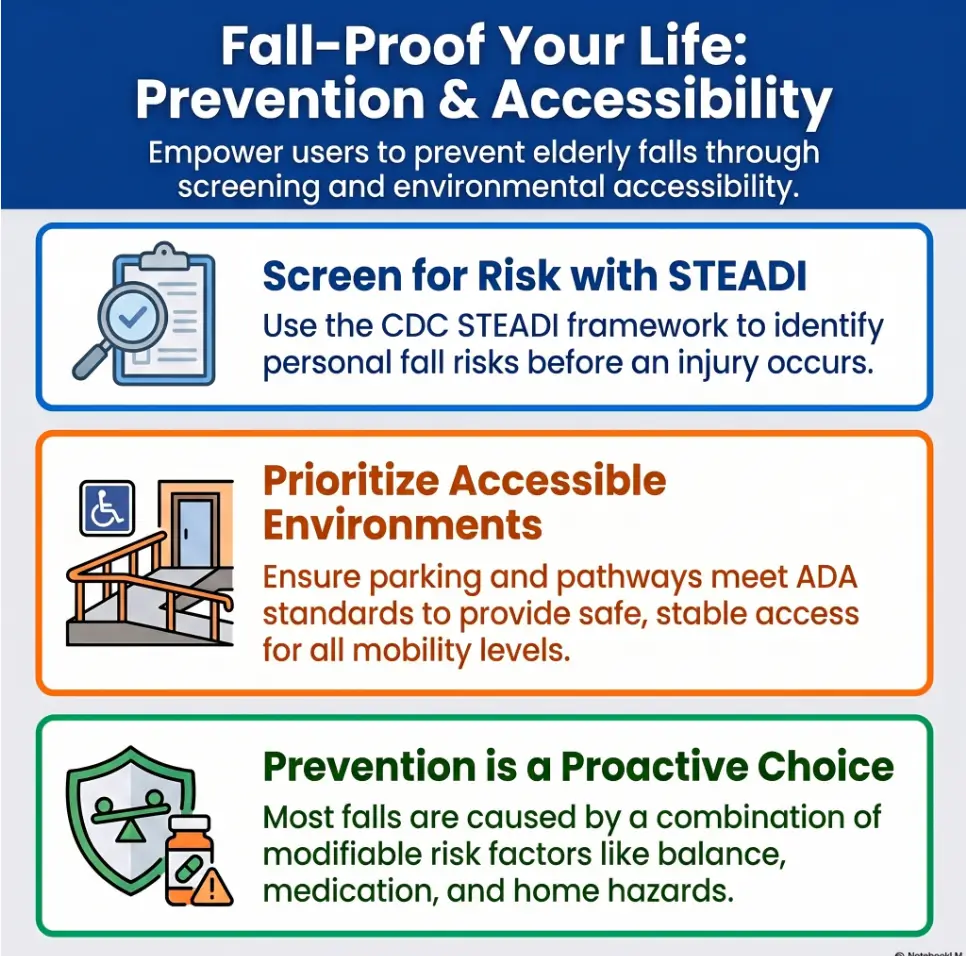
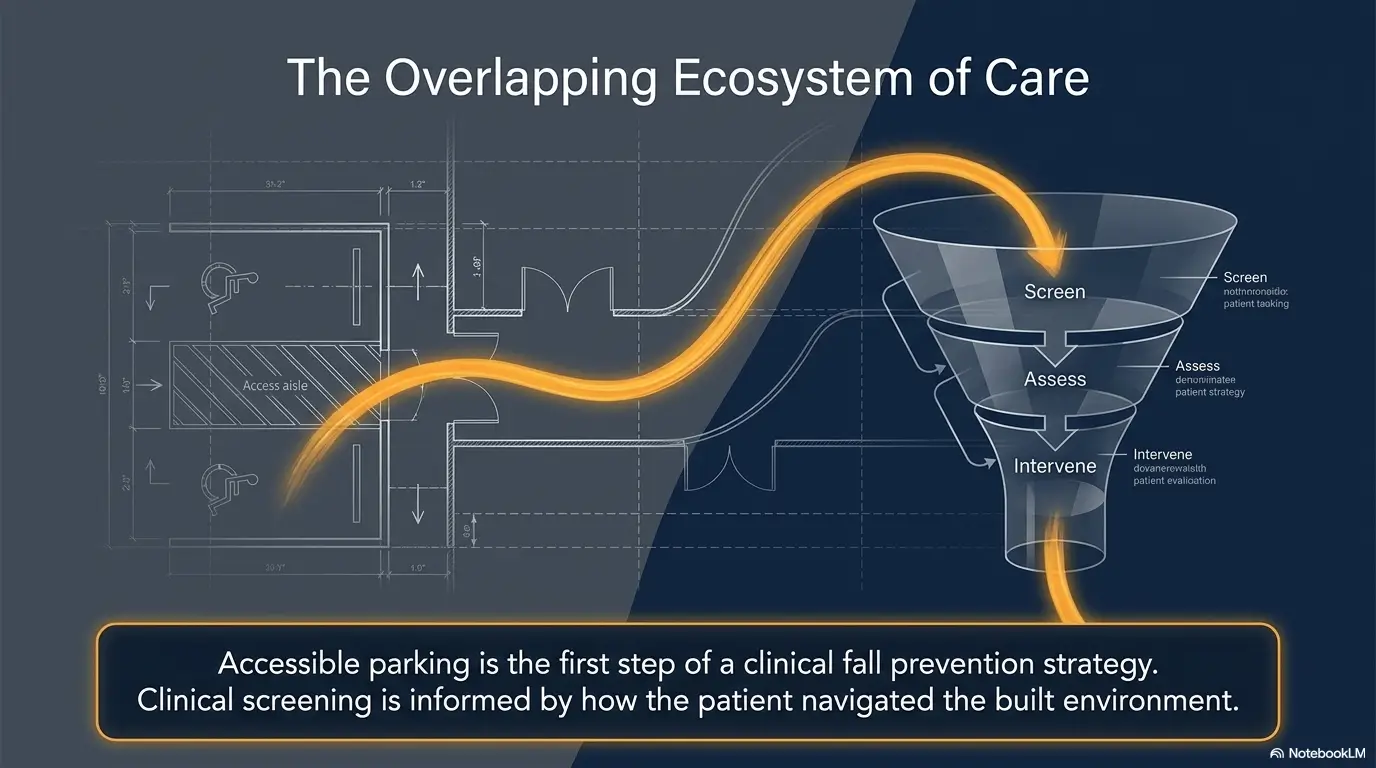
The CDC has long emphasized that older adult falls can often be prevented through risk screening, strength and balance work, medication review, vision care, and safer environments. Parking lots belong in that conversation because they combine surfaces, traffic, lighting, weather, and time pressure in one public place.
- Write down what happened, where it happened, and what surface was involved.
- Note symptoms such as dizziness, pain, weakness, confusion, or shortness of breath.
- Bring the details to a clinician instead of relying on memory after the adrenaline fades.
Apply in 60 seconds: Add one phone note called “Mobility changes” and record any fall, near-fall, or scary parking lot moment.
Who This Is For, And Who Should Not Wing It
For walker users who feel fine indoors but tense up outside
Indoor walking can be wonderfully predictable. The hallway is flat. The carpet is known. The chair is where it was yesterday. A parking lot is different. It has slope, glare, moving vehicles, cart corrals, puddles, cracks, curbs, strangers, and one shopping cart with a wheel that sounds like a haunted violin.
That tension makes sense. A walker needs steady ground and enough space. Outdoors, the ground keeps negotiating.
If someone moves well at home but freezes near the car door, the problem may be the environment, not their courage. This is especially common after surgery, during rehab, after a flare of knee or hip pain, or when someone is transitioning from a cane to a walker.
For people recovering from joint procedures, planning the car-to-door route matters as much as planning the ride itself. If your recovery also involves commuting or longer rides, the guide on commuting after knee replacement can help connect parking lot safety with the rest of the trip.
For caregivers who want to help without hovering
Good caregiver help is not a marching band. It is a quiet backup singer.
The safest support usually means staying close enough to notice traffic and surface changes, while giving the walker user room to control the device. Grabbing the walker, pulling an arm, rushing the pace, or talking in alarm-bell sentences can make balance worse.
Respect matters. A person using a walker is not luggage with opinions. Ask first. Offer specific information. Let them move at the pace their body can manage today.
Not for “just push through it” situations
There are times when grit is useful. Opening a jar. Learning a new phone update. Finding the end of a roll of tape.
But repeated near-falls, sudden weakness, new dizziness, fainting, chest pain, confusion, head impact, or a sudden inability to bear weight should not be treated as an errand problem. Those are reasons to stop and seek professional guidance.
Money Block: “Should I Do This Errand Today?” Safety Checklist
Use this yes/no check before leaving home. It is not a diagnosis. It is a decision filter.
| Question | If yes |
|---|---|
| Did you fall or nearly fall recently? | Consider help, delivery, or a clinician call. |
| Are you dizzy, unusually weak, confused, or short of breath? | Do not “test it” in a parking lot. |
| Is the weather icy, stormy, dark, or very windy? | Choose another time or bring support. |
| Are you carrying items that need both hands? | Use a pouch, basket, cart help, or caregiver support. |
Neutral action line: If two or more answers are yes, make the errand smaller, safer, or supported.
The Hidden Parking Lot Problem Most People Miss
Parking lots are not flat rooms with yellow lines
A parking lot looks simple from the windshield. It looks like painted order. Straight lines. Numbers. Arrows. Blue signs. A tidy little map.
But from walker height, a parking lot is closer to a mixed-terrain course. There are cross-slopes for drainage, curb ramps that tilt at odd angles, speed bumps, gravel, storm drains, shallow potholes, oil slicks, windblown leaves, and painted lines that may be slick when wet.
Add traffic and the brain has to do two jobs at once: walk safely and scan for cars. That dual tasking can be harder for anyone with pain, fatigue, vision changes, neuropathy, arthritis, or post-surgical precautions.
The walker makes small pavement problems bigger
A person walking without a device may barely notice a half-inch lip in the pavement. A walker may notice it with theatrical commitment.
One front wheel catches. One rubber tip drags. One side of the walker dips. The body reacts, the shoulders tense, the feet shuffle, and suddenly the whole rhythm is off. The issue may be tiny. The consequence is not tiny.
This is why “just be careful” is not enough. Careful needs a method.
Here’s what no one tells you…
A walker can make someone safer only when the environment supports it. The device is helpful, but the pavement still gets a vote.
That means safety is not only about the person using the walker. It is also about route choice, surface quality, traffic timing, door space, caregiver communication, and whether someone has been trained to use the device outside the living room.
The Car-Door-to-Store-Door Safety Path
Choose flat, clear, visible space.
Check cars, bags, feet, door swing.
Walker square, both feet stable.
Avoid slopes, curbs, blind traffic.
Move slowly through doors and mats.
Pause inside before shopping.
Choose the Space Before You Choose the Speed
Look for the shortest safe route, not just the closest spot
The closest parking space is not always the safest. A spot near the entrance may still require crossing behind parked cars, angling across a slope, navigating a curb, or squeezing past a cart corral that has become a metal porcupine.
A safer space usually has a calm route. Look for a clear path, good visibility, lower traffic, decent lighting, and a surface that does not tilt dramatically. If the “near” spot forces three awkward transitions, the slightly farther flat route may be better.
When pain is part of the story, route planning becomes energy planning. For older adults balancing orthopedic pain and daily errands, walker pain management for seniors can help frame how device use, pacing, and symptoms interact.
Accessible spaces matter because design matters
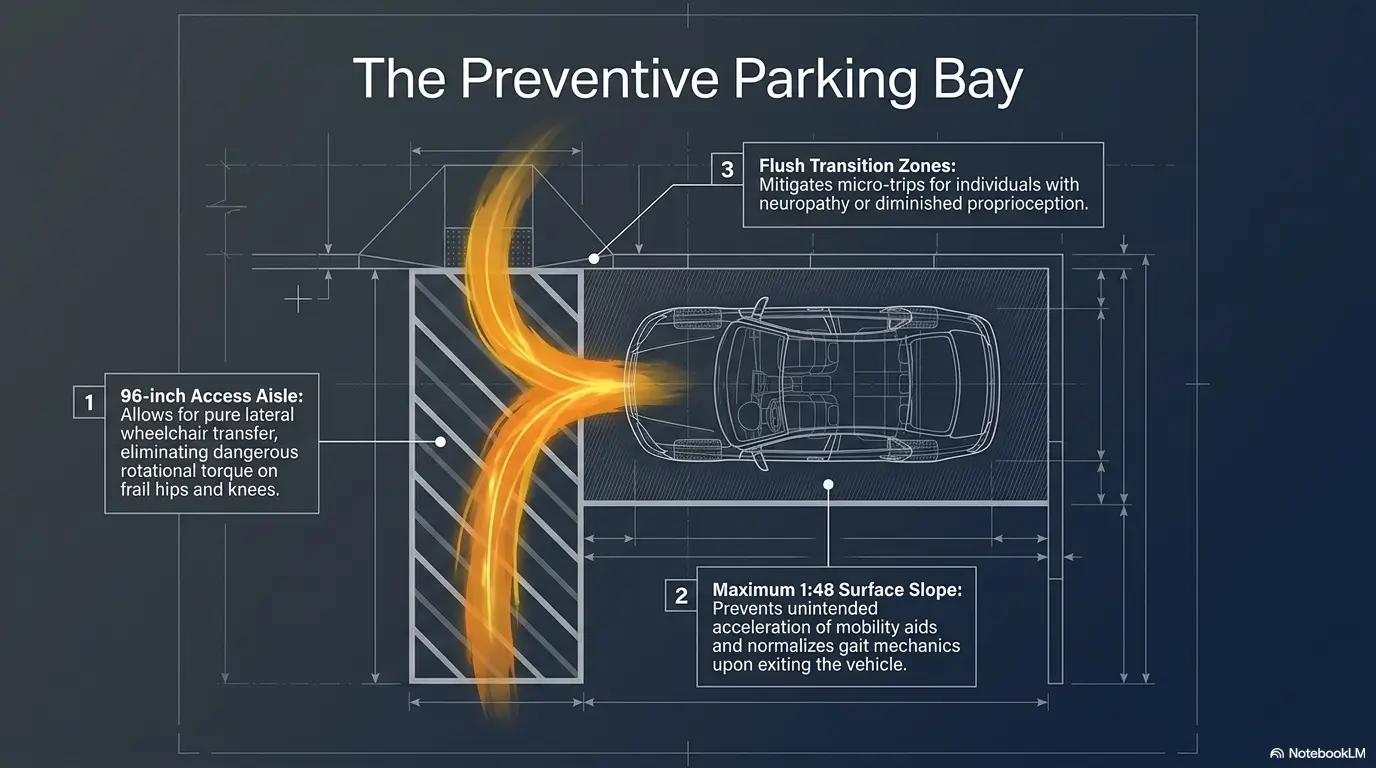
Accessible parking spaces are not just “closer spaces.” They are designed to provide room for safer transfers, access aisles, routes to entrances, and surface requirements. ADA guidance describes accessible parking features such as access aisles, signage, width, and relatively low slope because design affects whether people can actually use the space.
When eligible and available, accessible parking can make a real difference for a walker user. But the access aisle must be clear. If it is blocked by carts, a delivery vehicle, a scooter, or someone’s “I’ll only be a minute” parking performance, the design benefit disappears.
The best space has three quiet features
Look for flatness, clearance, and a direct route.
Flatness means the walker is not drifting downhill before the person even starts moving. Clearance means there is space to open the door, place feet, position the walker, and turn without twisting. Direct route means reaching the entrance without weaving behind cars or climbing a curb.
This is not overthinking. This is route design in miniature.
Money Block: Parking Space Decision Card
| Choose this | When it helps | Trade-off |
|---|---|---|
| Accessible space | Eligible, available, aisle clear, route direct | May still be blocked or crowded |
| Slightly farther flat space | Closest space has curb, slope, or traffic | More steps, but fewer hazards |
| Drop-off zone | Caregiver can park after helping transfer safely | Needs coordination and patience |
Neutral action line: Pick the route with fewer transitions, not the spot with the shortest distance on paper.
Don’t Start Walking Until the Car Door Zone Is Safe
The first three feet are the danger zone
The first three feet outside the car are busy. The door is open. The seat may be low. Feet must find pavement. The walker must be placed squarely. A purse, oxygen tubing, grocery list, phone, coat, or seatbelt may be involved. Meanwhile, someone in a large SUV may be reversing with the confidence of a sleepy rhinoceros.
Before standing, slow the scene down. Make sure the door can open wide enough. Keep both feet planted. Put bags where they will not swing. Position the walker in front, not off to the side. Avoid twisting from the seat while reaching.
If the bigger challenge is getting in or out of a taller vehicle after surgery, getting into an SUV after hip surgery offers related transfer ideas that may pair well with parking lot planning.
Don’t do this: standing before the walker is locked into place
A common risky sequence goes like this: open door halfway, stand quickly, reach for the walker, turn while stepping, tug a bag, and hope the body agrees with the schedule. That is not a plan. That is a tiny circus.
The walker should be stable before weight shifts forward. For a rollator, brakes should be used according to clinician instruction and the device manual. For a standard walker, all four points should be stable before the person rises.
Using the car door as the main support can be risky because doors move. Even when the door feels solid, it can swing, bounce, or shift if the car is on a slope.
The “pause, plant, then pivot” routine
Try this sequence:
- Pause: look for traffic, puddles, slope, door clearance, and bags.
- Plant: place both feet on the ground and position the walker squarely.
- Stand: rise slowly, using the support method recommended by a clinician.
- Pause again: check for dizziness before stepping.
- Pivot: turn in small steps, not a single twist.
That second pause is not dramatic. It is a quiet safety tax, and it is cheaper than a fall.
Short Story: The Three-Second Pause
Marian, 74, had a grocery store routine so familiar she could almost smell the bakery aisle before opening the car door. After knee surgery, she used a walker and felt embarrassed by how long it took to get from the driver’s seat to the entrance. One rainy Tuesday, she stood too quickly, reached for the walker with one hand, and felt it slide slightly on painted pavement.
Nothing terrible happened. Her daughter caught the moment with a soft, “Let’s pause.” They changed only one thing: Marian counted three slow breaths after standing before taking her first step. That tiny pause became her parking lot ritual. It gave her time to feel dizziness, check the walker, and let a reversing car pass. The lesson was not that Marian became fearless. It was better than that. She became repeatable.
- Set the walker before standing.
- Pause after standing to check dizziness and balance.
- Turn with small steps instead of twisting from the car seat.
Apply in 60 seconds: Practice “pause, plant, stand, pause, pivot” once at home before the next errand.
Curb Cuts, Slopes, And Access Aisles: The Small Geometry Of Safety
Curb cuts are helpful, but not magic
Curb cuts can make a route possible, but they are not automatically easy. A curb ramp may have a cross-slope, a puddle at the bottom, a rough transition, or people crowding near the entrance. The walker may roll faster downhill or feel uneven when one side hits the ramp before the other.
Approach curb ramps slowly and squarely when possible. Avoid coming at a diagonal if it makes one walker tip or wheel lift first. If a caregiver is present, this is a good moment for calm, specific words: “Ramp starts now,” or “Slight slope to your right.”
Access aisles are not loading zones
The striped aisle beside an accessible parking space is part of the usable space. It is not a cart nursery, scooter dock, delivery shortcut, or private loading zone for someone arranging seventeen shopping bags and one heroic watermelon.
For walker users, a blocked access aisle can force a narrow transfer, a curb crossing, or a path behind vehicles. If the aisle is blocked and there is no safe route, waiting or choosing another space may be wiser than squeezing through.
The slope test you can feel in your hands
Slopes often announce themselves through the walker before the eyes notice them. The device may drift downhill. One side may feel lighter. A rollator may need more brake control. A standard walker may feel awkward to place evenly.
Pay attention to those hand signals. They are surface information. If the walker wants to steer itself, the route deserves reconsideration.
Show me the nerdy details
Walkers increase the base of support, but they also require predictable contact with the ground. Outdoor surfaces introduce small changes in friction, slope, and height. A cross-slope can shift body weight sideways. Wet paint can reduce traction. A small vertical lip can interrupt forward momentum. When a person is also scanning for cars, carrying items, or managing pain, attention is split. That combination can make a technically small surface flaw feel large in real movement.
Common Mistakes That Turn Errands Into Fall Traps
Mistake 1: rushing because a car is waiting
Few things create pressure like a driver waiting with a turn signal blinking. But a parking lot is not a stage, and the walker user is not performing for traffic.
Traffic can wait. A fall changes the whole week.
If a car is waiting, pause somewhere safe rather than speeding up. A caregiver can use a calm hand signal to the driver or simply stand visible beside the walker user. No lecture needed. Just presence.
Mistake 2: carrying bags on walker handles
Hanging bags on walker handles can change steering, balance, and tipping risk. A swinging bag behaves like it has its own agenda. Add a slope and the walker may feel harder to control.
Use a walker basket, pouch, crossbody bag that does not interfere with movement, or caregiver help when appropriate. If the item is heavy, awkward, or fragile, it should not be making balance decisions.
For kitchen and home carryover, the article on how to carry a plate with a walker explains why hands-free planning matters beyond parking lots too.
Mistake 3: crossing behind parked cars
Backing cars are a major parking lot concern because drivers may have blind spots, distractions, tinted windows, quiet engines, or children in the back asking urgent philosophical questions about snacks.
Avoid walking directly behind parked cars when a safer walkway exists. Watch for reverse lights. Pause near vehicle rows. Make eye contact when possible, but do not rely on it. Some drivers are looking at mirrors. Some are looking at phones. Some are looking at the universe and losing.
Mistake 4: trusting painted lines more than pavement
Paint can guide direction, but it does not guarantee grip, smoothness, visibility, or low slope. Painted crosswalks may be slick when wet. Yellow lines can hide small cracks. Blue paint near accessible spaces may be smoother than surrounding pavement and more slippery in rain.
Use markings as clues, not promises.
Money Block: Mini Risk Score for a Parking Lot Route
Give each item 0, 1, or 2 points. Zero means low concern. Two means high concern.
Neutral action line: A higher score does not mean panic; it means choose more support and fewer transitions.
The Walker Setup Check Before Every Parking Lot Trip
Check height, grips, tips, wheels, and brakes
A walker that feels fine indoors may behave differently outdoors. Before a parking lot trip, check:
- Height: the walker should fit the user as instructed by a clinician or device professional.
- Grips: handles should not be loose, sticky, cracked, or slippery.
- Tips: rubber tips should not be worn flat, split, uneven, or missing.
- Wheels: wheels should turn smoothly and not wobble.
- Brakes: rollator brakes should engage reliably and release as expected.
- Attachments: baskets, pouches, trays, or bags should not swing into legs or change steering.
For people setting up recovery equipment at home too, orthopedic home care equipment planning can help connect walker use with the broader daily environment.
Don’t ignore worn rubber tips
Rubber tips are small, but they are the handshake between the walker and the ground. When they wear down, crack, or become uneven, the walker may slip or feel unstable, especially on wet pavement, painted lines, polished concrete, or sloped ramps.
Make tip checks part of the same routine as keys, wallet, and phone. The phone can summon help. The tips help prevent needing it.
Let’s be honest…
Most people check their phone battery more often than their walker tips. The phone will not catch them on a sloped curb ramp.
Walker maintenance does not need to become a garage project with dramatic lighting. It can be a 30-second glance before leaving home.
- Look at rubber tips before wet or outdoor trips.
- Test rollator brakes before standing from the car.
- Remove dangling items that can swing or catch.
Apply in 60 seconds: Put a small reminder near the car keys: “Tips, brakes, bags.”
Weather Changes Everything Under The Walker
Rain makes paint, metal plates, and leaves slippery
Rain changes the parking lot script. Crosswalk paint can become slick. Metal drainage grates can feel different under wheels or tips. Leaf piles hide edges. Oil spots shimmer. Polished concrete near entrances may turn into a skating invitation no one requested.
Move more slowly after rain, even if the pavement looks merely damp. Avoid stepping or placing walker tips directly on wet leaves, thick paint, or shiny patches when possible.
Winter adds hidden edges
Winter hazards are not only ice sheets. They include slush ridges, salt chunks, snow pushed into accessible spaces, curb shadows, and frozen puddles at the bottom of ramps.
Accessible spaces can become less accessible when snow removal leaves piles in access aisles or curb ramps. If the path looks uncertain, the safest move may be to wait, call the store, use curbside pickup, or bring support.
Bright sun can hide hazards too
Sun glare can make a curb disappear. Windshield reflections can wash out painted lines. Deep shadows can hide cracks, puddles, or uneven pavement.
Sunglasses, brimmed hats, and choosing a better-lit route can help, but sudden vision changes should be discussed with a clinician. If the person already has balance challenges, low contrast can make walking feel like trying to read fine print on a moving train.
Caregiver Help That Actually Helps
Walk beside, not in front
A caregiver walking in front may block the route or unintentionally set a faster pace. A better position is usually slightly beside and behind, close enough to notice changes but not so close that the walker user feels crowded.
The caregiver’s job is not to steer the person like a shopping cart. It is to watch the surface, traffic, doors, and timing while preserving the person’s control.
Ask before touching the walker
Touching a walker without warning can shift balance. Even a well-meant grab may surprise the person using it.
Use clear consent language: “Would you like me to hold the door?” “Do you want me on your left side?” “Would it help if I carried the bag?” These small questions protect dignity and safety at the same time.
Use calm traffic language
Vague warnings create noise. Specific warnings create useful information.
- Instead of “Watch out!” say, “Car backing up on your left.”
- Instead of “Be careful!” say, “Small curb ramp ahead.”
- Instead of “Hurry!” say, “Let’s pause and let that car pass.”
- Instead of grabbing the walker, say, “Do you want help with the bag?”
If pain communication is part of the caregiving picture, how to describe pain to a doctor can help families turn vague complaints into useful clinical details.
- Walk slightly beside and behind, not far ahead.
- Ask before touching the walker or the person.
- Name hazards clearly: car, curb, slope, puddle, mat.
Apply in 60 seconds: Choose one caregiver phrase now: “Let’s pause here and let the car pass.”
Safer Store Entrances Start Before The Automatic Door
The entrance bottleneck is real
Store entrances collect chaos. Carts gather. People stop suddenly. Mats wrinkle. Automatic doors hesitate. Dogs, strollers, baskets, delivery workers, wet floors, and seasonal displays crowd the space.
For a walker user, the entrance may be harder than the parking space because the route narrows and everyone’s speed changes at once.
Pause before the door. Let faster walkers pass. Look for carts, floor mats, puddles, and door timing. There is no prize for entering during the busiest three-second window.
Door mats deserve suspicion
Mats can reduce wet floors, but they can also curl, bunch, slide, or catch walker tips. Thick mats are especially worth noticing.
Approach mats squarely. Avoid dragging walker legs over a curled edge. If a mat is clearly unsafe, tell store staff. This is not complaining. This is hazard reporting in sensible shoes.
The reset spot
Once inside, pause. Re-center the walker. Breathe. Let the eyes adjust. Let the crowd move around. Decide whether to use a cart, ask for assistance, or continue with the walker.
This reset prevents one trip from becoming a chain reaction: parking lot tension, entrance crowding, cart confusion, then fatigue in aisle seven beside cereal boxes arranged like tiny skyscrapers.
When To Seek Help Before The Next Errand
Call a healthcare professional after any fall
Even a “minor” fall can reveal a bigger problem: medication side effects, vision changes, balance issues, blood pressure drops, pain flares, weakness, footwear problems, or a walker that does not fit well.
Call a healthcare professional after any fall, especially if there was head impact, new pain, bruising, dizziness, confusion, difficulty walking, or fear of falling again. If symptoms are severe or sudden, seek urgent help.
Ask about physical therapy or occupational therapy
A physical therapist can assess gait, strength, balance, walker fit, transfers, and outdoor walking needs. An occupational therapist can help with daily routines, energy conservation, home setup, car transfers, and real-world task planning.
This is especially valuable after surgery, a new diagnosis, a hospital stay, or a noticeable change in confidence. A walker is common, but safe use still depends on training, fit, and environment.
If an appointment is already planned, use an orthopedic appointment checklist to bring specific examples, not just “parking lots feel scary.” The more concrete the story, the easier it is for the clinician to help.
Red flags that should not wait
Do not wait for the next routine visit if any of these appear:
- New dizziness, fainting, or repeated lightheadedness
- Chest pain, shortness of breath, or sudden severe weakness
- Confusion, trouble speaking, facial droop, or one-sided weakness
- Head impact after a fall
- Inability to bear weight
- New severe pain, swelling, or deformity
- Repeated near-falls in familiar places
For people managing orthopedic pain, tracking the pattern before a medical visit can reduce guesswork. A pain timeline before an orthopedic visit is often more useful than a heroic attempt to remember everything in the exam room.
Money Block: What to Bring to a PT or OT Visit
- Walker details: standard walker, two-wheel walker, rollator, height setting, age of device.
- Parking lot story: where you felt unsafe, what surface was involved, and whether traffic or weather mattered.
- Symptoms: dizziness, pain, weakness, numbness, shortness of breath, fear of falling, fatigue.
- Footwear: shoes worn during the scary moment, including sole condition.
- Medication changes: new prescriptions, dose changes, sleep aids, blood pressure medicine, or pain medicine.
- Goals: “I want to get from car door to store door safely,” not just “I want better balance.”
Neutral action line: Bring one real parking lot example so the therapist can train the task you actually need.
Next Step: Do One Parking Lot Rehearsal This Week
Practice without the pressure of shopping
Do not make the first practice session a Saturday grocery run at noon. That is not practice. That is a public obstacle course with receipts.
Choose a quiet time and a familiar store. Go with a caregiver if helpful. Rehearse the route without buying anything:
- Choose a safer parking space.
- Open the car door fully.
- Place feet and position the walker.
- Stand, pause, and check balance.
- Choose the safest path to the entrance.
- Pause at the door and check mats.
- Step inside and reset.
The point is not to prove independence in one grand scene. The point is to build a repeatable script.
Make a personal “safe parking script”
A safe parking script should be short enough to remember when the lot is noisy. Try this:
Flat space. Clear aisle. Walker first. Pause before moving. No rushing.
Write it on a phone note, index card, or sticky note near the car keys. If a caregiver helps, both people should use the same words. Shared language reduces friction.
- Practice at a quiet time.
- Use the same car, store, and route at first.
- Stop after the entrance reset if fatigue appears.
Apply in 60 seconds: Save this script: “Flat space. Clear aisle. Walker first. Pause before moving. No rushing.”
FAQ
Is it safer to use accessible parking with a walker?
Yes, when the person is eligible and the space is available, accessible parking can reduce distance and provide more room for safer transfers. The safest choice still depends on the full route: a clear access aisle, firm surface, low slope, good visibility, and a direct path to the entrance.
Should I use a rollator or standard walker in a parking lot?
It depends on balance, strength, endurance, brake use, surface conditions, and clinician guidance. A rollator can move more easily, but it requires reliable brake control and judgment on slopes. A standard walker may feel steadier for some people but can be harder on uneven pavement. Ask a physical therapist if outdoor walking feels uncertain.
What should I do if the access aisle is blocked?
Do not squeeze through if it feels unsafe. Consider waiting, choosing another space, asking store staff for help, or reporting the obstruction to the property manager. A blocked access aisle can turn a designed safety feature into a forced hazard.
Is it okay to hang shopping bags on a walker?
Heavy or swinging bags are usually risky because they can affect steering, balance, and tipping. A walker basket or pouch may be safer when appropriate, but bulky or heavy items should be carried by someone else or moved with store assistance.
How can caregivers help without making someone feel embarrassed?
Use calm, specific language and ask before touching. Match the person’s pace. Focus on the environment, not the person’s limits. “Car backing up on your left” is more respectful and useful than “Be careful!” shouted like a smoke alarm.
What is the biggest parking lot risk for walker users?
The biggest risk is often the combination of uneven pavement, rushing, and moving vehicles. One issue may be manageable. Three at once can overwhelm attention, balance, and device control.
Should I avoid errands alone if I use a walker?
Not always. Many people use walkers independently. But if you have recent falls, dizziness, poor vision, medication changes, fear of falling, trouble with car transfers, or difficulty managing curbs and doors, ask a clinician or caregiver to help plan safer trips.
How long should a parking lot rehearsal take?
Ten to fifteen minutes can be enough. The goal is not a workout. It is a calm practice run: park, transfer, choose the route, enter, reset, and leave before fatigue becomes the main event.
Conclusion: Make the Parking Lot Boring Again
The car door opens, and the pavement begins making requests: step here, avoid that slope, watch the reversing truck, mind the mat, move faster, carry this bag. For a walker user, that is a lot of information packed into a short stretch of asphalt.
But the trip can be simplified. Choose the space before choosing the speed. Set the walker before standing. Pause before moving. Treat curb cuts, access aisles, wet paint, and store entrances as real transitions. Use caregiver help that respects control. Call a professional when falls, dizziness, weakness, or fear begin shaping daily life.
Your next step within 15 minutes: write a one-line safe parking script and practice the car-door setup once while the car is parked at home. No shopping bags. No traffic. No performance. Just the quiet rhythm of safer steps.
Last reviewed: 2026-05.