

SI Joint Injection vs. Lumbar ESI: Deciphering the Pain Map
The hardest part isn’t the needle—it’s translation. Navigating the messy, shape-shifting symptoms of the low back, buttock, and groin requires turning vague discomfort into clinical data.
“Is it a deep pelvic ‘hinge’ ache or a stripe of sciatica-like zing? One day it’s one; the next, the pain has changed addresses.”
Stop the guesswork that burns through weeks of recovery. Use a quick triad to separate sacroiliac joint patterns from lumbar radiculopathy and understand exactly what your body’s response to an injection means.
Read this first. Do this. See the pattern. Say the right sentence in the room.
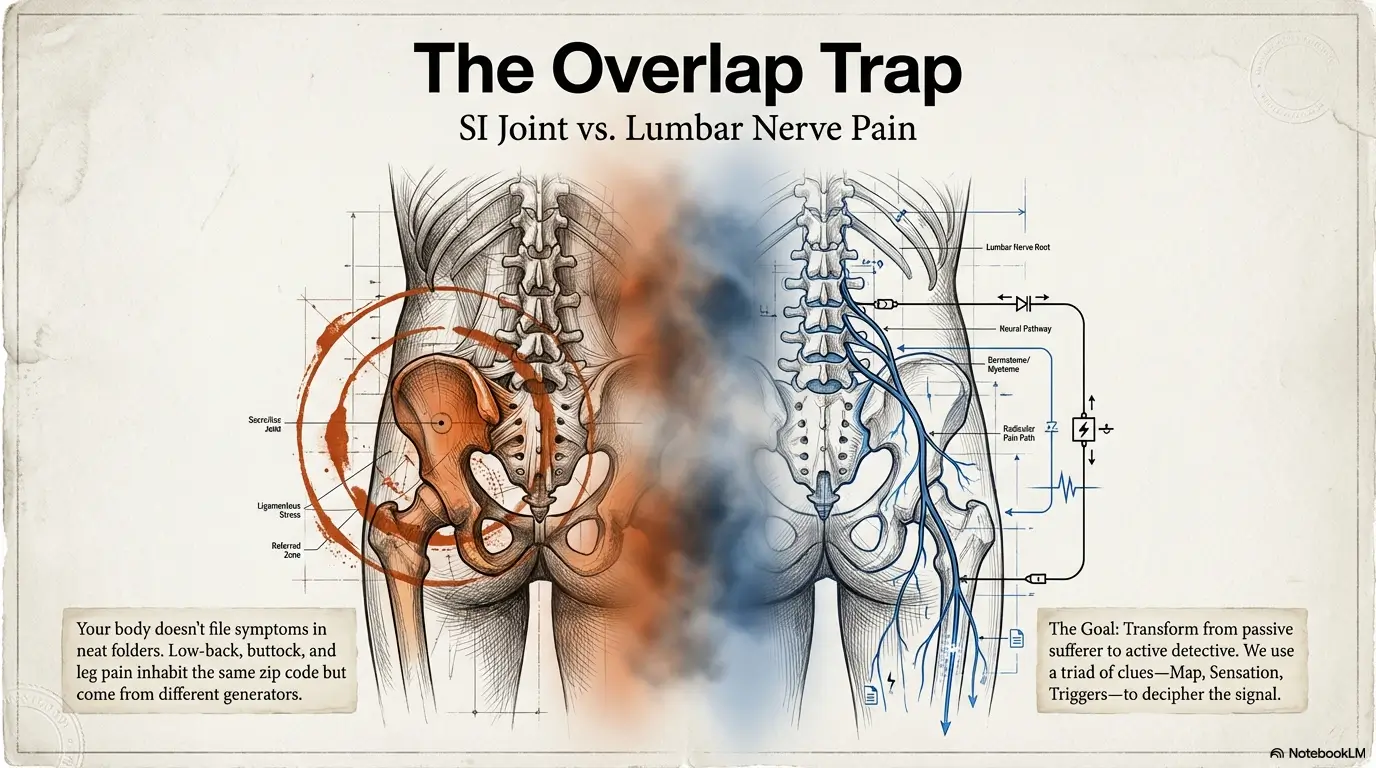
SI joint pain and lumbar nerve pain can overlap, but the “map” matters: SI joint pain often sits just below the low back near the dimple area and may wrap into the buttock or groin, while lumbar radiculopathy more often shoots down the leg in a stripe-like pattern with tingling/numbness. The best differentiator is a combo of symptom pattern, provocative movements, and response to a diagnostic injection, guided by a clinician.
Safety / Disclaimer (Read This First)
This is general education, not medical advice. Injection decisions and symptom interpretation should be made with a licensed clinician who knows your history and imaging. If you have new weakness, loss of bowel/bladder control, saddle numbness, fever, cancer history, or severe worsening pain, seek urgent care now. After any injection, urgent evaluation matters if you develop spreading redness, fever/chills, drainage, severe headache that changes with position, or rapidly worsening neurologic symptoms. If you’re unsure what counts as “don’t wait,” keep this bookmark handy: cauda equina syndrome red flags and urgent warning signs.
Table of Contents

SI Joint vs Lumbar ESI in 30 Seconds (What Each Targets)
SI joint injection = joint pain generator (often diagnostic + therapeutic)
The sacroiliac (SI) joint sits where the spine meets the pelvis. When it’s the main pain generator, discomfort often lives in a tight neighborhood: low back just below the beltline, buttock, sometimes groin. An SI joint injection is frequently used in two ways: diagnostic (does numbing the joint reduce pain?) and therapeutic (does anti-inflammatory medication calm the area for longer?).
Small lived-experience note: the first time I heard someone describe SI pain, they didn’t say “joint.” They said, “It feels like a rusty hinge in my pelvis when I roll over.” That phrasing taught me more than three anatomy diagrams. (If rolling and turning in bed is one of your loudest triggers, bookmark a practical technique like the log roll method for reducing pain during bed mobility.)
Lumbar ESI = irritated nerve roots (radicular pain drivers)
A lumbar epidural steroid injection (ESI) targets inflammation around spinal nerves in the epidural space. It’s commonly considered when symptoms look like nerve irritation, such as radiating leg pain, tingling, numbness, or pain that behaves like a “wire” more than an “ache.” ESIs may be done in different approaches (for example, transforaminal vs interlaminar), and your clinician chooses based on anatomy, symptom distribution, and imaging. If you want the plain-English breakdown, see TFESI vs interlaminar ESI for sciatica and the deeper anatomy/approach comparison at transforaminal vs interlaminar epidural injections.
The overlap trap: “same zip code” pain, different wiring
Here’s the trap: SI joint pain can refer into the buttock and thigh, and lumbar nerve irritation can masquerade as buttock or hip pain. Your body doesn’t file symptoms in neat folders. It tosses them onto the floor and says, “Good luck.” The goal is not perfection. The goal is probability plus a plan to test that probability safely.
- SI tends to be below-the-beltline and load-sensitive.
- Lumbar radicular pain tends to be leg-patterned and sensory.
- Overlap is common, so tracking matters.
Apply in 60 seconds: Write one sentence: “My pain starts at ___ and travels to ___, especially when ___.”
Pain Map Clues First (Where It Starts, Where It Travels)
SI joint pattern: “below-the-beltline” ache near PSIS + buttock, sometimes groin
Many people point to a spot just off-center at the low back, near the “dimple” area (around the posterior superior iliac spine, PSIS), then trace into the buttock. Some feel it wrap toward the groin or outer hip. SI pain often feels like it’s deep and close to the pelvis, not purely midline spine pain. If groin symptoms are part of your story, don’t skip the neighbor structure that loves to impersonate everything: how to tell hip vs spine pain.
A tiny anecdote: I once watched a friend try to “stretch their hamstring” for what was actually pelvic-driven pain. They looked like a pretzel, but the pain didn’t negotiate. That was my first lesson that location beats guesswork. If your “hamstring stretch” reliably makes symptoms sharper or more electric, compare it with hamstring tightness vs nerve pain.
Lumbar pattern: leg-dominant symptoms, stripe-like radiation, often past the knee
Lumbar radiculopathy (nerve root irritation) more often sends symptoms down the leg in a stripe-like path, sometimes past the knee into the calf or foot. It may come with numbness or tingling in a region that feels oddly consistent, like your nervous system is highlighting a route on a map. If you’re trying to decode which route you’re on, this can help: L4 vs L5 vs S1 sciatica patterns.
Pattern interrupt: Let’s be honest… pain doesn’t read anatomy textbooks
Yes, patterns help. No, they don’t guarantee. Your job is to gather good clues. Your clinician’s job is to put those clues next to exam findings, imaging, and response to targeted treatments. Together, you reduce the odds of chasing the wrong driver.
Show me the nerdy details
“Pain maps” are imperfect because referral patterns overlap. Clinicians often treat the pain pattern as one input among several: provocation tests, neurological findings, imaging context, and whether anesthetizing a suspected structure changes symptoms. That’s why a single symptom rarely “proves” SI vs lumbar. It’s the cluster that counts.
Sensation Clues (Numbness, Tingling, Weakness vs Deep Ache)
Nerve signals: pins/needles, burning, electric zaps, dermatomal numbness
When a nerve is irritated, people often describe burning, pins/needles, electric zaps, or numbness that follows a recognizable zone. Sometimes it’s intermittent, sometimes it’s constant, but it tends to have a “signal” quality, like static on a radio station that won’t fully tune in. If you’re trying to put words to the sensation, start with what sciatica nerve pain actually feels like.
Clinicians take these symptoms seriously because they can pair with objective findings: altered sensation, reflex changes, or weakness in specific movements. If you’re considering nerve testing, timing matters more than most people realize: sciatica EMG timing (when it’s useful, when it’s early).
Joint signals: deep ache, sharp with pivoting, “unstable” or “stuck” feeling
SI joint-driven pain often reads as a deep ache or sharp catch with pivoting and single-leg loading. Some people report a sensation of being “stuck,” or a feeling that one side of the pelvis is not cooperating. That language sounds vague, but it’s common and surprisingly consistent in real life.
Strength changes: when weakness is a bigger deal than pain
Here’s a grounded rule: weakness changes the urgency. Pain is loud. Weakness is a quiet but important narrator. New foot drop, progressive leg weakness, or trouble controlling the ankle/toes should trigger prompt medical attention. Even if your pain is “only moderate,” weakness is not a symptom to power through with grit and caffeine. If you’re debating “ER or wait,” keep this triage page saved: when low back pain is an emergency.
- Electric/burning sensations tend to favor radicular patterns.
- Sharp catches with pivoting can favor SI/hip mechanics.
- New weakness is a “don’t wait” symptom.
Apply in 60 seconds: Circle on a body diagram where you feel numbness vs where you feel ache. Keep them separate.
Movement Triggers That Split the Difference (Daily-Life Tests)
SI joint aggravators: single-leg loading, stairs, rolling in bed, getting out of a car
Classic SI aggravators tend to involve asymmetric load or pelvic rotation: stairs, stepping out of a car, standing on one leg to put on pants, rolling in bed, or that moment you shift weight to reach something and your pelvis files a complaint. (If stairs are the repeat-offender trigger, you’ll like a very specific adjustment guide: how to go down stairs with sciatica without provoking a flare.)
Personal note: the “getting out of a car” clue is so common it’s almost funny, except it’s not funny when it’s your daily life. People will redesign their entire day around avoiding that one pivot.
Lumbar aggravators: prolonged sitting/standing, forward bend, cough/sneeze pain spikes
Lumbar radicular symptoms often worsen with prolonged positions, forward bending, or maneuvers that increase spinal pressure (like coughing or sneezing). Some people feel a spike when rising from sitting, especially if nerve tension is involved. If your day is desk-shaped, the “prolonged positions” piece is where you can often buy relief with planning: a sit-stand schedule for desk-job sciatica and standing desk tweaks for sciatica.
Hip look-alikes: why hip OA and labral pain love this confusion
Hip osteoarthritis (OA), labral irritation, and other hip issues can mimic SI or lumbar pain, especially when groin pain is involved. Hip pain often shows up with walking tolerance changes, pain with hip rotation, or that “pinch” feeling in the front of the hip.
In the US system, it’s common to see a mix of specialties involved: spine/pain medicine, orthopedics, physical therapy. This is not you being “complicated.” This is anatomy being a shared wall between neighbors.
- Yes/No: Is your worst pain below the beltline near the dimple area?
- Yes/No: Does single-leg loading (stairs, stepping out of car) reliably trigger it?
- Yes/No: Do you have consistent tingling/numbness traveling in a stripe, especially past the knee?
- Yes/No: Do cough/sneeze or prolonged sitting create a clear spike?
- Yes/No: Any new weakness, bowel/bladder changes, or saddle numbness?
Neutral next step: Bring your “Yes” items to your visit and ask, “Which driver is most likely, and how will we test it?”
Exam Maneuvers Doctors Use (And What They’re Actually Checking)
SI provocation cluster (why one test is rarely enough)
Clinicians use multiple SI provocation maneuvers because any single test can be noisy. A cluster of tests that reproduce your familiar pain can raise suspicion that the SI joint is a meaningful contributor. Think of it like tasting soup: one spice doesn’t define the dish, but the combination tells a story.
Straight leg raise and slump test (what “positive” really suggests)
Straight leg raise and slump testing are designed to stress neural structures. A “positive” result doesn’t automatically mean “disc herniation forever.” It suggests nerve involvement is likely enough to matter. Your clinician then ties it to your symptom distribution, strength/reflex findings, and imaging context. If you want a safe, plain-language walk-through of what clinicians are looking for, see the straight leg raise test explained (at-home version).
Gait + neuro screen: reflexes, sensation, and motor strength as tie-breakers
Gait observation and a basic neurologic screen can be a tie-breaker. Changes in reflexes, measurable weakness, or consistent sensory deficits can push the probability toward lumbar radiculopathy. It’s one reason many reputable medical centers emphasize a focused neuro exam when leg symptoms are present.
Show me the nerdy details
Provocation tests aim to mechanically stress a suspected structure and reproduce concordant pain. Neural tension tests aim to reproduce symptoms by stressing nerve tissue. Both can have false positives. Clinicians often rely on patterns: multiple positive SI maneuvers can be more meaningful than a single one; objective neurological deficits raise the concern level for nerve root involvement.
Diagnostic Injection Logic (The “Did It Turn the Volume Down?” Rule)
SI joint injection as a diagnostic step: what “meaningful relief” implies
When an SI joint injection contains local anesthetic, the short-term question is simple: did numbing the joint change your familiar pain? If you get meaningful, time-limited relief that matches the anesthetic window, that supports the SI joint as a significant pain generator. If nothing changes, it doesn’t “prove” the SI joint is innocent, but it lowers the probability.
One practical reality: sometimes the injection reduces the deep ache but reveals another driver underneath. That’s not failure. That’s information.
Lumbar ESI response: why partial relief can still be informative
ESIs can reduce inflammation around nerve roots, but results vary. Partial relief can still matter if it changes your walking tolerance, sleep, or the “electric” quality of the pain. Sometimes the leg pain improves but the low-back ache remains, suggesting mixed generators (nerve + joint + muscle).
Curiosity gap: The relief timeline clue most people miss
The timeline often contains gold:
- Immediate relief (hours) can reflect anesthetic effect.
- Delayed improvement (days) can reflect anti-inflammatory effect.
- Short flare can happen after injections and may not equal “something went wrong,” but red flags always override.
I’ve seen people declare an injection “useless” at hour 6, then realize at day 3 they slept through the night for the first time in weeks. Bodies can be slow to update their software. If you want the “what to expect, hour-by-hour/day-by-day” view, use the epidural steroid injection relief timeline. And if the first 24–72 hours feel hotter, sharper, or more inflammatory, it helps to know what’s normal vs not: steroid flare after injection (what it is and when to call).
This is not a diagnostic tool. It’s a way to describe change clearly at your follow-up.
Estimated pain reduction: —
Function gained: —
Neutral next step: Bring the numbers and one sentence: “The deep ache changed, but the tingling didn’t,” (or vice versa).
Overlap Symptom Scenarios (The 5 Confusers That Fool Smart People)
Buttock pain + leg heaviness: SI dysfunction vs L5/S1 irritation
Buttock pain plus a heavy leg can be either pelvic mechanics (SI joint) or nerve irritation (often L5/S1). Clues that lean lumbar include consistent tingling/numbness, pain traveling past the knee, and neural tension signs. Clues that lean SI include pain that spikes with single-leg loading and pivoting.
Anecdote: a runner once told me, “My leg feels like it’s wearing a wet coat.” That description was oddly precise. The follow-up question that mattered most: “Does it come with tingling, or is it just heaviness?”
Groin pain: SI joint, hip joint, or upper lumbar referral?
Groin pain is a famous troublemaker. It can come from the hip joint, SI joint referral, or upper lumbar structures. Hip-related pain often shows up with hip rotation, walking limits, or a deep “pinch” in the front of the joint. SI/groin referral can feel more wrapped and positional. Upper lumbar referral may pair with back symptoms and different sensory zones.
“It hurts to sit” isn’t always lumbar
Sitting pain sounds lumbar, but it can be SI, hip, or even soft tissue. Ask: is it the transition (sit-to-stand) that’s brutal, or the duration of sitting? SI issues often hate transitions and asymmetry; nerve irritation often hates sustained positions and neural tension.
Pain that alternates sides: what that pattern can suggest
Alternating sides can suggest a mechanical component, sometimes involving pelvic alignment, gait, or compensations. It can also happen when your “driver” is one side and your coping strategy overloads the other. It’s not a diagnosis, but it’s a meaningful clue to report.
Curiosity gap: When “pain moved” after injection is actually a useful data point
When one pain generator calms down, your brain stops amplifying it, and another signal becomes noticeable. This can feel like pain “moved.” If it happened after a diagnostic injection, that shift is valuable information: it may imply mixed generators, not “the injection failed.”
- Groin pain demands hip consideration.
- Heaviness vs tingling is a meaningful split.
- “Pain moved” after injection can reveal layered drivers.
Apply in 60 seconds: Write: “After injection, the pain changed from ___ to ___,” and include the date/time window.
Short Story: The Two-Layer Alarm (120–180 words) …
A patient walked into a follow-up appointment carrying a notebook like it was a shield. “The SI injection didn’t work,” she said, already apologizing for being a “difficult case.” But her notes were quietly brilliant: hour-by-hour, what changed and what didn’t. The deep, below-the-beltline ache turned down within an hour, and she could roll in bed without that sharp catch.
Yet the leg tingling stayed, the stripe down the calf unchanged, especially after sitting. The clinician didn’t treat that as failure. He treated it as a clean split: one generator had been tested and partially confirmed (SI), and another still needed attention (nerve irritation). They adjusted the plan, not the patient’s self-trust. She left with a next step, not a mystery, and the kind of relief you can’t measure on a pain scale: “I’m not making it up.”
Don’t Do This: Two Mistakes That Delay the Right Treatment
Mistake #1: Treating the MRI like a verdict (not a clue)
MRIs often show disc bulges, degenerative changes, or “findings” that may not match your symptoms. Many reputable medical institutions emphasize that imaging is one piece of the puzzle, and symptoms plus exam findings matter. If your pain map and neuro findings don’t match the MRI “headline,” your clinician may look for alternate drivers like SI joint, hip, or myofascial contributors. If you want to sanity-check that mismatch without spiraling, read MRI pain mismatch (why images and symptoms don’t always agree).
I’ve seen people spiral after reading a report online at midnight, like it’s a fortune cookie written in medical Latin. Don’t do midnight radiology alone if you can help it. If you’re deciding between imaging types or confused by what each can and can’t show, this helps: sciatica MRI vs X-ray (what each one really tells you).
Mistake #2: Chasing the loudest symptom instead of the primary driver
The loudest symptom is not always the main driver. Sometimes the driver is SI mechanics and the loudness is muscle guarding. Sometimes the driver is nerve irritation and the loudness is low-back spasm. The better question is: what pattern repeats, what function is limited, and what changes with targeted testing?
What to do instead: track patterns for 7 days like a detective, not a judge
Act like a detective. Detectives collect evidence first and pronounce verdicts later. Track triggers, relief windows, and function changes. It’s not obsessive. It’s efficient. (If PT is part of your plan and you’re unsure whether “post-PT soreness” is normal or a nerve flare, compare nerve pain vs muscle soreness after physical therapy.)
Leaning SI injection first
- Worst pain is below-the-beltline near PSIS/dimple area
- Stairs, car exit, rolling in bed are top triggers
- Deep ache/catch dominates more than tingling
Trade-off: May not address leg tingling if a nerve driver is separate.
Leaning lumbar ESI first
- Leg symptoms dominate, often past the knee
- Tingling/numbness follows a stripe-like route
- Neural tension signs or objective neuro findings
Trade-off: May calm nerve pain but leave pelvic/hip mechanics unaddressed.
Neutral next step: Ask your clinician, “What result would change our plan next?”
Common Mistakes Patients Make Before/After Injections (Fixable)
Over-resting for weeks (stiffness becomes its own pain generator)
It’s normal to protect the area for a short time after an injection. But extended over-resting can create stiffness, deconditioning, and more sensitivity. This is especially true when your system has been bracing for pain for months. The goal is usually a gradual return to gentle movement, guided by your clinician’s instructions and your own red-flag awareness.
“Prove it” workouts too soon (flare cycles)
Some people feel a small improvement and immediately attempt a heroic workout to “test” it. The body responds with a flare and a nasty little lesson: pain is not impressed by bravado. If you do test activity, test it like a lab: one variable at a time, one day at a time.
I once heard someone say, “I celebrated relief with a three-hour cleaning binge.” Their pelvis did not attend the celebration.
Not documenting function (stairs, sleep, sitting time) so results get vague
Vague follow-ups create vague plans. If you can’t remember how long you could sit before, you’ll default to feelings. Feelings matter, but function clarifies. Track the boring metrics: minutes walking, minutes sitting, stairs tolerance, sleep interruptions.
Pattern interrupt: Here’s what no one tells you… “better” should mean specific things
“Better” isn’t a vibe. It’s measurable: “I can sit 20 minutes longer,” or “I can roll in bed without a 7/10 spike.” Those sentences are rocket fuel for good clinical decision-making. If your plan includes targeted PT alongside injections, this guide can help anchor the “what should I do next week?” piece: physical therapy for sciatica (what helps, what to avoid early).
Show me the nerdy details
Post-injection interpretation is easiest when you separate (1) pain intensity, (2) pain quality (ache vs electric), and (3) function. A change in only one domain can still be clinically meaningful. This also helps detect layered pain generators: one improves, another persists.
When to Seek Help (Red Flags and “Don’t Wait” Symptoms)
Emergency: bowel/bladder changes, saddle anesthesia, rapidly worsening weakness
If you develop loss of bowel or bladder control, saddle numbness, or rapidly worsening weakness, seek emergency evaluation. These symptoms can indicate serious neurologic compromise and require urgent attention.
Same-day/urgent: fever, spreading redness after injection, severe unrelenting night pain
After an injection, fever, spreading redness, warmth, drainage, or feeling systemically ill should be treated urgently. Severe unrelenting night pain, especially with fever or unexplained weight loss, also warrants prompt evaluation.
Prompt follow-up: new numbness, foot drop, progressive leg weakness, unexplained weight loss
New numbness, foot drop, or progressive weakness should not be “watched for weeks.” Call your clinic promptly. If you’re in the US and navigating referrals, be specific: “new weakness” moves faster than “pain got worse.” It’s not drama. It’s triage language.
Who This Is For / Not For
For: people with low back, buttock, groin, or leg symptoms deciding between SI vs lumbar pathways
If you’re comparing SI joint injection vs lumbar ESI, or trying to understand why your symptoms overlap, this is for you, especially if time is limited and you want to show up to your appointment with clean, useful data.
For: post-injection patients trying to interpret overlap symptoms without spiraling
If you had an injection and now symptoms feel rearranged, you’re in the right place. “Different” can be diagnostic, not just discouraging. If you’re also weighing comfort choices during the procedure, you may want to read epidural steroid injection sedation (what it changes, what it doesn’t).
Not for: anyone with red flags, acute trauma, infection risk, or rapidly progressive neurologic symptoms
If you have red flags, don’t use this article as a self-triage substitute. Use it later, when you’re safe, to communicate clearly with your care team.
Next Step (One Concrete Action)
Start a 7-day “Pain Map + Function Log” before your next appointment
Track: start point, radiation path, numb/tingle zones, top 3 triggers, sleep impact, walking/sitting tolerance, and response to heat/ice/NSAIDs (if allowed). Bring it to your clinician to decide whether SI, lumbar ESI, hip evaluation, or a combined plan fits best.
- Your diagnosis codes (if known) and the exact procedure name your clinician plans
- Whether imaging guidance is used (fluoroscopy/CT/ultrasound) and where it’s performed (ASC vs hospital)
- Your insurance details: deductible status, co-insurance, prior authorization requirements
- Your “must-hit” outcome: pain reduction, walking time, sleep, work tolerance
| Year | Item | Common self-pay ballpark range (US) | Notes |
|---|---|---|---|
| 2026 | SI joint injection (procedure only) | $300–$1,200+ | Varies by setting, guidance method, and facility fees. |
| 2026 | Lumbar ESI (procedure only) | $400–$1,500+ | Approach and number of levels can change cost. |
| 2026 | Imaging/facility fees (if billed separately) | $200–$2,000+ | Hospital outpatient settings can be higher than ASCs. |
Neutral next step: Ask for an “all-in estimate” (procedure + facility + imaging) before scheduling.

FAQ
1. Can SI joint pain mimic sciatica?
Yes. SI joint pain can refer into the buttock and down the thigh, which can feel “sciatica-like.” The differentiators are often the quality (deep ache/catch vs electric/tingly), triggers (single-leg loading vs neural tension/prolonged positions), and whether symptoms travel past the knee in a consistent stripe.
2. How do I tell SI joint pain from a herniated disc at home?
You can’t diagnose it at home, but you can collect useful clues. Note where pain starts, where it travels, what movements trigger it (stairs, car exit, rolling in bed vs coughing/sneezing, forward bending), and whether there’s tingling/numbness. Bring a 7-day log to your clinician. Think “better description,” not “self-verdict.”
3. Does pain going past the knee mean it’s definitely lumbar?
Not definitely, but it raises suspicion for nerve involvement, especially when paired with tingling/numbness or burning/electric sensations. SI referral can reach the thigh, but consistent below-knee symptoms are a classic reason clinicians look hard for a lumbar driver.
4. Can an SI joint injection help groin pain?
Sometimes, if your groin pain is part of an SI referral pattern. But groin pain is also a common hip signal. If an SI injection improves buttock/pelvic pain but groin pain persists, your clinician may consider hip evaluation or upper lumbar contributors.
5. What does it mean if an SI injection helped buttock pain but not leg tingling?
That pattern can suggest mixed generators: the SI joint may be contributing to the buttock/pelvic ache, while leg tingling may reflect nerve irritation. It’s not “all in your head.” It’s a layered problem that needs a layered plan.
6. How long should relief last after a lumbar epidural steroid injection?
Responses vary widely. Some people notice changes within days; others have partial improvement or none. The most helpful approach is to track function (walking/sitting tolerance, sleep, work tasks) over 1–2 weeks and report specific changes to your clinician.
7. Is numbness a sign I need an ESI instead of an SI injection?
Numbness suggests nerve involvement, which can make an ESI more relevant. But numbness can also coexist with SI or hip pain. The decision usually depends on the whole picture: symptom map, exam findings, strength/reflexes, and sometimes response to a diagnostic injection.
8. Can you have SI joint dysfunction and lumbar radiculopathy at the same time?
Yes. It’s common to have more than one contributor, especially if your body has been compensating for months. This is where timeline tracking and “what changed after injection” becomes especially valuable.
9. What are the red flags after an injection that require urgent care?
Fever, chills, spreading redness/warmth, drainage, severe worsening pain with systemic symptoms, new or rapidly worsening weakness, bowel/bladder changes, saddle numbness, or severe positional headache should prompt urgent evaluation.
10. What should I track to help my doctor choose SI injection vs lumbar ESI?
Track (1) start point and travel path, (2) numb/tingle zones, (3) top triggers, (4) function metrics (minutes sitting/walking, stairs, sleep interruptions), and (5) response timeline to any injection (hours vs days). Bring the simplest possible summary to your clinician.
Conclusion
Remember the curiosity loop from the top: why pain “moves” after an injection. Often, it’s because your body has more than one driver, and when one turns down, the next becomes audible. That’s not you failing treatment. That’s your nervous system handing your clinician cleaner data.
SI Joint “Leans”
- Pain below beltline near PSIS/dimple
- Buttock ± groin referral
- Triggers: stairs, car exit, rolling in bed
- Quality: deep ache, sharp catch with pivot
What to say: “Single-leg loading is my loudest trigger.”
Lumbar Nerve “Leans”
- Leg-dominant, stripe-like radiation
- Often past the knee
- Quality: burning, electric, tingling/numb
- Triggers: prolonged sitting, cough/sneeze spikes
What to say: “Tingling follows a consistent route.”
Use it: Pick the best-matching column, then list the 3 strongest clues you have. That’s your appointment opener.
If you have 15 minutes, do one thing that changes your next appointment: start the 7-day log and bring one clean sentence about what changed after your injection. That’s how you stop guessing and start testing.
Last reviewed: 2026-02-24.