
If Planks Light Up Your Back, Go Smarter, Not Harder.
A well-built dead bug progression can train anti-extension core strength in as little as 10 minutes, without the shoulder strain and symptom spikes that make many sciatica plans fail.
Most people with sciatica don’t need more effort; they need better dosage. Too much range, rushed reps, or a flared ribcage can turn a “core” drill into a nerve-irritation drill—fast.
Keep guessing, and you risk reinforcing pain patterns that make walking, sitting, and daily tasks feel less predictable week by week.
The Strategy
- Quiet spine, moving limbs, stable symptoms.
- One variable at a time: Range, load, or tempo.
- 24–48 hour symptom check protocol.
Build trunk control without provoking distal symptoms.
No macho rep targets. No “push through” nonsense. Just a clean progression that meets you where your back is today.
Table of Contents
1) Sciatica-safe core goal: “quiet spine, moving limbs”
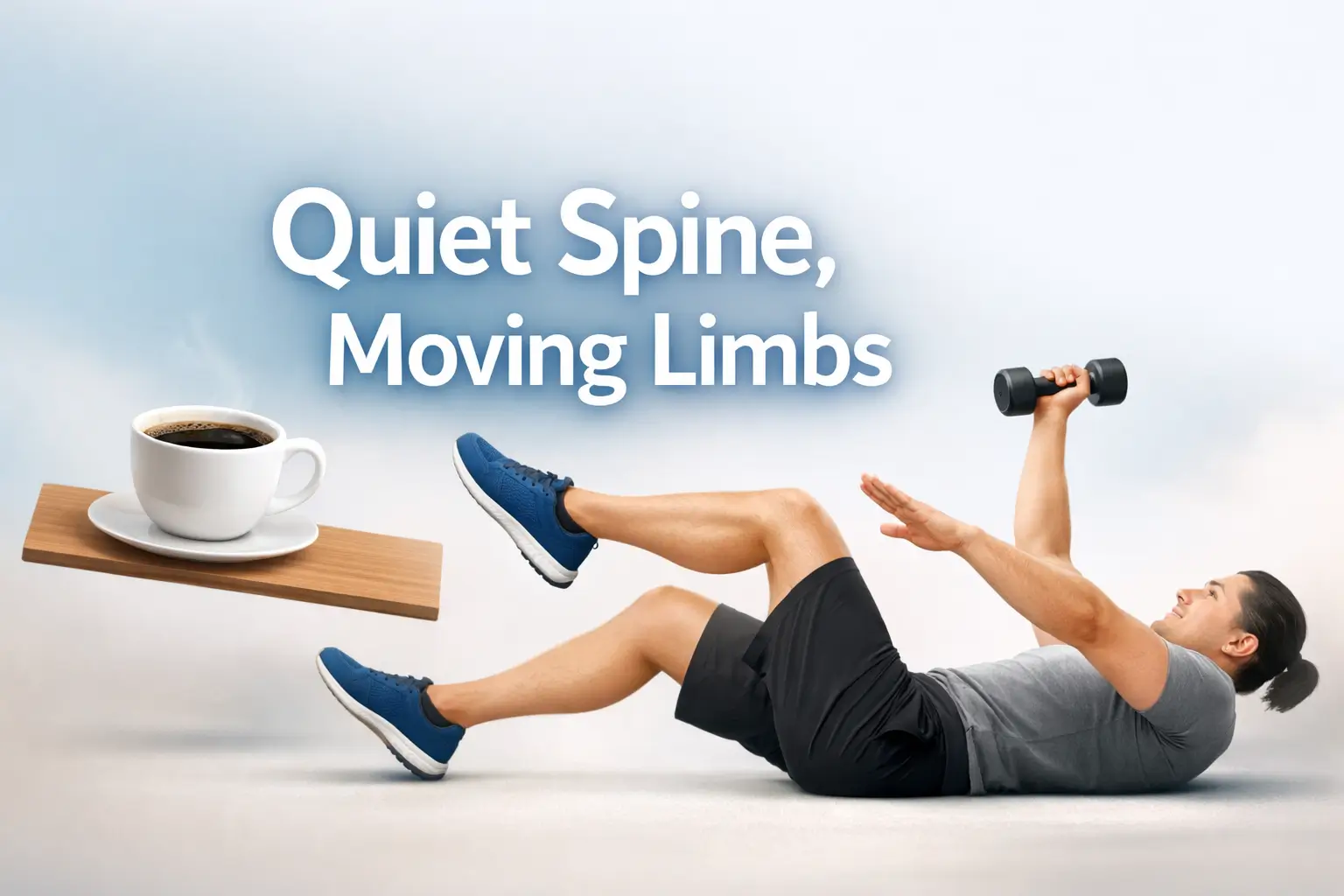
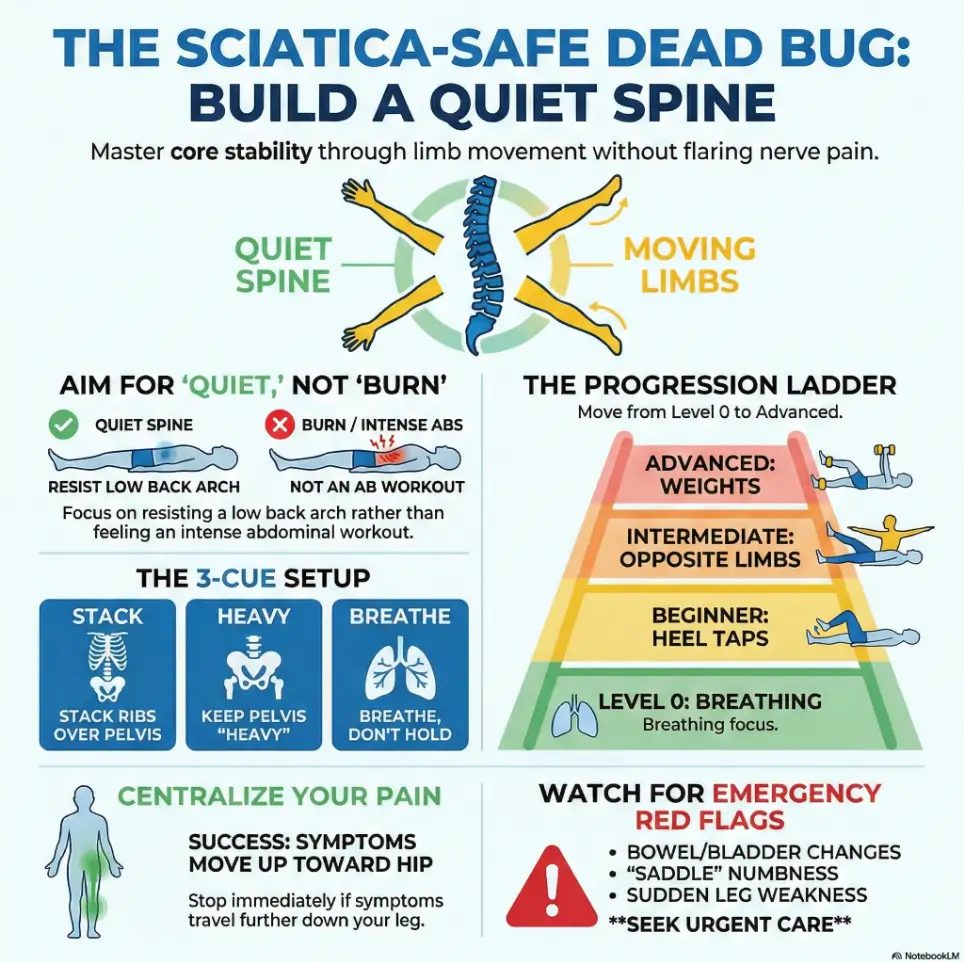
When people say “core,” they often mean “abs burning.” With sciatica, that’s the wrong scoreboard. Your goal is a spine that stays calm while your limbs do the moving. Think of it like holding a tray of coffee: you can walk (limbs) without sloshing (spine). The dead bug is basically that—lying down, practicing “steady tray” control.
What “anti-extension” actually means (without jargon)
“Extension” is the low back arching. “Anti-extension” is your ability to resist that arch while your arms and legs create leverage. You’re not trying to flatten your spine into the floor like a pancake; you’re trying to keep it quiet. Quiet means: no sudden arch, no rib flare, no bracing so hard you stop breathing.
Why planks aren’t required to build real core stiffness
Planks can be great. They can also be too much too soon for irritable backs—especially if your symptoms spike with extension, long holds, or shoulder stress. Dead bugs let you dial the challenge with range, tempo, and leverage—without the full body “hang on for dear life” vibe of planks. If plank-based routines keep flaring you, compare with a short McGill Big 3 style 10-minute progression.
The success metric: symptoms should centralize, not spread
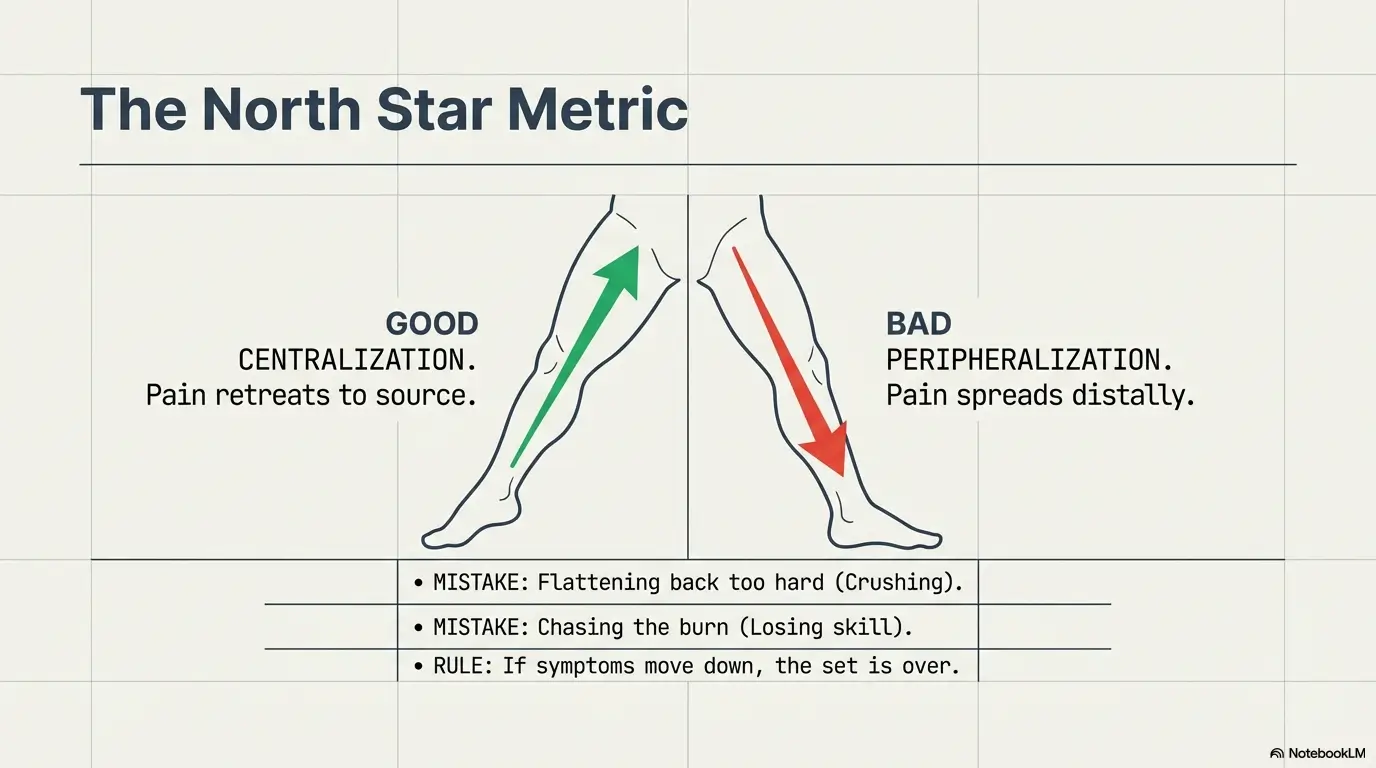
Here’s your north star: you want symptoms to stay the same or move up (toward the back/hip), not travel farther down the leg. If tingling or pain migrates toward the foot during a set, that’s a stop signal—not a “push through” badge. This same distal-spread rule applies to nerve flossing that starts making symptoms worse.
- Score “quiet” over “burn.”
- Progress by leverage and control, not ego.
- Stop if symptoms travel farther down the leg.
Apply in 60 seconds: Do 2 slow breaths with ribs down + 2 tiny heel taps/side and see if your back stays quiet.
2) Who this is for / not for
Good fit: irritability-aware beginners who flare with planks
If planks or sit-ups light up your back or leg, you’re in the right place. This ladder starts with “low-threat” positions and gives you clear gates before you move on. It’s built for the person who wants to stay active but refuses to gamble with symptoms.
Good fit: desk workers with sensitive backs who need “low-threat” core work
If you sit a lot, your hip flexors and back can feel like they’re negotiating a hostile contract all day. Dead bugs are a way to practice better terms: ribs over pelvis, breathing without gripping, legs moving without the low back taking over. It’s boring in the best way—like flossing, but for spinal control. If your workday is the trigger, use this alongside a sit-stand schedule for desk-job sciatica flare management and a practical standing desk setup for sciatica.
Not for: worsening neurological signs or severe, rapidly escalating symptoms
If you’re noticing new or worsening weakness, numbness, or trouble walking, don’t “program around it” in your living room. That needs medical attention. The plan below assumes you’re stable enough for gentle training—not sliding downhill.
Not for: “push through pain” personalities (this plan won’t reward that)
This is a control ladder. If your inner monologue is “more reps will fix me,” you’ll hate how often I ask you to do less. But sciatica isn’t impressed by effort. It’s impressed by the right dose.
- Yes if your symptoms are stable and you can change positions without sharp escalation.
- Yes if you can do a gentle exhale without your low back arching dramatically.
- No if you have bowel/bladder changes, saddle numbness, or rapidly worsening weakness.
- No if pain is escalating day-to-day despite rest and basic movement.
Neutral next step: If you checked “No,” pause the plan and contact a licensed clinician for an evaluation.
3) Red flags: when to seek help now (don’t DIY this)
Let’s be compassionate and blunt: some symptoms are not “tightness,” not “core weakness,” and not “I slept weird.” They’re medical. I’m putting this section early because the internet loves burying it, and I’d rather you leave this article and get help than keep reading like it’s a Netflix series.
Go now: bowel/bladder control changes (emergency)
If you suddenly can’t control urination or bowel movements, that’s an emergency. Don’t test it with another set of heel taps. Go get evaluated immediately.
Go now: numbness around genitals/anus (“saddle” area)
Numbness in the saddle region is a big red flag. Again: not a “stretch it out” situation.
Call a clinician soon: new or worsening leg weakness/numbness
If your foot is dropping, your leg is giving out, or numbness is spreading, that’s a strong sign you need medical input.
If pain lasts >12 weeks: get reevaluated (don’t normalize it)
Some cases resolve earlier; some linger. But if you’re past the “this should be changing” window and nothing is improving, it’s time to reassess.
4) The “don’t flare it” setup: 3 cues that decide everything
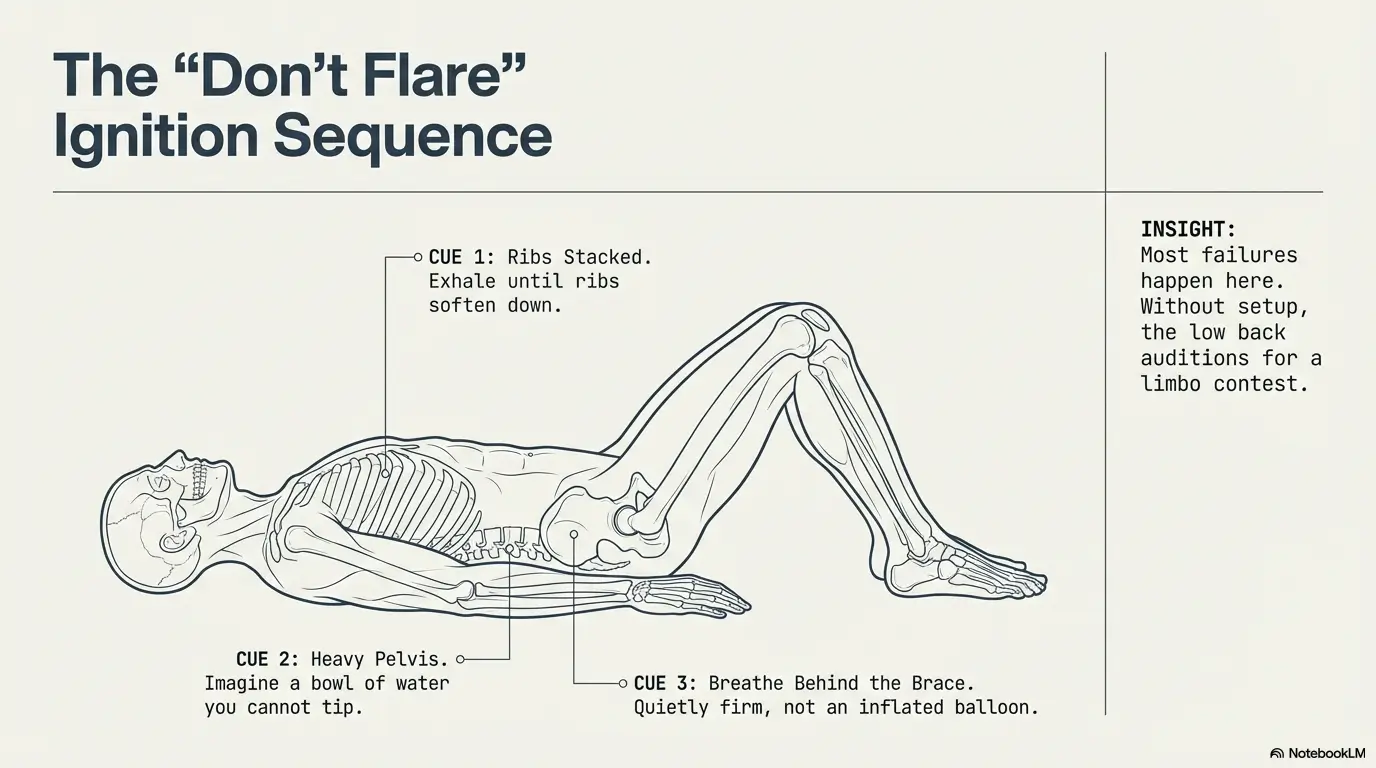
Most dead bugs don’t fail because the exercise is wrong. They fail because the setup is skipped. These three cues are your entire sciatica-friendly strategy.
Cue 1: ribs stacked over pelvis (no rib flare)
Lie on your back, knees bent at first. Put one hand on your lower ribs. Exhale gently until your ribs feel like they’re coming “down” toward your pelvis.
Cue 2: pelvis heavy, low back quiet (neutral-to-gentle brace)
You’re not trying to smash your spine into the floor. You’re trying to keep your pelvis from tipping forward as the legs extend.
Cue 3: breathe behind the brace (no breath-holding)
If you hold your breath, you’ll fake stability for a rep or two and then lose it. Keep a soft brace and breathe around it.
Input 1: Symptom irritability right now (0–3)
- 0 = calm: do 3–4 sets of 5–8 reps/side
- 1 = mild: do 2–3 sets of 4–6 reps/side
- 2 = touchy: do Level 0 only (holds + tiny range)
- 3 = flaring: skip reps; do breathing + a short walk if tolerated
Neutral next step: Choose the lowest dose that keeps your symptoms from traveling farther down the leg.
5) Level 0: regressions for flare days (yes, this counts)
Level 0 is where consistency is born. These drills keep your nervous system feeling safe while you practice the same key skill: ribs over pelvis, low back quiet.
90/90 breathing with pelvic heaviness (2 minutes)
Lie on your back, hips and knees at 90/90 (feet on a chair/couch). Exhale gently, feel ribs soften down, and imagine your pelvis getting heavy. If you need a deeper walkthrough, follow this detailed 90/90 position tutorial for sciatica relief.
Marching holds: one leg up, hold 5–10 seconds
From bent knees, lift one knee toward your chest to tabletop, hold 5–10 seconds, lower slowly. If your low back arches to “help,” shorten the range.
Arms-only reaches (teaches rib control first)
Keep knees bent. Reach arms overhead slowly, then return, all while keeping ribs down.
6) Beginner progression: dead bug without the “low back pop”
Beginner doesn’t mean easy. It means predictable. The beginner steps below build control without provoking the common trigger: the low back arch on the return phase.
Step 1: heel taps (short range, slow return)
Start in tabletop (knees over hips). Tap one heel to the floor with a small range, then return slowly.
Step 2: single-leg slide-outs (keep heel grazing the floor)
From bent knee, slide your heel away on the floor. Keep the heel barely touching.
Step 3: alternating heel taps with a 2-second pause
Add a 2-second pause at the hardest point. Pauses reveal cheating and build control without aggressive range.
Dose guide (beginner): 2–4 sets of 4–6 controlled reps/side
If you’re time-poor: do 2 sets. If you’re stable and recovering well: do 3–4. Stop a rep early if your low back starts “talking.”
7) Intermediate progression: contralateral patterns (where sciatica-proofing starts)
This is where dead bugs start doing what you really want: teaching your body to stabilize while opposite limbs move—more like walking, climbing stairs, or carrying groceries.
Step 4: opposite arm + heel tap (short lever)
Reach your right arm overhead as your left heel taps (small range). Return slowly. Alternate sides.
Step 5: opposite arm + leg extension (stop before back arches)
Now the lever increases. Extend the leg slowly, only as far as you can keep the low back quiet.
Step 6: dead bug “iso holds” (3–5 seconds at the hardest point)
Pause 3–5 seconds at the hardest position. Iso holds build stiffness without huge range.
- Planks flare you
- You need precise scaling
- You want anti-extension skill
- You tolerate hands/knees
- You want hip/shoulder integration
- You can keep spine neutral
- Your back arches quickly
- Your shoulders fatigue first
- Long holds spike symptoms
Neutral next step: Pick the option that keeps symptoms stable while you can breathe and control position.
8) Advanced progression: load and leverage—without planks
Advanced doesn’t mean reckless. It means you can keep your spine quiet while the levers get longer and the load gets real.
Step 7: banded dead bug (band anchored overhead for lat tension)
Anchor a light band overhead and hold the ends in your hands. Pull slightly down to engage your lats, then do contralateral dead bugs.
Step 8: overhead weight reach (light dumbbell/kettlebell)
Hold a light weight overhead. Start very light and prioritize quiet spine + smooth breathing.
Step 9: long-lever leg + overhead reach (only if symptom-free)
Only do this when symptoms are stable and return phase is controlled.
Step 10: instability sparingly (foam roller or stability ball option)
Instability tools can increase demand, but only if you already own the basics.
Progression rule: add one variable at a time (range or load or tempo)
If you add range, load, and speed in the same week, you won’t know what caused a flare. Progress like a scientist: change one variable, observe for 24–48 hours, then decide.
9) Common mistakes that trigger sciatica flare-ups
Mistake #1: flattening the low back aggressively (over-tucking)
Some people jam the low back flat by hard tucking. Aim for neutral-to-gentle control: quiet, not crushed.
Mistake #2: chasing “burn” instead of control (more reps ≠ safer)
If hip flexors dominate and low back arches, you’re losing the skill.
Mistake #3: moving too fast on the return (where the arch happens)
Make the return the slowest part for a week and monitor what changes.
Mistake #4: letting symptoms travel farther down the leg (stop signal)
If symptoms spread farther down the leg during the set, stop and regress. If symptoms are hard to classify, this differential guide on diabetic neuropathy vs sciatica symptom patterns can help framing before clinical review.
10) Programming that actually sticks (2-week blueprint)
A perfect plan you don’t do is a fantasy. Let’s build something repeatable.
The “3 lanes” plan: flare day / normal day / strong day
- Flare day: Level 0 only (90/90 breathing + marching holds). 6–10 minutes.
- Normal day: Beginner steps (heel taps or slide-outs). 10 minutes.
- Strong day: Intermediate or advanced (contralateral + iso holds; add band/load only if earned). 10–14 minutes.
Minimal effective routine (10 minutes, 3x/week)
- 90/90 breathing: 2 minutes
- Marching holds: 2 sets of 3 holds/side (5–10 seconds)
- Dead bug step of the day: 2–4 sets of 4–6 reps/side
- Easy walk (optional): 5–10 minutes if tolerated
Neutral action line: Log what step you did and how symptoms felt 2 hours later.
What to pair with dead bugs (gentle walking, hip mobility if tolerated)
Walking is often a friendly companion because it’s rhythmic and can help symptoms calm down for many people. Footwear can matter more than people think—see this quick selector for sciatica-friendly walking shoes. If you tolerate neural mobility work, consider a conservative morning dose from morning sciatica nerve glides.
When to progress: the 3-check system (symptoms, control, recovery)
- Symptoms: Did symptoms stay the same or centralize during/after?
- Control: Did ribs stay down and low back stay quiet for every rep?
- Recovery: Did you feel okay the next morning (not worse)?
If all three are “yes” for two sessions, progress one variable: a tiny bit more range or a longer pause or one extra rep.
FAQ
Are dead bugs good for sciatica?
They can be, because they train anti-extension core control in a low-threat position. Choose a level that doesn’t worsen symptoms and keep the spine quiet.
Can dead bugs make sciatica worse?
Yes—usually when range is too big, tempo is too fast, or setup is skipped (rib flare + low back arch).
What if I feel dead bugs in my hip flexors instead of my abs?
Shorten leg range, slow the return, and focus on exhaling to keep ribs stacked.
Should my low back be pressed flat into the floor?
Not necessarily. Aim for quiet control—no dramatic arching and no forced flattening.
How many reps should I do for back pain?
Start small: 2–4 sets of 4–6 controlled reps per side.
Dead bug vs bird dog: which is better?
Neither is universally better. Choose the one that keeps symptoms stable and control high.
Are dead bugs safe with a herniated disc?
Sometimes, but it depends on irritability and movement sensitivity. For a broader treatment path, review herniated disc sciatica treatment options and compare with sciatica vs herniated disc differences.
What if my leg tingling increases during the set?
Stop, rest, breathe, and reassess. Regress movement or consult a clinician if it repeats.
How long does sciatica usually take to improve?
Varies by cause and irritability. Track trend over days and weeks, not single sessions.
“`12) Next step: one concrete action
You don’t need motivation. You need a test you can run today.
Do the 60-second setup test today: 3 slow breaths + 2 heel taps/side
Lie down, stack ribs over pelvis, take 3 slow breaths, then do 2 tiny heel taps per side. If symptoms don’t worsen and your low back stays quiet, start with Level 0 → Beginner Step 1 for two weeks. If symptoms spread down the leg, stop and seek evaluation.
Move up only when the spine stays quiet and symptoms don’t travel farther down the leg.
- Add one: range or load or tempo
- Pass the 24–48h check
- Stop if symptoms spread distally
- What movements provoke symptoms: bending, arching, sitting, walking, coughing/sneezing?
- Where symptoms go: back/hip only or down the leg (how far)?
- What helps: walking, lying down, heat, positions, time of day?
- Any red flags: weakness changes, numbness pattern, bowel/bladder issues?
- What you tried: which dead bug step, dose, and what happened 24 hours later?
Neutral next step: Bring this list to a PT or physician to speed up your plan selection.
If you want a simple operator mindset: keep the spine quiet, move the limbs with control, and let symptoms—not pride—decide your next step. That’s how you build a core that supports you in real life, not just in workout clips. If sleep is the bottleneck, pair this plan with how to sleep with sciatica, plus targeted setup guides for side-sleeper sciatica nights and knee pillow vs body pillow for sciatica.
Last reviewed: 2026-01.