
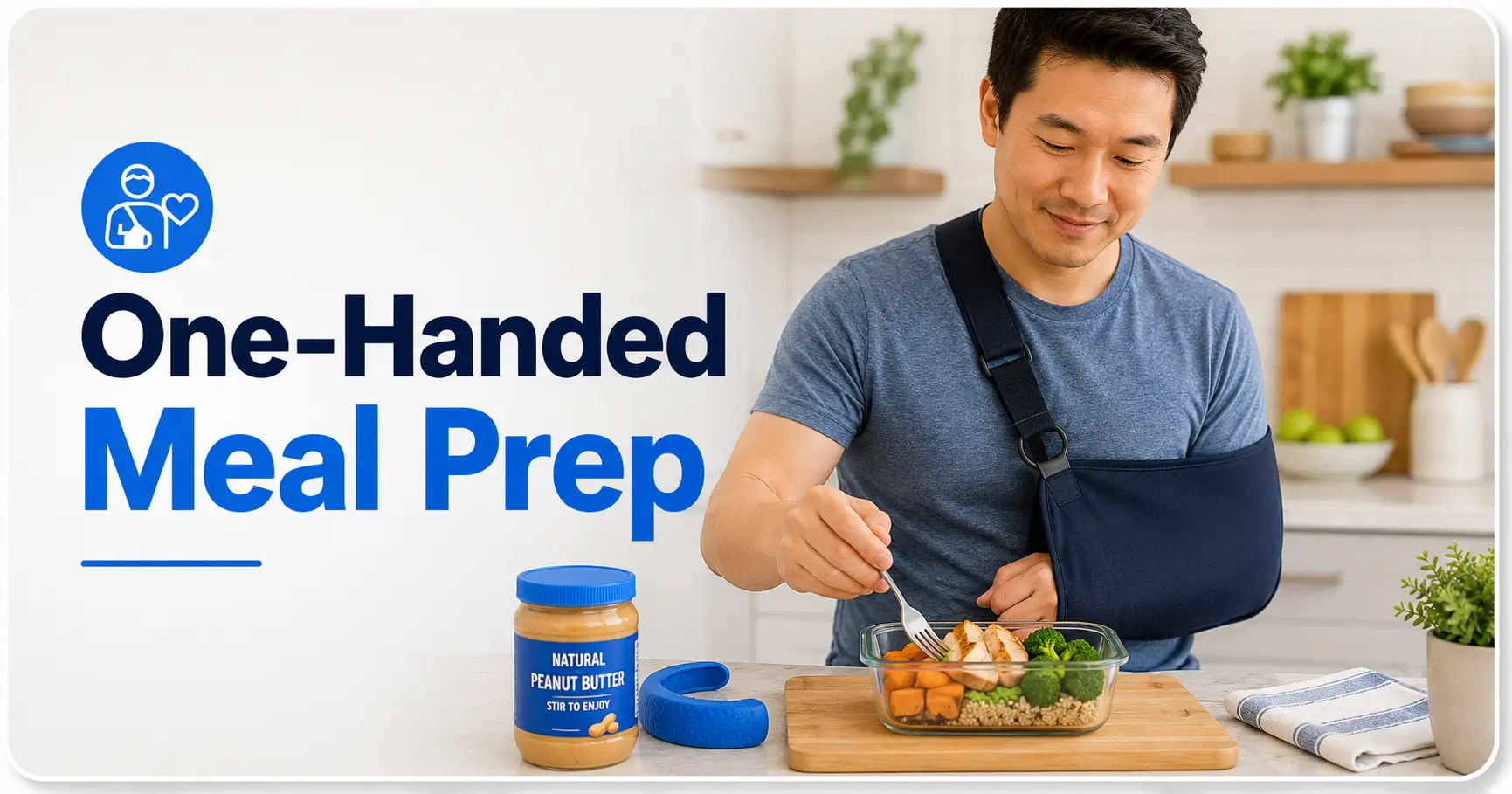
The First Surprise After Shoulder Immobilization…
It is not the pain. It is the peanut butter jar staring back like a locked bank vault.
One-handed meal prep turns ordinary kitchen tasks into small engineering problems: lids, heavy pans, fridge doors, hot bowls, slippery cutting boards, and packaging that suddenly feels personally offended by your recovery. When you are tired, medicated, sore, or working with your non-dominant hand, “just make lunch” can become the moment a safe day goes sideways.
Guessing your way through it can mean skipped meals, unsafe reaching, pain flare-ups, burns, dropped dishes, or using the healing shoulder before your care team clears it.
This guide helps you build a safer kitchen plan with no-chop foods, reachable meal stations, low-risk cooking methods, and grocery choices that reduce lifting and frustration. The goal is not culinary heroics. It is eating well without turning recovery into a countertop obstacle course.
Protect the shoulder, simplify the task, and make the safer option the easiest one.
Table of Contents
Safety First: Read This Before You Cook
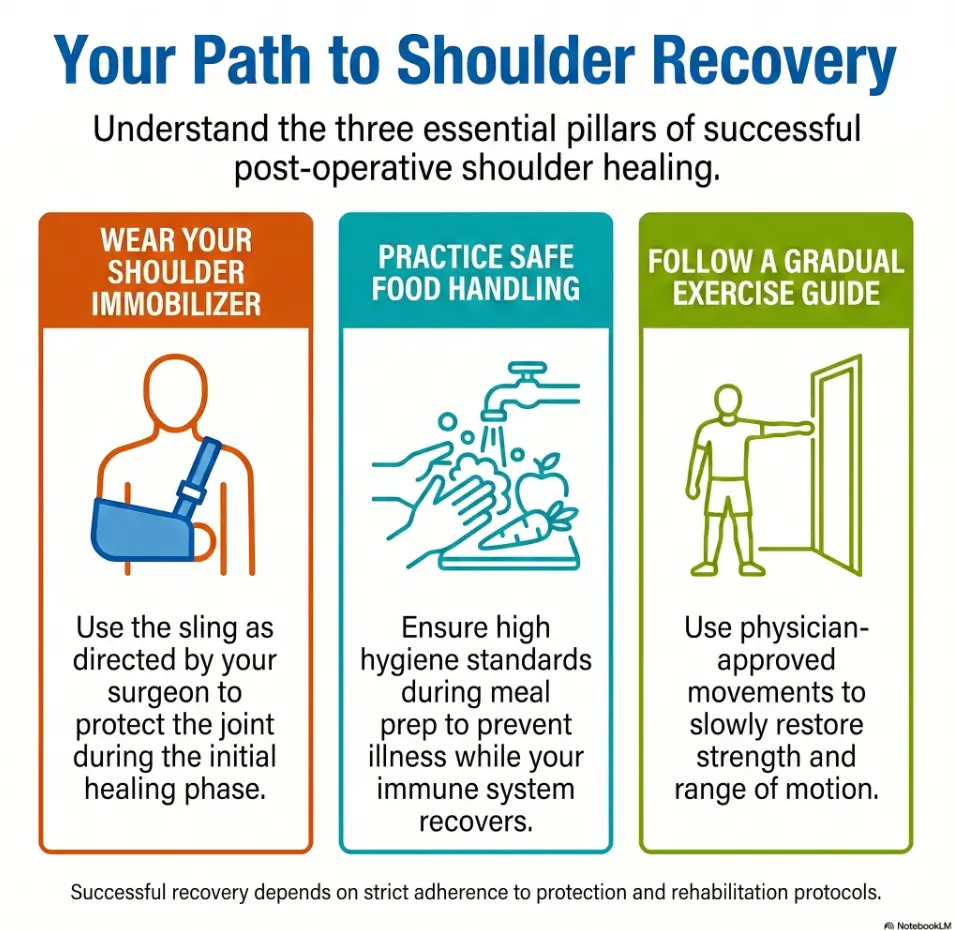
This article is general daily-living education, not personal medical advice. Shoulder immobilization rules vary by surgery type, injury, repair quality, pain level, dominant-hand involvement, medication use, wound status, and your surgeon’s protocol.
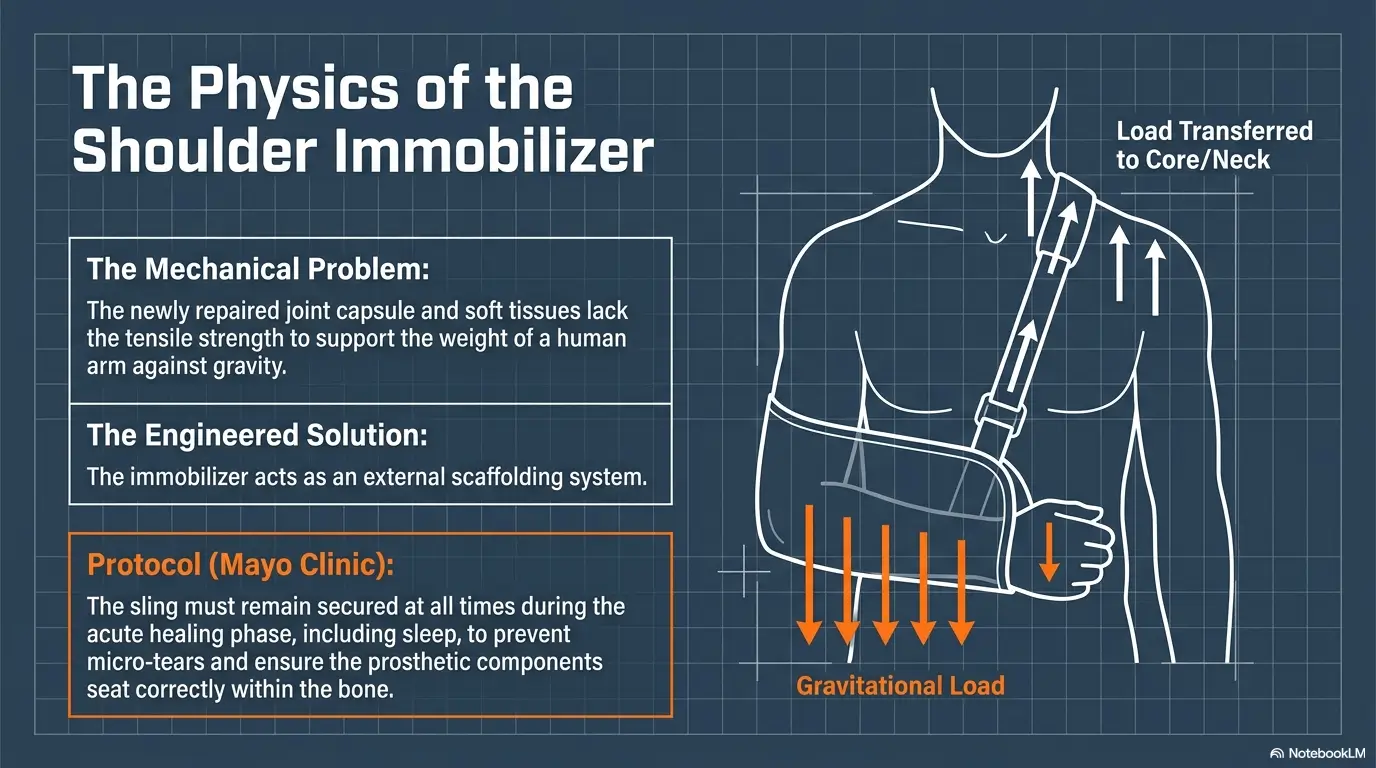
Mayo Clinic explains that after shoulder replacement, the shoulder may be placed in an immobilizer and patients should not move the shoulder unless the care team says it is okay. AAOS also emphasizes gradual return to everyday activities after shoulder surgery. Translation for the kitchen: your skillet does not outrank your surgeon.
If your care team says no meal prep, no lifting, no reaching, no standing alone while medicated, or no use of the surgical arm, that instruction wins. Every time. Even over the beautiful fantasy of making “just a quick soup.” Soup can wait. Tendons are dramatic little poets.
- Follow sling and movement rules from your care team.
- Avoid cooking if pain medication makes you dizzy, sleepy, or foggy.
- Ask for help before a task requires lifting, reaching, chopping, or hot liquid.
Apply in 60 seconds: Write your top three restrictions on a sticky note and place it on the fridge handle.
Start With the Real Problem: Your Kitchen Was Built for Two Hands
Why “just make something quick” becomes hard after a sling
Most kitchens quietly assume you have two cooperative hands, two stable shoulders, and the confidence of someone who can open a yogurt lid without negotiating with gravity.
After shoulder immobilization, “quick” changes shape. A normal breakfast might include opening the fridge, pulling a container, peeling a lid, reaching for a bowl, scooping food, carrying it to the table, and cleaning up. That is 7 or 8 separate chances to twist, drop, reach, or brace with the wrong side. If you are still deciding what kind of support belongs in your recovery day, a guide to shoulder immobilizer vs sling differences can help you understand why movement limits vary so much.
I once watched someone spend 4 minutes trying to open a hummus tub with one hand, then whisper, “This is how villains are made.” They were not wrong. Recovery can make small objects feel personally rude.
The hidden recovery tax: lids, jars, pans, doors, and reach zones
The hard part is rarely the recipe. It is the small friction points. Jar lids. Full milk cartons. Heavy ceramic plates. Deep freezer drawers. Cabinet doors above shoulder height. A pan that feels light empty but becomes a dumbbell when full of pasta water.
The hidden recovery tax is mental too. You may spend more energy deciding whether a task is safe than actually making the meal. That decision fatigue can lead to skipped meals, too much takeout, or the classic recovery dinner: crackers eaten with the solemn dignity of a raccoon in a cardigan.
Here’s what no one tells you… the fridge may be the hardest appliance
The fridge is sneaky. Doors pull forward. Shelves sit low or high. Condiments hide behind containers. A full pitcher asks for grip strength and shoulder stability. If your immobilized side is on the door side, even opening it may tempt a tiny forbidden movement.
Better plan: create one visible, front-row recovery shelf. Put easy meals, drinks, snacks, and sauces there. No treasure hunt. No crouching. No frozen peas avalanche.
One-Handed Recovery Kitchen Map
Hip to chest height. Plates, cups, utensils, snacks, meds, and water live here.
Pre-cut vegetables, washed greens, frozen rice, yogurt, eggs, beans, packets.
Microwave, toaster, kettle with caution, and sheet-pan meals only when lifting is cleared.
A labeled basket that others refill before they leave. Future you applauds quietly.
Who This Is For / Not For: Read This Before You Touch the Cutting Board
Good fit: sling users cleared for light daily activities
This guide is a good fit if your surgeon, physician assistant, occupational therapist, or physical therapist has cleared you for light daily activity using your non-immobilized hand.
That may include assembling cold meals, microwaving simple foods, making toast, pouring from lightweight containers, or using adaptive tools. The exact line is personal. Rotator cuff repair, shoulder replacement, fracture, dislocation, labrum repair, and nerve-related injuries can all come with different rules.
Not for: fresh post-op patients still dizzy, heavily medicated, or restricted from kitchen tasks
If you are fresh from surgery, dizzy when standing, groggy from pain medication, nauseated, faint, or under strict movement limits, the kitchen is not your proving ground.
Mayo Clinic notes that opioids can increase fall risk because they may cause sedation, dizziness, and trouble with thinking. That matters in a kitchen, where hot mugs, wet floors, sharp edges, and slippery packaging gather like a tiny committee of hazards. For a broader look at medication, timing, and safer symptom control, see this guide to orthopedic pain management after an injury or procedure.
When “independent” should wait one more day
Independence is not the same as doing everything alone. Some days, independence means eating well because you asked someone to put soup in single-serving containers.
I have seen recovery go smoother when people name the task honestly: “I can assemble lunch. I cannot lift the Dutch oven.” That sentence saves more trouble than a motivational poster ever could.
Eligibility Checklist: Should You Prep Food Alone Today?
- Yes / No: Have you been cleared for light kitchen activity?
- Yes / No: Can you stand for 5 to 10 minutes without dizziness?
- Yes / No: Are you alert enough to handle heat safely?
- Yes / No: Can the entire meal be made without using the immobilized shoulder?
- Yes / No: Is every item already between hip and chest height?
Neutral next step: If any answer is “No,” choose a no-cook meal or ask someone to prep the next meal.
The One-Handed Kitchen Reset: Put Everything Between Hip and Chest Height
Move daily foods before surgery or before the helper leaves
The best one-handed meal prep begins before you are hungry. Hunger makes people ambitious. Recovery kitchens need the opposite: boring, visible, repeatable.
Move daily items to one shelf, one drawer, or one counter basket. Think plates, bowls, cups, napkins, utensils, water bottle, protein snacks, easy sauces, medication schedule, and a list of meals you can make safely.
If surgery is already done, ask a helper to do a 10-minute reset. Not a full kitchen makeover. No one needs to alphabetize paprika while you are healing. Just move the essentials. A practical checklist for orthopedic home care equipment can also help you spot the small items that make recovery rooms and kitchens less annoying.
Build a no-reach zone for plates, cups, snacks, meds, and water
A no-reach zone is a small area where everything can be accessed with the non-immobilized hand while your shoulder stays quiet.
Place it on the side of your working hand. If your right shoulder is immobilized and your left hand is doing the work, put the station slightly left of center. This reduces cross-body reaching. It also reduces the awkward dance where you turn your entire torso to grab a spoon and suddenly feel like a poorly designed garden statue.
The tiny counter station that saves the whole morning
Your counter station should hold enough for one breakfast, one lunch, and one emergency snack. Add a non-slip mat, lightweight bowl, spoon, paper towel, shelf-stable protein, and a written helper note.
Good station foods: oatmeal cups, tuna packets, applesauce cups, nut butter packets, protein shakes, crackers, shelf-stable soup cups, microwave rice cups, and soft fruit that does not require heroic peeling.
- Keep essentials between hip and chest height.
- Place items on the side of your working hand.
- Use one counter basket for daily refills.
Apply in 60 seconds: Put one bowl, one spoon, one snack, and one water bottle on a non-slip mat right now.
Don’t Chop Brave: Use Ingredients That Already Did the Knife Work
Pre-cut vegetables, rotisserie chicken, washed greens, frozen rice, and canned beans
Chopping with one hand is where many good recovery plans get dramatic. The tomato rolls. The cutting board slides. The knife suddenly seems to have attended a chaos seminar.
Use ingredients that already did the knife work: pre-cut vegetables, washed greens, frozen rice, canned beans with pull tabs, rotisserie chicken, shredded cheese, soft tortillas, microwave potatoes, steam-in-bag vegetables, and single-serve hummus.
Yes, pre-cut ingredients can cost more. But during recovery, you are not only buying food. You are buying fewer risky motions, fewer dishes, and fewer chances to mutter words your grandmother would pretend not to hear.
Why soft foods beat heroic recipes during week one
Soft foods are not sad. They are strategic. Oats, yogurt bowls, scrambled eggs, soups, rice bowls, mashed avocado, cottage cheese, beans, and tender chicken are easier to scoop, chew, portion, and clean up.
They also help when appetite is strange after anesthesia or pain medication. Some people feel hungry but tired. Others feel tired of being hungry. A soft, protein-rich bowl can be the bridge between “nothing sounds good” and “I can do the next 3 hours.”
Mistake to avoid: balancing food against your body while cutting
Do not pin food against your chest, hip, sling, or immobilized arm so you can cut it. That workaround feels clever for exactly 2 seconds. Then the food slips, your shoulder tenses, and your kitchen becomes a blooper reel with medical consequences.
If it needs knife pressure, it needs help, a tool, or a different food.
Decision Card: Fresh Prep vs Pre-Cut Ingredients
| Choose this | When it makes sense | Trade-off |
|---|---|---|
| Pre-cut produce | Early recovery, limited stamina, no helper | Higher cost, shorter fridge life |
| Frozen vegetables | Need easy heat-and-eat sides | Texture may be softer |
| Helper-chopped batch | Someone can visit once or twice weekly | Requires planning and containers |
Neutral action: Pick the option that removes the most unsafe motion from your next 3 meals.
Heat Is the Villain: Choose Cooking Methods That Don’t Ask for Acrobatics
Microwave meals that still feel like food, not surrender
Microwave cooking gets mocked because people picture rubbery leftovers rotating under sad fluorescent light. But during shoulder immobilization, the microwave can be a safety tool wearing a humble little cape.
Use microwave-safe bowls with handles, vented lids, and small portions. Heat in short bursts. Stir carefully. Let food sit for 1 minute before carrying it. Avoid brim-full mugs and heavy glass containers.
Easy microwave meals include oatmeal with Greek yogurt stirred in after heating, rice cups with beans and salsa, steamed vegetables with rotisserie chicken, baked potatoes with cottage cheese, and soup in a handled mug.
Sheet-pan shortcuts only when lifting is allowed
Sheet-pan meals sound easy until you remember that a hot pan is wide, unstable, and usually requires two hands. Use them only if your care team allows the movement and someone can help with the oven.
If cleared, keep the pan light. Line it with parchment. Use pre-cut foods. Slide food onto a plate instead of lifting the pan across the room. Better yet, ask a helper to batch-cook sheet-pan meals and portion them into single-serving containers.
Slow cooker caution: heavy inserts are not recovery-friendly
Slow cookers are lovely in theory. In practice, the ceramic insert can be heavy before food even enters the story. A full insert plus hot liquid is not a recovery-friendly object.
If you use one, ask someone else to load, move, and clean it. Your job can be pressing the button and feeling morally accomplished. That counts.
Show me the nerdy details
One-handed kitchen risk rises when a task combines load, reach, heat, rotation, and time pressure. A light bowl at chest height is lower risk than a full pot lifted from a low cabinet. A cold packet opened on a non-slip mat is lower risk than a hot saucepan carried across a wet floor. The recovery-friendly question is not “Can I technically do it?” but “Can I do it without shoulder movement, bracing, rushing, heat exposure, or loss of balance?”
One-Handed Meal Formulas: Mix, Scoop, Heat, Eat
The bowl formula: grain + protein + soft vegetable + sauce
A formula beats a recipe when your energy is low. Recipes ask you to measure, chop, sauté, garnish, and pretend you are not annoyed. Formulas say, “Put food in bowl. Make it decent.” A civilized bargain.
Use this bowl formula: grain, protein, soft vegetable, sauce. Try microwave rice, canned beans, steamed frozen vegetables, and salsa. Or quinoa cup, rotisserie chicken, spinach, and yogurt sauce. Or oatmeal, nut butter, banana slices from a helper, and cinnamon.
The goal is not culinary theater. The goal is protein, fiber, comfort, and a clean exit.
The toast formula: spread + protein + crunch-free topping
Toast is a recovery hero because it stays flat, accepts toppings, and rarely requires a pan. Use a toaster only if it is easy to reach and the cord is not an obstacle.
Try ricotta and honey, hummus and soft chicken, peanut butter and banana, avocado mash and egg, or cream cheese and smoked salmon if packaging is already open. Choose toppings that spread or scoop easily. Avoid runaway cherry tomatoes unless they are already cut.
The mug formula: eggs, oats, soup, and emergency dignity
Mugs with handles are easier to stabilize than many bowls. Use them for instant oats, soup, scrambled eggs, reheated chili, or broth with noodles.
One tiny warning: a full mug of hot liquid can still be dangerous. Fill it halfway, use a tray if safe, or eat at the counter. There is no prize for transporting soup across the kitchen while your shoulder files a complaint.
Mini Calculator: How Many Recovery Meals Should Be Ready?
Use this simple planning rule. No app, no storage, no spreadsheet dragon.
Prep target: 6 easy meals, plus 2 backup snacks.
Neutral action: Ask a helper to portion that number into lightweight, single-serving containers.
Protein Without Wrestling: Easy Recovery Foods That Open Cleanly
Greek yogurt, cottage cheese, tuna packets, eggs, beans, and soft chicken
Protein matters during recovery, but protein packaging can be weirdly athletic. Giant tubs, vacuum seals, pull rings, and shrink-wrapped trays do not care about your sling.
Choose protein foods that open cleanly and portion easily. Greek yogurt cups, cottage cheese cups, tuna or salmon packets, pre-peeled hard-boiled eggs, canned beans with pull tabs, lentil soup, tofu cubes, soft rotisserie chicken, protein shakes, and nut butter packets can all work.
If you have dietary restrictions, keep the same principle: easy to open, easy to chew, easy to plate, easy to clean.
Avoid the “giant container trap” with single-serve backups
Bulk containers are economical until you need two hands to open them. A huge yogurt tub may save money but cost you energy every morning. During the first rough week, single-serve backups are not laziness. They are risk management in a tiny cup.
You can switch back to bulk later. Your budget and your shoulder can shake hands when healing is less bossy.
Let’s be honest… stubborn packaging is basically a kitchen boss fight
Some packaging seems designed by people who have never met a human wrist. If you need scissors, teeth, knees, countertop leverage, and spiritual negotiation, that food is not recovery-friendly.
Ask a helper to pre-open outer packaging, loosen lids, transfer food into easy containers, and label dates. Use lightweight containers with large tabs. Avoid glass when plastic or silicone is safer for your grip.
- Choose single servings during the hardest week.
- Ask helpers to loosen lids and portion food.
- Keep 2 shelf-stable protein backups within reach.
Apply in 60 seconds: Put one protein snack where you can reach it without opening a cabinet.
Common Mistakes: What Makes One-Handed Meal Prep Riskier Than It Looks
Mistake #1: lifting a full pot because it “doesn’t feel that heavy”
A full pot is not just weight. It is weight plus heat, slosh, grip demand, balance, and the temptation to use your immobilized side when things tilt.
If you cannot move it safely with the non-immobilized hand while keeping your shoulder still, do not move it. Use smaller portions, microwave-safe containers, or helper support.
Mistake #2: reaching across the body with the immobilized side
Cross-body reaching can sneak in when you grab the fridge handle, pull a drawer, steady a bowl, or catch a falling item. The movement may feel tiny, but early recovery is built from tiny choices.
Set the kitchen so the working hand does the work. If something falls, let it fall. A spoon on the floor is not an emergency. A healing repair deserves more loyalty than a spoon.
Mistake #3: cooking while pain medication is making judgment foggy
Medication fog can make unsafe plans sound completely reasonable. “I will just sauté onions” is a sentence that should be carefully questioned if you feel sleepy, lightheaded, or slow.
Choose no-cook food when medicated. If you must heat something, keep it microwave-based, small, and seated nearby. Better yet, ask someone to prepare it.
Mistake #4: skipping meals because prep feels embarrassing
This mistake is quiet. You look at the kitchen, feel overwhelmed, and decide you are “not that hungry.” Then pain medication hits an empty stomach, energy drops, and the day gets harder.
Needing help with food is not failure. It is logistics. Even elite athletes need support teams, and they are not usually trying to open applesauce with one shoulder locked down. If recovery support may involve therapy visits, mobility help, or a short-term facility stay, it can be useful to compare your options for choosing rehab after surgery before the hard week arrives.
Risk Scorecard: Is This Kitchen Task Too Much Today?
| Risk factor | Low-risk version | Higher-risk version |
|---|---|---|
| Weight | Single serving | Full pot or heavy pan |
| Heat | Warm bowl with handle | Boiling water or hot oil |
| Reach | Hip-to-chest zone | High shelf, low drawer, back of fridge |
| Alertness | Clear-headed | Dizzy, sleepy, medicated, rushed |
Neutral action: If a task has 2 or more higher-risk factors, change the meal or ask for help.
Tools That Help Without Turning Your Counter Into a Gadget Museum
Non-slip mats, electric can openers, rocker knives, jar openers, and lightweight dishes
Adaptive tools can help, but recovery shopping can become its own little carnival. Suddenly your cart contains 14 gadgets, a suction-cup cutting board, and something called a “universal opener” that looks like it escaped from a submarine.
Start with the bottleneck. If containers slide, get a non-slip mat. If cans are the problem, consider an electric can opener. If jars defeat you, use a mounted or rubber jar opener. If plates are heavy, use lightweight dishes. If chopping is unavoidable and approved by your care team, ask an occupational therapist whether a rocker knife or adaptive board is appropriate.
Buy only what solves a daily bottleneck
A tool earns counter space only if it solves a task you face at least 3 times a week. Otherwise, it becomes clutter, and clutter is a reach hazard wearing a retail receipt.
The best tools are simple: stable, washable, lightweight, and usable with your non-immobilized hand. Avoid gadgets that require force, awkward angles, or complicated cleaning. For broader planning beyond the kitchen, this overview of orthopedic home care equipment can help you separate useful supports from countertop clutter.
The “one-hand test” before any tool earns counter space
Before relying on a tool, test it with the immobilized side completely quiet. Can you use it with one hand? Can you clean it? Can you store it safely? Does it slide? Does it require pressing down hard?
If the answer is no, it may still be useful with a helper, but it is not an independence tool yet.
- Stabilize first with a non-slip mat.
- Choose lightweight dishes over heavy ceramics.
- Test each tool with the safe hand only.
Apply in 60 seconds: Name your worst kitchen bottleneck: opening, stabilizing, heating, carrying, or cleaning.
Grocery Planning: Order Like Someone Who Loves Future You
Choose delivery, pickup, or helper-friendly lists when possible
Grocery shopping after shoulder immobilization is not just shopping. It is lifting, carrying, bending, reaching, bag handling, payment, transport, unpacking, and pretending the watermelon was a good idea.
Use delivery, curbside pickup, or helper shopping when possible. Keep the list specific. Instead of “stuff for lunches,” write “6 Greek yogurt cups, 3 microwave rice cups, 2 tuna packets, 1 bag washed greens, 1 rotisserie chicken, 4 soup cups.” Helpers are kind, but they are not mind readers with produce intuition.
Build a seven-day recovery cart with low-prep anchors
Your recovery cart needs anchors, not inspiration. Choose 2 breakfasts, 2 lunches, 2 dinners, 2 snacks, and 2 drinks you can repeat. Repetition is not boring during recovery. It is a handrail.
Good anchors include oatmeal cups, eggs, yogurt, cottage cheese, soup, rice bowls, frozen vegetables, beans, soft tortillas, pre-cooked chicken, applesauce, protein shakes, bananas, and easy sauces.
Don’t do this: buying beautiful ingredients that require heroic prep
A whole butternut squash may look wholesome. During shoulder immobilization, it is basically a decorative boulder.
Skip foods that require peeling, chopping, draining heavy pots, tight twisting, or long cleanup. Choose the less romantic version. Cubed squash. Frozen vegetables. Pre-washed greens. Packets. Recovery is not the season for proving your relationship with root vegetables.
Seven-Day Recovery Cart: Low-Prep Anchors
| Meal slot | Easy options | Helper note |
|---|---|---|
| Breakfast | Oat cups, yogurt cups, protein shakes | Place at front of fridge or counter basket |
| Lunch | Rice cups, tuna packets, soup cups, washed greens | Open outer packaging in advance |
| Dinner | Frozen vegetables, rotisserie chicken, beans, microwave potatoes | Portion heavy foods into single servings |
| Backup | Applesauce, crackers, nut butter packets, cottage cheese | Keep 2 backups within safe reach |
Neutral action: Build the cart around meals you can assemble without chopping or lifting cookware.
Food Safety Still Counts: One Hand Is Not a Free Pass
Keep raw meat out of the early recovery menu when possible
Food safety does not pause because your arm is in a sling. The FDA’s core food safety message is still clean, separate, cook, and chill. That sounds simple until you try to wash a cutting board one-handed after handling raw chicken.
For early recovery, reduce raw meat handling when possible. Use fully cooked proteins, canned beans, pasteurized dairy, eggs cooked simply if you can manage them safely, and pre-cooked chicken portioned by a helper.
This is not because raw meat is forbidden forever. It is because raw meat adds more steps: separate tools, careful washing, temperature checks, and cleanup. More steps mean more chances to use the wrong arm or miss a safety detail while tired.
Use disposable prep barriers wisely, not wastefully
Parchment paper, paper plates, foil, and disposable gloves can reduce cleanup, but they should not create new problems. Loose foil can slide. Gloves can be hard to put on. Paper plates can buckle under hot food.
Use barriers where they reduce risk: lining a tray, covering a counter spot, or separating ready-to-eat foods from packaging. Keep a trash bag within safe reach so cleanup does not become a cabinet-opening expedition.
Clean-as-you-go, but only inside your safe reach zone
Clean-as-you-go is good advice until “go” involves bending, twisting, and carrying dishes across the kitchen. During immobilization, clean only what is within safe reach. Put messy items in a labeled bin for later helper cleanup if needed.
A clean kitchen matters. So does not slipping on spilled soup because you tried to mop heroically with one useful arm.
- Use cooked proteins when raw meat cleanup is too hard.
- Chill leftovers promptly in small containers.
- Keep cleaning supplies inside your safe reach zone.
Apply in 60 seconds: Move one disinfecting wipe pack or towel roll to your recovery station.
When to Seek Help: Kitchen Struggle Can Be a Medical Signal
Call your care team if pain spikes after simple kitchen tasks
Some soreness after daily activity may be expected depending on your procedure, but a sharp pain spike, new weakness, new swelling, or pain that feels different deserves attention.
Do not self-diagnose from a kitchen incident. Call your surgeon’s office, physical therapist, or urgent care line based on your discharge instructions. “I lifted a pot and now it hurts” is exactly the kind of ordinary detail care teams need to hear. If pain keeps outrunning the plan, this guide to joint replacement pain management may help you prepare better questions for your next appointment.
Get help if your hand becomes numb, cold, swollen, weak, or discolored
If your hand or arm becomes numb, cold, very swollen, weak, blue, pale, or unusually painful, contact medical help promptly. Those symptoms can signal circulation, nerve, swelling, or sling-fit concerns.
Also ask for help if the immobilizer feels too tight, your fingers are not moving normally, or your pain is not controlled as expected.
Ask for support if meal prep leads to skipped meals, dizziness, or unsafe lifting
Skipped meals are not just an inconvenience. They can make medication side effects feel worse, lower energy, and increase frustration. If meal prep regularly ends with you giving up, the plan is too hard.
Support can look modest: a neighbor opening jars, a family member portioning dinners, a friend placing groceries on the right shelf, or a meal delivery plan for 1 week. This is not surrender. This is project management with snacks.
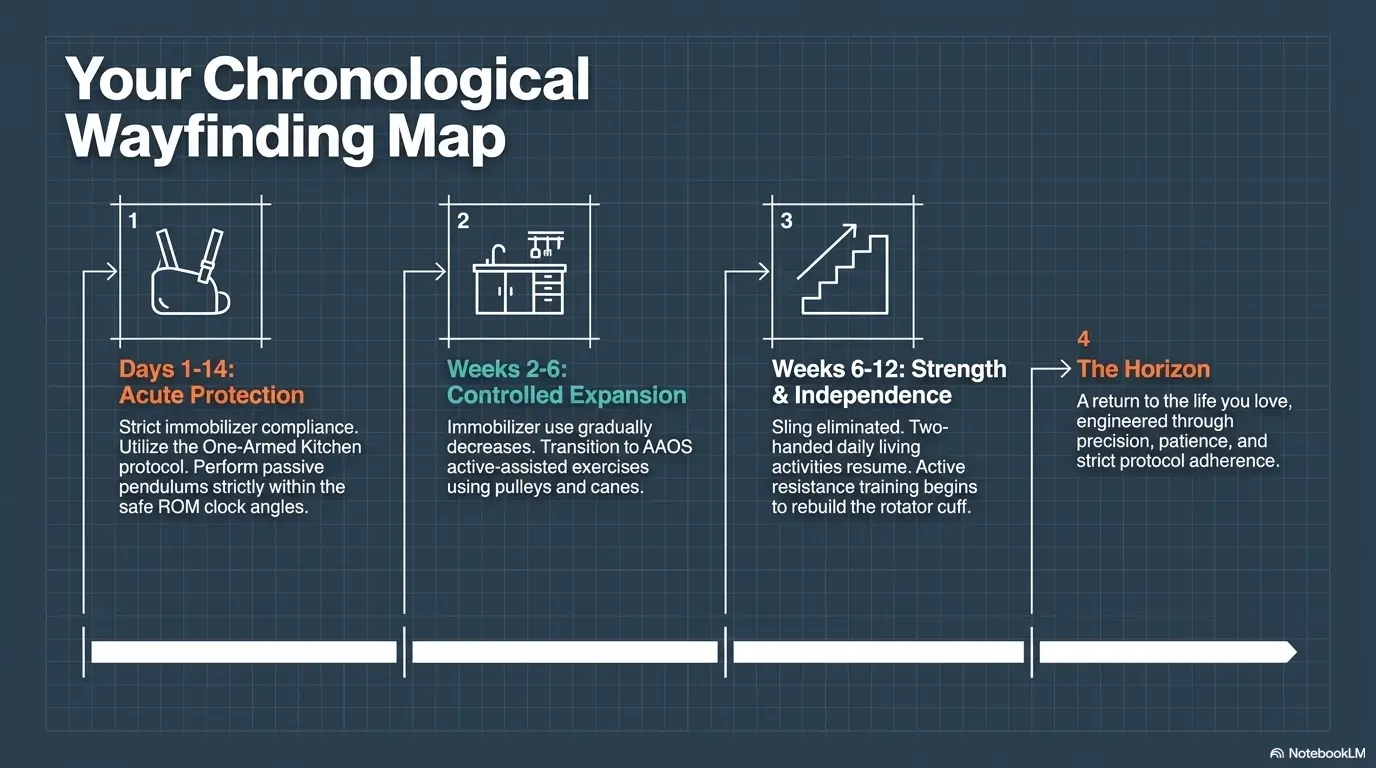
Follow your surgeon’s sling and movement instructions over any online checklist
Online advice can help you think through daily life. It cannot see your incision, repair, imaging, medication list, balance, or exact restrictions. Your care team has the map. This article is only a flashlight.
FAQ
Can I cook while wearing a shoulder immobilizer?
Maybe, but only if your care team has cleared you for light daily activity and the task can be done without moving or using the immobilized shoulder. Early on, many people should avoid cooking alone, especially if dizzy, medicated, or restricted from kitchen tasks. Choose no-cook or microwave meals first.
What meals are easiest to make with one hand after shoulder surgery?
The easiest meals follow a mix, scoop, heat, eat pattern. Good options include yogurt bowls, oatmeal cups, rice bowls, soup cups, microwave potatoes, cottage cheese with fruit, tuna packets with crackers, beans with microwave rice, and soft tortillas with pre-cooked protein.
Can I use a knife with one hand while my shoulder is immobilized?
Knife use is risky if food slides, the board moves, or you brace with your immobilized side. Use pre-cut ingredients when possible. If you need adaptive cutting tools, ask an occupational therapist or your care team what is appropriate for your restrictions.
How do I open jars and cans after shoulder immobilization?
Use pull-tab cans, packets, single-serve containers, rubber jar grips, mounted jar openers, or electric can openers. Better yet, ask a helper to loosen lids and portion foods into easy-open containers. Avoid using your teeth, knees, sling, or immobilized arm to force packaging open.
What kitchen tools help most after shoulder surgery?
The highest-value tools are usually simple: a non-slip mat, lightweight dishes, easy-grip utensils, handled microwave-safe bowls, a jar opener, an electric can opener, and pre-portioned containers. Buy based on your daily bottleneck, not because a gadget looks clever at 1 a.m.
Is microwave cooking safer than stovetop cooking during recovery?
Often, yes. Microwave cooking can reduce lifting, hot pans, stirring, and standing time. Still, use small portions, vented lids, handled containers, and short heating intervals. Hot liquids can burn, so do not overfill mugs or carry heavy bowls across the kitchen.
How should I grocery shop after shoulder immobilization?
Use delivery, curbside pickup, or helper shopping when possible. Build your list around low-prep anchors: yogurt cups, oatmeal, protein shakes, soup cups, microwave rice, canned beans, washed greens, frozen vegetables, rotisserie chicken, and easy snacks. Ask helpers to place items within safe reach.
When should I ask someone else to prepare meals for me?
Ask for help if you are dizzy, heavily medicated, in increased pain, not cleared for kitchen tasks, skipping meals, or tempted to lift, chop, reach, or handle hot cookware. Help with food is not weakness. It is one of the simplest ways to protect recovery.
Next Step: Build One Recovery Meal Station Today
Put three safe meals, two drinks, one snack, and utensils within easy reach
Remember the peanut butter jar from the beginning? The goal is not to defeat it with courage. The goal is to stop letting jars, cabinets, pans, and fridge shelves decide whether you eat.
Build one recovery meal station today. Place three safe meals, two drinks, one snack, utensils, napkins, and any approved medication schedule within your safe reach zone. Keep everything between hip and chest height. Put heavier items in smaller containers.
Test the setup with your non-immobilized hand only
Now test it. Keep the immobilized side quiet. Can you open the food? Can you plate it? Can you heat it if needed? Can you clean up the minimum mess? If not, adjust the station before hunger arrives wearing tap shoes.
This test takes 5 minutes and can prevent 5 days of frustration. That is a trade I would take even before coffee. If nighttime comfort is also disrupting recovery, a practical comparison of recliner vs bed after shoulder surgery can help you make the rest of the day less chaotic too.
Write one helper note: “Please refill this station before you leave”
Helpers want to help, but vague requests create vague results. Write a clear note: “Please refill this station before you leave: 3 meals, 2 drinks, 1 snack, clean spoon, napkins.”
That single note turns care into a system. It also protects your dignity because you do not have to ask from scratch every time.
- Stock meals before you are hungry.
- Test every item with the safe hand only.
- Use a refill note so helpers know exactly what to do.
Apply in 60 seconds: Choose the first three foods for your station and place them where you can see them.
One-handed meal prep after shoulder immobilization is not about becoming a heroic solo chef. It is about making the safer choice easier than the risky one. Reduce reach. Reduce weight. Reduce chopping. Reduce heat. Increase visibility, protein, hydration, and help.
Within the next 15 minutes, build one small station and test one meal with your non-immobilized hand only. If it works, you have a plan. If it does not, you have useful information before the soup gets hot and the jar starts smirking.
Last reviewed: 2026-05.
Tags: shoulder surgery recovery, one-handed meal prep, shoulder immobilizer, safe kitchen setup, recovery meal planning
Meta description: One-handed meal prep after shoulder immobilization made safer with no-chop foods, reach zones, tools, grocery plans, and recovery meal stations.