
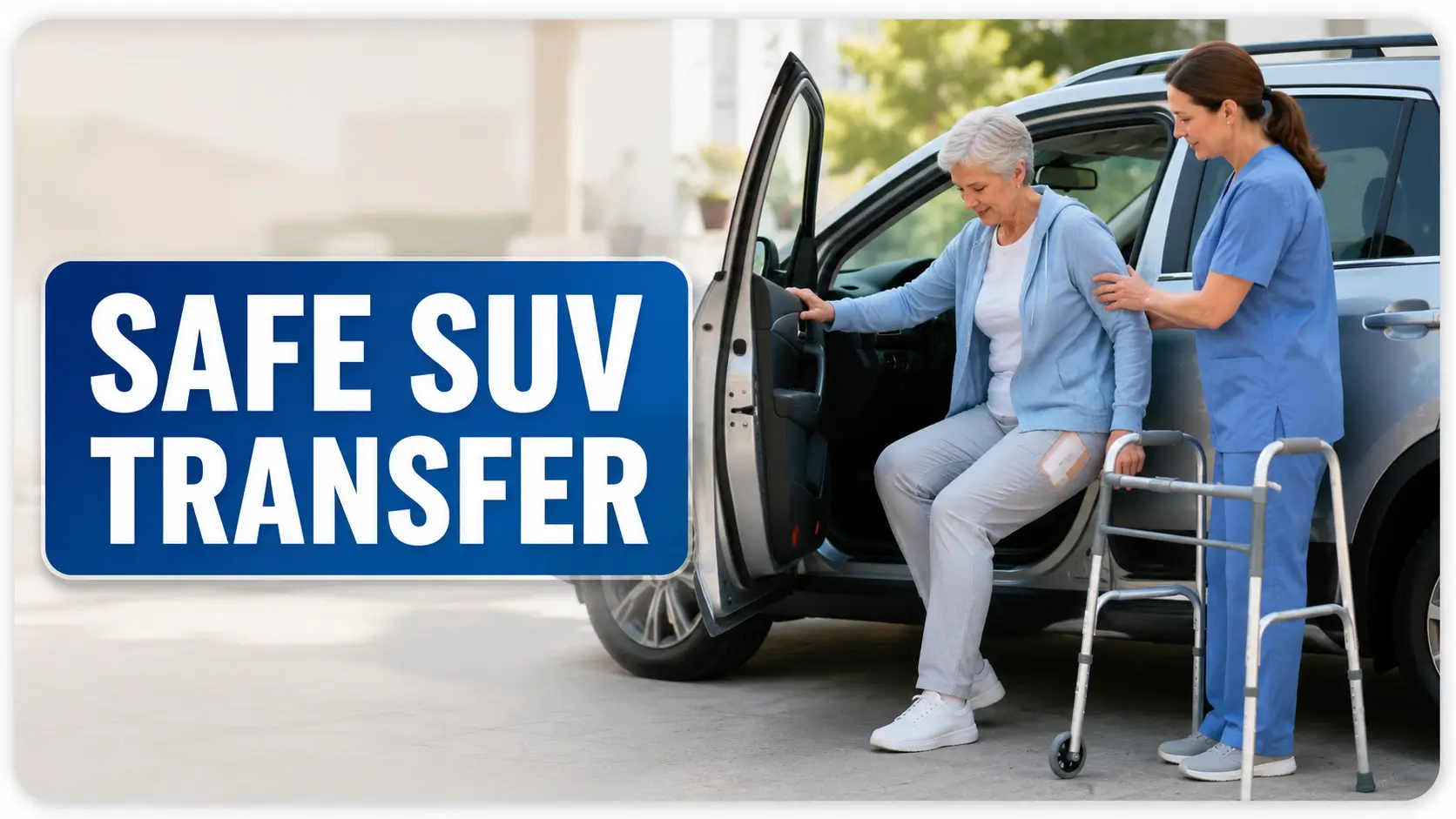
The Post-Op SUV Transfer:
Why “Boring” is the Ultimate Goal
A hip surgery ride home should not feel like a small obstacle course with seat belts, running boards, and one very anxious driver. Getting into an SUV can be trickier than it looks—the seat may be too high, too deep, or just awkward enough to invite twisting at the worst possible moment.
This guide helps you set up the vehicle, choose safer seat positioning, use calm caregiver cues, and identify red flags. Our approach is practical and conservative: follow the surgeon’s hip precautions, use the physical therapist’s logic, and make the whole sequence boring on purpose.
Because after hip surgery, boring is not bland. Boring is safe.
Table of Contents
Safety First: Read This Before Trying the Transfer
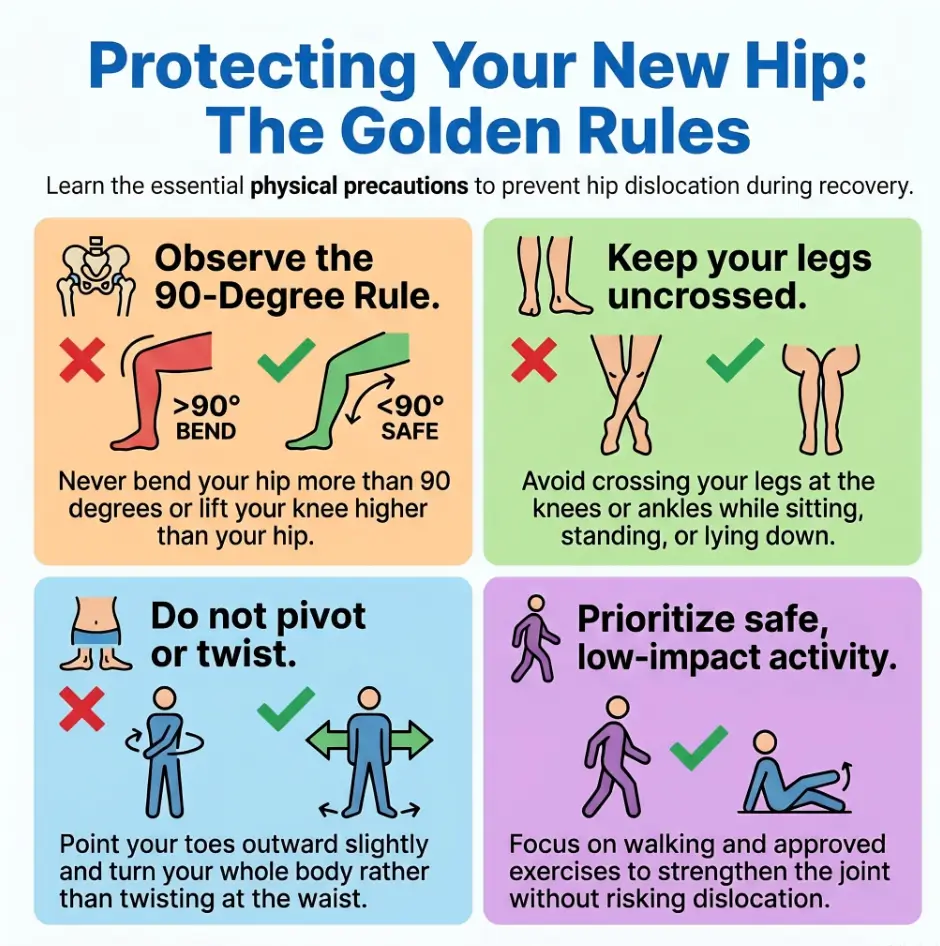
This article is general education, not personal medical advice. Hip surgery instructions vary by procedure, surgical approach, implant type, bone quality, pain level, medication, and weight-bearing status. A total hip replacement patient may receive different rules from someone recovering from a fracture repair, hip resurfacing, or labral surgery.
Your discharge paperwork, surgeon, and physical therapist outrank any article on the internet, including this one wearing its helpful little clipboard.
The American Academy of Orthopaedic Surgeons explains that returning to daily activities after total hip replacement should be gradual. MedlinePlus, from the U.S. National Library of Medicine, gives practical home-care guidance for new hip joints, including car transfers, seat height, breaks during long rides, and not driving until your surgeon clears you.
- Read the discharge instructions before the ride.
- Ask the physical therapist to demonstrate the transfer if possible.
- Stop if pain, dizziness, weakness, or confusion shows up.
Apply in 60 seconds: Circle the words “weight-bearing,” “hip precautions,” and “driving” in your discharge paperwork.
First, Know Which “Hip Surgery” Rules You Actually Have
Hip replacement, hip fracture repair, labral repair, or resurfacing? The transfer rules may differ
“Hip surgery” sounds like one category until you are standing beside an SUV with a walker, a nervous driver, and a seat that suddenly looks like a barstool. The rules can differ widely.
A total hip replacement often comes with precautions designed to reduce dislocation risk while tissues heal. Hip fracture repair may come with strict weight-bearing limits. Labral repair may focus more on range of motion and avoiding stress on healing tissue. Hip resurfacing may carry its own surgeon-specific instructions.
That is why the first step is not the car. The first step is knowing the rulebook you were actually handed. For a broader recovery context, it may also help caregivers understand how joint replacement pain management fits into early mobility, sleep, and appointment planning.
Posterior vs anterior precautions: why “don’t twist” is not always the whole story
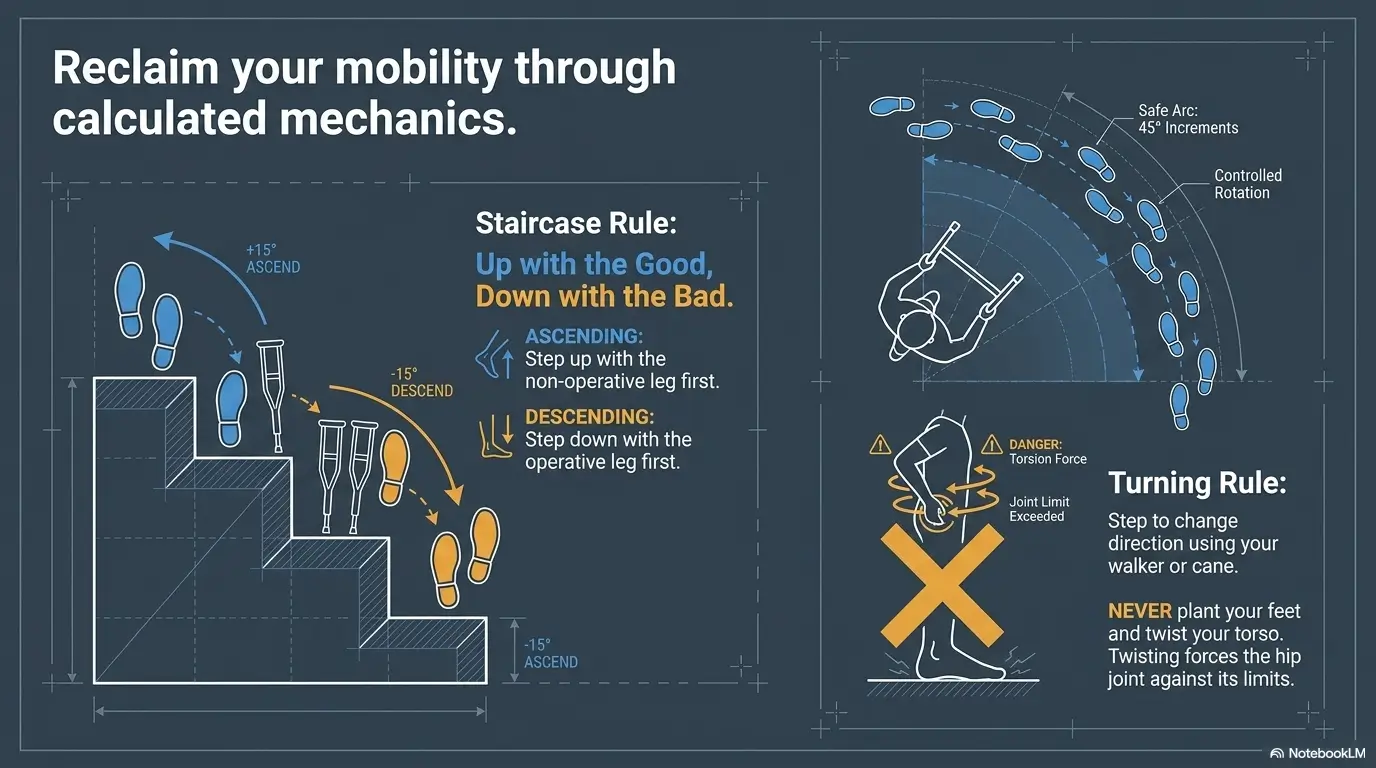
Some patients are told to avoid bending the hip too far, crossing the legs, or turning the operated leg inward. Others may receive fewer traditional restrictions, especially after certain anterior-approach procedures. But “fewer” does not mean “freestyle.” It means your care team has decided what applies to your case.
I have watched families treat hip precautions like a secret restaurant menu. Someone whispers, “My neighbor could do stairs on day two,” and suddenly everyone is improvising. Please do not let Neighbor Gary become your orthopedic consultant.
Weight-bearing status: the tiny phrase that changes the whole SUV plan
Weight-bearing status is the quiet boss of the transfer. It may say weight bearing as tolerated, partial weight bearing, toe-touch weight bearing, or non-weight bearing. Those phrases change how the patient approaches the SUV, whether they can step up, and how much help they need.
If the patient cannot safely bear full weight, a tall SUV with a running board may be a poor match. What looks sturdy in the driveway may behave like a small cliff when pain medication, fatigue, and a fresh incision enter the room.
Let’s be honest: discharge papers are not bedtime reading
Discharge instructions are usually written when everyone is tired. The patient wants a bed. The caregiver wants a coffee. The nurse is juggling three alarms and a printer that has chosen rebellion.
Still, that packet matters. Look for these exact items before the first SUV ride:
- Allowed hip motion: bending, twisting, crossing, and turning limits.
- Weight-bearing rule: how much weight may go through the surgical leg.
- Assistive device: walker, cane, crutches, or hands-on guarding.
- Medication warning: whether pain medicine makes driving or balance unsafe.
- Emergency signs: symptoms that require calling the surgeon or emergency care.
The SUV Problem: Too High, Too Deep, Too Much Pivot
Why SUVs feel safer but can be trickier than sedans
SUVs feel reassuring because they are tall, solid, and easy to spot in a parking lot. After surgery, that height can be either a gift or a trap. If the seat is close to hip level, wonderful. If the seat is too high, the patient may have to climb. If it is too low or too deep, they may drop, twist, or struggle to scoot back.
The safest vehicle is not always the newest or biggest. It is the one that lets the patient sit down with control.
Seat height, running boards, and the “half-climb” danger zone
The awkward part of many SUV transfers is the half-climb. One foot is on the ground. One hand is searching for a stable place. The surgical leg is trying to behave. The caregiver is hovering like a weather helicopter.
Running boards can help some people before surgery. After hip surgery, they may create a risky step-up motion, especially if weight-bearing is limited. They can also be narrow, wet, icy, or placed at a height that forces the hip into an angle your care team wanted you to avoid.
Door frame math: where walkers, canes, and human elbows collide
An SUV door opening can look generous until a walker joins the party. Then the geometry gets fussy. The open door may block the caregiver. The walker may not fit close enough. The seat may be set too far forward. The patient may reach for the door, which can move.
Good SUV transfers are not powered by strength. They are powered by setup, especially when the patient is also learning safer walker use during painful senior mobility.
SUV Transfer Mini-Map: The Calm Sequence
1
PrepareLevel ground, seat back, floor clear.
2
Back upFeel the seat behind both legs.
3
SitLower slowly, using stable support.
4
PivotBring both legs in together, no twisting.
The quiet risk: rushing because traffic is waiting
Driveways and hospital pickup lanes have a strange emotional pressure. A car is waiting. A staff member is nearby. Someone behind you sighs. Suddenly, the transfer becomes a performance.
Do not perform. Breathe. A safe transfer that takes 90 seconds is better than a fast one that turns into three weeks of regret.
Before You Open the Door, Build a 60-Second Transfer Zone
Park on level ground, not a curb, slope, or gravel patch
The best transfer starts before the patient reaches the SUV. Park on level ground if you can. Avoid curbs, steep driveways, loose gravel, wet leaves, snow, ice, and anything that makes the walker wobble.
Street-level entry matters because climbing from a curb or stepping down from a curb changes hip angles and balance. It also makes the caregiver’s job harder. A caregiver guarding on a slope is not caregiving. That is low-budget mountaineering.
Move the seat back before the patient arrives
Push the passenger seat all the way back before the patient approaches. This creates space for the legs and reduces the need to twist. If the seat is powered, do it early. No one wants to stand on a fresh hip while the seat motor hums along like a slow kitchen appliance.
Set the seat at a height that allows controlled sitting. If the SUV has adjustable suspension or seat height, use it only if you already know how it works. Surgery day is not the day to discover a hidden button labeled “Adventure Mode.”
Recline slightly, but not into a beach-chair trap
A slight recline can help the patient bring the legs into the SUV without bending too far at the hip. But too much recline can make it hard to sit down, scoot back, or buckle the seatbelt.
Think supportive, not lounge chair. The goal is to protect the hip, not create a nap pod.
Clear the floorboard: no bags, bottles, umbrellas, or rogue fries
Clear the passenger floor before the patient gets close. Remove backpacks, water bottles, purses, charger cords, umbrellas, fast-food bags, and anything that can catch a foot. A single rolling bottle can turn a careful transfer into slapstick nobody asked for.
Keep the walker or cane within reach until the patient is fully seated. Once the patient is inside, place the assistive device where it can be retrieved safely at the destination. Families setting up the home for recovery may also want to review orthopedic home care equipment before discharge day turns the hallway into a supply closet with opinions.
Money Block: 60-Second SUV Transfer Zone Checklist
| Check | Yes / No | Next step |
|---|---|---|
| Vehicle is on level ground | Yes / No | Move before transfer if no. |
| Seat is pushed back | Yes / No | Adjust before patient stands near door. |
| Floorboard is clear | Yes / No | Remove loose objects. |
| Caregiver knows the cue words | Yes / No | Use “back up, sit, legs together.” |
Neutral action line: Print or screenshot this checklist before discharge day.
The Safer SUV Entry Sequence: Back Up, Sit, Pivot, Breathe
Step 1: Back up until both legs touch the seat edge
The patient should approach the open passenger door using the recommended assistive device. Then they turn carefully, following hip precautions, until their back faces the seat. They should back up until they feel the seat against the backs of both legs.
This contact matters. It tells the body where the landing zone is. Without it, sitting becomes a trust fall with a deductible.
Step 2: Reach only for stable surfaces, not the door
Use stable surfaces your care team has approved. Many hospital therapy instructions warn against pulling on the open car door because it can move. The door may feel solid, then swing, shift, or bounce at exactly the wrong moment.
Depending on the vehicle and training, the patient may use the seat, dashboard area, grab handle, or walker until positioned. But this is where professional instruction matters. Some grab handles are useful. Some are decorative confidence traps.
Step 3: Sit first, then bring legs in together
The safest SUV entry pattern after many hip surgeries is: sit first, then bring the legs in. Do not lead with one leg, twist the upper body, and drag the surgical leg after it. That corkscrew motion is exactly what many precautions are trying to avoid.
Once seated, scoot back as safely as allowed. Then pivot the body and bring both legs into the vehicle together. Some patients use their hands to assist the surgical leg. Others use a leg lifter, belt, or caregiver cue if trained.
Step 4: Use a plastic bag or slick cloth only if your care team approves
Some therapy teams suggest a slick surface on the seat to reduce friction while pivoting. Others do not, especially if sliding creates instability. If approved, remove the slick item before the vehicle moves so the patient does not slide during braking.
That little detail matters. A slippery seat may help the pivot, then become a tiny ice rink at the first stop sign.
Pattern interrupt: the goal is boring
The best SUV transfer is not heroic. It is boring. No dramatic lift. No breath-holding. No “just one big step.” No caregiver grunt that sounds like a gym membership regretting itself.
Back up. Sit. Pivot. Breathe. That is the whole music.
Show me the nerdy details
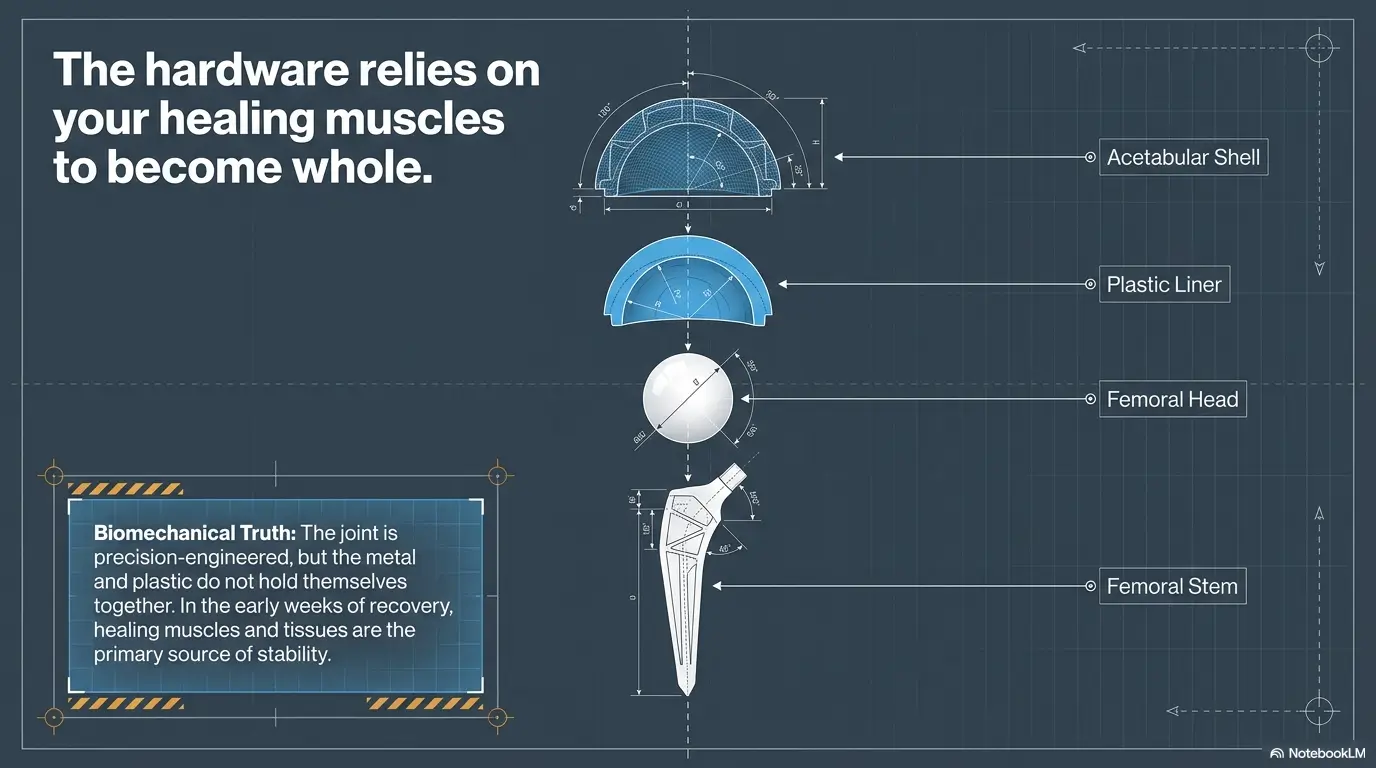
Most transfer problems come from combining too many motions at once: stepping, rotating, lowering, reaching, and loading the surgical side. A safer sequence breaks those motions into separate stages. First, the patient stabilizes with the assistive device. Next, they back up to the seat so the sitting target is known. Then they lower the body with control. Only after the pelvis is supported by the seat do they pivot the legs inward. This staged pattern can reduce uncontrolled twisting and rushing, especially when the SUV seat is higher or deeper than a normal chair.
Common Mistakes That Turn an SUV Transfer Into a Small Disaster
Mistake 1: stepping onto a running board too early
A running board looks helpful because it breaks the climb into two parts. But after hip surgery, two parts can mean two chances to lose balance. The step may be too narrow. It may force the hip into a poor angle. It may also require more weight through the surgical leg than allowed.
If the patient has not been cleared to use a running board, skip it. Ask the physical therapist whether the SUV height is appropriate or whether a lower vehicle would be safer.
Mistake 2: pulling on the open door like it is a grab bar
The open door is tempting. It is right there, big and friendly, practically waving. It is also mobile. Pulling on it can shift the patient’s balance away from the seat.
If a surface can move, it is not a reliable support. That is true for car doors, rolling chairs, loose walkers, and relatives who say “I got you” while standing in sandals on wet pavement.
Mistake 3: twisting the surgical leg while the upper body faces forward
Twisting often sneaks in when the patient sits halfway, turns the shoulders, and leaves the surgical leg behind. The body becomes a pretzel. A very expensive, recently operated pretzel.
Move the body as a unit. Keep the operated leg positioned as instructed. Bring the legs together rather than yanking one leg in at a sharp angle.
Mistake 4: letting the caregiver lift under the armpits
Lifting under the armpits can hurt shoulders, startle the patient, and pull the torso without controlling the hips or legs. It also turns the caregiver into a crane, which is bad for backs and worse for trust.
Caregivers should guard, cue, and steady according to therapy training. They should not haul the patient into the vehicle like luggage avoiding an airline fee.
Mistake 5: choosing the tallest family SUV because it “feels sturdy”
Sturdy is not the same as accessible. A tall SUV can be harder than a midsize sedan if the patient has to climb. A lower vehicle can be harder if the patient has to drop too far. The best option is the seat that meets the patient at a controlled sitting height.
- Do not use the door as a grab bar.
- Do not rush because someone is waiting.
- Do not assume bigger vehicles are safer.
Apply in 60 seconds: Pick the vehicle by seat height and transfer control, not by family habit.
Cushion or No Cushion? Fix Seat Height Without Creating a Slide
When a firm cushion can help with a low seat
If the SUV seat is too low, a firm cushion may help raise the sitting surface. MedlinePlus notes that car seats should not be too low after hip replacement care and that a pillow may help when extra height is needed.
The key word is firm. A firm cushion can reduce the drop into the seat. A soft pillow can collapse, tilt, or bunch up. It may feel kind for 8 seconds and then behave like a marshmallow with opinions.
When a cushion makes the transfer less stable
A cushion can backfire if it slides, raises the patient too high, changes the seatbelt position, or makes the patient feel perched rather than supported. It can also make it harder to scoot back safely.
Try the cushion before the real ride if possible. The first test should not happen in the hospital pickup lane while a volunteer waits with a wheelchair and the sky begins doing weather.
Why soft pillows can feel kind and behave badly
Soft pillows are comforting in bed, but car transfers need predictable surfaces. A pillow that compresses unevenly can make the pelvis tilt. A slippery pillowcase can move during the pivot. A thick pillow can lift the patient so high that their feet do not reach the ground well before sitting.
Predictable beats plush. If hip discomfort is also interfering with rest after the ride, this related guide on sleeping discomfort after hip replacement can help families think beyond the driveway and into the first nights at home.
The “can I slide easily?” test before the first ride
Before using any cushion, ask three questions:
- Does it stay in place when the patient begins to sit?
- Does it keep the hip within the allowed position?
- Can the patient buckle the seatbelt correctly after sitting?
If the answer is uncertain, ask the physical therapist. Small setup choices can create big transfer differences.
Caregiver Choreography: Help Without Accidentally Steering the Hip
Stand close enough to guard, not close enough to block
A caregiver should be close enough to help if balance shifts, but not so close that the patient cannot use the walker or sit down properly. The caregiver is not the main engine. The patient moves. The caregiver guards.
When I have helped with post-procedure rides in my own family circle, the hardest part was not strength. It was resisting the urge to over-help. Over-helping can feel loving, but sometimes it turns the patient into a passenger before they are even in the passenger seat.
Cue the movement in short phrases: “back up,” “sit,” “legs together”
Caregivers often talk too much during transfers because they are scared. The patient is already processing pain, fatigue, instructions, and balance. A lecture beside an SUV is not helpful.
Use short, steady cues:
- “Walker close.”
- “Back up.”
- “Feel the seat.”
- “Sit slowly.”
- “Legs together.”
That rhythm keeps everyone on the same page. It also prevents the classic family duet where one person says “turn” while another says “wait” and the patient considers moving to a monastery.
Keep the walker nearby until the patient is fully seated
Do not whisk the walker away too early. Keep it available until the patient is seated and stable. Once the patient is safely inside, store the walker so it can be reached at the destination without awkward unloading gymnastics.
Here’s what no one tells you: calm timing beats strong arms
A strong caregiver can still cause an unsafe transfer if the timing is wrong. A calm caregiver with good cues can make the whole moment feel manageable.
Money Block: Caregiver Decision Card
| Situation | Do this | Avoid this |
|---|---|---|
| Patient is steady but nervous | Use short verbal cues. | Crowding or rushing. |
| Patient starts to twist | Pause and reset position. | Pulling harder. |
| Seat feels too high | Ask PT about vehicle choice. | Forcing a running-board climb. |
| Patient reports sharp new pain | Stop and call the care team. | Trying again immediately. |
Neutral action line: Choose the caregiver’s role before the patient stands up.
Who This Is For / Not For
Good fit: cleared patients practicing normal car transfers after hip surgery
This guide is for patients who have been cleared to ride in a vehicle and are practicing normal transfers with the restrictions provided by their care team. It is especially useful for discharge-day rides, early follow-up appointments, and short passenger trips.
Good fit: caregivers planning discharge-day transportation
Caregivers often think transportation means “which car has gas?” After hip surgery, transportation means seat height, approach path, assistive device storage, pain timing, stop breaks, and who knows the cues.
If you are an adult child, spouse, friend, or discharge-day driver, you are not being fussy by planning. You are removing chaos before it puts on shoes.
Not for: sudden severe pain, suspected dislocation, fall, fever, or chest symptoms
This guide is not for emergency situations. If there is sudden severe hip pain, a fall, inability to bear weight, leg deformity, fever, chest pain, shortness of breath, fainting, or signs of a clot, stop the transfer plan and seek medical help.
Not for: patients told to avoid car travel except medical appointments
Some patients may be told to limit car travel early on. Follow that instruction. A comfortable SUV does not cancel a medical restriction.
Not for: anyone whose surgeon gave different movement restrictions
If your surgeon gave different rules, follow those. This article is a map, not a permission slip.
- Use this for routine transfers after clearance.
- Do not use this to override surgeon restrictions.
- Do not troubleshoot emergency symptoms in the driveway.
Apply in 60 seconds: Ask, “Are we cleared for this ride, and what would make us stop?”
The Ride Itself: Seatbelt, Pain, Swelling, and Stop Breaks
Buckle without leaning forward into a deep hip bend
Once seated, the patient still has work to do. Buckling the seatbelt can create an accidental forward bend or twist. The caregiver can hand the belt across if needed, but should avoid leaning over and trapping the patient’s legs.
Move slowly. Keep the surgical leg supported. Avoid reaching into the footwell or bending sharply to retrieve dropped items. Dropped phones can wait. Hips are less replaceable than group chats.
Keep the surgical leg supported, not dangling or jammed
The surgical leg should not be jammed against the dashboard, twisted inward, or left unsupported in a position that increases pain. Adjust the seat before departure. Small seat changes after the vehicle is moving are harder and often more painful.
Plan short rides first, longer rides later
The first ride home is usually not the moment to add errands. Keep early rides short unless the care team says otherwise. If the hospital is far from home, plan stops if allowed and safe.
MedlinePlus advises breaking up long car rides after hip replacement care and getting out to walk about every two hours. That does not mean every patient should do long rides early. It means that sitting too long can be a problem, and movement breaks may matter when travel is necessary.
Stop-and-walk breaks: why the trip home is not a road-trip audition
A long ride after surgery can increase stiffness, swelling, discomfort, and anxiety. If the patient has been told to move periodically, plan where that can happen safely. Gas stations with narrow parking spaces and mystery puddles are not ideal recovery studios.
Choose wide, level stops. Bring the walker. Move slowly. Keep the route boring. Boring is a medical strategy in disguise. If the trip involves back or leg nerve pain rather than hip precautions, the related guide to lumbar fusion car ride pain may be a better match for that recovery problem.
Money Block: Simple Ride Comfort Calculator
Use this quick estimate before a necessary longer ride. It does not replace medical advice.
Total ride time in minutes
Care team’s maximum sitting time
Safe places to stop
Output: If the ride is longer than the allowed sitting window, plan a safe break before symptoms force one.
Neutral action line: Map one level, accessible stop before leaving.
Driving After Hip Surgery: Passenger First, Driver Later
Why getting into the SUV is not the same as being safe to drive
Being able to enter an SUV does not mean you are ready to drive it. Driving requires reaction time, leg control, braking force, alertness, and the ability to turn safely without violating restrictions.
MedlinePlus states that patients should not drive until their hip surgeon says it is okay. This is especially important if the patient is taking opioid pain medicine, sedating medication, or anything that affects alertness.
Right hip vs left hip: why clearance may differ
Driving clearance may differ depending on which hip was operated on, whether the vehicle is automatic or manual, what medications are being used, and how quickly strength and reaction time return. Right hip surgery may affect braking and acceleration more directly for many U.S. drivers.
Do not convert someone else’s timeline into your timeline. The body is not a rental agreement with standard terms.
Pain medication, reaction time, and the false confidence problem
Many patients feel mentally clearer before their body is ready. Others feel physically capable but are still taking medication that makes driving unsafe. False confidence is sneaky. It puts on sunglasses and says, “I’m fine.”
If you cannot comfortably and safely enter, sit, buckle, brake, turn, and exit without hesitation, that is useful information for your follow-up visit.
Ask this exact question at follow-up: “When am I cleared to drive this vehicle?”
Ask about your actual vehicle, not just “driving.” A compact car, tall SUV, pickup truck, and manual transmission are different transfer and driving problems.
Use this wording: “When am I cleared to drive this specific SUV, and what physical milestones do you want me to meet first?”
- Do not drive until the surgeon clears you.
- Medication can make driving unsafe even when pain feels controlled.
- Ask about your specific SUV, not driving in general.
Apply in 60 seconds: Write the driving question in your phone before the follow-up appointment.
When to Seek Help Instead of Trying Again
Call the surgeon: new groin pain, catching, popping, or worsening transfer pain
Some soreness after surgery is expected. New sharp pain, catching, popping, sudden worsening pain, or pain that changes the way the patient can stand or move deserves attention.
If a transfer feels wrong, stop. Do not repeat the same movement to “see if it happens again.” Pain is not a software bug that improves with aggressive clicking.
Urgent care or ER: fall, inability to bear weight, leg deformity, or suspected dislocation
Seek urgent care or emergency help for a fall, inability to bear weight, visible deformity, severe pain, or concern that the hip may have dislocated. AAOS notes that dislocation after total hip replacement is uncommon, but risk is greatest in the first few months while tissues heal.
A suspected dislocation is not a driveway puzzle. Do not try to put anything back into place. Get medical help. When the symptoms feel serious but the destination is unclear, this guide on urgent care vs orthopedic clinic can help frame the next call, while emergency symptoms still require emergency services.
Emergency symptoms: chest pain, shortness of breath, fainting, or signs of clot trouble
Chest pain, shortness of breath, fainting, sudden confusion, or symptoms that may suggest a blood clot require urgent medical attention. Also take calf swelling, calf pain, redness, warmth, or sudden unexplained breathing symptoms seriously.
When in doubt, use the emergency instructions from the discharge packet or call emergency services.
Don’t “walk it off” after a bad transfer
After a bad transfer, the temptation is to pretend nothing happened. Everyone is tired. The patient may not want to return to the hospital. The caregiver may feel guilty. But silence is not a treatment plan.
Report what happened clearly: the movement, the pain, whether there was a pop, whether the patient can bear weight, and whether symptoms are improving or worsening.
FAQ
How soon after hip surgery can I get into an SUV?
Many patients ride in a vehicle shortly after surgery for discharge or follow-up visits, but timing depends on the procedure and surgeon instructions. Do not assume you are cleared for casual rides just because you can physically sit in the SUV. Ask your care team when car travel is appropriate and whether your vehicle height is safe.
Is an SUV better than a sedan after hip replacement?
Sometimes. An SUV may be easier if the seat is close to the patient’s safe sitting height. It may be harder if it requires climbing, using a running board, or twisting into a deep cabin. A sedan may be too low for some patients. The best vehicle is the one that allows a controlled sit-first transfer.
Should I sit in the front seat or back seat after hip surgery?
The front passenger seat is often easier because it can usually slide back and recline slightly. The back seat may be harder if the door opening is smaller or the patient has less leg room. Follow your physical therapist’s advice and test the setup before the ride when possible.
Can I use a running board after hip surgery?
Only if your care team says it is safe for your procedure, precautions, and weight-bearing status. Running boards can create a risky step-up motion, especially when the surgical leg is weak, painful, or restricted. Wet or narrow running boards add another layer of risk.
How do I get out of an SUV after hip surgery?
Reverse the logic: move slowly, bring both legs toward the outside together, avoid twisting, scoot toward the edge as instructed, place the assistive device safely, and stand with control. Do not slide out quickly or reach for the moving door as your main support.
Can I ride home from the hospital in a tall SUV?
Possibly, but it is not automatically the best choice. Ask the hospital physical therapist to assess the transfer if you are unsure. A vehicle that looks comfortable may be too tall if the patient has to climb or use a running board before safely sitting.
What should I do if my hip hurts while getting into the car?
Stop the movement. Do not force the leg, twist harder, or ask the caregiver to pull. If pain is sharp, new, worsening, or associated with a pop, inability to bear weight, or deformity, call the surgeon or seek urgent care according to your discharge instructions.
When can I drive an SUV after hip surgery?
Only after your surgeon clears you. Driving depends on surgical side, medication, reaction time, strength, pain control, and your vehicle. Riding as a passenger is not the same as being safe to drive.
Next Step: Do One Rehearsal Before the Real Ride
Measure seat height against the patient’s safe sitting level
Before the real ride, compare the SUV seat with a chair height the patient can use safely. You do not need laboratory equipment. You need honesty. Does the patient have to climb? Drop? Twist? Scoot with strain?
If the answer is yes, the SUV may need adjustment, a firm cushion, a different parking position, or a different vehicle.
Practice the verbal cues before discharge day
Caregivers should practice the cue sequence before the patient is standing beside the SUV. Say it once out loud: “Back up. Feel the seat. Sit slowly. Legs together.”
It may feel silly. Good. Silly practice is cheaper than panicked improvisation.
Put the walker, cushion, and caregiver on the same side of the plan
Decide where the walker goes, whether a cushion is approved, who opens the door, who gives cues, and where the caregiver stands. A 2-minute plan can prevent a 20-minute tangle.
Money Block: Quote-Prep Style List for the Physical Therapist
Before asking, “Can I use this SUV?” gather these details:
- Vehicle type and approximate seat height.
- Whether it has a running board.
- Which side the patient will enter from.
- Current weight-bearing status.
- Any hip precautions listed in discharge paperwork.
Neutral action line: Bring one photo of the SUV passenger seat to the therapy session.
One concrete action: ask the physical therapist to watch one SUV-height transfer before the first long ride
The best rehearsal is supervised. Ask the physical therapist to watch a car-height or SUV-height transfer before the first long ride. If the actual SUV is not available, describe it clearly and ask what seat height or motion would be unsafe.
This is the moment where the hook closes: the SUV transfer does not have to be a tiny obstacle course. It becomes a sequence. Prepare. Back up. Sit. Pivot. Breathe. If therapy progress stalls or the transfer still feels unsafe, it may be worth reading about what to do when physical therapy is not helping orthopedic pain so the next appointment becomes more specific, not just more frustrating.
Conclusion
Getting into an SUV after hip surgery is not about bravery. It is about removing surprise from a body that has already had enough surprise for one month.
Choose level ground. Move the seat back. Clear the floor. Avoid the door as a main support. Sit first, then pivot both legs in together while following your exact precautions. Skip the running board unless your care team approves it. Use a firm cushion only when it improves height without creating a slide. And do not drive until your surgeon clears you.
Within the next 15 minutes, do one practical thing: stand beside the SUV you plan to use and rehearse the setup without the patient moving. Open the door, push the seat back, clear the floor, place the walker, and say the cue sequence out loud. The rehearsal may look almost too simple. That is the point. After hip surgery, boring is beautiful.
Last reviewed: 2026-05.
Tags: hip surgery recovery, SUV transfer, hip replacement precautions, caregiver tips, post surgery transportation
Meta description: Learn how to get into an SUV after hip surgery safely with seat setup, caregiver cues, cushion tips, red flags, and driving guidance.