
Conquering the Tiny Plastic Gatekeeper:
How to Open Pill Bottles After Hand Surgery
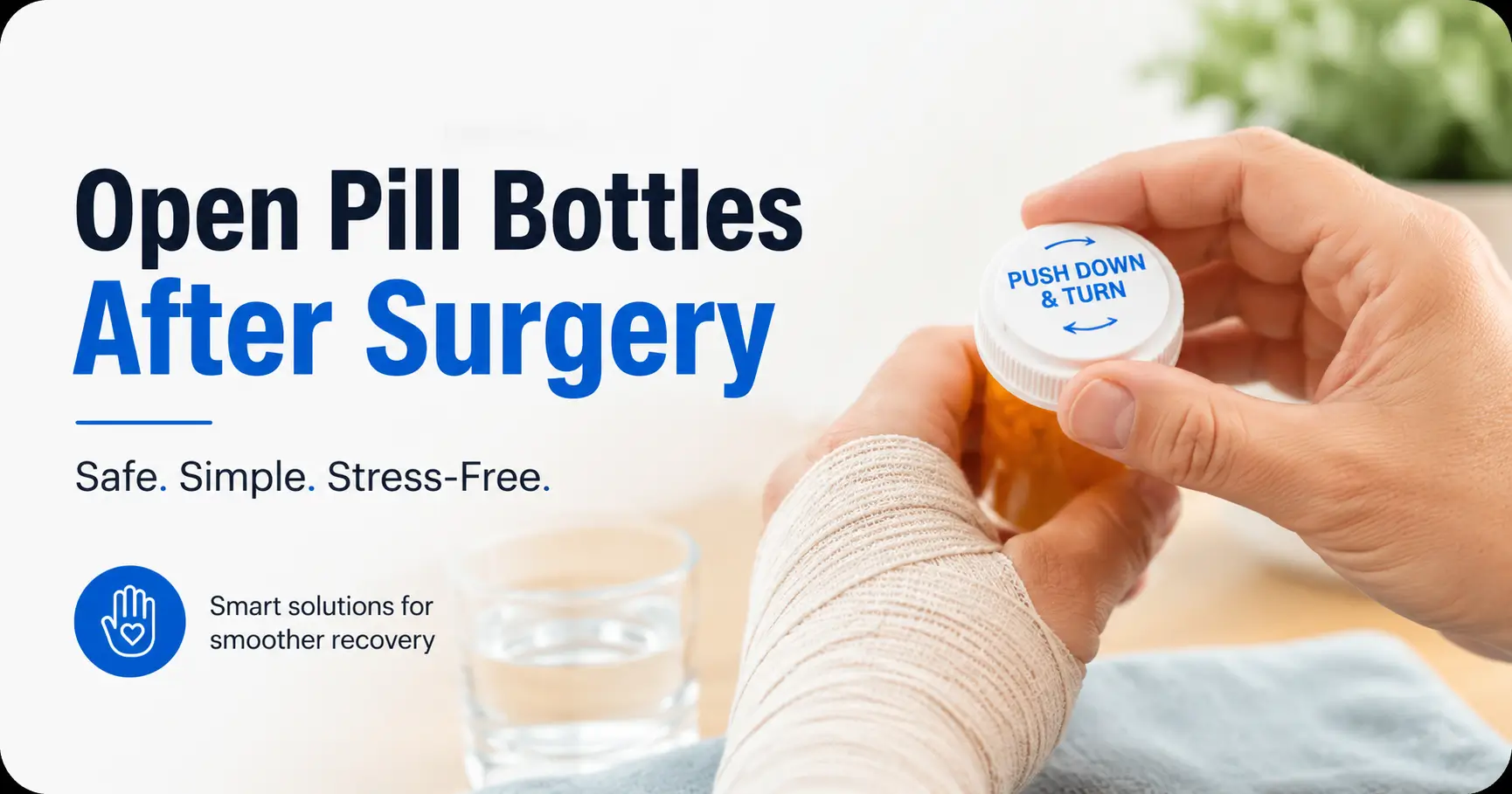
A pill bottle can become a tiny plastic gatekeeper after hand or wrist surgery. It looks harmless on the counter. Then the cap demands grip, pressure, rotation, patience, and a small negotiation with gravity. Suddenly, taking medication feels less like recovery and more like arm-wrestling a pharmacy gnome.
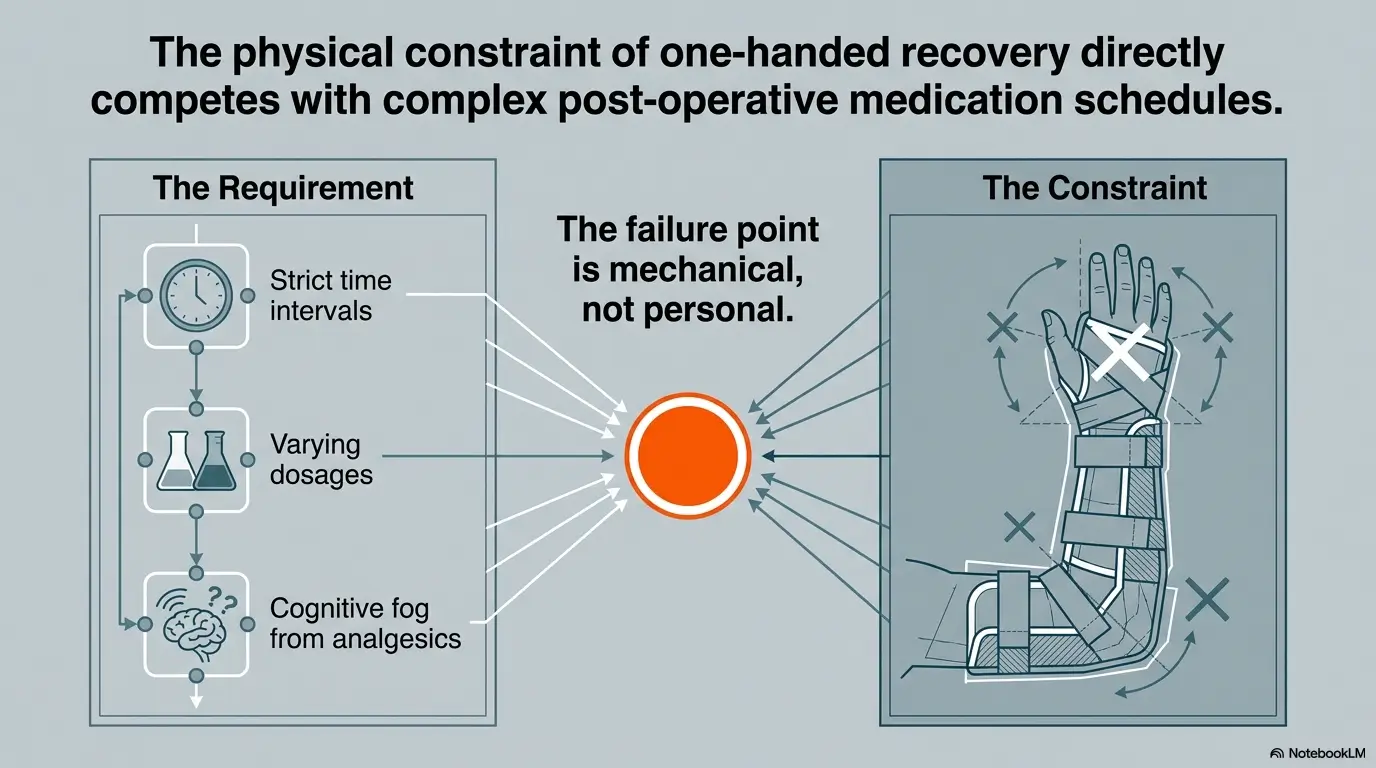
The Golden Rule: Do not force the cap with your recovering hand. Twisting, pinching, bracing, and pushing can irritate healing tissue, stress a splint, or turn a simple dose into a skipped dose. That matters when pain medicine, antibiotics, blood thinners, or anti-inflammatory instructions are time-sensitive.
What this guide covers:
- Pharmacist options & low-strain tools
- Pill organizer rules
- Child-safety trade-offs
- Warning signs & building a simple medicine station today
Quick Safe Setup
Best first move: call the pharmacy and ask whether your prescription can be placed in easier packaging without creating a safety problem at home.
Then place a non-slip mat on a stable counter, use your stronger hand for turning, keep labels visible, and ask for help sorting pills during the first few days. If children visit or live with you, easier caps must be balanced with locked, out-of-reach storage.
Table of Contents
Safety First: What This Guide Can and Cannot Do
This article is general education, not medical advice. Your surgeon’s discharge instructions come first, especially if you have a cast, splint, nerve block, stitches, pins, tendon repair, fracture repair, carpal tunnel release, thumb surgery, or weight-bearing restrictions.
Opening medicine should never require sharp pain, heavy gripping, teeth, knives, scissors, or the heroic facial expression people make when a jar of pickles has personally offended them.
Medicine access also has a second safety lane: household protection. The CDC recommends keeping medicines out of children’s reach and sight, and many safety programs remind families that child-resistant packaging is not the same as child-proof packaging. Easier caps can be helpful after surgery, but they can also create risk if children, pets, confused adults, or frequent visitors are in the home.
- Follow your surgical restrictions first.
- Ask your pharmacist about safer packaging options.
- Keep medicines secure if children or vulnerable adults are nearby.
Apply in 60 seconds: Put the pharmacy phone number beside your medicine station.
Who This Is For, and Who Should Not DIY This
Best fit: temporary one-handed living after surgery
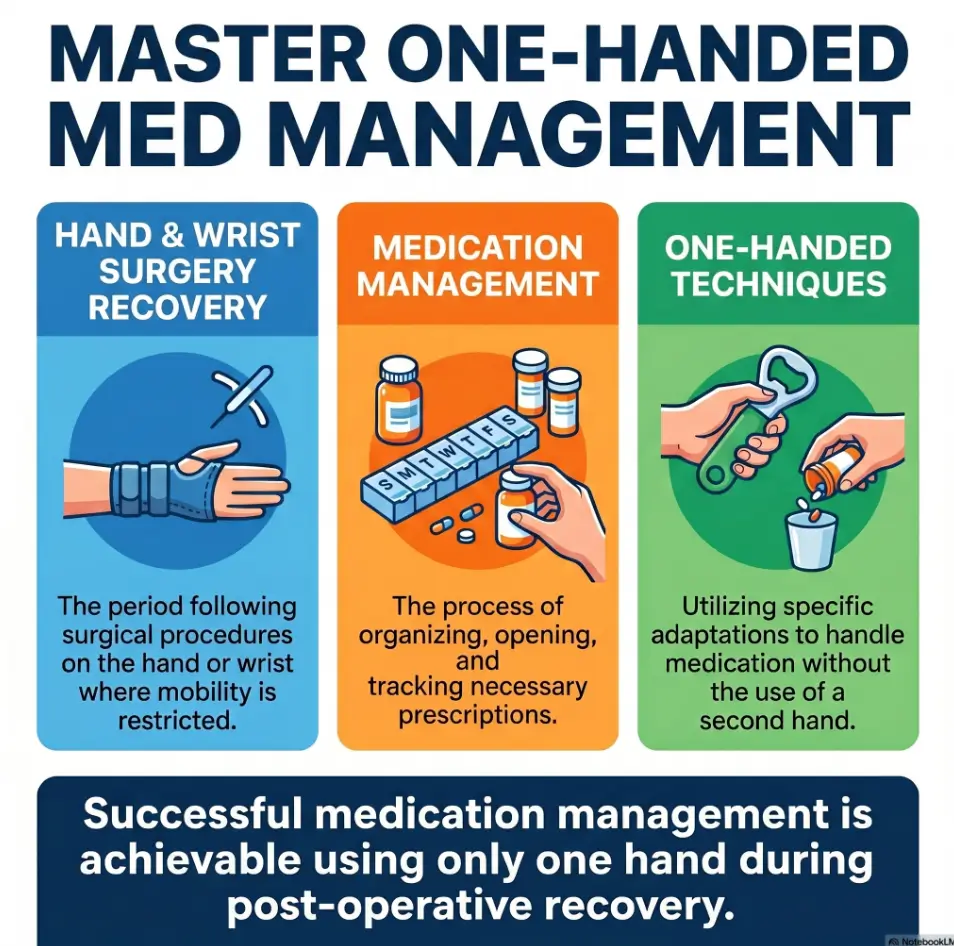
This guide is for adults trying to manage medicine after hand, wrist, thumb, or arm-related recovery. You may have one hand in a splint, one thumb wrapped like a tiny mummy, or a wrist that has been politely removed from the committee of daily tasks.
It can help after procedures such as carpal tunnel release, trigger finger surgery, wrist fracture repair, tendon repair, thumb arthritis surgery, or general hand surgery where gripping is limited.
It is also useful for arthritis flares, nerve irritation, weakness, or temporary one-handed living after shoulder surgery. If you are also adapting your kitchen routine, the same principles behind one-handed meal prep after surgery apply here: stabilize the object, reduce force, and make the environment do the heavy lifting.
Not for: severe pain, fresh complications, or unclear instructions
Do not treat bottle-opening pain as a cute inconvenience if it comes with new swelling, worsening numbness, tingling, burning, wound drainage, fever, chills, or finger color changes. A bottle should not become your diagnostic test, but sometimes it waves the flag.
If your splint feels tighter than before or your fingers look pale, blue, dusky, or unusually swollen, stop and call your care team. A stubborn cap can wait. Circulation cannot.
Caregiver note: “helpful” can become risky fast
Caregivers often want to solve the problem by opening every bottle and leaving caps loose. That may help the patient for an afternoon, then create confusion at midnight or a child-safety problem on Saturday.
Better help looks like this: confirm the label, open the correct bottle, observe the dose, close and store it properly, and write down the time. It is less dramatic than rescuing a kingdom, but much better for medication safety.
Eligibility checklist: Is DIY opening reasonable today?
- Yes if opening requires only your non-surgical hand, a stable surface, and no pain spike.
- Yes if labels remain readable and the correct medicine is obvious.
- No if you need teeth, pliers, scissors, a knife, or your recovering hand as a clamp.
- No if pain, swelling, numbness, dizziness, or confusion makes the task unsafe.
Neutral action: If two or more “no” items apply, ask the pharmacy or a trusted helper before the next dose.
First, Do Not Fight the Cap With Your Surgical Hand
The hidden problem: twisting is not a tiny movement
Opening a child-resistant bottle often combines downward pressure, grip, wrist rotation, thumb pinch, and forearm control. That is a lot of motion hiding inside one ordinary household task.
After surgery, your hand may not be ready for that cocktail. Even if the incision looks tidy, deeper structures may still be healing. Tendons, nerves, soft tissue, bone, and irritated joints do not care that the pill is due at 8:00.
Why grip plus rotation can stress healing tissue
Grip strength is rarely isolated. When you squeeze a bottle, your wrist, thumb, fingers, and forearm all join the meeting. Add rotation and you may accidentally use the exact motion your surgeon told you to limit.
This is especially relevant if you have thumb surgery, wrist fracture repair, tendon repair, or a splint that limits movement. If you are already modifying your work setup because typing hurts, a related guide on wrist splints for typing pain may help you think about neutral wrist positions during daily tasks too.
Let’s be honest: stubborn caps make sensible people foolish
People use teeth. They wedge bottles under elbows. They trap caps against counters. They summon pliers from the junk drawer like a medieval instrument.
That is understandable, especially when pain medicine is inside the bottle and pain is currently inside the person. But forcing the cap can turn a manageable access problem into a setback.
Show me the nerdy details
A push-and-turn cap often requires axial load, which means downward pressure, plus rotational torque. After hand or wrist surgery, that combination can increase strain through the thumb, wrist extensors, finger flexors, palm, and forearm. If the bottle is held in the recovering hand while the other hand turns, the recovering side may still be doing the harder job: stabilizing against torque. That is why a non-slip mat, counter edge, clamp-style holder, or caregiver support can be safer than simply “using the other hand.”
Ask the Pharmacist Before You Buy Gadgets
Easy-open caps: when they make sense
Many pharmacies can offer non-child-resistant or easy-open caps for some prescriptions when appropriate. This is often the fastest solution after hand or wrist surgery. It costs little or nothing in many cases, and it avoids turning your kitchen into a gadget museum.
Easy-open caps may be reasonable if you live alone, have no children visiting, can store medicine securely, and understand the trade-off. Ask directly: “Can this be packaged in a way I can open with one hand without making it unsafe?”
Child-resistant caps: when you should keep them
If children live with you, visit often, or stay overnight, keep child-resistant packaging unless your pharmacist and care team help you create a safer storage plan. The same applies if a family member has memory issues or if pets are talented counter-surfers with criminal ambition.
Child-resistant does not mean impossible to open. It means harder for children to open correctly and quickly. Medicine still belongs up, away, locked when needed, and out of sight.
Pharmacy packaging options that reduce daily wrestling
Ask about large-print labels, blister packs, medication synchronization, easy-open caps, flip-top lids, and whether certain medications can be dispensed in packaging that is easier to manage. Not every option fits every medication, insurance plan, state rule, or household, but asking costs less than buying three openers that end up in a drawer with mystery cables.
If you are preparing for surgery more broadly, the same planning mindset used in an orthopedic appointment checklist can help: write down your restrictions, ask specific questions, and leave with a practical next step.
The one question to ask: “Can this be made easier without making it unsafe?”
That sentence is the hinge. It tells the pharmacist you are not just seeking convenience. You are trying to prevent missed doses, hand strain, medication mix-ups, and household hazards.
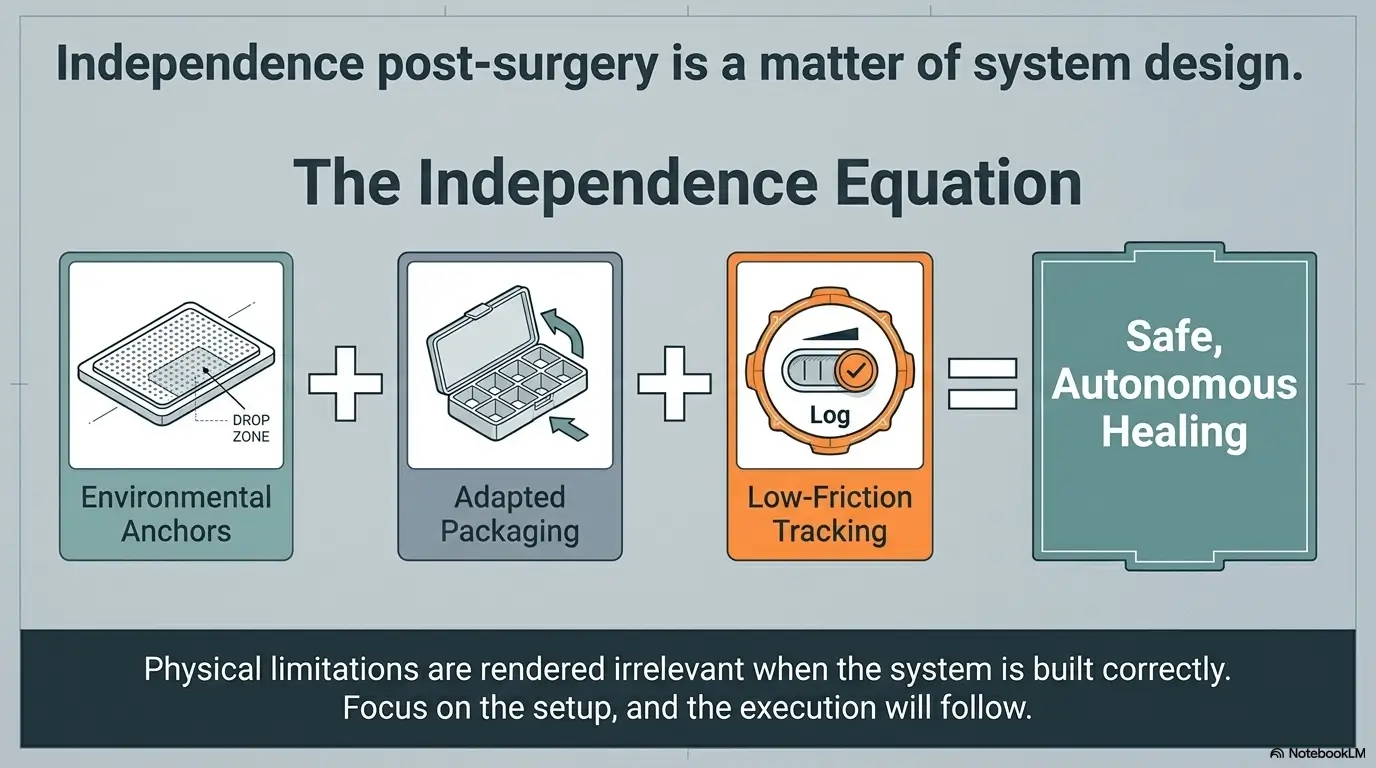
The One-Handed Opening Setup That Actually Works
Non-slip mat under the bottle
A non-slip silicone mat is often more useful than an expensive opener. Place the bottle on the mat, press down lightly with your stronger hand if needed, and use a cap tool or easy-open cap when appropriate.
The mat reduces sliding, which means your recovering hand does not have to become a clamp. This tiny square of grippy material is the quiet stagehand of post-op life.
Stable counter height, not couch balancing
Open bottles on a counter or sturdy table, not on a blanket, lap, sofa cushion, or the wobbly tray that has seen too many late-night snacks. A stable surface reduces surprise movement.
For many people, the best height is around waist to lower-rib level while standing or sitting upright. If you are recovering from more than one orthopedic issue, small setup changes matter. For example, office chair height after hip surgery uses the same core idea: position the environment so your body does not have to negotiate with furniture.
Use the strong hand for turning, not the healing hand for holding
The recovering hand should not brace the bottle if that causes strain. Let the mat, a clamp-style holder, a caregiver, or the counter provide stability.
If you must touch the bottle with the surgical hand, keep it light and within your restrictions. No pinching. No twisting. No “just this once” experiments. Healing tissue has a long memory and terrible comedic timing.
Here’s what no one tells you: the table is your second hand
One-handed living is not really one-handed. It is hand plus table, hand plus wall, hand plus tray, hand plus rubber mat, hand plus carefully placed elbow that is not on the surgical side.
One-Handed Bottle Flow
Use a non-slip mat or holder on a firm counter.
Read the label before the cap comes off.
Turn with the stronger hand, not the healing hand.
Take the dose and mark the time.
Close fully and place medicine out of reach.
Tools That Help, Ranked From Simple to Overkill
Rubber grip pads for basic traction
Start here. A rubber jar opener pad or silicone mat can keep the bottle from skating across the counter. It is cheap, low-tech, and rarely needs batteries, firmware, or emotional support.
Good for: mild weakness, one-handed setup, easy-open caps, and bottles that mostly slip rather than resist.
One-handed pill bottle openers for push-and-turn caps
Some tools are designed to grip the cap while the bottle stays stabilized. These can help if your strong hand can push and turn but you cannot hold the bottle with the other hand.
Look for wide handles, low pinch demand, and a shape that does not require bending the wrist. Avoid tools that look clever online but demand a thumb squeeze worthy of opening a submarine hatch.
Clamp-style holders for weak grip or thumb surgery
A clamp-style holder can secure the bottle while your stronger hand turns the cap. This is often useful after thumb surgery, wrist fracture repair, or arthritis-related procedures.
Test it with an empty bottle first. The holder should stabilize without making the bottle shoot sideways like a startled beetle.
Electric openers: useful, but not always necessary
Electric openers may help people with severe weakness, bilateral hand problems, arthritis, or limited caregiver support. They can be expensive, and not all work well with every cap size.
Before buying one, ask the pharmacy about packaging changes. Sometimes the best device is not a device. It is a different cap.
What to avoid: tools that demand squeezing, pinching, or wrist torque
A tool is not helpful if it simply moves the strain from the cap to your thumb. Avoid narrow handles, spring-loaded pinch tools, pliers, scissors, knives, and anything that turns the task into a tiny hardware store emergency.
Decision card: Which opener path fits your situation?
| Situation | Try first | Why |
|---|---|---|
| Bottle slips on counter | Non-slip mat | Reduces the need to brace with your surgical hand |
| Cap is push-and-turn | Pharmacy cap change | May solve the problem without extra force |
| Thumb cannot pinch | Clamp-style holder | Transfers holding work to the tool |
| Both hands are limited | Caregiver plus pharmacist plan | Reduces both access and medication-error risk |
Neutral action: Choose the lowest-force option that keeps the medicine label and storage plan intact.
Pill Organizers Can Help, But Only If You Set Them Up Safely
Use help during the first week, not heroic solo sorting
A weekly pill organizer can reduce bottle opening, but the setup can be risky right after surgery. Pain, anesthesia fog, poor sleep, and new medication names can turn sorting into a puzzle with consequences.
Ask a trusted adult to help fill it while reading each label out loud. Use good lighting. Keep distractions away. This is not the moment for TV crime drama, barking dogs, and a phone call from your cousin about patio furniture.
Keep original labels nearby for dose checks
Do not throw away original bottles or rely on memory. Keep the labeled containers near the organizer or in a secure storage box so you can confirm the name, strength, instructions, prescribing clinician, and refill details.
If you need to describe medication problems to your care team, the approach in how to describe pain to a doctor also works for medication conversations: be specific, name timing, explain function, and avoid vague “it feels weird” summaries when you can.
Choose child-resistant organizers if kids visit or live with you
Many pill organizers are easy for children to open. Some look colorful and interesting. A curious child does not know the difference between candy, vitamins, and post-op medicine.
If children are present, ask your pharmacist about child-resistant organizer options or use a locked container. Keep medicines high, hidden, and closed after every dose.
Don’t mix look-alike pills without a system
White tablets can look alike. Small capsules can look alike. Half-awake people at 2:13 a.m. can definitely make mistakes.
Use a written dose log, phone alarm labels, and a simple rule: one medicine change at a time. If something changes, update the organizer immediately or stop using it until a pharmacist or caregiver checks it.
- Use help when filling it early in recovery.
- Keep original labels available.
- Use locked or child-resistant storage when needed.
Apply in 60 seconds: Place a pen and dose log beside the organizer before your next medication time.
Short Story: The Cap That Changed the Kitchen
Marian had her right wrist wrapped after fracture surgery and insisted she was “basically fine,” which is a phrase families should treat with gentle suspicion. Her pain medicine bottle sat near the sink. Each dose became a small contest: bottle between knees, left hand pressing, right fingers hovering uselessly like guests at the wrong party. On the third try, the bottle slipped, pills scattered, and Marian cried from frustration more than pain.
Her daughter did not buy a fancy device first. She called the pharmacy, asked about an easier cap, placed a non-slip mat on the counter, taped a large-print dose schedule to a tray, and moved all medicines into a high cabinet after each dose. The problem did not become glamorous. It became boring. That was the victory. Recovery often improves when one daily task stops stealing courage.
Common Mistakes That Turn a Pill Bottle Into a Recovery Setback
Mistake 1: using teeth to open caps
Teeth are not tools. They are expensive, sensitive, and rarely covered emotionally by the phrase “I was just trying something.” Using teeth can damage dental work, spill pills, and cause sudden movement through the healing arm.
Mistake 2: bracing the bottle against the incision side
Some people trap the bottle against the recovering palm, wrist, forearm, or ribcage. That can put pressure where you are trying to heal. If your incision or dressing is involved in the opening strategy, the strategy needs retirement.
Mistake 3: pre-opening every bottle and forgetting child safety
Leaving caps loose can prevent strain, but it can also invite spills, dosing mistakes, and child access. A safer plan is scheduled help, better pharmacy packaging, or a secured organizer.
Mistake 4: transferring pills into mystery containers
Never move pills into unlabeled bags, cups, jars, or “I’ll remember” containers. Future-you may be tired, foggy, or distracted. Future-you deserves labels.
Mistake 5: skipping doses because the bottle is annoying
If you skip a dose because you cannot open the bottle, tell your pharmacist or clinician. Do not quietly abandon the plan. The issue is not willpower. It is access design.
Quote-prep list: What to gather before asking for help
- Medication name, strength, and dose instructions from the label.
- Which cap or bottle is hardest to open.
- Which hand had surgery and what movements are restricted.
- Whether children, pets, or vulnerable adults are in the home.
- Whether you use a pill organizer, alarms, or caregiver help.
Neutral action: Read this list to the pharmacist or nurse rather than trying to explain from memory while frustrated.
Pain Medicine Bottles Deserve Extra Attention
Opioids, sedatives, and “just one more” confusion
Some post-op medicines can cause drowsiness, dizziness, constipation, slowed reaction time, or confusion. If your pain medicine is hard to open, the problem can become bigger than hand strain. You may take it late, double-dose by accident, or forget whether you already took it.
Controlled medicines should be stored securely. Keep them away from guests, children, and casual countertop traffic. The nightstand may be convenient, but convenience is not the same as control.
Write down dose times before brain fog arrives
Use a simple paper log:
- Medicine name
- Dose taken
- Time taken
- Pain level before and after, if your clinician asked
- Side effects such as nausea, dizziness, itching, or unusual sleepiness
If pain tracking is confusing, a pain timeline before an orthopedic visit can help you organize symptoms without turning your notes into a novel with unreliable narrators.
Keep controlled medicines secure, not loose on the nightstand
If you need easier access overnight, set up a secure plan before bedtime. That may mean a caregiver opens the bottle at scheduled times, a lockbox with a manageable mechanism, or pharmacy packaging that lowers strain without leaving medicine loose.
Use alarms, not memory gymnastics
Post-op memory is not always elegant. Pain, poor sleep, anesthesia aftereffects, and routine disruption can blur the day. Use alarms labeled with the medication name and dose instructions.
Mini calculator: Next dose spacing checker
This does not replace your label or clinician’s instructions. It simply helps you avoid guessing.
Result: Enter your last dose time to estimate the earliest next dose based on the interval.
Neutral action: If the result conflicts with your label, call the pharmacist before taking the next dose.
When Opening a Bottle Is a Warning Sign
Sharp pain during twisting
Sharp pain is not the same as mild effort. If opening a bottle causes a sudden pain spike, stop. Do not retest it five times to “make sure.” Pain is not a doorbell you need to keep pressing.
New numbness, tingling, burning, or finger color changes
New numbness, tingling, burning, or color changes can suggest pressure, swelling, nerve irritation, or circulation problems. This is especially important if you have a cast or splint.
AAOS patient guidance on casts and splints lists increased pain, tightness, numbness, tingling, burning, stinging, and swelling below the cast as warning signs to take seriously.
Swelling that makes your splint or dressing feel tighter
If your splint or dressing feels tighter than it did earlier, do not blame the bottle and move on. Swelling can increase pressure. Elevation and rest may be part of your instructions, but new or worsening symptoms deserve a call to your care team.
Drainage, fever, warmth, redness, or worsening wound pain
MedlinePlus patient guidance notes that signs such as pus or drainage, fever, chills, heat, redness, and pain around a surgical wound are reasons to contact a medical professional. The exact threshold may depend on your surgery, but the theme is simple: worsening wound symptoms should not be ignored.
Call sooner if the problem appears suddenly
A sudden change matters. If you opened bottles easily yesterday and today your fingers are swollen, numb, or weak, treat that as new information.
Safer Workarounds for Different Surgery Types
Carpal tunnel release: protect the palm and wrist angle
After carpal tunnel release, the palm may be tender and the wrist may not appreciate forceful extension or pressure. Avoid pressing the bottle into the palm or bending the wrist to gain leverage.
Use the opposite hand, non-slip surface, and pharmacy packaging help. If symptoms are not improving as expected, track numbness, nighttime symptoms, and function before calling the clinic.
Trigger finger or thumb surgery: avoid pinch-heavy tools
Pinch-heavy tools can aggravate the exact area you are trying to rest. Look for wide-handled aids, clamp holders, or caregiver support instead.
If you also manage arthritis, compression gloves for arthritis may be a related topic to discuss with your clinician, though gloves should not replace surgical restrictions.
Wrist fracture surgery: do not use the healing wrist as a clamp
Wrist fracture recovery often comes with strict limits. Even if the fingers can move, the wrist may not be cleared for gripping, pushing, twisting, or load-bearing.
Do not stabilize a bottle with the recovering hand unless your care team has said that level of use is allowed.
Tendon repair: respect motion limits like they are legal documents
Tendon repairs can have very specific rules. Small forbidden motions may matter. If your instructions say not to actively bend, straighten, grip, or resist certain movements, do not let a pill bottle tempt you into negotiation.
Ask your hand therapist or surgeon for a medicine-opening workaround that fits your protocol.
Arthritis or joint replacement surgery: reduce force, not just pain
If arthritis was part of the reason for surgery, pain may not be the only limit. Joint alignment, grip endurance, swelling, and fatigue can all affect bottle opening.
Choose systems that reduce repeated force. A daily plan beats a daily struggle.
- Thumb surgery needs low-pinch solutions.
- Wrist fracture recovery needs low-torque solutions.
- Tendon repair needs protocol-specific permission.
Apply in 60 seconds: Circle the movement your instructions restrict, then choose an opening method that avoids it.
Build a 3-Day Medicine Station Before You Need It
Place medicines where you can reach them without bending or gripping hard
A medicine station is simply a safe, boring place where your supplies live. Boring is excellent here. Boring prevents midnight scavenger hunts.
Choose a counter, shelf, or tray that is easy to reach with your non-surgical hand. Avoid low drawers, tight cabinet pulls, and cluttered baskets that require digging.
Add water, snacks, instructions, and a dose log
Some medicines must be taken with food or water. Keep a water bottle, crackers if allowed, written instructions, and a pen nearby. If your medicine can upset your stomach, ask your pharmacist what food or timing guidance applies.
If you are setting up other recovery zones at home, guides such as bathroom setup after shoulder surgery and orthopedic home care equipment use the same philosophy: reduce friction before pain, fatigue, or sleepiness gets a vote.
Keep emergency contacts and pharmacy number visible
Write down your surgeon’s office, after-hours number, pharmacy, caregiver, and local urgent help line if your discharge papers provide one. Put the paper where you can see it.
Phone contacts are useful until the phone is charging in another room and your hand is throbbing. Paper is not glamorous. Paper shows up.
One tiny luxury: a tray with edges
A tray with raised edges prevents bottles from rolling and keeps supplies together. It also makes it easier for a caregiver to move the whole setup without collecting items one by one.
Coverage tier map: Medicine station setup
| Tier | Setup | Best for |
|---|---|---|
| Tier 1 | Non-slip mat, labels, water, pen | Mild one-handed difficulty |
| Tier 2 | Easy-open caps plus secure storage | Adults without child-access risk |
| Tier 3 | Pill organizer with caregiver check | Multiple daily medicines |
| Tier 4 | Lockbox, alarms, written log | Pain medicine or child-safety concerns |
| Tier 5 | Pharmacist packaging plan plus scheduled caregiver help | High risk of missed doses or medication errors |
Neutral action: Use the lowest tier that solves access without weakening storage safety.
When to Seek Help
Call your surgeon or care team for new or worsening symptoms
Call if opening a bottle triggers sharp pain, new swelling, numbness, tingling, burning, weakness, finger color changes, drainage, fever, chills, spreading redness, or worsening wound pain.
It is reasonable to say, “I noticed this when trying to open my medication.” That gives the care team context without making the bottle the villain of the entire medical record.
Call the pharmacist for cap changes, packaging, or dose confusion
Pharmacists are medication-access allies. Call if you cannot open a container, cannot read the label, are unsure whether a pill can be placed in an organizer, or missed a dose because the bottle was inaccessible.
Ask a caregiver if pain medicine, dizziness, or fatigue affects judgment
Medication tasks become riskier when you are sleepy, dizzy, nauseated, or in a pain spike. Ask someone to observe the process, not just open the cap. A second set of eyes can catch a wrong bottle before it becomes a problem.
Seek urgent help for severe symptoms
Seek urgent help for severe symptoms such as sudden shortness of breath, chest pain, fainting, severe allergic reaction signs, uncontrolled bleeding, severe worsening pain, or signs your fingers are losing circulation. Follow your discharge instructions for emergency thresholds.
FAQ
Can I ask the pharmacy for non-childproof caps after surgery?
Yes, you can ask. Whether it is appropriate depends on the medication, pharmacy policy, state rules, and your household. If children visit or live with you, easier caps may require locked storage or a different plan.
What is the easiest way to open a pill bottle with one hand?
The easiest safe method is usually a combination of pharmacy-approved easy-open packaging, a non-slip mat, a stable counter, and your stronger hand. If the cap still requires force, ask the pharmacist about alternatives before buying more tools.
Is it safe to move pills into a weekly organizer after surgery?
It can be safe if the organizer is filled carefully, labels stay available, the schedule is clear, and child-safety needs are handled. During the first week, ask a trusted adult to help check the setup.
What should I do if I cannot open my pain medicine bottle?
Call the pharmacy, surgeon’s office, or a trusted caregiver. Do not skip doses silently, double up later without instructions, or attack the bottle with sharp tools. If your pain is severe and you cannot access medication, contact your care team promptly.
Can I use scissors, a knife, or pliers to open a pill bottle?
Usually, no. Sharp or forceful tools can cause injury, spill pills, damage labels, and create unsafe storage. Use pharmacy packaging help, non-slip aids, or caregiver support instead.
How do I keep medicine safe if I need easier caps?
Store medicine high, out of sight, and locked if children or vulnerable adults may access it. Keep original labels. Close containers fully after use. Ask your pharmacist whether child-resistant organizers or safer packaging options are available.
Should I call my doctor if opening bottles hurts my wrist?
Call if the pain is sharp, new, worsening, or paired with swelling, numbness, tingling, burning, tight splint feeling, drainage, fever, redness, warmth, or finger color changes. Mild effort is one thing. warning signs deserve attention.
What tools help most after thumb or wrist surgery?
Start with low-force tools: non-slip mats, easy-open caps when safe, clamp-style holders, wide-grip openers, and caregiver help. Avoid tools that require strong pinching, squeezing, or twisting through the recovering side.
Next Step: Make One Bottle Easier Today
Pick the hardest bottle and call the pharmacy
Do not redesign your whole recovery in one heroic burst. Choose the bottle causing the most trouble and call the pharmacy. Ask: “Can this be made easier to open without making storage unsafe?”
Place one non-slip opener where you take medicine
Put a non-slip mat or grip pad at your medicine station. Not in a drawer. Not “somewhere safe.” Safe but invisible is just lost with manners.
Ask one trusted person to check your setup tonight
Have them confirm three things: the label is readable, the cap plan is realistic, and the medicine is stored safely after use. If pain medicine is involved, add a written dose log.
The point is not to win a strength contest with a cap. The point is to take the right medicine at the right time while letting your hand recover in peace. A bottle is small, but after surgery, small friction can drain a day. Remove that friction carefully, and recovery gets a little quieter.
Do this within 15 minutes: call your pharmacy, name the hardest bottle, and ask for the safest easier-opening option for your home.
Last reviewed: 2026-05.