
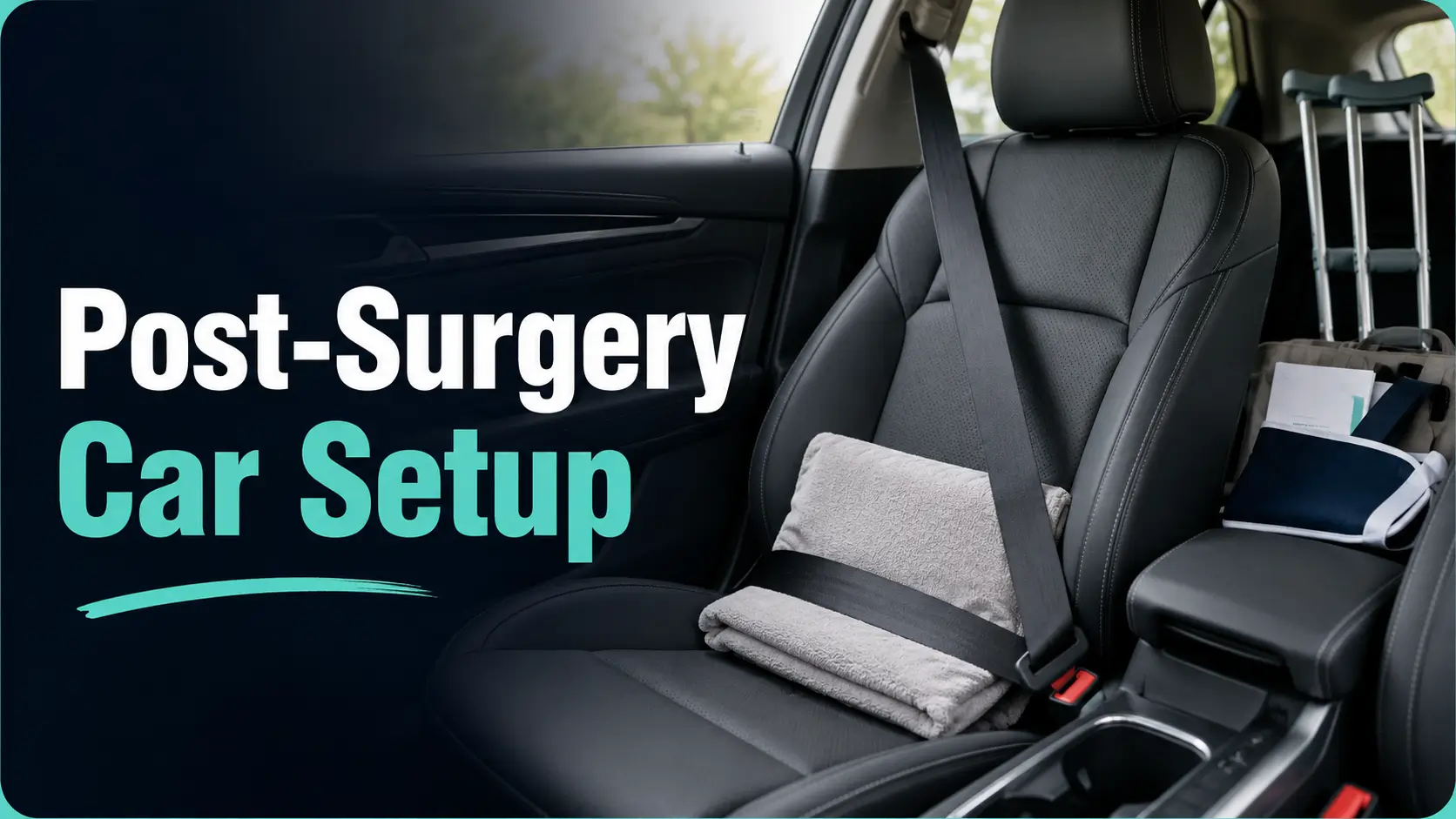
A practical guide for patients and caregivers
Post-Surgery Car Seat Setup
for Safer Short Trips
A ten-minute ride can feel surprisingly complicated after surgery. The seat seems lower than you remembered. The door opening suddenly looks narrow. A harmless bump in the road becomes something you can feel in every stitch, swollen joint, or guarded muscle.
The goal is not to build a nest of pillows or turn the passenger seat into a medical device. It is to reduce unnecessary twisting, pressure, reaching, and sudden movement while preserving proper seat-belt use. The safest setup is usually simple, prepared before the patient arrives, and consistent with written discharge instructions.
This guide walks caregivers and medically cleared passengers through seat choice, restraint placement, entry and exit, route planning, warning signs, and procedure-specific questions. It is designed to help you prepare calmly before the car door opens and everything becomes awkward at once.
Move with less strain
Plan the seat, doorway, and leg movement before the patient sits.
Protect belt geometry
Avoid comfort fixes that move restraints away from the body.
Know when not to go
Recognize symptoms that call for delay, medical advice, or emergency help.
🚗 The best ride begins while the car is still parked, empty, and quiet.
Article snapshot
This guide is for adults who have been medically cleared to ride in a car after outpatient or orthopedic surgery, and for the caregivers driving them. It helps you choose a seat, reduce difficult movement, preserve correct restraint placement, rehearse entry and exit, and decide when symptoms make travel unsafe.
Table of Contents
Safety Before Comfort: The Rules That Override This Guide
A post-surgery car seat setup is not a substitute for procedure-specific instructions. Different operations place different limits on hip bending, trunk rotation, shoulder movement, brace positioning, weight bearing, sitting duration, and driving.
The discharge packet is the first authority. The surgeon, anesthesiology team, physical therapist, occupational therapist, or nurse may also give verbal instructions that are more restrictive than anything in this article.
Medical and transportation safety disclaimer
This article provides general educational information for medically approved passenger travel. It does not determine whether a specific patient is fit to travel, drive, recline, bear weight, remove a brace, or use padding near an incision.
Follow the written discharge instructions and contact the surgical team when instructions are missing, unclear, or incompatible with the available vehicle. Call emergency services when the patient cannot be transported safely.
Read the written restrictions before touching the seat controls
Look for instructions about driving, passenger travel, sitting duration, bending, lifting, weight bearing, brace wear, sling use, wound care, and medication. “Activity as tolerated” does not automatically mean every vehicle position is appropriate.
A patient who may walk short distances could still have difficulty lowering into a compact sedan. Someone allowed to sit may still need a particular hip angle. A passenger wearing a spinal brace may need enough doorway clearance to enter without twisting.
Write down restrictions in plain language. For example: “Do not bend the hip past the limit provided by the therapist,” “Keep the sling on,” or “No riding longer than twenty minutes without a break.” This keeps a tired caregiver from trying to decode several pages in a parking garage.
Passenger travel is not the same as driving clearance
Being able to sit in a passenger seat does not mean the patient can drive. Safe driving requires alertness, rapid braking, controlled steering, comfortable head turning, reliable limb movement, and freedom from medication effects that impair judgment or reaction time.
After sedation or general anesthesia, the patient commonly needs a responsible adult to provide transportation home. Prescription pain medicines, anti-nausea medicines, sleep aids, muscle relaxants, and other medications may also affect alertness.
Do not invent a driving date based on how well the patient walks around the kitchen. Obtain explicit guidance from the treating clinician, especially after surgery involving the spine, abdomen, pelvis, shoulder, arm, hip, knee, ankle, or foot.
Ask for help when the vehicle conflicts with the instructions
Some instructions are easy to follow in a roomy minivan but nearly impossible in a low two-door car. That is a transportation problem worth solving before discharge, not a test of the patient’s determination.
Ask the care team whether another vehicle, a wheelchair-accessible service, non-emergency medical transportation, or a different seat position is appropriate. A nurse or therapist may also demonstrate the safest movement sequence before the patient leaves.
Key takeaway
A comfortable-looking setup is not automatically a medically appropriate setup. Written restrictions, required braces, and safe restraint placement come first.
Is the Patient Ready for a Short Car Trip?
“It is only five minutes away” can create false confidence. Most travel problems do not come from the number of miles. They come from sedation, nausea, pain, difficult transfers, sudden braking, or the inability to maintain a required position.
The decision starts with medical approval. After that, use a simple readiness check before each trip, including the ride home, a pharmacy stop, a follow-up appointment, or a brief visit to physical therapy.
Check alertness, balance, nausea, and pain before leaving
The patient should be awake enough to follow instructions and participate in the transfer at the level expected by the care team. Unusual sleepiness, confusion, faintness, or difficulty staying awake deserves attention before anyone heads toward the car.
Nausea matters because a passenger who suddenly vomits may bend, twist, unbuckle, or move the surgical area sharply. Pain matters because severe or rapidly worsening pain can make safe entry impossible and may signal a problem that should be discussed with the surgical team.
Ask concrete questions rather than “Are you okay?” Try: “Do you feel dizzy while sitting?” “Can you follow the entry steps?” “Is the pain controlled enough to move slowly?” “Do you feel sick enough that you might vomit?”
Use a three-movement readiness test
Only use movements already permitted by the care team. The patient should be able to complete the basic transfer sequence with the prescribed assistance:
- Stand or transfer toward the vehicle using the approved mobility aid.
- Turn or position the body without breaking surgical precautions.
- Lower onto the seat under control and bring the legs inside using the approved method.
If any step causes uncontrolled movement, near-fainting, sudden severe pain, or loss of balance, stop. The patient does not earn safety points for finishing a transfer that is already going badly.
Short-trip readiness checklist
Before opening the car door, confirm:
- The surgical team has allowed passenger travel.
- The patient is not planning to drive.
- The patient is alert enough to follow instructions.
- Dizziness, nausea, and pain are controlled enough for the transfer.
- The required brace, sling, dressing, or mobility aid is in place.
- The patient can maintain the required position in the chosen seat.
- A caregiver can provide the amount of help recommended by the care team.
- The destination has a safe drop-off and exit area.
Short Story: The Ride That Became Easier Before It Started
Maria expected the ride home after her father’s knee procedure to be the easy part. She had brought a pillow, bottled water, and a playlist he liked. The car, however, was parked nose-first between two vehicles in a narrow hospital garage.
When her father reached the passenger door with his walker, there was not enough room to open it fully. He began turning sideways while trying to hold the walker, the door, and his discharge bag.
Maria stopped the transfer. She asked him to sit in the hospital wheelchair while she moved the car to the loading area, slid the passenger seat back, and placed the walker in the cargo space.
The second attempt took less than a minute. The practical lesson was not about buying better equipment. It was about creating space before the patient had to move.
Choose the Seat That Requires the Least Difficult Movement
The safest passenger position depends on the procedure, the patient’s height and mobility, the vehicle’s doorway, airbag system, seat controls, and the instructions provided by the care team.
There is no universal rule that the front seat or rear seat is always best. The useful question is: Which approved seat allows the patient to enter, sit, buckle, ride, and exit with the least difficult movement while maintaining proper restraint use?
Front passenger seat: adjustable, visible, and often easier to reach
The front passenger seat commonly offers the most legroom and the greatest range of adjustment. It may be easier for a caregiver to monitor nausea, pain, or changes in alertness.
Sliding the seat rearward may create space for a brace, stiff knee, or carefully controlled leg movement. The seatback may also be adjusted within the limits provided by the clinician and vehicle manufacturer.
Front seating also requires attention to the dashboard and airbag area. Do not let the passenger brace feet, knees, hands, or a pillow against the dashboard. Keep the seat at a safe distance permitted by the vehicle manual while maintaining proper belt fit.
Rear seat: useful only when entry and belt fit remain manageable
A rear seat may provide separation from the dashboard and may work well in vehicles with wide doors, generous legroom, and an accessible seating height. In other cars, it creates a narrow doorway and forces more hip flexion, head ducking, or trunk rotation.
Check whether the door opens wide enough for the prescribed movement sequence. Also confirm that the lap and shoulder belt can be used normally. A center rear position is not automatically preferable if the patient must climb across the seat or cannot obtain proper belt fit.
Low sedan, SUV, or minivan: height can help or hinder
A low car may require deep hip and knee bending. A tall SUV may demand a step upward that a patient cannot safely manage. A minivan with a broad sliding door may be convenient, but the seat height and floor step still need to match the patient’s restrictions.
For someone following hip precautions, a low seat can be troublesome. For someone with limited leg strength or non-weight-bearing restrictions, a high vehicle may be equally problematic. The right height allows the patient to sit under control rather than drop down or climb up.
Readers preparing for hip-related travel may also find the site’s guide to getting into an SUV after hip surgery useful when comparing vehicle height and doorway access.
Quick seat comparison
| Seat option | Potential advantage | Potential problem | What to test while parked |
|---|---|---|---|
| Front passenger seat | More adjustment and legroom | Dashboard proximity and airbag considerations | Door width, seat distance, belt fit, and foot placement |
| Rear outboard seat | May offer a calm, protected passenger area | Narrow door or limited legroom | Whether the patient can sit without twisting or ducking sharply |
| Minivan second row | Wide doorway and often easier caregiver access | Step height or captain’s-chair angle | Whether the patient can step up and pivot as permitted |
| SUV front passenger seat | Seat may be closer to standing height | May require climbing or use of a running board | Whether the patient can reach the seat without pulling or hopping |
| Low sedan | Small step from pavement | Deep lowering and greater hip or knee bend | Whether the patient can lower slowly and rise without strain |
Key takeaway
Choose the seat after testing the movement, not by relying on a blanket rule. A spacious-looking vehicle can still create a poor doorway angle.
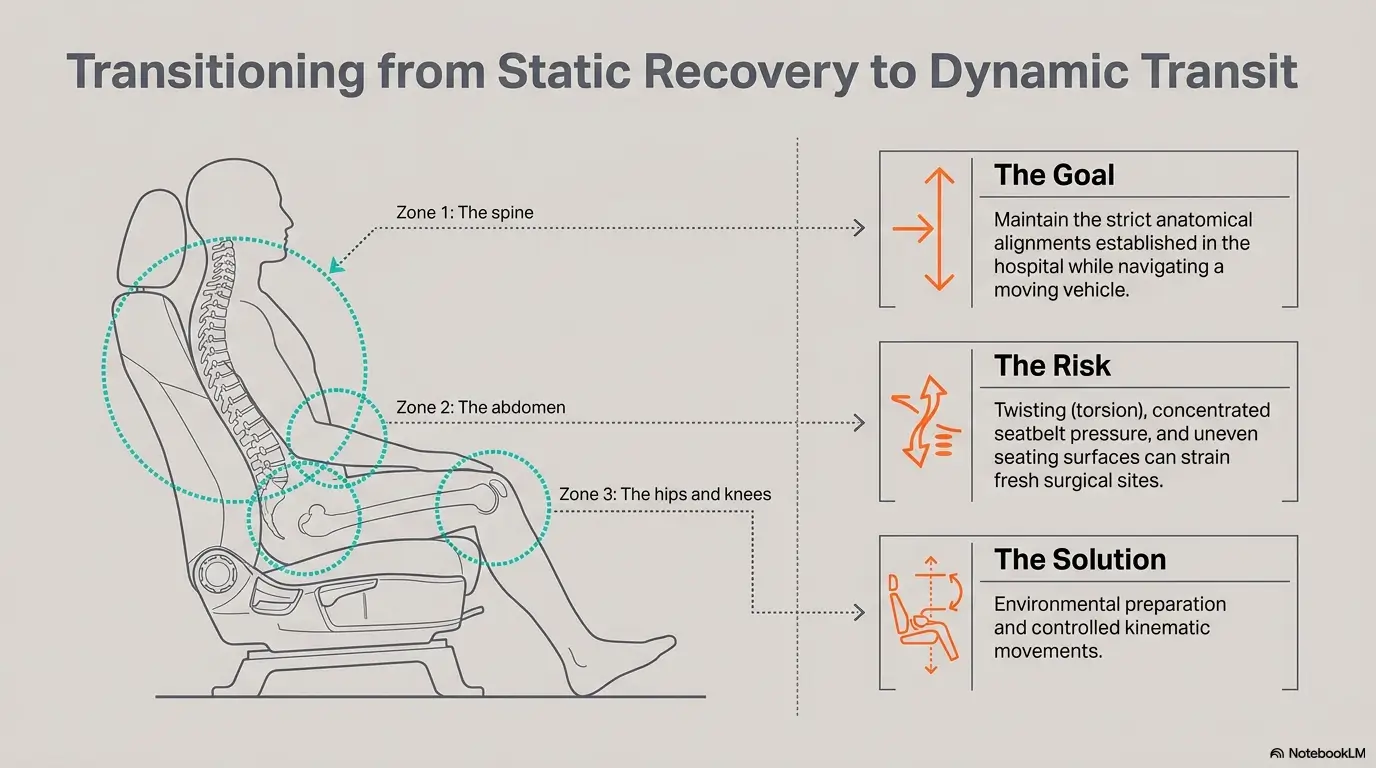
Set Up the Car Before the Patient Reaches It
Once the patient is standing beside the car, every adjustment becomes harder. The caregiver is trying to hold the door, manage a walker, remember the instructions, and prevent the discharge bag from sliding beneath someone’s feet.
Prepare the vehicle while the patient remains safely seated indoors, in a wheelchair, or with another responsible adult. Think of the empty car as a rehearsal room. This is the moment to move the seat, inspect the floor, and discover that the door does not open as widely as expected.
Adjust the seat for controlled entry, not maximum softness
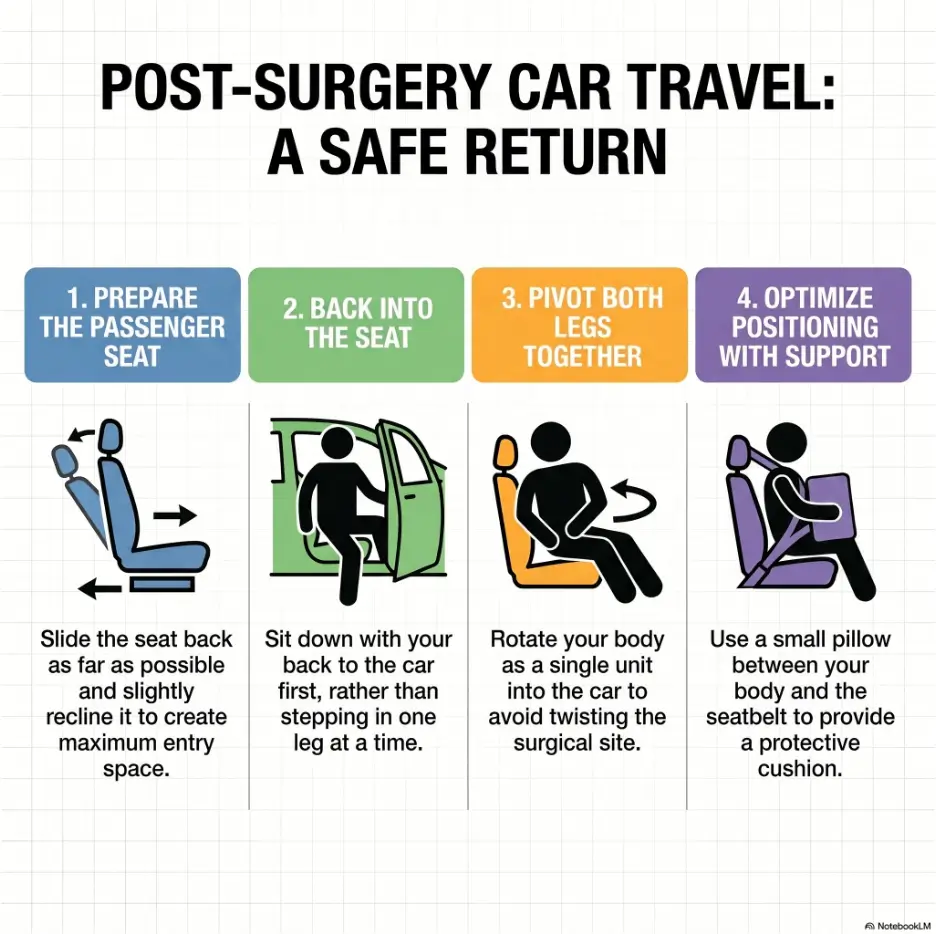
Slide the chosen seat back far enough to create room for the knees, lower legs, brace, and mobility aids. Check that the passenger can still sit against the seatback and obtain proper lap-and-shoulder belt placement.
Do not assume that fully reclining the seat is safer. Excessive recline can change restraint fit and allow the body to slide forward. Use only the degree of recline allowed by the patient’s instructions and compatible with normal seat-belt positioning.
If spinal or abdominal precautions require a more neutral posture, confirm the angle with the care team. If the patient was instructed to remain upright, do not improvise a lounge-chair position simply because it feels easier at first.
Clear the footwell, seat, doorway, and door pocket
Remove bottles, charging cables, umbrellas, loose mats, handbags, toys, and shopping bags. A small object can become a significant obstacle when the passenger cannot bend, balance on one leg, or correct a misplaced foot quickly.
Check that the floor mat is flat and secure. Make sure the seat belt is not buried behind the seat or twisted. Move the buckle into an easy-to-find position without fastening it in advance or placing it where the patient might sit on it.
Empty the door pocket if it reduces legroom or catches a brace. Remove decorative seat covers if they bunch, slide, or interfere with belt access.
Decide where the caregiver and mobility aids will go
The caregiver should know where to stand before the patient approaches. This position depends on the procedure, the prescribed transfer method, and whether a walker, crutches, cane, wheelchair, or transfer aid is being used.
Do not ask the patient to hold medication bags, paperwork, water, or a phone during entry. The patient’s hands may be needed for a walker, prescribed support surface, or balance.
Secure mobility devices after the patient is seated. A walker or crutch should not remain loose in the cabin where it can strike the passenger during sudden braking. Caregivers using walkers can review the practical advice in parking-lot safety with a walker and walker path safety.
Parked-car setup checklist
1
Read restrictions
Confirm sitting, bending, brace, weight-bearing, and travel rules.
2
Choose the doorway
Use the seat that requires the least difficult approved movement.
3
Clear the path
Remove clutter from the curb, doorway, seat, and footwell.
4
Protect belt fit
Keep lap and shoulder restraints in their normal safe positions.
5
Rehearse slowly
Practice the sequence while the car is parked and help is available.
Reduce Incision Pressure Without Defeating the Seat Belt
Seat belts work by contacting strong areas of the body and limiting movement during a crash. A postoperative passenger may understandably worry about tenderness near the abdomen, chest, shoulder, or pelvis, but moving a restraint away from its intended path can create a more serious safety problem.
The lap belt should remain low and snug across the hips or upper thighs rather than the stomach. The shoulder belt should cross the center of the chest and shoulder, away from the neck, without being tucked under an arm or placed behind the back.
Use padding cautiously and never as a homemade belt rerouter
A small, soft item may sometimes be used for comfort if the treating clinician approves it and it does not alter belt placement. The key question is not whether the item feels soft. It is whether the restraint still lies close to the body in its correct path.
Do not put thick cushions, folded blankets, rigid shields, ice packs, purses, or bulky wound pillows under the belt. Do not create a tunnel that holds the belt several inches away from the passenger.
Never use padding as a reason to loosen the belt. A restraint that floats above the body may not control movement as intended during a sudden stop or collision.
Handle chest or shoulder tenderness without moving the belt off course
After breast, chest, shoulder, or upper-limb surgery, the shoulder belt may cross a tender region. Ask the surgical team how to manage the ride before discharge, particularly when drains, dressings, slings, or immobilizers are present.
Do not place the shoulder belt behind the back, under the arm, outside the shoulder, or around a sling. Those shortcuts may feel better while the vehicle is stationary but defeat the intended restraint path.
If the belt cannot be positioned normally without contacting a prohibited area or disturbing medical equipment, the answer is not inventive belt routing. Contact the care team and arrange a suitable transportation method.
Avoid excessive recline and forward sliding
Reclining too far may allow the pelvis to slide forward and the lap belt to ride upward. The passenger should remain positioned against the seatback with the restraint lying flat and snug.
A small change in seatback angle can feel significant after surgery. Make changes before departure, then recheck the belt. If the patient gradually slides down, the setup needs correction rather than another pillow.
Show me the nerdy details
Seat-belt geometry describes where the lap and shoulder portions travel across the body. Thick padding, excessive recline, twisted webbing, or placing the shoulder belt under an arm can change how forces are distributed during a crash.
Postoperative comfort matters, but the safer approach is to adjust the vehicle seat and approved body position while keeping the restraint close, flat, and correctly routed. When normal routing conflicts with a surgical device or incision restriction, ask the treating team for an approved transportation plan.
For official guidance on adult seat-belt positioning, review the National Highway Traffic Safety Administration’s recommendations before planning modifications.
Key takeaway
A pillow is not helping if it pushes the belt away from the body, changes where the belt rests, encourages loosening, or hides a twisted restraint.
Match the Setup to the Type of Surgery
General principles are useful, but the details change with the surgical area. The following considerations are prompts for discussion with the treating team, not universal positioning orders.
Two patients with the same operation may receive different instructions because of surgical technique, complications, age, balance, body size, medical devices, or other health conditions.
Abdominal, pelvic, breast, and chest surgery
These patients may be especially sensitive to direct pressure, coughing, sudden braking, and trunk rotation. Loose clothing can prevent waistbands from pressing against dressings, but clothing must not interfere with the belt.
Set the seat far enough back to allow the patient to sit without folding sharply through the abdomen. Keep the lap belt low over the hips. Do not place a hard object, ice pack, or rigid incision guard between the body and restraint.
Chest or breast surgery may involve drains or restricted arm movement. Identify where tubing and collection bulbs will rest before the patient sits. They should not be trapped beneath the patient, stretched across the doorway, or used as handles during transfer.
Hip, knee, ankle, and foot surgery
Orthopedic restrictions may include limited bending, partial or non-weight bearing, brace use, or instructions about keeping a leg supported. Legroom is important, but so is the height of the seat.
A person recovering from hip surgery may need to avoid deep flexion or twisting. A person after knee surgery may need enough room to keep the knee within an approved range. A patient with foot or ankle restrictions may be unable to push through one leg when entering.
Do not lift the operated leg by grabbing the ankle unless a clinician has taught that method. Ask whether the patient should use a leg lifter, caregiver assistance, or another technique.
For longer-term transportation planning after knee surgery, see the guide to commuting after knee replacement. It addresses recurring trips rather than the immediate ride home.
Back, spinal, and neck surgery
Neutral alignment and controlled movement are often central concerns after spinal procedures. The patient may be instructed to avoid bending, lifting, and twisting, sometimes summarized as “BLT.” The exact restrictions must come from the surgeon.
Prepare the seat so the patient can approach, turn using the approved technique, sit, and bring the legs inside without rotating the trunk. The caregiver should not pull the patient by the arms or shoulders.
A bulky brace may change doorway clearance and sitting posture. Test whether the brace contacts the door frame, headrest, buckle, or center console. Do not remove or loosen it for convenience unless the care team specifically permits that.
Those recovering from lumbar procedures may benefit from the related discussion of car-ride discomfort after lumbar fusion, while remembering that individual instructions differ.
Shoulder, arm, wrist, and hand surgery
Upper-limb surgery changes how the patient uses door handles, mobility aids, armrests, and the seat-belt buckle. A sling or immobilizer may also make the passenger wider and less able to protect balance during entry.
Keep the affected arm supported as instructed, but do not use a pillow that pushes the shoulder belt off the chest. The caregiver may need to help close the door and buckle the belt if that assistance is permitted and can be provided without pulling the operated limb.
Confirm whether the patient may use the affected hand for support. Many people instinctively grab the roof handle, door frame, or seatback when lowering themselves, even when that movement is restricted.
| Surgical area | Likely setup concern | Question to ask the care team |
|---|---|---|
| Abdomen or pelvis | Trunk bending and incision pressure | How upright should the patient remain, and may a small comfort pad be used? |
| Chest or breast | Shoulder-belt contact, drains, and arm motion | How should the belt and medical devices be positioned? |
| Hip | Seat height, hip angle, and twisting | What bending and rotation limits apply during entry? |
| Knee, ankle, or foot | Legroom, brace clearance, and weight bearing | How should the operated leg be moved and supported? |
| Spine or neck | Neutral alignment and brace clearance | Which transfer sequence should be used? |
| Shoulder, arm, or hand | Door use, buckling, and limb support | May the affected arm be used for balance or support? |
Plan Entry and Exit as Carefully as the Ride
The most demanding part of a short trip is often the ten seconds between standing outside the vehicle and sitting securely inside it. Entry combines balance, bending, rotation, leg movement, hand placement, and communication.
Use the transfer technique taught by the care team. The sequence below is a general framework and must be changed when procedure-specific instructions say otherwise.
Approach the seat and align before lowering
Open the door fully and make sure it will stay open. Position the prescribed mobility aid according to the therapist’s instructions. The patient generally approaches until the back of the legs is near the seat, rather than twisting and diving headfirst into the cabin.
Pause before sitting. Confirm that clothing, braces, drains, bags, and tubing are clear. The caregiver should give one instruction at a time rather than delivering a small lecture while the patient balances on a tender leg.
Sit first, then bring the legs inside using the approved method
Many patients are taught to lower onto the seat first and then bring the legs into the vehicle in a controlled sequence. Some are instructed to move both legs together to reduce trunk or hip rotation.
Do not force this sequence if it conflicts with weight-bearing rules, hip precautions, a brace, or instructions from the therapist. The patient should not be pulled sideways by the arms or clothing.
Once seated, the patient should settle against the seatback before the belt is fastened. Check that neither leg is trapped against the door, center console, or a loose object.
Prevent the last-second twist to close the door
A patient who has just completed a careful transfer may instinctively reach backward or sideways for the door. That movement can undo the entire low-twist plan.
The caregiver should close the door unless the patient can do so within the approved movement limits. Make sure fingers, dressings, tubing, crutches, and clothing are clear before closing it.
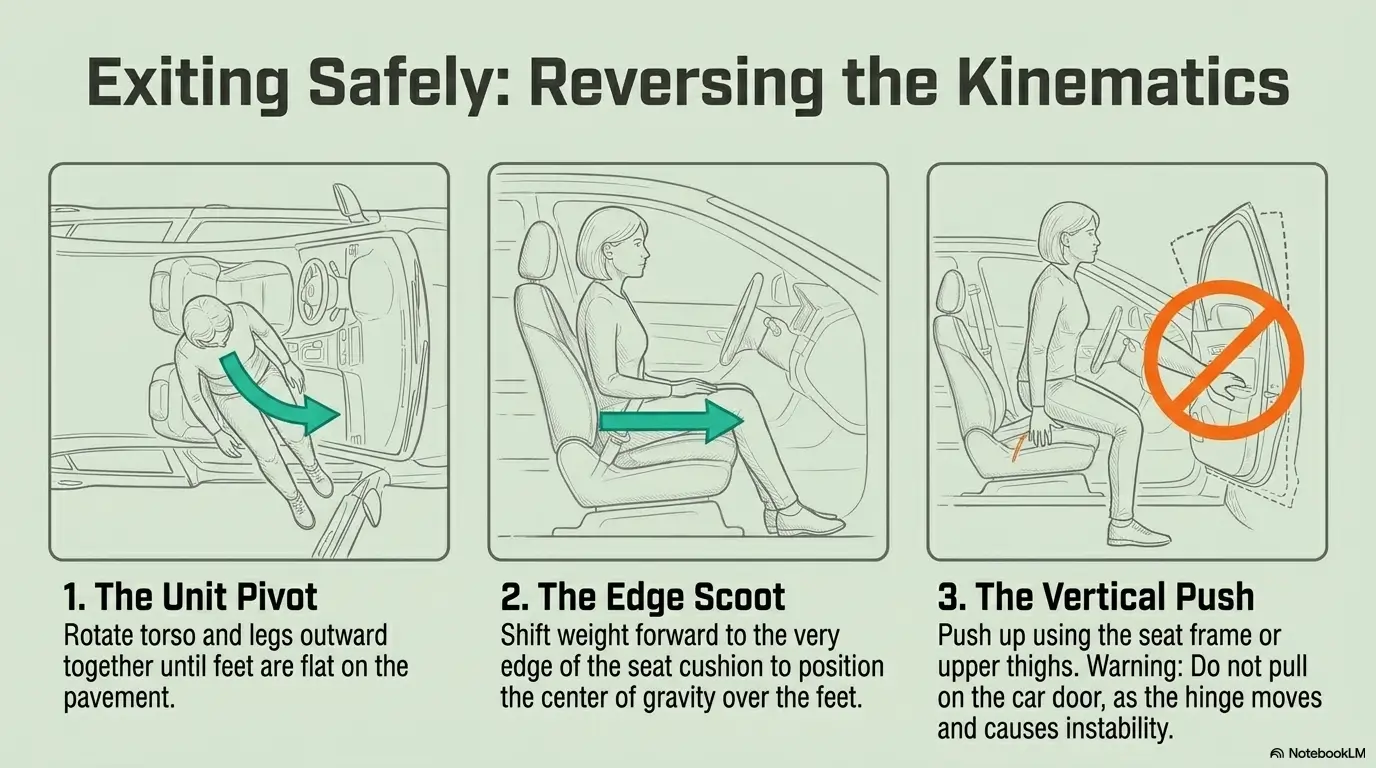
Reverse the process slowly at the destination
Before unbuckling, confirm that the mobility aid is ready and the ground is clear. Open the door fully. Help the patient move the legs out using the prescribed method, then assist with rising as instructed.
Do not rush because another car is waiting. A poor drop-off area can create pressure that leads to hurried movement. It is better to circle the block or use an accessible loading zone than perform a difficult transfer beside moving traffic.
Entry and exit mistake checklist
- Adjusting the seat after the patient is already sitting
- Letting the patient carry bags or paperwork during transfer
- Using a rolling walker as a fixed support without locking or positioning it correctly
- Pulling the patient by the arm, sling, clothing, or mobility aid
- Allowing a fast twist to grab the door
- Parking where the door cannot open fully
- Trying a new transfer method for the first time during discharge
- Standing where the caregiver blocks the patient’s feet or mobility aid
Key takeaway
The ride may be smooth, yet the transfer can still cause strain. Plan the doorway, hand placement, leg movement, and door closing as one continuous sequence.
Build a Five-Minute Caregiver and Route Plan
A good caregiver plan does not require a trunk full of accessories. It requires a few correctly chosen items, a quiet route, and clear responsibilities.
Prepare before the patient is tired, nauseated, or standing beside the vehicle. The calmer the system, the fewer improvised movements everyone has to make.
Bring the essentials without filling the passenger area
Keep discharge instructions, medication information, identification, a charged phone, and the surgical team’s contact details accessible to the caregiver. Bring an emesis bag for possible nausea.
Water should be brought only if the patient is permitted to drink. Do not offer food, gum, or medication merely because the ride is uncomfortable. Follow the discharge plan for timing and dosing.
Store bags in the trunk or cargo area. Keep the passenger’s lap, seat, and footwell clear. A tote bag is not useful when it becomes a small landslide during the first turn.
Choose the smoothest practical route, not merely the shortest
A route with fewer sharp turns, speed bumps, potholes, steep ramps, and sudden merges may be easier than a shorter route through heavy traffic. Check current road conditions before departure.
Drive gently, leave extra following distance, and begin braking earlier than usual. Even a properly positioned passenger may tense suddenly when the driver brakes late.
Avoid unnecessary stops. The ride home from an outpatient procedure is not the ideal moment for errands, a drive-through meal, or “just popping into” the pharmacy while the patient waits alone.
Plan the drop-off before leaving the starting point
Find out whether the destination has an accessible entrance, loading zone, curb cut, elevator, or bench. Consider the distance from the vehicle to the door and whether the patient can safely manage it.
The nearest parking space is not always the best space. A slightly more distant spot with a wide passenger-side clearance and level pavement may be much safer than a tight space beside a curb.
If the caregiver must park after dropping the patient off, arrange for another adult or staff member to remain with the patient. Do not leave a drowsy, dizzy, or mobility-limited person standing alone near traffic.
The five-minute caregiver card
Passenger transport card
Medical: Confirm travel approval, medication timing, alertness, nausea, pain, and required devices.
Vehicle: Select the seat, slide it into position, clear the footwell, and test the belt.
Transfer: Review who holds the mobility aid, who closes the door, and how the legs move.
Route: Choose smooth roads, gentle turns, and an accessible drop-off.
Backup: Carry contact details and know where to stop safely if symptoms change.
For a broader list of questions and documents to bring to follow-up care, the orthopedic appointment checklist and caregiver notes guide can help organize the next trip.
Patients recovering from sedation or anesthesia should follow their discharge instructions regarding transportation, supervision, activity, and driving.
When to Delay the Trip, Stop, or Seek Medical Help
A planned short ride should be delayed when the patient cannot enter, sit, ride, or exit safely. Medical symptoms also matter. The discharge instructions should list procedure-specific warning signs and contact numbers.
Do not use a car ride as a test of whether serious symptoms will settle down. When emergency symptoms are present, call emergency services rather than asking a family member to drive faster.
Delay the trip and call the surgical team when something is changing
Contact the surgical team according to the discharge instructions for concerns such as increasing incision redness, swelling, bleeding, unusual drainage, worsening pain, persistent vomiting, fever, or a new problem with a brace, dressing, drain, or limb position.
Also call when the patient cannot maintain the required posture, cannot safely use the mobility aid, becomes much sleepier than expected, or develops dizziness that makes transfer unsafe.
Specific fever thresholds and wound instructions vary by procedure. Use the numbers and symptoms printed in the patient’s own discharge paperwork rather than borrowing a threshold from someone else’s operation.
Use emergency services for severe or sudden symptoms
Seek emergency help for severe trouble breathing, chest pain, loss of consciousness, uncontrolled bleeding, sudden weakness, new facial droop, new difficulty speaking, seizure, severe confusion, or an inability to wake the patient normally.
Do not attempt ordinary passenger transport when the person cannot sit safely, protect the airway, remain conscious, or tolerate the required position. Emergency professionals can assess and transport the patient with appropriate equipment.
Know when to pull over during the ride
If the passenger develops sudden nausea, severe pain, faintness, breathing difficulty, confusion, or bleeding, pull over in a safe place. Turn on hazard lights when appropriate and assess the situation without asking the passenger to stand beside traffic.
Call the surgical team for non-emergency concerns covered by the discharge plan. Call emergency services for severe symptoms or when you are uncertain whether the passenger can continue safely.
A simple stoplight decision guide
| Level | Example situation | Action |
|---|---|---|
| Green | Travel is medically approved, symptoms are controlled, and the transfer can follow written precautions | Proceed with the prepared setup and gentle driving |
| Amber | New dizziness, repeated vomiting, worsening pain, concerning wound change, unusual sleepiness, or inability to maintain the required position | Delay travel and contact the surgical team or designated clinical line |
| Red | Severe breathing trouble, chest pain, fainting, uncontrolled bleeding, sudden neurological symptoms, or inability to wake normally | Call emergency services rather than transporting by ordinary car |
MedlinePlus provides general postoperative information and procedure-specific discharge resources, but the patient’s own instructions remain the primary guide.
Key takeaway
A short distance does not make serious symptoms safe to transport. When the patient cannot travel safely, bring medical help to the patient instead of bringing the patient to medical help by ordinary car.
FAQ
Can I put a pillow between the seat belt and a surgical incision?
Ask the surgical team first. A small, soft comfort layer may sometimes be acceptable, but it must not move the belt away from the body, change its route, encourage loosening, or place a hard object over the incision. Never use bulky padding as a homemade belt shield.
Is the front seat or back seat better after surgery?
Neither is always better. Choose the medically appropriate seat that allows the easiest approved entry, adequate legroom, correct posture, and normal lap-and-shoulder belt use. Test both options while the vehicle is parked before the patient approaches.
How far should the passenger seat recline after an operation?
Use the position recommended by the treating team and compatible with proper restraint fit. Do not recline so far that the passenger slides forward or the lap belt rises toward the abdomen. Some procedures require a more upright or neutral posture.
Can someone ride in a car on the same day as outpatient surgery?
Many outpatient patients are discharged as passengers with a responsible adult, but the surgical facility determines readiness. The patient should not drive after anesthesia or sedation until specifically cleared and should follow all supervision and medication instructions.
What is the safest way to get into a car after abdominal surgery?
Follow the transfer method taught by the care team. A common approach is to back toward the seat, lower under control, settle against the seatback, and bring the legs inside without a sharp trunk twist. The correct method depends on the operation and restrictions.
How can a passenger avoid twisting after hip, knee, or back surgery?
Prepare enough doorway and legroom, align the body before sitting, move slowly, and use the prescribed transfer technique. Some patients are taught to move the legs together. Do not pull the patient by the arms or improvise around a brace.
Can a patient ride in a car while taking prescription pain medication?
Medication does not automatically prevent passenger travel, but drowsiness, confusion, dizziness, nausea, or poor balance may make the transfer or ride unsafe. Follow the prescribing and discharge instructions, and contact the care team when side effects are concerning.
When is it safe to drive again after surgery?
Driving clearance depends on the operation, medications, strength, reaction time, mobility, ability to brake firmly, and ability to turn and observe traffic. Obtain explicit clearance rather than relying on a fixed number of days or how comfortable the patient feels as a passenger.
Can I protect the vehicle seat from wound drainage?
Ask the care team how dressings and drains should be managed. A clean protective layer may be placed on the vehicle seat only if it remains flat, does not slide, and does not interfere with restraint fit or positioning. Do not place bulky folded material beneath the patient.
Rehearse the Parked-Car Setup in Fifteen Minutes
The simplest next step is also the most useful: rehearse the setup before the patient needs it. Use the actual vehicle, actual mobility aid, and actual destination side of the car.
Do not ask a newly postoperative patient to perform an unnecessary practice transfer unless the care team recommends it. The caregiver can complete most of the preparation alone and review the movement sequence verbally.
Your fifteen-minute parked-car plan
- Minutes 1 to 3: Read the travel, sitting, bending, brace, and weight-bearing instructions.
- Minutes 4 to 6: Compare the front passenger and rear doorway, then choose the least difficult approved option.
- Minutes 7 to 9: Slide the seat, adjust the backrest conservatively, and clear the floor and door pocket.
- Minutes 10 to 11: Pull the belt across the empty seat and visualize its path across the patient’s hips, chest, and shoulder.
- Minutes 12 to 13: Decide where the walker, crutches, discharge bag, and caregiver will be positioned.
- Minutes 14 to 15: Rehearse the spoken sequence: approach, align, sit, move the legs, buckle, close the door.
Five questions to ask before discharge
- Is the patient medically cleared to ride in a car today?
- What exact sitting position and transfer method should be used?
- Must a brace, sling, or immobilizer remain on during the ride?
- May any small comfort padding be used without affecting the restraint?
- Which symptoms mean we should call the surgical team or emergency services?
A well-prepared car should look almost ordinary: a clear floor, an adjusted seat, an accessible buckle, and no tower of improvised cushions. The safety comes from the quiet decisions made beforehand.
When the passenger arrives, slow the moment down. Give one instruction at a time. Let the patient pause. Close the door for them. Drive as though a full cup of water is resting on the dashboard.
The practical promise
You do not need to predict every discomfort. You need a setup that respects the medical instructions, preserves the seat belt, removes avoidable obstacles, and gives the patient enough time to move without panic.
Last reviewed: 2026-07