
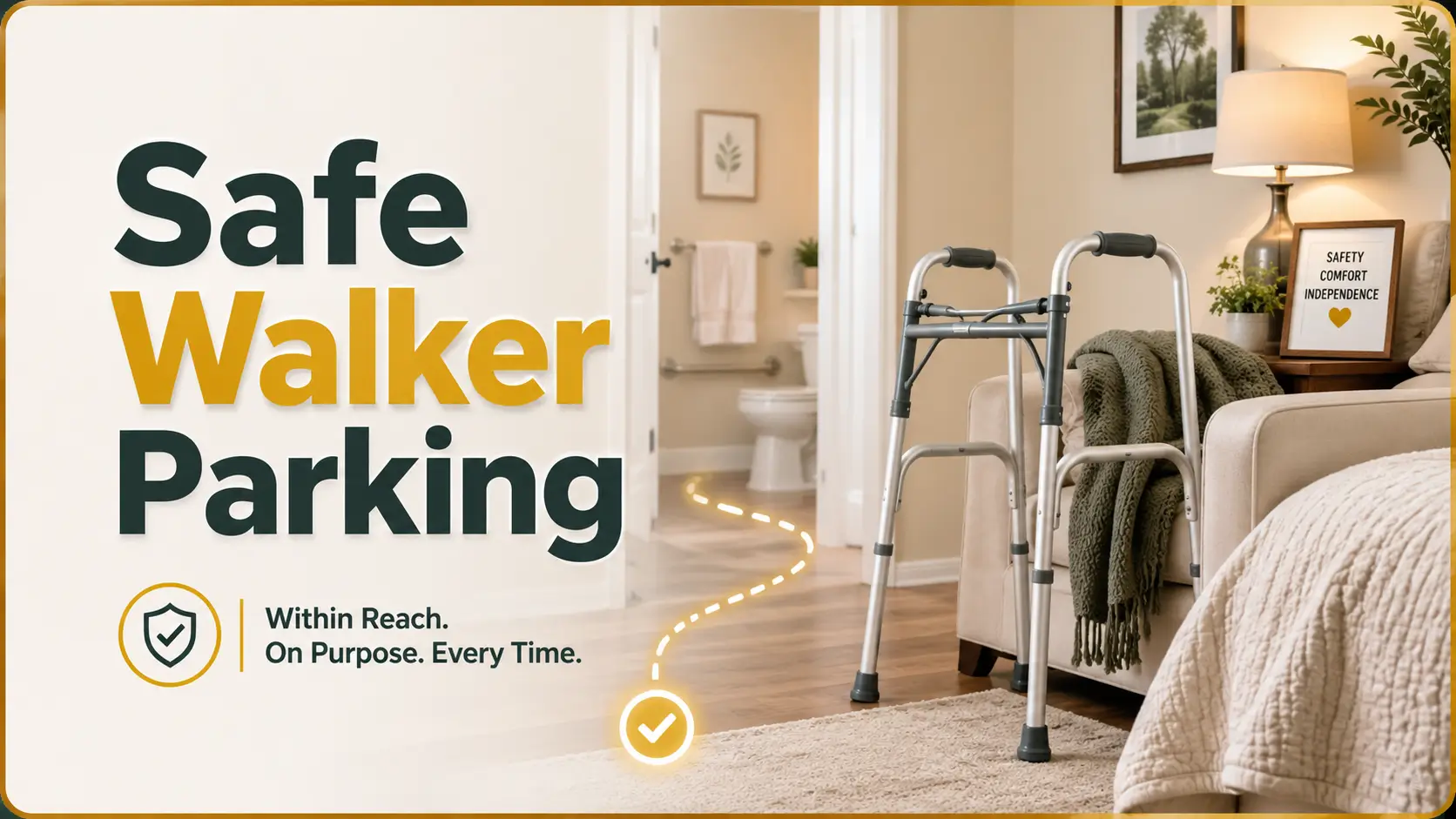
Home safety, aging in place, and the tiny habit that prevents big trouble
Walker Parking Spot at Home:
Why It Matters More Than Storage
A walker is not just equipment. In a real home, it becomes part of the choreography: bed to bathroom, chair to kitchen, doorway to car, midnight to morning. The danger often appears in the tiny gap between “I have a walker” and “the walker is exactly where my hand reaches next.”
That gap is where people twist, reach, furniture-walk, shuffle one step without support, or park the walker behind a chair because visitors are coming. It looks harmless. It behaves like a tripwire wearing a cardigan.
This guide turns walker placement into a simple home-safety system. You will learn where to park a walker room by room, what mistakes quietly increase fall risk, how caregivers can reset the layout without nagging, and when it is time to ask a physical therapist, occupational therapist, doctor, or home-safety professional for help.
For caregivers
Create safer habits without turning the home into a warning-sign museum.
For recovery homes
Reduce “just one step” moments after surgery, illness, or a pain flare.
For aging in place
Make daily routes clearer before the home becomes harder to navigate.
The safest walker is not the newest one. It is the one waiting in the right place for the next safe step. 🧭
Snapshot
This article is for older adults, family caregivers, post-surgery patients, and home-safety planners who want a safer walker setup at home. You will learn how to choose walker parking spots near beds, chairs, bathrooms, kitchens, and entryways, what storage mistakes to avoid, and how to run a 10-minute safety audit before a small inconvenience becomes a fall hazard.
Table of Contents
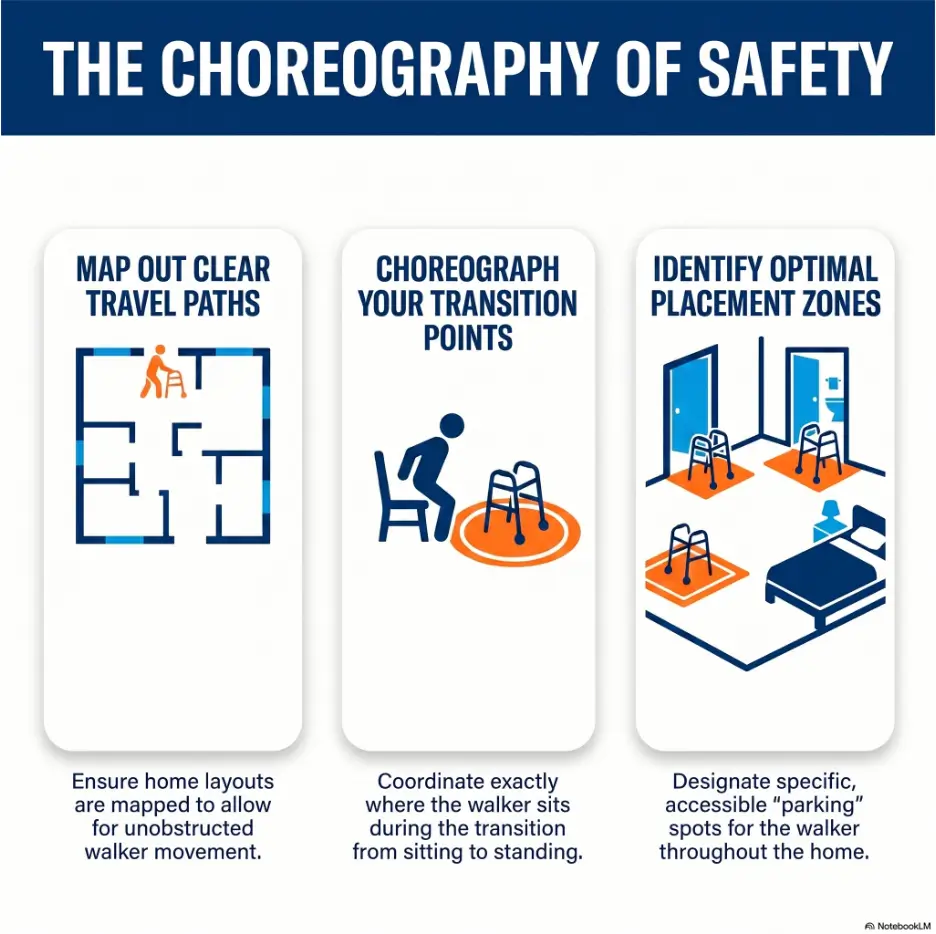
Before You Move the Furniture
A walker parking spot is a home-safety decision, not a decorating problem. The goal is simple: the walker should be available at the exact moment a person needs support, without requiring reaching, twisting, sidestepping, or furniture-walking.
This matters most for older adults, people recovering from joint surgery, people with balance changes, and anyone whose strength or attention varies during the day. A morning route may feel easy. A 2:17 a.m. bathroom route may not.
A walker spot is not a medical plan
This guide can help you think through safer walker placement, but it cannot tell you whether a walker is the right device, whether it is adjusted correctly, or whether a person should walk without supervision. Those decisions belong with a qualified clinician, especially after surgery, stroke, injury, fainting, dizziness, sudden weakness, or new confusion.
If a surgeon, physical therapist, occupational therapist, nurse, or physician gave specific instructions, follow those first. A tidy layout should never outrank a medical restriction.
Key takeaway
A walker parking spot should reduce effort, not create a new task. If the person has to reach, shuffle sideways, or move furniture to get the walker, the spot is not safe enough.
What this article can and cannot do
This article can help you spot common layout hazards, compare low-cost and professional options, and create safer routines at home. It can also give caregivers a calmer way to talk about walker placement without making the person feel watched, corrected, or reduced to their risk factors.
It cannot diagnose balance problems, replace therapy, choose a walker model, or guarantee fall prevention. Falls usually involve several overlapping factors, including strength, medications, vision, footwear, lighting, pain, fatigue, and the home environment.
For authoritative fall-prevention guidance, the National Institute on Aging offers room-by-room home safety tips, and the CDC STEADI program provides fall-prevention resources used by healthcare professionals and caregivers.
Who should not rely on layout alone
A better parking spot is helpful, but it is not enough when symptoms change suddenly. Get medical advice promptly if someone has new dizziness, fainting, sudden weakness, chest pain, shortness of breath, slurred speech, new confusion, severe pain, or repeated near-falls.
Also pause the DIY approach if the walker does not fit through essential pathways. If the only way to get from bed to bathroom is by turning sideways, squeezing past furniture, or lifting the walker over rugs, the issue is not “remembering better.” It is a route-design problem.
- After a fall, report it to a healthcare provider even if there was no obvious injury.
- After surgery, confirm weight-bearing and movement restrictions before changing routines.
- After a medication change, watch for dizziness, sleepiness, or balance changes.
- After new confusion, treat the change as a health concern, not a stubbornness issue.
The Parking Spot Problem Most Homes Miss
Most homes do not fail because there is no walker. They fail because the walker lives in the wrong small places: behind the chair, across the bedroom, folded in the hallway, tucked near the door hinge, or balanced against a wall like a polite but useless coat rack.
The problem is not storage. The problem is timing. A walker that is “nearby” may still be too far away during a transfer, a pain spike, a rushed bathroom trip, or a distracted moment when the phone rings.
Why “almost nearby” is still risky
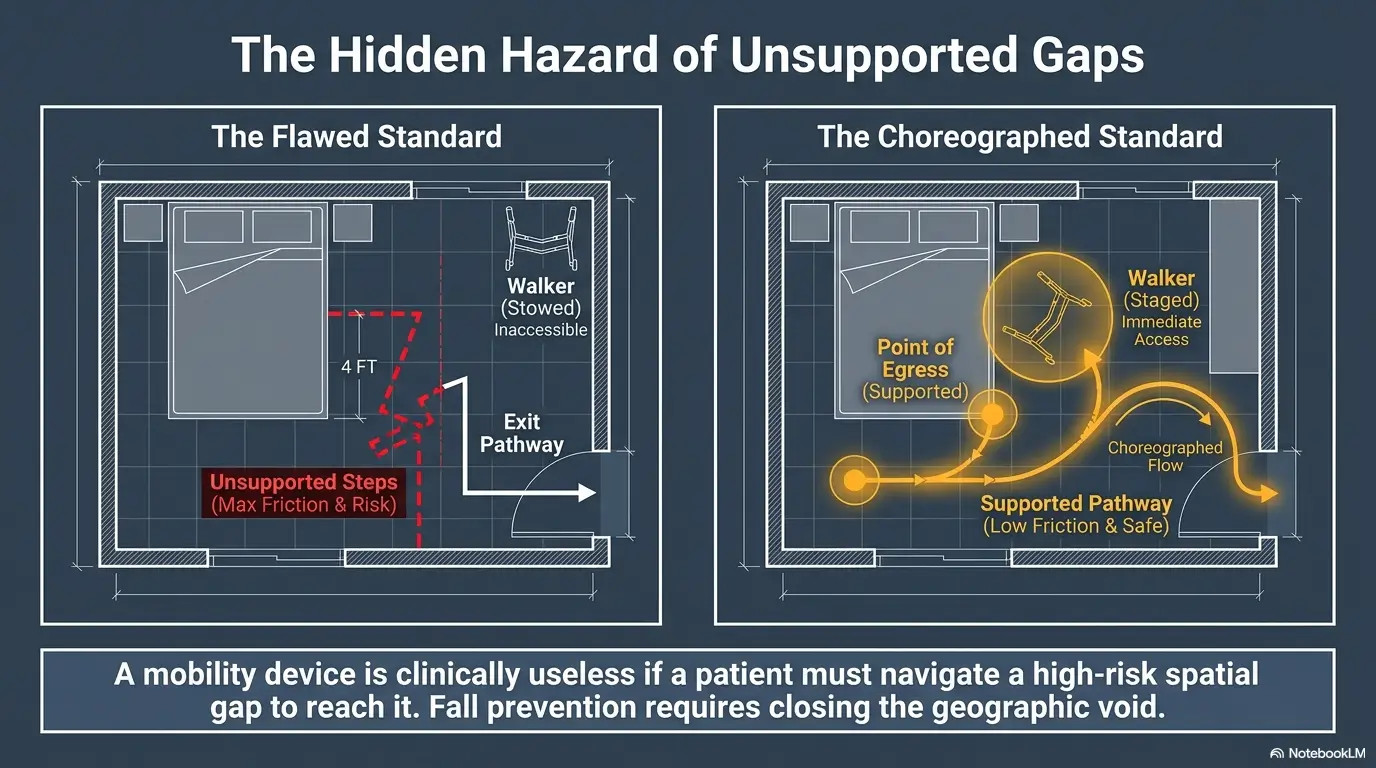
Almost nearby means the person must make a small unsupported move before they reach support. That small move may be a pivot from the bed, a lean from the recliner, a sidestep around the coffee table, or a hand planted on a rolling office chair.
One unsupported step can become more tempting when the walker is visible but inconvenient. The brain whispers, “It is only two steps.” The floor, unfortunately, has no sense of humor.
Key takeaway
A walker spot should be judged from the seated or lying position, not from where a standing adult thinks it “looks close enough.” Test it from the real starting position.
The hidden risk of leaning a walker against furniture
Leaning a walker against a bed, wall, dresser, sofa, or counter may seem harmless. But if it slides, tips, or turns away from the person, the first movement of the day becomes a small puzzle. And puzzles are charming at a breakfast table, not during a bathroom emergency.
A safer parking spot keeps the walker upright, facing the route, and reachable without pulling. The person should not need to drag it closer, fish it out from a corner, or rotate it before taking the first supported step.
Convenience beats willpower
Many caregivers try reminders first. “Use your walker.” “Don’t forget your walker.” “Please take the walker.” Sometimes reminders help. But a better layout is usually kinder and more reliable than a daily chorus of warnings.
Human beings choose the easiest safe action when the environment offers it. That is the heart of walker parking: design the room so the safe choice is also the lazy choice.
Short Story: The walker behind the blue chair
A daughter moved her father’s walker behind his favorite blue chair every evening. It made the living room look peaceful again. No metal frame in the middle of the room, no reminder of the surgery, no hospital feeling.
But each morning, he stood up, touched the armrest, turned halfway, and reached behind him. One day he admitted he often took two steps to get it because pulling it forward felt awkward.
They changed one thing. The walker now parked beside the chair, facing the hallway, with enough space for his feet. The room looked less polished, but mornings became quieter.
The lesson was not that the daughter had done something foolish. It was that homes tell people what to do. Sometimes the safest instruction is written in empty floor space.
Best Walker Parking Zones Room by Room
The best walker parking spot depends on the room, the person’s transfer pattern, and the next likely destination. A good spot is close, visible, stable, and not blocking the very feet it is supposed to protect.
Use the room-by-room guide below as a starting point, then adjust based on the person’s actual habits. Watch one real transfer from bed, chair, toilet, or doorway. The body will tell you what the floor plan forgot.
Bedroom: beside the bed, not across the room
The walker should usually park on the side of the bed the person actually uses. It should face the direction of the first route, often toward the bathroom, hallway, or dresser.
Avoid parking it at the foot of the bed if the person must stand, shuffle, and turn before reaching it. That setup can create the exact unsupported moment the walker is meant to prevent.
- Place the walker within easy arm’s reach from the sitting edge of the bed.
- Keep the path from bed to walker clear of slippers, cords, laundry, pet beds, and baskets.
- Use soft lighting so the walker is easy to see at night without glare.
- Keep glasses, phone, water, and needed items on the same side as the walker when possible.
For a deeper bedside setup after joint surgery, you may also find this related guide useful: knee replacement nightstand setup.
Bathroom: outside the splash zone, inside the reach zone
Bathrooms are tricky because they are small, wet, and full of hard surfaces with very little forgiveness. The safest walker parking spot may not be deep inside the bathroom. Often, it is just outside the bathroom door or beside the vanity, depending on the layout and what a clinician recommends.
The walker should not sit where it blocks the door, bumps the toilet, catches on a bath mat, or forces the person to twist around the sink. Wet floors can also affect rubber tips, wheels, and footing.
| Bathroom situation | Safer walker parking idea | What to check |
|---|---|---|
| Small half bath | Park outside the door, facing the exit route | Can the person safely transition to grab bars or prescribed support? |
| Large bathroom | Park near the vanity or toilet approach, away from wet areas | Does it block the door swing or cabinet doors? |
| Shower routine | Keep walker out of splash zones | Is there a shower chair, non-slip setup, or therapist-approved plan? |
| Night bathroom trips | Use lighting and a straight route from bed to bathroom | Are rugs, cords, and laundry removed? |
For related home-safety planning, see how to have a shower safety conversation and how to think about toilet seat riser height.
Living room: near the favorite chair without blocking feet
The favorite chair is a high-use transfer zone. That makes it one of the most important walker parking spots in the home. The walker should be close enough to reach after standing, but not so close that the person trips over it while getting their feet under them.
Watch the full transfer: scoot forward, feet under knees, stand, steady, reach, walk. If the walker interrupts foot placement, it is too close or angled poorly. If the person must step to reach it, it is too far.
Kitchen and entryway: where good intentions get busy
In the kitchen, do not park a walker where it blocks cabinet swings, refrigerator doors, oven doors, dishwasher doors, or stove access. Kitchens invite multitasking, and multitasking is not always kind to balance.
At the entryway, the walker should be close enough for shoe changes and coat routines but far enough from the door arc. A walker trapped behind an opening door is not parked. It is being held hostage by architecture.
If the person uses a walker outside the home, review this companion guide on parking lot safety with a walker. Outdoor transitions often reveal indoor layout problems, especially at thresholds and car doors.
The Walker Parking Loop
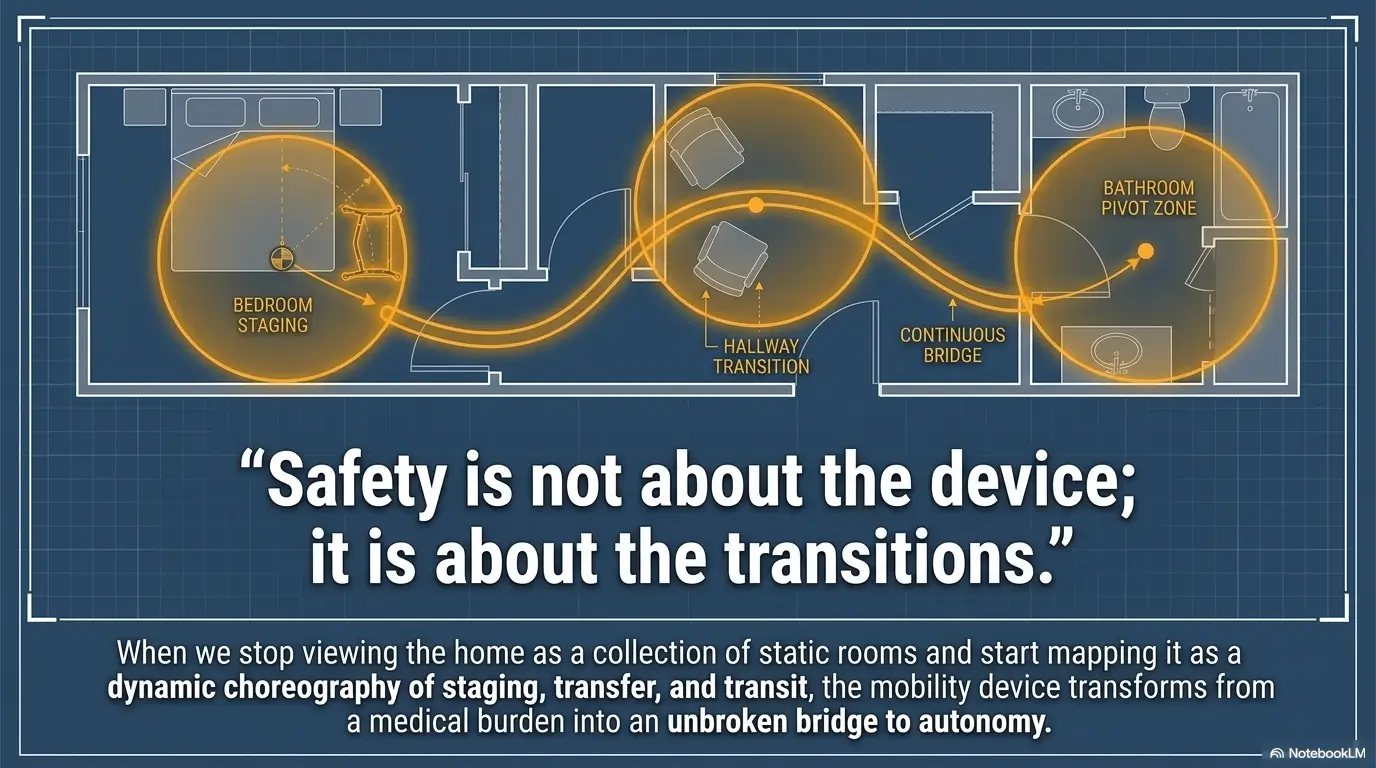
A safe spot is not a single dot on the floor. It is a loop that works before, during, and after movement.
Visible from bed, chair, toilet, or doorway.
No leaning, pulling, twisting, or one-step gamble.
Feet have room before hands move to support.
Enough space to face the route without squeezing.
No rugs, cords, baskets, pets, or narrow furniture gaps.
Parked again for the next real-life moment.
The 3-Foot Rule: Clear Space Before Clever Storage
Before buying organizers, hooks, labels, storage racks, or a prettier basket, protect clear floor space. A walker needs room to approach, turn, pause, and reset. Storage that looks clever but narrows the route is not clever enough.
A simple planning rule is to think in three feet of working space around important transfer areas when possible. That does not mean every home can offer a perfect three-foot bubble. Apartments, older homes, and narrow hallways may not cooperate. But it gives you a practical standard: make space before you decorate the problem.
Leave turning space, not just standing space
Many homes leave enough room for a walker to stand still, but not enough room for a person to turn with it. Turning is where rugs, coffee tables, baskets, floor lamps, ottomans, and pet beds suddenly become supporting actors in a bad little drama.
Test the space by watching the person do the real movement slowly. Can they stand, reach the walker, turn toward the route, and start walking without bumping furniture or stepping sideways?
Remove temporary piles first
Temporary piles are the house gremlins of fall prevention. The package by the door. The laundry basket near the bed. The charging cord across the route. The tote bag that was “just there for a minute” three Tuesdays ago.
For walker users, temporary clutter becomes a permanent decision point. Every obstacle asks the person to adjust, lift, twist, or improvise. Safer walker parking starts by making the route boring, open, and easy to repeat.
Clear-space checklist
- Can the walker sit upright without leaning on furniture?
- Can the person reach it without stepping first?
- Can both feet settle before movement begins?
- Can the walker turn toward the route without bumping a table, bed, or chair?
- Are rugs, cords, pet beds, baskets, shoes, and bags out of the route?
- Can another person assist without being trapped between furniture and the walker?
Don’t make the walker compete with a side table
Side tables are useful. They also attract lamps, remotes, pill organizers, books, drinks, tissues, charging cables, and the occasional heroic mountain of mail. If the walker and the side table both need the same space, the walker wins.
Move the table, reduce its footprint, or choose a route-side setup where essentials are reachable without stealing walker space. If the person must choose between grabbing the walker and grabbing the phone, the layout is asking the wrong question.
| Item competing for space | Why it matters | Safer alternative |
|---|---|---|
| Side table | Can block foot placement or walker turn | Move slightly behind the safe reach zone or use a smaller table |
| Floor lamp | Cord and base can become trip hazards | Use wall lighting, plug management, or a lamp outside the route |
| Decorative basket | Often migrates into walking space | Store outside the path or remove from transfer zones |
| Pet bed | Soft edges are easy to miss at night | Move away from bed-to-bathroom and chair-to-kitchen routes |
| Throw rug | Can catch walker tips or wheels | Remove it from the walker route unless a professional confirms it is safe |
Common Mistakes That Turn a Walker Into Clutter
A walker becomes clutter when the home treats it as something to hide between uses. That is understandable. Nobody wants their living room to feel like a clinic waiting area. But hiding the walker often creates more risk than visibility ever could.
The safer goal is not to make the walker disappear. The goal is to make it belong.
Mistake 1: parking it behind the chair
Behind the chair is one of the most common “looks tidy, works badly” spots. It may clear the room visually, but it forces the person to stand, turn, reach, and pull the walker into position.
A better spot is usually beside the chair, angled toward the next route, with enough space for feet and caregiver assistance. If the walker makes the chair area look busy, use a cleaner furniture arrangement instead of hiding the equipment.
Mistake 2: folding it after every use
Folding a walker after every use may seem tidy, but it can make the walker harder to access during the next transfer. It may also add a small dexterity task for someone with hand pain, shoulder restrictions, low vision, or fatigue.
Folding can make sense for transport, visitor traffic, or occasional storage. It should not be the default if the person needs the walker many times a day. Frequent-use equipment deserves a ready position.
Key takeaway
If a walker is used several times a day, folding it may save visual space while adding physical risk. Ready beats hidden when mobility is uncertain.
Mistake 3: storing it where visitors won’t see it
Many families move walkers before guests arrive. The impulse is human. The problem is that social tidying often removes the very support someone needs during a busy, distracting, high-movement time.
Visitors bring coats, bags, shoes, hugs, conversation, pets, kids, and doorway traffic. That is precisely when a walker should be predictable. Instead of hiding it, create a visible spot that does not block traffic.
Mistake 4: using furniture as backup walkers
Furniture-walking is when someone moves by touching counters, chair backs, beds, walls, dressers, or door frames instead of using prescribed support. It may look like independence. Often, it is a workaround for a walker that is too far away, awkwardly parked, or difficult to maneuver.
If furniture-walking appears often, do not treat it as a character flaw. Treat it as data. The walker route, device fit, pain level, strength, or home layout may need professional review.
| Common mistake | Why it backfires | Safer alternative |
|---|---|---|
| Walker behind chair | Requires twisting or stepping before support | Park beside chair, facing the route |
| Walker in closet | Too far for urgent or tired moments | Keep one ready spot near each high-use area |
| Walker folded all day | Adds setup friction before every transfer | Leave unfolded when used frequently |
| Bags hanging on handles | Can change balance and interfere with grip | Use only clinician-approved carrying options |
| Doorway parking | Blocks exits and door swings | Park outside the door arc with a clear path |
Nighttime Walker Parking: The Quiet Danger Zone
Nighttime is where a decent daytime setup can fail. The person may be half-awake, in pain, groggy from medication, moving quickly to the bathroom, or trying not to wake anyone. The home is darker, the body is slower, and the floor has suddenly become a negotiation.
The nighttime walker spot needs stricter rules than the daytime spot. It should be visible, reachable, facing the first route, and paired with lighting before reminders.
Why midnight bathroom trips need a stricter layout
A person who uses a walker well during the day may skip it at night because the bathroom feels urgent and the walker is not perfectly placed. That is not unusual. It is exactly why the setup must remove friction.
The walker should be parked on the side of the bed the person exits from, with a clear route to the bathroom. The route should be boring: no floor clutter, no loose rugs, no pet bowls, no charging cables, no laundry baskets, no slippers kicked into the path.
For more route planning after surgery or pain flares, see this related guide on bedroom lighting setup after joint surgery.
Add light before adding reminders
“Remember to use your walker” is less effective when the person cannot clearly see the walker, floor, slippers, or bathroom route. Lighting is not cosmetic here. It is part of the mobility system.
Use gentle night lighting that reveals the route without harsh glare. Bright glare can be disorienting, while darkness invites guessing. The sweet spot is enough light to identify the walker and walkable floor space without turning the bedroom into a stage production.
Keep slippers, glasses, phone, and walker in one chain
Night safety improves when the first few actions happen in a predictable order. Sit up. Put on glasses if needed. Put feet into safe footwear. Reach walker. Stand. Pause. Move.
That order should be physically built into the room. Do not place slippers across the room, glasses on the opposite side, and the walker near the dresser. That layout asks a sleepy person to conduct an orchestra before walking to the bathroom.
The half-awake reach test
- Sit on the bed exactly where the person usually sits before standing.
- Dim the room to normal nighttime lighting.
- Without standing, check whether the walker is visible and reachable.
- Check whether slippers, glasses, phone, and water are on the safe side.
- Stand only if safe to do so, then confirm the walker faces the route.
- If any step requires reaching, twisting, or guessing, adjust the layout.
Caregiver Setup: Make the Safe Choice the Easy Choice
Caregivers often carry the emotional weather of home safety. They notice the near-falls, the unsteady turns, the walker left in the wrong place, and the tiny choices that could become trouble. But constant correction can strain dignity on both sides.
A better system reduces the need for repeated reminders. It uses clear spots, predictable resets, visual cues, and practical language that respects the person’s independence.
Use visual cues without making the room feel clinical
A visual cue can be as simple as a small non-slip floor marker, a contrasting rug-free zone, a nearby lamp, or a consistent open space beside a chair. The cue should say, “This is where the walker lives,” without making the room feel like a compliance chart.
Labels can help some people, especially after routine changes or mild memory issues. But labels should not shame. “Walker spot” is better than “Do not forget your walker.” The first supports a habit. The second sounds like a scolding refrigerator magnet.
Create one parking spot per high-use area
Many homes need more than one walker parking spot. The bed, favorite chair, bathroom approach, kitchen edge, and entryway may each need a predictable place. This does not mean buying multiple walkers unless a clinician recommends it. It means the walker has a clear “home base” wherever the person pauses often.
If there are two walkers, such as one upstairs and one downstairs, confirm with a professional that both are appropriate, adjusted correctly, and safe for the person’s needs.
Build a five-second reset habit
The safest walker spot fails if the walker does not return there. After every transfer or route, the walker should be parked ready for the next use. This reset should take five seconds, not five minutes.
- After sitting down, check that the walker is beside the chair, not behind it.
- After returning to bed, park the walker on the exit side, facing the bathroom route.
- After guests leave, reset the walker before resetting the decorative pillows.
- After cleaning, remove buckets, cords, vacuums, and baskets from walker routes.
Show me the nerdy details
Walker parking works because it reduces three kinds of friction: physical friction, cognitive friction, and social friction.
Physical friction is the reach, turn, sidestep, or pull needed before support begins. Cognitive friction is the thinking required to remember where the walker is, especially at night or during pain. Social friction is the pressure to hide the walker because visitors are present or the room looks less tidy.
A strong setup removes all three. The walker is physically reachable, mentally predictable, and socially accepted as part of the room. That is why a walker spot is more than storage. It is behavioral design for safer movement.
Equipment, Costs, and Service Options Worth Comparing
Most walker parking improvements are low-cost: moving furniture, removing rugs, clearing cords, adding lighting, and creating a reset habit. But some homes need equipment, a professional assessment, or both.
The goal is not to buy everything that promises safety. The goal is to spend money where it removes a real barrier. A $15 cord cover may help more than a fancy storage rack. A professional home-safety visit may be worth more than another gadget if the route itself is wrong.
Good, better, best home setup options
Use this comparison as a practical decision guide, not a shopping command. Needs vary by home, diagnosis, recovery stage, and clinician instructions.
| Setup level | Best for | Typical focus | What to compare before paying |
|---|---|---|---|
| Good: DIY reset | Stable walker users with minor clutter issues | Move furniture, clear routes, set parking spots, improve lighting | Cost of small fixes, ease of daily reset, whether the person can use the layout safely |
| Better: targeted equipment | Homes with lighting, bathroom, threshold, or reach problems | Night lights, cord management, grab bars, non-slip solutions, safer storage for essentials | Installation quality, return policy, weight limits, fit, cleaning needs, clinician approval |
| Best: professional assessment | Repeated near-falls, post-surgery recovery, complex layouts, caregiver strain | Physical therapy, occupational therapy, home-safety assessment, route training | Credentials, insurance coverage, out-of-pocket cost, visit scope, written recommendations |
Free vs paid help: when each makes sense
A free DIY approach is often enough when the problem is obvious: the walker is behind the chair, the hallway has clutter, the bathroom path has rugs, or the bedroom has no night lighting. Start there. The best home-safety improvement is sometimes a laundry basket moved four feet to the left.
Paid help may be worth considering when the person has fallen, nearly fallen, refuses to use the walker, cannot fit through routes safely, or has medical restrictions after surgery. In those cases, the question is not “Which product should I buy?” It is “What is the real barrier, and who can assess it?”
The American Geriatrics Society’s Health in Aging resource on fall prevention can help families prepare better questions for healthcare providers.
Questions to ask before buying walker accessories
Walker trays, baskets, pouches, clips, glides, wheels, and storage accessories can be useful in the right context. They can also interfere with balance, grip, turning, or safe use if poorly chosen.
- Has a clinician confirmed this accessory is appropriate for the person’s walker and condition?
- Will it change the walker’s balance, width, height, or turning behavior?
- Can the person still grip both handles correctly?
- Does it make the walker harder to park beside the bed, chair, or toilet route?
- Does it encourage carrying heavy items that should be moved another way?
- Can it be cleaned easily and removed when needed?
For food and carrying routines, this guide on how to carry a plate with a walker may help you think through safer alternatives before hanging extra weight on the frame.
Key takeaway
Do not buy accessories to solve a layout problem. Fix the route first. Then compare equipment only if it supports the person’s actual movement pattern.
When to Seek Help
Some walker parking problems are household problems. Others are clinical problems wearing household clothes. The difference matters.
If the walker is in the wrong spot, you can move it. If the person cannot safely use it, avoids it, looks unstable with it, or needs to twist through the home to move at all, bring in professional eyes.
After any fall, near-fall, or repeated stumble
A fall should be reported to a healthcare provider, even when the person says, “I’m fine.” Many people minimize falls because they fear losing independence. A calm response helps: “Let’s understand what happened so the next route is safer.”
Record the time, location, lighting, footwear, walker position, recent medications, pain level, and what the person was trying to do. This turns a frightening event into useful information for a provider.
When the walker feels too tall, too short, too wide, or unstable
If the person hunches, shrugs, pushes the walker too far ahead, clips doorways, lifts the walker awkwardly, or complains that it feels wrong, do not solve that by changing the parking spot alone. Device fit and walking pattern may need review.
A physical therapist or occupational therapist can assess gait, transfers, device height, route design, and how the person actually moves through daily tasks. That kind of assessment can be especially helpful after orthopedic surgery, a hospital stay, or a decline in strength.
When the home forces sideways walking
Sideways walking with a walker is a warning sign. It may mean hallways are too narrow, furniture is crowding the route, doors are awkward, or the walker type does not fit the environment. Do not normalize it just because the person “manages.”
Review walker path safety at home for a broader route checklist, then consider professional help if the route cannot be made clear with simple changes.
Provider question checklist
- Is this walker the right type and height for the person right now?
- Are there specific weight-bearing, turning, or transfer restrictions?
- Where should the walker be during bed, chair, toilet, and shower transfers?
- Should an occupational therapist assess the bathroom, bedroom, or entryway?
- Could medication, vision, blood pressure, pain, or footwear be increasing fall risk?
- Should we document falls, near-falls, or nighttime confusion in a daily log?
FAQ: Walker Parking Spot at Home
Where should a walker be parked beside a bed?
Park it on the side of the bed the person actually uses, close enough to reach from a seated position and facing the first route, often toward the bathroom or hallway. The person should not need to stand, pivot, or step before reaching it.
Should a walker be folded when not in use?
Usually not if it is used many times a day. Folding may make sense for transport or occasional storage, but frequent-use walkers should be ready, visible, and reachable. Ask a clinician if folding or storing the walker changes safe use for that person.
How much space does a walker need near a chair?
There should be enough room for the person to place both feet, stand, reach the walker, turn toward the route, and begin walking without bumping furniture. When possible, think in terms of clear turning space, not just enough room for the walker to stand still.
Is it safe to keep a walker in the bathroom?
It depends on the bathroom layout and the person’s mobility plan. A walker should not sit in a wet splash zone, block the door, catch on mats, or force twisting. Some homes work better with the walker parked just outside the bathroom, paired with clinician-approved bathroom supports.
What should not be stored on a walker?
Avoid heavy bags, swinging purses, loose items, and anything that changes balance or blocks hand placement. Accessories should be chosen carefully and, when there is any doubt, reviewed with a physical therapist, occupational therapist, or medical equipment professional.
How can caregivers remind someone to use the walker?
Start with the environment before verbal reminders. Put the walker where it is easy to reach, add lighting, remove obstacles, and create a reset habit. If words are needed, use respectful language such as, “Let’s keep your next step easy,” rather than repeated correction.
How many walker parking spots should a home have?
Most homes need one clear spot in each high-use area: bed, favorite chair, bathroom approach, kitchen edge, and entryway. The same walker may move between spots, but each stopping point should have a predictable place where the walker rests safely.
What is the safest place for a walker at night?
At night, the walker should usually be on the bed-exit side, visible in low light, within reach from sitting, and facing the bathroom or first walking route. Slippers, glasses, phone, and lighting should support the same sequence.
Do a 10-Minute Walker Parking Audit
The best next step is not buying a product. It is walking through the home with fresh eyes and a little honesty. Ten minutes can reveal the one basket, rug, chair angle, or habit that keeps turning the walker into a scavenger hunt.
Start with the four places where small risks repeat most often: bed, favorite chair, bathroom route, and entryway. Do not attempt a full home makeover. Choose one route, one obstacle, and one safer parking spot.
Your 10-minute walker parking audit
- Minute 1: Stand at the bed and identify where the walker waits overnight.
- Minute 2: Sit on the bed and check whether the walker is reachable without standing first.
- Minute 3: Walk the bed-to-bathroom route and remove one obstacle.
- Minute 4: Check nighttime lighting from the pillow, not from the doorway.
- Minute 5: Sit in the favorite chair and test the walker’s position from that seat.
- Minute 6: Move any side table, basket, pet bed, or rug competing for walker space.
- Minute 7: Check the kitchen edge and entryway for door swings and cabinet conflicts.
- Minute 8: Choose one clear parking spot per high-use area.
- Minute 9: Practice the five-second reset after sitting or returning to bed.
- Minute 10: Write down one concern to ask a clinician if the setup still feels unsafe.
After one real day of use, recheck the setup. Homes are honest after dinner, after visitors, after cleaning, and after the first sleepy bathroom trip. If the walker migrates to the wrong place, do not blame the person first. Ask what made the safe spot inconvenient.
A walker parking spot at home matters because safety is often built from small, repeated mercies. A clear space beside the bed. A chair that does not trap the frame. A hallway without laundry. A bathroom route that does not require bravery. None of it is glamorous. That is exactly why it works.
Last reviewed: 2026-07