
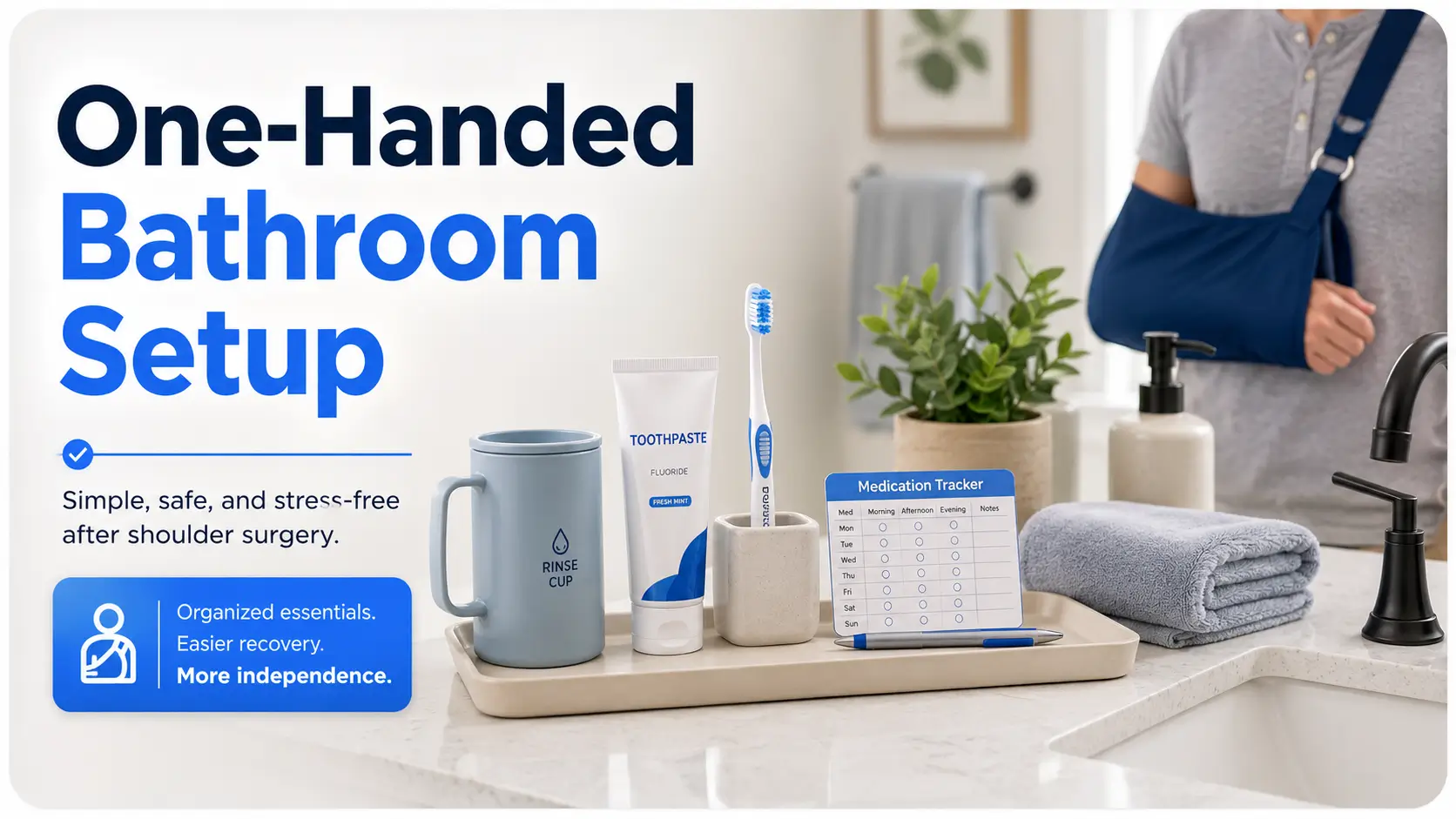
The One-Handed Command Center:
Post-Op Bathroom Setup
The first morning after shoulder surgery can make a toothpaste cap feel like a tiny household ambush. A bathroom counter is no longer just a place for toiletries. It becomes a one-handed command center for brushing, medication tracking, and navigating the morning without bargaining with gravity.
Most bathrooms are designed for two healthy arms, not for pain fog and limited mobility. Guessing your way through a standard setup increases the risk of strain, spills, and the exact movements your surgeon warned against.
“This guide helps you turn an ordinary counter into a safer, calmer recovery station with clear one-hand zones, smart bottle swaps, and caregiver-friendly labels.”
Table of Contents
Safety first: what this setup can and cannot do
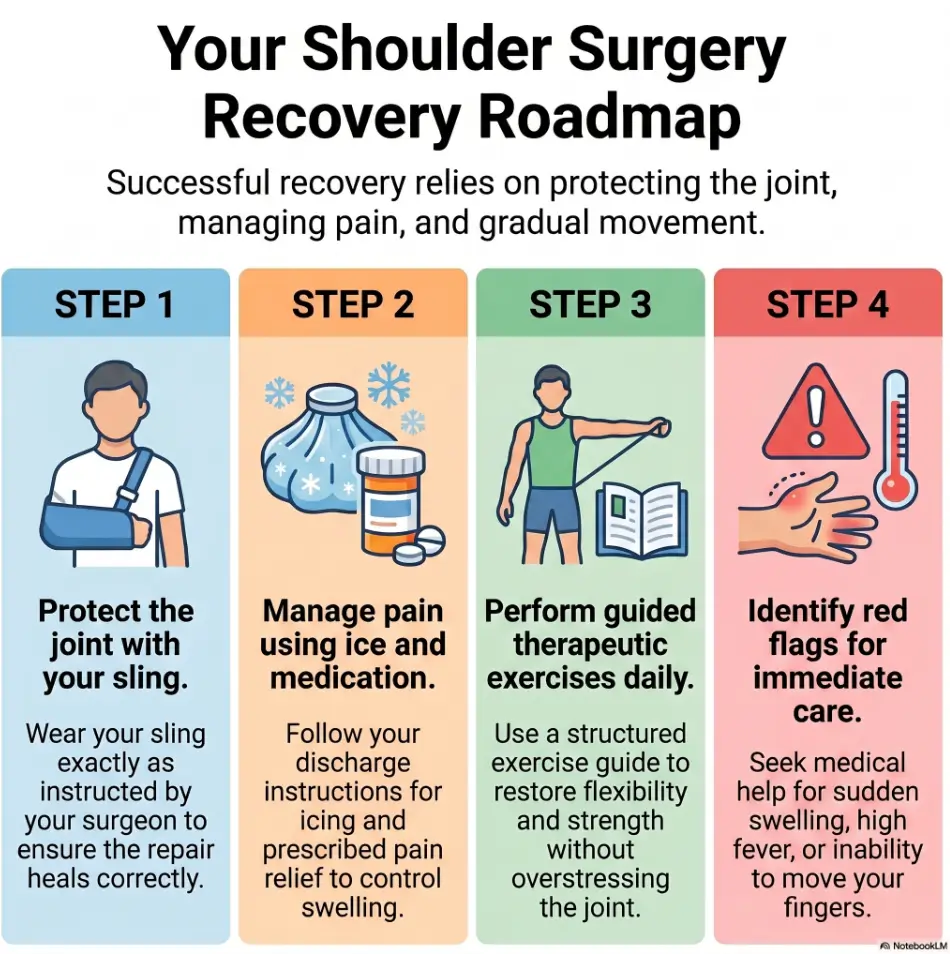
This article is home-organization guidance, not medical advice. Shoulder surgeries vary a lot. A rotator cuff repair, labrum repair, fracture repair, and shoulder replacement can all come with different movement limits, sling rules, wound care instructions, and bathing restrictions.
Your surgeon’s discharge instructions come first. If your physical therapist, orthopedic surgeon, nurse, or discharge paperwork says something different from this article, follow your care team. The counter is the backup singer. Your surgical plan is the lead vocalist.
For many shoulder procedures, patients are told not to lift, reach, push, pull, twist, or use the surgical arm until cleared. MedlinePlus shoulder-surgery discharge guidance also emphasizes protecting the wound, avoiding soaking until approved, and keeping the arm positioned safely during washing. AAOS recovery guidance commonly stresses gradual return to daily activity under the direction of the surgeon and physical therapist. If your recovery includes broader pain planning, a plain-English guide to orthopedic pain management after an injury or procedure can help you organize questions before your next appointment.
- Keep the surgical arm protected.
- Use the non-surgical side for daily items.
- Call your care team when symptoms change.
Apply in 60 seconds: Put your discharge instructions in a clear sleeve or folder near your medication tracker.
First 48 Hours: Build a Counter That Works Before Pain Does the Talking
The first 48 hours are not the time to discover that your deodorant lives in a drawer built by a raccoon with a puzzle habit. Pain, anesthesia fog, sleep disruption, and sling awkwardness can make ordinary tasks feel strangely theatrical.
The goal is simple: the counter should answer your morning before your shoulder has to ask.
Put the “must-touch” items on the non-surgical side
Start with the side your good arm can reach without crossing your body. If your right shoulder was repaired, your left side becomes the VIP lane. If your left shoulder was repaired, your right side gets the crown.
Move only the daily essentials there:
- Toothbrush and toothpaste
- Small rinse cup
- Face cleanser or wipes
- Deodorant
- Medication tracker, if bathroom storage is safe in your home
I once watched a caregiver “tidy” a counter by moving everything into matching bins. Beautiful. Also completely useless to the patient, who then had to excavate for floss with one arm. In recovery, visible beats pretty.
Keep everything between belly-button and chest height
Your safest counter zone is usually the space between waist and chest height. Not under the sink. Not on a high shelf. Not tucked behind a decorative candle that smells like expensive pinecones and poor judgment.
Place supplies where your non-surgical arm can reach while your shoulders stay level. If you have to shrug, twist, bend deeply, or lean your surgical side toward the sink, the item is too far away. The same reach logic applies beyond the bathroom, especially when choosing orthopedic home care equipment that actually fits your daily routine instead of cluttering the house with good intentions.
The tiny test: can you use it without shrugging?
Stand where you brush your teeth. Let the surgical arm rest as instructed. Now reach for each item using only your non-surgical arm. If your shoulder climbs toward your ear, that setup is asking too much.
The tiny test: You should be able to reach, open, use, and put back each daily item without changing your posture dramatically.
| Question | Yes means | No means |
|---|---|---|
| Can you reach essentials with the non-surgical arm? | Keep them there. | Move them closer today. |
| Can you use items without twisting? | The workflow is safer. | Reposition or simplify. |
| Are wet surfaces controlled? | Slip risk is lower. | Add a towel or nonslip mat. |
Neutral action: Run this checklist once before surgery and again the first full day home.
One-Hand Zones: The Four Counter Areas That Save the Morning
A bathroom counter after shoulder surgery should not be one big puddle of objects. It should be four small neighborhoods. Tiny civic planning, but with toothpaste.
Zone 1: Medication and timing tools
If your home is safe for bathroom medication storage, create a clearly marked medication zone. Use a small tray, a written dose log, and a pen that does not roll away like it has unpaid debts.
Important note: bathrooms can be humid. Some medicines should not be stored there. Check the label and your pharmacist’s advice. If the medicine belongs elsewhere, keep only the tracker on the counter and store the medication in the recommended location.
Zone 2: Toothbrush, rinse cup, and face care
This is the “start the day without drama” zone. Keep it at the front edge on the non-surgical side. Use a lightweight cup with a handle if gripping is easier that way.
For toothpaste, consider a flip cap or a tube squeezer that can be used one-handed. A tube rolling across the counter can feel absurdly personal when you are already tired.
Zone 3: Grooming items that do not require arm gymnastics
Keep grooming minimal in the early period. Hairbrush, comb, electric razor, lip balm, deodorant, and basic moisturizer may be enough. This is not the week to test a twelve-step grooming routine unless your surgeon also installed a spare arm.
Zone 4: Clean towels, wipes, and surgeon-approved wound supplies
Keep wound supplies separate from ordinary toiletries. If your surgeon gave you dressings, tape, or cleaning instructions, those items should have their own clean bin or pouch. Do not improvise wound care with random bathroom products.
Dose log, timer, pen, surgeon notes.
Toothbrush, flip-cap paste, handled cup.
Comb, deodorant, lip balm, easy tools.
Towels, wipes, approved wound items.
Rule: daily items go on the non-surgical side, in the front half of the counter.
I like zones because they reduce micro-decisions. Recovery already comes with enough tiny negotiations: sleep angle, ice timing, shirt choice, whether that ache is normal. Your counter should not add a pop quiz.
Reach Traps: What Looks Harmless Until Your Shoulder Says No
Reach traps are the innocent-looking setups that invite one bad motion. They do not look dangerous. They look normal. That is the whole problem.
Don’t store essentials behind the faucet
Behind the faucet is where good intentions go to become shoulder math. Reaching across the sink can make you lean, rotate, or lift without noticing. After surgery, the movement you “barely did” is exactly the one you wish you had not.
Move essentials forward. Keep the back of the counter for backup items, not daily tools.
Don’t use deep baskets that require digging
Deep baskets look tidy from above. In real life, they become little wells of chaos. You reach in for face wipes and find nail clippers, an expired sunscreen, and a travel shampoo from a hotel that no longer exists.
Use shallow trays instead. One layer. Labels facing up. No digging.
Here’s what no one tells you: the back corner becomes a tiny mountain
The back corner is the bathroom version of a snowy pass. Before surgery, you barely notice it. After surgery, reaching there can require a lean, a shoulder shift, and a private argument with physics.
- Daily items belong in front.
- Backup items belong behind or elsewhere.
- No essential item should require leaning over the sink.
Apply in 60 seconds: Move everything you use twice a day to the front 12 inches of the counter.
Show me the nerdy details
After shoulder surgery, risky bathroom movement often comes from combined motion: leaning forward, rotating the trunk, lifting the arm slightly, and gripping a small object at the same time. Even when each movement feels minor, the combination can create strain, instability, or pain. A one-handed counter setup reduces combined motion by shortening reach distance, lowering grip force, and keeping the body square to the sink.

Common Mistakes: The Pretty Bathroom Setup That Fails at 6:30 A.M.
A beautiful bathroom can fail a recovering shoulder with exquisite manners. The counter may look calm, coordinated, and magazine-ready, while quietly forcing you to reach like a circus apprentice.
Mistake 1: Keeping both sides of the counter “balanced”
Symmetry is lovely in architecture. It is less useful when your right arm is in a sling and your toothbrush is placed on the right because “it looks even.” Recovery design is not about visual balance. It is about functional bias.
Load the non-surgical side with the real tools. Let the other side look a little empty. Empty is not failure. Empty is breathing room.
Mistake 2: Leaving heavy pump bottles in place
Full-size pump bottles can slide, tip, or require downward force. That tiny press can turn into shoulder involvement before your brain catches the memo.
Swap heavy pumps for smaller flip-cap bottles, lightweight containers, or products that can be opened and dispensed with one hand.
Mistake 3: Using slick trays on a wet surface
A tray that skates across a wet counter is not storage. It is a tiny luge event. Use a tray with rubber feet, a textured bottom, or a towel underneath if it stays dry and clean.
Mistake 4: Forgetting where the sling goes during brushing
Brushing your teeth sounds simple until the sling bumps the counter, the strap shifts, and you suddenly feel like a marionette managed by a sleepy puppeteer.
Stand slightly back from the counter. Keep the surgical side protected. Do not lean your operated arm into the sink edge. If your discharge paperwork gave you a specific device, compare it with a patient-friendly explanation of a shoulder immobilizer vs sling so you know which movements your setup should avoid.
| Setup choice | Works when | Trade-off |
|---|---|---|
| Decorative tray | It is shallow, stable, and dry. | May slide if slick. |
| Open one-hand zone | Daily items are visible and close. | Looks less styled. |
| Closed bins | Used only for backups. | Daily use may require digging. |
Neutral action: Choose function over symmetry for the first 2 weeks, then adjust as your care team clears more activity.
Bottle Swaps: Make Soap, Shampoo, and Lotion Behave One-Handed
Bottles are sneaky. They pretend to be passive household objects, then demand twisting, squeezing, balancing, and grip strength at exactly the wrong moment.
Choose flip caps over screw caps
A screw cap can become a two-handed task. Flip caps are usually easier. Better yet, choose caps that open with the thumb of your non-surgical hand and do not require you to hold the bottle against your body.
Before surgery, test each bottle with one hand. If it makes you mutter, replace it.
Use small travel bottles instead of full-size bricks
Full-size bottles are heavy, slippery, and often overkill. Small travel bottles are lighter and easier to control. Label them clearly: face wash, lotion, shampoo, conditioner.
Use products you already tolerate. This is not the ideal moment to experiment with a new fragrance that makes your skin angry. Recovery has enough plot twists.
Let’s be honest: pump bottles are tiny shoulder ambushes
Pump bottles can work if they are stable, light, and placed where your non-surgical hand can press straight down without shifting your body. But many pumps require more force than expected.
Test the pump before surgery:
- Does the bottle slide?
- Does the pump need a hard press?
- Can you dispense without lifting your surgical side?
- Can you clean spills one-handed?
AAOS explains that recovery plans often include surgeon- or therapist-directed movement and gradual return to everyday activity. That is why the bathroom setup should support your restrictions, not tempt you to freestyle through them.
Medication Corner: Keep Pain Pills, Ice Notes, and Doses From Becoming a Fog
Medication management after surgery deserves respect. Pain, poor sleep, nausea, anesthesia after-effects, and a disrupted schedule can make memory feel like a radio station fading under a bridge.
Use a written dose tracker, not memory
Write down the medication name, dose, time taken, and next allowed time. Do this even if you usually have a magnificent memory. Surgery can turn magnificent into “did I take that at 8 or just think about taking it at 8?”
A simple tracker can live on a clipboard, index card, whiteboard, or printed sheet. Keep it near the medication, unless medicine storage needs to be elsewhere because of humidity, children, pets, or safety rules.
Separate daily meds from “as needed” meds
Do not let daily medications, pain medications, stool softeners, nausea medication, and supplements mingle in one mysterious pile. Separate them physically and label clearly. For older adults or households juggling multiple prescriptions, a broader overview of orthopedic pain management for older adults can make medication conversations with the care team feel less like decoding a tiny-print opera.
Use plain language:
- Morning daily meds
- Pain medication, as prescribed
- As-needed medication
- Do not take together unless approved
Add one bright note: “Do not double dose”
A bright reminder is not childish. It is a guardrail. Put it where your eyes land when you reach for medication. If a caregiver is helping, have both of you use the same tracker.
- Write down every dose.
- Separate scheduled and as-needed medication.
- Ask your pharmacist about storage and interactions.
Apply in 60 seconds: Tape a blank dose log beside the counter or wherever medication is safely stored.
| Input 1 | Time you took the dose |
| Input 2 | Minimum hours between doses from your label |
| Output | Next allowed time = dose time + required interval |
Neutral action: If the label is unclear, call your pharmacist or surgeon’s office before guessing.
Hygiene Setup: Brush, Wash, Shave, and Moisturize Without Reaching Across Your Body
Bathroom hygiene after shoulder surgery is not glamorous, but it is deeply human. A clean face, brushed teeth, and dry towel can make the day feel less like a hospital hallway and more like your own life returning in small, useful pieces.
Use a handled cup instead of lifting a heavy glass
A handled plastic or lightweight cup can be easier to grip one-handed. Keep it on the non-surgical side. Do not store it upside down if flipping it over becomes annoying. Annoying tasks multiply at 6:30 a.m. like damp gremlins.
Place toothpaste uncapped only if it stays sanitary
Some people remove the toothpaste cap during the first few days so they do not have to twist it. That can work only if the tube stays clean, upright, and away from splashes. A flip-cap tube is usually better.
Another option is a small toothpaste dispenser that works one-handed. Test it first. Some dispensers require more force than they admit in their glossy little product photos.
Choose electric tools only if they do not vibrate near the surgical side
Electric toothbrushes, razors, and grooming tools can reduce hand effort, but vibration may be uncomfortable if used near the surgical side or if it causes you to brace awkwardly. Use your non-surgical hand and keep movement small.
For shaving, consider delaying a close shave if your setup feels unstable. A slightly scruffy chin is not a moral collapse. It is temporary risk management with whiskers.
Short Story: The Toothpaste Cap That Started a Better System
On a chilly Tuesday morning, a patient named Mark stood at the sink with his left shoulder strapped into a sling and his toothpaste cap rolling toward the drain like it had a train to catch. His wife had arranged the counter beautifully the night before: matching jars, folded towels, a tiny plant. But the toothbrush was on the wrong side, the mouthwash was full and heavy, and the cap had become a marble-sized emergency.
They laughed first, because sometimes laughing is the only graceful exit. Then they rebuilt the counter in five minutes. Toothbrush left. Flip-cap toothpaste. Small cup. Dose card. No jars with lids. By Wednesday, the bathroom no longer felt elegant. It felt loyal. That was the lesson: recovery tools do not need to impress guests. They need to obey tired hands.
Sling Reality: Where Your Arm Lives While the Counter Does Its Job
A sling changes the geometry of your morning. You are not just using one arm. You are moving with a protected arm attached to your front like a fragile parcel marked “do not jostle.”
Create a sling-safe standing position
Stand with your hips facing the sink, feet steady, and surgical side slightly protected from the counter edge. Avoid leaning your operated side into the counter, especially when rinsing or spitting.
Place a small towel near the front of the counter so you do not drip water while hunting for something. Wet counters create slippery objects, and slippery objects create sudden reaches. That is the bathroom domino chain we are trying to interrupt.
Keep towel hooks and robe hooks on the good-arm side
If your towel hook is on the surgical side, move the towel. You may not need to move the hardware. Just use a temporary over-door hook, command hook, or nearby chair if safe and stable.
Place robe, towel, and washcloth where your non-surgical hand can grab them without twisting. The best hook is not the prettiest hook. It is the hook that does not ask your surgical shoulder to join the conversation.
Avoid leaning your surgical side into the counter
Counter edges can press into the sling, incision area, or tender tissues. Keep a few inches of space. If your bathroom is narrow, slow down and turn with your whole body rather than pivoting sharply.
- Stand square to the sink.
- Keep hooks on the non-surgical side.
- Leave space between sling and counter edge.
Apply in 60 seconds: Move your towel to the same side as your non-surgical arm.
Caregiver Pass: Arrange the Counter So Help Does Not Become Hovering
Caregivers can be heroic. They can also accidentally move the exact item the patient finally learned to find without looking. Love, when too tidy, can become a scavenger hunt.
Label zones so family members do not “tidy away” essentials
Use painter’s tape, sticky notes, or small labels. Keep the labels simple:
- Morning teeth
- Meds log
- Clean towels
- Do not move
Yes, “do not move” may feel dramatic. Use it anyway. Recovery has enough soft chaos without someone relocating the rinse cup because it disturbed the visual poetry of the sink.
Put backup supplies in one visible bin
Backup gauze, wipes, travel bottles, extra toothbrush heads, and clean washcloths can live in one visible bin. Not three drawers. Not under a stack of hand towels. One bin.
Caregivers should know the difference between daily items and backup items. The daily items stay close. Backups refill the daily zone when needed.
Create a night version for sleepy bathroom trips
Night trips are different. The patient may be groggy, medicated, or moving slowly. Keep the path clear. Put a night light near the bathroom. Remove loose bath mats unless they are stable and recommended for the space. If the patient also needs safer movement around the bedroom or hallway, a practical look at home orthopedic equipment for recovery can help caregivers avoid buying five gadgets when one stable setup would do.
| Gather this | Why it matters |
|---|---|
| Surgery type and restrictions | Rotator cuff, labrum, fracture, and replacement plans differ. |
| Dominant hand and surgical side | Counter layout should favor the usable arm. |
| Bathroom width and counter depth | Small bathrooms need tighter zones. |
| Discharge wound-care instructions | Avoid buying supplies your surgeon did not approve. |
Neutral action: Use this list before comparing trays, hooks, shower supplies, or medication organizers.
Who This Is For, And Who Should Not Use This Setup Alone
This setup is useful, but it is not magic. It is a practical counter plan for people who have clear discharge instructions and enough balance, alertness, and support to use the bathroom safely.
Good fit: rotator cuff, labrum, replacement, or fracture recovery with clear discharge instructions
If your surgeon has given you specific rules and you understand them, a counter setup can make daily hygiene easier. It can support sling use, medication tracking, and one-handed routines.
AAOS patient guidance on shoulder replacement notes that many patients gradually return to simple activities such as eating, dressing, and grooming, but timing and restrictions vary. That “vary” is doing serious work. Your plan may not match your neighbor’s plan, even if both of you have heroic ice packs and the same suspicious recliner.
Good fit: caregivers setting up the bathroom before surgery day
This guide is especially useful before surgery. Practice one-handed tasks ahead of time. Brush your teeth. Open toothpaste. Reach for a towel. Write a dose note. If it feels awkward before surgery, it will probably feel worse after. Sleep setup matters too, so many patients also compare a recliner vs bed after shoulder surgery before the first night home.
Not enough: readers with dizziness, balance issues, confusion, or uncontrolled pain
If the patient is dizzy, confused, faint, very sleepy, or in uncontrolled pain, counter organization is not enough. They may need hands-on help, medical guidance, or a safer bathroom plan.
Not enough: anyone whose surgeon gave stricter bathing, wound, or sling rules
Some instructions may limit showering, dressing changes, arm position, or movement. Follow those instructions first. Do not organize around a rule you were told not to break.
- Clear instructions make home setup safer.
- Dizziness or confusion changes the risk level.
- Caregivers should not override medical restrictions.
Apply in 60 seconds: Circle the movement restrictions on your discharge papers and place them near your setup plan.
When to Seek Help: The Counter Is Not the Problem Anymore
Sometimes the bathroom setup is not the issue. Sometimes the body is waving a red flag, and the correct response is not another tray, label, or bottle swap. It is contacting the right medical help.
Call the surgeon for fever, worsening redness, drainage, swelling, or incision concerns
MedlinePlus shoulder replacement discharge guidance lists concerns such as redness, pain, swelling, yellowish wound discharge, fever above 101°F, pain that does not improve with medication, numbness or tingling, cool or darker fingers, arm swelling, and shortness of breath as reasons to seek medical help. Your own discharge paperwork may use different thresholds, so follow it closely.
If the incision looks worse, smells unusual, drains more, or becomes hotter and more painful, call your surgeon’s office. Do not wait for the counter to become more organized. The counter is innocent. The symptom is the headline.
Seek urgent care for sudden severe pain, sudden swelling, deformity, or inability to use the arm after a fall
Mayo Clinic advises urgent medical care for shoulder pain with sudden swelling, deformity after injury, intense pain, or inability to use the joint or move the arm away from the body. After surgery, a fall or sudden change deserves prompt attention. If you are unsure whether a symptom belongs in urgent care or a specialist office, review the difference between urgent care vs an orthopedic clinic before the decision has to be made in a panic.
Do not “organize around” numbness, color change, or temperature change in the surgical arm
If the hand or fingers become darker, cooler, numb, increasingly swollen, or tingly, contact the care team as directed. Do not just loosen a sleeve, move the soap, and hope the body sends a nicer email later.
| Tier | Situation | Next step |
|---|---|---|
| 1 | Item is hard to reach. | Move it to the non-surgical side. |
| 2 | Routine is tiring but safe. | Simplify zones and ask for help. |
| 3 | Pain or swelling is increasing. | Call the surgeon’s office. |
| 4 | Fever, drainage, numbness, or color change appears. | Seek medical guidance promptly. |
| 5 | Fall, deformity, severe pain, or breathing trouble occurs. | Use urgent or emergency care. |
Neutral action: Write your surgeon’s after-hours number on the medication tracker before the first night home.

FAQ
What should I keep on the bathroom counter after shoulder surgery?
Keep only daily essentials within easy reach of your non-surgical arm: toothbrush, flip-cap toothpaste, lightweight rinse cup, face wipes or cleanser, deodorant, dose tracker, pen, clean towel, and surgeon-approved wound supplies if needed. Store backups elsewhere in one visible bin.
Which side of the counter should I use after right shoulder surgery?
After right shoulder surgery, most people should place daily counter items on the left side so the non-surgical arm can reach them without crossing the body. Reverse this after left shoulder surgery. Always follow your surgeon’s movement restrictions.
How do I brush my teeth one-handed after shoulder surgery?
Place the toothbrush, toothpaste, and cup on your non-surgical side. Use flip-cap toothpaste if possible. Stand square to the sink, keep the surgical arm protected in the sling if instructed, and avoid leaning your operated side into the counter.
Should I remove pump bottles from the bathroom counter?
Often, yes. Heavy pump bottles can slide or require downward force. If a pump is stable, light, and easy to press with the non-surgical hand, it may be fine. Otherwise, use small flip-cap bottles or travel-size containers.
Can I shower or wash my hair after shoulder surgery?
Only follow the bathing instructions from your surgeon or discharge paperwork. Some patients must keep the incision dry or avoid soaking. MedlinePlus shoulder-surgery discharge guidance emphasizes protecting the wound and not soaking until the surgeon says it is okay.
How do I organize medication safely in the bathroom?
First, check whether the medication can be stored in a bathroom, since humidity can be a problem. If safe, use a labeled tray, a written dose tracker, and a bright “do not double dose” note. If storage belongs elsewhere, keep only the tracker on the counter.
What bathroom items should I avoid reaching for after surgery?
Avoid items behind the faucet, deep baskets, high shelves, low cabinets, heavy bottles, screw-cap containers, slick trays, and anything that makes you twist, shrug, lean, or reach across your body.
How can a caregiver set up the counter before surgery day?
Ask which shoulder is surgical, which hand will be usable, and what restrictions the surgeon gave. Then create four labeled zones: medication tracker, hygiene, grooming, and clean supplies. Take a photo of the setup so nobody “tidies” it into uselessness.
What if I live alone after shoulder surgery?
Set up the counter before surgery, practice one-handed routines, and arrange check-ins if possible. If you have dizziness, confusion, poor balance, uncontrolled pain, or trouble following medication instructions, ask your care team about extra support.
Next Step: Do the Three-Minute Counter Audit Tonight
The toothpaste cap was never the real villain. The real villain was a counter designed for two healthy arms pretending nothing had changed.
Your next step is small enough to do tonight and useful enough to matter tomorrow: stand at the sink and perform a three-minute counter audit.
Stand where you will brush your teeth
Face the sink. Let your surgical arm rest the way your surgeon instructed, or practice with that arm out of service if surgery is upcoming. Notice what your non-surgical hand can reach without drama.
Move every daily item to your non-surgical side
Toothbrush, toothpaste, cup, towel, deodorant, face care, and dose log should live where the good arm can reach them. Backup items can move away. Decorative items can take a brief sabbatical.
Remove one thing that requires reaching, twisting, or lifting
Start with one offender. The heavy pump bottle. The deep basket. The towel on the wrong hook. The mouthwash hiding behind the faucet like a smug little lighthouse.
Take a photo so caregivers know the “do not move this” layout
A photo prevents helpful people from undoing the system. It also gives you a reference if the counter slowly drifts back into clutter.
- Favor the non-surgical side.
- Keep essentials visible and shallow.
- Use your surgeon’s rules as the boundary line.
Apply in 60 seconds: Remove one reach trap from your counter before bedtime.
Last reviewed: 2026-05.
Tags: shoulder surgery recovery, bathroom safety, post surgery home setup, caregiver checklist, one handed hygiene
Meta description: Arrange a bathroom counter after shoulder surgery with safer one-handed zones, medication tracking, sling tips, and warning signs.