

How to Explain Night Pain to Your Doctor
Night pain has a particular way of stealing your nerve. At 2:17 a.m., the room is quiet, the phone is glowing, and your brain starts drafting a tiny disaster novel. Then morning comes, the appointment is rushed, and the sentence you meant to say turns into, “It just hurts.”
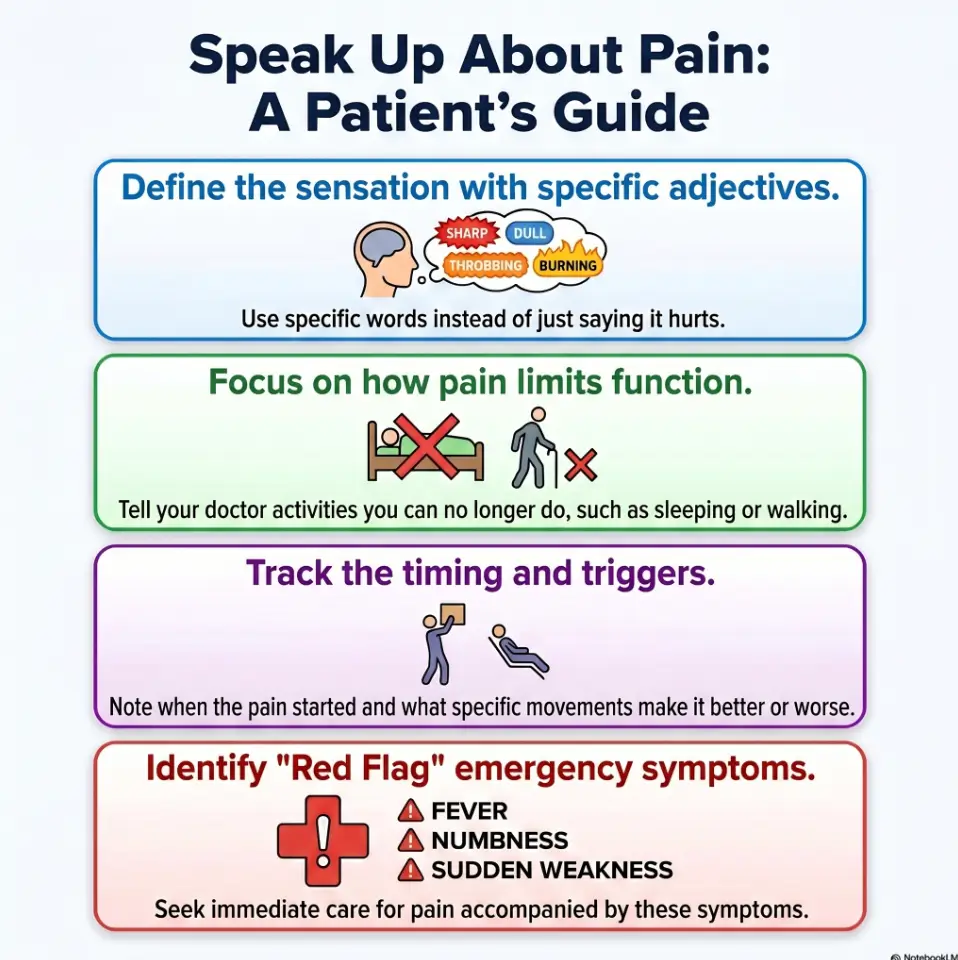
If you want to know how to explain night pain to a doctor, the goal is not to sound medical. The goal is to sound clear. Your doctor needs location, timing, pain quality, severity, triggers, relief, sleep impact, and any symptoms that travel with the pain. Guessing wastes time. Minimizing can blur the map. Over-explaining can bury the one detail that matters.
This guide gives you a calm, appointment-ready script for describing recurring or unexplained night pain to a primary care doctor, orthopedist, rheumatologist, or pain specialist:
- Start simple.
- Bring the pattern.
- Name the red flags.
- Let the doctor do the doctoring.
The 30-Second Night Pain Brief
Say this first: “This pain wakes me from sleep. It is located in [body area], feels like [pain word], happens [pattern], reaches [severity], and affects my sleep by [specific impact]. I’m also noticing [related symptoms].”
That one sentence gives your clinician a clean starting point. It beats a ten-minute fog of apology, guessing, and late-night internet theories wearing a lab coat.
Table of Contents
Safety and Medical Disclaimer
This article is for appointment preparation. It does not diagnose the cause of night pain, replace a medical exam, or tell you whether a symptom is harmless.
Night pain can come from many causes: sleep position, overuse, arthritis, nerve irritation, inflammation, reflux, injury, medication timing, or a pain condition that needs a more careful workup. Sometimes, pain that is constant, worsening, intense at night, or paired with neurologic or whole-body symptoms needs prompt medical attention.
Seek urgent medical help for chest pain, trouble breathing, stroke-like symptoms, severe injury, confusion, sudden weakness, new loss of bowel or bladder control, fever with severe pain, or rapidly worsening numbness or weakness. If the symptom feels dangerous, do not wait to assemble the world’s prettiest pain diary.
- Use plain words instead of medical guesses.
- Report red flags early, not as an afterthought.
- Bring a short pattern, not a courtroom speech.
Apply in 60 seconds: Write one sentence that begins, “This pain wakes me because…”
Start With the Wake-Up Moment, Not the Diagnosis
The most useful starting point is often the moment the pain interrupts sleep. Doctors are trained to sort symptoms by pattern. Your job is to hand them the pattern before your memory starts rearranging furniture.
Say what actually happens at 2:17 a.m.
Tell the doctor whether the pain wakes you from sleep, prevents you from falling asleep, or appears only after you wake for another reason. These are different stories.
Try this:
- “The pain wakes me after about four hours of sleep.”
- “I can fall asleep, but I wake when I roll onto my left side.”
- “I wake for the bathroom, then notice the pain when I get back into bed.”
- “It is worse when I lie flat, so I sleep in a recliner.”
If your pain is orthopedic, such as hip, shoulder, back, knee, or neck pain, this timing can shape the next question. It may help your clinician decide whether the issue sounds mechanical, inflammatory, nerve-related, sleep-position related, or something that needs a broader medical check.
Describe the first 60 seconds after waking
The first minute after waking is full of clues. Do you sit up? Walk around? Stretch? Freeze? Take medication? Use heat? Grab ice? Change pillows? Wake your partner by whisper-yelling at your own hip?
That sequence matters because relief patterns can point toward what kind of evaluation makes sense. For example, pain that eases after walking around may be described differently from pain that worsens with standing. Pain that improves with a pillow change may belong in the same conversation as using a wedge pillow for better nighttime positioning, while pain that shoots down the leg may need a different pathway.
Here’s what no one tells you: timing is evidence
“It hurts at night” is a start. “It wakes me every night between 2 and 4 a.m. and I need 20 minutes to settle again” is much stronger.
Doctors do not need you to be poetic. They need the clock, the pattern, and the consequence. The night is not just a mood. It is a data window with bad lighting.
Money Block: The Wake-Up Moment Checklist
Use this yes/no checklist before your visit.
- Yes / No: The pain wakes me from sleep.
- Yes / No: The pain is worse when lying flat.
- Yes / No: I need to get out of bed for relief.
- Yes / No: I changed pillows, mattress, or sleep position because of it.
- Yes / No: It happens at roughly the same time of night.
- Yes / No: It comes with numbness, weakness, fever, swelling, chest symptoms, or bowel/bladder changes.
Neutral action line: Bring the checked items to your appointment and read them before giving extra background.
Use the “Where, When, What, How Bad” Script
When pain scrambles your thoughts, use a four-part script: where, when, what, and how bad. It is plain, quick, and hard to derail.
Where: point with one finger first
Start with the exact spot. Point with one finger before describing the larger area.
Say “right outer hip,” “left low back,” “front of the knee,” “back of the shoulder,” “center of the chest,” “calf,” “jaw,” “bottom of the foot,” or “thumb side of the wrist.” If the pain spreads, say where it starts and where it travels.
For example:
- “It starts in my low back and travels down the outside of my right leg.”
- “It is deep in the groin, not on the outside of the hip.”
- “It is under the kneecap when I bend, but at night it becomes a deep ache.”
If you are unsure whether pain is coming from the hip or spine, it can help to read about hip versus spine pain patterns before your visit. Do not use that reading to self-diagnose. Use it to describe location more cleanly.
When: give the pattern, not just the clock
Timing includes more than hour of night. Mention frequency, pattern, and triggers.
- Every night or only some nights?
- Worse after walking, lifting, sitting, driving, or exercise?
- Worse after rest?
- Worse near morning?
- Worse on one side?
- Better with movement, medication, heat, ice, or position change?
“It happens around 3 a.m.” is useful. “It happens around 3 a.m. after days I climb stairs or sit in the car for more than an hour” is better.
What: choose plain pain words
Doctors often ask what the pain feels like because the quality can help shape the exam. Choose words that fit your actual sensation.
- Burning
- Stabbing
- Throbbing
- Cramping
- Deep ache
- Pressure
- Electric
- Shooting
- Tight
- Gnawing
Do not worry about sounding dramatic. A burning pain and a deep ache are not the same sentence in a doctor’s mind.
How bad: pair the number with function
A 0-to-10 pain score can help, but it becomes much more useful when paired with function. A “7” means different things to different people. “A 7 that makes me get out of bed and miss work the next day” speaks more clearly.
Try this formula:
“It is a [number] out of 10, and it makes me [specific function problem].”
Examples:
- “It is a 6 out of 10 and makes me sleep in a chair.”
- “It is an 8 out of 10 and I cannot walk to the bathroom normally.”
- “It is a 5 out of 10, but it wakes me four nights a week.”
For a deeper way to describe impact, use a function-first approach like the one in a functional pain assessment. Doctors often listen closely when pain is tied to walking, sleeping, dressing, lifting, gripping, driving, or working.
Show me the nerdy details
Pain descriptions help clinicians sort several overlapping signals: location, radiation, provoking factors, relieving factors, timing, severity, associated symptoms, and functional impact. A pain score alone is subjective. A function statement anchors the number to observable consequences, such as waking from sleep, needing to stand, losing grip strength, or being unable to climb stairs. That is why “7 out of 10 and I had to sleep upright” is more useful than “bad pain.”
Don’t Say “It Just Hurts” and Stop There
“It just hurts” is honest, but it is too small for the job. It gives the doctor a closed box with no label. You need a box with handles.
The vague pain trap
People get vague for understandable reasons. They feel embarrassed. They worry they are wasting the doctor’s time. They have rehearsed the symptom in the car and then forget everything once the paper on the exam table starts doing its crinkly little thunderstorm.
Avoid stopping at:
- “It’s weird.”
- “It’s bad.”
- “I can’t explain it.”
- “Maybe it’s nothing.”
- “I probably slept wrong.”
You can say those things, but follow them with specifics.
Better sentence formula
Use this:
“I feel [type of pain] in [location], mostly [time/pattern], and it affects [sleep/function].”
That one sentence keeps you from floating away into apology fog.
Example phrases readers can copy
- “I get a deep ache in my right hip that wakes me around 3 a.m. four nights a week.”
- “I feel burning pain down my leg when I lie flat, and I have to sit in a chair to sleep.”
- “My shoulder throbs when I roll onto it, and I wake up every time I change position.”
- “My knee feels tight and hot at night after days with stairs.”
- “The pain is not terrible during the day, but it becomes constant when I lie down.”
If your night pain overlaps with back or leg symptoms, pages like L4 vs L5 vs S1 sciatica patterns can help you notice where symptoms travel. Bring observations, not conclusions.
- Use one pain-quality word.
- Name the body part precisely.
- Connect pain to sleep or daily function.
Apply in 60 seconds: Replace “it hurts” with “it feels like…” and finish the sentence.
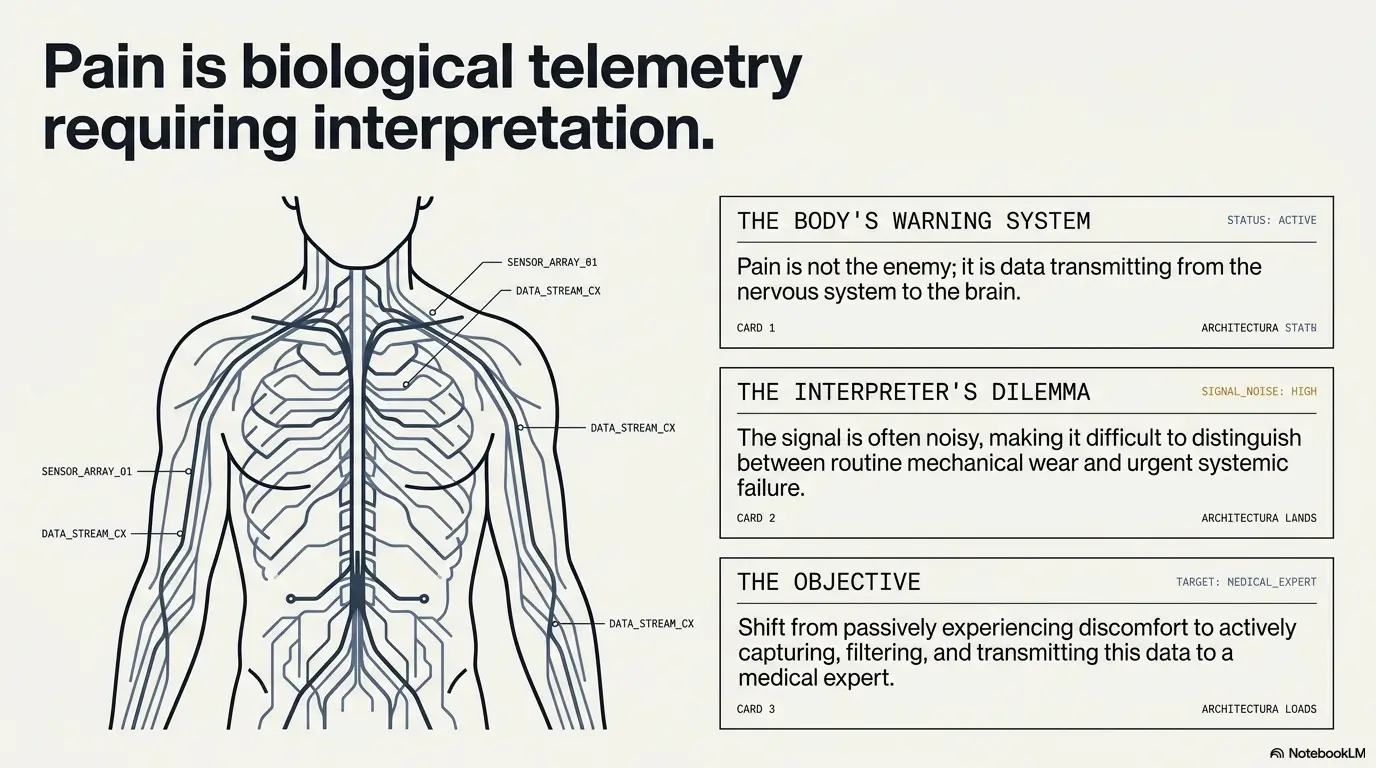
Bring a 7-Night Pain Log, Even If It Looks Messy
A pain log does not need to be beautiful. It needs to be useful. A notes app, scrap paper, printed table, or text message to yourself can work.
Track only what a doctor can use
For seven nights, write down:
- Bedtime
- Wake-up time
- Pain location
- Pain rating from 0 to 10
- Sleep position
- Medication or treatment tried
- How long relief took
- Any unusual symptoms
- What happened the day before
The “day before” line is the quiet hero. Lifting boxes, sitting through a long drive, skipping medication, trying a new workout, drinking alcohol, eating late, traveling, or sleeping on a different mattress can all matter.
Keep it boring, useful, and honest
Do not build a leather-bound pain diary with tragic moonlight energy. A simple log is enough. The less ceremonial it feels, the more likely you are to keep it.
| Night | Wake Time | Pain Location | Rating | Position | What Helped |
|---|---|---|---|---|---|
| 1 | 2:40 a.m. | Right hip | 7/10 | Left side | Walking 10 minutes |
| 2 | No wake-up | Mild low back | 3/10 | Back with pillow | No medication |
The one detail patients forget
Write what happened the day before. If you drove six hours, carried groceries, slept on a hotel mattress, used a new office chair, walked hills, or started a new exercise, include it. The doctor may not ask unless you put the clue on the table.
If you already have an orthopedic appointment scheduled, pair your log with an orthopedic appointment checklist so you do not forget medication names, imaging reports, prior treatments, or insurance questions.
Money Block: 7-Night Log Mini Calculator
Use this quick calculator to summarize your week before the visit. It stores nothing.
Neutral action line: Tell your doctor the wake-up rate and the worst functional impact, not just the highest pain number.
Separate Pain From Sleep Trouble
Pain and sleep can braid together until you cannot tell which strand started the knot. That is normal. Still, it helps to separate the sequence as clearly as you can.
Pain that wakes you vs pain you notice while awake
Tell your doctor which is closer:
- “The pain wakes me from sleep.”
- “I wake up first, then notice pain.”
- “I cannot fall asleep because of pain.”
- “I fall asleep, but changing position triggers pain.”
- “I wake anxious, then the pain feels louder.”
This distinction can shape the visit. The conversation may move toward pain control, inflammation, nerve symptoms, sleep mechanics, anxiety, reflux, medication timing, or another pathway.
Why this distinction matters
If pain is the alarm clock, your clinician may focus on the pain generator and why lying down worsens it. If insomnia comes first, the plan may also include sleep habits, stress physiology, caffeine, medication timing, or chronic pain sleep strategies.
For people with chronic pain and insomnia, structured sleep treatment can sometimes help. If you want a practical companion topic, see CBT-I for insomnia with chronic pain. It is not a substitute for evaluating new or worsening night pain, but it can help you ask better sleep-related questions.
Let’s be honest: nights make everything louder
At night, there are fewer distractions. The body becomes an orchestra tuning in a dark hall. A knee creaks. A nerve sparks. A shoulder complains like it pays rent.
Acknowledge fear without letting fear write the whole chart. Say, “I’m worried because it wakes me repeatedly,” instead of “I know something terrible is happening.” The first sentence gives the doctor a fact. The second gives them fog.
- Notice whether pain causes the awakening.
- Track whether position change triggers symptoms.
- Mention anxiety or insomnia without apologizing.
Apply in 60 seconds: Write “pain wakes me” or “I wake first, then notice pain” at the top of your notes.
Name the Body Clues Around the Pain
Pain rarely walks into the room alone. It may bring numbness, swelling, stiffness, weakness, fever, rash, fatigue, nausea, or shortness of breath. These companion clues can change the urgency and direction of care.
Symptoms that travel with pain
Mention any of the following if present:
- Fever or chills
- Unexplained weight loss
- Swelling, redness, warmth, or rash
- Numbness or tingling
- Weakness
- Stiffness that lasts in the morning
- Shortness of breath
- Chest pressure or chest pain
- Nausea, sweating, or faintness
- Urinary symptoms
- Bowel or bladder changes
- Unusual fatigue
Do not decide whether a clue is “related enough.” Tell the doctor and let them sort it. Your job is to bring the puzzle pieces, not finish the jigsaw while sleep-deprived.
Function clues doctors listen for
Function turns pain from a feeling into a care-planning issue. Say whether you can:
- Climb stairs
- Grip a cup
- Turn your neck
- Lie flat
- Walk to the bathroom at night
- Return to sleep
- Drive safely
- Get dressed
- Work a full shift
For example, “My pain is a 6” is less useful than “My pain is a 6 and I cannot get back to sleep for two hours.” A function statement brings the problem into daylight.
Medication and relief clues
Tell your doctor what you tried, how much, when, and whether it helped. Include over-the-counter pain relievers, prescriptions, heat, ice, stretching, pillows, massage, topical creams, braces, rest, and physical therapy exercises.
If heat or cold is part of your nighttime routine, compare your pattern with heating pad versus ice wrap decision points. Be careful with heat while sleeping, especially if you have numbness, reduced sensation, diabetes-related nerve symptoms, or medications that make you drowsy.
Short Story: The Hip Pain Note That Changed the Visit
Marianne almost canceled her appointment because her right hip pain felt “too random.” Some nights she slept fine. Other nights she woke at 3 a.m., walked circles around the kitchen island, and returned to bed irritated enough to negotiate with the ceiling fan. Before the visit, she wrote seven messy lines in her phone: wake time, pain spot, sleep side, walking relief, and what she did the day before.
The doctor noticed a pattern she had missed. Her worst nights followed long car rides and side sleeping without support. That did not solve everything, and it did not replace the exam. But it changed the conversation from “my hip is weird” to “my hip wakes me after prolonged sitting and side pressure.” The practical lesson is small but powerful: a pattern does not need to be perfect to be useful. It only needs to be visible.
Money Block: Decision Card for Relief Clues
| If this helps | Tell the doctor this | Why it matters |
|---|---|---|
| Walking | “Movement eases it after about 10 minutes.” | Relief pattern may guide exam questions. |
| Changing position | “Side sleeping triggers it; back sleeping helps.” | Position clues may point to mechanical stress. |
| Medication | “I took the dose at 9 p.m.; relief lasted four hours.” | Timing can affect treatment planning. |
Neutral action line: Report what helped and what failed with dose, timing, and duration whenever you can.
Don’t Minimize Red Flags to Sound “Reasonable”
Many people soften serious symptoms because they do not want to seem dramatic. This is noble in dinner conversation and unhelpful in medicine.
Say scary symptoms clearly
Tell your doctor promptly if night pain is paired with:
- Weakness
- Numbness or tingling that is new or worsening
- Fever or chills
- Unexplained weight loss
- Recent fall, crash, or injury
- Chest pain or pressure
- Trouble breathing
- New bowel or bladder problems
- Saddle numbness
- Severe pain that is constant or worsening
- Pain that is intense at night or worse when lying down
For back or leg symptoms, new bowel or bladder changes, saddle numbness, or rapidly worsening weakness can be urgent. If you need a focused explanation, review cauda equina syndrome red flags and seek urgent care if those symptoms fit.
The “I didn’t want to be dramatic” mistake
Clear reporting is not overreacting. It is respectful. It helps your clinician decide whether the next step should be reassurance, monitoring, medication adjustment, physical therapy, imaging, lab work, referral, or urgent evaluation.
A useful sentence is:
“I don’t know if this is related, but I’m also having…”
Then name the symptom. Do not bury it under five minutes of nervous laughter and a weather report.
When pain is constant or intense at night
Major medical institutions, including Mayo Clinic, advise people to contact a healthcare professional when back pain is constant or intense, especially at night or when lying down, or when it is associated with symptoms such as weakness, numbness, tingling, radiating pain, or unexplained weight loss.
That does not mean every night pain is dangerous. It means certain patterns deserve a cleaner, faster conversation.
- Say new weakness plainly.
- Name bowel or bladder changes without embarrassment.
- Report fever, weight loss, trauma, chest symptoms, or severe worsening pain.
Apply in 60 seconds: Circle any red-flag symptom on your notes so you mention it first.
Who This Is For and Not For
This guide is for communication. It is not a home triage system for emergencies. That line matters.
This is for appointment preparation
Use this guide if you have recurring night pain, unclear pain patterns, chronic pain flares, new sleep disruption, or symptoms you struggle to explain. It can help you prepare for primary care, orthopedics, rheumatology, neurology, pain management, or physical therapy discussions.
It also helps when you have already tried care and still feel unheard. If physical therapy has not improved orthopedic pain, organize your pattern before the next appointment using ideas from what to do when physical therapy is not helping orthopedic pain.
This is not for emergencies
Do not use a blog article as a waiting room when symptoms are severe, sudden, or dangerous. Seek urgent medical care for chest pain, trouble breathing, stroke-like symptoms, major injury, confusion, fainting, new bowel or bladder problems, rapidly worsening weakness, or fever with severe pain.
If severe low back pain feels urgent, low back pain emergency warning signs can help you think through what to report, but urgent symptoms should be evaluated promptly.
Not every night pain is sinister
Night pain can come from ordinary causes, too. A cranky mattress. Overuse. Arthritis. Poor pillow support. A shoulder that resents your sleeping position. A hip that has strong opinions about side sleeping.
For example, some readers may find practical positioning ideas in side-sleeper hip pain relief or neck and shoulder pain sleeping positions. Still, recurring or worsening pain that wakes you deserves clear communication with a clinician.
Money Block: Appointment vs Urgent Care Decision Card
| Situation | Usually fits | Next step |
|---|---|---|
| Recurring pain wakes you several nights a week, but no emergency symptoms | Scheduled medical visit | Bring a 7-night log and medication list. |
| New numbness, weakness, fever, unexplained weight loss, or rapidly worsening pain | Prompt medical contact | Call your clinician or seek timely evaluation. |
| Chest pain, trouble breathing, stroke-like symptoms, severe injury, or bowel/bladder loss | Emergency evaluation | Seek urgent help now. |
Neutral action line: When in doubt about urgent symptoms, choose safety and contact a healthcare professional promptly.
Common Mistakes That Make the Visit Less Useful
A medical visit is a small room with a short clock. The goal is not perfection. The goal is to avoid the most common ways useful details get lost.
Mistake 1: leading with your internet diagnosis
It is understandable to search symptoms. It is also easy to arrive with a diagnosis shaped by midnight panic and three tabs you cannot now defend.
Try this instead:
“I read a few possibilities, but I want to start with what is actually happening.”
Then give the pattern. Symptoms first, theories second.
Mistake 2: forgetting medication details
Medication details matter. Bring names, doses, timing, frequency, side effects, and whether each one helped. Include supplements and topical products, too.
Instead of “I took ibuprofen,” say, “I took 400 mg at 10 p.m. three nights this week. It helped for about two hours and upset my stomach once.” That is a useful sentence.
If you are using over-the-counter pain relievers often, discuss safety with your clinician, especially if you have kidney disease, stomach ulcers, blood thinner use, liver disease, high blood pressure, heart disease, or other medical conditions.
Mistake 3: hiding sleep impact
Lost sleep changes your day. Tell the doctor whether night pain causes fatigue, mood changes, missed work, reduced driving confidence, lower activity, or less independence.
“I’m tired” is useful. “I’m sleeping four hours because pain wakes me, and I nearly fell asleep while driving” is more urgent and more specific.
Mistake 4: reporting only the worst night
The worst night matters, but so does the usual pattern. Give both.
Say: “Most nights it is a 4 or 5, but twice this week it reached an 8 and I had to get out of bed.” The whole film matters, not only the thunderclap scene.
- Lead with what happens.
- Bring medication details.
- Describe the usual pattern and the worst episode.
Apply in 60 seconds: Add “usual night” and “worst night” to your appointment notes.
Ask Better Questions Before the Visit Ends
The end of the visit is where many people nod, smile, collect a paper, and then sit in the car wondering what just happened. Prepare three questions before you go in.
“What symptoms would make this urgent?”
This gives you a safety plan. Ask the clinician to name the specific symptoms that should trigger a call, urgent care visit, or emergency evaluation.
Write the answer down. Sleep-deprived brains are not archival systems. They are more like sock drawers during a power outage.
“What should I track for the next two weeks?”
Monitoring is only useful when you know what to monitor. Ask whether to track pain timing, medication response, numbness, weakness, swelling, morning stiffness, walking tolerance, fever, sleep position, or activity triggers.
If imaging is being discussed or denied, your symptom log may support the next step. For orthopedic concerns, you may also want to understand pain management steps before asking for an MRI and what an MRI referral for orthopedic pain may require.
“What are we trying first, and when do we reassess?”
Ask for the plan in plain language:
- What are we trying?
- How long should it take to help?
- What should improve first?
- What side effects should I watch for?
- When do I follow up?
- What happens if it does not help?
This turns vague reassurance into a measurable plan. It also helps you avoid the strange limbo where a symptom is “being monitored” but no one knows the finish line.
Visit Framework Infographic: From Night Pain to Next Step
When does pain interrupt sleep?
Where, when, what, how bad?
Symptoms, function, relief, triggers.
Weakness, fever, chest symptoms, bladder changes.
What to try, track, and reassess.
When to Seek Help
Night pain does not need to be terrifying to deserve attention. A repeated pattern that steals sleep, changes function, or feels unexplained is worth discussing with a healthcare professional.
Call promptly for concerning patterns
Contact a clinician when night pain is persistent, worsening, intense, unexplained, or interfering with sleep and daily function. Also call if it comes with swelling, warmth, fever, weight loss, numbness, tingling, weakness, or new trouble walking.
If the issue is orthopedic and you are unsure where to go, compare options like urgent care versus orthopedic clinic or pain clinic versus orthopedist. The right door can save time, money, and a surprising amount of hallway confusion.
Seek urgent care for emergency symptoms
Urgent evaluation is important for chest pain, trouble breathing, sudden weakness, loss of bowel or bladder control, confusion, severe injury, fever with severe pain, or rapidly worsening neurologic symptoms.
For nerve-like leg pain, sudden worsening weakness or bowel/bladder changes should not be treated as a routine appointment problem. Get medical help promptly.
Don’t wait for the “perfect” symptom list
A short, imperfect report today is better than a polished diary three months too late. You can always add details later. You cannot recover time spent minimizing a pattern that needed attention.
- Persistent night pain deserves a conversation.
- Emergency symptoms deserve urgent evaluation.
- Incomplete notes are still better than silence.
Apply in 60 seconds: Decide whether your symptom belongs in “schedule,” “call promptly,” or “urgent now.”
FAQ
Is night pain always serious?
No. Night pain can come from sleep position, overuse, arthritis, inflammation, nerve irritation, reflux, medication timing, or stress-related sleep disruption. But pain that repeatedly wakes you, worsens, feels intense when lying down, or comes with red flags should be discussed with a clinician.
What should I say first when explaining night pain?
Start with the clearest sentence: “This pain wakes me from sleep.” Then add location, timing, pain quality, severity, and what helps or worsens it. A strong first sentence is: “This pain wakes me around 3 a.m. in my right hip, feels like a deep ache, and makes me get out of bed.”
Should I bring photos or a pain diary?
Yes, if they are simple and relevant. A 7-night log, swelling photo, rash photo, medication list, or sleep-position note can help. Do not bring a giant folder unless the history is complex. One page often works better than a suitcase of paper.
What if I feel embarrassed describing pain?
Use plain words. Doctors do not need poetry, though pain often arrives wearing a dramatic hat. They need pattern, severity, location, function, and associated symptoms. If you freeze, hand over your written notes.
Should I ask for imaging?
You can ask whether imaging is appropriate, but a sharper question is: “Based on my symptoms, what would imaging change about the plan?” This keeps the discussion practical and helps you understand whether imaging, physical therapy, medication changes, labs, or referral makes sense.
What if the doctor says to monitor it?
Ask what to monitor, how long to monitor, what changes would be concerning, and when to schedule follow-up. “Monitor it” should come with a clock and a checklist, not a vague handshake.
Can night pain be caused by my mattress or sleeping position?
Yes, sleeping position, pillow height, mattress firmness, and pressure on joints can contribute to night pain. Still, if the pain is new, worsening, intense, or paired with numbness, weakness, fever, swelling, or unexplained weight loss, treat it as a medical question rather than only a bedding problem.
How much detail is too much for a doctor visit?
Lead with the summary, then offer details. A good structure is one sentence, one 7-night pattern, one medication list, and one question about next steps. If the clinician needs more, they will ask.
Next Step: Write a 5-Line Night Pain Summary
The goal is not to perform medicine. The goal is to hand your doctor a clean flashlight in a dark room.
The concrete action
Before your appointment, write this:
- “My pain is located in…”
- “It happens at night when…”
- “It feels like…”
- “It affects my sleep by…”
- “The symptoms that worry me are…”
Then add your medication list and any red flags. If you have time, track seven nights. If you do not, bring three nights. If you only have one night, bring that. The page does not need to be elegant. It needs to be true.
Bring the page, not the panic
Remember the opening scene: the dark room, the glowing phone, the symptom that feels larger because the world is quiet. The way out is not a perfect diagnosis typed into a search bar. It is a clear report, a safer conversation, and a plan you understand.
Within the next 15 minutes, write your five-line summary in your phone. Put the strongest line first: “This pain wakes me from sleep.” That sentence is small, but it can open the right door.
Last reviewed: 2026-05.