
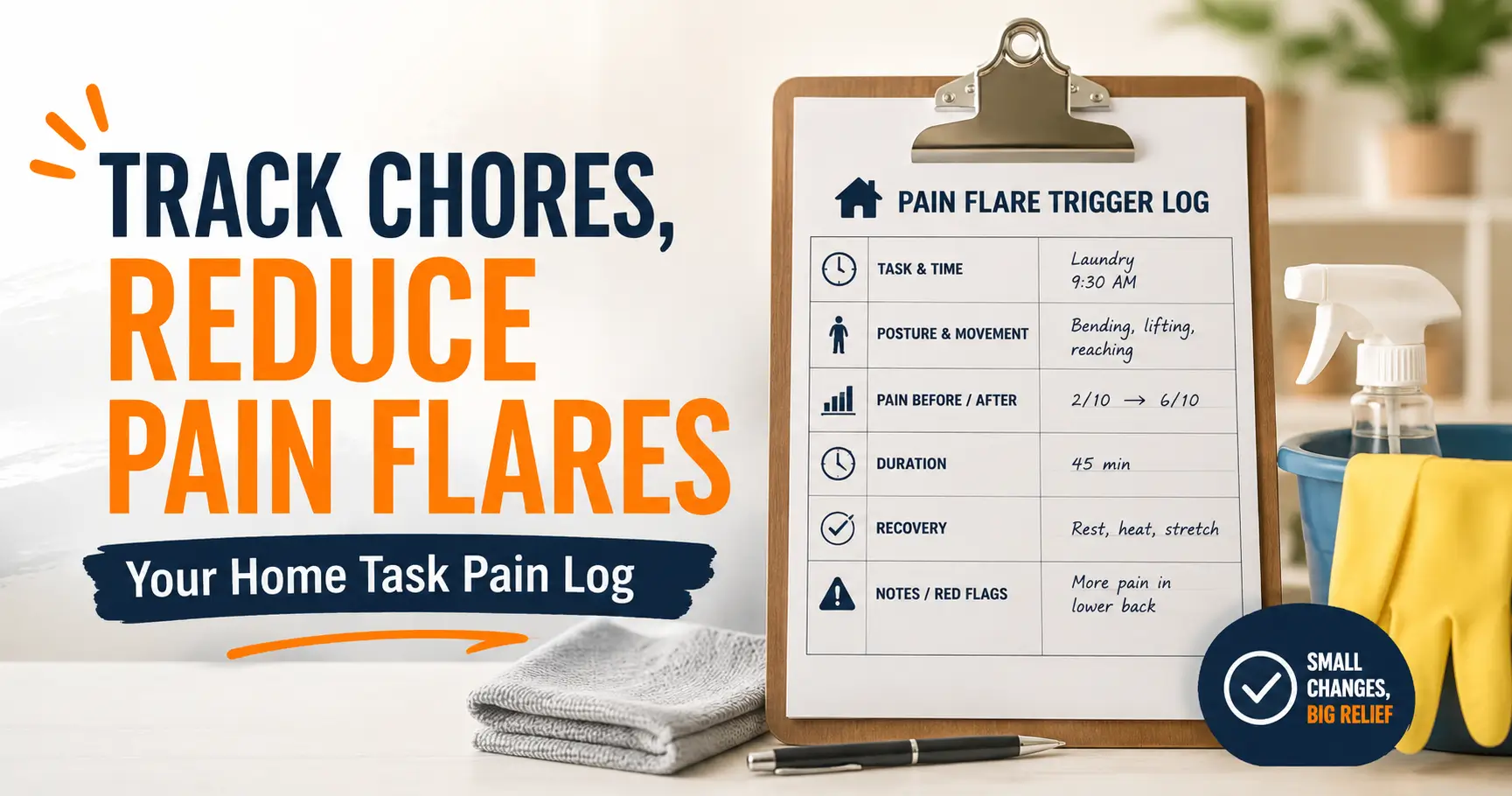
Tracking the Quiet Storm: Your Home Task Pain Flare Log
Some pain flares arrive like a storm. Others sneak in wearing house slippers, carrying a laundry basket, and pretending they are “just one quick chore.”
If recurring pain after home tasks keeps surprising you, a pain flare trigger log for home tasks can help you spot the small patterns your memory naturally sands smooth. In the next few minutes, you will learn how to track chores, timing, posture, recovery, and red flags in a way that is useful for you and much easier to discuss with a doctor, physical therapist, or occupational therapist.
Table of Contents
Key takeaway
- A pain flare log is not a diagnosis tool.
- It helps you notice links between chores, movement, timing, recovery, sleep, and stress.
- The best log is simple enough to use when you are tired.
Apply in 60 seconds: Pick one chore that often ruins your day and write down your pain before, during, and two hours after doing it.
Safety First: What This Log Can and Cannot Do
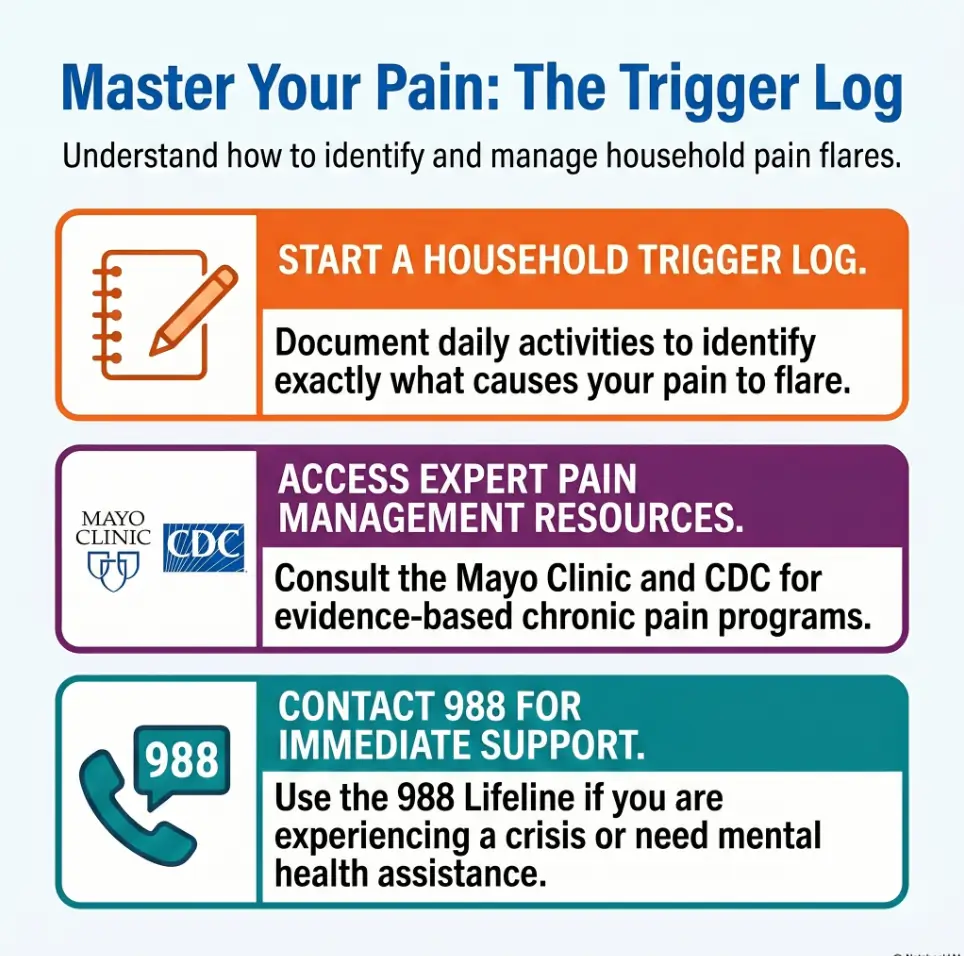
This article is general education, not medical advice, diagnosis, or treatment. A pain flare trigger log can help you organize clues, but it should not replace care from a physician, physical therapist, occupational therapist, pharmacist, or emergency service.
Do not stop prescribed treatment, change medication use, push through severe pain, or attempt risky household tasks because a log suggests you “might be fine.” A notebook is helpful. A notebook is not a tiny white-coated doctor with a clipboard and malpractice insurance.
Pain that keeps worsening, interrupts sleep, limits daily life, or continues despite conservative care may deserve medical evaluation. Mayo Clinic notes that a pain medicine specialist may be helpful when pain continues despite treatment or interferes with daily activities, sleep, or quality of life.
Why Pain Flares Often Feel Random After Chores
Pain flares often feel random because the pain may not peak during the chore itself. The trouble can arrive 30 minutes later, two hours later, or the next morning, when yesterday’s vacuuming suddenly returns wearing a villain cape.
The flare rarely starts when the pain starts
Many home tasks contain delayed-load ingredients: bending, gripping, lifting, twisting, stairs, standing still, reaching overhead, or repeating one movement far longer than planned. Laundry is not just laundry. It is lifting, bending, carrying, folding, standing, and negotiating with a basket that has the emotional density of a small sofa.
A pain flare trigger log gives you a way to catch the sequence. Instead of writing “bad pain today,” you can write, “Carried wet laundry upstairs at 10 a.m., folded standing for 22 minutes, pain rose from 3/10 to 7/10 by 1 p.m.” That single sentence is a lamp in a dark hallway.
Your body may be tracking what your memory edits out
Memory is practical, not perfect. It remembers the obvious chore and forgets the bend angle, the heavy pan, the missing break, the poor sleep, the rushed morning, and the cheerful lie called “I’ll just finish this one last thing.”
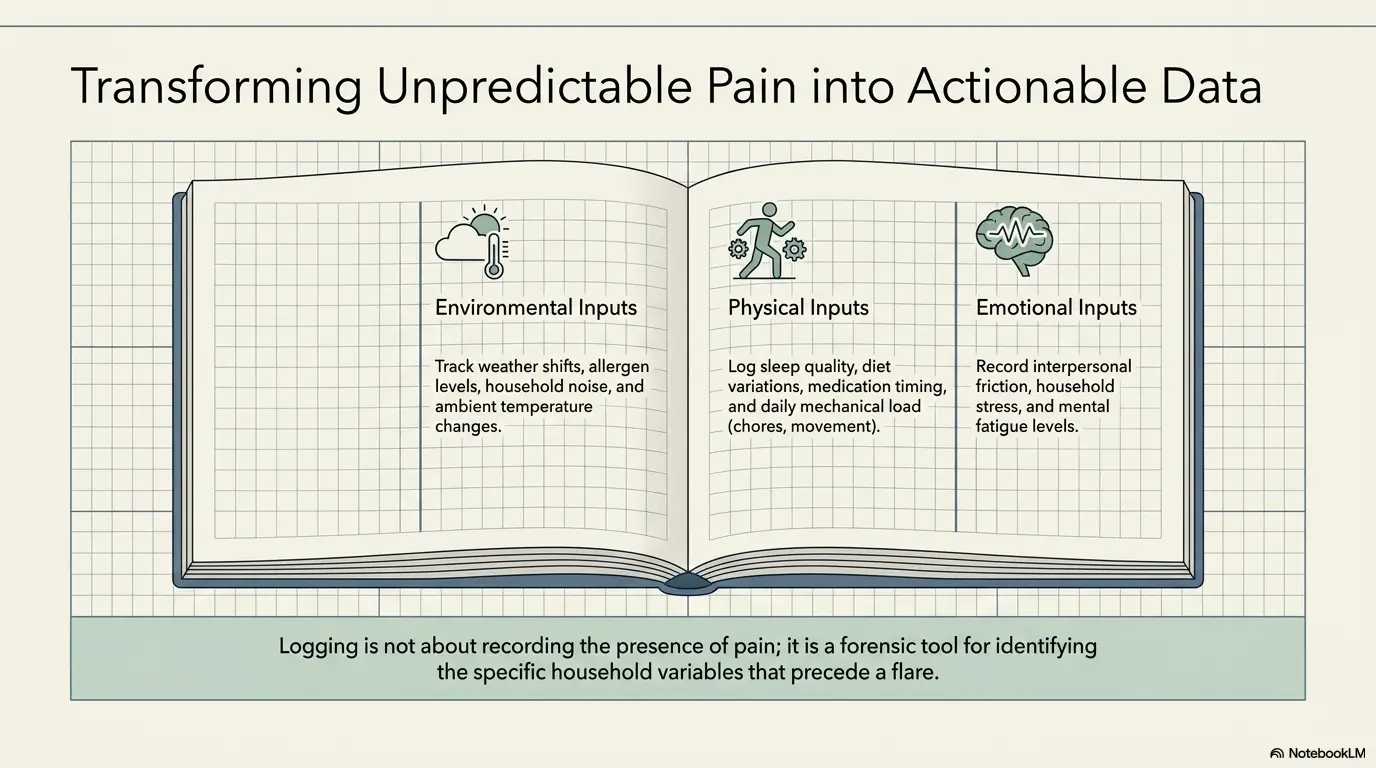
That is why a useful log tracks context. Sleep, stress, weather, hydration, medication timing as prescribed, task duration, body position, tools, and recovery choices can all affect how a chore lands in the body.
Here’s what no one tells you
A “good day” can quietly plant tomorrow’s flare. When pain feels lower, many people try to catch up on every delayed task before lunch. That makes emotional sense. The floor looks tragic. The laundry has formed a local government. But the body may experience that catch-up sprint as overload.
Who This Home Task Trigger Log Is For
This log is most useful for people who already notice recurring pain flares around ordinary home tasks but cannot identify the exact trigger. It is especially helpful when symptoms seem connected to task dose: how long, how heavy, how repetitive, how awkward, or how rushed.
Good fit: recurring flares after normal home tasks
You may benefit from tracking if pain often appears after chores such as washing dishes, vacuuming, cooking, carrying groceries, folding laundry, gardening, cleaning the bathroom, climbing stairs, or making the bed.
The point is not to catch one chore and declare it guilty forever. The point is to find the dose and conditions that change the outcome.
Better with a clinician: new, severe, spreading, or unexplained pain
If pain is new, severe, spreading, unexplained, or getting worse, tracking may still be useful, but it should not delay care. Use the log as a conversation tool, not a permission slip to wait indefinitely.
Not for emergencies, numbness, chest pain, or sudden weakness
Some symptoms are not journaling prompts. Sudden weakness, chest pain, shortness of breath, loss of bladder or bowel control, severe injury after a fall, fever with severe pain, or new numbness should be treated as urgent warning signs.
Key takeaway
- Use the log for recurring, non-emergency patterns.
- Do not use it to delay urgent care.
- Red flags deserve action, not better stationery.
Apply in 60 seconds: Write “call clinician if pain worsens, spreads, disrupts sleep, or limits daily function” at the top of your log.
What to Track Besides Pain Scores
A pain score by itself is too lonely. “Pain was 8/10 today” tells you something hurt. It does not tell you what loaded the body, what helped, what worsened it, or whether the same task is safe in a smaller dose.
The problem with “pain was 8/10 today”
Pain numbers can be useful, but they need company. A 6/10 after ten minutes of dishes is different from a 6/10 after three hours of yard work, poor sleep, skipped lunch, and carrying mulch like a tragic farmhand in a novel.
Track task name, position, load, duration, and breaks
For home tasks, the most useful details are concrete:
- Task: vacuuming, laundry, cooking, dishes, groceries, stairs, bathroom cleaning
- Duration: total minutes and whether you took breaks
- Position: bending, twisting, kneeling, standing still, reaching overhead
- Load: basket weight, grocery bags, pan weight, wet towels, trash bags
- Tools: mop handle length, cart, stool, reacher, shower chair, braces as prescribed
- Response: pain immediately, later, and the next morning
Add the recovery column most people forget
Recovery choices matter. Track heat, ice, rest, stretching if recommended, medication only as prescribed, hydration, sleep, and whether symptoms settled. Your goal is to learn what helps you return to baseline, not just what pushes you away from it.
For related reading on describing symptoms clearly, you can internally link to how to describe pain to a doctor, pain timeline before an orthopedic visit, and functional pain assessment.
The 5-Minute Pain Flare Trigger Log Template
The first version of your log should be small. Not perfect. Not decorative. Not a spreadsheet cathedral with 41 columns and the emotional warmth of airport security. Small wins.
1. Before
Pain, energy, sleep, mood, confidence
2. During
Task, minutes, position, load, breaks, tools
3. After
Pain now, 2 hours later, next morning if possible
4. Recovery
What helped, what failed, how long to settle
Before the task: baseline pain and energy
Write down your starting pain level, fatigue, sleep quality, mood, and confidence. The “before” score is the anchor. Without it, every chore looks guiltier than it may be.
During the task: movement clues
Track the movement ingredients. Did you bend? Twist? Reach overhead? Kneel? Grip hard? Stand still? Carry something heavy? Climb stairs? Repeat the same motion for twenty minutes?
After the task: delayed flare window
Check immediately after the chore, then again later if you can. A simple rhythm is: right after, two hours later, and the next morning. Close-to-the-event notes are usually more useful than trying to reconstruct yesterday from memory, especially when pain, fatigue, and normal life have all thrown confetti on the floor.
| Log Field | Example Entry | Why It Helps |
|---|---|---|
| Task | Vacuumed living room | Connects pain to real activity |
| Dose | 18 minutes, no break | Shows whether duration matters |
| Movement | Bent forward, twisted right | Identifies posture triggers |
| Pain response | 3/10 before, 6/10 two hours later | Captures delayed flares |
| Recovery | Rested 20 minutes, heat helped | Shows what restores function |
Common Chores That Hide Pain Triggers
Home tasks look ordinary because we do them so often. But ordinary does not mean light. A kitchen, laundry room, or driveway can become a small biomechanics laboratory with worse lighting.
Laundry: the bend-lift-twist trap
Laundry combines repeated bending, lifting, twisting, carrying, and standing. Wet towels can be surprisingly heavy. A low washer can demand deep bending. Stairs add load. Folding at a low bed or couch may keep the spine, hips, shoulders, or wrists in awkward positions.
Useful internal links include pick up laundry with sciatica, folding laundry with sciatica, and carry laundry upstairs with sciatica.
Vacuuming and mopping: small pushes, big repetition
Vacuuming and mopping often involve forward reaching, twisting, gripping, pushing, pulling, and “just one more room” thinking. That last one is not a posture, but it behaves like one.
Track handle height, room size, breaks, wrist position, stride length, and whether pain rises during or after the task. You may also connect readers to mopping with sciatica and vacuuming stairs with sciatica.
Cooking: standing still is still work
Cooking can flare pain because standing still is not passive. Chopping, leaning over the counter, reaching cabinets, lifting pans, twisting to the sink, and standing through prep can all add up.
Readers who struggle with cooking-related pain may benefit from internal links to cutting board riser for sciatica, one-handed meal prep, and sciatica while washing dishes.
Gardening and yard work: the flare with muddy shoes
Gardening can mix kneeling, squatting, pulling, gripping, lifting soil, carrying watering cans, sun exposure, and long sessions that feel relaxing until the body files its complaint after dinner.
For yard tasks, track surface level, tool length, load weight, temperature, time of day, and whether breaks happened before symptoms forced them.
Logging Mistakes That Blur the Pattern
A pain flare log should make life clearer, not become homework soup. If the log is too complicated, it will quietly die beside the junk drawer, next to the tape measure and a battery that may or may not be alive.
Mistake 1: Only writing on bad days
Bad-day entries matter, but good-day entries are just as valuable. They show what your body tolerated. Without those, you cannot compare a safe task dose with a flare-producing dose.
Mistake 2: Tracking everything
Do not track 25 variables on day one. Start with task, duration, position, pain before, pain later, and what helped. Add more detail only if you actually keep using the log.
Mistake 3: Blaming one chore too quickly
One chore may be the visible domino. Sleep, stress, yesterday’s activity, medication timing as prescribed, dehydration, inflammation, or a rushed schedule may have arranged the whole line.
Key takeaway
- Track both flare days and better days.
- Keep the first version short.
- Look for repeated patterns, not one dramatic entry.
Apply in 60 seconds: Circle any chore that appears twice in your notes with a similar delayed pain response.
The Boom-Bust Loop: Why Catching Up Can Backfire
The boom-bust loop is the cycle where a person does too much on a better day, flares afterward, rests because symptoms demand it, then tries to catch up again when pain drops. It is an understandable loop. It is also exhausting.
The good-day sprint that steals tomorrow
On a low-pain morning, the home can look newly possible. Dishes, laundry, groceries, bathroom, sheets, trash, meal prep. The task list starts tapping its foot. But doing all of it at once may create tomorrow’s crash.
Pacing is not quitting
Pacing means choosing breaks before symptoms force a stop. Pain self-management resources often describe pacing as balancing activity and rest, breaking activity into smaller pieces, and setting realistic goals so daily function lasts longer.
Let’s be honest
Most people do not flare because they are lazy. They flare because the chore list behaves like it owns a tiny clipboard. A log helps you move from guilt to data. And data, unlike guilt, can be discussed, adjusted, and tested.
Turn Trigger Notes Into Safer Task Experiments
Once you notice a pattern, do not overhaul your whole life overnight. Change one variable at a time. This makes the results easier to understand and less likely to create a new problem.
Change one variable at a time
Possible variables include task duration, load weight, break timing, tool height, surface height, body position, time of day, or whether you sit for part of the task.
| Pattern You Notice | One-Variable Experiment | What to Log |
|---|---|---|
| Pain rises after 25 minutes folding laundry | Fold for 8 minutes, sit, then stop | Pain now, two hours later, next morning |
| Vacuuming flares back or hip pain | Vacuum one room only with a planned break | Duration, posture, pain change |
| Cooking pain after long standing | Use seated prep for chopping | Standing time and recovery time |
| Groceries trigger next-day flare | Use lighter bags or more trips | Bag weight estimate and delayed pain |
Use “same task, smaller dose” testing
The cleanest experiment is often the same chore at a smaller dose. If folding laundry for 25 minutes flares symptoms, try eight minutes. If dishes for 18 minutes hurts, try six minutes, then stop before symptoms climb.
Watch for repeatable patterns
Look for two or three repeated clues before drawing a conclusion. One wild pain day may be weather, poor sleep, stress, illness, overexertion, or a mystery cameo from the body’s chaotic theater department.
Make the Log Useful for a Doctor, PT, or OT Visit
A clinician does not need a 48-page household epic. They need the pattern. Bring a one-page summary: top triggers, worst tasks, best relief strategies, pain timing, and functional limits.
Bring patterns, not a novel
Write a summary like this:
- Top trigger: standing at sink longer than 10 minutes
- Delayed pattern: pain rises two hours later and affects sleep
- Best relief: planned sitting break, heat, shorter task blocks
- Functional limit: cannot cook dinner and clean dishes on the same evening without flare
Translate chores into daily-life impact
Instead of saying, “My back hurts,” write, “I can stand at the sink for about nine minutes before pain climbs from 3/10 to 6/10, and the flare lasts into the evening.” That gives the clinician function, timing, and severity.
Helpful internal links include orthopedic appointment checklist, physical therapy not helping orthopedic pain, and orthopedic pain management before asking for MRI.
Ask better questions from better notes
Your log can help you ask:
- Is this movement safe for my situation?
- Should I modify this chore or pause it?
- Would assistive tools help?
- What symptoms should make me stop?
- Should I see a physical therapist or occupational therapist?
- Could medication timing, sleep, or another condition be affecting flares?
Show me the nerdy details
A home-task pain flare log works because it separates “activity” into smaller variables. Instead of treating “cleaning” as one event, it breaks the event into load, posture, repetition, duration, rest timing, and recovery. That makes the notes more actionable. A clinician may not be able to use “cleaning hurts” as precisely as “mopping for 14 minutes with forward bending causes pain to rise from 2/10 to 6/10 two hours later, while six-minute blocks with breaks stay near 3/10.”
When to Seek Help Instead of Just Tracking
A pain flare log should improve judgment, not replace it. Some patterns deserve a professional review. Some symptoms deserve urgent care.
Get prompt medical advice for worsening or disabling pain
Seek medical guidance if pain is getting worse, limiting basic activities, disrupting sleep, not improving despite conservative steps, or interfering with quality of life. Pain that changes your daily world deserves more than a brave little shrug.
Treat red flags as red flags, not journaling prompts
Get urgent help for sudden weakness, new numbness, loss of bladder or bowel control, chest pain, shortness of breath, severe pain after a fall or injury, fever with severe pain, or pain with unexplained weight loss.
For spine-related emergency context, internally link to low back pain emergency and cauda equina syndrome red flags.
Mental health matters too
Chronic pain can affect mood, identity, relationships, sleep, and safety. If pain is connected with thoughts of self-harm, readers in the US can call or text 988 for immediate crisis support. The 988 Suicide & Crisis Lifeline is available for mental health crisis, emotional distress, substance use crisis, or suicide crisis support.
FAQ
What should I include in a pain flare trigger log for chores?
Include the task, start pain, end pain, delayed pain, duration, position, load, breaks, tools used, stress, sleep, and what helped recovery. Keep it short enough that you will actually use it.
How long should I track home task pain triggers?
A practical starting window is 7 to 14 days, or long enough to capture repeated chores and delayed flares. If symptoms are new, severe, or worsening, do not wait two weeks to contact a healthcare professional.
Should I track pain every hour?
Not usually. For home-task tracking, entries before and after chores plus one delayed check may be more sustainable. The best log is the one that survives real life.
Can a pain flare log diagnose my condition?
No. A log can reveal patterns and support better clinical conversations, but diagnosis belongs with qualified healthcare professionals.
What pain score scale should I use?
A 0 to 10 scale is common, but add plain-language function notes. “6/10 and cannot stand at sink longer than nine minutes” is more useful than a number alone.
What if every chore seems to trigger pain?
That is a reason to seek professional guidance. The issue may involve pacing, conditioning, inflammation, injury, medication, ergonomics, sleep, stress, or another health factor.
Is paper, a notes app, or a spreadsheet better?
The best tool is the one you will use. Paper works beautifully if it lives near the chore zone. A notes app works well if your phone is always nearby. A spreadsheet works if you like sorting patterns.
Should I stop chores that cause pain?
Not automatically. Avoid unsafe pushing, use pacing, and ask a clinician what level of activity is appropriate for your situation. Severe, worsening, or unusual pain needs professional guidance.
Next Step: One Chore, One Week, One Pattern
Start small today. Choose the chore that steals the most from your day: laundry, dishes, vacuuming, cooking, groceries, stairs, or yard work. Do not track your whole life. Track one door into the pattern.
Pick the chore that steals the most from your day
Choose the task that most often creates a flare, limits your evening, disrupts sleep, or makes you cancel something you wanted to do. That is your first candidate.
Use a three-line log today
Write:
- Before: pain, energy, sleep
- During: task, minutes, position, load, breaks
- After: pain now, pain later, what helped
Bring one pattern to your next appointment
The goal is not a perfect diary. The goal is one useful clue with enough context to help someone help you. A good pain flare trigger log does not scold you. It turns the lights on. And sometimes, in the small domestic theater of baskets, pans, stairs, and stubborn floors, that light is the first real relief.