

Mastering the Stairs: Beyond the Hinged Knee Brace
Stair pain transforms a simple trip into a negotiation with gravity. While a hinged knee brace provides a foundation, it is rarely the complete solution. The real challenge lies in the hesitation, the shifting swelling throughout the day, and that unnerving sensation that going down is far more treacherous than going up.
“Not in the catalog photo, but on the third trip of the day, carrying too much, moving too fast.”
Stop the guesswork. Every staircase shouldn’t be a stress test for your joints.
This guide offers a practical approach to orthopedic pain management. Learn to distinguish between support and false security, identify patterns of instability or patellofemoral pain, and discover how to make stairs feel less like an ambush and more like a simple transition.
Table of Contents
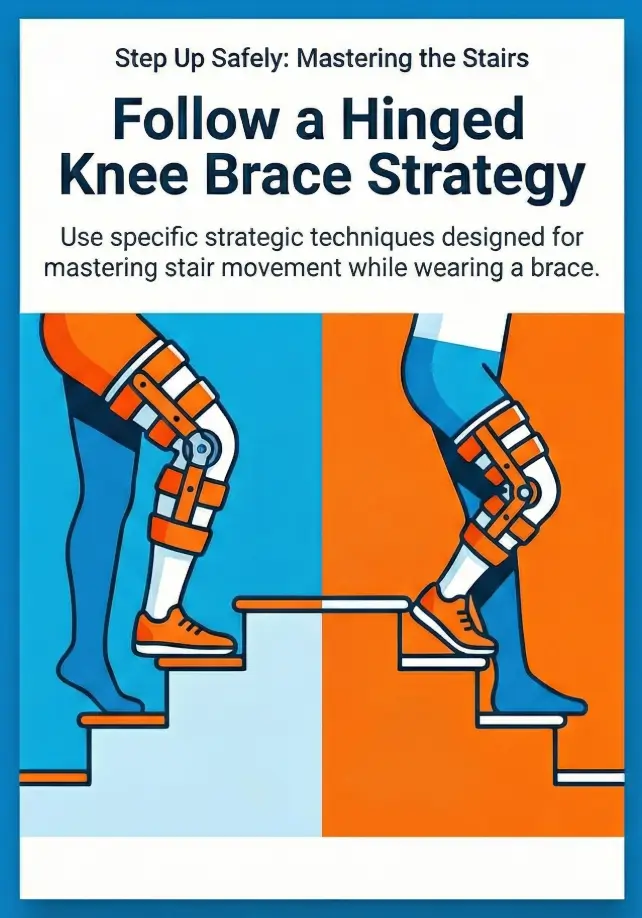
Why Stairs Hurt More Than Flat Ground With a Hinged Knee Brace
The hidden load problem: why one staircase can flare a “manageable” knee
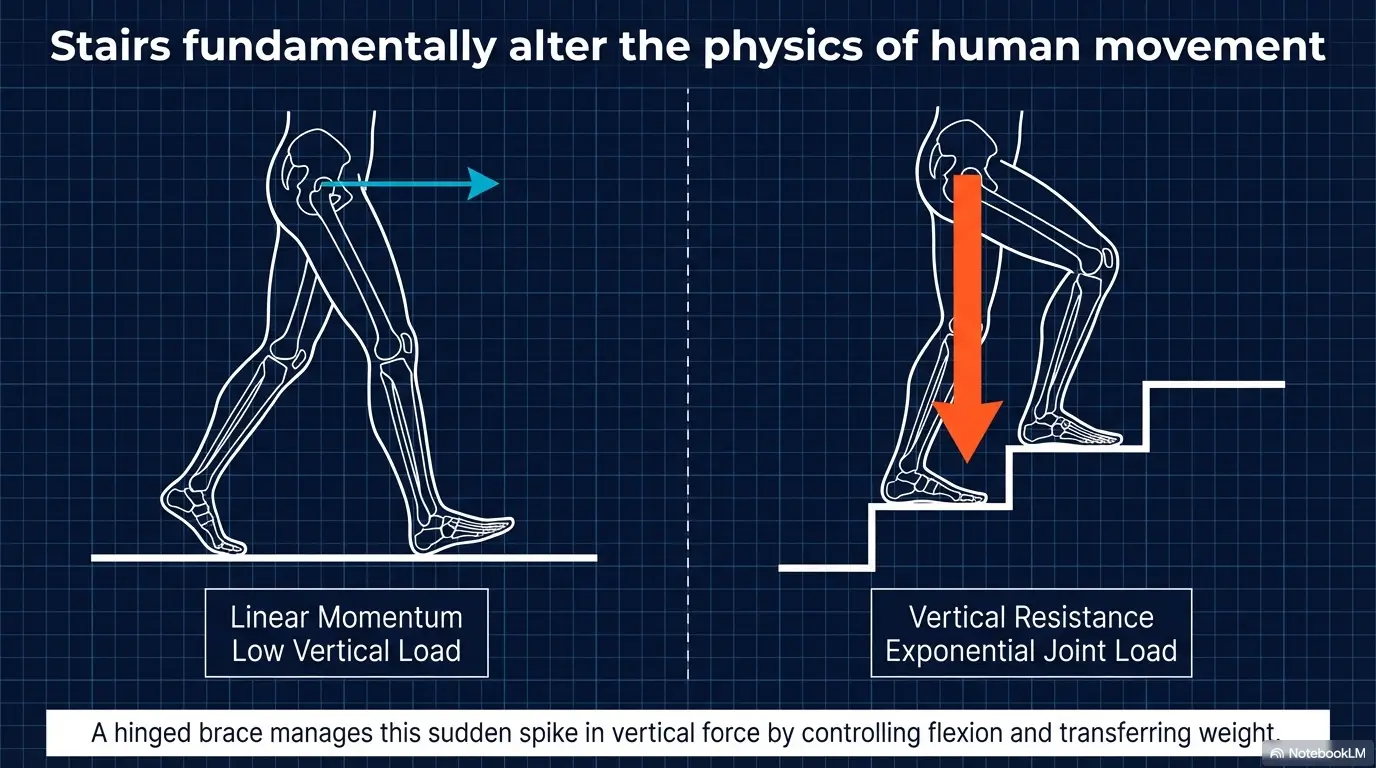
Stairs concentrate the drama. They ask for more bend, more control, and more trust in a joint that may already be irritated. A knee that tolerates a grocery aisle can still protest on twelve steps because stairs compress time and force into a smaller, less forgiving movement. If arthritis is part of the picture, orthopedic guidance notes that knee pain commonly shows up during everyday tasks like climbing stairs. And if front-of-knee pain is your main complaint, patellofemoral conditions are especially famous for making stairs feel like a personal insult.
How brace support and stair stress can collide instead of cooperate
A hinged brace may improve the feeling of support, but it does not magically supply strength, coordination, or eccentric control. That last phrase matters. On stairs, your muscles still have to manage the descent, your balance system still has to keep the body stacked, and your pain system still notices every sloppy repetition. I have seen this pattern in ordinary life: someone says, “The brace helps when I walk,” then whispers, “but stairs are still awful.” That is not contradiction. That is biomechanics behaving like a strict accountant.
Here’s what no one tells you: the brace may be fine, but the stair pattern may not be
Sometimes the brace is not the villain. The technique is. People rush, carry bags, skip the rail, or try to move “normally” before the knee is ready. That can turn a decent support tool into a front-row seat for pain. The useful question is not merely, “Does the brace work?” It is, “What happens when this brace, this staircase, this speed, and this pain pattern meet at 7:40 a.m. with one hand full of laundry?”
- Stairs demand more control than level walking
- A brace can help support, but not replace muscle control
- Pain on stairs still offers useful diagnostic clues
Apply in 60 seconds: On your next staircase, notice whether pain starts at lift-off, mid-step, or lowering down.
Brace First, Stairs Second: What a Hinged Knee Brace Can and Cannot Do
When hinged support helps with stability, tracking, or confidence
Used appropriately, a brace can be useful. AAOS notes that braces may help with stability and function in some knee arthritis situations, while AAHKS similarly explains that braces can assist with function for some people but are not a fit for everyone. That is a modest claim, but a valuable one. “Useful” is often enough. It can mean less wobble, more confidence, or a clearer sense of where the knee is in space. Readers also often want to know the practical side of paying for support devices, especially when asking whether orthopedic braces and supports are HSA eligible.
When a brace becomes a false promise instead of a pain plan
The brace becomes a false promise when it turns into permission. Permission to take stairs faster. Permission to ignore swelling. Permission to keep going because the straps feel reassuring. A support device should lower chaos, not invite negotiation with common sense. In one clumsy week of my own recovery from a different leg issue, I learned that “supported” and “ready” are not twins. They barely share a mailbox.
Why “more rigid” does not always mean “less pain”
More hardware can feel impressive. It can also feel hot, stiff, slippery, bulky under clothes, and oddly wrong on the hinge line. The point of a brace is not to create a tiny exoskeleton worthy of a sci-fi subplot. The point is to support the right knee problem in the right way. If pain rises because the brace slips, rubs, pinches, or changes gait, the elegant theory has already lost the argument.
Decision card: When a brace may help vs when it may not
| Pattern | More likely useful | Needs clinician review sooner |
|---|---|---|
| Mild instability, known diagnosis | Yes, as part of a plan | Only if worsening |
| Unknown pain, frequent buckling | Maybe temporarily | Yes |
| Post-op knee with surgeon protocol | Only as prescribed | Yes if guidance is unclear |
Neutral next step: match the brace decision to the diagnosis, not to the marketing photo.
Show me the nerdy details
Hinged braces can change perceived stability and may influence motion quality, but they do not independently solve weakness, poor motor control, swelling, or an irritated patellofemoral joint. In practical terms, a brace can reduce “wobble panic” while still leaving the underlying stair limitation untouched.
Pain Pattern Check: The 4 Stair Symptoms That Change the Whole Story
Front-of-knee pain vs side pain vs deep joint ache
Location matters more than people think. Front-of-knee pain often points readers toward patellofemoral overload or irritation. Side pain can raise different questions, including ligament or compartment-specific stress. A deep, dull ache may behave differently again, especially in arthritis. This is why saying “my knee hurts on stairs” is useful, but saying “the front hurts going down” is much better. AAOS specifically notes that patellofemoral arthritis can make climbing and descending stairs difficult, which is a good reminder that the exact spot and motion matter.
Swelling, buckling, locking, and the meaning behind each
Swelling is the body’s unruly memo. Buckling hints at weakness, instability, pain inhibition, or all three. Locking or catching is a different kind of warning light. NIAMS notes that sudden severe pain, extreme swelling, inability to place weight, inability to move a joint normally, or a visibly out-of-place joint deserve prompt medical attention. Those are not “watch and see for three months” signals.
Let’s be honest… “it only hurts on stairs” is still useful clinical information
People downplay stair pain because it feels oddly specific, as if specificity makes it less real. It does not. Stairs are a stress test hidden in plain sight. If your knee only complains there, that pattern still helps a clinician narrow the suspects and improve the plan.
Eligibility checklist for self-management first
- Known diagnosis or familiar flare pattern: yes / no
- No sudden major swelling: yes / no
- No new locking or collapse: yes / no
- You can bear weight safely with a rail: yes / no
Neutral next step: if you answered “no” to any of these, move clinician contact higher on the list.
Up vs Down: Why Descending Usually Feels Worse
The eccentric control problem most readers never name
Going down stairs often feels worse because the knee is not just moving. It is controlling a lowering body. That controlled lowering asks a lot from the muscles around the knee and hip. When those muscles are weak, inhibited by pain, or simply tired by late afternoon, the descent becomes a little negotiation with gravity, and gravity is famously not sentimental.
Why going down can expose weakness, fear, and poor brace timing
Descending also magnifies hesitation. The brace may feel supportive in a straight line, but on the way down the knee has to trust the timing of the foot placement, the rail, the trunk position, and the lowering phase. If one part is off, confidence falls before the body does. That is often why people say, “Going up is annoying. Going down feels unsafe.” For readers trying to untangle whether the problem is the knee, the back, or a mixed pattern, it can help to compare this with what sciatica going down stairs tends to feel like.
The article’s open loop: same knee, same stairs, very different pain
This difference between ascent and descent is not random. It is one of the most helpful clues in the entire conversation. If you notice that your pain spikes mainly on the way down, you have learned something practical already: your next fix is less likely to be “tighter straps” and more likely to involve pacing, rail use, controlled stepping, and strengthening around the knee. AAOS materials on knee conditioning emphasize that stronger muscles supporting the knee reduce stress on the joint and help absorb shock.
Fit Before Force: How Bad Brace Setup Creates Good-Looking Failure
Straps too loose, hinge misaligned, sleeve slipping
A brace can look “on” while being functionally wrong. Hinges that sit too high or too low, straps that migrate, or sleeves that twist on the stairs can all turn support into friction. A badly aligned brace is the orthopedic version of wearing elegant shoes one size off. It may photograph beautifully. It will still betray you by lunch.
Clothing friction, skin irritation, and swelling changes through the day
Knees are not static objects. Swelling changes. Heat changes. Socks bunch. Pants catch. Skin gets irritated. A brace that feels perfect at 8 a.m. may feel mean by 4 p.m. This is one reason AAHKS notes that braces can be difficult to fit for some people. “Difficult to fit” sounds mild on paper, but in real life it means slippage, pinching, sweat, and the slow erosion of trust.
Why a brace that feels “secure” can still be fitted badly
Security is not the same as alignment. Many people overtighten because tighter feels safer. Sometimes that only creates pressure, skin irritation, or awkward mechanics without improving control. The better test is whether the brace stays aligned during actual stair use, not whether it can win an arm-wrestling match with your thigh.
Short Story: A reader once described her brace as “a loyal dog that turns into a scarf halfway down the stairs.” That image stayed with me because it captured the exact problem: something can feel supportive in theory and still fail in motion. She was tightening the top strap every morning, then wondering why the hinge drifted by evening.
The real fix was duller and better. She checked the hinge line in a mirror, adjusted fit after swelling changed, stopped carrying bags on the stairs, and used the rail every single time. Nothing about it sounded heroic. But within a week, the staircase stopped feeling like an ambush. Sometimes progress arrives wearing beige shoes and carrying no cinematic soundtrack at all.
Infographic: 4-point stair safety check
Centered with the knee, not drifting high or low.
Snug enough to stay put, not so tight it bites.
One free hand for support every time.
Notice whether up or down is worse before changing anything.
Don’t Do This on the Stairs: The Most Common Brace-Related Mistakes
Grabbing speed because the brace makes you feel protected
Fast stairs are glamorous only in movies and people who no longer have cartilage opinions. In ordinary life, speed steals time from control. If the brace makes you feel bolder, that is useful only if your technique stays disciplined.
Using the brace as permission to ignore pain spikes
Pain spikes are feedback, not a personality flaw. If symptoms ramp up during or after stairs, the answer is not usually to grit your teeth harder. It is to reduce load, improve setup, and decide whether the pattern fits self-management or clinician review.
Keeping the same fit all day even as swelling changes
The knee you have at breakfast may not be the knee you have after errands, a commute, or a long shift. Rechecking the fit later in the day is not fussy. It is maintenance.
Carrying items while trying to manage rail, brace, and balance
MedlinePlus home-prep guidance for knee or hip surgery warns against carrying items while walking around because your hands may be needed for balance, and it specifically advises practicing stair use correctly. That principle travels well beyond surgery. The staircase is not the place to audition your one-handed laundry basket skills. If carrying chores are part of the problem, readers may also relate to the everyday load-management lessons in how to carry laundry upstairs more safely.
Quote-prep list for your PT or orthopedist
- What diagnosis is the brace actually treating?
- Should I use one step at a time or alternate steps?
- What amount of stair pain is acceptable during rehab?
- What brace fit changes should trigger a re-check?
Neutral next step: bring this list and one week of stair notes to your visit.
Rail, Rhythm, Sequence: The Safer Stair Method Readers Actually Need
Using the handrail like equipment, not decoration
The handrail is not a moral compromise. It is equipment. Use it. Especially if the pain pattern includes hesitation, weakness, or fear on descent. A rail lowers the chaos budget immediately.
One step at a time vs alternating steps: when to keep it simple
For many readers in a flare, one step at a time is the smarter option. It is not elegant, but elegance is badly overrated when compared with not falling. “Normal” stair walking is not a prize category. It is merely one option, and sometimes not the right one.
Why slow, boring stair technique often beats “normal” technique
Slow technique gives you more chances to place the foot well, use the rail, keep the trunk from pitching, and notice pain before it becomes a sharp lecture. This is where orthopedic pain management gets unglamorous and effective. You are building repeatability, not winning style points.
Here’s what no one tells you: confidence drops faster going down than going up
That matters because fear changes mechanics. When people anticipate pain or collapse, they often rush or stiffen, which can make the staircase feel even worse. A calmer sequence helps: rail first, place the foot, transfer weight deliberately, then continue. Not thrilling. Very useful.
- Use the rail every time during a flare
- Choose one-step-at-a-time when control is shaky
- Keep one hand free by not carrying items
Apply in 60 seconds: Before your next staircase, decide your rail hand and whether you will use single-step sequencing.
Pain Management Beyond the Brace: What Belongs in the Same Plan
Activity pacing, icing, elevation, and load management
A brace works best inside a larger plan. That plan often includes pacing the number of stair trips, spreading demanding tasks through the day, and calming the knee after flare-provoking activity. This is especially important because pain on stairs is often less about one dramatic failure and more about accumulated irritation. Three unnecessary trips up and down can be the tiny tax bill that arrives at bedtime with interest. For older adults especially, that broader approach fits well with the everyday strategies discussed in pain management for seniors waiting on joint treatment.
Why low-impact conditioning matters more than readers expect
Strength and conditioning are quieter than braces, but they often matter more over time. AAOS knee conditioning guidance explains that stronger muscles supporting the knee reduce stress on the joint and help absorb shock. That does not mean heroic workouts. It means targeted, boring, repeatable work that gives the staircase less power to ruin your afternoon.
Muscle support around the knee: the quiet pain reducer
The knee is deeply affected by what the surrounding muscles are doing or failing to do. When those supports get better, stairs often stop feeling quite so personal. I wish there were a more glamorous truth. There usually is not. And when knee pain overlaps with nerve symptoms or back pain, it may help to compare exercise decisions with guides such as sciatica and knee arthritis exercises.
Recovery is rarely about one device
AAHKS and AAOS both frame nonoperative knee care as broader than bracing alone. Exercise, weight management when relevant, activity adjustments, and other treatment tools may all belong in the same conversation. That wider framing helps prevent the classic disappointment of asking one brace to do the job of an entire rehab plan.
Show me the nerdy details
When stair pain is worse on descent, the practical suspect list often includes load tolerance, patellofemoral irritation, weak eccentric control, or poor movement strategy. A brace may change confidence and alignment cues, but the load still has to be absorbed by tissue that is ready for it.
Who This Is For / Not For
Best fit readers: arthritis, ligament recovery, instability, or clinician-prescribed brace users
This guide is most useful for adults with a known knee problem, a hinged brace already in play, and a need to manage stairs more safely. Common examples include arthritis, some post-injury situations, instability concerns, or recovery plans where a clinician has already discussed bracing. AAOS notes that braces may help stability and function in selected knee arthritis cases.
Not a fit: unexplained knee pain, locked knee, fresh traumatic injury, major swelling, or readers using an old brace without guidance
If the pain is new, severe, unstable, or accompanied by locking, major swelling, or inability to bear weight, step away from the DIY optimism. NIAMS flags those patterns as reasons for medical evaluation rather than casual persistence.
Post-op readers: why surgeon instructions outrank generic internet advice
Post-op knees come with protocol, and protocol wins. The same staircase can mean one thing after mild arthritis flare and something entirely different after surgery. If you have post-op instructions, that document is the conductor. The internet is merely a spare violin. Readers juggling multiple recovery logistics may also find related planning helpful in practical recovery guides like showering after hip surgery.
Common Mistakes
Wearing the brace correctly but using the stairs badly
This is more common than people admit. The brace is on. The technique is not. Poor sequencing, rushed cadence, or skipping the rail can quietly cancel the benefit you hoped the brace would provide.
Chasing zero pain instead of safer pain reduction
The goal is usually not immediate perfection. It is safer, more manageable function. Waiting for a magical zero-pain staircase can keep people from noticing the real win, which is reduced pain spikes and fewer shaky moments.
Staying active in the wrong way and getting punished at night
Some activity is helpful. Too much poorly timed loading is not. The knee often sends the bill later, at exactly the hour when you wanted peace and got throbbing instead. If your symptoms reliably intensify after dark, the pattern may rhyme with broader recovery frustrations described in why joint pain can feel worse at night.
Assuming a hinged brace replaces strengthening or rehab
It does not. A brace may assist. It does not graduate from physical therapy on your behalf. For readers navigating the practical cost side of rehab decisions, it can also help to understand physical therapy copay versus coinsurance before delaying care for the wrong reason.
Copying someone else’s stair technique from a different diagnosis
Your neighbor’s meniscus issue, cousin’s knee replacement, and your patellofemoral flare do not necessarily want the same strategy. Borrowing technique without diagnosis is like borrowing eyeglasses because someone else says the frames look responsible.
Mini calculator: daily stair load reality check
Count your staircase trips for one day. Multiply trips by number of steps. Then compare your pain that evening.
Example: 8 trips × 12 steps = 96 loaded steps. That number often explains more than “I barely did anything.”
Neutral next step: reduce unnecessary trips tomorrow and compare the evening result.
When to Seek Help Instead of “Pushing Through”
Sudden swelling, major instability, or inability to bear weight
These belong in the “call someone” category, not the “maybe the brace needs a wash” category. NIAMS lists sudden severe pain, extreme swelling, inability to place weight, inability to move the joint normally, and visible joint displacement among acute injury warning signs.
Pain that is worsening rather than settling
If the pattern is clearly deteriorating over days rather than improving with smarter stair behavior, that is useful information, and usually not the flattering kind.
Locking, catching, deformity, fever, or severe post-op concern
These are not “keep watching YouTube and hope for wisdom” symptoms. They justify direct clinical guidance, especially in post-op contexts.
When stairs become the place your knee keeps “giving out”
Recurrent giving-way on stairs pushes the situation closer to a fall-risk issue. That shifts the tone from convenience to safety. MedlinePlus guidance on assistive devices and home prep emphasizes correct use and balance support, especially around stairs. And if pain, weakness, or nerve symptoms are starting to blur into a more urgent spinal picture, readers should not ignore red-flag discussions such as when low back pain may be an emergency.
Next Step: Do One Real-World Stair Audit Before You Change Anything Else
Check brace fit at the hinge and straps
Before you buy anything new or declare the brace useless, check the fit in motion. Not on the couch. On the actual staircase you use. See whether the hinge stays aligned and whether the straps migrate.
Test stairs only with a rail and no carried items
Give the knee a fair trial. One hand free. No bags. No heroic multitasking. This removes one big source of chaos immediately. MedlinePlus explicitly advises not carrying items while walking when balance support is needed and highlights practicing correct stair use.
Note whether pain is worse going up or down
This one detail often tells a better story than a generic pain score. Up versus down, first few steps versus later steps, morning versus evening, with swelling versus without. Patterns matter.
Bring that pattern, not just the pain score, to your clinician or PT
That closes the loop from the opening problem. The staircase feels mysterious until you start observing it properly. Then it becomes data. Not glamorous data, admittedly. But useful data. In the next 15 minutes, you can do one careful stair audit and write down four things: brace alignment, rail use, pain direction, and whether the knee feels weak, wobbly, or simply irritated. That single note will do more for your next appointment than vague memories ever will. If the visit itself is part of your hesitation, some readers also benefit from knowing the basics of joint injection consultation cost before that conversation begins.
Last reviewed: 2026-03.
FAQ
Can a hinged knee brace make stairs easier?
Yes, sometimes. It may improve the feeling of support or stability for certain knee problems, but it does not replace strength, control, or diagnosis-specific advice. That is why some people feel better on level ground yet still struggle on stairs.
Why does my knee hurt more going down stairs than going up?
Descending often demands more controlled lowering and can expose weakness, poor confidence, or poor movement strategy more than ascent does. Many readers notice this before they have words for it.
Should I wear a hinged knee brace all day?
That depends on the diagnosis, fit, clinician guidance, and how your knee responds. Braces are not right for everyone, and all-day use is not automatically better. Fit problems, skin irritation, and movement changes matter.
Can the wrong brace fit make knee pain worse?
Yes. A slipping, twisted, overly tight, or poorly aligned brace can create discomfort, alter movement, or erode confidence on stairs. Secure does not always mean correctly fitted.
Is it normal for my brace to slip during stair use?
It is common enough to be worth checking, but not something to casually accept. Slippage can mean the fit, hinge alignment, strap tension, swelling pattern, or brace type needs review.
Should I use one step at a time on stairs?
Often yes during a flare or when control is shaky. One-step-at-a-time with a rail is frequently the calmer, safer option until symptoms and confidence improve.
Can I rely on a brace instead of physical therapy?
Usually no. A brace may be one tool in the plan, but strengthening and movement retraining often matter more for long-term improvement, especially if stairs are the main trigger. AAOS knee conditioning guidance emphasizes stronger support muscles to reduce stress on the knee joint.
When is stair pain a sign I should call my doctor?
Call sooner if you have sudden severe pain, major swelling, inability to bear weight, a locked or visibly deformed joint, or repeated giving-way on stairs. Those patterns deserve medical attention rather than improvised determination.
Does knee arthritis change how a hinged brace should be used on stairs?
It can. Braces may help some people with knee arthritis, especially when stability and function are part of the problem, but the right brace type and fit still depend on the knee’s specific pattern.
Is it safe to use a hinged brace after surgery without specific stair instructions?
That is not a good assumption to make. Post-op instructions from your surgeon or physical therapist should guide brace use and stair method. Generic advice should never outrank your recovery protocol.