

Navigating Orthopedic Care:
Cutting Through the Medicare Advantage Fog
One small sentence can turn a sore knee, stiff hip, or aching back into a week of phone calls: “Your Medicare Advantage plan requires prior authorization.”
The pain may feel like one problem, but the plan may treat the orthopedist, MRI, physical therapy, medication, injection, walker, brace, and pharmacy refill as separate checkpoints. When families guess, they risk losing time, money, mobility, and the narrow window when pain is still manageable at home.
This guide helps you navigate the care path before it gets tangled. Learn to manage:
- ✔ Provider Networks & Referrals
- ✔ Prior Authorization Rules
- ✔ Physical Therapy Costs
- ✔ Equipment & Drug Formularies
The method is simple: Ask sharper questions, document the answers, and build the care plan from facts.
Stop the bill before it arrives. Keep pain from running the household.
Table of Contents
Start Here: Medicare Advantage Changes the Pain-Care Map
Why the same knee pain can have different costs under different plans
Orthopedic pain feels personal. Insurance makes it procedural. That mismatch is where many families lose time.
A senior with the same knee arthritis, the same X-ray, and the same physical therapy recommendation may face very different steps depending on the Medicare Advantage plan. One plan may require a referral before an orthopedic visit. Another may allow direct specialist scheduling but require prior authorization for an MRI. A third may cover therapy only at certain clinics. It can feel less like health care and more like entering a building where every hallway has a badge scanner.
Medicare Advantage plans are private Medicare-approved plans. They generally provide Part A and Part B benefits, and many include Part D drug coverage. Medicare.gov explains that these plans may use networks, prior authorization, copays, and additional plan rules that do not work exactly like Original Medicare.
The hidden route from primary care to orthopedics, imaging, therapy, and medication
Most orthopedic pain care is not one appointment. It is a chain:
- Primary care visit
- Orthopedic specialist
- X-ray, MRI, CT scan, or ultrasound
- Physical therapy or occupational therapy
- Medication review
- Injection, brace, walker, cane, or surgery discussion
Each link in that chain may have a different coverage rule. The strange part is that the painful body experiences it as one problem, while the plan processes it as several separate services. The hip does not know it has entered a billing ecosystem. Sadly, the hip receives no orientation packet.
What “covered” does not always mean when a senior is already hurting
“Covered” can mean several things. It may mean covered after referral. Covered only in network. Covered after prior authorization. Covered with a copay. Covered after a deductible. Covered with a specific supplier. Covered only when the plan agrees that medical necessity criteria are met.
That does not mean the plan is automatically wrong or the care is impossible. It means the family needs to ask sharper questions before the appointment calendar fills up.
- Doctor network status matters.
- Authorization rules can affect timing.
- Out-of-pocket cost can change by service type.
Apply in 60 seconds: Write down the next planned service, not just the diagnosis.
Who This Is For, and Who This Is Not For
For seniors trying to manage arthritis, back pain, hip pain, shoulder pain, or joint pain
This guide is for the person who says, “My knee is not an emergency, but it is ruining my morning.” It is for the stiff shoulder that makes dressing slow, the back pain that turns grocery shopping into a strategic operation, and the hip pain that makes a normal chair look suspicious.
Orthopedic pain management for seniors may include exercise, therapy, heat or cold strategies, medication, injections, braces, walking aids, surgery evaluation, or home modifications. The right path depends on the medical condition, the person’s function, other health issues, and clinician judgment.
Insurance is not the doctor. But insurance rules can affect which doctor, how fast, where, and at what cost.
For adult children helping compare doctors, referrals, bills, and plan rules
This is also for adult children who become accidental care coordinators. One minute you are making coffee. The next minute you are comparing plan documents, orthopedist reviews, pharmacy tiers, and a mystery bill that arrived with the emotional tone of a tax notice.
I have seen families spend 45 minutes choosing a doctor online, then discover the appointment is out of network for the exact Medicare Advantage plan. The lesson lands with a thud: “accepts Medicare” and “accepts this Medicare Advantage plan” are not twins. They are distant cousins who wave politely at reunions.
Not for emergencies, sudden neurologic symptoms, or severe unexplained pain
Plan navigation is for non-emergency decisions. It is not for situations where symptoms may signal serious harm.
Seek urgent medical help for severe injury after a fall, sudden weakness, new numbness, fever with severe joint pain, chest pain, severe unexplained pain, new confusion, or loss of bladder or bowel control. Do not wait for plan paperwork if the situation may be an emergency.
Not a substitute for a clinician, Medicare counselor, or plan representative
This article can help you ask better questions. It cannot diagnose pain, interpret every plan document, or replace advice from a clinician, a licensed insurance professional, the plan, Medicare, or a State Health Insurance Assistance Program counselor.
- Yes if the pain is ongoing and you are planning non-emergency orthopedic care.
- Yes if you are comparing doctors, therapy clinics, equipment, medication costs, or imaging.
- No if symptoms are sudden, severe, or neurologic. Get medical help first.
- No if you need a personalized plan recommendation. Use official plan materials or licensed help.
Neutral action: Decide whether this is a medical urgency, a plan-navigation question, or both.
The First Phone Call: Ask Before the Appointment, Not After the Bill
Confirm the orthopedic doctor is in network for this exact plan
The first phone call should be boring. That is its superpower.
Call the Medicare Advantage plan using the number on the member ID card. Ask whether the orthopedic doctor, clinic, imaging center, therapy clinic, and equipment supplier are in network for that exact plan name and plan year. Not the insurance company generally. Not the clinic’s hopeful guess. The exact plan.
UnitedHealthcare, Humana, Aetna, Cigna, Blue Cross Blue Shield plans, Kaiser Permanente, and other carriers may offer several Medicare Advantage products in the same region. A doctor may accept one plan and not another. The logo on the card is not enough.
Ask whether a referral is required before seeing a specialist
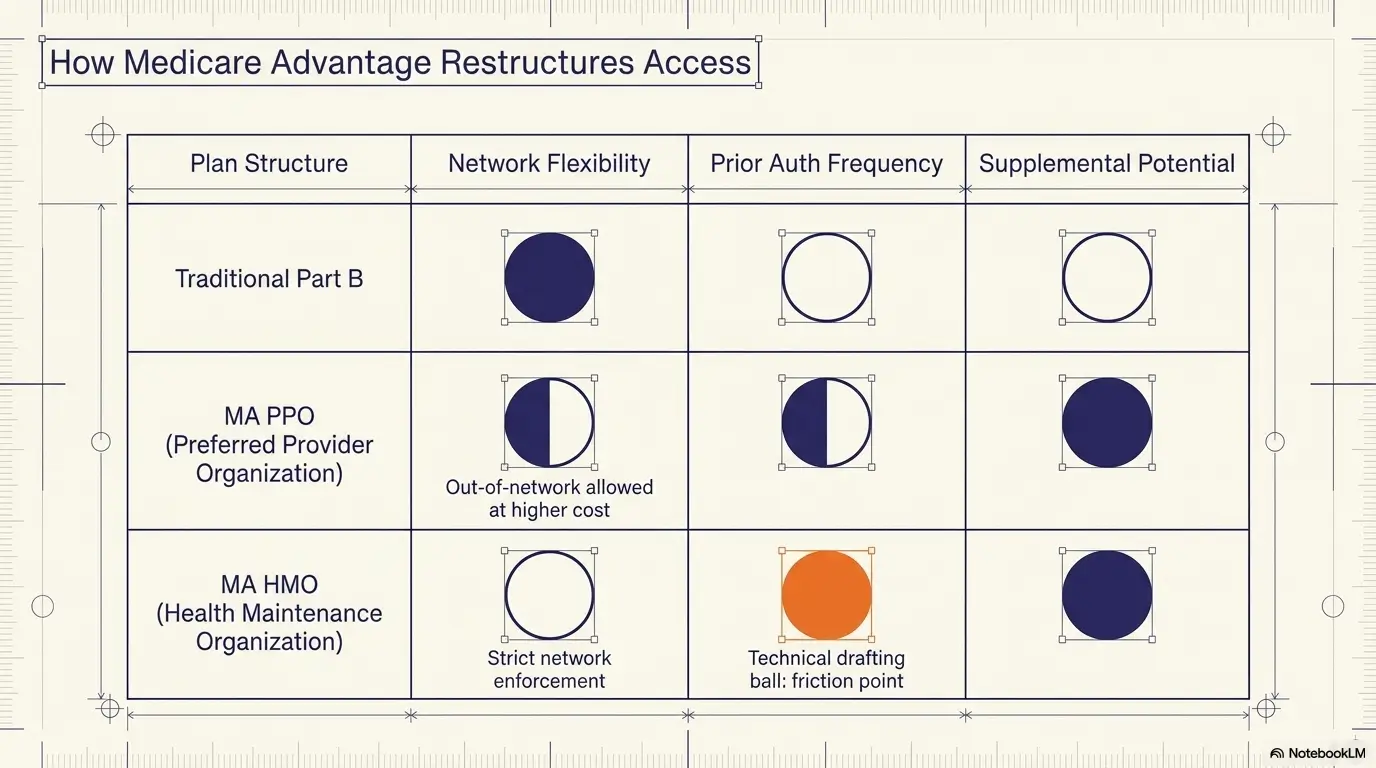
Some Medicare Advantage plans, especially HMO-style plans, may require a referral from a primary care doctor before a specialist visit. PPO-style plans may work differently, but out-of-network care can still cost more or come with restrictions. If the wait itself is becoming part of the pain problem, it may help to understand orthopedic referral wait times before assuming the next available appointment is the only possible path.
Ask this plainly: “Does this member need a referral before seeing this orthopedic specialist?” Then ask who sends it, how long it takes, and whether the referral must be approved before the appointment.
Ask the plan to explain copays, coinsurance, and annual out-of-pocket limits
Families often ask, “Is it covered?” The better question is, “What will we pay if everything is approved and in network?”
Copays can stack. A specialist visit, imaging appointment, therapy sessions, injection visit, and medication refill may each create a separate cost. Medicare Advantage plans do have a yearly limit on out-of-pocket costs for Part A and Part B covered services, but the number varies by plan.
Let’s be honest: “They take Medicare” is not the same as “they take your plan”
This sentence deserves a tiny brass plaque. Many offices say they “take Medicare,” but Medicare Advantage is plan-specific. The clinic may accept Original Medicare but not the private Medicare Advantage plan. Or it may accept the carrier but not that network.
- Member ID card and plan name
- Doctor or facility name, address, and phone number
- Service being considered, such as orthopedic consult, MRI, PT, brace, or injection
- Diagnosis or body area, such as hip pain, knee arthritis, shoulder injury, or back pain
- Preferred appointment date, if already scheduled
Neutral action: Keep the call notes in one notebook or phone note, not on three envelopes and a receipt from the pharmacy.
Prior Authorization: The Small Gate That Can Delay Big Relief
Which pain treatments often trigger approval checks
Prior authorization means the plan may need to approve a service or item before it is covered. Medicare.gov notes that Medicare Advantage plans typically may require prior authorization for certain services or supplies, and members should contact the plan with coverage questions before care is provided.
Orthopedic pain services that may involve approval rules can include advanced imaging, some injections, some surgeries, certain durable medical equipment, out-of-network care, and certain medications. The exact list depends on the plan.
Prior authorization is not always a denial. Sometimes it is a gate. But when someone has pain climbing stairs, even a gate with polite signage can feel like a wall.
Why imaging, injections, surgery, and equipment may move slower than expected
An orthopedic doctor may recommend an MRI after an exam. The family hears “next step.” The plan may hear “review required.” That review can add days, sometimes longer, depending on paperwork, medical necessity documentation, and the plan’s process. Before assuming the scan is automatically the right next move, families may want to review orthopedic pain management before asking for MRI, especially when conservative steps or exam findings still need to be documented.
This matters because pain changes behavior. When walking hurts, a senior may sit more. When sitting increases stiffness, movement gets harder. When nighttime pain ruins sleep, balance and mood can suffer. Waiting is not neutral; it rearranges the day.
What to ask the doctor’s office before assuming paperwork is handled
Before leaving the office, ask:
- Who submits prior authorization?
- What documentation is needed?
- How will we know if it is approved or denied?
- Should we schedule now or wait for approval?
- Who should we call if the plan says it has not received anything?
These questions are not rude. They are handrails. Good offices hear them every day.
Keep a paper trail: dates, names, reference numbers, and denial letters
Write down the date, time, representative name, call reference number, and summary of what was said. If something is denied, ask for the denial reason in writing. Save letters and portal messages. A paper trail turns “someone told me” into a usable record.
- Ask before scheduling non-emergency services.
- Confirm who submits the request.
- Save written decisions and call details.
Apply in 60 seconds: Create one note titled “Pain care authorization log.”
Show me the nerdy details
Prior authorization decisions usually depend on plan rules, medical necessity criteria, documentation, and whether the requested service matches the plan’s coverage process. For orthopedic pain, that can mean the plan reviews prior conservative treatment, exam findings, imaging history, diagnosis codes, medication history, or therapy notes. The practical caregiver move is simple: ask the ordering office what evidence they are submitting and ask the plan how status updates are communicated.
Physical Therapy Math: Relief Depends on Visits, Rules, and Follow-Through
Check whether PT needs a referral, authorization, or in-network clinic
Physical therapy can be the quiet workhorse of orthopedic pain care. It is rarely glamorous. Nobody frames a resistance band and hangs it over the mantel. But therapy can help with strength, range of motion, balance, transfers, and confidence.
Medicare covers medically necessary outpatient physical therapy when conditions are met. Medicare.gov’s therapy information also reminds Medicare Advantage members to check their plan for coverage rules. That last part is where many families stumble. For a deeper cost-focused companion, see this guide to Medicare Part B physical therapy.
Before the first visit, ask whether the therapy clinic is in network, whether a referral is needed, whether authorization is required, and whether the plan has visit management rules.
Ask about visit limits, copays per session, and home health therapy rules
Therapy cost is not only the first appointment. It is the rhythm. Twice a week for several weeks can feel reasonable medically but surprising financially if each session has a copay.
Ask the plan:
- What is the copay or coinsurance per outpatient PT visit?
- Does PT require prior authorization?
- Are there visit limits or review points?
- Is home health therapy covered if the person qualifies?
- Which therapy clinics are in network nearby?
Why “twice a week” can become expensive faster than families expect
If a plan has a per-visit copay, the total cost depends on frequency. A simple example: 2 visits per week for 6 weeks equals 12 visits. Multiply that by the plan’s per-visit cost, then add transportation, parking, time off work for a caregiver, or rideshare costs. Suddenly the calendar has teeth. When bills are confusing, it can help to separate physical therapy copay vs coinsurance before the visit schedule becomes a financial surprise.
Input 1: Copay per visit
Input 2: Visits per week
Input 3: Number of weeks
Output: Copay per visit × visits per week × weeks = estimated visit copay total.
Neutral action: Use the estimate to ask whether the therapy plan is realistic, not to avoid medically needed care.
The quiet win: therapy that improves stairs, chairs, showers, and sleep
The best therapy goal is not always “less pain” in the abstract. It may be “stand from the toilet safely,” “walk to the mailbox,” “shower without fear,” or “sleep 5 hours without waking from hip pain.”
I once watched a family celebrate not because pain vanished, but because their mother could get out of her favorite chair without that little gasp she tried to hide. That is the kind of win insurance paperwork does not understand, but daily life absolutely does.
Pain Medication Coverage: The Bottle Has an Insurance Story Too
Check the formulary before changing or refilling pain medicine
Pain medication coverage can feel like a second puzzle sitting inside the first puzzle. Many Medicare Advantage plans include Part D drug coverage, but each plan has its own formulary, which is the list of covered drugs and coverage conditions.
Before changing or refilling a pain medication, ask whether the drug is on the formulary, what tier it is on, whether a generic is preferred, and whether there are restrictions. This matters for common pain-related prescriptions, but also for medications used around orthopedic procedures, nerve pain, inflammation, or muscle spasms.
Ask about step therapy, quantity limits, and prior authorization for certain drugs
Some medications may require step therapy, meaning the plan wants the patient to try another drug first. Others may have quantity limits or prior authorization rules. This can affect timing, refill planning, and cost.
The prescribing clinician and pharmacist can often help identify alternatives, but the plan’s formulary is still the rulebook. It is not a thrilling read. It has the narrative warmth of a dishwasher manual. Still, it can prevent a surprise at the pharmacy counter.
Watch for fall risk, dizziness, constipation, and medication overlap
Insurance coverage is only one part of medication safety. Seniors may be more vulnerable to dizziness, sedation, constipation, confusion, and fall risk from some pain medicines or medication combinations. A medication that is covered is not automatically safe for every person.
Ask the clinician or pharmacist to review the full medication list, including over-the-counter pain relievers, sleep aids, supplements, and old prescriptions that still live in the cabinet like retired actors hoping for a comeback.
Here’s what no one tells you: cheaper medicine is not always simpler medicine
A lower copay may come with more frequent dosing, side effects, interactions, or confusion. A higher-cost medicine may not be better. The practical question is: “Can this person take this safely and consistently?”
- Tier 1: Often preferred generics with lower cost sharing.
- Tier 2: Other generics or preferred options, depending on the plan.
- Tier 3: Preferred brand-name drugs may cost more.
- Tier 4: Non-preferred drugs often have higher cost sharing.
- Tier 5: Specialty drugs may have the highest cost sharing and more rules.
Neutral action: Ask the plan and pharmacist how the exact drug is covered this plan year.
Equipment Rules: Walkers, Braces, Canes, and the “Approved Supplier” Trap
Durable medical equipment may need an in-network supplier
Walkers, braces, canes, and other durable medical equipment can help reduce pain by making movement safer and less demanding. But under Medicare Advantage, equipment may need to come from an in-network or plan-approved supplier.
Before buying, ask the plan whether the item is covered, whether a prescription is needed, whether prior authorization is required, and which suppliers can provide it. A quick online purchase may feel efficient, but reimbursement later is not guaranteed.
A brace bought online may not be reimbursed later
This is the classic trap: pain spikes, a caregiver orders a brace at 11:42 p.m., and by morning everyone feels more prepared. The brace may help. Or it may fit poorly, fail to match the condition, or not qualify for plan reimbursement.
Do not let the shopping cart become the care plan. Equipment should match the person, the diagnosis, and the repeated movement that causes trouble. For knee pain on stairs, for example, the question is not merely whether a brace exists, but whether a hinged knee brace for stairs matches the person’s movement pattern and clinician guidance.
Match equipment to the hardest repeated movement, not the scariest possible future
The best equipment question is not “What might we need someday?” It is “Which movement is hardest every day?”
- Standing from bed?
- Getting on and off the toilet?
- Walking to the bathroom at night?
- Climbing the front steps?
- Standing long enough to cook?
A walker that helps in a wide hallway may be awkward in a tight bathroom. A cane may help outdoors but not during a painful chair transfer. A brace may support one movement while making another harder.
Don’t buy the hallway first: test the bathroom, bed, and chair transfer
In real homes, orthopedic pain often reveals itself at the edges: the bed edge, the toilet edge, the shower threshold, the kitchen counter, the car door. Test those places first.
Short Story: The Walker That Lost to the Bathroom Door
A daughter once told me she bought a sturdy walker for her father after his hip pain worsened. It looked sensible in the living room, almost heroic, standing there like a tiny chrome bodyguard. Then they tried the bathroom. The walker clipped the door frame, blocked the turn, and forced him to twist exactly where twisting hurt most.
The fix was not a fancier walker. It was a narrower route, a grab bar discussion with the clinician, a raised seat question for the plan, and a new habit of leaving the bathroom light on before bedtime. The lesson stayed with me: equipment is not helpful because it exists. It is helpful when it fits the room, the body, and the moment that keeps repeating.
Infographic: The 5 Checkpoints Before Non-Emergency Orthopedic Pain Care
Is the provider in network for this exact plan?
Does the specialist visit need primary care approval?
Does imaging, injection, surgery, or equipment need pre-approval?
What are the copays, coinsurance, and limits?
Will the plan support walking, bathing, stairs, sleep, and transfers?
Common Mistakes: The Pain-Plan Errors Families Make Under Pressure
Mistake 1: Scheduling imaging before checking authorization
When pain gets worse, families want answers. Imaging feels like progress because it produces a picture. But if a scan requires authorization and the family schedules too soon, the appointment may be delayed, denied, or billed unexpectedly.
Ask the ordering office and the plan before the appointment. “Has authorization been approved?” is a small sentence with large muscles. If the request is refused, this guide to orthopedic pain management after MRI denial appeal can help families think through documentation and next-step questions without turning the kitchen table into a paper storm.
Mistake 2: Choosing a specialist because a friend liked them, not because they are in network
Personal recommendations are useful, but network status is not contagious. Your neighbor’s perfect orthopedist may be out of network for your plan.
Use recommendations as a starting point, then verify plan fit. Better yet, ask the plan for in-network options and then compare experience, location, reviews, hospital affiliation, and appointment availability.
Mistake 3: Assuming every “extra benefit” applies to orthopedic pain care
Medicare Advantage extra benefits can be helpful, but they are plan-specific. Transportation, over-the-counter allowances, fitness benefits, meal support, or in-home supports may have eligibility rules, county limits, provider restrictions, or benefit caps.
The brochure may look like a buffet. The actual benefit may be more like a lunch ticket with fine print.
Mistake 4: Waiting until pain is unbearable before calling the plan
Insurance navigation is easier when pain is a problem, not a crisis. Waiting until someone cannot sleep, shower, or climb stairs makes every phone call feel like a fire drill in socks.
Call early when function starts slipping: walking less, avoiding stairs, skipping showers, needing more help with transfers, or taking medication inconsistently because of confusion or side effects.
Mistake 5: Forgetting transportation, stairs, pharmacy access, and caregiver availability
A care plan that works on paper can fail in the driveway. Ask whether the senior can physically get to therapy twice a week, pick up prescriptions, climb steps after an injection, or manage ice, rest, and follow-up instructions without help.
- Check authorization before imaging.
- Verify network status before loyalty.
- Plan around transportation and home barriers.
Apply in 60 seconds: Ask, “What could make this appointment fail even if the doctor is excellent?”
Extra Benefits: Helpful, But Not a Magic Coupon Book
Transportation benefits may help appointments, but details matter
Some Medicare Advantage plans offer transportation benefits for medical appointments. This can be valuable for seniors with orthopedic pain, especially when driving is unsafe or transfers are difficult.
But ask for details: number of rides, distance limits, scheduling requirements, approved destinations, whether a caregiver can ride along, and whether the ride helps with mobility needs. A ride that drops someone at the curb may not solve the problem if the building entrance is far away.
OTC allowances may help supplies, but they rarely replace medical care
Over-the-counter allowances may help with certain plan-approved items, but they do not replace clinical evaluation. A heat wrap, pill organizer, or topical product may support comfort, but worsening pain still deserves medical guidance.
Ask whether the allowance applies to the specific item, where it can be used, whether a debit card is involved, and whether unused amounts expire.
Fitness benefits can support mobility, but pain still needs clinical guidance
Fitness benefits may help seniors stay active, but orthopedic pain changes the calculation. A class that is excellent for one person may be too intense for another. Before starting new exercise with significant joint, back, or post-injury pain, ask a clinician what movements are safe.
The fine print question: “Is this benefit available for my condition, in my county, this plan year?”
CMS has emphasized clearer administration and transparency around certain supplemental benefits, including special supplemental benefits and benefit debit cards. That makes current-year verification important. Last year’s brochure may not be a reliable map for this year’s pain problem.
| Benefit | When it may help | Question to ask |
|---|---|---|
| Transportation | Appointments, therapy visits, follow-ups | How many rides, and to which locations? |
| OTC allowance | Plan-approved comfort or safety supplies | Is this item eligible under this plan year? |
| Fitness benefit | General mobility support when clinically appropriate | What activities are safe for this pain condition? |
Neutral action: Treat extra benefits as support tools, not as substitutes for medical evaluation.
When Pain Gets Worse: Know the Line Between Plan Navigation and Medical Help
Seek urgent help for sudden weakness, fall injury, fever, chest pain, or severe new pain
Some symptoms should skip the insurance maze and go straight to medical help. Sudden weakness, severe injury after a fall, chest pain, fever with severe joint pain, new confusion, severe unexplained pain, or loss of bladder or bowel control can signal urgent problems.
When in doubt, call emergency services or seek urgent care. A prior authorization form has never caught anyone at the bottom of the stairs. For borderline situations, families may also need to compare urgent care vs orthopedic clinic so the first stop matches the seriousness of the symptoms.
Call the clinician when pain disrupts walking, bathing, sleep, or medication safety
Pain score matters, but function may matter more. A senior may say pain is “about the same” while quietly avoiding stairs, shortening walks, skipping showers, or doubling up on medication because sleep is broken.
Caregivers can ask better questions:
- Are you walking less this week?
- Are showers or bathroom trips harder?
- Are stairs being avoided?
- Are you sleeping less because of pain?
- Have you missed, doubled, or changed medication?
Do not wait for authorization if symptoms may be an emergency
Prior authorization may matter for planned non-emergency services. It should not delay emergency evaluation. If symptoms are serious, get medical help first and handle plan questions afterward.
The practical signal: function matters as much as pain score
A person can tolerate pain and still be unsafe. Watch the tasks that keep a person independent: standing from a chair, walking to the bathroom, managing medications, bathing, eating, sleeping, and getting out of the house.
Appeal or Switch? What to Do When the Plan Says No
Ask for the denial reason in writing
If the plan denies a service, medication, or equipment request, ask for the denial reason in writing. The letter should explain the decision and appeal rights. Do not rely only on a phone summary, especially when the pain problem is serious or costly.
The written reason helps the clinician understand what evidence may be missing. It also helps the family avoid arguing in fog.
Request the doctor’s help with medical necessity documentation
Appeals often depend on medical necessity documentation. Ask the doctor’s office whether they can provide exam findings, treatment history, therapy notes, imaging results, functional limitations, and why the requested treatment is appropriate.
For example, “knee pain” is vague. “Knee pain causing unsafe stair use, reduced walking, sleep disruption, and failed conservative treatment” gives the plan more context.
Compare appeal timing with the urgency of the pain problem
Appeals take time. The right move depends on urgency, the service denied, the senior’s function, clinician advice, and plan rules. In some cases, there may be an expedited process if waiting could seriously harm health.
Ask the plan what appeal options exist, how long each takes, and whether the clinician can request a faster review when medically appropriate.
During enrollment windows, review whether the plan still fits orthopedic needs
If orthopedic needs are ongoing, use enrollment periods to review whether the plan still fits. Compare networks, specialist access, prior authorization rules, drug formulary, therapy cost sharing, equipment suppliers, and maximum out-of-pocket limits.
This is where a Medicare counselor, licensed agent, or trusted plan comparison tool can help. Do not switch based on one shiny benefit. Switch only after checking the boring parts, because the boring parts are where the money and delays hide.
- Get the reason in writing.
- Ask the doctor for medical necessity support.
- Review plan fit during enrollment windows.
Apply in 60 seconds: Save every denial letter in one folder, paper or digital.
Caregiver Checklist: The 10-Minute Medicare Advantage Pain Review
Doctor: Is the orthopedist in network?
Start with the doctor. Confirm the orthopedist, clinic, hospital, and any related facility are in network for the exact plan. If the senior has already seen the doctor before, still verify. Networks can change.
Treatment: Does imaging, injection, therapy, or surgery need approval?
List the next likely services. X-ray may be handled differently from MRI. Therapy may be different from an injection. Surgery evaluation may be different from surgery authorization. Ask about each one separately.
Medication: Is the prescription on the formulary?
Check drug coverage before the pharmacy counter becomes a tiny theater of despair. Ask about tier, prior authorization, quantity limits, step therapy, and lower-cost clinically appropriate alternatives.
Equipment: Which suppliers are covered?
For braces, walkers, canes, and other durable medical equipment, ask whether the item must come from a plan-approved supplier. Also ask whether a clinician’s order is needed.
Home risk: Are bathroom trips, stairs, and transfers getting harder?
The plan may discuss services. The body discusses tasks. Bring those worlds together by describing functional problems clearly.
- Minute 1–2: Write the next appointment or service.
- Minute 3–4: Verify network status.
- Minute 5–6: Ask about referral and prior authorization.
- Minute 7–8: Ask about copay, coinsurance, and supplier rules.
- Minute 9–10: Write down the call reference number and next action.
Neutral action: Use this checklist before non-emergency care, especially imaging, therapy, injections, equipment, and surgery planning.

FAQ
Does Medicare Advantage cover orthopedic doctors?
Medicare Advantage plans must cover medically necessary services that Original Medicare covers, but plan rules may affect how care is accessed. Orthopedic specialists may be covered when medically appropriate, but the doctor usually needs to be in the plan network unless the plan allows out-of-network care. Always confirm the exact provider and facility with the plan before scheduling non-emergency care.
Does a senior need a referral to see an orthopedic specialist?
It depends on the plan. Some Medicare Advantage plans require a primary care referral before a specialist visit. Others may not, especially some PPO-style plans, but network and cost rules still matter. Call the plan and ask, “Does this member need a referral to see this orthopedic doctor?”
Does Medicare Advantage cover physical therapy for joint pain?
Physical therapy may be covered when it is medically necessary and plan rules are followed. Medicare.gov explains that Medicare covers medically necessary outpatient therapy services under certain conditions, while Medicare Advantage members should check their own plan rules. Ask about referral, authorization, in-network therapy clinics, visit reviews, and per-visit cost.
Can a plan deny an MRI, injection, or surgery?
A Medicare Advantage plan may deny or delay coverage if the service does not meet plan criteria, lacks required documentation, is out of network, or was not authorized when required. If this happens, ask for the denial reason in writing and request the doctor’s help with medical necessity documentation. Do not delay urgent medical evaluation for emergency symptoms.
Are walkers, braces, and canes covered by Medicare Advantage?
They may be covered when medically necessary and when plan rules are followed, but durable medical equipment often has supplier, documentation, and authorization requirements. Ask the plan whether the specific item is covered, whether a prescription is needed, and which supplier must be used.
What happens if the preferred pain doctor is out of network?
Out-of-network care may cost more, require approval, or not be covered, depending on the plan type and service. Ask the plan whether out-of-network benefits exist, what the cost difference is, and whether an in-network specialist with similar experience is available.
Can Medicare Advantage cover transportation to orthopedic appointments?
Some plans offer transportation benefits, but details vary. Ask how many rides are included, which appointment types qualify, how far the ride can go, how early it must be scheduled, and whether mobility support or a caregiver passenger is allowed.
What should families do if pain treatment is delayed by prior authorization?
Call both the doctor’s office and the plan. Ask whether the request was submitted, what documentation is missing, whether review is pending, and when a decision is expected. If symptoms are worsening or function is declining, tell the clinician. If symptoms may be urgent, seek medical care rather than waiting on paperwork.
Next Step: Make One Call Before the Next Appointment
Call the plan with the member ID card, doctor name, treatment name, and diagnosis ready
The open loop from the first sentence was this: how can a family avoid being ambushed by plan rules after pain has already worsened? The answer is not glamorous. It is one careful phone call before non-emergency care.
Have the member ID card ready. Have the doctor or facility name ready. Have the treatment name ready: orthopedic consult, MRI, injection, physical therapy, brace, walker, surgery evaluation, or medication. Have the diagnosis or body area ready if you know it.
Ask: “Is this in network, does it need prior authorization, and what will I pay?”
This one sentence does a lot of work:
- “Is this provider or facility in network for this exact plan?”
- “Does this service need a referral or prior authorization?”
- “What will the member pay if the service is approved and in network?”
- “Are there supplier, pharmacy, or location rules?”
- “Can I have a reference number for this call?”
Write down the answer before scheduling care
Do not rely on memory. Pain makes memory slippery. Caregiving makes it slipperier. Write down the date, representative name, reference number, and exact next step.
If the plan answer conflicts with what the doctor’s office says, call both back. It is annoying. It is also cheaper than discovering the conflict after the bill arrives.
Small action, big friction saved
Orthopedic pain management for seniors with Medicare Advantage plans is not only about the joint, the spine, the brace, or the medication bottle. It is about protecting the person’s daily function while navigating a plan system that has rules, gates, and occasional trapdoors. For families waiting on next steps, this broader guide to pain management for seniors waiting on joint care may help connect coverage questions with safer daily routines.
Within the next 15 minutes, choose one planned service and make the verification call. Not everything can be solved today. But one clear answer can turn a foggy care path into a hallway with lights.
Last reviewed: 2026-04