

The Smart Bedside Setup for Knee Replacement Recovery
The most dangerous item beside the bed after knee replacement is not always the walker, the ice machine, or the pain medication bottle. Sometimes it is the phone charger quietly stretched across the floor like a black shoelace in the dark.
A smart nightstand setup after knee replacement is not about making the room look tidy for visitors. It is about reducing nighttime falls, medication confusion, swelling misery, and the small recovery frictions that feel enormous at 2:13 a.m. when the knee is stiff, the bladder is impatient, and the lamp switch has apparently moved to another county.
The goal is simple: keep essential recovery items reachable from bed while keeping the walking path open, bright, and boring. Boring is beautiful here. Boring means no cord traps, no bottle avalanches, no twisting for water, and no hunting for the phone during a pain spike.
Here is the bedside system that helps patients and caregivers set up the first nights home with more confidence, less clutter, and fewer “where did we put that?” moments.
Bedside Safety Snapshot
The best post-knee-replacement nightstand is a reach station, not a storage shelf. Put only high-use essentials on top: phone, charger, water, glasses, tissues, light control, medication log, and care-team numbers. Move bulky supplies into a nearby bin, secure all cords, keep the walker parked where the patient naturally stands, and test the route to the bathroom before the first night home.
Simple rule: nothing essential should require standing, twisting, bending, or stepping over anything first.
Table of Contents
Safety Disclaimer
This guide is for general home-organization and recovery planning. It is not medical advice. After knee replacement, the patient should follow the discharge instructions from the surgeon, physical therapist, pharmacist, and care team.
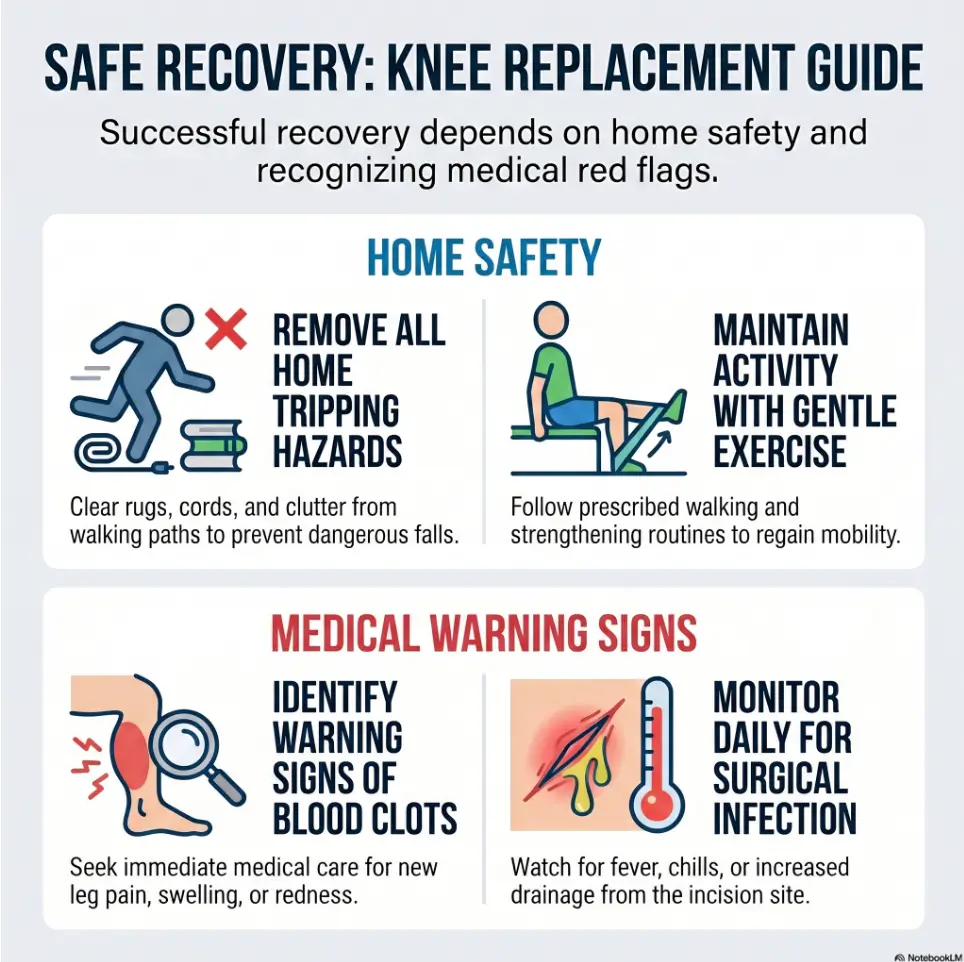
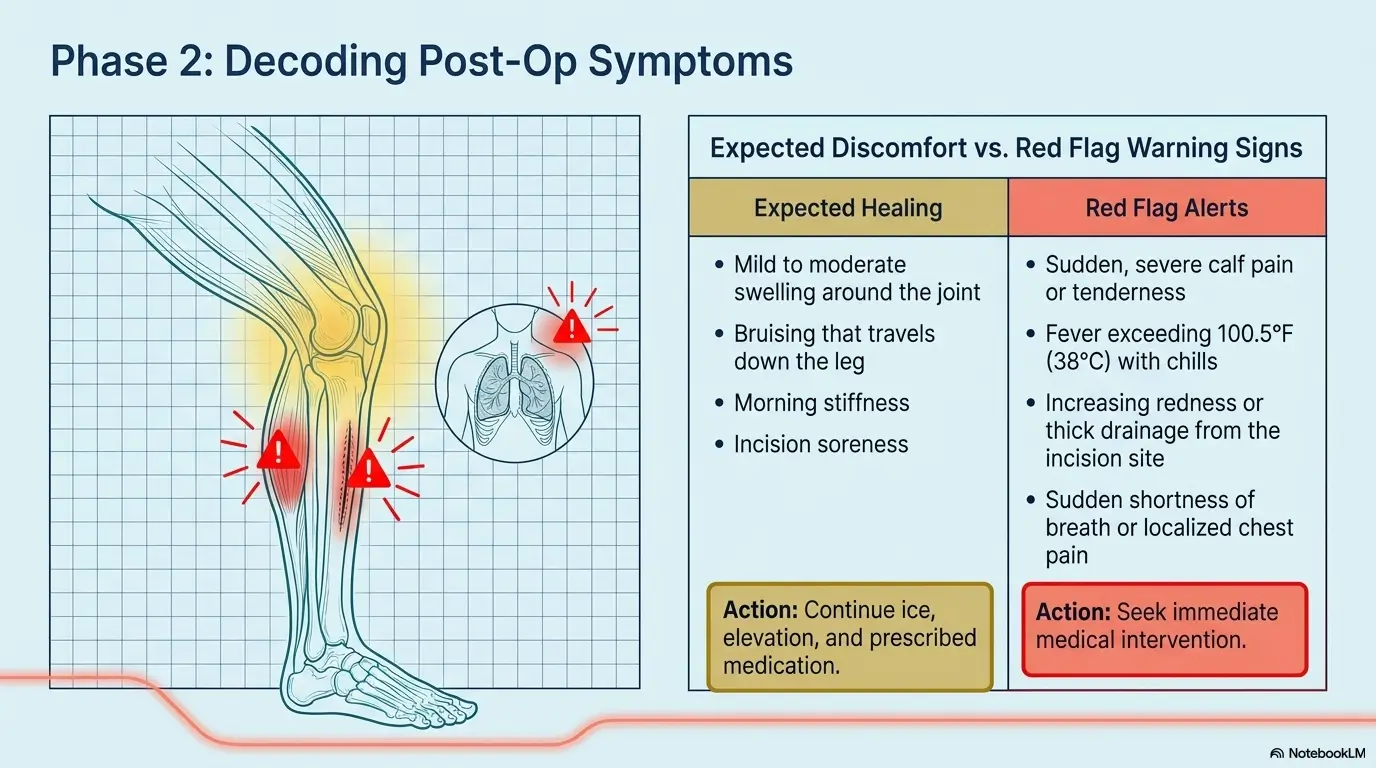
Home setup matters because falls, medication errors, wound problems, infection signs, and blood clot symptoms can become serious after joint replacement. MedlinePlus, a service of the National Library of Medicine, advises preparing the home before knee or hip surgery by removing loose cords and rugs, fixing uneven flooring, and improving lighting. The American Academy of Orthopaedic Surgeons also lists warning signs after knee replacement, including persistent fever, chills, wound drainage, increasing redness, calf pain, swelling, shortness of breath, and chest pain.
Use this article as a practical room-planning companion. Use the medical instructions from the care team as the authority. The nightstand can be clever. It should not freelance as a doctor in a wooden costume.
First Night Home: Build the Nightstand Around the Hardest Moment
Why the 2 a.m. bathroom trip deserves top billing
The first night home is rarely elegant. Pain medicine may cause grogginess. The operated leg may feel heavy. The knee may be stiff from lying still. The bathroom suddenly seems farther away, as if someone moved it to the next ZIP code.
That is why the nightstand should be designed around the hardest moment, not the neatest daytime version of recovery. Daytime walking with a caregiver nearby is one thing. Nighttime walking in low light, half awake, with a sore knee is a different animal entirely.
Put the nightstand on the side that allows the patient to reach important items without twisting across the body. If the stronger arm or easier turning direction is on the right, set up the main reach zone there. If the bed layout forces the opposite side, compensate with a bed rail, overbed table, or second small surface, if approved and safe.
Put the “grab zone” on the stronger, easier-to-reach side
The grab zone is the top 12 to 18 inches of the nightstand: the area the patient can reach while lying down or sitting at the edge of the bed. This is prime real estate. Treat it like Manhattan with a knee brace.
Only daily, urgent, or nighttime items belong there. A phone, water bottle, glasses, lamp control, tissues, and medication log earn their place. A mystery stack of mail, three novels, old cough drops, and a decorative ceramic bird do not.
The tiny test: can they reach it without twisting?
Before surgery, have the patient sit and lie in the bed as they will after coming home. Ask them to reach for the phone, water, lamp, and tissues. If they twist, lean hard, or push through the operated side awkwardly, move the item.
This test takes less than five minutes and often reveals the real problem. The table is too far back. The lamp switch is behind the shade. The charger cord is too short. The water bottle falls over. The drawer handle requires bending. Recovery loves to hide inside these tiny details.
- Place essentials on the easiest side to reach.
- Test reach while sitting and lying down.
- Keep the first two steps from bed completely clear.
Apply in 60 seconds: Move the phone, water, and lamp control until all three can be reached without twisting.
Who This Is For: Match the Setup to the Recovery Reality
Best fit: patients using a walker, cane, ice machine, or medication schedule
This setup is especially useful for anyone coming home with a walker, cane, cold-therapy machine, compression device, wound instructions, or a scheduled medication plan. That combination creates a bedside command center whether anyone planned it or not.
The article also fits people recovering in an apartment, small bedroom, guest room, or temporary downstairs sleep space. If the whole home needs a wider recovery rethink, pair this bedside plan with a broader knee replacement apartment setup so the bedroom, bathroom, and walking routes work as one system.
Caregiver fit: spouses, adult children, and home helpers setting up the room before discharge
Caregivers often do heroic work in quiet increments: filling water, checking the log, locating the remote, moving the walker six inches, and preventing the pillow mountain from colonizing the floor. This guide gives that invisible work a structure.
The best time to set up the nightstand is before discharge day. After surgery, the patient may be tired, sore, and mentally foggy. That is not the ideal hour to debate charger geography.
Not enough: when the person lives alone without safe mobility support
A better nightstand cannot solve unsafe transfers, severe weakness, confusion, or the inability to reach the bathroom safely. If the patient lives alone and cannot reliably get in and out of bed, walk with the recommended device, manage medications, or call for help, the discharge plan needs more support.
That may mean asking the care team about home health, a short rehabilitation stay, caregiver shifts, or equipment changes. A nightstand can reduce friction. It cannot catch a fall from across the room wearing tiny wooden shoes.
Money Block: Bedside Setup Eligibility Check
Use this setup if most answers are “yes.”
- Can the patient sit at the edge of the bed without severe dizziness?
- Can the patient reach the nightstand without twisting or bending low?
- Can the walker or cane be parked within safe reach?
- Can medications be tracked by time and dose?
- Can the path to the bathroom stay clear overnight?
One-line next step: If any answer is “no,” ask the discharge team or physical therapist what needs to change before the first night home.
The Safe-Reach Map: What Belongs on the Nightstand, Not Across the Room
Top shelf items: phone, water, glasses, remote, lamp switch, tissues
The top of the nightstand should serve the first minute after waking. Keep it simple:
- Phone with emergency contacts saved and visible.
- Long charger secured to the wall or back of the nightstand.
- Water bottle with a closed lid or straw, if allowed.
- Glasses in a bright case or shallow tray.
- Tissues and a small trash bag or lined container.
- Lamp switch, touch lamp, or remote light control.
- Medication log and pen.
Use a shallow tray with raised edges so items do not slide behind the table. A tray also tells helpers, “This is the system.” Without a tray, the nightstand becomes a tiny museum of panic.
Medication zone: use the surgeon-approved plan, not bedside improvisation
Medication organization should follow the discharge plan exactly. Some patients may use a pill organizer. Others may need original bottles, especially when instructions are changing or when controlled medications are involved. The pharmacist’s instructions matter here.
Keep only the current recovery medications in the bedside zone. Old prescriptions, leftover muscle relaxers, random over-the-counter sleep aids, and “I think this was from my back thing in 2021” bottles should not be mixed into the recovery station.
For broader pain tracking and appointment communication, a functional pain assessment can help patients describe what pain prevents them from doing, not just how dramatic the number feels on a bad night.
Paper zone: discharge instructions, pain log, emergency contacts, PT schedule
Paper is not glamorous, but after surgery it can save arguments, calls, and guesswork. Keep a folder or clipboard near the nightstand with:
- Discharge instructions.
- Medication schedule.
- Surgeon and after-hours phone numbers.
- Physical therapy appointment times.
- Wound-care instructions.
- Insurance card and pharmacy information.
Use large print when possible. A medication log written in tiny handwriting at midnight is basically a puzzle box with legal implications.
The Bedside Safety Map
Phone, water, glasses, light control, tissue, medication log.
Extra gauze, charger backup, snacks if approved, spare socks.
No cords, rugs, slippers, pets, laundry, stools, or loose pillows.
Handles facing patient, stable, close enough to stand safely.
Plain-English rule: the nightstand holds reach items; the floor holds nothing important.
Do Not Stack the Table: A Crowded Nightstand Can Become a Recovery Booby Trap
Why too many bottles, gadgets, and books create fumbling risk
Recovery rooms often collect supplies the way kitchen drawers collect rubber bands. One day it is a water bottle and phone. By day three, it is seven pill bottles, two snack wrappers, a remote, wound tape, a thermometer, lip balm, a paperback, a receipt, and one mysterious cap that belongs to nothing.
Clutter matters because the patient may be reaching while tired, sore, medicated, or wearing glasses with one lens smudged by fate. If they knock over a bottle, lean to catch it, or step around dropped items, the nightstand has stopped helping.
Use one tray, one bin, and one “not tonight” basket
Try this three-part system:
- One tray: urgent, reachable items only.
- One bin: backup supplies near the bed but off the floor path.
- One “not tonight” basket: books, mail, extra gadgets, and nonurgent items.
The “not tonight” basket is oddly powerful. It lets you remove clutter without turning the room into a courtroom. Nothing is thrown away. It is simply demoted from emergency status.
Let us be honest: the nightstand is not a pharmacy warehouse
If every possible item lives on the table, the patient cannot quickly identify what matters. A clean surface reduces search time and lowers the chance of grabbing the wrong bottle, cord, or remote.
For home equipment beyond the nightstand, use a separate planning list, such as orthopedic home care equipment, so the bedside does not become the overflow closet for the entire recovery operation.
Money Block: One-Tray Bedside Decision Card
| Item Type | Best Place | Why It Helps |
|---|---|---|
| Needed during the night | Top tray | Fast reach without twisting |
| Needed once daily | Side bin or dresser | Reduces clutter |
| Nice but not urgent | Not-tonight basket | Protects the reach zone |
Neutral action line: Remove three nonurgent items from the nightstand before the patient’s first evening home.
Cord Control: The Boring Detail That Prevents the Scary Trip
Anchor phone chargers before surgery day
A long charger is helpful only if it does not cross the walking path. Use cord clips, painter’s tape, a cable sleeve, or furniture placement to route the cord behind the nightstand and along the wall.
Leave enough slack for the phone to rest on the tray, not on the floor. A phone on the floor creates a bend-and-reach situation. After knee replacement, the floor is not a filing cabinet.
Keep ice-machine tubing and power cords out of the walker path
Cold-therapy machines can be useful when prescribed or recommended, but the tubing and power cord need a route. Place the machine on the side opposite the walking path when possible, and keep tubing from looping near the patient’s feet.
If the patient also uses a wedge pillow, elevation cushion, or bed rail, check how all pieces interact. A wedge pillow after surgery may help positioning, but it should never push cords, blankets, or pillows into the standing zone.
Use a lamp switch that does not require leaning or reaching behind furniture
A touch lamp, remote-controlled plug, large rocker switch, or voice-controlled light can reduce reaching. The best switch is the one the patient can operate while calm, tired, and not fully awake.
Do not do this: running a cord across the bedroom walkway
No cord should run from the nightstand to an outlet across the walking route. Not a charger. Not a lamp. Not an ice machine. Not the beloved gadget that allegedly “only takes two seconds.”
Those two seconds are exactly when a sleepy patient turns, steps, catches a toe, and meets gravity’s legal department.
Lighting Strategy: Make the Room Navigable Before Pain Medication Gets Involved
Add a low night light from bed to bathroom
Lighting should show the path without blasting the patient awake. Use low night lights along the route from bed to bathroom, especially near turns, thresholds, and the bathroom entrance.
Do not rely on a bright overhead light alone. Sudden brightness can be disorienting. It can also wake a caregiver who then pops up like a startled prairie dog, which is not dangerous but does add drama.
Choose soft lighting that does not blind half-awake eyes
Warm, low lighting usually works better than harsh blue-white lighting at night. The point is not interior design perfection. The point is seeing the walker, the floor, the bathroom door, and the dog who thinks recovery is a group project.
Put the main light control within reach, not behind the patient
The main bedside light should turn on without leaning behind furniture. If the switch is on the wall across the room, add a lamp, remote plug, or reachable switch. If the patient has to stand in the dark to turn on the light, the system has failed its first exam.
The 10-second darkness test before surgery
At night, turn off the main lights. Let your eyes adjust. Then walk from the bed to the bathroom using the planned night lights. Watch for dark patches, shiny floors, rug edges, cords, and furniture corners.
Fix the first hazard you notice. Then repeat the test. This is the kind of unglamorous preparation that makes recovery feel less like improvisational theater.
Show me the nerdy details
Nighttime fall risk rises when several small factors stack together: low light, medication-related drowsiness, pain, urgency to reach the bathroom, reduced knee range of motion, and obstacles in the first few steps from bed. The nightstand setup works best when it reduces cognitive load. That means fewer visible choices, stable item locations, high-contrast objects, no floor clutter, and a single predictable route. The system is not only physical; it is behavioral. When the same items live in the same places every night, the patient uses less attention searching and more attention moving safely.
Medication Station: Keep It Clear Without Turning the Bedside Into a Pill Puzzle
Separate scheduled meds from “as needed” items if the care team allows it
After knee replacement, medication instructions may include scheduled pain medicine, blood clot prevention medication, stool softeners, antibiotics in some cases, or other prescriptions depending on the patient. Follow the discharge plan. Do not combine, skip, restart, or substitute medications without medical guidance.
If the care team approves, separate scheduled medications from “as needed” items. Use labels that are simple and large: “Morning,” “Bedtime,” “As directed,” or “Ask before taking.” Avoid clever coding systems that require a legend. Recovery brains do not need a treasure map.
Add a simple written log for time, dose, pain level, and side effects
A medication log can prevent double dosing, missed doses, and foggy arguments. Keep it extremely simple:
- Time taken.
- Medication name and dose.
- Pain level before or after, if useful.
- Side effects such as nausea, dizziness, constipation, or unusual sleepiness.
- Initials of the person who gave or took it.
For longer recovery planning, pair this with joint replacement pain management guidance so the patient can discuss pain patterns more clearly at follow-up visits.
Keep water and a small snack nearby only if approved
Some medications may be easier on the stomach with food, but the care team’s instructions should lead. If a snack is allowed, keep it simple: crackers, applesauce cup, or another approved option that does not require refrigeration or kitchen wandering.
Mistake to avoid: mixing old medications with new discharge prescriptions
Do not leave older pain pills, sleep aids, or leftover prescriptions beside the bed. Mixing old and new medications can create confusion and risk. If unsure what belongs in the current plan, call the pharmacist or care team.
Money Block: Mini Medication Log Template
| Time | Medication | Pain / Notes |
|---|---|---|
| 7:00 a.m. | As prescribed | Pain 4/10, mild nausea |
| 1:00 p.m. | As prescribed | Pain 5/10 after PT |
| 9:00 p.m. | As prescribed | Ready for sleep |
Neutral action line: Print or handwrite one page before surgery and keep it on a clipboard beside the bed.
- Keep current prescriptions separate from old bottles.
- Use a written time-and-dose log.
- Ask the pharmacist or care team before changing anything.
Apply in 60 seconds: Put old medications in a separate, clearly marked location away from the recovery nightstand.
Ice, Elevation, and Swelling: Make Comfort Easy Without Blocking Movement
Where to place the ice machine, gel packs, or cold-therapy supplies
Cold therapy may be part of the recovery plan, depending on the surgeon’s instructions. If using an ice machine, place it on a stable surface near the bed but outside the walking path. The cord and tubing should run away from the patient’s feet.
If using gel packs, keep them in a cooler only if that is safe and practical, or have a caregiver swap them from the freezer. Do not ask the patient to shuffle to the kitchen at night for ice unless the care team says they are safe to do so. Midnight freezer missions have a way of becoming tiny expeditions with poor footwear.
Keep elevation pillows nearby, not on the floor
Elevation tools should be easy to position, but they should not live on the floor where the patient steps. A nearby chair, bench, or clean side surface works better. If using a wedge, make sure it does not force the knee into a position the care team discouraged.
If the patient is deciding between cold and heat for discomfort, the article on heating pad vs ice wrap can help frame the conversation, though post-surgical instructions should always override general comfort habits.
Protect bedding from condensation and leaks
Use a towel or waterproof pad under cold-therapy equipment if recommended and safe. Check for leaks before bedtime. Wet bedding can lead to cold discomfort, skin irritation, or a late-night linen change that nobody requested.
The open loop: comfort tools only help if they are reachable safely
An ice machine placed perfectly for cooling but poorly for walking is not a win. The bedside comfort system must support two goals at once: less pain and safer movement. If those goals compete, safety wins.
Short Story: The Charger That Moved Six Inches
Marilyn came home after knee replacement with a bedroom that looked beautifully prepared. Fresh sheets. New tray. Water bottle. Remote. A cheerful little plant that seemed emotionally committed to optimism. But at 1:40 a.m., she reached for her phone and found the charger cord pulling tight behind the nightstand. She leaned, then stopped. Her daughter had taped a note to the tray: “No heroic reaching.”
The next morning, they moved the nightstand six inches forward, clipped the cord to the back edge, and parked the walker closer to the mattress. Nothing expensive changed. No miracle product arrived in a glossy box. But the room became calmer. Marilyn could reach the phone without twisting, turn on the lamp without leaning, and stand without stepping over the cord. The practical lesson is almost annoyingly small: recovery safety often improves by inches, not inventions.
Walker Parking: The Nightstand Setup Is Useless If the Walker Is in the Wrong Place
Park the walker where the patient naturally stands up
The walker should be positioned where the patient will actually use it, not where it looks tidy in the room. Handles should face the patient. The walker should be close enough to reach after sitting up, but not so close that it blocks leg movement or becomes a shin trap.
If the patient is also learning how to carry items safely, the guide on how to carry a plate with a walker pairs well with bedside planning because both topics involve the same principle: keep hands, balance, and the walking path protected.
Keep the brake-free, wheel-free side path clean
Many standard walkers do not have brakes. Some rollators do. Either way, the parking spot should be stable. Avoid leaning the walker against the bed at an angle or leaving it tangled with blankets, cords, slippers, or tubing.
Avoid low stools, baskets, pets, and laundry near the bed
The first two steps from bed should be sacred territory. No baskets. No footstools. No decorative trunks. No laundry. No pet bed. No shoes arranged like a tiny obstacle parade.
If the patient also needs bathroom modifications, a safe bedroom setup should connect to the bathroom plan. A toilet seat riser height check can prevent a difficult sit-to-stand transfer from becoming the weak link in the nighttime route.
Pattern interrupt: the walker needs a “parking spot,” not a vague neighborhood
Mark the walker spot with painter’s tape if needed. That may sound excessive until three helpers move it three different ways in one evening. A clear parking spot keeps everyone from inventing a new layout every time they enter the room.
- Park it where standing begins.
- Keep handles facing the patient.
- Protect the first two steps from clutter.
Apply in 60 seconds: Place tape on the floor to mark the walker’s overnight parking spot.
Common Mistakes: Small Bedside Choices That Make Recovery Harder
Mistake 1: placing essentials on the operated-knee side when reach is limited
Some patients can reach comfortably on either side. Others cannot. The operated side may feel awkward, especially early on. Test real movement instead of guessing from room symmetry.
Mistake 2: keeping the phone charger behind the bed
If the patient has to fish behind the bed for the charger, it is in the wrong place. Secure it so the phone always returns to the tray.
Mistake 3: using a deep drawer for urgent items
Drawers hide things. Deep drawers hide things with confidence. Keep urgent items visible and shallow.
Mistake 4: storing pain meds without a written schedule
A written schedule helps patients and caregivers avoid double dosing or missed doses. If medication instructions feel unclear, call the pharmacist or surgeon’s office.
Mistake 5: leaving throw rugs, slippers, or cords near the first step
Loose rugs and cords are classic trip hazards. Slippers can help only if they fit securely and have safe soles. Floppy slippers near the bed are not footwear; they are soft little ambushes.
Mistake 6: assuming daytime mobility equals nighttime safety
Patients may walk well at 2 p.m. and still be unsafe at 2 a.m. Pain, stiffness, urgency, darkness, and medication effects change the equation.
For larger mobility planning, walker pain management for seniors can help families think through comfort, posture, and pacing beyond the bedroom.
Money Block: Bedside Hazard Scorecard
Give each item one point. A score of 3 or more means the room needs a reset before bedtime.
- Any cord crosses the walking path.
- The walker is not reachable from the bed edge.
- The lamp cannot be turned on from bed.
- Urgent items are inside a deep drawer.
- There is a rug, slipper, basket, or pet bed near the first step.
- Medication times are not written down.
Neutral action line: Fix the highest-risk point first: cords, walker position, or lighting.
When to Seek Help: Red Flags That Do Not Belong in a Blog Checklist
Call the surgeon or care team for worsening wound redness, drainage, fever, or chills
Some discomfort, swelling, and fatigue can be expected after knee replacement, but worsening wound redness, warmth, drainage, persistent fever, or shaking chills should be reported promptly. Infection signs need medical attention, not bedside optimism.
Ask urgently about calf pain, unusual swelling, or sudden shortness of breath
Blood clot risk can increase after knee replacement. Calf or thigh pain, tenderness, one-sided swelling, sudden shortness of breath, chest pain, fainting, or coughing blood should be treated as urgent. Follow the care team’s emergency instructions.
Get help if the patient cannot safely get in or out of bed
If the patient cannot stand safely, becomes confused, has repeated dizziness, or nearly falls, the home plan needs review. Call the surgeon’s office, discharge nurse, home health team, or physical therapist. A safer setup may require equipment changes, caregiver coverage, or a different sleeping location.
Call emergency services for chest pain, breathing trouble, fainting, or severe sudden symptoms
Do not wait for morning if symptoms are severe or sudden. Chest pain, breathing trouble, fainting, signs of stroke, heavy bleeding, or a serious fall belong in emergency territory.
Caregiver Setup: How to Make the Nightstand Work When You Are Not in the Room
Label the tray so helpers do not rearrange the system
Caregivers often have different instincts. One person moves the phone to the charger. Another puts medications in the drawer. Someone else clears the tray because it looks “messy.” By nightfall, the system has been edited by committee.
Use simple labels: “Phone returns here,” “Medication log stays here,” “Walker parks here,” and “Do not move overnight.” This is not bossiness. It is choreography.
Put emergency numbers in large print
Print the surgeon’s office number, after-hours number, pharmacy, primary caregiver, and emergency contact. Put the page in a clear sleeve or tape it near the nightstand where it does not block anything.
If the patient is preparing for follow-up, an orthopedic appointment checklist can help organize medication questions, pain notes, swelling changes, and mobility concerns before the next visit.
Create a morning reset: refill water, clear trash, confirm medication log
The nightstand should reset every morning. Refill water. Remove trash. Check whether tissues, pen, and log are still present. Confirm the phone charger still reaches the tray. Put the walker back in its parking spot after cleaning or bed-making.
This two-minute reset keeps the room from slowly sliding into chaos. Recovery clutter rarely arrives with a marching band. It sneaks in wearing socks.
The dignity detail: make help visible without making the room feel clinical
A recovery room should feel safe, not institutional. Use a nice tray, a calm lamp, a clean bin, and labels that are practical rather than scolding. The patient is healing, not checking into a warehouse.
Good setup protects independence. It lets the patient do small things without calling for help every four minutes. That matters emotionally as much as physically.
- Use large labels for key zones.
- Post emergency numbers where they are easy to read.
- Reset the tray every morning.
Apply in 60 seconds: Write “Phone, water, light, log” on a sticky note and place it on the tray edge.
FAQ
What should be on a nightstand after knee replacement?
Keep the essentials within easy reach: phone, secured charger, water, glasses, tissues, lamp control, medication log, pen, emergency contacts, and current discharge instructions. Avoid crowding the surface with extra bottles, books, chargers, or supplies that are not needed overnight.
Which side of the bed should the nightstand be on after knee surgery?
Place the main nightstand on the side the patient can reach most safely without twisting, bending, or leaning across the body. This may be the stronger side, the side opposite the operated knee, or simply the side that works better with the room layout and walker position.
Should pain medication be kept on the nightstand after knee replacement?
Only if the discharge instructions, pharmacist, and caregiver plan support that setup. Medications should be clearly organized, current, and tracked with a written log. Do not mix old prescriptions with new surgery medications. If there is any confusion, call the pharmacist or care team.
How can I prevent falls at night after knee replacement?
Secure cords, remove throw rugs, add low night lights, park the walker in a consistent spot, keep the first two steps clear, and place essentials within reach from bed. Test the route to the bathroom before surgery or before the first night home.
Where should I keep a walker beside the bed?
Park the walker where the patient naturally stands up, with the handles facing them and the legs stable. It should be close enough to reach safely after sitting up, but not so close that it blocks the operated leg, bedding, or first step.
Is an ice machine safe to keep near the bed?
It can be safe when used according to medical instructions and placed correctly. Keep the machine stable, route tubing away from the feet, secure the power cord, and protect bedding from leaks or condensation. Do not let cold-therapy equipment block the walking path.
What should caregivers check every morning?
Caregivers should refill water, clear trash, confirm the medication log, check that the charger reaches the tray, return glasses and phone to the same place, inspect the walking path, and make sure the walker is parked correctly.
When should I call the doctor after knee replacement recovery at home?
Call the care team for worsening wound redness, drainage, fever, chills, increasing pain, unusual swelling, calf or thigh pain, dizziness, medication problems, or trouble moving safely. Call emergency services for chest pain, breathing trouble, fainting, severe sudden symptoms, or a serious fall.
Conclusion: Do the Three-Reach Test Before Surgery Day
The nightstand after knee replacement is not just furniture. It is the patient’s first control panel for the hardest hours: waking in pain, needing the bathroom, checking the medication schedule, finding the phone, turning on the light, and standing safely.
The good news is that the best changes are small. Move the charger. Clear the floor. Add a night light. Label the tray. Park the walker with intention. Put the medication log where it will actually be used. Recovery does not need a luxury command center. It needs a calm little dock where the important things return, night after night.
Here is the 15-minute next step: sit on the bed and reach for the phone, water, and light without twisting. Then stand with the walker and check the first two steps. Finally, walk the route to the bathroom with the lights low. Fix the first problem you find before midnight turns it into an obstacle course.
Last reviewed: 2026-05.