

Is Post-Surgery Recovery Still Matching the Discharge Plan?
The first sign is often not dramatic. It is the untouched soup in the refrigerator, the walker parked too far from the bed, the pill bottle that seems fuller than it should be. After surgery, families often look for one obvious emergency. But the real question is usually quieter.
Signs your parent needs more help after surgery can include worsening pain, confusion, wound changes, missed medications, unsafe walking, poor eating or drinking, bathroom problems, or daily tasks becoming suddenly too hard. Some changes call for a better family care plan. Others call for the surgeon, home health, urgent care, or emergency services.
“Guessing is expensive. It costs sleep, safety, dignity, and sometimes a preventable hospital trip. This guide helps you sort the gray zone faster, using the discharge plan, symptom patterns, and practical caregiver checks instead of panic math at 11:47 p.m.”
What This Guide Helps You Achieve:
- Spot post-surgery red flags without turning every twinge into an alarm bell.
- Decide whether your parent needs family help, home health, urgent evaluation, or 911.
- Build a simple recovery log that makes doctor calls clearer.
- Protect your parent’s independence while still taking safety seriously.
Caregiver Recovery Snapshot
The safest question is not “Is my parent okay?” It is “Is today’s reality matching the written discharge instructions?”
If pain, medication timing, wound appearance, eating, drinking, walking, bathroom use, or mental clarity are moving in the wrong direction, write it down and call the surgical team’s discharge number. A short, specific call beats a long night of family committee theater.
Table of Contents
Safety and Medical Disclaimer
This guide is caregiver education, not a diagnosis tool. Your parent’s surgeon, discharge nurse, primary care clinician, home health team, or emergency medical services should guide medical decisions.
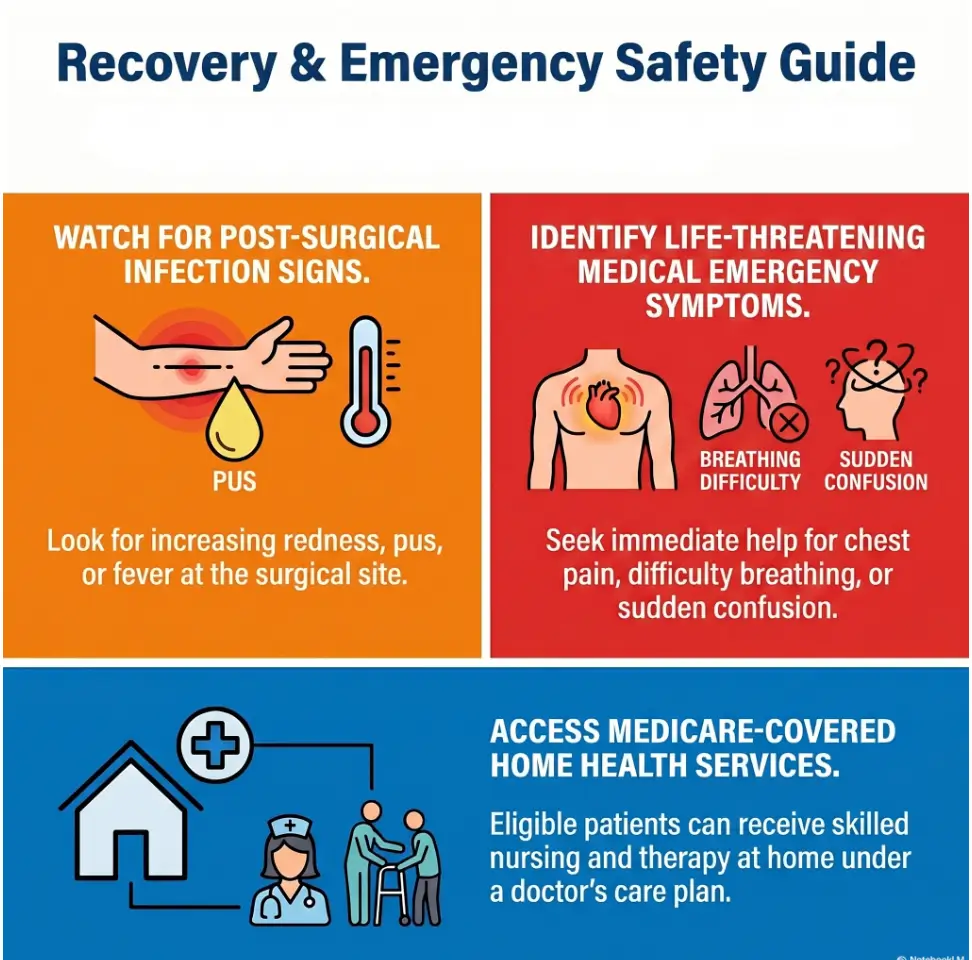
Follow the written discharge instructions first. Use the after-hours number from the hospital or surgical team when symptoms do not match the plan. Call emergency services for severe symptoms such as trouble breathing, chest pain, fainting, stroke-like symptoms, uncontrolled bleeding, a severe allergic reaction, or sudden severe confusion.
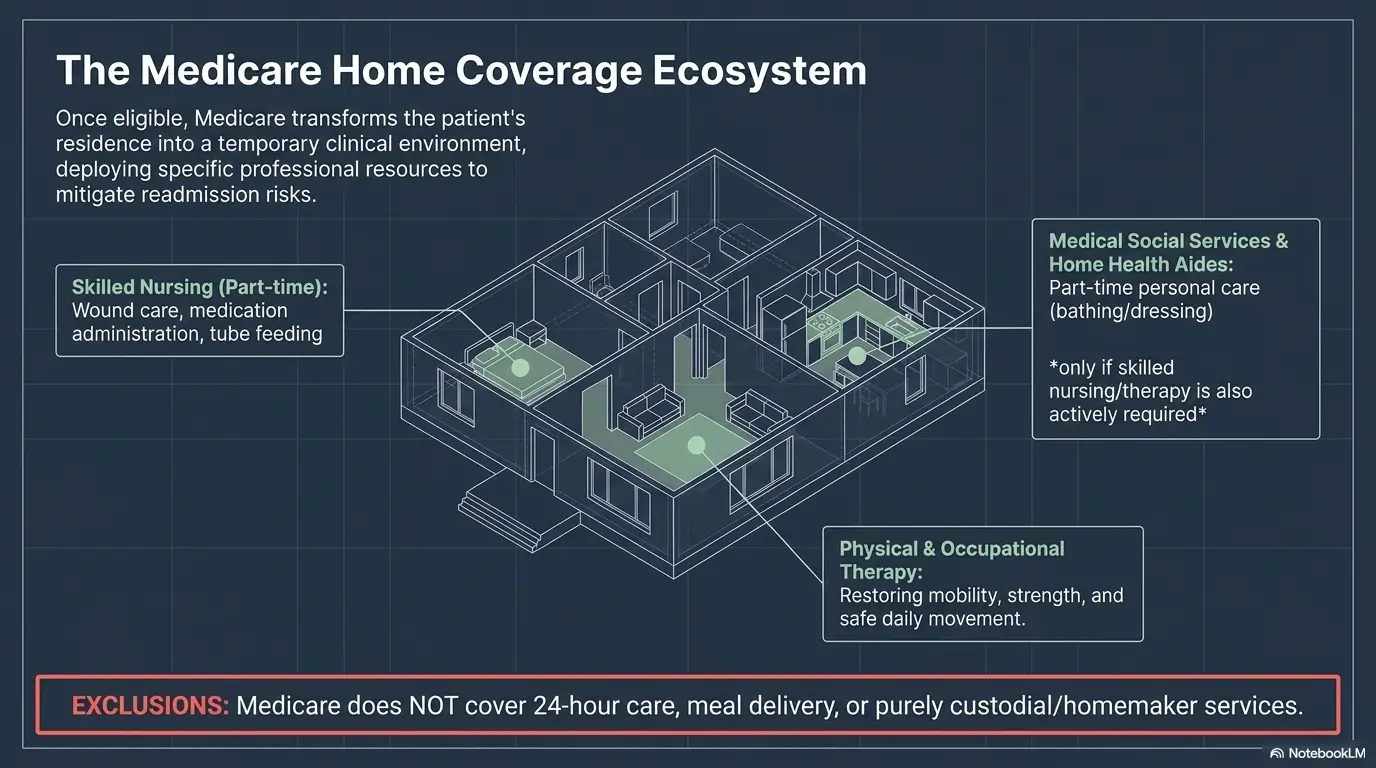
Medicare describes home health as care that may include skilled nursing, wound care, therapy, patient and caregiver education, injections, and monitoring when a patient meets coverage rules. That is different from long-term custodial help with daily living. Knowing the difference can save time, money, and three family text threads that all end with “Wait, who is calling the doctor?”
The Quiet Clue: Recovery Is Not Following the Discharge Plan
Discharge papers are not decorative paperwork. They are the map back to ordinary life. After surgery, “normal” recovery is not perfect recovery. It is a general direction: pain should become more manageable, movement should slowly improve, eating and drinking should resume, and follow-up instructions should make sense in daily life.
When your parent’s recovery stops matching that map, pay attention. The mismatch may be small at first. Maybe the pain medicine schedule is confusing. Maybe your parent stopped walking to the kitchen. Maybe the wound care instructions are still folded in the hospital folder, living a quiet life under a grocery receipt.
The “normal recovery” checklist suddenly stops matching reality
Compare the discharge plan against what is happening today. Do not rely only on how your parent says they feel. Look at function.
- Is pain improving, stable, or getting worse?
- Can your parent walk the recommended amount or move safely around the home?
- Are they eating, drinking, and using the bathroom in a reasonable pattern?
- Is the wound care happening exactly as instructed?
- Are medications being taken at the right dose and time?
- Are follow-up appointments scheduled and reachable?
If the answer is “not really” in two or more areas, it is time to organize help. That may mean family shifts, a call to the surgical team, a home health referral discussion, or a safer home setup.
When small deviations become a pattern
One missed snack may not matter. Missed meals plus dizziness plus stronger pain medicine is different. A little soreness may be expected. New swelling plus less movement plus shortness of breath needs a call. Recovery trouble often arrives as a cluster, not a trumpet blast.
Think in pairs and trios. Confusion plus missed medications. Constipation plus poor fluids. Weakness plus near-falls. Wound redness plus fever. A pattern is your cue to stop “checking in” casually and start documenting.
- Compare today’s pain, movement, wound care, meals, bathroom use, and medications with the written plan.
- Look for clusters, not just single symptoms.
- Call the surgical team when reality drifts from instructions.
Apply in 60 seconds: Put the discharge papers on the table and circle any instruction your parent cannot follow today.
Here’s what no one tells you…
A parent may say “I’m fine” because they are fine. They may also say it because they fear losing the house, the car keys, the upstairs bedroom, or the right to be treated like an adult. The phrase can be a health update or a shield.
Respect the shield. Then verify function. “Can you show me how you’re getting out of bed?” is kinder and more useful than “Are you sure you’re okay?” The second question invites a performance. The first gathers evidence.
Money Block: 7-Point Recovery Match Checklist
Use this as a yes/no scan after each visit or phone call.
| Check | Yes / No | Next step |
|---|---|---|
| Pain is manageable and not worsening | Yes / No | If no, call the discharge number. |
| Medications are taken correctly | Yes / No | If no, simplify the pill schedule and call if confused. |
| Wound looks as expected in instructions | Yes / No | If no, take a dated photo and contact the care team. |
| Walking and transfers are safe | Yes / No | If no, arrange supervision and ask about therapy. |
| Eating and fluids are adequate | Yes / No | If no, track intake and call if weakness or dizziness appears. |
| Bathroom pattern is reasonable | Yes / No | If no, compare with instructions and report concerning changes. |
| Thinking and mood are close to baseline | Yes / No | If no, call promptly, especially if sudden or severe. |
Neutral action line: If two or more answers are “No,” call the surgical team or discharge nurse before the next full day passes.
Pain That Changes Direction: When “Sore” Becomes a Signal
Post-surgical pain is expected. Escalating, strange, or function-blocking pain deserves attention. The key is direction. Pain that gradually becomes easier to manage is one story. Pain that gets sharper, spreads, prevents walking, interrupts breathing, or keeps your parent from sleeping or eating is another.
A practical tool is a functional pain check. Instead of only asking “What number is your pain?” ask what the pain prevents. If pain blocks bathroom trips, deep breathing, wound care, sleep, or basic movement, it is not just a number. It is a care barrier. For a deeper way to document this, use a functional pain assessment that ties symptoms to daily tasks.
Pain should generally become more manageable, not more mysterious
Call the care team when pain is getting worse instead of better, suddenly changes character, or appears with other symptoms such as fever, swelling, wound drainage, calf pain, chest discomfort, or confusion.
Also call if pain prevents the activity your discharge plan specifically asks your parent to do. For example, after some orthopedic surgeries, gentle walking or physical therapy may be part of recovery. If pain makes that impossible, the plan needs adjustment, not silent heroics.
The medication clue hiding in plain sight
Pain medication can help recovery because movement, sleep, and breathing matter. But pain medicine can also create problems: sleepiness, constipation, dizziness, nausea, confusion, or accidental double dosing. The pill bottle is not a villain. It is a powerful tool that needs a grown-up traffic controller.
Check whether your parent is:
- Taking pain medicine too late, then becoming unable to move.
- Taking more than instructed because pain feels frightening.
- Skipping medication because they fear dependence, side effects, or “bothering people.”
- Mixing medications without understanding timing or duplication.
- Taking pills on an empty stomach when instructions advise food.
If your parent had orthopedic surgery, a broader guide to orthopedic pain management for older adults can help you frame safer questions for the care team.
Don’t do this: “toughing it out” until the follow-up visit
Waiting can turn a fixable problem into a midnight scramble with slippers, panic, and bad coffee. If pain is stopping recovery tasks today, the follow-up appointment next week is not a magic calendar square.
Use plain language when calling: “Pain was a 4 yesterday and is an 8 today. She cannot walk to the bathroom. She took the medication as written. No fever that we know of. What should we do?” That is much better than “She seems bad,” which is emotionally true but clinically foggy.
Wound Changes: The Incision Is Talking, Even If Your Parent Isn’t
Many adult children are reluctant to inspect a parent’s incision. Fair. Nobody prepares you for the emotional oddity of becoming both loving child and bandage detective. Still, wound changes are one of the clearest signs your parent may need more help after surgery.
Follow the discharge instructions for dressing changes, bathing, and what to report. Do not scrub, apply ointments, remove closures, or improvise wound care unless the clinician told you to. The goal is observation, not home-based surgical jazz.
Redness, heat, drainage, odor, or opening deserves attention
Contact the surgical team if the incision becomes more red, warm, swollen, painful, draining pus-like fluid, smells unusual, opens, bleeds more than expected, or appears with fever or your parent feeling suddenly sick.
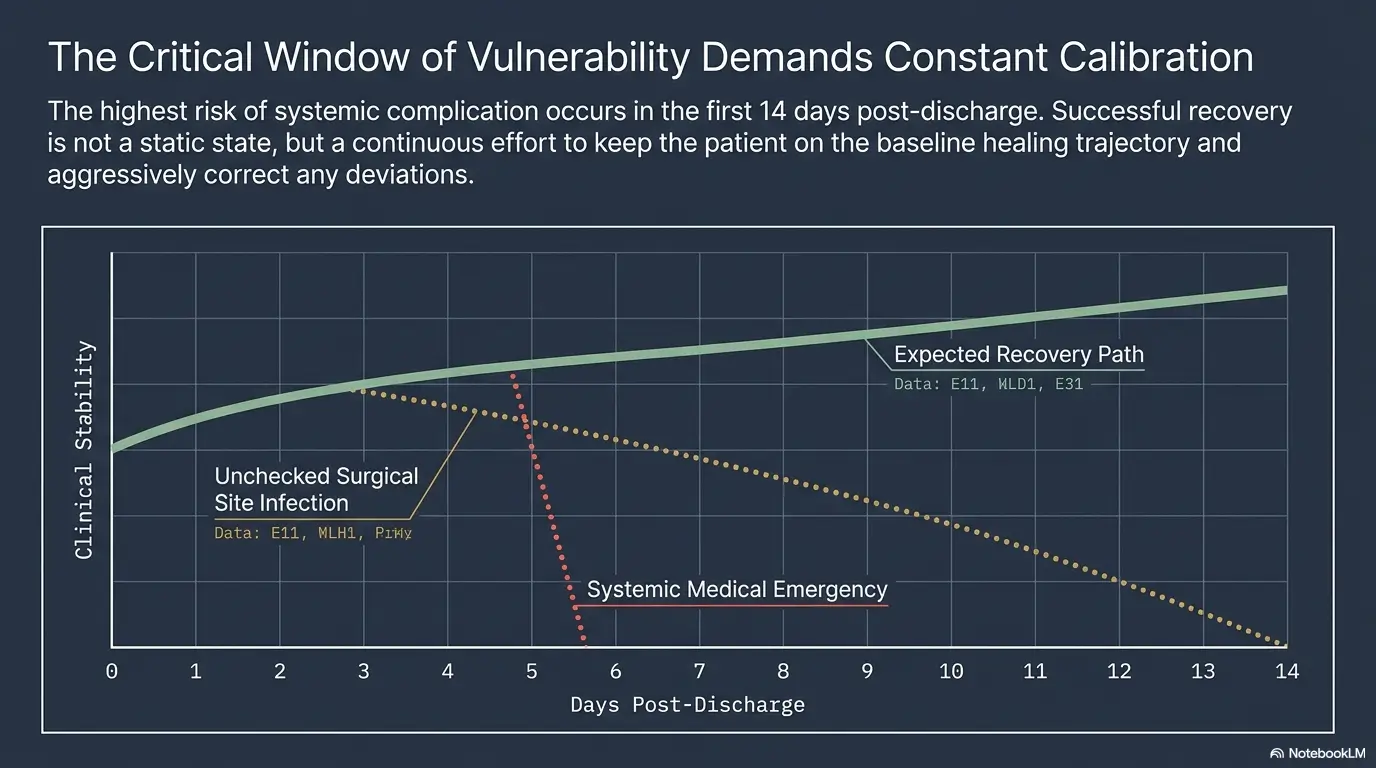
Many surgical wound infections appear within the first month after surgery, though the timeline can vary by procedure and patient risk. That is why “it looked okay yesterday” does not end the conversation today.
The photo habit that helps clinicians
A dated photo can help a nurse or surgeon understand change over time. Use consistent lighting, the same distance, and no dramatic filter. This is not an art-house incision portrait. It is a timeline.
- Wash hands first.
- Take the photo before new dressing is applied, if dressing changes are already allowed.
- Include the date and time in your recovery log.
- Do not poke, squeeze, or clean beyond written instructions.
The bandage trap
A clean-looking bandage does not always mean the wound underneath is stable. A parent may also avoid changing the bandage because looking at the incision makes them uneasy. That avoidance is human, but it can hide problems.
If your parent cannot manage wound care safely, ask the surgical team whether skilled nursing or home health evaluation is appropriate. Wound care is one of the services that may be covered when ordered and medically necessary under home health rules.
Short Story: The Bandage on the Lamp Table
My friend once found her father’s unopened dressing supplies stacked neatly on the lamp table, still in the hospital bag. He had told everyone the incision was “fine.” The room was tidy, the TV was on, and the whole scene looked almost peaceful. But the supplies had not moved in four days. When she asked him to show her the wound care routine, his confidence folded like a paper fan.
He was not being stubborn. He was scared to look at the incision and embarrassed to admit it. She called the discharge nurse, took a dated photo, and arranged help for dressing changes. The practical lesson was not “catch your parent hiding something.” It was softer and more useful: when a task is avoided, ask what makes it hard. Fear often wears the costume of independence.
Confusion After Surgery: Not Just “Getting Older”
New confusion after surgery should not be brushed aside as age. Older adults can be more vulnerable to mental status changes after anesthesia, infection, dehydration, pain, poor sleep, unfamiliar settings, and medication changes.
Confusion can look like fogginess. It can also look like agitation, suspicion, sleep reversal, hallucinations, repeating the same question, or saying things that are oddly out of character. Families often notice before a clinician does because they know the person’s normal rhythm.
New confusion, agitation, sleep reversal, or hallucinations needs a call
Call the surgical team or medical provider if your parent is newly confused, unusually sleepy, difficult to wake, seeing things that are not there, acting suddenly suspicious, mixing up medications, or unable to follow basic instructions.
Call emergency services for sudden severe confusion, fainting, signs of stroke, trouble breathing, chest pain, or any rapid decline. A sudden change in thinking can be a medical warning sign, not a personality problem.
The “they sound different” phone test
Long-distance caregivers have one powerful tool: voice memory. If your parent sounds different on the phone, treat that as data. Listen for unusual pauses, repeated stories, slurred words, strange suspicion, or not tracking the conversation.
Try concrete questions:
- “What did you eat today?”
- “Which medicine did you take this morning?”
- “What time is your follow-up appointment?”
- “Can you read me the first line of your discharge instructions?”
You are not quizzing them for sport. You are checking whether the home recovery system still has lights on.
Let’s be honest…
Families often explain away confusion because naming it feels frightening. It can feel like a door opening to a future nobody wants to enter. But early naming can protect dignity. It lets you adjust medications, fluids, sleep, infection checks, supervision, and follow-up before a small problem becomes a dangerous one.
- Compare your parent’s thinking with their normal baseline.
- Watch for medication mistakes, dehydration, infection signs, and sleep disruption.
- Call urgently for sudden severe confusion or rapid decline.
Apply in 60 seconds: Write one sentence describing what is different: “Today Mom is repeating questions and cannot explain her medication schedule.”
Show me the nerdy details
Caregiver triage works best when it separates baseline, trigger, and function. Baseline means how your parent usually thinks, walks, eats, sleeps, and manages tasks. Trigger means what changed after surgery: anesthesia, new medicines, pain, infection risk, dehydration, limited mobility, or poor sleep. Function means what the change prevents: safe walking, wound care, medication timing, eating, drinking, toileting, or communication. A symptom becomes more urgent when it is new, worsening, paired with other symptoms, or blocking the recovery plan.
Mobility Trouble: The House Becomes an Obstacle Course
After surgery, the house changes personality. The bathroom becomes a cliff. The stairs become a negotiation. The bed becomes a puzzle box. The kitchen floor, previously innocent, begins auditioning as a skating rink.
Mobility trouble is one of the clearest signs your parent needs more help after surgery because it affects everything else: toileting, meals, medication access, wound care, sleep, and fall risk.
Watch the bathroom, stairs, bed, and kitchen
Do not judge mobility only by whether your parent can stand up once while you are watching. Look at repeatable safety. Can they get to the bathroom at night? Can they step into the shower? Can they carry a glass of water while using a walker? Can they get out of bed without twisting or pulling on furniture?
Bathroom setup matters. A safer plan may include grab bars, a shower chair, non-slip surfaces, better lighting, or a raised toilet seat when appropriate. If your parent is recovering from a shoulder procedure, a practical bathroom setup after shoulder surgery can prevent awkward reaches and risky one-handed maneuvers. For hip or knee recovery, the right toilet seat riser height can make transfers less dramatic.
Falls, near-falls, furniture-walking, and fear of standing
Falls are obvious. Near-falls are warnings with better luck. Furniture-walking, sudden fear of standing, or refusing to shower may mean your parent knows something feels unsafe but cannot explain it clearly.
Watch for:
- Grabbing walls, counters, towel bars, or chairs for support.
- Leaving the walker in another room.
- Standing up too quickly and getting dizzy.
- Dragging a foot or shuffling more than before.
- Avoiding the bathroom because getting there is hard.
- Sleeping in a recliner because bed transfers feel impossible.
If your parent is using a walker but still looks unsafe, review walker pain management for seniors and ask the care team whether physical therapy, occupational therapy, or home safety evaluation is needed.
When equipment is not enough
A walker does not solve dizziness. A shower chair does not solve confusion. A reacher does not solve pain that prevents standing. Equipment helps when the problem is mechanical. It is not a magic wand with rubber tips.
If you are deciding what to buy or borrow, start with the tasks your parent cannot do safely. A broad guide to orthopedic home care equipment can help you match tools to real daily activities instead of filling the living room with well-intentioned clutter.
Money Block: Home Safety Decision Card
| If you notice… | Try first… | Escalate when… |
|---|---|---|
| Slow but steady walking | Clear pathways, improve lighting, keep walker close | Walking worsens or pain blocks movement |
| Near-falls or furniture-walking | Supervision, mobility aid review, remove rugs | Any fall, dizziness, confusion, or repeated near-falls |
| Shower or toilet fear | Shower chair, raised seat, caregiver nearby | Parent cannot transfer safely or refuses hygiene |
Neutral action line: Match the support to the unsafe task, then call the care team if equipment does not solve the risk.
Food, Fluids, and Bathroom Changes: The Unflashy Warning Signs
Food, fluids, and bathroom patterns are not glamorous. They are recovery plumbing. When they go wrong, everything else becomes harder: pain control, thinking, walking, medication tolerance, sleep, and wound healing.
After surgery, appetite may be lower for a while. But not eating, not drinking, dizziness, severe nausea, inability to urinate, severe constipation, diarrhea, black stools, or sudden accidents deserve attention.
Not eating or drinking can derail recovery fast
Poor intake can worsen weakness and dizziness. Some medicines upset the stomach. Pain can reduce appetite. Constipation can make food feel impossible. The fix may be simple, but the pattern matters.
Look for signs in the kitchen. Are meals untouched? Are water bottles full? Is the refrigerator still holding the same polite container of soup from three days ago? Is your parent taking medication on an empty stomach when the instructions suggest otherwise?
For shoulder or arm limitations, one-handed meal prep after surgery can make eating less dependent on heroic knife skills. After hip surgery, getting into a car safely for appointments may also affect food and medication pickup; review getting into an SUV after hip surgery if transportation is part of the problem.
Bathroom changes worth tracking
Bathroom patterns are awkward to discuss, which is exactly why problems can hide there. Be direct and respectful.
- “Have you been able to urinate normally?”
- “When was your last bowel movement?”
- “Any black stools, blood, severe diarrhea, or accidents?”
- “Are you avoiding fluids because getting to the bathroom is hard?”
Constipation is common after surgery, especially with reduced movement, pain medicine, and lower fluid intake. But severe constipation, inability to pass urine, uncontrolled diarrhea, black stools, or new leakage should be reported according to the discharge instructions or through the care team.
The kitchen-counter audit
Walk through the kitchen like a detective with manners. Count what changed, not what you wish changed. Full water bottles, untouched meals, expired snacks, and pill bottles near an empty coffee mug all tell a story.
Do not shame your parent. Shame does not hydrate anyone. Instead, turn the audit into a support plan: smaller meals, prepared snacks, water within reach, anti-nausea questions for the clinician, or supervised bathroom trips if mobility is the barrier.
- Poor fluids can worsen weakness and confusion.
- Constipation and nausea can block nutrition and movement.
- Bathroom avoidance may be a mobility problem in disguise.
Apply in 60 seconds: Ask when your parent last ate, drank water, urinated, and had a bowel movement, then write the answers down.
Medication Management: The Pillbox Tells the Truth
Medication mistakes after surgery are common enough to deserve humble respect. A parent who managed pills perfectly for years may still struggle when new prescriptions arrive with temporary dosing, stop dates, pain levels, antibiotics, blood thinners, nausea medicine, and bowel regimens.
The problem is not intelligence. It is system overload. Even a tidy kitchen can become a tiny pharmacy maze.
Missed doses, double doses, and mystery pills
Watch for medication warning signs:
- Pill bottles with unclear labels or duplicate medicines.
- Missed doses because your parent slept through the schedule.
- Double doses because pain or confusion scrambled timing.
- Old medicines mixed with new post-surgery prescriptions.
- Side effects such as dizziness, constipation, nausea, sleepiness, or confusion.
Do not stop or change prescribed medicine without medical guidance unless the discharge instructions specifically say to. If something seems wrong, call the care team, pharmacist, or prescribing clinician.
Build a one-page medication command center
Use one page. Not eight sticky notes, not a family group chat scroll, not “Dad knows.” One page.
| Medication detail | What to write |
|---|---|
| Name | Brand and generic if available |
| Dose and timing | How much, how often, with or without food |
| Reason | Pain, infection prevention, blood clot prevention, nausea, bowel plan |
| Prescriber | Surgeon, primary care, specialist, hospitalist |
| Stop date | Temporary or ongoing |
| Side effects to watch | Dizziness, confusion, constipation, rash, nausea, bleeding concerns |
If your parent has an orthopedic follow-up coming, bring this list. A strong orthopedic appointment checklist can help families ask cleaner questions instead of leaving the clinic and remembering the important thing in the parking lot.
Don’t do this: assume “they’ve handled meds for years” still applies
Surgery changes the system. New medications, pain, fatigue, and multiple prescribers can turn a familiar routine into a chessboard with missing pieces. The safest approach is temporary supervision without treating your parent like a child.
Say: “Let’s make this easier while recovery is messy.” Not: “You can’t handle this.” One sentence preserves dignity. The other lights the family fuse.
Money Block: Medication Call Prep List
Gather these before calling the surgeon, nurse line, pharmacist, or primary care office.
- Medication name, dose, and time last taken.
- Current pain score and what pain prevents.
- Temperature if available.
- New symptoms such as dizziness, rash, nausea, constipation, bleeding, or confusion.
- Whether your parent ate or drank before the dose.
- Any missed or doubled doses.
- Photos of medication labels if you are not with your parent.
Neutral action line: Use the list to make one specific call rather than sending scattered messages to three relatives.
Home Help vs. Medical Help: Know Which Door to Knock On
One of the hardest caregiving decisions is figuring out what kind of help your parent needs. Family support, paid nonmedical care, skilled home health, outpatient rehab, inpatient rehab, urgent care, and emergency care all solve different problems.
Choosing the wrong door wastes time. Choosing the right door can turn a chaotic recovery into a manageable one.
When family support may be enough
Family support may be enough when your parent is medically stable but temporarily needs help with daily life.
- Meal prep and grocery pickup.
- Laundry, dishes, trash, and pet care.
- Transportation to appointments.
- Medication reminders, not complex medical decisions.
- Shower standby assistance if the plan allows it and transfers are safe.
- Note-taking during calls and follow-up visits.
This is practical help. It is casserole logistics. It is not skilled nursing.
When home health may be appropriate
Home health may be appropriate when there is a skilled medical need and a clinician orders it. Depending on eligibility and the plan of care, services may include skilled nursing, wound care, physical therapy, occupational therapy, injections, patient education, caregiver teaching, and monitoring of a serious or unstable condition.
If your parent was discharged without home health but cannot manage wound care, medications, therapy tasks, or safe mobility, call the surgeon or primary care clinician and ask whether a home health evaluation is appropriate.
When paid nonmedical care fills the gap
Paid nonmedical care may help with bathing, dressing, meals, companionship, errands, and supervision. It usually does not replace skilled nursing, physical therapy, wound assessment, or medical monitoring.
Ask agencies exactly what their aides can and cannot do. Can they assist with transfers? Can they remind about medications but not administer them? Can they provide overnight supervision? What happens if your parent falls? Policies matter more than brochure poetry.
Money Block: Coverage Tier Map for Post-Surgery Help
| Tier | Type of help | Best for | Key caution |
|---|---|---|---|
| Tier 1 | Family and friends | Meals, rides, reminders, light chores | Burnout arrives quietly |
| Tier 2 | Paid nonmedical care | Personal care, supervision, errands | Not skilled medical care |
| Tier 3 | Home health | Skilled nursing, wound care, therapy, teaching | Requires eligibility and clinician order |
| Tier 4 | Outpatient rehab or clinic follow-up | Stable patients who can travel safely | Transportation can be the weak link |
| Tier 5 | Urgent or emergency care | Severe, sudden, or dangerous symptoms | Do not delay for convenience |
Neutral action line: Choose the lowest safe tier that matches the actual problem, then escalate if symptoms worsen.
Who This Is For / Not For
This guide is for the uneasy middle. Not the obvious emergency where everyone knows to call 911. Not the smooth recovery where your parent is walking, eating, joking, and following instructions with the calm of a retired air traffic controller.
It is for the family member who feels something is off but cannot yet name it.
This is for adult children noticing “something is off”
You may be comparing normal soreness with warning signs. You may be trying to decide whether to take time off work, hire help, ask about home health, or call the surgeon again without feeling like “that family.”
For the record, “that family” often prevents problems. Polite, specific calls are part of recovery. You are not bothering the system by reporting worsening symptoms, medication confusion, wound changes, or unsafe movement.
This is also for long-distance family members
Long-distance caregiving is detective work through a keyhole. You may notice missed calls, voice changes, skipped follow-ups, untouched grocery deliveries, neighbor concerns, or a parent who says everything is fine but cannot explain the medication schedule.
Ask for specifics. Use video calls when possible. Ask a nearby friend, neighbor, or relative to check the house if your parent sounds confused or unsafe. If severe symptoms appear, call emergency services in your parent’s local area.
This is not for diagnosing a complication at home
This guide does not teach you to diagnose infection, blood clots, medication reactions, dehydration, delirium, or surgical complications. It helps you notice when the home recovery plan is not holding.
Severe symptoms, rapid decline, or uncertainty should go through the surgeon, nurse line, urgent care, or emergency services.
Post-Surgery Help Ladder
Meals, rides, chores, reminders, appointment notes.
Bathing help, supervision, errands, companionship.
Worsening pain, wound concerns, medication confusion.
Skilled needs, therapy, wound care, medical monitoring.
Rapid decline, severe symptoms, breathing trouble, chest pain.
Use the ladder: Start with the safest matching level, not the most convenient one.
Common Mistakes Families Make After Surgery
Families usually do not make mistakes because they do not care. They make them because they are tired, worried, over-scheduled, and trying to respect independence while also preventing disaster. That is a lot to hold before breakfast.
Mistake 1: Trusting the “I’m fine” script too quickly
Independence deserves respect. It also deserves a reality check. Ask your parent to demonstrate key tasks: standing, walking to the bathroom, opening medication bottles, explaining wound care, and getting food.
Verify function without turning the visit into a courtroom drama.
Mistake 2: Waiting until the post-op appointment
Follow-up appointments matter, but new fever concerns, worsening pain, wound changes, confusion, falls, medication mistakes, or inability to eat or drink may need action sooner.
If you are unsure whether a symptom can wait, that is exactly why discharge numbers exist.
Mistake 3: Helping without documenting
A simple log can prevent family arguments and help clinicians see patterns. It also keeps the loudest relative from becoming the official historian by volume alone.
Track pain, temperature, wound appearance, medications, meals, fluids, bathroom habits, walking distance, sleep, mood, and questions. Keep it boring. Boring records are often the most useful records.
Mistake 4: Ignoring caregiver burnout
If one person becomes the entire care plan, the plan has a single point of failure. That person may be you. You may be noble, capable, and running on crackers.
Build shifts. Assign jobs. Let one person handle medication documentation, another meals, another appointment transportation, another insurance calls. If your parent’s recovery requires more than family can safely provide, ask about home health, rehab, or paid support.
- Verify function instead of relying only on reassurance.
- Call before the follow-up visit if symptoms move in the wrong direction.
- Spread caregiving tasks before one person breaks.
Apply in 60 seconds: Send one family message assigning three jobs: meals, medications, and appointment notes.
When to Seek Help: The Call, Clinic, Urgent Care, or 911 Ladder
The hardest part of caregiving is not caring. It is choosing the right next action while your nervous system is playing cymbals. Use a ladder.
Call the surgeon or discharge number
Call the surgeon, discharge nurse, or after-hours number for symptoms outside the discharge instructions, including worsening pain, wound changes, fever concerns, medication confusion, poor intake, severe constipation, nausea, new weakness, falls, near-falls, or confusion.
Use a concise script:
“My parent had surgery on [date]. The discharge plan says [instruction]. Today we’re seeing [specific change]. Pain is [number] and function is [what they cannot do]. Medications were taken [how]. What should we do next?”
Consider urgent care or same-day medical evaluation
Use urgent care or same-day evaluation when symptoms are concerning but not clearly life-threatening, especially if the surgical team advises it. Depending on the surgery, the surgeon may prefer you go to a specific emergency department or contact their office before urgent care.
If you are choosing between urgent care and an orthopedic clinic for a post-surgical concern, urgent care vs. orthopedic clinic can help you think through the trade-off, though the surgical team’s instructions should come first.
Call 911 for emergency warning signs
Call emergency services for trouble breathing, chest pain, fainting, signs of stroke, uncontrolled bleeding, severe allergic reaction, sudden severe confusion, or rapid deterioration. Do not drive your parent yourself if emergency transport is safer.
When the symptom is severe, speed matters more than perfect categorization. You do not need to win a medical vocabulary contest before calling for help.
FAQ
How do I know if my parent needs home health after surgery?
Your parent may need home health if they have a skilled medical need, such as wound care, therapy, injections, medication teaching, or monitoring ordered by a clinician. Home health is not the same as general housekeeping or long-term custodial care. Call the surgeon or primary care clinician and ask whether a home health evaluation is appropriate.
What are the biggest warning signs after surgery in an older adult?
Major warning signs include worsening pain, fever concerns, wound redness or drainage, new confusion, falls, trouble breathing, chest pain, poor intake, uncontrolled bleeding, inability to urinate, severe constipation, or sudden inability to function safely. Severe symptoms should be treated as urgent or emergency situations.
Is confusion normal after surgery for elderly parents?
Mild grogginess can happen after surgery, but new or worsening confusion should be reported. This is especially important if confusion is sudden, severe, paired with fever or wound concerns, linked to medication mistakes, or different from your parent’s usual baseline.
What should I track during my parent’s recovery?
Track pain score, what pain prevents, temperature if instructed, wound appearance, medication timing, meals, fluids, bathroom habits, walking distance, sleep, mood, confusion, and questions for the surgeon. A simple daily log is more useful than a dramatic memory reconstruction later.
What if my parent refuses help after surgery?
Start with specific tasks rather than broad labels. Say, “Can I handle dinner and medication notes for three days?” instead of “You need care.” Preserve choice where possible. If safety is at stake, use the discharge plan as neutral evidence and involve the clinician.
Does Medicare cover help at home after surgery?
Medicare may cover certain medically necessary home health services when eligibility requirements are met and a clinician orders the care. Covered services can differ from long-term personal care, housekeeping, or custodial support. Always check the current Medicare rules and your parent’s specific plan.
When should I call the surgeon after my parent’s surgery?
Call for symptoms outside the discharge instructions, worsening pain, wound changes, fever concerns, medication problems, falls, confusion, poor eating or drinking, bathroom problems, or anything that makes you unsure. A clear early call is usually better than a worried wait.
How can I help from far away after a parent’s surgery?
Use scheduled calls, video checks, grocery delivery, medication lists, shared recovery logs, and a local backup person. Listen for voice changes, missed calls, confusion, skipped follow-ups, or vague answers. If your parent sounds unsafe or suddenly confused, ask someone local to check or call emergency services.
Next Step: Make the 15-Minute Recovery Reality Check
The quiet clue from the beginning was not a single symptom. It was mismatch. Recovery becomes risky when the discharge plan says one thing and real life says another.
Your next step is simple: make a one-page recovery reality check today.
One page, three columns
Draw three columns:
- What the discharge plan says
- What is happening today
- Who to call or what to change
Use the main categories: pain, medications, wound, movement, food, fluids, bathroom, sleep, thinking, and appointments.
Use the next phone call wisely
Ask direct questions:
- Is pain improving?
- Are medications on schedule?
- Any fever concerns?
- Any wound redness, drainage, odor, opening, or new swelling?
- Are you eating and drinking?
- Bathroom okay?
- Walking safely?
- Any confusion, unusual sleepiness, or strange behavior?
If your parent is recovering from a joint procedure, related setup guides such as knee replacement apartment setup, wedge pillow use after surgery, and showering after hip surgery can help you remove daily friction while the medical team handles medical concerns.
The calmest action is written down
Compare today’s reality against the discharge instructions. If two or more items do not match, call the surgical team or discharge number. If severe symptoms appear, call emergency services.
That is the whole lighthouse: notice the mismatch, write the facts, call the right door. No family has to be perfect. The goal is earlier clarity, safer recovery, and fewer nights spent staring at a phone wondering whether “probably fine” is a plan.
Last reviewed: 2026-05.