

Decoding Your Spine Injection Bill
The weirdest thing about a spine injection bill is that it can turn one appointment into six line items, and still be telling the truth. Your body remembers a needle. Your insurer remembers a spreadsheet.
CPT codes are the standardized procedure labels used to process your spine injection claim. They identify what was done (the injection), often alongside modifiers (side, level, component), possible imaging guidance like fluoroscopy, and drug/supply codes (often HCPCS/J-codes). Depending on where you had it done, you may also see a separate facility fee (if you’re fuzzy on how those facility bills behave, this primer on hospital outpatient vs ASC facility fees can make the “two envelopes” problem feel less supernatural).
“`The pain is modern and specific: an EOB full of CPT strings, units, RT/LT/50, and a “charges” column that looks like a prank. Keep guessing and you risk paying the wrong amount, missing a fixable coding mismatch, or burning hours on calls that go nowhere.
“`This guide helps you translate the claim into a coherent story: procedure + setting + modifiers + units, fast enough to sanity-check before you pay. It’s built for calm audits, not gotchas: highlight, label, match to the note, and request a coding review if something doesn’t line up.
Good. Now we start where the bill actually lies to you: the columns.
Table of Contents

CPT meaning first: What your bill is really “saying”
Think of your claim as three people trying to describe the same event in different languages. Your body had one appointment. The billing system may describe it as a small chorus. That chorus is usually made of three “code languages,” and once you know who sings what, the invoice stops feeling haunted.
CPT vs ICD-10 vs HCPCS (three code languages, one confusing invoice)
- CPT: the procedure (what was done). CPT is maintained and updated annually by the AMA.
- ICD-10: the diagnosis (why it was done).
- HCPCS (often J-codes): drugs/supplies (what was used).
A tiny personal confession: the first time I saw an EOB with four lines for “one injection,” I assumed someone billed me for four injections. Nope. The system was splitting “the one thing” into “the main thing + how it was guided + what was used + where it happened.” Annoying. Also, explainable.
Where to find the truth: EOB, bill, itemized statement (they are not the same)
- EOB (Explanation of Benefits): how insurance processed it (allowed amount, deductible, coinsurance, adjustments).
- Provider bill: the request for payment (often shows “charges” that do not equal what you’ll actually owe after insurance).
- Itemized statement: the line-by-line version that helps you match codes to services.
Tiny disclaimer, big sanity
Codes can vary by payer, setting, and year. Use this guide to ask better questions and request a review when needed. Don’t use it to self-diagnose, self-bill, or “gotcha” your clinician. The goal is alignment: does the CPT + modifiers + units match what happened and what was documented?
- CPT = what was done
- ICD-10 = why it was done
- HCPCS/J-codes = what was used
Apply in 60 seconds: On your EOB, highlight each line and label it P (procedure), G (guidance), or M (medication/supply).
Show me the nerdy details
“Modifiers” are the claim’s grammar. The same CPT can mean different things depending on modifiers like RT/LT (side), 50 (bilateral), 26/TC (professional vs technical component), or 59/XS (distinct procedural service). Most patient confusion comes from grammar, not from the main CPT itself.
Who this is for / not for
This is for
- Anyone who had a spine-related injection (epidural, facet/medial branch block, SI injection, trigger point) and now sees unfamiliar CPT strings.
- Caregivers trying to triage a bill quickly without becoming a part-time medical coder.
- People who want to avoid paying the wrong amount because a column looked scary.
This is not for
- Disputes about medical necessity or whether you “should have” had the procedure.
- Clinical advice about what treatment is best for your symptoms.
- DIY coding changes. (You can request a review. You should not rewrite claims yourself.)
If you’re time-poor, here’s the north star: you’re not trying to become an expert. You’re trying to become specific enough that the people who are experts can’t dismiss you with “that’s just how it bills.”
Bill anatomy decoded: Professional, facility, and the EOB triangle
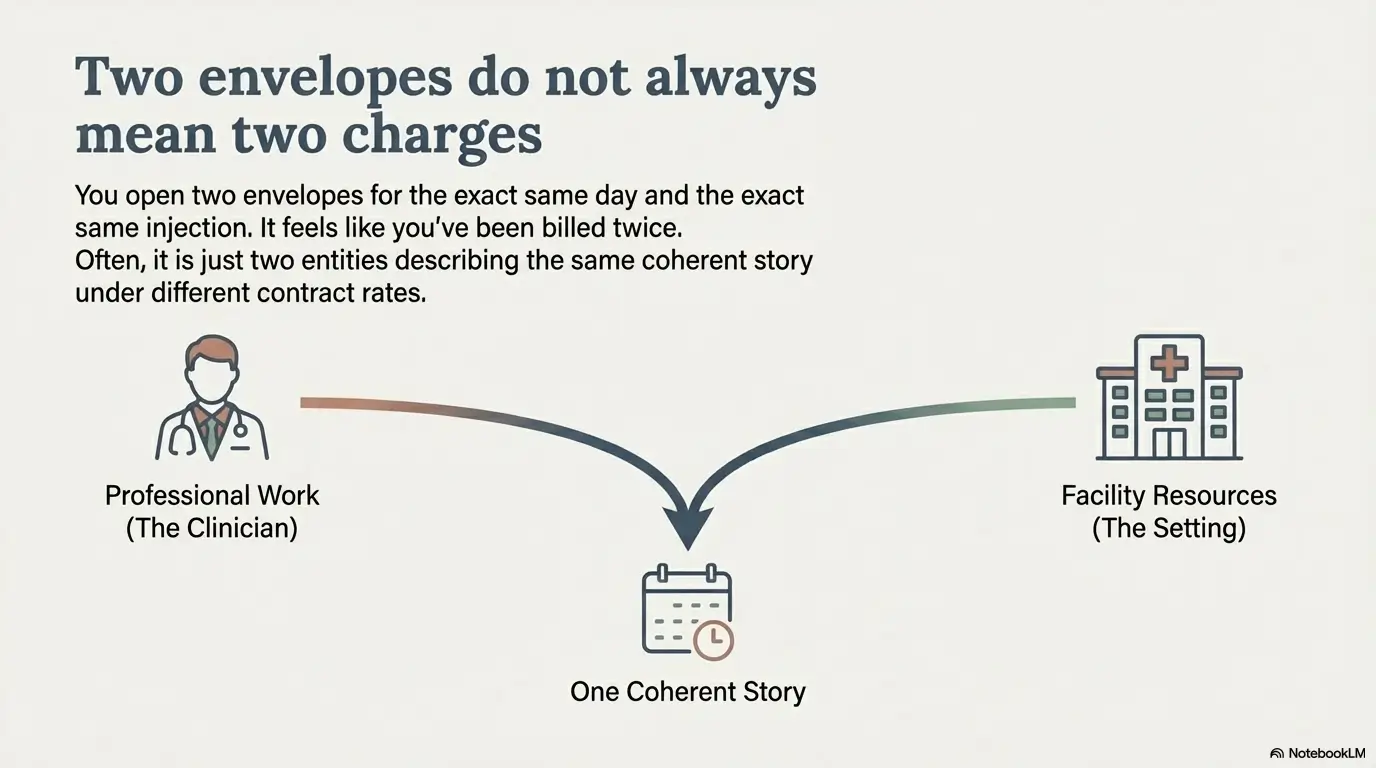
This is the part nobody tells you, usually because they assume you already know it (you don’t): two bills can be normal. Not always. Not automatically. But often.
Here’s what no one tells you: “two bills” can be normal
- Professional fee: the physician or physician group (the “who did it” bill).
- Facility fee: the hospital outpatient department or ambulatory surgery center (the “where it happened” bill).
A tiny scene from real life: I once watched a friend open two envelopes and whisper, “They billed me twice.” The second envelope wasn’t a duplicate. It was the facility. Same day. Same injection. Different billing entity. Different contract rates. Same stunned facial expression.
The three columns that trick people
- Billed charges: what they list as the sticker price.
- Allowed amount: what your insurer says is payable under your plan.
- Patient responsibility: what matters for your wallet (deductible, coinsurance, copay).
- Wait for the EOB unless you’re on a strict payment clock
- Match the date of service and place of service first
- Ask billing for the “allowed” or “contracted” view if needed
Apply in 60 seconds: Put a sticky note on the bill: “Do I have the EOB yet?” and don’t pay the sticker price out of panic.
The setting trap: office vs ASC vs hospital outpatient
Your claim can look different depending on where the injection happened. Office-based procedures may bundle differently than an ASC or a hospital outpatient department. This is why two people can swear they had “the same injection” and still see different line items (and if you’re comparing settings for future care, it helps to understand how hospital outpatient facility fees can reshape the final total).
Decision card: If you’re comparing costs (or planning a future injection)
| Setting | Common billing pattern | What to ask |
|---|---|---|
| Office | Often fewer facility-style line items | “Is this billed as office? What’s my in-network estimate?” |
| ASC | Facility fee likely; bundled rules vary | “Will there be a separate facility bill? What codes do you expect?” |
| Hospital outpatient | Facility fee common; packaging can differ | “Is this outpatient hospital? What is the place-of-service on the claim?” |
Neutral next action: Call your insurer with the CPT(s) and the planned setting to request a pre-service estimate.
Epidural codes spotted: Interlaminar vs transforaminal (the big fork)
When people say “epidural,” they often mean “the shot.” But billing needs the route, the region, and sometimes the number of levels. That’s why epidural claims tend to look like a small parade of codes rather than a single label (if you want a clean mental model of the fork in the road, see transforaminal vs interlaminar epidural).
Interlaminar/caudal epidural families you may see
Many bills show interlaminar or caudal epidural code families such as 62321 or 62323, often distinguished by the spinal region. If your paperwork says “interlaminar” or “caudal,” you’re usually in this neighborhood.
Transforaminal epidural families you may see
Transforaminal epidurals often show families like 64479/64480 (cervical/thoracic) and 64483/64484 (lumbar/sacral). You may also see “additional level” logic when more than one level is treated (this is also where patients confuse a selective block with an epidural, so it can help to read nerve root block vs ESI when your paperwork uses both terms).
The “two injections” illusion: one visit, multiple levels/sides
This is where brains short-circuit. Multiple lines can mean:
- Multiple levels (one primary level plus add-on level codes)
- Left and right (RT/LT or bilateral logic)
- Separate components (procedure + imaging guidance + meds)
Quick gut-check: if the EOB shows the same CPT repeated with different modifiers or units, it’s often reporting level or side, not a second appointment. “One visit, two lines” is not automatically shady. It’s automatically worth matching.
Facet/medial branch codes: The 64490–64495 family in plain English
Facet and medial branch billing is famous for multiplying lines. Not because anyone is trying to build a billing pyramid scheme, but because facet interventions are documented and coded by levels, and levels stack.
“Facet joint” vs “medial branch” (same neighborhood, different address)
Patients hear “facet joint injection.” Clinicians may talk about “medial branch blocks.” Billing often lives in code families like 64490–64495 that describe the nerve supply to the facet joint by region and level. In practice: it’s the same neighborhood, different address label.
Levels matter (and they multiply line items)
A common pattern is one “base” code for the first level, followed by add-on codes for additional levels. This is why your bill can look like it’s counting stairs: first step, second step, third step.
- Expect “first level” + “additional level” patterns
- Modifiers (RT/LT, 50) change the story fast
- Ask for the procedure note summary if confused
Apply in 60 seconds: On each facet/medial branch line, write “L?” (level) or “S?” (side) beside it, then verify with documentation.
- CMS guide: How to read an Explanation of Benefits (EOB)
- CMS MLN (PDF): Proper use of modifiers 59, XE, XP, XS, XU (distinct procedural service rules)
- AMA: CPT code set overview (what CPT codes are and why they exist)
When you see 64633–64636 later (RFA shows up in follow-ups)
If a later visit includes radiofrequency ablation (RFA), you may see code families like 64633–64636. Many care pathways use diagnostic blocks before RFA, so patients sometimes see “block codes” on one date and “RFA codes” on a later date. If your claim timeline looks like a two-act play, that may be why.
SI joint codes: When 27096 or 64451 appears (and why)
SI joint services are the plot twist on many “back pain” bills. People expect “spine” codes, then an SI code appears like an uninvited cousin at a family dinner. Still, SI pain is common, and the billing has its own habits (and if you’re comparing “what I thought I got” vs “what the code suggests,” this guide on SI joint injection vs lumbar ESI can help you sanity-check the neighborhood).
Why SI injections appear on “back pain” bills
SI joint injections may show up under 27096 and/or 64451, depending on payer guidance, the exact service, and how the setting bills. If your procedure note mentions “sacroiliac” or “SI,” these codes stop being mysterious and start being descriptive.
Imaging bundled surprises (and why 27096 can look “expensive”)
SI injections can include imaging guidance within the service description or be packaged differently depending on setting. That “expensive-looking” line item is sometimes the code absorbing what you assumed would be split out.
Curiosity gap: why your facility bill might show G0260 instead of 27096
Some outpatient facility claims may report SI injections using a different HCPCS code (like G0260) depending on billing guidance and payer rules. Patients still experience “one injection.” Claims sometimes narrate it with different labels.
If you remember nothing else from this section, remember this: different settings can legitimately speak different billing dialects even when the procedure felt identical.
Imaging guidance lines: 77003, 26/TC, and the “X-ray you didn’t feel”
Imaging guidance codes are the emotional villain of spine injection billing. You didn’t “feel” imaging. You didn’t walk out saying, “What a lovely fluoroscopy experience.” Yet there it is, charging rent on your EOB.
What 77003 usually signals
A code like 77003 often signals fluoroscopic guidance associated with certain spine/paraspinous procedures. Sometimes it’s appropriate and separately reportable. Sometimes it’s bundled by payer or setting. The truth is not in the vibe. The truth is in the documentation and the payer rule.
Let’s be honest: the imaging line item feels like a second procedure
That feeling is normal. Here’s the practical move: don’t argue about whether imaging “should” be there. Ask whether it’s separately billable for your situation and whether it’s supported by the note and the setting’s billing rules.
Modifiers that change meaning fast (26, TC, RT/LT, 50, 59/XS)
- 26 and TC often split professional interpretation vs technical equipment/services in imaging contexts.
- RT/LT indicate side; 50 indicates bilateral (plan-dependent usage).
- 59 or XS may indicate distinct procedural services when bundling edits would otherwise apply.
A quick lived-experience note: I’ve watched people spend 30 minutes arguing about a CPT number when the real issue was a modifier. The CPT was fine. The grammar was wrong. Like blaming the noun when the verb is the problem.
Show me the nerdy details
Bundling edits can deny payment unless a modifier clarifies that two services were distinct (different site, different session, different structure). That’s why you’ll sometimes see 59/XS appear next to imaging or secondary procedure lines. When you request a coding review, ask, “What bundling edit is this addressing?” You don’t need to know the edit list. You just need them to explain their rationale.
Drug & supply codes: Steroid J-codes, contrast, and sedation add-ons
This section is where your claim starts looking like a grocery receipt: medication, contrast, supplies, maybe sedation-related services. Patients often assume “the shot” includes “the stuff.” Billing sometimes itemizes.
HCPCS “J-codes” and why the medication is billed separately
Steroids and other injectables may appear as separate HCPCS lines (often J-codes) depending on setting and payer. A facility claim might be more itemized than a professional claim. If you see a medication line, the right question is: Is it consistent with the documented medication and dose?
Trigger point injections aren’t epidurals (and the codes behave differently)
Trigger point injections commonly appear under code families like 20552 or 20553. They are not epidurals. They don’t live in the same billing “family tree.” If your consent or note says “trigger point,” but your claim looks like an epidural family, that’s a good moment for a polite coding review request (and if you want a plain-English reset on what counts as a trigger point injection, this guide to trigger point injections for sciatica can help you spot the mismatch faster).
Sedation and monitoring: why some patients see extra anesthesia-related charges
Some settings bill sedation or monitoring separately, depending on what was done and documented. If you see anesthesia-related lines and you don’t remember sedation, don’t panic. Memory is not a billing system. Ask:
- “Was sedation documented?”
- “Who billed it, and under what provider?”
- “Is it part of the facility claim or a separate anesthesia group?”
If you’re trying to connect the dots between “sedation” and “why is there another line item,” it helps to read a focused explainer on epidural steroid injection sedation so you know what usually gets billed separately vs bundled.
Mini calculator: quick estimate of what you might owe (simple, not legal advice)
Neutral next action: Compare this estimate to the EOB’s “patient responsibility” and ask billing to explain any gap.
Commercial reality check (neutral, not promotional): big payers like UnitedHealthcare, Aetna, Cigna, and Blue Cross Blue Shield can apply different bundling and setting rules, even when the CPT looks the same. Medicare claims follow CMS rules. The system is consistent in one way: it’s consistent at being complicated. If you’re trying to estimate what you might owe before you schedule (or if you’re staring at a cash quote), a practical benchmark is to read about self-pay TFESI cost so you can recognize when a number is “normal range” vs “needs clarification.”
Common mistakes: The 9 bill-reading errors that cost real money
This is the part where you stop bleeding time and start saving it. I’m going to name the mistakes the way they happen in real life, usually at a kitchen counter with a half-cold coffee and a rising sense of betrayal.
Mistake #1: paying the “charges” column before the EOB arrives
If you pay the sticker price before insurance processes the claim, you can overpay and spend weeks chasing a refund. Wait for the EOB whenever possible.
Mistake #2: ignoring modifiers (they can flip the story)
Modifiers are the difference between “left side” and “additional level,” between “technical component” and “professional component.” Don’t treat them as decoration.
Mistake #3: assuming “two lines” means “two procedures”
Two lines often mean the system is describing side/level/guidance. Confirm with documentation before you conclude double billing.
Mistake #4: mixing up side vs level vs session
Side (RT/LT), level (additional level logic), and session (different dates/times) are three different concepts. Your job is to identify which one the claim is using.
Mistake #5: forgetting the facility fee is separate from the doctor fee
Two bills may be normal. But two bills should still be consistent with one story.
Mistake #6: not requesting an itemized statement (or procedure note summary)
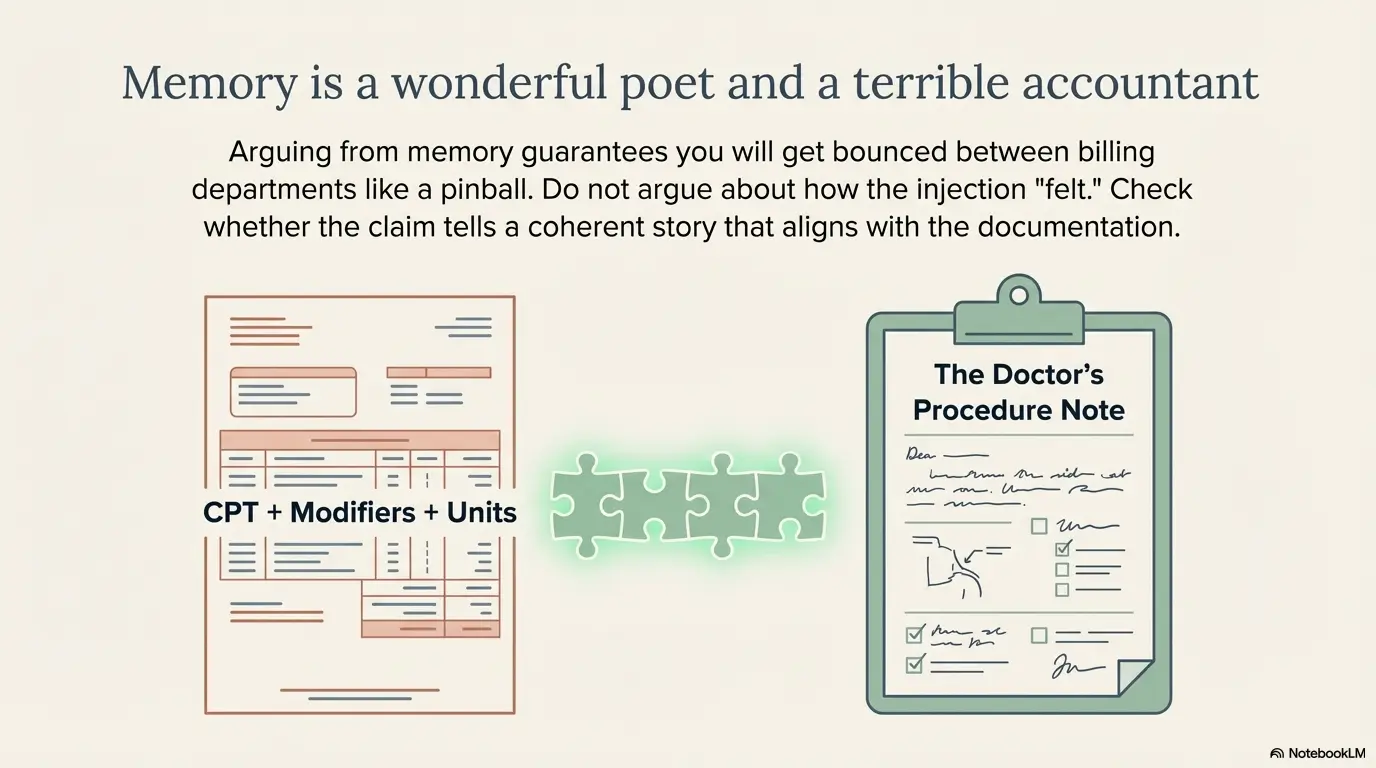
Without the line-item statement and a brief note summary, you’re arguing from memory. Memory is a wonderful poet and a terrible accountant.
Don’t do this: argue CPT numbers without the CPT + modifier + units string
“CPT 64483 is wrong” is vague. “CPT 64483 with RT and 2 units doesn’t match the note that says left only at one level” is a solvable sentence.
Don’t do this: call insurance without the date of service + place of service
You’ll get bounced between departments like a pinball. Bring the date of service, place of service, provider name, and the line items.
Mistake #7: assuming “denied” means you owe the full amount
Denials can mean “needs more info,” “bundled,” “not covered,” or “out of network,” each with different next steps.
Mistake #8: treating the first explanation as final
Front-line reps often see the same screen you do. If the answer is generic, politely escalate to a supervisor or request a formal review.
Mistake #9: paying out of fear of collections without asking for a hold
If you’re actively disputing or requesting a coding review, ask billing whether they can place a temporary hold while it’s investigated.
- Wait for the EOB when possible
- Always read CPT + modifier(s) + units together
- Request itemized statement + brief note summary
Apply in 60 seconds: Write the date of service and place of service at the top of your notes before making any phone call.
Fix it playbook: Calls, appeals, and one-page documentation asks
This is the “operator” section. Not aggressive. Not dramatic. Just clean, specific, and hard to ignore. Your goal is to request a review in a way that makes it easy for billing to help you.
The 5-minute phone script to billing (calm, specific, effective)
- “Can you confirm the CPT codes, modifiers, units, and place of service submitted on the claim?”
- “Can you tell me which line items are professional and which are facility?”
- “Can you email or mail an itemized statement that shows each line?”
- “If something doesn’t match the note, can you request a coding review?”
The “coding review” request that gets traction
Ask for a coding review when a code appears inconsistent with the documented procedure family, side/level, or setting. The key is to anchor your request to documentation:
- “The note says left only, but the claim has bilateral reporting. Can you review?”
- “The note describes interlaminar, but the claim looks like transforaminal. Can you confirm the coding?” (If you need language for this exact mismatch, the comparison in TFESI vs interlaminar ESI for sciatica gives you the right nouns without turning you into a pretend clinician.)
- “The claim shows multiple levels. Can you point me to where the note documents each level?”
When to escalate (without lighting your day on fire)
- If the explanation is generic, ask for a supervisor or coding team review.
- If insurance says “bundled,” ask what modifier or documentation is needed to clarify distinct services.
- If you’re stuck, request a written response with the reason and next step.
Show me the nerdy details
If a denial is due to bundling edits, the path is often: confirm the documentation supports distinct services, confirm the setting’s billing rules, then submit corrected modifiers or additional documentation through the billing office. Patients usually can’t change the claim directly, but you can trigger the review.
Quote-prep list: gather these before you call (saves 15–30 minutes)
- Date of service
- Place of service (office, ASC, hospital outpatient)
- Provider name and billing entity name (may differ)
- CPT + modifier(s) + units for each line
- EOB showing allowed amount and patient responsibility
Neutral next action: Take a photo or screenshot of the EOB lines so you can read them verbatim on the call.
Next step: 10-minute CPT + EOB audit checklist
If your goal is to be done with this in under 15 minutes, follow this exact sequence. It’s the shortest path I know that still respects reality.
Step 1: Circle the CPT + modifier(s) + units (ignore the scary “charges” for now)
Make a simple list. One line per claim line item. Example format: “CPT 64483 | RT | 1 unit.” Repeat until you’ve captured everything visible.
Step 2: Match the code family to the procedure type (epidural vs facet vs SI vs trigger point)
You’re not trying to memorize. You’re trying to label which neighborhood the codes live in. Epidural families, facet/medial branch families, SI families, trigger point families.
Step 3: Confirm level/side logic (additional level vs left/right)
Look for RT/LT, 50, and repeated codes with different units. Ask: is this describing multiple levels, two sides, or separate components?
Step 4: Separate professional vs facility lines
If you have two bills or two EOB sections, label them. “Professional” and “Facility.” This stops you from comparing apples to microwaves.
Step 5: Call billing for a coding review if any single line “doesn’t fit the story”
Pick the one line item that feels most inconsistent and ask for documentation alignment. You don’t have to fight the whole bill at once.
Eligibility checklist: should you request a coding review today?
- Yes if the code family doesn’t match what the note/consent describes.
- Yes if modifiers (RT/LT/50/26/TC/59/XS) don’t match side, component, or distinctness.
- Yes if units suggest multiple levels/sides that you can’t find in the note summary.
- No if the only concern is the “charges” column and you don’t have the EOB yet.
Neutral next action: If you checked any “Yes,” request an itemized statement and a coding review in the same call.
Short Story: The “two lines” that weren’t a scam
Short Story: A friend once called me, voice tight, because their EOB showed two procedure-looking lines for one spine injection. They were convinced someone billed twice and that the fight would take months. We did one quiet thing: we wrote down each line as “CPT + modifiers + units,” then asked the clinic for a two-sentence procedure summary. The note described two levels on the same side, done under imaging.
The EOB lines were the base level and an additional level, and the imaging was packaged on the facility side. Nothing magical, nothing predatory, just a billing dialect that reads like a bad translation. The best part was the emotional shift: instead of “I’ve been robbed,” it became “I have questions with receipts.” The call to billing took eight minutes, not an afternoon. The bill still wasn’t fun. It was just finally understandable.
FAQ
Why do I see both a doctor charge and a facility charge?
Because the professional work (physician/group) and the facility resources (ASC or hospital outpatient department) are often billed separately. Same date of service, different billing entities. Match both to the same procedure story before assuming duplication.
What does “RT/LT” or “50” mean on my injection code?
RT/LT usually indicate right vs left side. “50” often indicates bilateral. Which modifier is used can depend on payer rules and how the claim is structured. The practical move is to confirm it matches what was documented (one side or both).
Why is there an imaging code when I barely remember imaging?
Fluoroscopy or other guidance can be part of how the injection is performed and documented, even if you didn’t feel it as a separate event. Sometimes imaging is separately reported; sometimes it’s bundled or packaged depending on the setting and payer.
What’s the difference between an epidural code and a facet/medial branch code?
They describe different targets and approaches. Epidural codes generally describe delivering medication into the epidural space via specific approaches (like interlaminar or transforaminal). Facet/medial branch codes describe interventions around the facet joint nerve supply and often bill by spinal levels.
Why do I have multiple CPT lines for one appointment?
Common reasons: multiple levels, left/right reporting, imaging guidance, medications/supplies, and separate professional vs facility claims. Multiple lines are not proof of multiple appointments. They’re proof of a billing system that likes detail.
What should I do if the billed code doesn’t match what I consented to?
Request an itemized statement and a brief procedure note summary. Then ask billing for a coding review: “Can you confirm CPT + modifiers + units match the documented procedure?” If needed, ask how to submit a formal dispute or reconsideration.
Can my bill show different codes than my friend’s for “the same injection”?
Yes. Codes and billing patterns can differ by payer rules, setting (office vs ASC vs hospital outpatient), documentation style, and year-to-year code updates. Focus on whether your codes match your documentation and setting, not whether they match someone else’s claim.
What documents should I request before I pay?
At minimum: the EOB, an itemized statement, and a brief procedure summary (or the relevant portion of the procedure note if available). Those three together let you confirm CPT + modifiers + units match reality.
Conclusion
Let’s close the loop from the beginning: your EOB isn’t a verdict. It’s a translation. And sometimes the translation is sloppy, incomplete, or missing its grammar. The reason this guide works is simple: you’re no longer reacting to a scary number. You’re checking whether the claim tells a coherent story: procedure family + setting + modifiers + units.
If you do one thing in the next 15 minutes, do this: take your EOB, circle each CPT line, and write “P” (procedure), “G” (guidance), or “M” (meds/supplies) next to it. If one line still doesn’t fit, request an itemized statement and a coding review. Calm. Specific. Effective.
Two last resources that can help when the question is “is this modifier use even allowed?” or “how does Medicare describe these services?”: (Tip: if your bigger puzzle is what happens after the procedure, patients often get blindsided by timing and flares, so you may also want to skim epidural steroid injection relief timeline and steroid flare after injection before you interpret every post-visit symptom as a billing or care catastrophe.)
Last reviewed: 2026-03-05.