
The 15-Minute Orthopedic Appointment Guide
A short orthopedic appointment can feel like trying to pour a whole winter into a teacup. The patient has pain, the caregiver has questions, the clinician has a tight schedule, and the most important detail often appears in the parking lot after everyone has already buckled up.
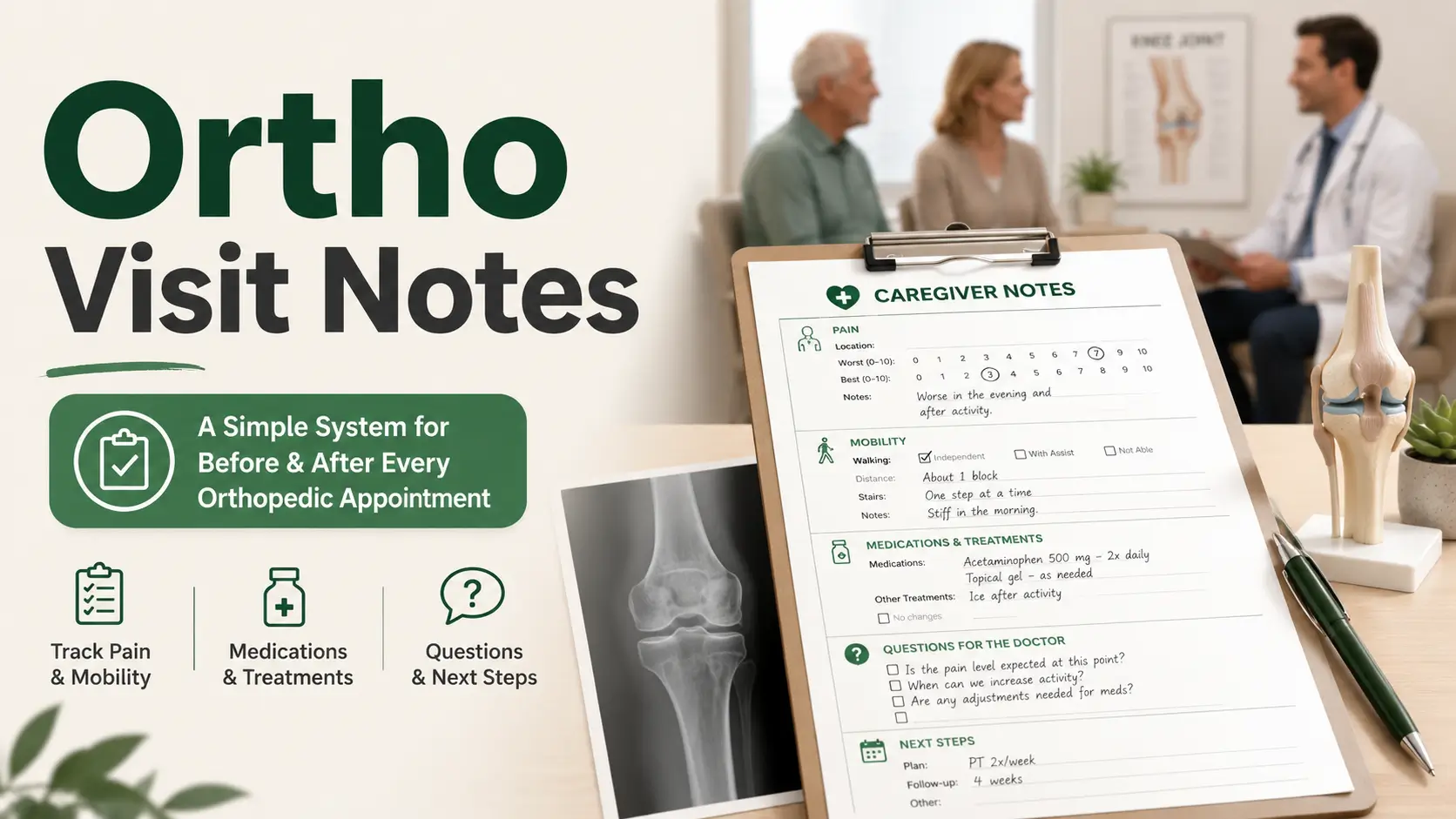
Caregiver notes for orthopedic appointments solve that exact problem. They help families bring pain changes, mobility problems, medication updates, fall risks, surgery questions, and follow-up tasks into one calm page instead of a foggy memory pile.
The stakes are real. Guessing can lead to missed restrictions, unclear medication instructions, delayed therapy, or a home setup that works beautifully for imaginary people but not for the person trying to get from bed to bathroom at 2:13 a.m.
This guide gives you a practical note system you can build today, use in about 15 minutes, and repeat before every orthopedic visit.
The Quick Visit System
One page. Five zones. Better conversations.
Use caregiver notes to capture what changed, what hurts, what limits daily life, what medications changed, and what the orthopedic team said to do next. The goal is not to replace the patient’s voice. The goal is to protect it from the appointment-room blender.
- Before the visit: summarize symptoms, function, medications, and questions.
- During the visit: write the diagnosis, options, restrictions, and warning signs.
- After the visit: turn the plan into assigned tasks with dates.
Table of Contents
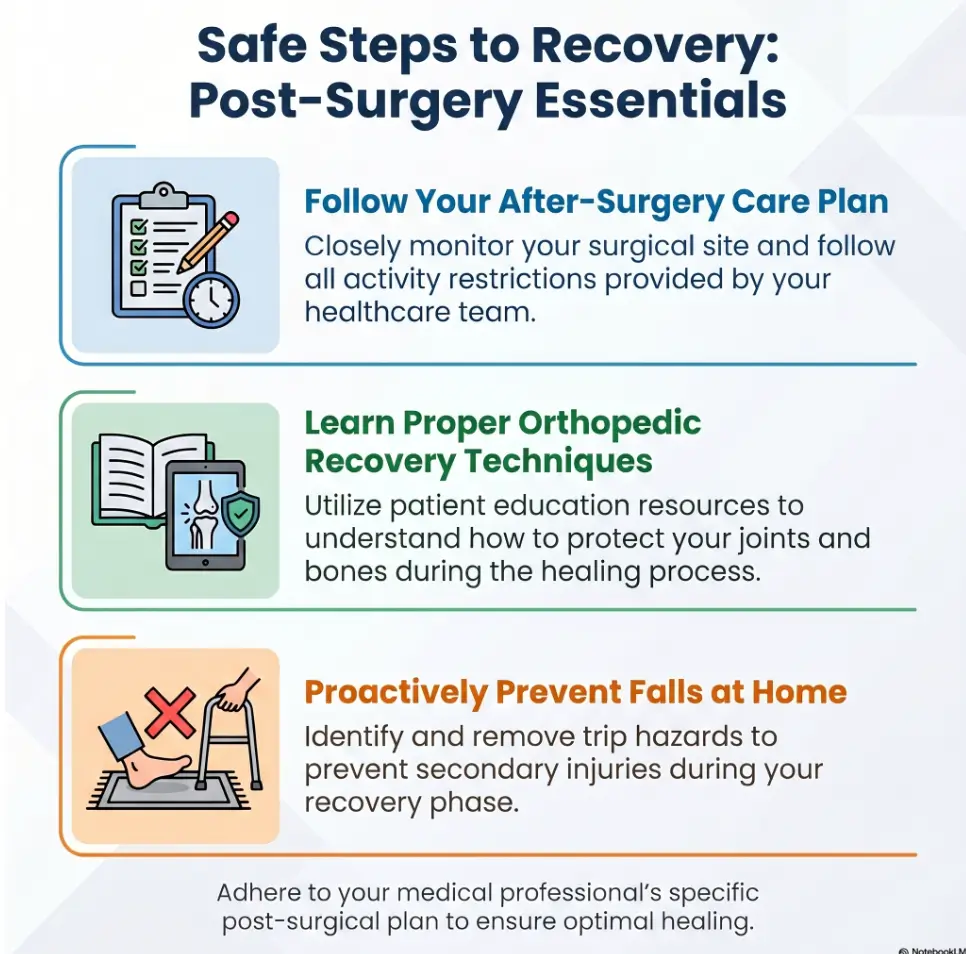
Safety and Medical Disclaimer
This guide is for general education and appointment preparation only. It does not replace medical advice from an orthopedic surgeon, primary care clinician, physical therapist, pharmacist, emergency clinician, or other licensed professional.
Caregiver notes can make visits clearer. They cannot diagnose a fracture, blood clot, infection, nerve problem, medication reaction, or surgical complication. That job belongs to the care team.
Seek urgent help for symptoms such as chest pain, trouble breathing, fainting, sudden weakness, severe uncontrolled pain, new numbness, signs of infection, possible blood clot symptoms, serious falls, or fast worsening after surgery or injury.
- Use notes to report what happened.
- Let clinicians interpret what it means.
- Escalate red flags instead of waiting for the next appointment.
Apply in 60 seconds: Write the orthopedic office number, after-hours line, and nearest emergency location at the top of your note page.
Why Caregiver Notes Can Change the Whole Appointment
The visit is short, but the story is long
Orthopedic appointments often compress weeks of pain, swelling, sleep disruption, therapy effort, medication changes, and daily frustration into a brief conversation. A caregiver may have watched the patient limp to the mailbox, avoid stairs, skip the shower, or quietly stop making coffee because lifting the pot hurts.
Those moments matter. They show how the injury, arthritis, spine issue, surgery, or joint pain behaves in real life. The exam room can measure range of motion. Your notes can show what happens on carpet, tile, porch steps, car seats, and the treacherous kingdom of the bathroom rug.
A strong caregiver note answers one question: What has changed since the last visit?
That includes:
- Pain that moved, intensified, or started waking the patient at night.
- Swelling, redness, warmth, drainage, stiffness, or bruising.
- Falls, near-falls, balance issues, or new fear of walking.
- Medication side effects, missed doses, or extra over-the-counter use.
- Physical therapy progress, setbacks, or exercises the patient cannot do.
- Functional changes such as stairs, dressing, bathing, driving, cooking, or transfers.
Memory gets slippery in exam rooms
Stress turns details into confetti. A caregiver may remember that Tuesday was terrible, but not whether the pain was in the knee, calf, hip, or lower back. The patient may say, “I’m fine,” because politeness is a stubborn houseplant. Meanwhile, the clinician is trying to sort safety, diagnosis, imaging, treatment options, insurance realities, and recovery timing.
Written notes slow the room down. They give everyone a shared map.
The best notes are not elegant. They are dated, specific, and plain. “Right knee pain 7/10 after stairs, improves after ice, wakes patient twice nightly” beats “knee is awful” every time.
What orthopedic teams actually need
Orthopedic teams usually care deeply about function. Pain matters, but function tells the story with shoes on.
Try to capture whether the patient can:
- Walk across a room, down a hall, outside, or around a store.
- Use stairs safely.
- Get in and out of bed, a chair, a toilet, or a car.
- Sleep through the night.
- Dress, bathe, cook, clean, drive, work, or attend school.
- Use a cane, walker, brace, sling, boot, or other assistive device correctly.
If pain description is a challenge, it helps to prepare before the visit with a simple plain-language system for describing pain to a doctor. Caregivers do not need medical vocabulary. They need clean observations.
Who This Is For, And Who Needs More Than Notes
Best fit: family caregivers and appointment companions
This system is useful for spouses, adult children, relatives, friends, home-care aides, and patient advocates who help someone prepare for orthopedic visits.
It is especially helpful when the patient:
- Has several conditions or medications.
- Recently had surgery or is considering surgery.
- Has falls, balance problems, or mobility limits.
- Gets overwhelmed during medical visits.
- Minimizes symptoms to avoid “making trouble.”
- Needs help remembering instructions after the appointment.
A caregiver note should support the patient, not take over. When possible, let the patient speak first. The note can fill in details gently: “We wrote down a few changes since the last visit.” That sentence is a small bridge. It does not barge into the room wearing tap shoes.
Not enough: emergencies and fast-changing symptoms
Notes are not enough when symptoms are rapidly worsening. If someone has severe pain after a fall, new weakness, sudden inability to walk, trouble breathing, chest pain, signs of infection, or symptoms that could suggest a blood clot, do not wait to make a prettier note.
Call the orthopedic office, use the after-hours line, contact the primary care clinician, go to urgent care, or seek emergency help based on the situation.
For spine-related symptoms, be especially cautious with new bowel or bladder changes, numbness in the saddle area, or severe weakness. These are not “let’s see how it feels after lunch” symptoms.
The quiet middle group
Many patients can speak for themselves but still benefit from a second set of ears. This is the quiet middle group: independent, thoughtful, and still human enough to forget half the plan by the elevator.
For them, caregiver notes become a bridge, not a steering wheel.
Money Block: Is a Caregiver Note System Worth Using?
Use this yes/no checklist before the next orthopedic visit.
- Yes/No: Has pain changed since the last appointment?
- Yes/No: Has walking, bathing, stairs, dressing, sleep, driving, or work changed?
- Yes/No: Were there falls, near-falls, swelling, side effects, or new symptoms?
- Yes/No: Are there multiple medications, specialists, imaging studies, or therapy instructions?
- Yes/No: Does the patient forget or downplay symptoms during visits?
Neutral action line: If you answered yes to two or more, bring a one-page note to the appointment.
Build the One-Page Orthopedic Visit Snapshot
Start with the patient’s “today status”
The top of the page should orient the clinician quickly. Think of it as the label on a medicine bottle, not the first chapter of a family saga.
Include:
- Patient name and date of visit.
- Appointment reason.
- Current diagnosis, injury, or surgery if known.
- Surgery date, injection date, injury date, or symptom start date if relevant.
- Main concern in one sentence.
Example:
Main concern: “Since the last visit, right hip pain is less sharp, but walking distance is worse and the patient now needs help getting into the SUV.”
That one sentence tells the orthopedic team more than “hip still hurts.” If car transfers are part of the problem, a related home-practical guide such as getting into an SUV after hip surgery can help the family turn instructions into safer daily routines.
Use a pain-and-function mini grid
A simple grid keeps the page readable. It also keeps the caregiver from writing a novella called The Knee and Its Discontents.
| Category | What to Write | Example |
|---|---|---|
| Pain | Location, intensity, timing, trigger | Left shoulder 6/10 when dressing |
| Mobility | Walking distance, stairs, transfers | Can walk to mailbox, not grocery store |
| Sleep | Night waking, positions, pillows | Wakes twice from hip pain |
| Swelling | Location, warmth, redness, timing | Ankle swelling worse by evening |
| Care tasks | Dressing, bathing, cooking, toileting | Needs help with socks and shower |
For older adults or patients with multiple pain sites, a functional pain assessment can make the difference between vague pain reporting and a care plan that matches daily life.
Keep it boring on purpose
The best note page is not pretty. It is useful. Use plain words, dates, and numbers. Avoid decorative formatting that hides the important part like a chandelier in a storage closet.
A good one-page snapshot has:
- Short phrases instead of long paragraphs.
- Dates for key changes.
- Specific body locations.
- Medication names and doses when possible.
- Questions grouped at the bottom.
- A blank area for instructions during the visit.
Show me the nerdy details
A useful caregiver note works because it reduces cognitive load. The clinician does not have to reconstruct the timeline from scattered memory, and the caregiver does not have to hold every detail in working memory while emotions are high. The best format is “structured enough to scan, loose enough to update.” Dates, symptom pattern, functional limits, and treatment response are the highest-value categories because they help distinguish a single bad day from a meaningful trend.
Bring the Right Details, Not the Whole Kitchen Drawer
Medications, supplements, and recent changes
Medication information can change orthopedic decisions. Blood thinners, diabetes medications, steroids, opioids, NSAIDs, sleep medications, supplements, allergies, and recent dose changes may all matter.
Bring a current medication list that includes:
- Prescription medications.
- Over-the-counter pain relievers.
- Topical creams or patches.
- Supplements and herbal products.
- Medication allergies or past reactions.
- Recent changes, missed doses, or extra doses.
Be honest. If the patient took more acetaminophen than the label allows, skipped a blood thinner, mixed medication with alcohol, or stopped a drug because it caused dizziness, the care team needs to know. Shame is a terrible pharmacist.
Imaging, therapy, and surgery history
Orthopedic care often depends on what has already been tried. A clean history can prevent repeated testing, missed context, and the dreaded phrase “I think we had that scan somewhere.” Somewhere is not a filing system. It is a tiny swamp.
Write down:
- X-rays, MRI, CT scans, ultrasound, or other imaging dates.
- Injections, braces, splints, casts, boots, or assistive devices.
- Physical therapy start date, frequency, and response.
- Prior surgeries and approximate dates.
- Hospitalizations or emergency visits related to the issue.
If the visit is a general orthopedic check, a broader orthopedic appointment checklist can pair well with caregiver notes. The checklist helps gather records; the caregiver page helps tell the story.
Here’s what no one tells you…
A caregiver who brings three precise details often helps more than one who brings a 40-page folder with no labels.
Useful:
- “Pain became worse after physical therapy on May 12.”
- “Patient fell once in the bathroom and twice nearly fell on the porch step.”
- “New swelling started three days after changing activity level.”
Less useful:
- “Everything is worse.”
- “The internet said it might be twelve different things.”
- “We brought every paper since 2013 and one recipe for lentil soup.”

Ask Better Questions Before the Clinician Leaves the Room
Questions about diagnosis
Caregiver notes should include questions that clarify what the team thinks is happening. You are not asking the clinician to deliver a lecture under fluorescent lights. You are asking for decision-useful clarity.
Try these:
- What is the most likely cause of the pain or limitation?
- What else could be causing similar symptoms?
- What would make you change the treatment plan?
- Are the symptoms consistent with the imaging and exam?
- What signs would suggest this is getting worse?
If the patient has pain but normal imaging, do not assume the pain is imaginary. Pain and imaging do not always line up neatly. For families facing that confusing gap, what to do when an X-ray is normal but pain continues can help frame the next conversation.
Questions about treatment choices
Treatment choices may include rest, medication, injections, bracing, physical therapy, surgery, activity changes, or watchful waiting. A caregiver’s job is not to push one option. It is to help the patient understand the trade-offs.
Ask:
- What is the goal of this treatment?
- How soon should we expect improvement?
- What are the main risks or side effects?
- What happens if we wait?
- What should we try before surgery, if anything?
- When should we reassess?
Money Block: Decision Card for Treatment Options
| If the choice is… | Ask about… | Trade-off to clarify |
|---|---|---|
| Physical therapy vs rest | Safe movements, pain limits, frequency | Progress vs flare risk |
| Brace vs no brace | When to wear it, skin checks, fit | Support vs stiffness or dependence |
| Injection vs medication | Expected duration, side effects, limits | Targeted relief vs broader medication exposure |
| Surgery vs watchful waiting | Recovery time, home help, risks | Potential benefit vs recovery burden |
Neutral action line: Bring one decision card question to the visit and write the answer in the patient’s own words.
Questions about restrictions
Restrictions are where good intentions can trip over a throw rug. Ask about the exact activities that affect home life.
- Can the patient bear weight? If yes, how much?
- Can the patient climb stairs?
- Can the patient drive?
- Can the patient lift, push, pull, reach, kneel, twist, or bend?
- How should bathing, dressing, toileting, and transfers be handled?
- Does the brace, sling, boot, or walker have specific rules?
For example, after shoulder surgery, a bathroom can become a puzzle box. A practical resource on bathroom setup after shoulder surgery can help translate restrictions into safer routines.
Common Mistakes That Make Orthopedic Notes Less Useful
Mistake 1: Writing “pain is bad” with no context
“Pain is bad” is emotionally true but clinically thin. It does not show location, pattern, trigger, or impact.
Better:
- “Right knee pain 7/10 after stairs.”
- “Improves to 4/10 after ice and rest.”
- “Wakes patient twice nightly.”
- “No longer walks to mailbox without cane.”
If your family is struggling to capture pain over time, use a pain timeline before an orthopedic visit. A timeline turns scattered episodes into a pattern the care team can scan.
Mistake 2: Forgetting what changed since last visit
Orthopedic decisions often depend on whether symptoms are improving, stable, or drifting downhill like a shopping cart with one wild wheel.
Use three labels:
- Better: less pain, better motion, improved sleep, longer walking distance.
- Same: no meaningful change despite treatment.
- Worse: more pain, new swelling, more falls, less function, new symptoms.
Put the label beside each issue. This avoids a mushy report where everything sounds equally urgent.
Mistake 3: Leaving without a next-step summary
The visit is not complete until someone understands what happens next.
Before leaving, confirm:
- Diagnosis or working concern.
- Treatment plan.
- Medication changes.
- Activity restrictions.
- Therapy or imaging orders.
- Warning signs.
- Follow-up timing.
- Write what changed.
- Connect pain to daily tasks.
- End with the next step.
Apply in 60 seconds: Add “better, same, or worse?” beside the top three symptoms on your current note.
Don’t Do This: The Notes That Accidentally Create Confusion
Don’t diagnose from the waiting room
Caregivers can report observations. Clinicians interpret causes and treatment options.
Helpful:
“Pain starts in the low back and travels down the right leg after standing.”
Less helpful:
“This is definitely a pinched nerve because I watched three videos and one had dramatic music.”
You can absolutely ask whether symptoms fit a nerve, joint, tendon, muscle, or hardware issue. Just keep the note observational. The clinician brings the diagnostic lens.
Don’t hide medication use or falls
Families sometimes hide information because they do not want the patient to seem careless. But falls, near-falls, extra medication, skipped therapy, alcohol use, dizziness, confusion, or missed doses can affect safety.
The note does not need to make anyone look perfect. It needs to make the care plan safer.
Try neutral language:
- “Patient fell in bathroom on May 9, no head injury reported, increased fear of showering.”
- “Took extra ibuprofen twice due to pain, caused stomach upset.”
- “Skipped therapy one week because transportation fell through.”
Let’s be honest…
Caregiving lives in the space between love and logistics. The sock aid is missing. The appointment card is in the wrong purse. The patient says they are “fine” while gripping the counter like it owes them money.
Notes bring a little mercy to that chaos. They let the caregiver tell the truth without turning the visit into a courtroom.
Short Story: The Yellow Notepad in the Glove Box
Maria started keeping a yellow notepad in the glove box after her father’s second orthopedic visit. At the first visit, she had tried to remember everything: the knee pain, the swelling, the fall near the laundry room, the way he stopped using the front steps. In the exam room, all of it scattered. Her father smiled politely and said, “I’m doing pretty good.” Later, in the car, he admitted the stairs scared him.
Before the next appointment, Maria wrote six lines: pain after stairs, swelling by evening, one fall, cane indoors, sleep worse, afraid of porch steps. The visit changed. The clinician adjusted the plan, discussed fall prevention, and clarified therapy goals. The magic was not the notepad. It was the honesty made portable. A caregiver note does not need perfect grammar. It needs the courage to carry the ordinary facts into the room.
Track Pain Without Turning the Patient Into a Spreadsheet
Use location, intensity, timing, and trigger
Pain tracking works best when it is specific but not obsessive. You are not trying to build a weather station for every ache. You are trying to notice patterns.
Use this four-part line:
Location + intensity + timing + trigger.
Examples:
- “Left hip 6/10 at night, worse when lying on that side.”
- “Right shoulder 5/10 when reaching overhead, better with rest.”
- “Low back and leg pain after standing 10 minutes, eases when sitting.”
- “Knee pain 8/10 after stairs, swelling later the same day.”
If heat or cold is part of the home routine, ask the care team what is appropriate for the condition. Families comparing comfort options can review heating pad vs ice wrap basics, but the clinician’s instructions should guide post-surgical or injury-specific decisions.
Add one sentence about life impact
Orthopedic notes get stronger when they include one sentence about life impact.
Try:
- “Cannot climb porch steps without help.”
- “Stopped grocery shopping because walking aisle distance is too much.”
- “Needs help getting out of bed.”
- “Can now walk to mailbox with walker.”
- “Avoids showering because stepping into tub feels unsafe.”
That last example matters. Bathing is not a small detail. It is dignity with plumbing.
Watch the pattern, not one dramatic day
One terrible Tuesday matters, but the trend matters more. Orthopedic care often listens to patterns hiding under ordinary mornings.
Track for three to seven days before the visit if possible. Do not overdo it. Over-tracking can make the patient feel studied instead of supported.
Better, same, or worse since the last visit.
Pain location, swelling, weakness, numbness, or stiffness.
Stairs, walking, sleep, dressing, therapy, driving.
Rest, ice, brace, medication, position, therapy adjustment.
Plan, restrictions, warning signs, follow-up task owner.
Surgery Visits Need a Different Note Template
Before surgery: decision and preparation notes
Before surgery, caregiver notes should focus on decision-making, preparation, and the first week at home. Recovery does not happen in the brochure. It happens beside the recliner, near the pill organizer, with a phone charger that is somehow always too short.
Write down:
- Procedure name.
- Expected benefit.
- Major risks discussed.
- Recovery timeline.
- Driving, bathing, lifting, stairs, and sleeping restrictions.
- Medication instructions before surgery.
- Transportation plan.
- Home setup needs.
- Who will help during the first 24 to 72 hours.
For joint replacement planning, home details matter. A patient preparing a small living space may benefit from knee replacement apartment setup ideas before discharge day arrives with its clipboard and tiny avalanche of instructions.
After surgery: recovery and warning-sign notes
After surgery, notes should track recovery and safety signals. Keep them brief but consistent.
Include:
- Pain level and whether medication controls it.
- Incision appearance if the clinician asked you to monitor it.
- Swelling, redness, warmth, drainage, or fever.
- Walking distance and assistive device use.
- Physical therapy participation.
- Medication side effects such as constipation, dizziness, nausea, or confusion.
- New symptoms such as calf pain, shortness of breath, numbness, or weakness.
Follow the discharge instructions and call the care team when symptoms match their warning list. If the patient is recovering from hip surgery, practical details like showering after hip surgery can help caregivers ask better safety questions before returning home.
The discharge-paper trap
Discharge instructions can feel clear at the hospital and foggy at home. Rewrite them into a simple checklist before the first night.
Money Block: Post-Surgery Quote-Prep List for Home Help
If you are comparing home-care help, transportation, equipment, or therapy logistics, gather these before calling providers.
- Surgery date and expected discharge date.
- Weight-bearing or movement restrictions.
- Number of stairs and bathroom setup.
- Current assistive devices, such as walker, cane, sling, brace, boot, or raised toilet seat.
- Medication schedule complexity.
- Needed help: bathing, dressing, meal prep, transfers, transportation, errands, or overnight monitoring.
Neutral action line: Use this list to request apples-to-apples estimates and avoid paying for help that does not match the recovery plan.
- Track restrictions, not just pain.
- Assign recovery tasks to real people.
- Keep warning signs visible.
Apply in 60 seconds: Rewrite the discharge plan into five plain lines: medication, movement, wound care, therapy, and call-if symptoms.
When to Seek Help Between Orthopedic Appointments
Call the orthopedic office for concerning changes
Some symptoms are not emergencies but should still be reported promptly. Call the orthopedic office or use the patient portal when the care team recommends it for issues such as:
- Worsening pain despite following the plan.
- New swelling, redness, warmth, drainage, or wound concerns.
- Medication side effects.
- Difficulty following restrictions.
- Physical therapy setbacks.
- New falls or near-falls.
- Brace, sling, boot, cast, or walker problems.
Use the caregiver note when you call. Say what changed, when it started, how severe it is, and what has already been tried.
Seek urgent or emergency care for red flags
Urgent signs may include chest pain, trouble breathing, fainting, severe sudden pain, signs of infection, new numbness or weakness, suspected blood clot symptoms, or a major fall. After surgery, follow the surgeon’s specific warning list.
The CDC and major medical institutions emphasize fall prevention for older adults because falls can lead to serious injury and loss of independence. In orthopedic recovery, a fall can also disrupt healing, confidence, and the plan itself.
When in doubt, escalate calmly
Caregivers do not need to be dramatic. They need to be specific.
Use this call script:
- “The patient had [symptom] starting [date/time].”
- “Severity is [number or description].”
- “It is worse with [activity] and better with [relief method].”
- “We tried [steps already taken].”
- “We are concerned because [specific change or risk].”
If you are unsure whether urgent care or an orthopedic clinic is the better fit, a guide comparing urgent care vs orthopedic clinic choices can help families think through the setting, while still following local emergency guidance for serious symptoms.
Turn the Appointment Into an Action Plan
Write the plan in five plain lines
At the end of the visit, write the plan in plain language. Five lines are enough for most appointments.
- Diagnosis or concern: What the clinician thinks is happening.
- Treatment decision: What the patient will do next.
- Medication changes: Start, stop, continue, adjust, or avoid.
- Activity instructions: Weight-bearing, driving, lifting, stairs, bathing, therapy, work.
- Follow-up: Date, test, referral, portal message, or call timing.
This five-line plan prevents the common after-visit problem where three family members remember three different versions of the same instruction. Medical telephone is a risky parlor game.
Assign every task to a person
Vague plans are where good intentions go to nap. Assign tasks before everyone leaves the parking lot.
| Task | Owner | Due Date | Done? |
|---|---|---|---|
| Schedule imaging | Caregiver | This week | Yes / No |
| Call physical therapy | Patient or family member | Within 2 days | Yes / No |
| Pick up medication | Spouse or adult child | Today | Yes / No |
| Update family | One designated person | Tonight | Yes / No |
If home equipment is part of the plan, make sure the task list names the actual item and who will get it. For example, families sorting through mobility supports may need a practical overview of orthopedic home care equipment before buying things that turn the hallway into a medical yard sale.
Confirm the “call us if” list
Before leaving, ask exactly what symptoms should trigger a phone call, portal message, urgent visit, or emergency care.
Write it down in the clinician’s words when possible.
Examples:
- “Call if fever, drainage, redness spreading, or pain suddenly worsens.”
- “Go to emergency care for chest pain, trouble breathing, or sudden weakness.”
- “Message the office if therapy increases pain for more than 24 to 48 hours.”
- “Call before changing medication dose.”
FAQ
What should a caregiver write down at an orthopedic appointment?
Write the patient’s main concern, pain location and severity, mobility changes, medication list, recent falls, questions, clinician instructions, treatment options discussed, and the follow-up plan. The most useful notes are dated, specific, and tied to daily function.
Can a caregiver speak during an orthopedic visit?
Usually yes, if the patient agrees. The caregiver should add helpful observations while allowing the patient to describe symptoms in their own words whenever possible. A respectful phrase is, “May I add what we noticed at home?”
How detailed should orthopedic caregiver notes be?
Use enough detail to show patterns without creating clutter. Dates, symptom changes, functional limits, medication changes, falls, and clear next steps are more useful than long paragraphs. One page is often better than five pages of fog.
Should caregiver notes include pain scores?
Yes, but pain scores work best with context. Pair the number with location, timing, activity trigger, swelling, sleep disruption, and what relieves the pain. “7/10 after stairs” is more useful than “7/10” alone.
What should I ask after orthopedic surgery?
Ask about wound care, pain control, activity restrictions, weight-bearing limits, physical therapy, blood clot warning signs, medication timing, driving, bathing, and follow-up appointments. Also ask who to call after hours.
How can caregivers organize orthopedic records?
Keep a simple folder or digital note with appointment summaries, medication lists, imaging dates, surgery details, therapy updates, and questions for the next visit. Put the newest visit summary at the top so no one has to excavate the folder like an archaeological site.
What if the patient forgets symptoms during the appointment?
The caregiver can gently offer the written notes and say, “We wrote down a few changes since the last visit.” This keeps the conversation respectful and useful without making the patient feel corrected.
Are caregiver notes part of the medical record?
Personal caregiver notes are usually not part of the official medical record unless shared with the care team or uploaded through a patient portal. If you want something considered by the clinician, ask how the office prefers to receive it.
Can caregiver notes help with insurance, workers’ comp, or disability paperwork?
They may help you remember dates, functional changes, visits, therapy attempts, and restrictions. However, formal insurance, workers’ compensation, disability, or legal documentation has its own rules. Ask the clinician, insurer, employer, or qualified professional what records are required.
Should I bring printed notes or use my phone?
Either can work. Printed notes are easy to hand over and scan. Phone notes are easier to update. The best format is the one you can actually maintain when life is noisy, the car is cold, and the appointment is in 23 minutes.
Next Step: Make the 10-Minute Caregiver Note Page
Create one note before the next appointment
You do not need a perfect system. You need one usable page.
Before the next orthopedic appointment, write:
- Date and appointment reason.
- Main concern in one sentence.
- Three symptom changes since the last visit.
- Current medications and recent changes.
- Two questions the patient wants answered.
- One outcome the family needs from the visit.
That is enough to begin. A small lantern still changes a dark hallway.
Bring two copies
Bring one copy for yourself and one to share if helpful. If you use a phone, consider taking a screenshot so the note is easy to open even if the clinic Wi-Fi behaves like a sleepy turtle.
During the visit, write the plan in five lines. After the visit, assign tasks before the day swallows the details.
- Keep it one page.
- Focus on changes and function.
- Leave with tasks, dates, and warning signs.
Apply in 60 seconds: Open a blank note and type: “Main concern, what changed, medications, questions, plan.”
Conclusion: Carry the Facts Into the Room
The appointment began as a teacup trying to hold a whole winter. Caregiver notes make the cup bigger. They do not remove pain, uncertainty, surgery decisions, insurance friction, or the tender awkwardness of helping someone you love move through a difficult season.
But they do something valuable. They turn stress into structure.
With one dated page, a caregiver can help the patient report symptoms accurately, ask better questions, remember restrictions, track recovery, and leave with a plan that survives the parking lot.
Your next step is simple: within 15 minutes, create one note for the next visit with the date, main concern, three changes, current medications, two questions, and a blank space for the plan.
That page may not look impressive.
Good.
It is not there to impress anyone. It is there to help the right details arrive safely.
Last reviewed: 2026-05.